Samizdat

Publishing the Forbidden. All Rights Reserved. © Samizdat 2014-2025.

Tag: Portuguese

Eco: Theoretical Objections and Counter-objections

Projet_d'éléments_d'idéologie_par_le_[...]Destutt_de_bpt6k10455061

Antoine-Louis-Claude Destutt de Tracy (1754-1836), Projet d’éléments d’idéologie, Paris, 1801. This copy in the Bibliothèque nationale de France. This work is in the public domain in its country of origin and other countries and areas where the copyright term is the author’s life plus 100 years or less. 

“A fundamental objection that can be applied to any of the a posteriori projects generically is that they can make no claim to having identified and artificially reorganized a content system.

They simply provide an expression system which aims at being easy and flexible enough to express the contents normally expressed in a natural language. Such a practical advantage is also a theoretical limit. If the a priori languages were too philosophical, their a posteriori successors are not philosophical enough.

The supporters of an IAL have neither paid attention to the problem of linguistic relativism, nor ever been worried by the fact that different languages present the world in different ways, sometimes mutually incommensurable.

They have usually taken it for granted that synonymous expressions exist from language to language, and the vast collection of books that have been translated into Esperanto from various of the world’s languages is taken as proof of the complete “effability” of this language (this point has been discussed, from opposite points of view, by two authors who are both traditionally considered as relativist, that is, Sapir and Whorfcf. Pellerey 1993: 7).

To accept the idea that there is a content system which is the same for all languages means, fatally, to take surreptitiously for granted that such a model is the western one. Even if it tries to distance itself in certain aspects from the Indo-European model, Esperanto, both in its lexicon and in its syntax, remains basically an Indo-European tongue.

As Martinet observed, “the situation would have been different if the language had been invented by a Japanese” (1991: 681).

One is free to regard all these objections as irrelevant. A theoretical weak point may even turn out to be a practical advantage. One can hold that linguistic unification must, in practice, accept the use of the Indo-European languages as the linguistic model (cf. Carnap in Schlipp 1963:71).

It is a view that seems to be confirmed by actual events; for the moment (at least) the economic and technological growth of Japan is based on Japanese acceptance of an Indo-European language (English) as a common vehicle.

Both natural tongues and some “vehicular” languages have succeeded in becoming dominant in a given country or in a larger area mainly for extra-linguistic reasons. As far as the linguistic reasons are concerned (easiness, economy, rationality and so on), there are so many variables that there are no “scientific” criteria whereby we might confute the claim of Goropius Becanus that sixteenth century Flemish was the easiest, most natural, sweetest and most expressive language in the entire universe.

The predominate position currently enjoyed by English is a historical contingency arising from the mercantile and colonial expansion of the British Empire, which was followed by American economic and technological hegemony.

Of course, it may also be maintained that English has succeeded because it is rich in monosyllables, capable of absorbing foreign words and flexible in forming neologisms, etc.: yet had Hitler won World War II and had the USA been reduced to a confederation of banana republics, we would probably today use German as a universal vehicular language, and Japanese electronics firms would advertise their products in Hong Kong airport duty-free shops (Zollfreie Waren) in German.

Besides, on the arguable rationality of English, and of any other vehicular language, see the criticism of Sapir (1931).

There is no reason why an artificial language like Esperanto might not function as an international language, just as certain natural languages (such as Greek, Latin, French, English, Swahili) have in different historical periods.

We have already encountered in Destutt de Tracy an extremely powerful objection: a universal language, like perpetual motion, is impossible for a very “peremptory” reason: “Even were everybody on earth to agree to speak the same language from today onwards, they would rapidly discover that, under the influence of their own use, the single language had begun to change, to modify itself in thousands of different ways in each different country, until it produced in each a different dialect which gradually grew away from all the others” (Eléments d’idéologie, II, 6, 569).

It is true that, just for the above reasons, the Portuguese of Brazil today differs from the Portuguese spoken in Portugal so much that Brazilian and Portuguese publishers publish two different translations of the same foreign book, and it is a common occurrence for foreigners who have learned their Portuguese in Rio to have difficulty understanding what they hear on the streets of Lisbon.

Against this, however, one can point out the Brazilians and Portuguese still manage to understand each other well enough in practical, everyday matters. In part, this is because the mass media help the speakers of each variety to follow the transformations taking place on the other shore.

Supporters of Esperanto like Martinet (1991: 685) argue that it would be, to say the least, naive to to suppose that, as an IAL diffused into new areas, it would be exempt from the process through which languages evolve and split up into varieties of dialects.

Yet in so far as an IAL remained an auxiliary language, rather than the primary language of everyday exchange, the risks of such a parallel evolution would be diminished.

The action of the media, which might reflect the decisions of a sort of international supervisory association, could also contribute to the establishment and maintenance of standards, or, at least, to keeping evolution under control.”

Umberto Eco, The Search for the Perfect Language, translated by James Fentress, Blackwell. Oxford, 1995, pp. 330-2.

Eco: The International Auxiliary Languages

Couturat & Leau, Histoire de la Langue Universelle, 1903

Louis Couturat (1868-1914) & Léopold Leau (1868-1943), Histoire de la langue universelle, Hachette, Paris, 1903, held in the Bibliothèque nationale de France, and archive.org. This work is in the public domain in its country of origin and other countries and areas where the copyright term is the author’s life plus 100 years or less. 

“The dawn of the twentieth century witnessed a revolution in transport and communications. In 1903 Couturat and Leau noted that it was now possible to voyage around the world in just forty days; exactly one half of the fateful limit set by Jules Verne just thirty years before.

Now the telephone and the wireless knitted Europe together and as communication became faster, economic relations increased. The major European nations had acquired colonies even in the far-flung antipodes, and so the European market could extend to cover the entire earth.

For these and other reasons, governments felt as never before the need for international forums where they might meet to resolve an infinite series of common problems, and our authors cite the Brussels convention on sugar production and international accord on white-slave trade.

As for scientific research, there were supranational bodies such as the Bureau des poides et  mesures (sixteen states) or the International Geodesic Association (eighteen states), while in 1900 the International Association of Scientific Academies was founded.

Couturat and Leau wrote that such a growing of scientific information needed to be organized “sous peine de revenir à la tour de Babel.”

What could the remedy be? Couturat and Leau dismissed the idea of choosing a living language as an international medium as utopian, and found difficulties in returning to a dead language like Latin.

Besides, Latin displays too many homonyms (liber means both “book” and “free”), its flexions create equivocations (avi might represent the dative and ablative of avis or the nominative plural of avus), it makes it difficult to distinguish between nouns and verbs (amor means both love and I am loved), it lacks a definite article and its syntax is largely irregular . . . The obvious solution seemed to be the invention of an artificial language, formed on the model of natural ones, but which might seem neutral to all its users.

The criteria for this language should be above all a simple and rational grammar (as extolled by the a priori languages, but with a closer analogy with existing tongues), and a lexicon whose terms recalled as closely as possible words in the natural languages.

In this sense, an international auxiliary language (henceforth IAL) would no longer be a priori but a posteriori; it would emerge from a comparison with and a balanced synthesis of naturally existing languages.

Couturat and Leau were realistic enough to understand that it was impossible to arrive at a preconceived scientific formula to judge which of the a posteriori IAL projects was the best and most flexible. It would have been the same as deciding on allegedly objective grounds whether Portuguese was superior to Spanish as a language for poetry or for commercial exchange.

They realized that, furthermore, an IAL project would not succeed unless an international body adopted and promoted it. Success, in other words, could only follow from a display of international political will.

What Couturat and Leau were facing in 1903, however, was a new Babel of international languages invented in the course of the nineteenth century; as a matter of fact they record and analyze 38 projects–and more of them are considered in their further book, Les nouvelles langues internationales, published in 1907.

The followers of each project had tried, with greater or lesser cohesive power, to realize an international forum. But what authority had the competence to adjudicate between them?

In 1901 Couturat and Leau had founded a Delégation pour l’adoption d’une langue auxiliaire internationale, which aimed at resolving the problem by delegating a decision to the international Association of Scientific Academies.

Evidently Couturat and Leau were writing in an epoch when it still seemed realistic to believe that an international body such as this would be capable of coming to a fair and ecumenical conclusion and imposing it on every nation.”

Umberto Eco, The Search for the Perfect Language, translated by James Fentress, Blackwell. Oxford, 1995, pp. 317-9.

Eco: Kircher’s Polygraphy

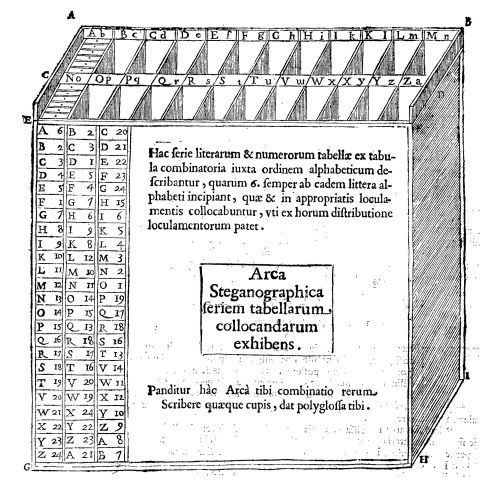
Kircher, the Steganographic Ark, from Polygraphia Nova, p. 130

Athanasius Kircher (1602-80), the steganographic ark, Polygraphia nova et universalis ex combinatoria arte detecta, 1663. This work is in the public domain in its country of origin and other countries and areas where the copyright term is the author’s life plus 100 years or less. 

Kircher wrote his Polygraphia nova et universalis ex combinatoria arte detecta in 1663, several years after his early works on Egypt and hieroglyphics, but he was concerned with the problem of universal writing from the beginning of the decade, and it seems evident that he was at the same time fascinated by the hieroglyphic mysteries and the polygraphic publicity.

It is also significant that in this same volume Kircher designed not only a polygraphy, or international language open to all, but also, in the wake of Trithemius, a steganography, or secret language in which to cipher messages.

What (at the end of the previous chapter) seemed to us a contradiction appeared to Kircher rather as a natural connection. He cited, at the outset, an Arab proverb: if you have a secret, hide it or reveal it (“si secretum tibi sit, tege illud, vel revela“).

Such a decision was not so obvious, after all, since in his works on Egyptology Kircher had chosen a “fifty-fifty solution,” saying something by concealing it, alluding without revealing.

Finally, the second part of the title of Kircher’s work reveals that, in designing his polygraphy, Kircher was also using Lull’s art of combination (contrary to the opinion of Knowlson 1975: 107-8).

In the enthusiastic preface that the author addressed to the emperor Ferdinand III, he celebrated polygraphy as “all languages reduced to one” (“linguarum omnium ad nam reductio“).

Using polygraphy, “anyone, even someone who knows nothing other than his own vernacular, will be able to correspond and exchange letters with anybody else, of whatever their nationality.”

Thus Kircher’s polygraphy was in reality a pasigraphy, that is, a project for a written language, or international alphabet, which was not required to be spoken.

It is easy to confuse Kircher’s project with a double pentaglottic dictionary, in A and B versions (both in Latin, Italian, Spanish, French and German). In Kircher’s time, English was not considered an important international language, and, in his Character, Becher had assumed that French was sufficient, as a vehicular language, for English, Italian, Spanish and Portuguese native speakers.

Ideally, Kircher thought (p. 7) that his dictionary should also include Hebrew, Greek, Bohemian, Polish, Lithuanian, Hungarian, Dutch, English and Irish (“linguae doctrinales omnibus communes“)–as well as Nubian, Ethiopic, Egyptian, Congolese, Angolan, Chaldean, Arabic, Armenian, Persian, Turkish, Tartar, Chinese, Mexican, Peruvian, Brazilian and Canadian.

Kircher did not, it seems, feel himself ready to confront such a gigantic task; perhaps he intuited that the missionary activity, followed eventually by colonialism, would drastically simplify the problem (transforming many exotic languages into mere ethnological remnants): Spanish would substitute for Mexican, French for Canadian, Portuguese for Brazilian, and various pidgins would substitute for all the rest.

Kircher’s A and B dictionaries each contain 1,228 items. The grounds for selection were purely empirical: Kircher chose the words that seemed to him most commonly used.

Dictionary A served to encode messages. It started with a list of common nouns and verbs, in alphabetical order. There followed alphabetic lists of proper nouns (regions, cities, persons), and of adverbs and prepositions.

Added to this there was also a list of the conjugations of both the verbs to be and to have. The whole material was subdivided into 32 tables, marked by Roman numerals, while every item of each table was marked by an Arabic numeral.

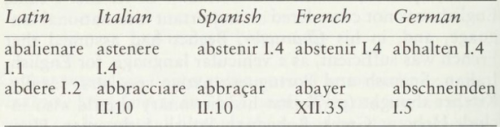
The dictionary was set out in five columns, one for each of the five languages, and the words in each language were listed in their proper alphabetical order. Consequently, there is no necessary semantic correspondence between the terms recorded on the same line, and only the terms scored with the same Roman and Arabic numbers were to be considered synonymous.

We can see this best by giving the first two lines of the dicti0nary:

Umberto Eco, The Search for the Perfect Language, p. 198

Umberto Eco, The Search for the Perfect Language, p. 198. 

The Roman numerals refer to tables found in dictionary B; the Arabic numerals refer to the items themselves. Latin acts as the parameter language: for each specific term, the numbers refer to the Latin alphabetic ordering.

For example, the code for the French word abstenir is I.4, which indicates that the position of its Latin synonym, abstinere, is fourth in the Latin column I (obviously, to encode the Latin word abstinere, one also writes I.4).

To decode the message, it was necessary to use dictionary B. This too was arranged in 32 tables, each assigned a Roman numeral. But for each column (or language) the words did not follow their alphabetic order (except the Latin one), while the Arabic numbers marking each term were in an increasing arithmetical order.

Thus all the terms on the same line were synonymous and each synonym was marked by the same Arabic number.

Again, it is easiest to see how this worked by citing the first two lines of the first table:

Umberto Eco, The Search for the Perfect Language, p. 199

Umberto Eco, The Search for the Perfect Language, p. 199. 

Thus, if one wants to send the Latin word abdere (to hide), according to the dictionary A one encodes it as I.2. A German addressee, receiving the message I.2, goes to dictionary B, first table, German column, and looks for the second word, which is exactly verbergen (to hide).

If the same addressee wants to know how to translate this term in Spanish, one finds in the same line that the synonymous term is esconder.

However, Kircher found that a simple lexicon did not suffice; he was forced to invent 44 supplementary signs (notae) which indicated the tense, mood and number of verbs, plus 12 more signs which indicated declensions (nominative, genitive, dative, etc., both singular and plural).

Thus, to understand the following example, the sign N meant nominative, while a sign like a D indicated the third person singular of the past tense. In this way, the ciphered expression “XXVII.36N, XXX.21N, II.5N, XXIII.8D, XXVIII.10, XXX.20” can be decoded as “Petrus noster amicus, venit ad nos” (literally, “Peter our friend came to us”), and on the basis of Latin, can be transformed into an equivalent sentence in any of the other four languages.

Kircher proudly claims that, by dictionary A, we can write in any language even though though we know only our own, as well as that, with dictionary B, we can understand a text written in an unknown language.

The system also works when we receive a non-ciphered text written in a natural foreign language. All we have to do is to look up the reference numbers for each foreign word in dictionary A (where they are listed in alphabetical order), then, with the reference numbers, find the corresponding words in dictionary B, in the column for our own language.

Not only was this process laborious, but the entire project was based on the assumption that all other languages could be directly reduced to the Latin grammar. One can imagine the results of such a method if one thinks of translating literally, word by word, a German sentence into an English one.

Kircher never confronted the problem of why an item-by-item translation should be syntactically correct, or even comprehensible, in the new language. He seemed to rely on the good will and good sense of whoever used his system.

Yet even the most willing users might slip up. In August 1663, after reading the Polygraphia, Juan Caramuel y Lobkowitz wrote to Kircher to congratulate him on his wonderful invention (Mss Chigiani f. 59 v., Biblioteca Apostolica Vaticana; cf. Casciato et al. 1986: table 5).

Appropriately, Caramuel chose to congratulate Kircher in his own polygraphy. Yet his first problem was that Kircher’s own first name, Athanasius, did not appear in the list of proper names. Adopting the principle that where a term is missing, an analogous one must be sought, Caramuel addressed his letter to “Anastasia.”

Moreover, there are passages that can be decoded fairly easily, while for others one suspects that the labor of consulting the dictionary to obtain reference numbers for every word proved so tedious that even Caramuel began to nod.

Thus we find ourselves in front of a passage which, in Latin, would need to be translated as follows: “Dominus + sign of vocative, Amicus + sign of vocative, multum sal + sign of vocative, Anastasia, a me + sign of accusative, ars + sign of accusative, ex illius + sign of ablative, discere posse + sign of second person plural, future active, non est loqui vel scribere sub lingua + ablative, communis + ablative.”

After many heroic efforts, one can try to render it (in a sort of “Me Tarzan-You Jane” language) as “O Lord and Friend, O witty Athanasius, to me (?) you could learn from him an art (which) is not speaking and writing under a common language.”

Umberto Eco, The Search for the Perfect Language, translated by James Fentress, Blackwell. Oxford, 1995, pp. 196-200.

Eco: Kircher’s Chinese

kircher_049-826x1024

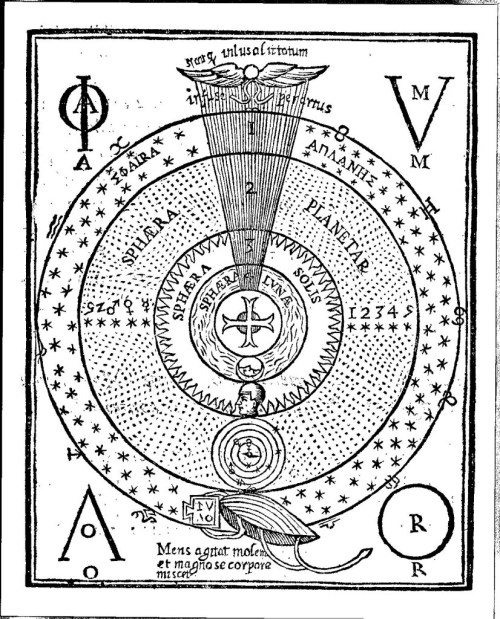
Athanasius Kircher (1602-80), schema of the Egyptian cosmos, Oedipus Aegyptiacus, tom. 2, vol. 1, p. 418. This work is in the public domain in its country of origin and other countries and areas where the copyright term is the author’s life plus 100 years or less.

“In an earlier chapter, we saw the suggestion made that Chinese might be the language of Adam. Kircher lived in a period of exciting discoveries in the Orient. The Spanish, Portuguese, English, Dutch, and, later, French conquered the route to the Indies, the Sunda seas, the way to China and to Japan.

But even more than by merchants, these pathways were traversed by Jesuits, following in the footsteps of Matteo Ricci who, a century before, had brought European culture to the Chinese, and returned to give Europe a deeper understanding of China.

With the publication of the Historia de las cosas más notables, ritos y costumbres del gran reino de la China by Juan Gonzales de Mendoza in 1585, there appeared in print in Europe characters in Chinese script.

In 1615 there finally appeared Ricci’s De christiana expeditione apud Sinas ab Societate Ieus suscepta, in which he explained that in Chinese, there existed as many characters as there were words. He insisted as well on the international character of the Chinese script, which, he wrote, was readily understood not only by the Chinese, but also by the Japanese, the Koreans, the Cochin-Chinese and by the Formosans.

We shall see that this was a discovery that would initiate the search for a real character from Bacon onwards. Already in 1627, in France, Jean Douet published a Proposition présentée au roy, d’une escriture universelle, admirable pour ses effects, très-utile à tous les hommes de la terre, in which Chinese was offered as a model for an international language.

At the same time, there had begun to appear information about the pictographic writings of Amerindians. Attempts at interpretation had yielded contradictory results; and this was discussed in works such as the Historia natural y moral de las Indias by José de Acosta in 1570, and the Relaciòn de las cosas de Yucatàn by Diego de Landa, written in the sixteenth century, although appearing only in the eighteenth; in 1609 there also appeared the Comentarios reales que tratan del origine de los Yncas by Garcilaso de la Vega.

An observation often repeated by these early observers was that contact with the indigenous natives was at first carried out by means of gestures. This awoke an interest in gesture’s potential as a universal language.

The universality of gestures and the universality of images turned out to be related themes (the first treatise on this subject was Giovanni Bonifacio‘s L’arte de’ cenni of 1616; on this topic in general, see Knox 1990).

The reports of his Jesuit brothers gave Kircher an incomparable source of ethnographic and linguistic information (see Simone 1990 on “Jesuit or Vatican linguistics”).

In his Oedipus, Kircher was especially interested in the diffusion of Chinese. He took up the same arguments, in a more elliptical form, in his China monumentis quà sacris quà profanis, nec non variis naturae et artis spectaculis, aliarum rerum memorabilis argumentis illustrata of 1667.

This latter work was more in the nature of a treatise in ethnography and cultural anthropology which, with its splendid and sometimes documented illustrations, collected all the reports that arrived from the missionaries of the Company, and described every aspect of Chinese life, culture and nature.

Only the sixth and last part of the work was dedicated to the alphabet.

Kircher presumed that the mysteries of hieroglyphic writing had been introduced to the Chinese by Noah’s son Ham. In the Arca Noe of 1675 (pp. 210ff) he identified Ham with Zoroaster, the inventor of magic.

But, unlike Egyptian hieroglyphs, Chinese characters were not for Kircher a puzzle. Chinese was a writing system still in use, and the key to its understanding had already been revealed. How could such a comprehensible language be sacred and a vehicle for occult mysteries?

Kircher realized that Chinese characters were originally iconic and only later had grown extremely stylized over time, so as to lose their original similarity with things. He reconstructed after  his own fancy what he took to be the designs of fish and birds that had formed the starting points for current ideograms.

Kircher also realized that these ideograms did not express either letters or syllables, but referred to concepts. He noted that in order to translate our dictionary into their idiom we would need as many different characters as we had words (Oedipus, III, 11).

This led him to reflect on the amount of memory that was necessary for a Chinese scholar to know and remember all these characters.”

Umberto Eco, The Search for the Perfect Language, translated by James Fentress, Blackwell. Oxford, 1995, pp. 158-60.

Eco: Kircher’s Egyptology

kircher_008

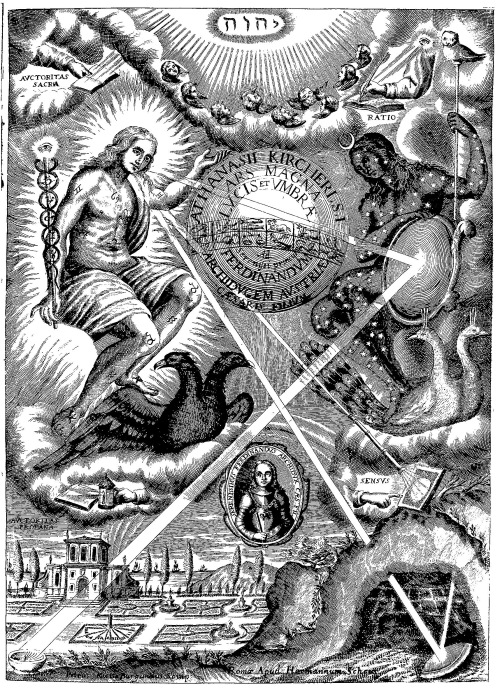
Athanasius Kircher (1602-80), frontispiece to Ars Magna Lucis et Umbrae, Rome, Scheus, 1646. Compendium Naturalis says that this allegorical engraving was executed on copper by Petrus Miotte Burgundus. Multiple copies are posted on the internet, including an eBook courtesy of GoogleBooks, one at the Max Planck Institute, one at the Herzog August Bibliothek, and one at Brigham Young University among many others. This work is in the public domain in its country of origin and other countries and areas where the copyright term is the author’s life plus 100 years or less. 

“When Kircher set out to decipher hieroglyphics in the seventeenth century, there was no Rosetta stone to guide him. This helps explain his initial, mistaken, assumption that every hieroglyph was an ideogram.

Understandable as it may have been, this was an assumption which doomed his enterprise at the outset. Notwithstanding its eventual failure, however, Kircher is still the father of Egyptology, though in the same way that Ptolemy is the father of astronomy, in spite of the fact that his main hypothesis was wrong.

In a vain attempt to demonstrate his hypothesis, Kircher amassed observational material and transcribed documents, turning the attention of the scientific world to the problem of hieroglyphs. Kircher did not base his work on Horapollo’s fantastic bestiary; instead, he studied and made copies of the royal hieroglyphic inscriptions.

His reconstructions, reproduced in sumptuous tables, have an artistic fascination all of their own. Into these reconstructions Kircher poured elements of his own fantasy, frequently reportraying the stylized hieroglyphs in curvaceous baroque forms.

Lacking the opportunity for direct observation, even Champollion used Kircher’s reconstructions for his study of the obelisk standing in Rome’s Piazza Navona, and although he complained of the lack of precision of many of the reproductions, he was still able to draw from them interesting and exact conclusions.

Already in 1636, in his Prodromus Coptus sive Aegyptiacus (to which was added, in 1643, a Lingua Aegyptiaca restituta), Kircher had come to understand the relation between the Coptic language and, on the one hand, Egyptian, and, on the other, Greek.

It was here that he first broached the possibility that all religions, even those of the Far East, were nothing more than more or less degenerated versions of the original Hermetic mysteries.

There were more than a dozen obelisks scattered about Rome, and restoration work on some of them had taken place from as early as the time of Sixtus V. In 1644, Innocent X was elected pope. His Pamphili family palace was in Piazza Navona, and the pope commissioned Bernini to execute for him the vast fountain of the four rivers, which remains there today.

On top of this fountain was to be placed the obelisk of Domitian, whose restoration Kircher was invited to superintend.

As the crowning achievement of this restoration, Kircher published, in 1650, his Obeliscus Pamphilius, followed, in 1652-4, by the four volumes of his Oedipus Aegyptiacus. This latter was an all-inclusive study of the history, religion, art, politics, grammar, mathematics, mechanics, medicine, alchemy, magic and theology of ancient Egypt, compared with all other eastern cultures, from Chinese ideograms to the Hebrew kabbala to the language of the brahmins of India.

The volumes are a typographical tour de force that demanded the cutting of new characters for the printing of the numerous exotic, oriental alphabets. It opened with, among other things, a series of dedications to the emperor in Greek, Latin, Italian, Spanish, French, Portuguese, German, Hungarian, Czech, Illirian, Turkish, Hebrew, Syriac, Arabic, Chaldean, Samaritan, Coptic, Ethiopic, Armenian, Persian, Indian and Chinese.

Still, the conclusions were the same as those of the earlier book (and would still be the same in the Obelisci Aegyptiaci nuper inter Isaei Romani rudera effosii interpretatio hieroglyphica of 1666 and in the Sphinx mystagoga of 1676).

At times, Kircher seemed to approach the intuition that certain of the hieroglyphs had a phonetic value. He even constructed a rather fanciful alphabet of 21 hieroglyphs, from whose forms he derives, through progressive abstractions, the letters of the Greek alphabet.

Kircher, for example, took the figure of the ibis bending its head until it rests between its two feet as the prototype of the capitalized Greek alpha, A. He arrived at this conclusion by reflecting on the fact that the meaning of the hieroglyphic for the ibis was “Bonus Daemon;” this, in Greek, would have been Agathos Daimon.

But the hieroglyph had passed into Greek through the mediation of Coptic, thanks to which the first sounds of a given word were progressively identified with the form of the original hieroglyph.

At the same time, the legs of the ibis, spread apart and resting on the ground, expressed the sea, or, more precisely, the only form in which the ancient Egyptians were acquainted with the sea–the Nile.

The word delta has remained unaltered in its passage into Greek, and this is why the Greek letter delta (Δ) has retained the form of a triangle.

It was this conviction that, in the end, hieroglyphs all showed something about the natural world that prevented Kircher from ever finding the right track. He thought that only later civilizations established that short-circuit between image and sound, which on the contrary characterized hieroglyphic writing from its early stages.

He was unable, finally, to keep the distinction between a sound and the corresponding alphabetic letter; thus his initial intuitions served to explain the generation of later phonetic alphabets, rather than to understand the phonetical nature of hieroglyphs.

Behind these errors, however, lies the fact that, for Kircher, the decipherment of hieroglyphs was conceived as merely the introduction to the much greater task–an explanation of their mystic significance.

Kircher never doubted that hieroglyphs had originated with Hermes Trismegistus–even though several decades before, Isaac Casaubon had proved that the entire Corpus Hermeticum could not be earlier than the first centuries of the common era.

Kircher, whose learning was truly exceptional, must have known about this. Yet he deliberately ignored the argument, preferring rather to exhibit a blind faith in his Hermetic axioms, or at least to continue to indulge his taste for all that was strange or prodigious.

Out of this passion for the occult came those attempts at decipherment which now amuse Egyptologists. On page 557 of his Obeliscus Pamphylius, figures 20-4 reproduce the images of a cartouche to which Kircher gives the following reading: “the originator of all fecundity and vegetation is Osiris whose generative power bears from heaven to his kingdom the Sacred Mophtha.”

This same image was deciphered by Champollion (Lettre à Dacier, 29), who used Kircher’s own reproductions, as “ΑΟΤΚΡΤΛ (Autocrat or Emperor) sun of the son and sovereign of the crown, ΚΗΣΡΣ ΤΜΗΤΕΝΣ ΣΒΣΤΣ (Caesar Domitian Augustus).”

The difference is, to say the least, notable, especially as regards the mysterious Mophtha, figured as a lion, over which Kircher expended pages and pages of mystic exegesis listing its numerous properties, while for Champollion the lion simply stands for the Greek letter lambda.

In the same way, on page 187 of the third volume of the Oedipus there is a long analysis of a cartouche that appeared on the Lateran obelisk. Kircher reads here a long argument concerning the necessity of attracting the benefits of the divine Osiris and of the Nile by means of sacred ceremonies activating the Chain of Genies, tied to the signs of the zodiac.

Egyptologists today read it as simply the name of the pharaoh Apries.”

Umberto Eco, The Search for the Perfect Language, translated by James Fentress, Blackwell. Oxford, 1995, pp. 154-8.