
Samizdat

Publishing the Forbidden. All Rights Reserved. © Samizdat 2014-2025.

Tag: Pisces

Selz: On the Astronomical Diaries of Babylon

“I cannot discuss here the philological evidence that anchors the biblical tradition in the historical charts. This is a different, albeit very important field which may support my arguments: I just mention one recent example: Jeremiah 39:3 may go back to an eye witness’s account of Nebuchadnezzar’s conquest of Jerusalem in 589 BCE.

Tablet VAT 4956 in the Berlin Museum details the positions of the moon and the planets during the year 37 of the reign of Nebuchadnezzar, king of Babylon, 567 BCE. This tablet is famous for confirming the destruction of Jerusalem in 586 BCE. http://www.lavia.org/english/archivo/vat4956en.htm

Tablet VAT 4956 in the Berlin Museum details the positions of the moon and the planets during the year 37 of the reign of Nebuchadnezzar, king of Babylon, 567 BCE. This tablet is famous for confirming the destruction of Jerusalem in 586 BCE.
http://www.lavia.org/english/archivo/vat4956en.htm

This is indicated by my colleague Michael Jursa’s identification of the chief-eunuch Nabu-sharrussu-ukin, the biblical נכו שרםכים רכםרים or Nebu-Sarsekim, in an economic document from the sun-god temple in Sippar, dated to the “Month XI, day 18, year 10 Nebuchadnezzar, king of Babylon.”

(M. Jursa, Nabû-šarrūssu-ukīn, rab ša-rēši, und ‘Nebusarsekim’ (Jeremiah 39:3),” NABU 5 (2008). Jursa’s translation of the document runs as follows:

“Regarding] 1.5 minas (0.75 kg) of gold, the property of Nabû-šarrūssu-ukīn, the chief eunuch, which he sent via Arad-Bānītu the eunuch to [the temple] Esangila: Arad-Bānītu has delivered [it] to Esangila.

In the presence of Bēl-usāti, son of Alpāya, the royal bodyguard, [and of] Nādin, son of Marduk-zēru-ibni. Month XI, day 18, year 10  [of] Nebuchadnezzar, king of Babylon.”

We may note here that the evaluation of this document provoked a broad discussion in scholarly literature and in the Internet.)

The Babylonian exile had a major impact on the development of Judaism, possibly even on the moulding of the apocalyptic traditions.

(Jeremiah 39:3 gives account of Nebuchadnezzar’s conquest of Jerusalem and his victory over the Judean King Zedekiah: The passage reports that all of the officers of the king of Babylon made their entry, and occupied the middle gate.)

(Kvanvig, Roots, writes: “The emergence of the apocalyptic traditions and literature presupposes both a direct contact with Mesopotamian culture in the Babylonian diaspora, and the syncretistic tendencies in Palestine in the post-exilic centuries.” See also Sarah Robinson, “The Origins of Jewish Apocalyptic Literature: Prophecy, Babylon, and 1 Enoch,” MS Thesis, University of South Florida, 2005.)

The background of this “knowledge transfer,” however, is the scholarly situation as just described. I say this not to deny the contribution of mere story-telling and fantastic lore to the growth of the corpus of apocalyptic literature, but we cannot neglect the scholarly and even empirical background of the underlying world-view.

Indeed, this may provide the best explanation for why so many different topics and stylistic features are fused in the extant Enochic traditions.
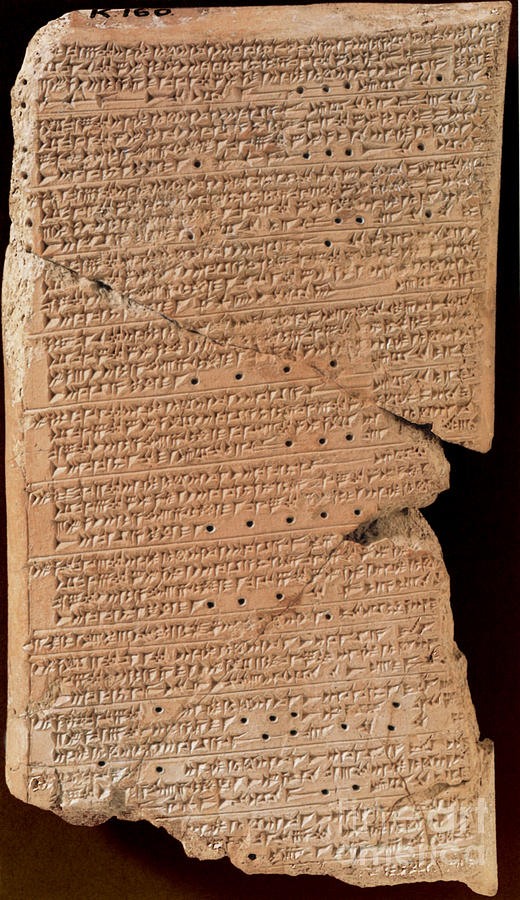
The Venus Tablet of Ammisaduqa, which is tablet 63 in the Enuma Anu Enlil sequence, preserves the astronomical observations of Venus during the 1st Millennium BCE. This tablet is dated back to the mid-7th Century BCE, during the reign of King Ammisaduqa. http://fineartamerica.com/featured/2-venus-tablet-of-ammisaduqa-7th-century-science-source.html

The Venus Tablet of Ammisaduqa, which is tablet 63 in the Enuma Anu Enlil sequence, preserves the astronomical observations of Venus during the 1st Millennium BCE.
This tablet is dated back to the mid-7th Century BCE, during the reign of King Ammisaduqa.
http://fineartamerica.com/featured/2-venus-tablet-of-ammisaduqa-7th-century-science-source.html

What concerns us here is the heuristic attitude of Mesopotamian scholarship. Even in the late Seleucid period this scholarship remains basically “holistic” or “monistic” in the way that it links all sorts of empiricism, as may be demonstrated with examples from the famous “Astronomical Diaries.”

(We follow here the unpublished manuscript of G. Graßhoff, “The Diffusion of Knowledge: From Babylonian Regularities to Science in the Antiquity” (paper presented at the 97th Dahlem Workshop on Globalization of Knowledge and its Consequences at the Dahlem Konferenzen, Berlin, 18-23 November 2007).

In the fifth year of Darius III (331 BCE) we find a series of astronomical observations:

“Day 13 [20 September]: Sunset to moonrise 8. There was a lunar eclipse. Its totality was covered at the moment when Jupiter set and Saturn rose. During totality the west wind blew, during clearing the east wind. During the eclipse, deaths and plague occurred.

Day 14: All day clouds were in the sky …”

The reports then continue with observations from the “Burse of Babylon”; commodity prizes are given together with the positions of the planets in the zodiacal signs.

“That month, the equivalent for 1 shekel of silver was: barley . . . at that time, Jupiter was in Scorpio; Venus was in Leo, at the end of the month in Virgo; Saturn was in Pisces; Mercury and Mars, which had set, were not visible.”

The reports further continue with the famous account of the downfall of the Persian empire in the same year, after the battle at Gaugamela, north of Mosul (331 BCE).”

(H. Hunger, ed., Astronomical Diaries and Related Texts from Babylonia, vol. 2: Diaries from 261 BCE to 165 BCE (Denkschriften der philosophisch-historischen Klasse 210; Wien: Verlag der Österreichischen Akademie der Wissenschaften, 1989), pp. 175-6.)

Gebhard J. Selz, “Of Heroes and Sages–Considerations of the Early Mesopotamian Background of Some Enochic Traditions,” in Armin Lange, et alThe Dead Sea Scrolls in Context, v. 2, Brill, 2011, pp. 786-7.

The Zodiacal Organization of the Gilgamesh Epic

“The doctrine of the necessity for ministering to the dead is here enunciated in no uncertain fashion.

Unless their bodies are decently buried and offerings of food and drink made at their graves, their lives in the otherworld must be abjectly miserable. The manner in which they meet their end is likewise taken into account, and warriors who have fallen on the field of battle are pre-eminently fortunate.

Eabani is evidently one of the ‘happy’ spirits; his ghost is designated utukku, a name applied not only to the fortunate dead, but likewise to a class of beneficent supernatural beings.

The term edimmu, on the other hand, designates a species of malevolent being as well as the errant and even vampirish spirits of the unhappy dead. The due observance of funeral and commemorative rites is thus a matter which touches the interests not only of the deceased but also of his relatives and friends.

We have seen from the foregoing that the epic of Gilgamesh is partly historical, partly mythological. Around the figure of a great national hero myths have grown and twined with the passing of the generations, and these have in time become woven into a connected narrative, setting forth a myth which corresponds to the daily or annual course of the sun.

Within this may be discerned other myths and fragments of myths—solar, seasonal, and diluvian.

But there is in the epic another important element which has already been referred to—the astro-theological. The zodiacal significance of the division of the epic into twelve tablets may be set aside, since, as has been indicated, the significance is in all probability a superficial one merely, added to the poem by the scribes of Assur-bani-pal, and not forming an integral part of it.

At the same time it is not hard to divide the epic naturally into twelve episodes, thus:

  1. Gilgamesh’s oppression of Erech;
  2. the seduction of Eabani;
  3. the slaying of the monster Khumbaba;
  4. the wooing of Ishtar;
  5. the fight with the sacred bull;
  6. Eabani’s death;
  7. Gilgamesh’s journey to the Mountain of the Sunset;
  8. his wanderings in the region of thick darkness;
  9. the crossing of the waters of death;
  10. the deluge-story;
  11. the plant of life;
  12. the return of Eabani’s spirit.

Throughout the epic there are indications of a correspondence between the exploits of the hero and the movements of heavenly bodies.

It is possible, for instance, that Gilgamesh and his friend Eabani had some relation to the sign Gemini, also associated in ancient Chaldean mythology with two forms of the solar deity, even as were the hero and his friend.

The sign Leo recalls the slaying of Khumbaba, the allegorical victory of light over darkness, represented on monuments by the figure of a lion (symbol of fire) fighting with a bull.

Following the sign of Leo, the wooing of the hero by the goddess Ishtar falls naturally into the sign of Virgo, the virgin. The sign of Taurus is represented by the slaying of the celestial bull, Alu, by Gilgamesh.

The journey of the hero to Mashu and his encounter with the scorpion-men at the gate of the sunset are, of course, mythological representations of the sign of Scorpio, as are also his wanderings in the region of thick darkness.

It is noticeable in this respect that Babylonian astrology often doubled the eighth sign (Scorpio) to provide a seventh; it is therefore not unlikely that this sign should correspond with two distinct episodes in the poem.

The first of these episodes is associated with Scorpio by virtue of the introduction of scorpion-men; and the second, on the assumption that the scorpion is symbolical of darkness.

Perhaps the sea-goddess Sabitu is associated astrologically with the fish-tailed goat which is the conventional representation of Capricornus.

Then the placing of the deluge-story in the XIth tablet, corresponding with the eleventh sign of the zodiac, Aquarius, the water-bearer, is evidently in keeping with the astrological aspect of the epic.

Chaldean mythology connected the rainy eleventh month with the deluge, just as the first month of spring was associated mythologically with the creation.

The healing of Gilgamesh’s sickness by Ut-Napishtim may possibly symbolise the revival of the sun after leaving the winter solstice.

Lastly, the sign of Pisces, the twelfth sign of the zodiac, corresponding to the return of Eabani from the underworld, and perhaps also to the restoration of Gilgamesh to Erech, is emblematic of life after death, and of the resumption of ordinary conditions after the deluge.

It has been suggested, though without any very definite basis, that the epic was first put together before the zodiac was divided into twelve—that is, more than two thousand years before the Christian era.

Its antiquity, however, rests on other grounds than these. In later times the Babylonian astrological system became very complicated and important, and so lent its colour to the epic that, whatever the original plan of that work may have been, its astral significance became at length its most popular aspect.”

Lewis Spence, Myths and Legends of Babylonia and Assyria, 1917, pp. 181-3.