
Samizdat

Publishing the Forbidden. All Rights Reserved. © Samizdat 2014-2026.

Tag: Perfection

Eco: The Arbor Scientarium
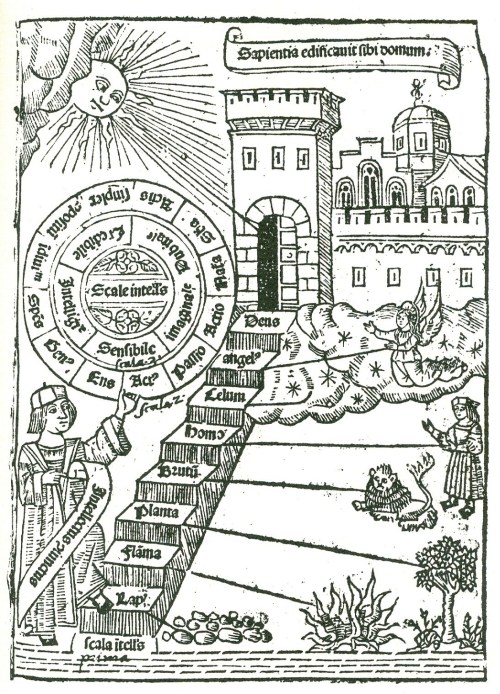
Ramon Llull, Liber de ascensu et decensu intellectus, 1304, first published 1512

Ramon Llull, Liber de ascensu et decensu intellectus, 1304, first published 1512. This work is in the public domain in its country of origin and other countries and areas where the copyright term is the author’s life plus 100 years or less.     

“The Lullian art was destined to seduce later generations who imagined that they had found in it a mechanism to explore the numberless possible connections between dignities and principles, principles and questions, questions and virtues or vices.

Why not even construct a blasphemous combination stating that goodness implies an evil God, or eternity a different envy? Such a free and uncontrolled working of combinations and permutations would be able to produce any theology whatsoever.

Yet the principles of faith, and the belief in a well-ordered cosmos, demanded that such forms of combinatorial incontinence be kept repressed.

Lull’s logic is a logic of first, rather than second, intentions; that is, it is a logic of our immediate apprehension of things rather than of our conceptions of them. Lull repeats in various places that if metaphysics considers things as they exist outside our minds, and if logic treats them in their mental being, the art can treat them from both points of view.

Consequently, the art could lead to more secure conclusions than logic alone, “and for this reason the artist of this art can learn more in a month than a logician can in a year.” (Ars magna, X, 101).

What this audacious claim reveals, however, is that, contrary to what some later supposed, Lull’s art is not really a formal method.

The art must reflect the natural movement of reality; it is therefore based on a notion of truth that is neither defined in the terms of the art itself, nor derived from it logically. It must be a conception that simply reflects things as they actually are.

Lull was a realist, believing in the existence of universals outside the mind. Not only did he accept the real existence of genera and species, he believed in the objective existence of accidental forms as well.

Thus Lull could manipulate not only genera and species, but also virtues, vices and every other sort of differentia as well; at the same time, however, all those substances and accidents could not be freely combined because their connections were determined by a rigid hierarchy of beings (cf. Rossi 1960: 68).

In his Dissertatio de arte combinatoria of 1666, Leibniz wondered why Lull had limited himself to a restricted number of elements. In many of his works, Lull had, in truth, also proposed systems based on 10, 16, 12 or 20 elements, finally settling on 9. But the real question ought to be not why Lull fixed upon this or that number, but why the number of elements should be fixed at all.

In respect of Lull’s own intentions, however, the question is beside the point; Lull never considered his to be an art where the combination of the elements of expression was free rather than precisely bound in content.

Had it not been so, the art would not have appeared to Lull as a perfect language, capable of illustrating a divine reality which he assumed from the outset as self-evident and revealed.

The art was the instrument to convert the infidels, and Lull had devoted years to the study of the doctrines of the Jews and Arabs. In his Compendium artis demonstrativa (“De fine hujus libri“) Lull was quite explicit: he had borrowed his terms from the Arabs.

Lull was searching for a set of elementary and primary notions that Christians held in common with the infidels. This explains, incidentally, why the number of absolute principles is reduced to nine (the tenth principle, the missing letter A, being excluded from the system, as it represented perfection or divine unity).

One is tempted to see in Lull’s series the ten Sefirot of the kabbala, but Plazteck observes (1953-4: 583) that a similar list of dignities is to be found in the Koran. Yates (1960) identified the thought of John Scot Erigene as a direct source, but Lull might have discovered analogous lists in various other medieval Neo-Platonic texts–the commentaries of pseudo-Dionysius, the Augustinian tradition, or the medieval doctrine of the transcendental properties of being (cf. Eco 1956).

The elements of the art are nine (plus one) because Lull thought that the transcendental entities recognized by every monotheistic theology were ten.

Lull took these elementary principles and inserted them into a system which was already closed and defined, a system, in fact, which was rigidly hierarchical–the system of the Tree of Science.

To put this in other terms, according to the rules of Aristotelian logic, the syllogism “all flowers are vegetables, X is a flower, therefore X is a vegetable” is valid as a piece of formal reasoning independent of the actual nature of X.

For Lull, it mattered very much whether X was a rose or a horse. If X were a horse, the argument must be rejected, since it is not true that a horse is a vegetable. The example is perhaps a bit crude; nevertheless, it captures very well the idea of the great chain of being (cf. Lovejoy 1936) upon which Lull based his Arbor scientiae (1296).”

Umberto Eco, The Search for the Perfect Language, translated by James Fentress, Blackwell. Oxford, 1995, pp. 64-7.

Naassene Fragment, Concerning the Greater and Little Mysteries of Eleusis

” … (23) S. This same [Man] is called by the Phrygians Unfruitful.

C. For He is unfruitful as long as He is fleshly and works the work of the flesh.

This (H. he says) is what is said:

“Every tree that beareth not good fruit, is cut down and cast into the fire.” 1

For these “fruits” (H. he says) are the logic, 2 living men only who pass through the third Gate. 3

J. At any rate they 4 say:

“If ye have eaten dead things and made living ones, what will ye make if ye eat living things?” 5

And by “living things” they mean logoi and minds and men—the “pearls” of that Inexpressible [Man] cast into the plasm below. 6

C. This is what He saith (H. he says):

“Cast not the holy thing to the dogs nor the pearls to the swine.” 7

H. For they say that the work of swine is the intercourse of man with woman.

(24 8) S. This same [Man] (H. he says) the Phrygians also call Ai-polos; 9 not because (H. he says) He feeds she-goats and he-goats, as the (C.—psychics 1) interpret the name, but because (H. he says) He is Aei-polos—that is, “Always-turning” (Aei-polōn), 2 revolving and driving round the whole cosmos in [its] revolution; for polein is to “turn” and change things.

Hence (H. he says) all call the two centres 3 of heaven poles. And the poet also  (H. he says) when he says: “Hither there comes and there goes (pōleitai) Old Man of the Sea, whose words are e’er true—Egypt’s undying Prōteus.” 4

[By pōleitai] he does not mean “he is put on sale,” 1 but “he turns about” [or comes and goes] there,—as though it were, [he spins] and goes round.

And the cities in which we live, in that we turn about and circulate in them, are called poleis.

Thus (H. he says) the Phrygians call Aipolos this [Man] who turns all things at all times all ways, and changes them into things kin.

(25) The Phrygians, moreover (H. he says), call Him Fruitful.

J. For (H. he says):

“Many more are the children of the desolate [woman] than of her who hath her husband.” 2

C. That is, the regenerated, deathless, and ever-continuing [children] are many, although few are they [thus] generated; but the fleshly (H. he says) all perish, though many are they [thus] generated.

C. For this cause (H. he says):

“Rachel bewailed her children, and would not (H. he says) be comforted weeping over them; for she knew (H. he says) that they are not.” 1

J. And Jeremiah also laments the Jerusalem Below—not the city in Phœnicia, 2 but the generation below—which is subject to destruction.

C. For Jeremiah also (H. he says) knew the perfect man, regenerated from water and spirit, not fleshly.

J. At any rate the same Jeremiah said:

“He is man, and who shall know him?” 3

C. Thus (H. he says) the knowledge of the perfect man is deep and hard to comprehend.

J. For “The beginning of Perfection (H. he says) is Gnosis of man, but Gnosis of God is perfect Perfection.” 4

(26) S. And the Phrygians (H. he says) call Him also “Plucked Green Wheat-ear”; and after the Phrygians the Athenians [so designate Him], when, in the secret rites at Eleusis, they show those who receive in silence the final initiation there into the Great—

C. —and marvellous and most perfect—

S. —Epoptic Mystery, a plucked wheat-ear. 5

And this Wheat-ear is also with the Athenians the Light-giver 1

C. —perfect [and] mighty—

J. —from the Inexpressible—

S. —as the hierophant himself—not emasculated like the “Attis,” 2 but made eunuch with hemlock juice—

C. —and divorced from all fleshly generation—

S. —in the night, at Eleusis, solemnising the Great Ineffable Mysteries, when the bright light streams forth, 3 shouts and cries aloud, saying:

“[Our] Lady hath brought forth a Holy Son: Brimō [hath given birth] to Brimos”—

—that is, the Strong to the Strong.

(27) J. And “[Our] Lady” (H. he says) is the Genesis—

C. —the Spiritual, Heavenly [Genesis]—

J. —Above. And the Strong is he who is thus generated.

For it is the Mystery called “Eleusis” and “Anaktoreion”;—“Eleusis,” because we—

C. —the spiritual—

J. —come 2 from Above, streaming down from Adamas, for eleus-esthai (H. he says) is “to come”; and “Anaktoreion” [from anag-esthai, “leading back,” that is 3] from “returning” 4 Above. 5

This [Return] (H. he says) is that of which those who are initiated into the great Mysteries of the Eleusinia speak.

(28) S. And the law is that after they have been initiated into the Little Mysteries, they should be further initiated into the Great.

“For greater deaths do greater lots obtain.” 6

The Little (H. he says) are the Mysteries of Persephonē Below; concerning which Mysteries and the way leading there and—

C. —being broad and wide,—

—taking [men] to Persephonē, the poet also speaks:

“Beneath this there is another path death-cold,

Hollow and clayey. But this 1 is best to lead

To grove delightsome of far-honoured Aphroditē.” 2

These 3 are (H. he says) the Little Mysteries—

C. —those of the fleshly generation—

S. —and after men have been initiated into them, they should cease for a little, and become initiated in the Great—

C. —heavenly [Mysteries].

S. For they to whom the “deaths” in them 4 are appointed, “receive greater lots.”

J. For this [Mystery] (H. he says) is the Gate of Heaven, and this is the House of God, where the Good God dwells alone; into which [House] (H. he says) no impure [man] shall come—

C. —no psychic, no fleshly [man]—

J. —but it is kept under watch for the spiritual alone; where when they come, they must cast away their garments, and all become bridegrooms, obtaining their true manhood 5 through the Virginal Spirit.

For this (H. he says) is the Virgin big with child, conceiving and bearing a Son 1

C. —not psychic, not fleshly, but a blessed Æon of Æons. 2

Concerning these [Mysteries] (H. he says) the Saviour hath explicitly said that:

“Narrow and strait is the Way that leadeth to Life, and few are they who enter it; but broad and wide [is] the Way that leadeth to Destruction, and many are they who journey thereby.” 3

G.R.S. Mead, Thrice-Greatest HermesVol. 1, 1906, pp. 175-82.

From Hippolytus, Philosophumena; or, Refutation of all Heresies.