
Samizdat

Publishing the Forbidden. All Rights Reserved. © Samizdat 2014-2025.

Tag: Parādu-Fish

Kvanvig: The Apkallus had a Cosmic Function

“There is a clear difference between the group of seven and the subsequent group of four figures in Bīt Mēseri. The difference is not expressed in the same way as in the Uruk tablet in a general pattern of apkallus and succeeding ummanus. In Bīt Mēseri all the figures are apkallus with a curious exception of the last one, who is only two-thirds apkallu.

In Bīt Mēseri, there are thus two periods of transition, from the seven apkallus of divine descent to the four apkallus of human descent, and from the extraordinary apkallus to ordinary scholarship (we assume ummanus).
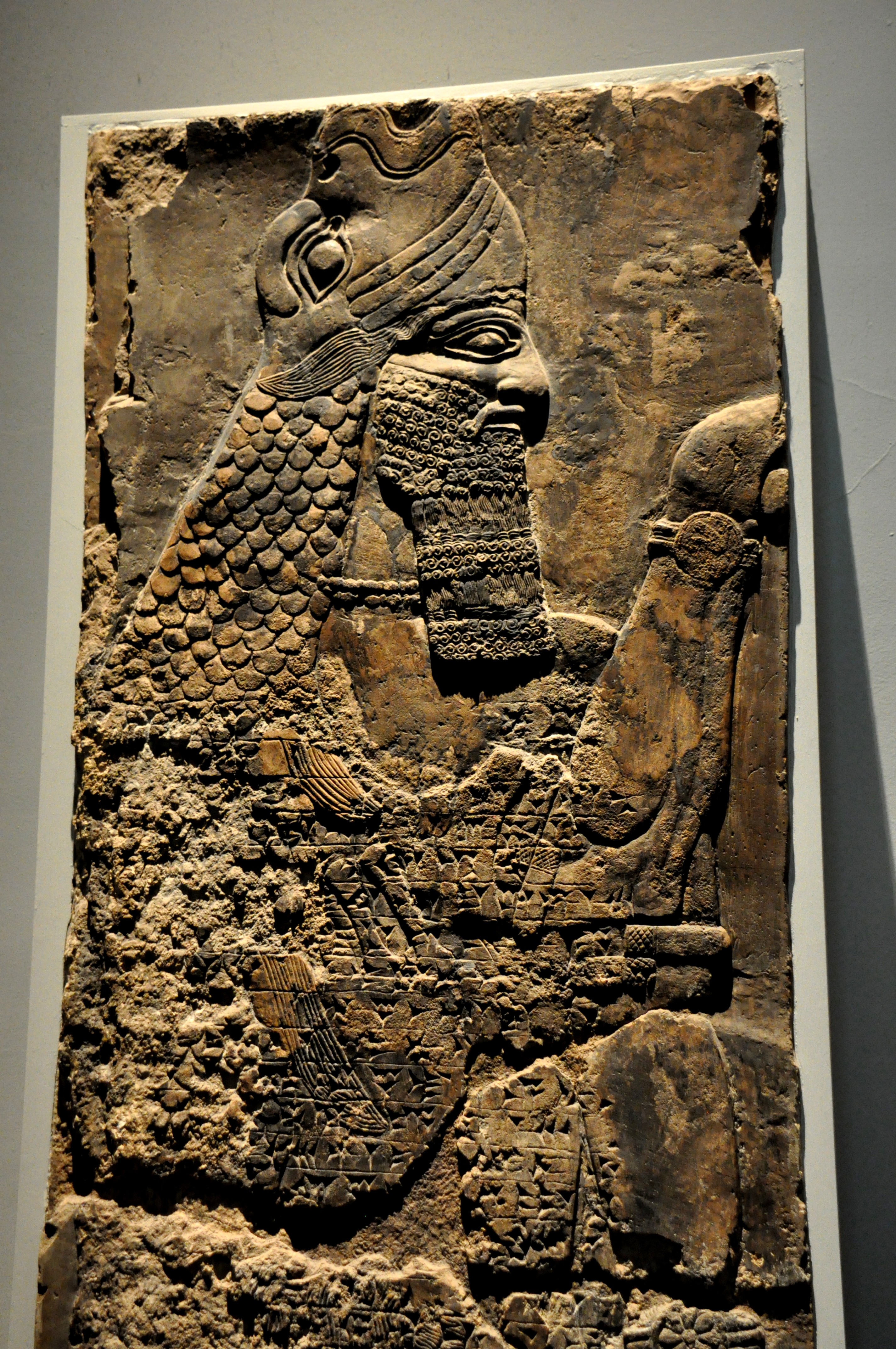
This depiction of a fish-apkallū of the parādu-fish type guarded the entrance to the temple of Ninurta at Nimrud.  A fish's head can be seen on the Apkallu's head, and its skin hangs down over the back of his body.  It is important to recall that the so-called Seven Sages of Sumeria were apkallū of this type. Neo-Assyrian era, 865-860 BCE.  From the Temple of Ninurta, Nimrud (ancient Kalhu; Biblical Calah), northern Mesopotamia, Iraq. (The British Museum, London). Osama Shukir Muhammed Amin FRCP (Glasg) http://www.ancient.eu/image/2708/

This depiction of a fish-apkallū of the parādu-fish type guarded the entrance to the temple of Ninurta at Nimrud.
A fish’s head can be seen on the Apkallu’s head, and its skin hangs down over the back of his body.
It is important to recall that the so-called Seven Sages of Sumeria were apkallū of this type.
Neo-Assyrian era, 865-860 BCE.
From the Temple of Ninurta, Nimrud (ancient Kalhu; Biblical Calah), northern Mesopotamia, Iraq. (The British Museum, London).
Osama Shukir Muhammed Amin FRCP (Glasg)
http://www.ancient.eu/image/2708/

The last transition is exemplified with Lu-Nanna; he is a mixture of both apkallu and, we must assume, ummanu. The difference between the first two groups is expressed through their origin. At the end of the list of four it is stated: [seb]et apkallu ša Ea bēlum [u]zna rapašta ušaklilušunuti,” of human descent, whom the lord Ea has endowed with a broad understanding” (lines 30-31).

“Born in the river” means engendered in the abode of Ea, which shows divine descent, in opposition to the human descent of the four succeeding ones, who, nevertheless are given great wisdom.

The apkallus are given a cosmic function. This is repeated twice, first in connection with the first apkallu, then in connection with all seven apkallus at the end of the list in Bīt Mēseri.

In both cases their responsibility concerns usurāt šamê u erseti (lines 1 and 13). Akkadian usurtu means concretely, “drawing,” abstractly, “plan, regulation, destiny;” so the apkallus are in charge of the “plans of heaven and earth.”

We have met this concept in Atrahasis where the birth-goddess Nintu: usurāti ša niši ussar, “draws the drawings for the people,” (S, 14), i.e. creates the basic conditions and fixes the destinies.

(Text in Lambert and Millard, Atra-Hasis, 62-3).

There is, however, a difference in Bīt Mēseri, which is made clear by the two different verbs used. In the case of the first apkallu (line 1) the verb mušaklil, participle, of the verb šuklulu (Š stem), is used. The verb means both “complete” and “make perfectly.”

In this bas relief from Nimrud, human apkallū, the ummánū, kneel and tend to a sacred tree.  Both ummânū wear horned tiaras and display rosette bracelets on their wrists. Bracelets are also apparent on their upper arms.  In the lower register, bird-apkallū raise mulillu cones to sprinkle water in a gesture of exorcism and liberation of sin.  As is typical, the banduddu buckets are in their left hands.  Interestingly in this case, the bracelets of the bird-apkallū are atypical. No rosettes are apparent.

In this bas relief from Nimrud, human apkallū, the ummánū, kneel and tend to a sacred tree.
Both ummânū wear horned tiaras and display rosette bracelets on their wrists. Bracelets are also apparent on their upper arms.
In the lower register, bird-apkallū raise mulillu cones to sprinkle water in a gesture of exorcism and liberation of sin.
As is typical, the banduddu buckets are in their left hands.
Interestingly in this case, the bracelets of the bird-apkallū are atypical. No rosettes are apparent.

The first apkallu thus “completed” or “made perfectly the drawings of heaven and earth.”

In the summary about all the apkallus (line 13) the verb muštešer, participle, Št stem, of the verb ešēru is used, which has the meaning “keep in order.”

Thus there is a distinction between what the first apkallu initially did, and what all apkallus did together. The first apkallu completed the design of the world-order; the seven apkallus, as a group, maintained this world order.

The corresponding Sumerian line 12 (the tablet is bilingual) has a text close to what we find in a Sumerian hymn. We quote the text in the German translation by van Dijk:

Die urformen von Himmel und Erde

in rechter Ordnung zu halten, in die Weite von Himmel und Erde

den grossen Entscheidungen den Weg zu bahnen, 

die Kultordnungen vollkommen zu machen.”

(Hymn to Nusku I, 14).

(J. van Dijk, Summarische Götterlieder, AHAW, PH, abh. I. Heidelberg 1960, 14; transliteration, 108; translation, 111.).

What is said here about the god Nusku is in Bīt Mēseri said about the apkallus. It covers the wide aspects of culture and civilization listed by Berossos about the first and seventh apkallu; it brings us, however, even one step further. The apkallus had a cosmic function; they were cosmic guardians.

They were both in charge of the me, and they were in charge of people’s destinies. In the last role, they are also described in a Babylonian myth where they are the custodians of the tablets of destinies.”

(W.G. Lambert, “The Twenty-One “poultices,”” AnSt 30 (1980): 77-83; B.R. Foster, “Wisdom and the Gods in Ancient Mesopotamia,” Orientalia (NS) 43 (1974): 344-54.).

Helge Kvanvig, Primeval History: Babylonian, Biblical, and Enochic: An Intertextual Reading, Brill, 2011, pp. 116-7.

Lenzi: The Antediluvian Medical Tablet from Ashurbanipal’s Library (K.4023)

“As is well-known, antediluvian knowledge had special significance in Mesopotamia. (For other examples of antediluvian knowledge (though sometimes in a broken context), see the examples gathered by Lambert, “Catalogue of Texts and Authors,” 72 at the note on VI 15.)

The most important example of this fact for the purposes of this study comes from an oft cited colophon of a medical tablet from Ashurbanipal’s library, AMT 105,1 (K.4023), lines 21-25.

AM-102 ; No. #1 (K4023) British Museum of London 

Tablet K.4023  COL. I  [Starting on Line 38] . . .  Root of caper which (is) on a grave, root of thorn (acacia) which (is) on a grave, right horn of an ox, left horn of a kid, seed of tamarisk, seed of laurel, Cannabis, seven drugs for a bandage against the Hand of a Ghost thou shalt bind on his temples.  FOOTNOTES:  [1] - The American Journal of Semitic Languages and Literatures, Vol. 54, No. 1/4 (Oct., 1937), pp. 12-40; Assyrian Prescriptions for the Head By R. Campbell Thompson 

 http://antiquecannabisbook.com/chap2B/Assyria/K4023.htm

AM-102 ; No. #1 (K4023)
British Museum of London 

Tablet K.4023
COL. I
[Starting on Line 38] . . .
Root of caper which (is) on a grave, root of thorn (acacia) which (is) on a grave, right horn of an ox, left horn of a kid, seed of tamarisk, seed of laurel, Cannabis, seven drugs for a bandage against the Hand of a Ghost thou shalt bind on his temples.
FOOTNOTES:
[1] – The American Journal of Semitic Languages and Literatures, Vol. 54, No. 1/4 (Oct., 1937), pp. 12-40; Assyrian Prescriptions for the Head By R. Campbell Thompson 


http://antiquecannabisbook.com/chap2B/Assyria/K4023.htm

This colophon shows not only the association of antediluvian sages and a human sage but also the “mythology of scribal succession” in action.

(For the original copy of the tablet, see R. Campbell Thompson, Assyrian Medical Texts (London: H. Milford / New York: Oxford University Press, 1923; reprinted, Osnabrück: Otto Zeller Verlag, 1983), 105,1 (=K.4023, col. iv, and thus probably from Nineveh).

I have cited the text according to Hermann Hunger, Babylonische und assyrische Kolophone, Alter Orient und Altes Testament 2 (Neukirchen-Vluyn: Neukirchener Verlag / Kevelaer: Verlag Butzon and Bercker, 1968), no. 533, with corrections from Yaakov Elman, “Authoritative Oral Tradition in Neo-Assyrian Scribal Circles,” Journal of the Ancient Near Eastern Society 7 (1975), 19-32, here 31.)

Salves (and) bandages: tested (and) checked, which are ready at hand, composed by the ancient sages from before the flood, which in Suruppak in the second year of Enlil-bani, king of Isin, Enlil-muballit, sage of Nippur, bequeathed.

Although the number of apkallū is unspecified in this text, the indication of plurality of sages and the antediluvian time frame strongly suggest an association with the seven sages known from traditions such as Bīt mēseri and the ULKS.

The fact that the tablet claims the apkallū composed these recipes bolsters the authority (by invoking these beings associated with Ea) and legitimacy (by asserting antiquity) of the recipes contained in the text.

This depiction of a fish-apkallū of the parādu-fish type guarded the entrance to the temple of Ninurta at Nimrud.  A fish's head can be seen on the apkallu's head, and its skin hangs down over the back of his body.  It is important to recall that the so-called Seven Sages of Sumeria were apkallū of this type. Neo-Assyrian era, 865-860 BCE.  From the Temple of Ninurta, Nimrud (ancient Kalhu; Biblical Calah), northern Mesopotamia, Iraq. (The British Museum, London). Osama Shukir Muhammed Amin FRCP (Glasg) http://www.ancient.eu/image/2708/

This depiction of a fish-apkallū of the parādu-fish type guarded the entrance to the temple of Ninurta at Nimrud.
A fish’s head can be seen on the apkallu’s head, and its skin hangs down over the back of his body.
It is important to recall that the so-called Seven Sages of Sumeria were apkallū of this type.
Neo-Assyrian era, 865-860 BCE.
From the Temple of Ninurta, Nimrud (ancient Kalhu; Biblical Calah), northern Mesopotamia, Iraq. (The British Museum, London).
Osama Shukir Muhammed Amin FRCP (Glasg)
http://www.ancient.eu/image/2708/

But I do not think that is its primary purpose. The claim is not made in the context of a ritual; so it does not primarily function to create ritual power.

Rather, the claim occurs in a colophon, a label that communicates something about the tablet for other would-be readers/users of it. The invocation of the apkallū and a claim to antediluvian knowledge in a colophon intends therefore to affect the social situation in which the tablet is used.

In this case the colophon credentials a human being as the possessor of antediluvian knowledge (i.e., medical recipes). Revealed by primeval apkallū, mediated to the human sage Enlil-muballit, and transmitted, presumably, by means of various copyists to the present possessor, AMT 105,1 implies the same notion of succession as the ULKS.

A similar idea is probably attested in KAR 177, obv. iv 25-32, a text containing hemerologies, which reads:

Favorable days. According to the seven s[ages(?)].
Duplicate of a tablet from Sippar, Nippur, Babylon, Larsa, Ur, Uruk, and Eridu.
The scholars excerpted, selected, and gave it to Nazimuruttash, king of the world.

(The tablet is from Assur and presumably the NA period. The text and restorations follow W. G. Lambert, “Ancestors, Authors, and Canonicity,” Journal of Cuneiform Studies 11 (1957), 1-14, here 8.

Lambert also gives the remainder of the colophon, rev. iv 1-3 (8), which is of no interest in this context, and sets out von Soden’s readings in a follow-up note (“Ancestors, Authors, and Canonicity [JCS XI, 1-14]: Additions and Corrections,” Journal of Cuneiform Studies 11 [1957], 112).

It seemed highly unlikely to the editor (Lambert) that the seven cities named in the text represented the seven exemplars from which the scribe worked. In other words, it seems unlikely that the scribe was looking at seven different copies while writing his own tablet.

Instead, Lambert proposed that the seven cities represent a succession of exemplars. Each of the exemplars was written by one of the seven sages one after another thereby creating a line of succession for the present tablet that extends back into earliest times.

The claim of this colophon, therefore, is that the tablet of hemerologies over which the ummânū labored goes back to the apkallū and ultimately originated in Eridu, the home city of Ea.

This again demonstrates an example of the “mythology of scribal succession” and an implicit assertion of antediluvian knowledge.”

Alan Lenzi, The Uruk List of Kings and Sages and Late Mesopotamian ScholarshipJANER 8.2, Brill, Leiden, 2008. pp. 149-51.