
Samizdat

Publishing the Forbidden. All Rights Reserved. © Samizdat 2014-2026.

Tag: Olender

Eco: The Indo-European Hypothesis, 2
kircher_079

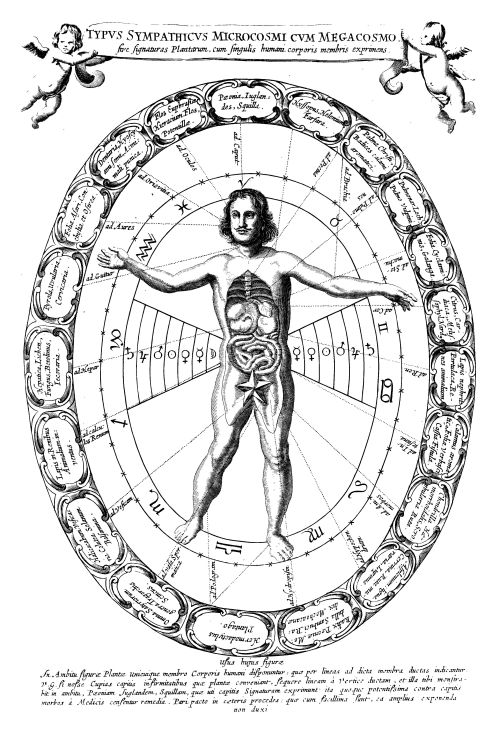
Athanasius Kircher (1602-80), sympathies between the microcosm and the megacosm, from Mundus subterraneus, 1665, vol. 2, p.406. Courtesy of Stanford University and the University of Oklahoma Libraries. This work is in the public domain in its country of origin and other countries and areas where the copyright term is the author’s life plus 100 years or less. 

“But are we really able to say that with the birth of the modern science of linguistics the ghost of Hebrew as the holy language had finally been laid to rest? Unfortunately not. The ghost simply reconstituted itself into a different, and wholly disturbing, Other.

As Olender (1989, 1993) has described it, during the nineteenth century, one myth died only to be replaced by another.

With the demise of the myth of linguistic primacy, there arose the myth of the primacy of a culture–or of a race. When the Hebrew language and civilization was torn down, the myth of the Aryan races rose up to take its place.

The reality of Indo-European was only virtual; yet it was still intrusive. Placed face to face with such a reality, Hebrew receded to the level of metahistory. It became a symbol.

At the symbolic level, Hebrew ranged from the linguistic pluralism of Herder, who celebrated it as a language that was fundamentally poetic (thus opposing an intuitive to a rationalistic culture), to the ambiguous apology of Renan, who–by contrasting Hebrew as the tongue of monotheism and of the desert to Indo-European languages (with their polytheistic vocation)–ends up with oppositions which, without our sense of hindsight, might even seem comic: the Semitic languages are incapable of thinking in terms of multiplicity, are unwilling to countenance abstraction; for this reason the Semitic culture would remain closed to scientific thinking and devoid of a sense of humor.

Unfortunately, this is not just a story of the gullibility of scientists. We know only too well that the Aryan myth had political consequences that were profoundly tragic. I have no wish to saddle the honest students of Indo-European with blame for the extermination camps, especially as–at the level of linguistic science–they were right.

It is rather that, throughout this book, we have been sensitive to side effects. And it is hard not to think of these side effects when we read in Olender the following passage from the great linguist, Adolphe Pictet, singing this hymn to Aryan culture:

“In an epoch prior to that of any historical witnesses, an epoch lost in the night of time, a race, destined by providence to one day rule the entire world, slowly grew in its primitive birthplace, a prelude to its brilliant future.

Privileged over all others by the beauty of their blood, by their gifts of intelligence, in the bosom of a great and severe nature that would not easily yield up its treasures, this race was summoned from the very beginning to conquer. [ . . . ]

Is it not perhaps curious to see the Aryas of Europe, after a separation of four or five thousand years, close the circle once again, reach their unknown brothers in India, dominate them, bring to them the elements of a superior civilization, and then to find ancient evidence of a common origin?”

(Les origines indo-européennes ou les Aryas primitifs, 1859-63: III, 537, cited in Olender 1989: 130-9).

At the end of a thousand year long ideal voyage to the East in search of roots, Europe had at last found some ideal reasons to turn that virtual voyage into a real one–for the purposes not of intellectual discovery, however, but of conquest.

It was the idea of the “white man’s burden.” With that, there was no longer any need to discover a perfect language to convert old or new brothers. It was enough to convince them to speak an Indo-European language, in the name of a common origin.”

Umberto Eco, The Search for the Perfect Language, translated by James Fentress, Blackwell. Oxford, 1995, pp. 105-6.
Eco: The Nationalistic Hypothesis, 2

kircher_087

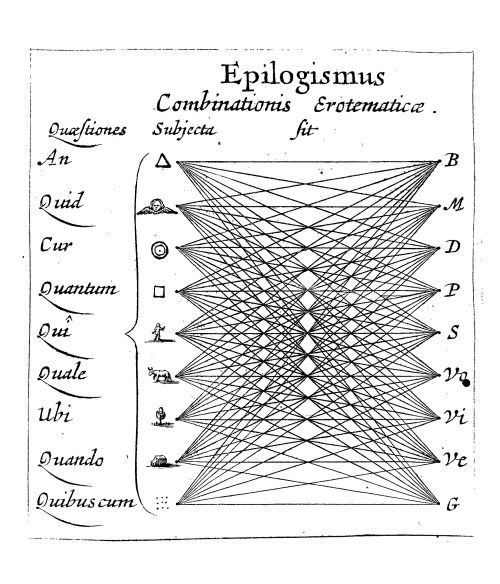
Athanasius Kircher (1602-80), Combinations of the nine universal symbols, from Ars Magna Sciendi Sive Combinatoria, 1669, p. 171. Courtesy of Stanford University.  This work is in the public domain in its country of origin and other countries and areas where the copyright term is the author’s life plus 100 years or less.


“Despite its improbability, the so-called “Flemish thesis” proved remarkably long-lasting. It survived even into the nineteenth century. It did so, however, less on its scientific merits than because it was part of a larger nationalistic polemic.

In his La province de Liège . . . Le flamand langue primordiale, mère de toutes les langues of 1868, the baron de Ryckholt proclaimed that “Flemish is the only language spoken in the cradle of humanity” and that “it alone is a language, while all the rest, dead or living, are but mere dialects or debased forms more or less disguised” (cf. Droixhe 1990: for linguistic follies de grandeur in general, Poliakov 1990).

With such a persistent and ebullient Flemish claim, it can hardly be surprising that there should be a Swedish candidacy as well. In 1671, Georg Stiernhielm wrote his De linguarum origine praefatio.

In 1688, his fellow countryman, Andreas Kempe, wrote Die Sprachen des Paradises; this included a scene in which God and Adam conversed with one another, God speaking in Swedish while Adam spoke in Danish; while they were talking, however, Eve was busy being seduced by a French-speaking serpent (cf. Borst 1957-63: III, 1, 1338; Olender 1989, 1993).

We are, by now, close to parody; yet we should not overlook the fact that these claims were made precisely in Sweden’s period as a major power on the European chessboard.

Olaus Rudbeck, in his Atlantica sive Mannheim vera Japheti posterorum sedes ac patria of 1675, demonstrated that Sweden was the home of Japheth and his line, and that from this racial and linguistic stock all the Gothic idioms were born.

Rudbeck identified Sweden, in fact, as the mythical Atlantis, describing it as the ideal land, the land of the Hesperides, from which civilization had spread to the entire world.

This was an argument that Isidore himself had already used. In his Etymologiarum, IX, ii, 26-7, he had suggested that the progenitor of the Goths was another of Japheth’s sons–Magog. Vico was later to comment acidly on all such claims (Scienza nuova seconda, 1744: II, 2.4, 430):

“Having now to enter upon a discussion of this matter, we shall give a brief sample of the opinions that have been held respecting it–opinions so numerous, inept, frivolous, pretentious or ridiculous, and so numerous, that we need not relate them.

By way of sample then: because in the returned barbarian times Scandinavia by the conceit of the nations was called vagina gentium and was believed to be the mother of all other nations of the world, therefore by the conceit of the scholars Johannes and Olaus Magnus were of the opinion that their Goths had preserved them from the beginning of the world the letters divinely inspired by Adam.

This dream was laughed at by all the scholars, but this did not keep Johannes van Gorp from following suit and going one better by claiming his own Dutch language, which is not much different from Saxon, has come down from the Earthly Paradise and is the mother of all other languages. [ . . . ]

And yet this conceit swelled to bursting point in the Atlantica of Olaus Rudbeck, who will have it that the Greek letters came from the runes; that the Phoenician letters, to which Cadmus gave the order and values those of the Hebrew, were inverted runes; and that the Greeks finally straightened them here and rounded them there by rule and compass.

And because the inventor is Merkurssman among the Scandinavians, he will have it that the Mercury who invented letters for the Egyptians was a Goth.”

Already by the fourteenth century, the idea of a German linguistic primacy was shaking the German-speaking world. The idea later appeared in Luther, for whom German was the language closest to God.

In 1533 Konrad Pelicanus (Commentaria bibliorum) set out the analogies between German and Hebrew, without, however, coming to a final judgement over which of the two was truly the Ursprache (cf. Borst 1957-63: III/1, 2).

In the baroque period, Georg Philipp Harsdörffer (Frauenzimmer Gesprächspiele, 1641, Niemayer Tübingen, ed., 1968: 335ff) claimed that the German language:

“speaks in the languages of nature, quite perceptibly expressing all its sounds. [ . . . ]

It thunders with the heavens, flashes lightening with the quick moving clouds, radiates with the hail, whispers with the winds, foams with the waves, creaks with the locks, sounds with the air, explodes with the cannons; it roars like the lion, lows like the oxen, snarls like the bear, bells like the stag, bleats like the sheep, grunts like the pig, barks like the dog, whinnies like the horse, hisses like the snake, meows like the cat, honks like the goose, quacks like the duck, buzzes like the bumble bee, clucks like the hen, strikes its beak like the stork, caws like the crow, coos like the swallow, chirps like the sparrow. [ . . . ]

On all those occasions in which nature gives things their own sound, nature speaks in our own German tongue. For this, many have wished to assert that the first man, Adam, would not have been able to name the birds and all the other beasts of the fields in anything but our words, since he expressed, in a manner conforming to their nature, each and every innate property and inherent sound; and thus it is not surprising that the roots of the larger part of our words coincide with the sacred language.”

German had remained in a state of perfection because Germany had never been subjected to the yoke of a foreign ruler. Lands that had been subjected had inevitably adapted their customs and language to fit those of the victor.

This was also the opinion of Kircher. French, for example, was a mix of Celtic, Greek and Latin. The German language, by contrast, was richer in terms than Hebrew, more docile than Greek, mightier than Latin, more magnificent in its pronunciations than Spanish, more gracious than French, and more correct than Italian.”

Umberto Eco, The Search for the Perfect Language, translated by James Fentress, Blackwell. Oxford, 1995, pp. 97-9.