
Eco: Kircher’s Egyptology
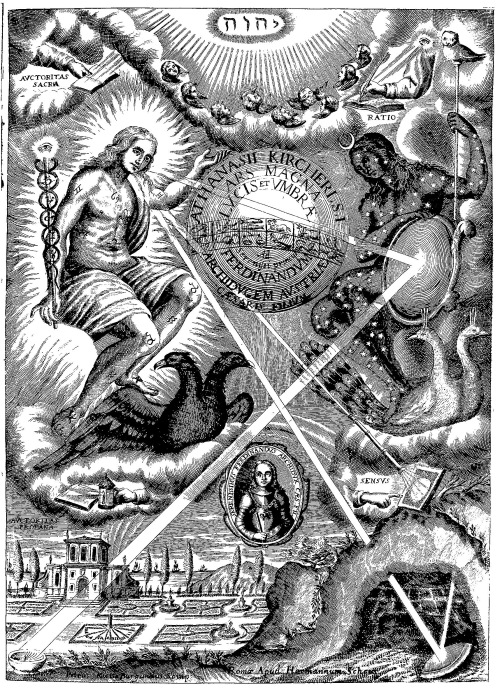
Athanasius Kircher (1602-80), frontispiece to Ars Magna Lucis et Umbrae, Rome, Scheus, 1646. Compendium Naturalis says that this allegorical engraving was executed on copper by Petrus Miotte Burgundus. Multiple copies are posted on the internet, including an eBook courtesy of GoogleBooks, one at the Max Planck Institute, one at the Herzog August Bibliothek, and one at Brigham Young University among many others. This work is in the public domain in its country of origin and other countries and areas where the copyright term is the author’s life plus 100 years or less.
“When Kircher set out to decipher hieroglyphics in the seventeenth century, there was no Rosetta stone to guide him. This helps explain his initial, mistaken, assumption that every hieroglyph was an ideogram.
Understandable as it may have been, this was an assumption which doomed his enterprise at the outset. Notwithstanding its eventual failure, however, Kircher is still the father of Egyptology, though in the same way that Ptolemy is the father of astronomy, in spite of the fact that his main hypothesis was wrong.
In a vain attempt to demonstrate his hypothesis, Kircher amassed observational material and transcribed documents, turning the attention of the scientific world to the problem of hieroglyphs. Kircher did not base his work on Horapollo’s fantastic bestiary; instead, he studied and made copies of the royal hieroglyphic inscriptions.
His reconstructions, reproduced in sumptuous tables, have an artistic fascination all of their own. Into these reconstructions Kircher poured elements of his own fantasy, frequently reportraying the stylized hieroglyphs in curvaceous baroque forms.
Lacking the opportunity for direct observation, even Champollion used Kircher’s reconstructions for his study of the obelisk standing in Rome’s Piazza Navona, and although he complained of the lack of precision of many of the reproductions, he was still able to draw from them interesting and exact conclusions.
Already in 1636, in his Prodromus Coptus sive Aegyptiacus (to which was added, in 1643, a Lingua Aegyptiaca restituta), Kircher had come to understand the relation between the Coptic language and, on the one hand, Egyptian, and, on the other, Greek.
It was here that he first broached the possibility that all religions, even those of the Far East, were nothing more than more or less degenerated versions of the original Hermetic mysteries.
There were more than a dozen obelisks scattered about Rome, and restoration work on some of them had taken place from as early as the time of Sixtus V. In 1644, Innocent X was elected pope. His Pamphili family palace was in Piazza Navona, and the pope commissioned Bernini to execute for him the vast fountain of the four rivers, which remains there today.
On top of this fountain was to be placed the obelisk of Domitian, whose restoration Kircher was invited to superintend.
As the crowning achievement of this restoration, Kircher published, in 1650, his Obeliscus Pamphilius, followed, in 1652-4, by the four volumes of his Oedipus Aegyptiacus. This latter was an all-inclusive study of the history, religion, art, politics, grammar, mathematics, mechanics, medicine, alchemy, magic and theology of ancient Egypt, compared with all other eastern cultures, from Chinese ideograms to the Hebrew kabbala to the language of the brahmins of India.
The volumes are a typographical tour de force that demanded the cutting of new characters for the printing of the numerous exotic, oriental alphabets. It opened with, among other things, a series of dedications to the emperor in Greek, Latin, Italian, Spanish, French, Portuguese, German, Hungarian, Czech, Illirian, Turkish, Hebrew, Syriac, Arabic, Chaldean, Samaritan, Coptic, Ethiopic, Armenian, Persian, Indian and Chinese.
Still, the conclusions were the same as those of the earlier book (and would still be the same in the Obelisci Aegyptiaci nuper inter Isaei Romani rudera effosii interpretatio hieroglyphica of 1666 and in the Sphinx mystagoga of 1676).
At times, Kircher seemed to approach the intuition that certain of the hieroglyphs had a phonetic value. He even constructed a rather fanciful alphabet of 21 hieroglyphs, from whose forms he derives, through progressive abstractions, the letters of the Greek alphabet.
Kircher, for example, took the figure of the ibis bending its head until it rests between its two feet as the prototype of the capitalized Greek alpha, A. He arrived at this conclusion by reflecting on the fact that the meaning of the hieroglyphic for the ibis was “Bonus Daemon;” this, in Greek, would have been Agathos Daimon.
But the hieroglyph had passed into Greek through the mediation of Coptic, thanks to which the first sounds of a given word were progressively identified with the form of the original hieroglyph.
At the same time, the legs of the ibis, spread apart and resting on the ground, expressed the sea, or, more precisely, the only form in which the ancient Egyptians were acquainted with the sea–the Nile.
The word delta has remained unaltered in its passage into Greek, and this is why the Greek letter delta (Δ) has retained the form of a triangle.
It was this conviction that, in the end, hieroglyphs all showed something about the natural world that prevented Kircher from ever finding the right track. He thought that only later civilizations established that short-circuit between image and sound, which on the contrary characterized hieroglyphic writing from its early stages.
He was unable, finally, to keep the distinction between a sound and the corresponding alphabetic letter; thus his initial intuitions served to explain the generation of later phonetic alphabets, rather than to understand the phonetical nature of hieroglyphs.
Behind these errors, however, lies the fact that, for Kircher, the decipherment of hieroglyphs was conceived as merely the introduction to the much greater task–an explanation of their mystic significance.
Kircher never doubted that hieroglyphs had originated with Hermes Trismegistus–even though several decades before, Isaac Casaubon had proved that the entire Corpus Hermeticum could not be earlier than the first centuries of the common era.
Kircher, whose learning was truly exceptional, must have known about this. Yet he deliberately ignored the argument, preferring rather to exhibit a blind faith in his Hermetic axioms, or at least to continue to indulge his taste for all that was strange or prodigious.
Out of this passion for the occult came those attempts at decipherment which now amuse Egyptologists. On page 557 of his Obeliscus Pamphylius, figures 20-4 reproduce the images of a cartouche to which Kircher gives the following reading: “the originator of all fecundity and vegetation is Osiris whose generative power bears from heaven to his kingdom the Sacred Mophtha.”
This same image was deciphered by Champollion (Lettre à Dacier, 29), who used Kircher’s own reproductions, as “ΑΟΤΚΡΤΛ (Autocrat or Emperor) sun of the son and sovereign of the crown, ΚΗΣΡΣ ΤΜΗΤΕΝΣ ΣΒΣΤΣ (Caesar Domitian Augustus).”
The difference is, to say the least, notable, especially as regards the mysterious Mophtha, figured as a lion, over which Kircher expended pages and pages of mystic exegesis listing its numerous properties, while for Champollion the lion simply stands for the Greek letter lambda.
In the same way, on page 187 of the third volume of the Oedipus there is a long analysis of a cartouche that appeared on the Lateran obelisk. Kircher reads here a long argument concerning the necessity of attracting the benefits of the divine Osiris and of the Nile by means of sacred ceremonies activating the Chain of Genies, tied to the signs of the zodiac.
Egyptologists today read it as simply the name of the pharaoh Apries.”
Umberto Eco, The Search for the Perfect Language, translated by James Fentress, Blackwell. Oxford, 1995, pp. 154-8.
 Samizdat