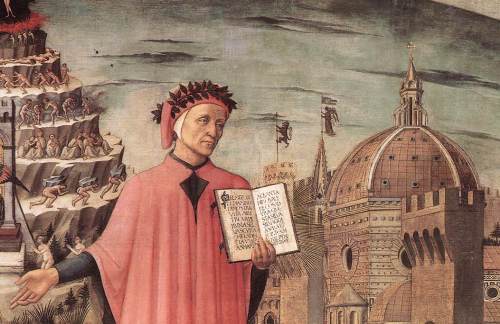
Dante Alighieri (1265-1321), with the mountain of Purgatory behind him and the city of Florence to his left, holds the incipit “Nel mezzo del cammin di nostra vita” in a detail taken from a painting by Domenico di Michelino (1417-91), 1465. This work is in the public domain in its country of origin and other countries and areas where the copyright term is the author’s life plus 100 years or less.
“An apology for the vernacular, DVE is written in Latin. As a poet, Dante wrote in Italian; as a philosopher and as a political scientist (as we would say today) who advocated the restoration of a universal monarchy, Dante stuck to the language of theology and law.
DVE defines a vernacular as the speech that an infant learns as it first begins to articulate, imitating the sounds made to it by its nurse, before knowing any rule. The same was not true of that locutio secundaria called grammar by Romans.
Grammar meant a ruled-governed language, one, moreover, that could be mastered only after long study to acquire the habitus.
Considering that in the vocabulary of the Schoolmen habitus was a virtue, a capacity to do some specific thing, a present-day reader might take Dante merely to be distinguishing between the instinctive ability to express oneself in language (performance) and grammatical competence.
It is clear, however, that by grammar Dante meant scholastic Latin, the only language whose rules were taught in school during this period (cf. also Viscardi 1942: 31ff).
In this sense Latin was an artificial idiom; it was, moreover, an idiom which was “perpetual and incorruptible,” having been ossified into the international language of church and university through a system of rules by grammarians from Servius (between the fourth and fifth centuries) to Priscian (between the fifth and sixth) when Latin had ceased to be the living language of the Romans.
Having made this distinction between a primary and a secondary language clear, Dante went on to proclaim in no uncertain terms that, of the two, it was the first, the vernacular, that was the more noble.
He gave various reasons for this opinion: vernaculars were the first languages of humanity; “though divided by different words and accents” (I, i, 4) the whole world continues to use them; finally, vernaculars are natural and not artificial.
This choice led Dante, however, into a double predicament.
First, although assuming that the most noble language must be natural, the fact that natural languages were split into a multiplicity of dialects suggested that they were not natural but conventional.
Second, a vulgar tongue is the language spoken by everyone (by vulgus, or common people). But in DVE Dante insists on the variety of the languages of the world.
How can he reconcile the idea that languages are many with the idea that the vernacular was the natural language for the whole human race? To say that learning a natural language without the aid of rules is common to the whole human race does not amount to saying that we all speak the same one.
A way to escape such a double predicament would be to interpret Dante’s argument as if he wanted to say that our ability to learn different natural languages (according to the place of our birth or to the first linguistic training we receive) depends on our native faculty for languages.
This is certainly an innate faculty which manifests itself in different linguistic forms and substances, that is, in our ability to speak different natural languages (see also Marigo 1938: comment 9, n. 23; Dragonetti 1961: 23).
Such a reading would be legitimated by various of Dante’s assertions concerning our faculty to learn a mother tongue; this faculty is natural, it exists in all peoples despite their differences in word and accent, and is not associated with any specific language.
It is a general faculty, possessed by humanity as a species, for “only man is able to speak” (I, ii, 1). The ability to speak is thus a specific trait of human beings; one that is possessed by neither angels, nor beasts, nor demons.
Speaking means an ability to externalize our particular thoughts; angels, by contrast, have an “ineffable intellectual capacity:” they either understand the thoughts of others, or they can read them in the divine mind.
Animals lack individual feelings, possessing only “specific” passions. Consequently each knows its own feelings and may recognize feelings when displayed by animals of the same species, having no need to understand the feelings of other species.
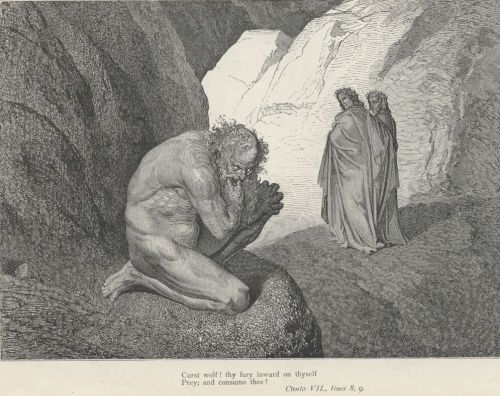
Gustave Doré (1832-83), Inferno, Canto VII, lines 8,9, 1883. This work is in the public domain in its country of origin and other countries and areas where the copyright terms in the author’s life plus 100 years or less.
Each demon immediately recognizes the depths of perfidy of another. (By the way, in the Divine Comedy Dante will decide to make his demons talk; they will still sometimes use a speech not quite human: the celebrated diabolical expression of Inferno, vii, 1, “Pape Satan, pape Satan aleppe,” is curiously reminiscent of another expression: “Raphèl maí amècche zabì almi,” Inferno xxxi, 67–the fatal words, spoken by Nimrod, which set off the catastrophe of Babel; even the devils thus speak the languages of the confusion; cf. Hollander 1980).
In contrast to these beings, however, humans are guided by reason. In individuals, this takes the forms of discernment and judgement. Yet human beings also need some further faculty which might allow them to externalize the contents of this intellect in outward signs.
Dante defines the faculty for language as the disposition for humans to associate rational signifiers with signifieds perceived by the senses, thus accepting the Aristotelian doctrine that the relation between outward signs and both the corresponding passions of the soul, and the things that they signify, is conventional and ad placitum.
Dante made it very clear that while the linguistic faculty is a permanent and immutable trait of the human species, natural languages are historically subject to variation, and are capable of developing over the course of time, enriching themselves independently of the will of any single speaker.
Dante was no less aware that a natural language may be enriched through the creativity of single individuals as well, for the illustrious vernacular that he intended to shape was to be the product of just such an individual creative effort.
Yet it seems that between the faculty of language and the natural languages which are the ultimate result, Dante wished to posit a further, intermediate stage. We can see this better by looking at Dante’s treatment of the story of Adam.”
Umberto Eco, The Search for the Perfect Language, translated by James Fentress, Blackwell. Oxford, 1995, pp. 35-8.

 Samizdat