
Samizdat

Publishing the Forbidden. All Rights Reserved. © Samizdat 2014-2025.

Tag: Japan

Eco: Theoretical Objections and Counter-objections

Projet_d'éléments_d'idéologie_par_le_[...]Destutt_de_bpt6k10455061

Antoine-Louis-Claude Destutt de Tracy (1754-1836), Projet d’éléments d’idéologie, Paris, 1801. This copy in the Bibliothèque nationale de France. This work is in the public domain in its country of origin and other countries and areas where the copyright term is the author’s life plus 100 years or less. 

“A fundamental objection that can be applied to any of the a posteriori projects generically is that they can make no claim to having identified and artificially reorganized a content system.

They simply provide an expression system which aims at being easy and flexible enough to express the contents normally expressed in a natural language. Such a practical advantage is also a theoretical limit. If the a priori languages were too philosophical, their a posteriori successors are not philosophical enough.

The supporters of an IAL have neither paid attention to the problem of linguistic relativism, nor ever been worried by the fact that different languages present the world in different ways, sometimes mutually incommensurable.

They have usually taken it for granted that synonymous expressions exist from language to language, and the vast collection of books that have been translated into Esperanto from various of the world’s languages is taken as proof of the complete “effability” of this language (this point has been discussed, from opposite points of view, by two authors who are both traditionally considered as relativist, that is, Sapir and Whorfcf. Pellerey 1993: 7).

To accept the idea that there is a content system which is the same for all languages means, fatally, to take surreptitiously for granted that such a model is the western one. Even if it tries to distance itself in certain aspects from the Indo-European model, Esperanto, both in its lexicon and in its syntax, remains basically an Indo-European tongue.

As Martinet observed, “the situation would have been different if the language had been invented by a Japanese” (1991: 681).

One is free to regard all these objections as irrelevant. A theoretical weak point may even turn out to be a practical advantage. One can hold that linguistic unification must, in practice, accept the use of the Indo-European languages as the linguistic model (cf. Carnap in Schlipp 1963:71).

It is a view that seems to be confirmed by actual events; for the moment (at least) the economic and technological growth of Japan is based on Japanese acceptance of an Indo-European language (English) as a common vehicle.

Both natural tongues and some “vehicular” languages have succeeded in becoming dominant in a given country or in a larger area mainly for extra-linguistic reasons. As far as the linguistic reasons are concerned (easiness, economy, rationality and so on), there are so many variables that there are no “scientific” criteria whereby we might confute the claim of Goropius Becanus that sixteenth century Flemish was the easiest, most natural, sweetest and most expressive language in the entire universe.

The predominate position currently enjoyed by English is a historical contingency arising from the mercantile and colonial expansion of the British Empire, which was followed by American economic and technological hegemony.

Of course, it may also be maintained that English has succeeded because it is rich in monosyllables, capable of absorbing foreign words and flexible in forming neologisms, etc.: yet had Hitler won World War II and had the USA been reduced to a confederation of banana republics, we would probably today use German as a universal vehicular language, and Japanese electronics firms would advertise their products in Hong Kong airport duty-free shops (Zollfreie Waren) in German.

Besides, on the arguable rationality of English, and of any other vehicular language, see the criticism of Sapir (1931).

There is no reason why an artificial language like Esperanto might not function as an international language, just as certain natural languages (such as Greek, Latin, French, English, Swahili) have in different historical periods.

We have already encountered in Destutt de Tracy an extremely powerful objection: a universal language, like perpetual motion, is impossible for a very “peremptory” reason: “Even were everybody on earth to agree to speak the same language from today onwards, they would rapidly discover that, under the influence of their own use, the single language had begun to change, to modify itself in thousands of different ways in each different country, until it produced in each a different dialect which gradually grew away from all the others” (Eléments d’idéologie, II, 6, 569).

It is true that, just for the above reasons, the Portuguese of Brazil today differs from the Portuguese spoken in Portugal so much that Brazilian and Portuguese publishers publish two different translations of the same foreign book, and it is a common occurrence for foreigners who have learned their Portuguese in Rio to have difficulty understanding what they hear on the streets of Lisbon.

Against this, however, one can point out the Brazilians and Portuguese still manage to understand each other well enough in practical, everyday matters. In part, this is because the mass media help the speakers of each variety to follow the transformations taking place on the other shore.

Supporters of Esperanto like Martinet (1991: 685) argue that it would be, to say the least, naive to to suppose that, as an IAL diffused into new areas, it would be exempt from the process through which languages evolve and split up into varieties of dialects.

Yet in so far as an IAL remained an auxiliary language, rather than the primary language of everyday exchange, the risks of such a parallel evolution would be diminished.

The action of the media, which might reflect the decisions of a sort of international supervisory association, could also contribute to the establishment and maintenance of standards, or, at least, to keeping evolution under control.”

Umberto Eco, The Search for the Perfect Language, translated by James Fentress, Blackwell. Oxford, 1995, pp. 330-2.
Eco: Kircher’s Chinese

kircher_049-826x1024

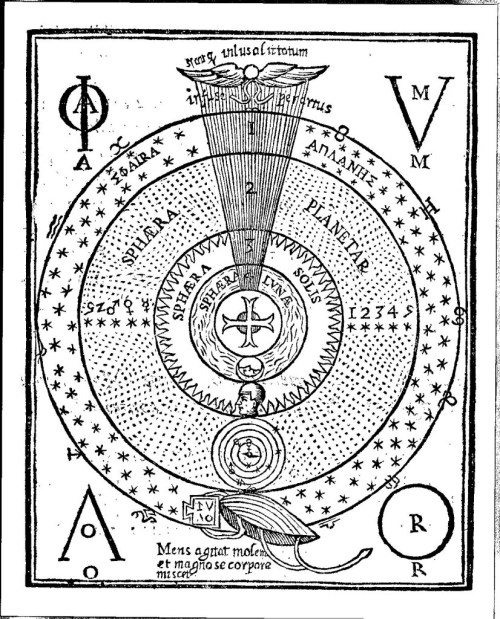
Athanasius Kircher (1602-80), schema of the Egyptian cosmos, Oedipus Aegyptiacus, tom. 2, vol. 1, p. 418. This work is in the public domain in its country of origin and other countries and areas where the copyright term is the author’s life plus 100 years or less.

“In an earlier chapter, we saw the suggestion made that Chinese might be the language of Adam. Kircher lived in a period of exciting discoveries in the Orient. The Spanish, Portuguese, English, Dutch, and, later, French conquered the route to the Indies, the Sunda seas, the way to China and to Japan.

But even more than by merchants, these pathways were traversed by Jesuits, following in the footsteps of Matteo Ricci who, a century before, had brought European culture to the Chinese, and returned to give Europe a deeper understanding of China.

With the publication of the Historia de las cosas más notables, ritos y costumbres del gran reino de la China by Juan Gonzales de Mendoza in 1585, there appeared in print in Europe characters in Chinese script.

In 1615 there finally appeared Ricci’s De christiana expeditione apud Sinas ab Societate Ieus suscepta, in which he explained that in Chinese, there existed as many characters as there were words. He insisted as well on the international character of the Chinese script, which, he wrote, was readily understood not only by the Chinese, but also by the Japanese, the Koreans, the Cochin-Chinese and by the Formosans.

We shall see that this was a discovery that would initiate the search for a real character from Bacon onwards. Already in 1627, in France, Jean Douet published a Proposition présentée au roy, d’une escriture universelle, admirable pour ses effects, très-utile à tous les hommes de la terre, in which Chinese was offered as a model for an international language.

At the same time, there had begun to appear information about the pictographic writings of Amerindians. Attempts at interpretation had yielded contradictory results; and this was discussed in works such as the Historia natural y moral de las Indias by José de Acosta in 1570, and the Relaciòn de las cosas de Yucatàn by Diego de Landa, written in the sixteenth century, although appearing only in the eighteenth; in 1609 there also appeared the Comentarios reales que tratan del origine de los Yncas by Garcilaso de la Vega.

An observation often repeated by these early observers was that contact with the indigenous natives was at first carried out by means of gestures. This awoke an interest in gesture’s potential as a universal language.

The universality of gestures and the universality of images turned out to be related themes (the first treatise on this subject was Giovanni Bonifacio‘s L’arte de’ cenni of 1616; on this topic in general, see Knox 1990).

The reports of his Jesuit brothers gave Kircher an incomparable source of ethnographic and linguistic information (see Simone 1990 on “Jesuit or Vatican linguistics”).

In his Oedipus, Kircher was especially interested in the diffusion of Chinese. He took up the same arguments, in a more elliptical form, in his China monumentis quà sacris quà profanis, nec non variis naturae et artis spectaculis, aliarum rerum memorabilis argumentis illustrata of 1667.

This latter work was more in the nature of a treatise in ethnography and cultural anthropology which, with its splendid and sometimes documented illustrations, collected all the reports that arrived from the missionaries of the Company, and described every aspect of Chinese life, culture and nature.

Only the sixth and last part of the work was dedicated to the alphabet.

Kircher presumed that the mysteries of hieroglyphic writing had been introduced to the Chinese by Noah’s son Ham. In the Arca Noe of 1675 (pp. 210ff) he identified Ham with Zoroaster, the inventor of magic.

But, unlike Egyptian hieroglyphs, Chinese characters were not for Kircher a puzzle. Chinese was a writing system still in use, and the key to its understanding had already been revealed. How could such a comprehensible language be sacred and a vehicle for occult mysteries?

Kircher realized that Chinese characters were originally iconic and only later had grown extremely stylized over time, so as to lose their original similarity with things. He reconstructed after  his own fancy what he took to be the designs of fish and birds that had formed the starting points for current ideograms.

Kircher also realized that these ideograms did not express either letters or syllables, but referred to concepts. He noted that in order to translate our dictionary into their idiom we would need as many different characters as we had words (Oedipus, III, 11).

This led him to reflect on the amount of memory that was necessary for a Chinese scholar to know and remember all these characters.”

Umberto Eco, The Search for the Perfect Language, translated by James Fentress, Blackwell. Oxford, 1995, pp. 158-60.

Selz: Plant of Birth or Plant of Life in the Etana Legend?

“The story of Etana, one of the oldest tales in a Semitic language, was, as I have argued elsewhere, modeled after the then extant Sumerian tales of the Gilgamesh Epic.

Gilgamesh’s search for “the plant of life,” the ú-nam-ti-la (šammu ša balāti) was, however, replaced by Etana’s search for the plant of birth-giving (šammu ša alādi). The entire story runs as follows:

British Museum K. 19530, Library of Ashurbanipal (reigned 669-631 BCE), excavated from Kouyunjik by Austen Henry Layard. Neo-Assyrian 7th Century BCE, Nineveh.  This cuneiform tablet details the legend of Etana, a mythological king of Kish.  http://www.britishmuseum.org/research/collection_online/collection_object_details.aspx?objectId=287204&partId=1&searchText=WCT28297&page=1 http://www.britishmuseum.org/explore/highlights/highlight_objects/me/c/cuneiform_the_legend_of_etana.aspx This image is released under a Creative Commons Attribution-NonCommercial-ShareAlike 4.0 International (CC BY-NC-SA 4.0) license.

British Museum K. 19530, Library of Ashurbanipal (reigned 669-631 BCE), excavated from Kouyunjik by Austen Henry Layard. Neo-Assyrian 7th Century BCE, Nineveh.
This cuneiform tablet details the legend of Etana, a mythological king of Kish.
http://www.britishmuseum.org/research/collection_online/collection_object_details.aspx?objectId=287204&partId=1&searchText=WCT28297&page=1
http://www.britishmuseum.org/explore/highlights/highlight_objects/me/c/cuneiform_the_legend_of_etana.aspx
This image is released under a Creative Commons Attribution-NonCommercial-ShareAlike 4.0 International (CC BY-NC-SA 4.0) license.

The gods build the first city Kish, but kingship is still in heaven. A ruler is wanted (and found). Due to an illness, Etana’s wife is unable to conceive. The plant of birth is wanted.

In the ensuing episode eagle and snake swore an oath of friendship. Suddenly the eagle plans to eat up the snake’s children; a baby eagle, with the name of Atrahasīs opposes this plan, but eagle executes it.

Now, the weeping snake seeks justice from the sun-god. With the god’s help the eagle is trapped in a burrow, and now the eagle turns to the sun-god for help. He receives the answer that, because of the taboo-violation he cannot help, but will send someone else.

Etana prays daily for the plant of birth and in a dream the sun-god tells Etana to approach the eagle. In order to get the eagle’s support Etana helps him out of his trap.

BM 89767, Limestone cylinder seal illustrating the myth of Etana, shepherd and legendary king of Kish, who was translated to heaven by an eagle to obtain the plant of life.  This seal portrays Etana’s ascent, witnessed by a shepherd, a dog, goats and sheep. Dated 2250 BCE, this seal was excavated by Hormuz Rassam, and came from an old, previously unregistered collection acquired before 1884.  Dominique Collon, Catalogue of the Western Asiatic Seals in the British Museum: Cylinder Seals II: Akkadian, Post-Akkadian, Ur III Periods, II, London, British Museum Press, 1982.  R.M. Boehner, Die Entwicklung der Glyptic wahrend der Akkad-Zeit, 4, Berlin, 1965.  Alfred Jeremias, Das Alte Testament im Lichte des Alten Orients: Handbuch zur biblisch-orientalischen Altertumskunde, Leipzig, JC Hinrichs, 1906.  Also AN128085001, 1983, 0101.299.  This image is released under a Creative Commons Attribution-NonCommercial-ShareAlike 4.0 International (CC BY-NC-SA 4.0) license.  © The Trustees of the British Museum. http://www.britishmuseum.org/research/collection_online/collection_object_details/collection_image_gallery.aspx?partid=1&assetid=128085001&objectid=368707

BM 89767, Limestone cylinder seal illustrating the myth of Etana, shepherd and legendary king of Kish, who was translated to heaven by an eagle to obtain the plant of life.
This seal portrays Etana’s ascent, witnessed by a shepherd, a dog, goats and sheep. Dated 2250 BCE, this seal was excavated by Hormuzd Rassam, and came from an old, previously unregistered collection acquired before 1884.
Dominique Collon, Catalogue of the Western Asiatic Seals in the British Museum: Cylinder Seals II: Akkadian, Post-Akkadian, Ur III Periods, II, London, British Museum Press, 1982.
R.M. Boehner, Die Entwicklung der Glyptic wahrend der Akkad-Zeit, 4, Berlin, 1965.
Alfred Jeremias, Das Alte Testament im Lichte des Alten Orients: Handbuch zur biblisch-orientalischen Altertumskunde, Leipzig, JC Hinrichs, 1906.
Also AN128085001, 1983, 0101.299.
This image is released under a Creative Commons Attribution-NonCommercial-ShareAlike 4.0 International (CC BY-NC-SA 4.0) license.
© The Trustees of the British Museum.
http://www.britishmuseum.org/research/collection_online/collection_object_details/collection_image_gallery.aspx?partid=1&assetid=128085001&objectid=368707

Now the eagle, carrying Etana on his back, ascends to the heavens. On the uppermost level of the heavens Etana becomes afraid and the eagle takes him back to the earth.

The end of the story is missing, but that Etana finally got hold of the plant of birth is very likely, since other sources mention his son.

To summarize: I have tried to show that some features of the Enoch tradition are a re-writing of very ancient concepts. I do not claim that they all can be explained assuming dependencies, as earlier scholarship has done.

I do not intend to idolize “origins,” but what might eventually come out of such a research—if the topics mentioned here are thoroughly worked out and elaborated in detail—is, that our texts implicate many more meanings than tradition may have supposed.

In my opinion there can be little doubt that the official transmission of texts in Mesopotamia was supplemented by a wealth of oral tradition. Indeed, the situation may be comparable to the one attested in the (still) living oral tradition on Enoch in the Balkanian vernaculars.”

This Akkadian clay tablet, dated to circa 1900-1600 BCE, preserves a partial version of the Sumerian Legend of Etana.  Held by the Morgan Library.  http://www.codex99.com/typography/1.html

This Akkadian clay tablet, dated to circa 1900-1600 BCE, preserves a partial version of the Sumerian Legend of Etana.
Held by the Morgan Library.
http://www.codex99.com/typography/1.html

(See G.J. Selz, “Die Etana-Erzählung: Ursprung und Tradition eines der ältesten epischen Texte in einer semitischen Sprache,” Acta Sumerologica (Japan) 20 (1998): pp. 135-79.

A different opinion is expressed by P. Steinkeller, “Early Semitic Literature and Third Millennium Seals with Mythological Motifs,” in Literature and Literary Language at Ebla (ed. P. Fronzaroli; Quaderni di Semitistica 18; Florence: Dipartimento di linguistica Università di Firenze, 1992), pp. 243-75 and pls. 1-8.

Further remarks on the ruler’s ascension to heaven are discussed by G.J. Selz, “Der sogenannte ‘geflügelte Tempel’ und die ‘Himmelfahrt’ der Herrscher: Spekulationen über ein ungelöstes Problem der altakkadischen Glyptik und dessen möglichen rituellen Hintergrund,” in Studi sul Vicino Oriente Antico dedicati alla memoria di Luigi Cagni (ed. S. Graziani; Naples: Istituto Universitario Orientale, 2000, pp. 961-83.)

Gebhard J. Selz, “Of Heroes and Sages–Considerations of the Early Mesopotamian Background of Some Enochic Traditions,” in Armin Lange, et alThe Dead Sea Scrolls in Context, v. 2, Brill, 2011, pp. 799-800.