
Samizdat

Publishing the Forbidden. All Rights Reserved. © Samizdat 2014-2025.

Tag: Indo-European

Eco: New Prospects for the Monogenetic Hypothesis

kircher_021

Athanasius Kircher (1602-80), frontispiece to Magnes sive De Arte Magnetica, 1641 and 1643 editions, digitized by the University of Lausanne and Stanford University. This work is in the public domain in its country of origin and other countries and areas where the copyright term is the author’s life plus 100 years or less.

“Doubting the possibility of obtaining scientific agreement upon an argument whose evidence had been lost in the mists of time, about which nothing but conjectures might be offered, the Société de Linguistique of Paris 1866 decided that it would no longer accept scientific communications on the subject of either universal languages or origins of language.

In our century that millenary debate took the form of research on the universals of language, now based on the comparative analysis of existing languages. Such a study has nothing to do with more or less fantastic historic reconstructions and does not subscribe to the utopian ideal of a perfect language (cf. Greenberg 1963; Steiner 1975: I, 3).

However, comparatively recent times have witnessed a renewal of the search for the origins of language (cf., for example, Fano 1962; Hewes 1975, 1979).

Even the search for the mother tongue has been revived in this century by Vitalij Ševorškin (1989), who has re-proposed the Nostratic hypothesis, originally advanced in Soviet scientific circles in the 1960s, and associated with the names of Vladislav Il’ič-Svitych and Aron Dolgoposkiji.

According to this hypothesis, there was a proto-Indo-European, one of the six branches of a larger linguistic family deriving from Nostratics–which in its turn derives from a proto-Nostratics, spoken approximately ten thousand years ago. The supporters of this theory have compiled a dictionary of several hundred terms of this language.

But the proto-Nostratics itself would derive from a more ancient mother tongue, spoken perhaps fifty thousand years ago in Africa, spreading from there throughout the entire globe (cf. Wright 1991).

According to the so-called “Eve’s hypothesis,” one can thus imagine a human couple, born in Africa, who later emigrated to the Near East, and whose descendants spread throughout Eurasia, and possibly America and Australia as well (Ivanov 1992:2). To reconstruct an original language for which we lack any written evidence, we must proceed like

“molecular biologists in their quest to understand the evolution of life. The biochemist identifies molecular elements that perform similar functions in widely divergent species, to infer the characteristics of the primordial cell from which they are presumed to have descended.

So does the linguist seek correspondences in grammar, syntax, vocabulary, and vocalization among known languages in order to reconstruct their immediate forebears and ultimately the original tongue. (Gamkrelidze and Ivanov 1990: 110).”

Cavalli-Sforza’s work on genetics (cf., for example, 1988, 1991) tends to show that linguistic affinities reflect genetic affinities. This supports the hypothesis of a single origin of all languages, reflecting the common evolutionary origin of all human groups.

Just as humanity evolved only once on the face of the earth, and later diffused across the whole planet, so language. Biological monogenesis and linguistic monogenesis thus go hand in hand and may be inferentially reconstructed on the basis of mutually comparable data.

In a different conceptual framework, the assumption that both the genetic and the immunological codes can, in some sense, be analyzed semiotically seems to constitute the new scientific attempt to find a language which could be defined as the primitive one par excellence (though not in historical but rather in biological terms).

This language would nest in the roots of evolution itself, of phylogenesis as of onto-genesis, stretching back to before the dawn of humanity (cf. Prodi 1977).”

Umberto Eco, The Search for the Perfect Language, translated by James Fentress, Blackwell. Oxford, 1995, pp. 115-6.
Eco: The Indo-European Hypothesis, 2

kircher_079

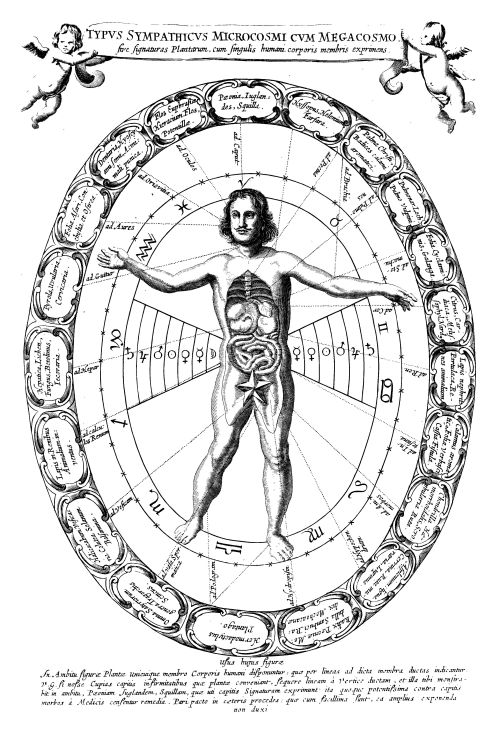
Athanasius Kircher (1602-80), sympathies between the microcosm and the megacosm, from Mundus subterraneus, 1665, vol. 2, p.406. Courtesy of Stanford University and the University of Oklahoma Libraries. This work is in the public domain in its country of origin and other countries and areas where the copyright term is the author’s life plus 100 years or less. 

“But are we really able to say that with the birth of the modern science of linguistics the ghost of Hebrew as the holy language had finally been laid to rest? Unfortunately not. The ghost simply reconstituted itself into a different, and wholly disturbing, Other.

As Olender (1989, 1993) has described it, during the nineteenth century, one myth died only to be replaced by another.

With the demise of the myth of linguistic primacy, there arose the myth of the primacy of a culture–or of a race. When the Hebrew language and civilization was torn down, the myth of the Aryan races rose up to take its place.

The reality of Indo-European was only virtual; yet it was still intrusive. Placed face to face with such a reality, Hebrew receded to the level of metahistory. It became a symbol.

At the symbolic level, Hebrew ranged from the linguistic pluralism of Herder, who celebrated it as a language that was fundamentally poetic (thus opposing an intuitive to a rationalistic culture), to the ambiguous apology of Renan, who–by contrasting Hebrew as the tongue of monotheism and of the desert to Indo-European languages (with their polytheistic vocation)–ends up with oppositions which, without our sense of hindsight, might even seem comic: the Semitic languages are incapable of thinking in terms of multiplicity, are unwilling to countenance abstraction; for this reason the Semitic culture would remain closed to scientific thinking and devoid of a sense of humor.

Unfortunately, this is not just a story of the gullibility of scientists. We know only too well that the Aryan myth had political consequences that were profoundly tragic. I have no wish to saddle the honest students of Indo-European with blame for the extermination camps, especially as–at the level of linguistic science–they were right.

It is rather that, throughout this book, we have been sensitive to side effects. And it is hard not to think of these side effects when we read in Olender the following passage from the great linguist, Adolphe Pictet, singing this hymn to Aryan culture:

“In an epoch prior to that of any historical witnesses, an epoch lost in the night of time, a race, destined by providence to one day rule the entire world, slowly grew in its primitive birthplace, a prelude to its brilliant future.

Privileged over all others by the beauty of their blood, by their gifts of intelligence, in the bosom of a great and severe nature that would not easily yield up its treasures, this race was summoned from the very beginning to conquer. [ . . . ]

Is it not perhaps curious to see the Aryas of Europe, after a separation of four or five thousand years, close the circle once again, reach their unknown brothers in India, dominate them, bring to them the elements of a superior civilization, and then to find ancient evidence of a common origin?”

(Les origines indo-européennes ou les Aryas primitifs, 1859-63: III, 537, cited in Olender 1989: 130-9).

At the end of a thousand year long ideal voyage to the East in search of roots, Europe had at last found some ideal reasons to turn that virtual voyage into a real one–for the purposes not of intellectual discovery, however, but of conquest.

It was the idea of the “white man’s burden.” With that, there was no longer any need to discover a perfect language to convert old or new brothers. It was enough to convince them to speak an Indo-European language, in the name of a common origin.”

Umberto Eco, The Search for the Perfect Language, translated by James Fentress, Blackwell. Oxford, 1995, pp. 105-6.