
Samizdat

Publishing the Forbidden. All Rights Reserved. © Samizdat 2014-2025.

Tag: Iliad

On the Literature of Ancient Sumer

” … Now let us compare this date with that of the various ancient literatures known to us at present.

In Egypt, for example, one might have expected an ancient written literature commensurate with its high cultural development. And, indeed, to judge from the pyramid inscriptions, the Egyptians in all probability did have a well developed written literature in the third millennium B. C.

Unfortunately it must have been written largely on papyrus, a readily perishable material, and there is little hope that enough of it will ever be recovered to give a reasonably adequate cross-section of the Egyptian literature of that ancient period.

Then, too, there is the hitherto unknown ancient Canaanite literature which has been found inscribed on tablets excavated in the past decade by the French at Rash-esh-Shamra in northern Syria.

These tablets, relatively few in number, indicate that the Canaanites, too, had a highly developed literature at one time. They are dated approximately 1400 B. C., that is, they were inscribed over half a millennium later than our Sumerian literary tablets. 21

As for the Semitic Babylonian literature as exemplified by such works as the Epic of Creation, the Epic of Gilgamesh, etc., it is not only considerably later than our Sumerian literature, but also includes much that is borrowed directly from it. 22

We turn now to the ancient literatures which have exercised the most profound influence on the more spiritual aspects of our civilization. These are the Bible, which contains the literary creations of the Hebrews; the Iliad and Odyssey, which are filled with the epic and mythic lore of the Greeks; the Rig-veda, which contains the literary products of ancient India; and the Avesta, which contains those of ancient Iran.

None of these literary collections were written down in their present form before the first half of the first millennium B. C.

Our Sumerian literature, inscribed on tablets dating from approximately 2000 B.C., therefore antedates these literatures by more than a millennium. Moreover, there is another vital difference.
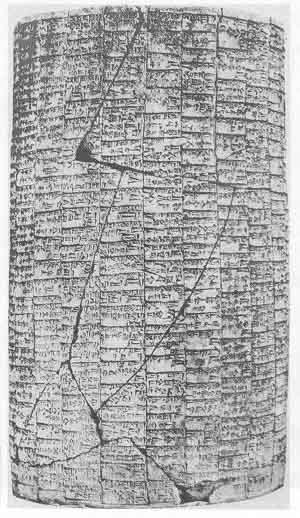
pl04

"To judge from the script, the Nippur cylinder illustrated on this plate 
(8383 in the Nippur collection of the University Museum) may date as early 
as 2500 B. C. Although copied and published by the late George Barton as 
early as 1918, its contents, which center about the Sumerian air-god Enlil 
and the goddess Ninhursag, are still largely unintelligible. Nevertheless, 
much that was unknown or misunderstood at the time of its publication is now 
gradually becoming clarified, and there is good reason to hope that the not 
too distant future will see the better part of its contents ready for 
translation."

-Samuel Noah Kramer, Sumerian Mythology, 1944, p. 18.

The texts of the Bible, of the Iliad and Odyssey, and of the Rig-veda and Avesta, as we have them, have been modified, edited, and redacted by compilers and redactors with varied motives and diverse points of view.

Not so our Sumerian literature; it has come down to us as actually inscribed by the ancient scribes of four thousand years ago, unmodified and uncodified by later compilers and commentators.”

Samuel Noah Kramer, Sumerian Mythology, 1944, pp. 19-20.

On Fear, Anxiety, Angst, and Mythology

“Fear is to be met and managed by the hero on his path to manhood, and an encounter with fear plays a major part in initiation ceremonies.”

[…]

Simply, there are two faces to panic: lived out in relation to a stimulus and called fear; held in with no known stimulus and called anxiety. Fear has an object; anxiety has none.  There can be panicky fear, a stampede, say; there can be panicky anxiety in a dream. In either condition, death can result. Psychoanalytic and psychosomatic case reports, as well as dream research and anthropological studies (for instance, on Voodoo death) provide instances of the fatal consequences of anxiety.

The anxiety dream can be distinguished from the nightmare in the classical sense. The classical nightmare is a dreadful visitation by a demon who forcibly oppresses the dreamer into paralysis, cuts off his breath, and release comes through movement. The anxiety dream is less precise, in that there is no demon, no dyspnea, but there is the same inhibition of movement. (A collection of these dreams is given by M. Weidhorn, “The Anxiety Dream in Literature from Homer to Milton,” Studies in Philology 64, pp. 65-82, Univ. of NC., 1967). A literary prototype of the anxiety dream, emphasizing an inhibited peculiarity of movement, occurs in the Iliad xxii, 199-201 (Achilles in pursuit of Hector):

“As in a dream a man is not able to follow one
who runs from him, nor can the runner escape,
nor the other pursue him, so he could not run
him down in his speed, nor the other get clear.”

[…]

Contemporary existential philosophy gives to anxiety, dread or Angst a more intentional, a more fulsome interpretation. Angst reveals man’s fundamental ontological situation, his connections with not-being, so that all fear is not just dread of death, but of the nothing on which all being is based. Fear thus becomes the reflection in consciousness of a universal reality.

Buddhism goes yet further: fear is more than a subjective, human phenomenon. All the world is in fear: trees, stones, everything. And the Buddha is the redeemer of the world from fear. Hence the significance of the mudra (hand gesture) of fear-not, which is not merely a sign of comfort but of total redemption of the world from its “fear and trembling,” its thralldom to Angst. Buddha’s perfect love, in the words of the Gospels, “driveth out fear.”

“…to further mix the contexts: let us say that the world of nature, Pan’s world, is in a continual state of subliminal panic just as it is in a continual state of subliminal sexual excitation. As the world is made by Eros, held together by that cosmogonic force and charged with the libidinal desire that is Pan, an archetypal vision most recently presented by Wilhelm Reich–so its other side, panic, recognized by the Buddha belongs to the same constellation. Again, we come back to Pan and the two extremes of instinct.

Brinkman has already pointed to the bankruptcy of all theories of panic that attempt to deal with it sociologically, psychologically or historically and not on its own terms. The right terms, Brinkman says, are mythological. We must follow the path cleared by Nietzsche whose investigation of kinds of consciousness and behavior through Apollo and Dionysos can be extended to Pan. Then panic will no longer be regarded as a physiological defense mechanism or an inadequate reaction or an abaissment du niveau mental, but will be seen as the right response to the numinous.”

–W.H. Roscher, Pan and the Nightmare: Ephialtes–A Pathological-Mythological Treatise on the Nightmare in Classical Antiquity, & An Essay on Pan by James Hillman, 1972. Pp. xxvi-xxviii. (James Hillman, “An Essay on Pan.”)