
Samizdat

Publishing the Forbidden. All Rights Reserved. © Samizdat 2014-2025.

Tag: Ibbi-Sin

Selz: Patriarchs and Sages

“A central figure in the discussion about the alleged Mesopotamian model for the antediluvian patriarchs soon became Enoch, who lived for 365 (364) years and of whom we read in Genesis 5:24: “Enoch walked with God then he was no more, because God took him away.”

The verb lāqah in this context has received numerous comments. Biblical sources offer three interpretations:

a) The liberation of a dead person from the power of the underworld;

b) A final removal from earth (cf. Elijah); or

c) An act of temporal transference, as in dream visions.
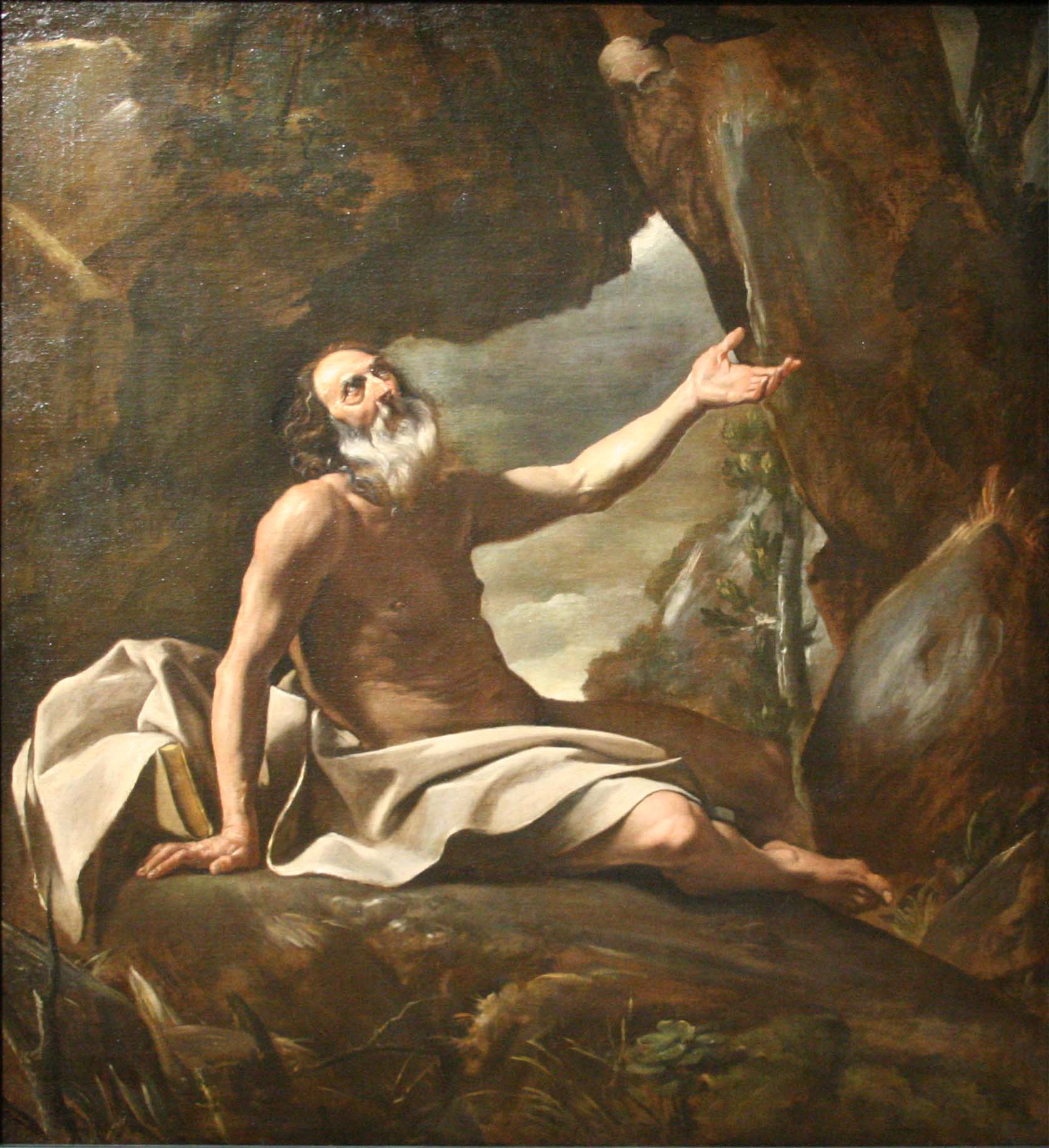
Giovanni Lanfranco (1582-1647 CE), Elie nourri par le corbeau, 1624-5 CE. Oil on canvas, held at the Musée des Beaux-Arts de Marseille, Accession number BA 451, photographed by Rvalette.  This faithful photographic reproduction of an original two-dimensional work of art is in the public domain where the copyright term is the author’s life plus 100 years or less.

Giovanni Lanfranco (1582-1647 CE), Elie nourri par le corbeau, 1624-5 CE. Oil on canvas, held at the Musée des Beaux-Arts de Marseille, Accession number BA 451, photographed by Rvalette.
This faithful photographic reproduction of an original two-dimensional work of art is in the public domain where the copyright term is the author’s life plus 100 years or less.

The name Enoch has found several interpretations: It has been argued that J derived the name from hānaq, “to dedicate” and “to train” which comes close to an interpretation of “the sage” (cf. also Arabic Idris!), and it may well be that the two values attributed to Enoch in Genesis are a “babilistic” interpretation of “a man dedicated to and trained by God.”

In the light of Genesis 4:17 the name was also thought to convey the meaning of “founder,” referring to the eponymous city Enoch. This Enoch is possibly entering the rank of those patriarchs who, according to biblical tradition, were perceived as a sort of cultural heroes.
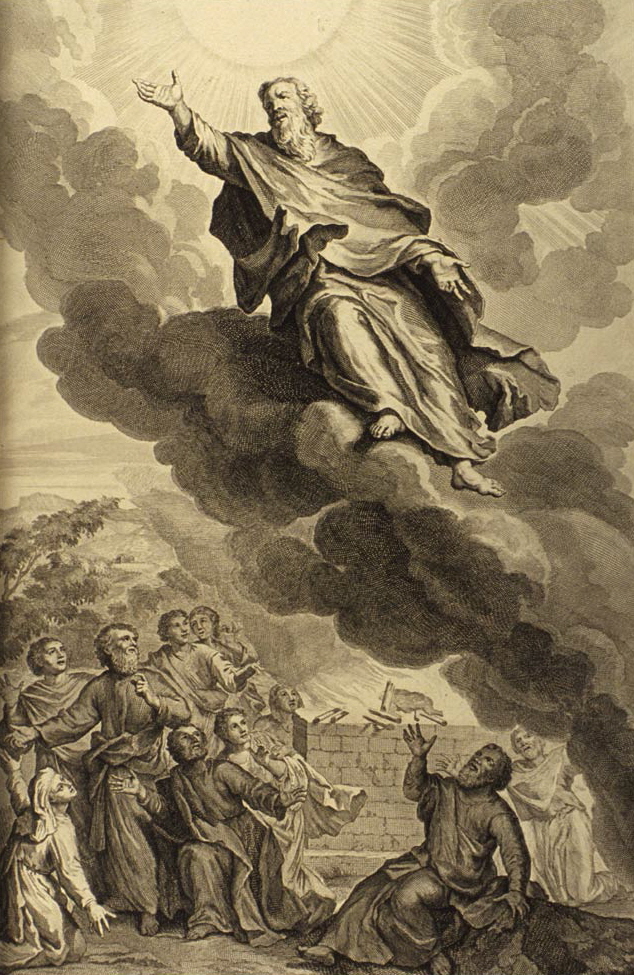
Gerard Hoet (1648-1733 CE), Illustrators of the Figures de la Bible, P. de Hondt, The Hague, 1728 CE. God took Enoch, as in Genesis 5:24: "And Enoch walked with God: and he was not; for God took him." (KJV) illustration from the 1728 Figures de la Bible; illustrated by Gerard Hoet (1648–1733) and others, and published by P. de Hondt in The Hague; image courtesy Bizzell Bible Collection, University of Oklahoma Libraries. This work is in the public domain in its country of origin and other countries and areas where the copyright term is the author's life plus 70 years or less. https://commons.wikimedia.org/wiki/File:Figures_God_took_Enoch.jpg

Gerard Hoet (1648-1733 CE), Illustrators of the Figures de la Bible, P. de Hondt, The Hague, 1728 CE.
God took Enoch, as in Genesis 5:24: “And Enoch walked with God: and he was not; for God took him.” (KJV) illustration from the 1728 Figures de la Bible; illustrated by Gerard Hoet (1648–1733) and others, and published by P. de Hondt in The Hague; image courtesy Bizzell Bible Collection, University of Oklahoma Libraries.
This work is in the public domain in its country of origin and other countries and areas where the copyright term is the author’s life plus 70 years or less.
https://commons.wikimedia.org/wiki/File:Figures_God_took_Enoch.jpg

(Westermann, Genesis, pp. 443-45 suggests that Enoch may refer to the foundation of a city or sanctuary. Westermann writes: “In Israel wurde die Erinnerung daran bewahrt, daß der Städtebau zum dem gehört, was vor und außerhalb der Geschichte Israels geschah. Die Gründung der ersten Stadt gehört der Urgeschichte an” (p. 444).

("In Israel, the memory was preserved because of urban development, 
what happened before and outside of history. 
The founding of the first city belongs to prehistory.")

Discussing Genesis 4:17 most exegetes remark that it seems unlikely that Kain, the tiller, condemmed to a nomadic life, could be renowned as the founder of a city. In an attempt to harmonize the alleged discrepancies, they even assume that the said founder was originally Enoch (cf. e.g. Westermann, Genesis, p. 443).

With the publication of a Seleucid text from Uruk, W 20030,7 the comparison between Berossos, the Old Testament, and the Sumerian King List reached a new level:

Seleucid text, Uruk, W 20030,7.  Excerpt from Selz, Of Heroes and Sages, 2011, p. 793.

Seleucid text, Uruk, W 20030,7. Published by J.J.A. van Dijk, “Die Tontafeln aus dem Resch-Heiligtum,” in Uruk-Wanka Vorberichte 18 (1962): pp. 43-52, from which this transcription is taken. Also on Samizdat, in Lenzi: The Uruk List of Kings and Sages.
Excerpt from Selz, Of Heroes and Sages, 2011, p. 793.

This document establishes an important link between Berossos’ account of the primeval kings and his story of the sage Oannes.

In this text the names of Mesopotamian rulers are accompanied by names of advisors, sages, the so-called apkallū which play an important role in Mesopotamian iconography and have been known, up until now, chiefly from the so-called Etiological Myth of the “Seven Sages” studied by Erica Reiner in 1961.

(E. Reiner, “The Etiological Myth of the ‘Seven Sages,’Orientalia 30 (1961): 1-11; eadem, Astral Magic in Babylonia (Transactions of the American Philosophical Society 85.4; Philadelphia: American Philosophical Society, 1995).

(See further S. Parpola, “Mesopotamian Astrology and Astronomy as Domains of the Mesopotamian ‘Wisdom,’” in Die Rolle der Astronomie in den Kulturen Mesopotamiens: Beiträge zum 3. Grazer Morgenländischen Symposium (ed. H. Galter and B. Scholz; Grazer Morgenländische Studien 3; Graz: RM Druck-und Verlagsgesellschaft, 1993), pp. 23-7.)

This list is certainly fictional, it is, however, based on scholarly traditions: the name of the well-known compiler of the standard version of the Gilgamesh Epic, dsîn-liq-unninnī, functions as an apkallu to Gilgamesh himself.

Further, a certain Kabtu-il-Marduk, perhaps referring to the author of the Erra Epic Kabti-ilāni-Marduk, is mentioned as a sage during the reign of Ibbi-Sîn (ca. 2028-2004 BCE), unlucky last king of the Ur III empire.”

Gebhard J. Selz, “Of Heroes and Sages–Considerations of the Early Mesopotamian Background of Some Enochic Traditions,” in Armin Lange, et alThe Dead Sea Scrolls in Context, v. 2, Brill, 2011, pp. 792-4.
Lenzi: The Mythology of Scribal Succession

“The text of the ULKS is as follows:

“During the reign of Ayalu, the king, Adapa was sage.

During the reign of Alalgar, the king, Uanduga was sage.

During the reign of Ameluana, the king, Enmeduga was sage.

During the reign of Amegalana, the king, Enmegalama was sage.

During the reign of Enmeušumgalana, the king, Enmebuluga was sage.

During the reign of Dumuzi, the shepherd, the king, Anenlilda was sage.

During the reign of Enmeduranki, the king, Utuabzu was sage.

After the flood,(?) during the reign of Enmerkar, the king, Nungalpirigal was sage, whom Ištar brought down from heaven to Eana. He made the bronze lyre, whose . . . (were) lapis lazuli, according to the technique of Ninagal (Ninagal is Ea’s smith). The lyre was placed before Anu . . ., the dwelling of (his) personal god.?

During the reign of Gilgamesh, the king,? Sin-leqi-unnini was scholar.

During the reign of Ibbi-Sin, the king, Kabti-ili-Marduk was scholar.

During the reign of Išbi-Erra, the king, Sidu, a.k.a. Enlil-ibni, was scholar.

During the reign of Abi-ešuh, the king, Gimil-Gula and Taqiš-Gula were the scholars.

During the reign of . . ., the king, Esagil-kin-apli was scholar.

During the reign of Adad-apla-iddina, the king, Esagil-kin-ubba (this name … despite chronological problems, is probably to be identified with Saggil-kina-ubbib, the author of The Babylonian Theodicy; see van Dijk, “Die Inschriftenfunde,” 51) was scholar.

During the reign of Nebuchadnezzar, the king, Esagil-kin-ubba was scholar.

During the reign of Esarhaddon, the king, Aba-Enlil-dari was scholar, whom the Arameans call Ahiqar.

. . . Nikarchos.

Tablet of Anu-belšunu, son of Nidintu-Anu, descendant of Sin-leqi-unnini, the lamentation-priest of Anu and Antu. An Urukean. (Copied) by his own hand. Uruk, 10 Ayyar, 147th year of Antiochus, the king.

The one who reveres Anu will not carry it off.”

Gaining a historical perspective on the scholarly genealogical tradition attested in the text of ULKS is the first element of contextualizing our text. Clearly, the ULKS is unique.

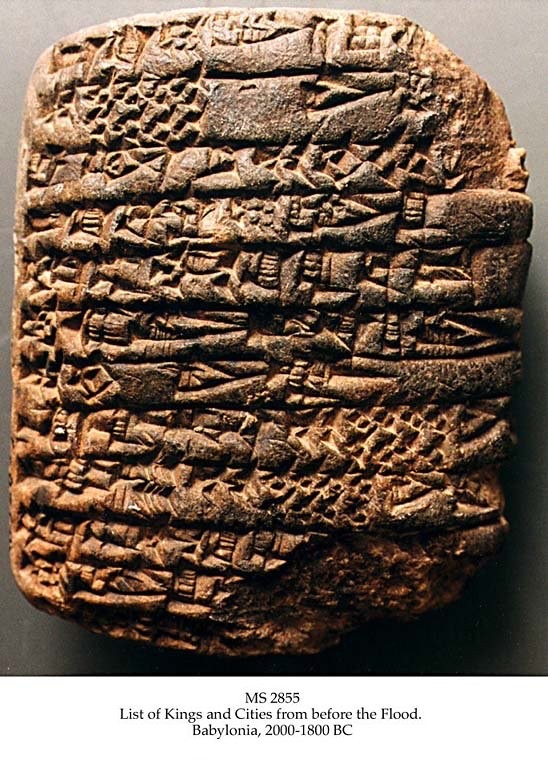
 Text:  "IN ERIDU: ALULIM RULED AS KING 28,800 YEARS. ELALGAR RULED 43,200 YEARS. ERIDU WAS ABANDONED. KINGSHIP WAS TAKEN TO BAD-TIBIRA. AMMILU'ANNA THE KING RULED 36,000 YEARS. ENMEGALANNA RULED 28,800 YEARS. DUMUZI RULED 28,800 YEARS. BAD-TIBIRA WAS ABANDONED. KINGSHIP WAS TAKEN TO LARAK. EN-SIPA-ZI-ANNA RULED 13,800 YEARS. LARAK WAS ABANDONED. KINGSHIP WAS TAKEN TO SIPPAR. MEDURANKI RULED 7,200 YEARS. SIPPAR WAS ABANDONED. KINGSHIP WAS TAKEN TO SHURUPPAK. UBUR-TUTU RULED 36,000 YEARS. TOTAL: 8 KINGS, THEIR YEARS: 222,600" MS in Sumerian on clay, probably Larsa Babylonia, 2000-1800 BC, 1 tablet, 8,1x6,5x2,7 cm, single column, 26 lines in cuneiform script. 5 other copies of the Antediluvian king list are known only: MS 3175, 2 in Oxford: Ashmolean Museum, one is similar to this list, containing 10 kings and 6 cities, the other is a big clay cylinder of the Sumerian King List, on which the kings before the flood form the first section, and has the same 8 kings in the same 5 cities as the present.  A 4th copy is in Berkeley: Museum of the University of California, and is a school tablet. A 5th tablet, a small fragment, is in Istanbul. The list provides the beginnings of Sumerian and the world’s history as the Sumerians knew it. The cities listed were all very old sites, and the names of the kings are names of old types within Sumerian name-giving. Thus it is possible that correct traditions are contained, though the sequence given need not be correct. The city dynasties may have overlapped. It is generally held that the Antediluvian king list is reflected in Genesis 5, which lists the 10 patriarchs from Adam to Noah, all living from 365 years (Enoch) to 969 years (Methuselah), altogether 8,575 years.  It is possible that the 222,600 years of the king list reflects a more realistic understanding of the huge span of time from Creation to the Flood, and the lengths of the dynasties involved.  The first of the 5 cities mentioned , Eridu, is Uruk, in the area where the myths place the Garden of Eden, while the last city, Shuruppak, is the city of Ziusudra, the Sumerian Noah. Jöran Friberg: A remarkable Collection of Babylonian Mathematical Texts. Springer 2007.  Sources and Studies in the History of Mathematics and Physical Sciences.  Manuscripts in the Schøyen Collection, vol. 6, Cuneiform Texts I. pp. 237-241. Andrew George, ed.: Cuneiform Royal Inscriptions and Related Texts in the Schøyen Collection, Cornell University Studies in Assyriology and Sumerology, vol. 17,  Manuscripts in the Schøyen Collection, Cuneiform texts VI. CDL Press, Bethesda, MD, 2011, text 96, pp. 199-200, pls. LXXVIII-LXXIX. Andrew E. Hill & John H. Walton: A survey of the Old Testament, 3rd ed., Grand Rapids, Mi., Zondervan Publ. House, 2009, p. 206.  Zondervan Illustrated Bible, Backgrounds, Commentary. John H. Walton, gen. ed. Grand Rapids, Mich., Zondervan, 2009, vol 1, p. 482, vol. 5, p. 398. Babylonia 2000 - 1800 BC

MS 2855
Text:
“IN ERIDU: ALULIM RULED AS KING 28,800 YEARS. ELALGAR RULED 43,200 YEARS. ERIDU WAS ABANDONED. KINGSHIP WAS TAKEN TO BAD-TIBIRA. AMMILU’ANNA THE KING RULED 36,000 YEARS. ENMEGALANNA RULED 28,800 YEARS. DUMUZI RULED 28,800 YEARS. BAD-TIBIRA WAS ABANDONED. KINGSHIP WAS TAKEN TO LARAK. EN-SIPA-ZI-ANNA RULED 13,800 YEARS. LARAK WAS ABANDONED. KINGSHIP WAS TAKEN TO SIPPAR. MEDURANKI RULED 7,200 YEARS. SIPPAR WAS ABANDONED. KINGSHIP WAS TAKEN TO SHURUPPAK. UBUR-TUTU RULED 36,000 YEARS. TOTAL: 8 KINGS, THEIR YEARS: 222,600”
MS in Sumerian on clay, probably Larsa Babylonia, 2000-1800 BC, 1 tablet, 8,1×6,5×2,7 cm, single column, 26 lines in cuneiform script.
5 other copies of the Antediluvian king list are known only: MS 3175, 2 in Oxford: Ashmolean Museum, one is similar to this list, containing 10 kings and 6 cities, the other is a big clay cylinder of the Sumerian King List, on which the kings before the flood form the first section, and has the same 8 kings in the same 5 cities as the present.
A 4th copy is in Berkeley: Museum of the University of California, and is a school tablet. A 5th tablet, a small fragment, is in Istanbul.
The list provides the beginnings of Sumerian and the world’s history as the Sumerians knew it. The cities listed were all very old sites, and the names of the kings are names of old types within Sumerian name-giving. Thus it is possible that correct traditions are contained, though the sequence given need not be correct. The city dynasties may have overlapped.
It is generally held that the Antediluvian king list is reflected in Genesis 5, which lists the 10 patriarchs from Adam to Noah, all living from 365 years (Enoch) to 969 years (Methuselah), altogether 8,575 years.
It is possible that the 222,600 years of the king list reflects a more realistic understanding of the huge span of time from Creation to the Flood, and the lengths of the dynasties involved.
The first of the 5 cities mentioned, Eridu, is Uruk, in the area where the myths place the Garden of Eden, while the last city, Shuruppak, is the city of Ziusudra, the Sumerian Noah.
Jöran Friberg: A Remarkable Collection of Babylonian Mathematical Texts. Springer 2007.
Sources and Studies in the History of Mathematics and Physical Sciences.
Manuscripts in the Schøyen Collection, vol. 6, Cuneiform Texts I. pp. 237-241. Andrew George, ed.: Cuneiform Royal Inscriptions and Related Texts in the Schøyen Collection, Cornell University Studies in Assyriology and Sumerology, vol. 17,
Manuscripts in the Schøyen Collection, Cuneiform texts VI. CDL Press, Bethesda, MD, 2011, text 96, pp. 199-200, pls. LXXVIII-LXXIX.
Andrew E. Hill & John H. Walton: A Survey of the Old Testament, 3rd ed., Grand Rapids, MI., Zondervan Publ. House, 2009, p. 206.
Zondervan Illustrated Bible, Backgrounds, Commentary. John H. Walton, gen. ed. Grand Rapids, MI., Zondervan, 2009, vol 1, p. 482, vol. 5, p. 398.
Babylonia
2000 – 1800 BC
http://www.schoyencollection.com/history-collection-introduction/sumerian-history-collection/king-cities-before-flood-ms-2855

It lists seven well-known antediluvian kings, each paired with his corresponding apkallū-sage, then a single post-diluvian king-apkallū pair, followed by eight post-diluvian kings, each with his corresponding ummânu-scholar (in one case, two scholars).

The list is arranged from start to finish in what one must recognize as an attempt at chronological order. Focusing on the ummânū, the implication of the text is rather clear: the human, post-diluvian scholars are the direct professional descendants of the earlier semi-divine apkallū.

In a previous study I called this traditional genealogical relationship the “mythology of scribal succession.”

Alan Lenzi, The Uruk List of Kings and Sages and Late Mesopotamian ScholarshipJANER 8.2, Brill, Leiden, 2008. pp. 140-3.