
Samizdat

Publishing the Forbidden. All Rights Reserved. © Samizdat 2014-2025.

Tag: Gomer

Eco: The Nationalistic Hypothesis, 4
kircher_058

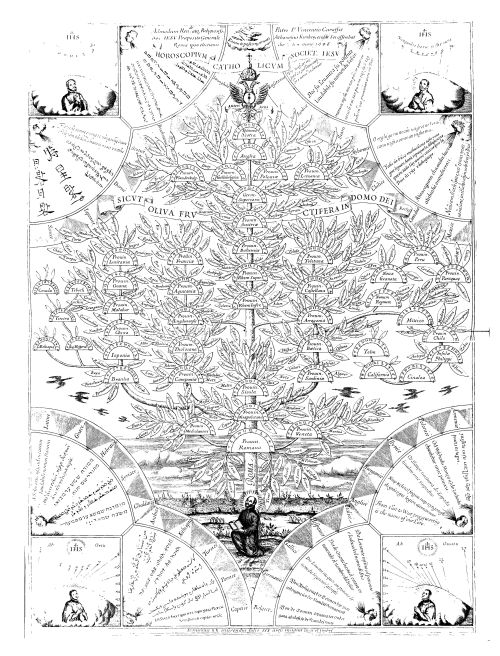
Athanasius Kircher (1602-80), Universal horoscope of the Society of Jesus, or the Jesuits. Comprising an olive tree as a sundial, the time in each Jesuit province can be read. From Ars Magna Lucis et Umbrae, 1646, p. 553, courtesy of Herzog August Bibliothek, and Stanford University. This work is in the public domain in its country of origin and other countries and areas where the copyright term is the author’s life plus 100 years or less.

“In the British context, the Celtic hypothesis had naturally quite a different meaning; it meant, for one thing, an opposition to the theory of a Germanic origin.

In the eighteenth century the thesis of Celtic primacy was supported by Rowland Jones, who argued “no other language, not even English, shows itself to be so close to the first universal language, and to its natural precision and correspondence between words and things, in the form and in the way in which we have presented it as universal language.”

The English language is

“the mother of all the western dialects and the Greek, elder sister of all orientals, and in its concrete form, the living language of the Atlantics and of the aborigines of Italy, Gaul and Britain, which furnished the Romans with much of their vocables . . . The Celtic dialects and knowledge derived their origin from the circles of Trismegistus, Hermes, Mercury or Gomer . . . [and] the English language happens more peculiarly to retain its derivation from that purest fountain of languages (“Remarks on the Circles of Gomer,” The Circles of Gomer, 1771: II, 31-2).”

Etymological proofs follow.

Such nationalistic hypotheses are comprehensible in the seventeenth and eighteenth centuries, when the larger European states began to take form, posing the problem of which of them was to be supreme on the continent.

In this period, spirited claims to originality and superiority arise no longer from the visionary quest for universal peace, but–whether their authors realized this or not–from concrete reasons of state.

In whatever case, and whatever their nationalist motivations, as a result of what Hegel calls the astuteness of reason, the furious search for etymologies, which was supposed to prove the common descent of every living language, eventually ended by creating the conditions in which serious work in comparative linguistics might become more profitable.

As this work expanded, the phantom of an original mother tongue receded more and more into the background, remaining, at most, a mere regulative hypothesis. To compensate for the loss, there arose a new and pressing need to establish a typology of fundamental linguistic stocks.

Thus, in this radically altered perspective, the search for the original mother tongue transformed itself into a general search for the origins of a given language.

The need to document the existence of the primeval language had resulted in theoretical advances such as the identification and delimitation of important linguistic families (Semitic and Germanic), the elaboration of a model of linguistic descent with the inheritance of common linguistic traits, and, finally, the emergence of an embryonic comparative method typified in some synoptic dictionaries. (Simone 1990: 331).”

Umberto Eco, The Search for the Perfect Language, translated by James Fentress, Blackwell. Oxford, 1995, pp. 102-3.
Eco: Postel’s Universalistic Utopia

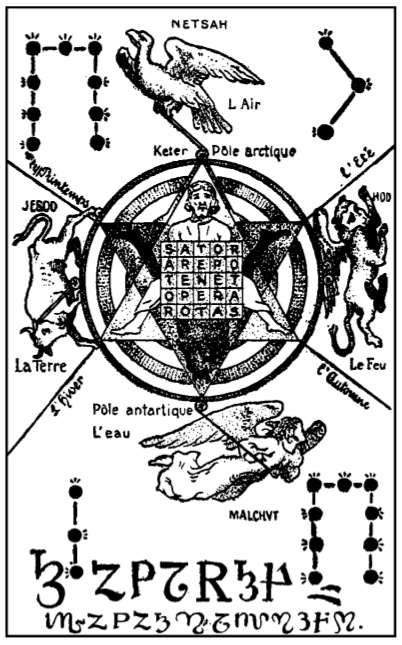
Guillaume Postel, The Great Key, Eliphas Levi, The Key of the Great Mysteries, 1861

Guillaume Postel (1510-81), The Great Key, in Eliphas Levi (1810-75), La Clef des Grands MystèresThe Key of the Great Mysteries, 1861.

“A special place in the story of the renewal of Hebrew studies belongs to the French utopian thinker and érudit, Guillaume Postel (1510-81). Councillor to the kings of France, close to the major religious, political and scientific personalities of his epoch, Postel returned from a series of diplomatic missions to the Orient, voyages which enabled him to study Arabic and Hebrew as well as to learn of the wisdom of the kabbala, a changed and marked man.

Already renowned as a Greek philologist, around 1539, Postel was appointed to the post of “mathematicorum et peregrinarum linguarum regius interpretes” in that Collège des Trois Langues which eventually became the Collège de France.

In his De originibus seu de Hebraicae linguae et gentis antiquitate (1538), Postel argued that Hebrew came directly from the sons of Noah, and that, from it, Arabic, Chaldean, Hindi and, indirectly, Greek had all descended as well.

In Linguarum duodecem characteribus differentium alphabetum, introductio (1538), by studying twelve different alphabets he proved the common derivation of every language. From here, he went on to advance the project of a return to Hebrew as the instrument for the peaceable fusion of the peoples of differing races.

To support his argument that Hebrew was the proto-language, Postel developed the criterion of divine economy. As there was but one human race, one world and one God, there could be but one language; this was a “sacred language, divinely inspired into the first man” (De Foenicum litteris, 1550).

God had educated Adam by breathing into him the capacity to call things by their appropriate names (De originibus, seu, de varia et potissimum orbit Latino ad hanc diem incognita aut inconsyderata historia, 1553).

Although Postel does not seem to have thought either of an innate faculty for languages or of a universal grammar, as Dante had done, there still appears in many of his writings the notion of an Averroist active intellect as the repository of the forms common to all humanity, in which the roots of our linguistic faculty must be sought (Les très merveilleuses victoires des femmes du nouveau monde together with La doctrine du siècle doré, both from 1553).

Postel’s linguistic studies were connected to his particular vision of a religious utopia: he foresaw the reign of universal peace.

In his De orbis terrae concordia (1544:I) he clearly states that his studies in language would help to lay the foundations upon which a universal concord could be created. He envisioned the creation of a linguistic commonwealth that would serve as living proof to those of other faiths that not only was the message of Christianity true, but equally it verified their own religious beliefs: there are some principles of a natural religion, or sets of innate ideas held by all peoples (De orbis, III).

Here was the spirit that had inspired Lull and Nicholas of Cusa. Yet Postel was convinced that universal peace could only be realized under the protection of the king of France: among the world’s rulers the king of France alone held a legitimate claim to the title of king of the world.

He was the direct descendent of Noah, through Gomer, son of Japheth, founder of the Gallic and Celtic races (cf. particularly Les raisons de la monarchie, c. 1551). Postel (Trésor des propheties de l’univers, 1556) supported this contention with a traditional etymology (see, for example, Jean Lemaire de Belges, Illustration de Gaule et singularitez de Troye, 1512-3, fol. 64r): in Hebrew, the term gallus meant “he who overcame the waves;” thus the Gauls were the people who had survived the waters of the Flood (cf. Stephens 1989:4).

Postel first attempted to convert Francis I to his cause. The king, however, judged him a fanatic, and he lost favor at court. He went to Rome, hoping to win over to his utopian schemes Ignatius of Loyola, whose reformist ideals seemed kindred to his own.

It did not take Ignatius long, however, to realize that Postel’s ambitions were not identical to those of the Jesuits. Accepting Postel’s project might have placed their vow of obedience to the pope at risk.

Besides, Ignatius was a Spaniard, and the idea of turning the king of France into the king of the world would hardly have appealed to him. Although Postel continued long afterwards to look upon the Jesuits as the divine instrument for the creation of universal peace, he himself was forced to leave the company after a mere year and a half.”

Umberto Eco, The Search for the Perfect Language, translated by James Fentress, Blackwell. Oxford, 1995, pp. 75-7.