
Eco: First Attempts at a Content Organization
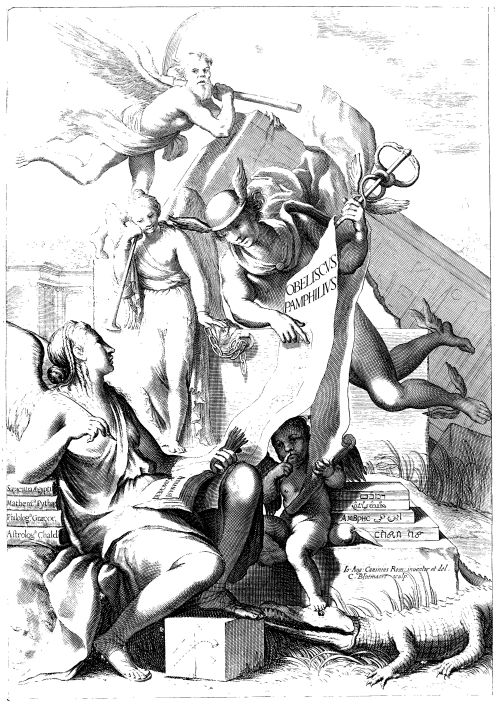
Athanasius Kircher (1602-80), Frontispiece of Obeliscus Pamphilius, Obeliscus Pamphilius: Hoc est Interpretatio nova & hucusque intenta obelisci Hieroglyphici, eBook courtesy of GoogleBooks, published by Lud. Grignani 1650, held by Ghent University. This work is in the public domain in its country of origin and other countries and areas where the copyright term is the author’s life plus 100 years or less.
“Probably in 1660, three years before the publication of the Polygraphia, Kircher wrote a manuscript bearing the title Novum hoc inventum quo omnia mundi idiomata ad unum reducuntur (Mss. Chigiani I, vi, 225, Biblioteca Apostolica Vaticana; cf. Marrone 1986).
Schott says that Kircher kept his system a secret at the express wish of the emperor, who had requested that his polygraphy be reserved for his exclusive use alone.
The Novum inventum was still tentative and incomplete; it contained an extremely elementary grammar plus a lexicon of 1,620 words. However, the project looks more interesting that the later one because it provides a list of 54 fundamental categories, each represented by an icon.
These icons are reminiscent of those that one might find today in airports and railway stations: some were schematically representative (like a small chalice for drinking); others were strictly geometrical (rectangles, triangles, circles).
Some were furthermore superficially derived from Egyptian hieroglyphics. They were functionally equivalent to the Roman numbers in the Polygraphia (in both texts, Arabic numbers referred to particular items).
Thus, for example, the square representing the four elements plus the numeral 4 meant water as an element; water as something to drink was instead expressed by a chalice (meaning the class of drinkable things) followed by the numeral 3.
There are two interesting features in this project. The first is that Kircher tried to merge a polygraphy with a sort of hieroglyphical lexicon, so that his language could be used (at least in the author’s intention) without translating it into a natural language.
Seeing a “square + 4,” the readers should immediately understand that the named thing is an element, and seeing “chalice + 3” they should understand that one is referring to something to drink.
The difficulty was due to the fact that, while both Kircher’s Polygraphia and Becher’s Character allow a translating operator (be it a human being or a machine) to work independently of any knowledge of the meaning of the linguistic items, the Novum inventum requires a non-mechanical and quasi-philosophical knowledge: in order to encode the word aqua as “square + 4,” one should previously know that it is the name of an element–information that the term of a natural language does not provide.
Sir Thomas Urquhart, who published two volumes describing a sort of polygraphy (Ekskubalauron, 1652, and Logopandecteision, 1653), noted that, arbitrary as the order of the alphabet might be, it was still easier to look things up in alphabetical order than in a categorical order.
The second interesting feature of Kircher’s initial project is certainly given by the effort to make the fundamental concepts independent of any existing natural language.
Its weakness is due to the fact that the list of the 54 categories was notably incongruous: it included divine entities, angelic and heavenly, elements, human beings, animals, vegetables, minerals, the dignities and other abstract concepts deriving from the Lullian Ars, things to drink, clothes, weights, numbers, hours, cities, food, family, actions such as seeing or giving, adjectives, adverbs, months of the year.
It was perhaps the lack of internal coherency in this system of concepts that induced Kircher to abandon this line of research, and devote himself to the more modest and mechanical method used in the Polygraphia.
Kircher’s incongruous classification had a precedent. Although he regarded Kircher as the pioneer in the art of polygraphy, in his Technica curiosa (as well as in his Jocoseriorum naturae et artiis sive magiae naturalis centuriae tres) Gaspar Schott gave an extended description of a 1653 project that was certainly earlier than Kircher’s (the Novum inventum is dedicated to Pope Alexander VII, who ascended the pontifical throne only in 1655).
The project was due to another Jesuit, a Spaniard (“whose name I have forgotten,” as Schott says on p. 483), who had presented in Rome (on a single folio) an Artificium, or an Arithmeticus nomenclator, mundi omnes nationes ad linguarum et sermonis unitatem invitans (“Artificial Glossary, inviting all the nations of the world to unity of languages and speech”).
Schott says that the anonymous author wrote a pasigraphy because he was a mute. As a matter of fact the subtitle of the Artificium also reads Authore linguae (quod mirere) Hispano quodam, vere, ut dicitur, muto (“The author of this language–a marvelous thing–being a Spaniard, truly, it is said, dumb”).
According to Ceñal (1946) the author was a certain Pedro Bermudo, and the subtitle of the manuscript would represent a word play since, in Castilian, “Bermudo” must be pronounced almost as Ver-mudo.
It is difficult to judge how reliable the accounts of Schott are; when he described Becher’s system, he improved it, adding details that he derived from the works of Kircher. Be that as it may, Schott described the Artificium as having divided the lexicon of the various languages into 44 fundamental classes, each of which contained between 20 and 30 numbered items.
Here too a Roman number referred to the class and an Arabic number referred to the item itself. Schott noted that the system provided for the use of signs other than numbers, but gave his opinion that numbers comprised the most convenient method of reference since anyone from any nation could easily learn their use.
The Artificium envisioned a system of designating endings, (marking number, tense or case) as complex as that of Becher. An Arabic number followed by an acute accent was the sign of the plural; followed by a grave accent, it became the nota possessionis.
Numbers with a dot above signified verbs in the present; numbers followed by a dot signified the genitive. In order to distinguish between vocative and dative, it was necessary to count, in one case, five, and, in the other, six, dots trailing after the number.
Crocodile was written “XVI.2” (class of animals + crocodile), but should one have occasion to address an assembly of crocodiles (“O Crocodiles!”), it would be necessary to write (and then read) “XVI.2′ . . . . . ‘.
It was almost impossible not to muddle the points behind one word with the points in front of another, or with full stops, or with the various other orthographic conventions that the system established.
In short, it was just as impracticable as all of the others. Still, what is interesting about it is the list of 44 classes. It is worth listing them all, giving, in parenthesis, only some examples of the elements each contained.
- Elements (fire, wind, smoke, ashes, Hell, Purgatory, centre of the earth).
- Celestial entities (stars, lightning, bolts, rainbows . . .).
- Intellectual entities (God, jesus, discourse, opinion, suspicion, soul, stratagems, or ghosts).
- Secular statuses (emperor, barons, plebs).
- Ecclesiastical states.
- Artificers (painters, sailors).
- Instruments.
- Affections (love, justice, lechery).
- Religion.
- Sacramental confession.
- Tribunal.
- Army.
- Medicine (doctor, hunger, enema).
- Brute animals.
- Birds.
- Fish and reptiles.
- Parts of animals.
- Furnishings.
- Foodstuffs.
- Beverages and liquids (wine, beer, water, butter, wax, and resin).
- Clothes.
- Silken fabrics.
- Wool.
- Homespun and other spun goods.
- Nautical and aromas (ship, cinnamon, anchor, chocolate).
- Metal and coin.
- Various artifacts.
- Stone.
- Jewels.
- Trees and fruits.
- Public places.
- Weights and measures.
- Numerals.
- Time.
- Nouns.
- Adjectives.
- Verbs.
- Undesignated grammatical category.
- Undesignated grammatical category.
- Undesignated grammatical category.
- Undesignated grammatical category.
- Undesignated grammatical category.
- Persons (pronouns and appellations such as Most Eminent Cardinal).
- Vehicular (hay, road, footpad).
The young Leibniz would criticize the absurdity of arrangements such as this in his Dissertatio de arte combinatoria, 1666.
This sort of incongruity will affect as a secret flaw even the projects of a philosophically more sophisticated nature–such as the a priori philosophic languages we will look at in the next chapter.
This did not escape Jorge Luis Borges. Reading Wilkins, at second hand as he admits (in Other Inquisitions, “The analytical idiom of John Wilkins“), he was instantly struck by the lack of a logical order in the categorical divisions (he discusses explicitly the subdivisions of stones), and this inspired his invention of the Chinese classification which Foucault posed at the head of his The Order of Things.
In this imaginary Chinese encyclopedia bearing the title Celestial Emporium of Benevolent Recognition, “animals are divided into: (a) belonging to the emperor, (b) embalmed, (c) tame, (d) sucking pigs, (e) sirens (f) fabulous, (g) stray dogs. (h) included in the present classification, (i) frenzied, (j) innumerable, (k) drawn with a very fine camelhair brush, (l) et cetera, (m) having just broken the water pitcher, (n) that from a long way off look like flies.”).
Borge’s conclusion was that there is no classification of the universe that is not arbitrary and conjectural. At the end of our panorama of philosophical languages, we shall see that, in the end, even Leibniz was forced to acknowledge this bitter conclusion.”
Umberto Eco, The Search for the Perfect Language, translated by James Fentress, Blackwell. Oxford, 1995, pp. 203-8.
 Samizdat