
Samizdat

Publishing the Forbidden. All Rights Reserved. © Samizdat 2014-2025.

Tag: Fano

Eco: New Prospects for the Monogenetic Hypothesis

kircher_021

Athanasius Kircher (1602-80), frontispiece to Magnes sive De Arte Magnetica, 1641 and 1643 editions, digitized by the University of Lausanne and Stanford University. This work is in the public domain in its country of origin and other countries and areas where the copyright term is the author’s life plus 100 years or less.

“Doubting the possibility of obtaining scientific agreement upon an argument whose evidence had been lost in the mists of time, about which nothing but conjectures might be offered, the Société de Linguistique of Paris 1866 decided that it would no longer accept scientific communications on the subject of either universal languages or origins of language.

In our century that millenary debate took the form of research on the universals of language, now based on the comparative analysis of existing languages. Such a study has nothing to do with more or less fantastic historic reconstructions and does not subscribe to the utopian ideal of a perfect language (cf. Greenberg 1963; Steiner 1975: I, 3).

However, comparatively recent times have witnessed a renewal of the search for the origins of language (cf., for example, Fano 1962; Hewes 1975, 1979).

Even the search for the mother tongue has been revived in this century by Vitalij Ševorškin (1989), who has re-proposed the Nostratic hypothesis, originally advanced in Soviet scientific circles in the 1960s, and associated with the names of Vladislav Il’ič-Svitych and Aron Dolgoposkiji.

According to this hypothesis, there was a proto-Indo-European, one of the six branches of a larger linguistic family deriving from Nostratics–which in its turn derives from a proto-Nostratics, spoken approximately ten thousand years ago. The supporters of this theory have compiled a dictionary of several hundred terms of this language.

But the proto-Nostratics itself would derive from a more ancient mother tongue, spoken perhaps fifty thousand years ago in Africa, spreading from there throughout the entire globe (cf. Wright 1991).

According to the so-called “Eve’s hypothesis,” one can thus imagine a human couple, born in Africa, who later emigrated to the Near East, and whose descendants spread throughout Eurasia, and possibly America and Australia as well (Ivanov 1992:2). To reconstruct an original language for which we lack any written evidence, we must proceed like

“molecular biologists in their quest to understand the evolution of life. The biochemist identifies molecular elements that perform similar functions in widely divergent species, to infer the characteristics of the primordial cell from which they are presumed to have descended.

So does the linguist seek correspondences in grammar, syntax, vocabulary, and vocalization among known languages in order to reconstruct their immediate forebears and ultimately the original tongue. (Gamkrelidze and Ivanov 1990: 110).”

Cavalli-Sforza’s work on genetics (cf., for example, 1988, 1991) tends to show that linguistic affinities reflect genetic affinities. This supports the hypothesis of a single origin of all languages, reflecting the common evolutionary origin of all human groups.

Just as humanity evolved only once on the face of the earth, and later diffused across the whole planet, so language. Biological monogenesis and linguistic monogenesis thus go hand in hand and may be inferentially reconstructed on the basis of mutually comparable data.

In a different conceptual framework, the assumption that both the genetic and the immunological codes can, in some sense, be analyzed semiotically seems to constitute the new scientific attempt to find a language which could be defined as the primitive one par excellence (though not in historical but rather in biological terms).

This language would nest in the roots of evolution itself, of phylogenesis as of onto-genesis, stretching back to before the dawn of humanity (cf. Prodi 1977).”

Umberto Eco, The Search for the Perfect Language, translated by James Fentress, Blackwell. Oxford, 1995, pp. 115-6.
Eco: The Pre-Hebraic Language

kircher_099

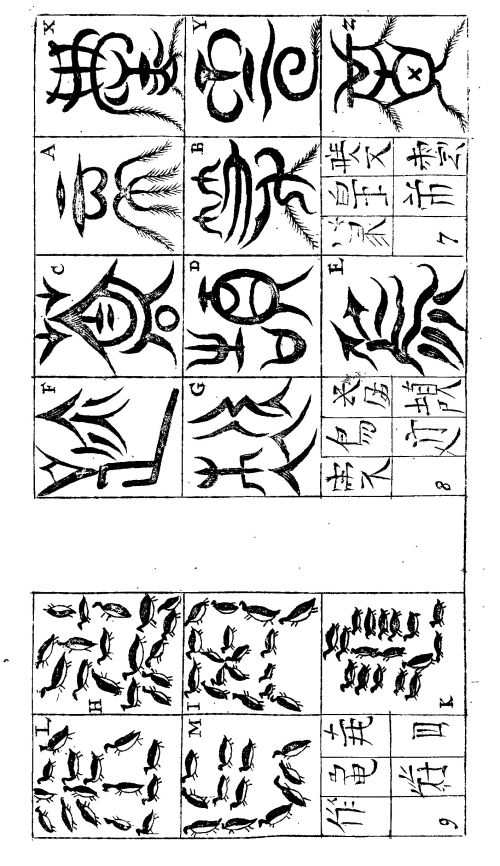
Athanasius Kircher (1602-80), Origins of the Chinese Characters, China Illustrata, or China monumentis, qua sacris qua profanis, nec non variis naturae & artis spectaculis, aliarumque rerum memorabilium argumentis illustrata (1667), p. 229. Courtesy of Stanford University. This work is in the public domain in its country of origin and other countries and areas where the copyright term is the author’s life plus 100 years or less. 

“Alongside these philosophical discussions, other inspired glottogonists (for whom the defeat of the Hebraic hypothesis was a consummated fact) were breaking new theoretical ground.

The explorers and missionaries of the sixteenth and seventeenth centuries had discovered civilizations, older than the Hebrews, which had their own cultural and linguistic traditions.

In 1699, John Webb (An Historical Essay endeavoring the Probability that the Language of the Empire of China is the Primitive Language) advanced the idea that, after the Flood, Noah had landed his Ark and gone to live in China.

Consequently, it was the Chinese language which held primacy. Furthermore, since the Chinese had not participated in the construction of the Tower of Babel, their language had remained immune from the effects of the confusio; Chinese had survived intact for centuries, protected from foreign invasion. Chinese thus conserved the original linguistic patrimony.

Ours is a story that proceeds through many strange anachronisms. Near the end of the eighteenth century, just at the moment when, quite unconnected with any form of the monogenetic hypothesis, a comparative methodology was about to emerge, there appeared the most gigantic attempt to date to rediscover the primitive language.

In 1765, Charles de Brosses wrote a Traité de la formation méchanique des langues. The treatise propounded a theory of language that was both naturalistic (the articulation of terms reflects the nature of things–sweet sounds designate sweet objects) and materialistic (language is reduced to physical operations, supernatural entities are seen as the result of linguistic play: cf. Droixhe 1978).

As part of this theory, however, de Brosses could not resist indulging in a series of speculations about the nature of the primitive language, “organic, physical, and necessary, that not one of the world’s peoples either knows or practices in its simplicity, but which, none the less, was spoken by all men, and constitutes the basis of language in every land” (“Discours préliminaire,” xiv-xv).

“The linguist must analyze the mechanisms of different languages, discovering which of those features arise through natural necessity. From this he may, moving through a chain of natural inferences, work his way back from each of the known languages to the original, unknown matrix.

It is only a matter of locating a small set of primitive roots that might yield a universal nomenclature for all languages, European and oriental.

Radically Cratylian and mimologist as it was (cf. Ginette 1976: 85-118), the comparative approach of de Brosses took the vowels to constitute the raw material in a continuum of sound upon which the consonants acted to sculpt out the intonations and the caesurae.

Their effect, often more visible to the eye than to the ear (remember the persistent failure to distinguish between sounds and letters), is to render consonantal identity the key criterion of comparative analysis.

Like Vico, de Brosses considered that the invention of articulated sounds had proceeded in step with the invention of writing. Fano (1962: 231; English tr., p. 147) sums up his theory very well:

“De Brosses imagines this process as follows: like the good school teacher who takes chalk in hand to make his lesson clearer from a didactic viewpoint, the cave man intermingled his discourses with little explicative figures.

If, for example, he wanted to say “a raven flew away and rested on the top of a tree,” he would first imitate the croaking of the bird, then he would express the flight with a “frrr! frrr!” and eventually take a piece of coal and draw a tree with a raven on top.”

Another Herculean effort in the cause of mimological hypothesis was that of Antoine Court de Gébelin, who, between 1773 and 1782, published nine quarto volumes, totaling over five thousand pages, giving to this opus–multiple, creaking, though not utterly devoid of interest–the title Le monde primitif analysé et comparé avec le monde moderne (cf. Genette 1976: 119-48).

Court de Gébelin knew the results of previous comparativist research. He also knew that the human linguistic faculty was exercised through a specific phonatory apparatus; and he was acquainted with its anatomy and physiology.

He followed, moreover, the doctrines of the Physiocrats, and when he sought to explain the origin of language, he did so through a re-reading of ancient myths, interpreting them as allegories describing the relation of man the farmer to the land (vol. I).

Writing, too, was susceptible to this sort of explanation. Although it was born before the separation of peoples, writing could be interpreted as having evolved in the time of the agrarian states, which needed to develop an instrument that would keep track of landed property and foster commerce and law (vol. III, p. xi) . . .

Yet there still shines Court de Gébelin‘s dream of uncovering the original language of the primitive world, the language which served as the origin and basis of a universal grammar through which all existing languages might be explained.

In the preliminary discourse to volume III, dedicated to the natural history of speech or the origins of language, Court de Gébelin affirmed that words were not born by chance: “each word has its own rationale deriving from Nature” (p. ix). He developed a strongly mimological theory of language accompanied by an ideographic theory of writing, according to which the alphabet itself is nothing but the primitive hieroglyphic script reduced to a small set of radical characters or “keys” (III, xii).

As a faculty based upon a determined anatomical structure, language might certainly be considered as God’s gift, but the elaboration of a primitive tongue was a human endeavor. It followed that when God spoke first to human beings, he had to use a language that they could understand, because it was a product of their own (III, 69).

To uncover this primitive language, Court de Gébelin undertook an impressive etymological analysis of Greek, Latin and French. Nor did he neglect coats of arms, coins, games, the voyages of the Phoenicians around the world, American Indian languages, medallions, and civil and religious history as manifested in calendars and almanacs.

As a basis for this original language he set out to reconstruct a universal grammar, founded on necessary principles, valid in all times and in all places, so that the moment that one of these principles was discovered lying immanent in any one language it could be projected into all the others.

Court de Gébelin seems, in the end, to have wanted too much. He wanted a universal grammar; he wanted the mother tongue; he wanted the biological and social origins of language.

He ended up, as Yaguello observes (1984: 19), by muddling them all together in a confused mass. To top it all off, he fell victim in the end to the siren call of the Celto-nationalist hypothesis which I shall be describing in the next section.

Celtic (being similar to oriental languages from which it originated) was the tongue of Europe’s first inhabitants. From Celtic had derived Greek, Latin, Etruscan, Thracian, German, the Cantabrian of the ancient Spaniards, and the Runic of the Norsemen (vol. V).”

Umberto Eco, The Search for the Perfect Language, translated by James Fentress, Blackwell. Oxford, 1995, pp. 91-5.