
Samizdat

Publishing the Forbidden. All Rights Reserved. © Samizdat 2014-2026.

Tag: Esar Haddon

The Power and Magic of Names

“The voices heard by the Babylonian in nature, however, were not a whit more sacred to him than the inarticulate voice which found expression in the name. Like all primitive peoples, the Chaldeans confounded the person and the name by which he was known.

The name, in fact, was the personality, and whatever happened to the name would happen equally to the personality. Injury could be done to a person by using his name in a spell; and, similarly, to pronounce the name of a deity compelled him to attend to the wishes of the priest or exorcist.

As among the ancient Egyptians, the secret names of the gods–many of them heirlooms from a primeval age, whose actual meaning was forgotten–were not only especially holy, but also especially efficacious.

Names, consequently, like the persons or things they represented, were in themselves of good and evil omen; and the Babylonian would have sympathised with the feeling which made the Roman change Maleventum into Beneventum, or has caused the Cape of Storms to become the Cape of Good Hope.

Whether this superstition about names was of purely Semitic origin, or whether it was shared in by the Accadians, we have no means of determining at present; the analogy of other races, however, in a corresponding stage of social development would lead us to infer that the superstition was the independent possession of Accadians and Semites alike.

At all events, it was deeply imprinted upon the Semitic mind. The sacredness attached to the name of the God of Israel among the later Jews, and the frequent employment of the name for the person of the Lord, bear witness to the fact.

When Moses was ordained to his mission of leading his people out of Egypt and forming them into a nation, it was prefaced by what was henceforth to be the sacred and national name of their God.

There were names of good fortune and names of evil fortune, and special significance was attached to a change of name.

Three successive usurpers of the throne of Assyria–Pul, Ululâ or Ilulaios, and the father of Sennacherib–all discarded their old names on the successful accomplishment of their usurpation.
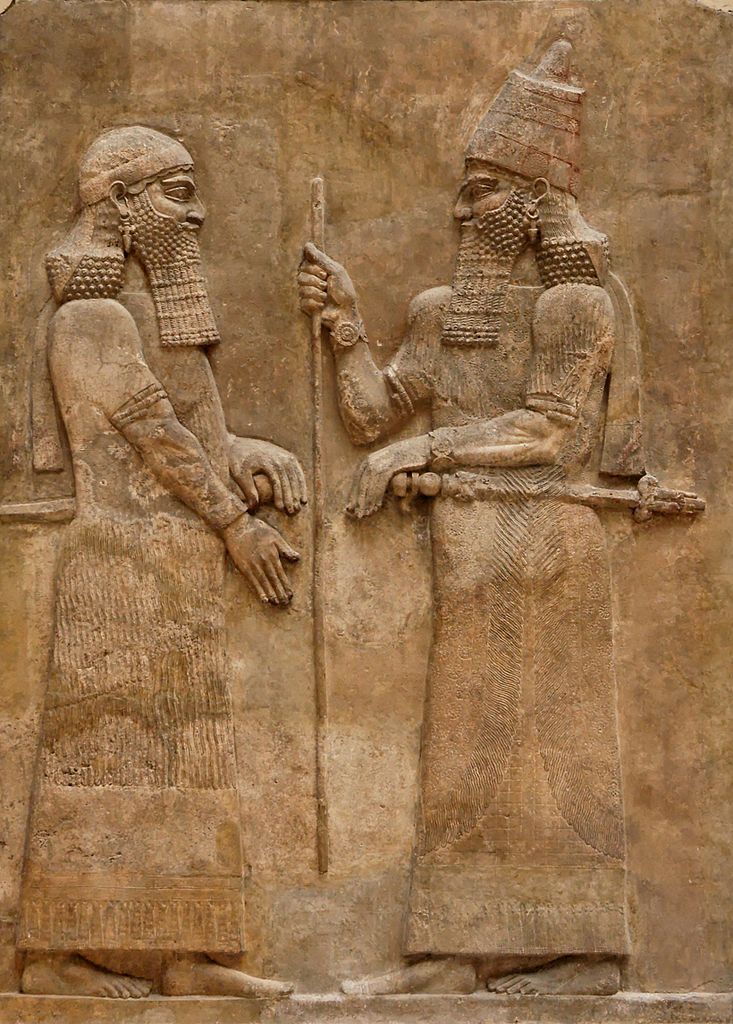
Sargon II and dignitary, said to be his marshal Tartan. Low-relief from the L wall of the palace of Sargon II at Dur Sharrukin in Assyria (now Khorsabad in Iraq), c. 716–713 BC. Fouilles de Paul-Émile Botta en 1843–1844. DimensionsH. 3.30 m (10 ft. 9 ¾ in.), W. 2.30 m (7 ft. 6 ½ in.), D. 33 cm (12 ¾ in.) Current location	 (Inventory) Louvre Museum  Department of Oriental Antiquities, Richelieu wing, ground floor, room 4 Accession number	AO 19873 & AO 19874 Credit line	Excavations of Paul-Émile Botta, 1843–1844 Source/Photographer	Jastrow (2006) http://commons.wikimedia.org/wiki/File:Sargon_II_and_dignitary.jpg

Sargon II and dignitary, said to be his marshal Tartan. Low-relief from the L wall of the palace of Sargon II at Dur Sharrukin in Assyria (now Khorsabad in Iraq), c. 716–713 BC.
Fouilles de Paul-Émile Botta en 1843–1844.
Dimensions H. 3.30 m (10 ft. 9 ¾ in.), W. 2.30 m (7 ft. 6 ½ in.), D. 33 cm (12 ¾ in.)
Current location
(Inventory) Louvre Museum
Department of Oriental Antiquities, Richelieu wing, ground floor, room 4
Accession number AO 19873 & AO 19874
Credit line Excavations of Paul-Émile Botta, 1843–1844
Source/Photographer Jastrow (2006)
http://commons.wikimedia.org/wiki/File:Sargon_II_and_dignitary.jpg

Pul and Ululâ adopted those of the two famous monarchs of the older Assyrian dynasty, Tiglath-Pileser and Shalmaneser, retaining their original designations only in Babylonia, where the names they had adopted were associated with ideas of hostility and invasion; while Sargon, who claimed to be lord of Babylonia as well as of Assyria, identified himself with the past glories of the ancient kingdom by taking the name of Sargon of Accad.

In 1847 archaeologists discovered a prism of Sargon dated to the early 8th century BC reading: "At the beginning of my royal rule, I…the town of the Samarians I besieged, conquered (2 Lines destroyed) [for the god…] who let me achieve this my triumph… I led away as prisoners [27,290 inhabitants of it (and) equipped from among them (soldiers to man)] 50 chariots for my royal corps…. The town I rebuilt better than it was before and settled therein people from countries which I had conquered. I placed an officer of mine as governor over them and imposed upon them tribute as is customary for Assyrian citizens." (Nimrud Prism IV 25-41) https://theosophical.files.wordpress.com/2011/08/sargon-nimrud-cylinder1.jpg

In 1847 archaeologists discovered a prism of Sargon dated to the early 8th century BC reading:
“At the beginning of my royal rule, I…the town of the Samarians I besieged, conquered (2 Lines destroyed) [for the god…] who let me achieve this my triumph… I led away as prisoners [27,290 inhabitants of it (and) equipped from among them (soldiers to man)] 50 chariots for my royal corps…. The town I rebuilt better than it was before and settled therein people from countries which I had conquered. I placed an officer of mine as governor over them and imposed upon them tribute as is customary for Assyrian citizens.” (Nimrud Prism IV 25-41)
https://theosophical.files.wordpress.com/2011/08/sargon-nimrud-cylinder1.jpg

The adoption of these time-honoured names of itself conferred legitimacy upon the new claimants of the throne; along with the name they inherited the title and the claim to veneration of those who had borne them.

It must have been for a similar reason that Esar-haddon’s name, according to Sennacherib, was changed to that of Assur-etil-yukin-abla, “Assur the hero has established the son,” “for affection’s sake,” though the prince preferred to retain his earlier appellation of Esar-haddon or Assur-akh-iddina, “Assur has given the brother,” after his accession to the throne.

We are reminded of the records of the Jews, from which we learn that Jedidiah became the Solomon of later history, and the Pharaoh of Egypt “turned the name” of Eliakim into Jehoiakim.”

A.H. Sayce, Lectures on the Origin and Growth of Religion as Illustrated by the Religion of the Ancient Babylonians, 5th ed., London, 1898, pp. 302-4.

There Were Giants

” … But if all the nations, or even the upper classes of those nations, which bear the name, be the sons of Cush, one-third of the present human race must be the descendants of that patriarch. Indeed, before the introduction of Ionism, Epiphanius and others appear to have included all mankind under the name of Scuths. The first apostacy might have been introduced by Cush, and its followers have borne his name; which the succeeding heresy of Nimrod could not obliterate.

The Scythian nations of Touran and the North were generally addicted to the Scythic superstition; and whenever they rolled back the tide of war upon their ancient rivals; the idols temples and cities were the objects upon which they satiated their revenge.

They were esteemed excommunicated, and of the Giant race, Nephelim, Rephaim and Anakim. The Scuths of Iran were also of the Giant race, with Nimrod as their chief. Of the Titanian war there appears to be a double aspect. When the Scuths of Touran are the Giants, the war between them and the Ionim is the subject of the legend; and they are the Giants cast out into Cimmerian darkness, and buried under mountains.

The other view presents both parties conjointly before the schism, as the Nephelim, Apostates or Giants, engaged in carrying on the war against Heaven itself. And in these accounts we find more frequent allusions to the Tower and its supernatural overthrow.

The catastrophe at Babel completed the dispersion. On the division of the earth and planting of the nations, there are some very curious notices extant. But whether Nimrod and his immediate adherents survived, and retained possession of Babylon, or transferred their seat of government to Nineveh and founded the great Iranian empire, or whether that empire and city were founded by Assur and the sons of Shem, is still a subject of dispute.

We find Nimrod, however, under the well-known title of Alorus, at the head of the two Chaldæan dynasties, mentioned above: but these appear rather to refer to the antediluvian patriarchs than to the proper kings of Chaldæa.

The first dynasty of Chaldæan Kings is placed by almost all chronologists as the first Iranian dynasty, that of Nimrod under the name of Evechius, and his immediate descendants. Evexius is also placed by Polyhistor as the first Chaldæan king. The dynasty of the Arabian kings of Chaldæan is placed by Eusebius, Syncellus and others, as well as by Berossus, next in the order of succession.

They have likewise been supposed to be a Scythic nation, which broke in upon the empire from the Scythian settlements of Cashgar, and obtained possession either of the entire empire, or only of the city of Babylon, during the period of its desolation, with the plains of Shinar and the country round the head of the Persian gulf, from whence they were expelled, and discharged themselves upon Palestine as the Palli or Philistines, and upon Egypt as the Hycsos or Shepherd Kings.

Next in succession, according to Eusebius and Syncellus, or perhaps contemporary with the preceding, came the long line of the great dynasty of the Assyrian Kings, who held the empire of the world for ten or twelve centuries, till their dominion was wrested from them by the Medes in the time of Thonus Concolerus, the Sardanapalus of the Greek historians.

The different catalogues of the great Assyrian succession that are extant, will be found among the Dynasties. The overthrow of the Assyrian empire was followed by several years of universal anarchy, bloodshed and revolution. And it is ascertained, that it was during this scene of confusion that Jonah was sent upon his mission to stop its progress at Nineveh.

[ … ]

The Babylonians acquired a temporary independence at the fall of the Assyrian empire, but after two or three short reigns they were subdued by Senecherib. Syria also became an independent kingdom, and prospered for a time, till again reduced under the Assyrian yoke. Persia at the same time arose, and alone maintained its independence against the growing power of the Medes and the new Assyrian dynasty, till the successes of Cyrus raised it above them all, and vested the empire of the world in the Persian race.

The Assyrian empire revived under Nabonasar, supposed to be the same with the Salmanasar of the Scriptures. Of this dynasty three several catalogues will be found, the Ecclesiastical and Astronomical canons preserved by Syncellus, and the celebrated canon of Ptolemæus, besides some other notices of the successors of Nabonasar, among the supplemental Chaldæan fragments.

The first princes of the line appear to have fixed their residence at Nineveh, and among them we may recognize the Tiglath Pileser, Senecherib, and Esar Haddon of the Scriptures. Their race appears to have terminated in Saracus, another Sardanapalus.

Nabopollasar, a successful rebel, began the last line of the Assyrian and Chaldæan monarchs. He transferred the seat of empire to Babylon, and in his reign, his celebrated son, Nebuchadnezzar, extended his conquests over the bordering kingdoms of the north and west, by the reduction of Syria, Phœnicia, Judæa, Egypt, and Arabia; an accurate account of which is transmitted by Berossus.

On the death of his father, Nebuchadnezzar succeeded to the throne. Concerning him we have several very interesting fragments from Berossus, and one from Megasthenes. In these are detailed the splendor of his works at Babylon, its celebrated walls, and brazen gates; its temples, palaces, and hanging gardens.

The prophesy of Nebuchadnezzar, probably alludes to the public notification of Daniel’s interpretation of his vision.”

I.P. Cory, Ancient Fragments, 1832, Introduction.