Eco: Kabbalism and Lullism in Modern Culture
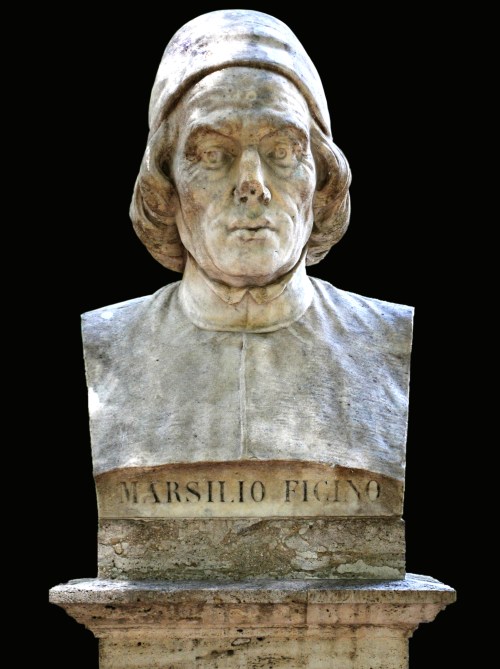
Marsilio Ficino (1433-99), a bust published in “Marsilio Ficino and Renaissance Neoplatonism,” by Nicholas Goodrick-Clarke, on Rosicrucian.org. This work is in the public domain in its country of origin and other countries and areas where the copyright term is the author’s life plus 100 years or less.
“Hebrew was not the only beneficiary of the passion for archaic wisdom that gripped scholars from the end of the Middle Ages onwards. The dawn of the modern era also saw a revival of interest in Greek thought and in the Greek’s fascination with Egypt and its mysterious hieroglyphic script (see ch. 7).
Greek texts were rediscovered and enthusiastically assigned an antiquity they did not, in fact, possess. They included the Orphic Hymns, attributed to Orpheus, but, in fact, written probably between the second and third centuries AD; the Chaldean Oracles, also written in the second century, but attributed to Zoroaster; and, above all, the Corpus Hermeticum.
This was a compilation acquired in 1460 for Cosimo de’ Medici in Florence, and immediately rushed to Marsilio Ficino so that he might translate it.
This last compilation, as was later shown, was the least archaic of all. In 1614, by using stylistic evidence and by comparing the innumerable contradictions among the documents, Isaac Casaubon, in his De rebus sacris et ecclesiasticis, showed that it was a collection of texts by different authors, all writing in late Hellenistic times under the influences of Egyptian spirituality.
None of this was apparent in 1460, however. Ficino took the texts to be archaic, directly written by the mythical Hermes or Mercurius Trismegistus.
Ficino was struck to discover that his account of the creation of the universe resembled that of Genesis, yet–he said–we should not be amazed, because Mercurius could be none other than Moses himself (Theologica platonica, 8, 1).
This enormous historical error, as Yates says, was destined to have surprising results (1964: 18-9).
The Hermetic tradition provided a magico-astrological account of the cosmos. Celestial bodies exercise their power and influence over earthly things, and by knowing the planetary laws one can not only predict these influences, but also manipulate them.
There exists a relation of sympathy between the universal macrocosm and the human microcosm, a latticework of forces which it is possible to harness through astral magic.
Astral magic was practiced through words and other signs, because there is a language by which human beings can command the stars. Such miracles can be performed through “talismans,” that is, images which might guarantee safe recovery, health or physical prowess.
In his De vita coelitus comparanda, Ficino provided a wealth of details concerning how such talismans were to be worn; how certain plants linked by sympathy to certain stars were to be consumed; how magical ceremonies were to be celebrated with the proper perfumes, garments and songs.
Talismanic magic works because the bond which unites the occult virtues of earthly things and the celestial bodies which instilled them is expressed by signatures, that is, formal aspects of material things that recall certain features (properties or powers) of the corresponding heavenly bodies.
God himself has rendered the sympathies between macrocosm and microcosm perceptible by stamping a mark, a sort of seal, onto each object of this world (cf. Thorndike 1923-58; Foucault 1966; Couliano 1984; Bianchi 1987).
In a text that can stand as the foundation for such a doctrine of signatures, Paracelsus declared that:
“The ars signata teaches the way in which the true and genuine names must be assigned to all things, the same names that Adam, the Protoplastus, knew in the complete and perfect way [ . . . ] which show, at the same time, the virtue, the power, and the property of this or that thing. [ . . . ]
This is the signator who signs the horns of the stag with branches so that his age may be known: the stag having as many years as his horns have branches. [ . . . ] This is the signator who covers the tongue of a sick sow with excrescences, so that her impurity may be known; if the tongue is impure so the whole body is impure.
This is the signator who tints the clouds with divers colors, whereby it is possible to forecast the changes of the heavens. (De natura rerum, I, 10, “De signatura rerum“).”
Even the Middle Ages were aware that “habent corpora omnia ad invisibilia bona simulitudinem” (Richard of Saint Victor, Benjamin Major, PL, 196, 90): all bodies possess qualities which give them similarities with invisible goods.
In consequence, every creature of the universe was an image, a mirror reflecting our terrestrial and supernatural destinies. Nevertheless, it did not occur to the Middle Ages that these images might speak in a perfect language.
They required interpretation, explication and comment; they needed to be enclosed in a rational didactic framework where they could be elucidated, deciphered, in order to make clear the mystical affinities between a symbol and its content.
For Renaissance Platonism, by contrast, the relation between the images and the ideas to which they referred was considered so intuitively direct that the very distinction between a symbol and its meaning disappeared (see Gombrich 1972: “Icones Symbolicae,” v).
Umberto Eco, The Search for the Perfect Language, translated by James Fentress, Blackwell. Oxford, 1995, pp. 117-9.
 Samizdat