
Eco: Images for Aliens
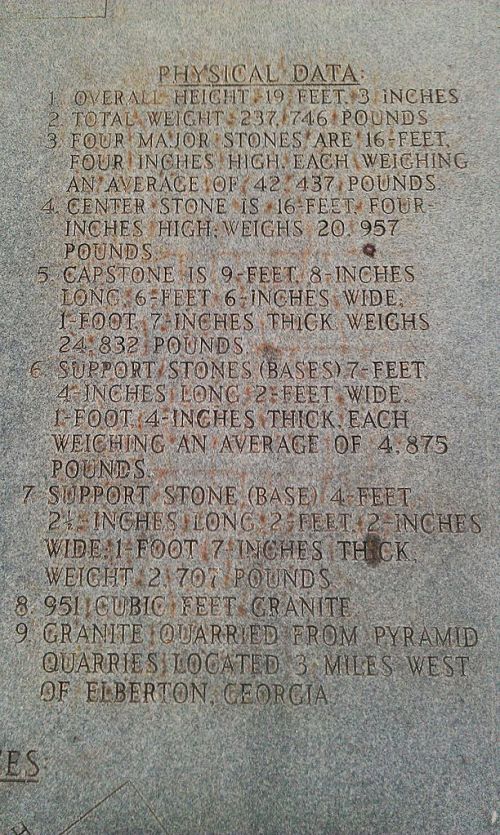
Georgia Guidestone, closeup of the detail stone, with physical dimensions and weight of the guidestones. The Georgia Guidestones are a granite monument erected by anonymous philanthropists in 1980 in Elbert County, Georgia, USA. The Guidestones include 10 guidelines inscribed in eight modern languages and four ancient tongues, including Babylonian, Classical Greek, Sanskrit and Egyptian hieroglyphs. Photo taken by KiltedEditor71 in August 2011 and published under the Creative Commons Attribution-Share Alike 3.0 Unported license.
“Perhaps the most discomforting document for the future of the language of images is the report drawn up in 1984 by Thomas A. Sebeok (Sebeok 1984). He had been commissioned by the Office of Nuclear Waste Isolation and by a group of other institutions to elaborate answers to a question posed by the US Nuclear Regulatory Commission.
The American government had chosen several desert areas in the US for the burial (at the depth of hundreds of meters) of nuclear waste. The problem was not so much that of protecting the area from imprudent intrusions today, but rather that the waste would remain radioactive for another ten thousand years.
That is more than enough time for great empires and flourishing civilizations to perish. We have seen how, a few centuries after the last pharaoh had disappeared, knowledge of how to read hieroglyphs had disappeared as well.
It is easily conceivable that, ten thousand years hence, something similar will have happened to us. We may have reverted to barbarism. We may even be visited by inhabitants of other planets: how will we warn these alien visitors that they are in a danger zone?
Almost immediately, Sebeok discarded the possibility of any type of verbal communication, of electric signals as needing a constant power supply, of olfactory messages as being of brief duration, and of any sort of ideogram based on convention.
Even a pictographic language seemed problematic. Sebeok analyzed an image from an ancient primitive culture where one can certainly recognize human figures but it is hard to say what they are doing (dancing, fighting, hunting?).
Another solution would be to establish temporal segments of three generations each (calculating that, in any civilization, language will not alter beyond recognition between grandparents and grandchildren), giving instructions that, at the end of each segment, the message would be reformulated, adapting it to the semiotic conventions prevailing at the moment.
But even this solution presupposes precisely the sort of social continuity that the original question had put into doubt. Another solution was to fill up the entire zone with messages in all known languages and semiotic systems, reasoning that it was statistically probable that at least one of these messages would be comprehensible to the future visitors.
Even if only part of one of the messages was decipherable, it would still act as a sort of Rosetta stone, allowing the visitors to translate all the rest. Yet even this solution presupposed a form of cultural continuity (however weak it would be).
The only remaining solution was to institute a sort of “priesthood” of nuclear scientists, anthropologists, linguists and psychologists supposed to perpetuate itself by coopting new members. This caste would keep alive the knowledge of the danger, creating myths and legends about it.
Even though, in the passage of time, these “priests” would probably lose a precise notion of the peril that they were committed to protect humanity from, there would still survive, even in a future state of barbarism, obscure but efficacious taboos.
It is curious to see that, having been presented with a choice of various types of universal language, the choice finally fell on a “narrative” solution, thus reproposing what really did happen millennia ago.
Egyptian has disappeared, as well as as any other perfect and holy primordial language, and what remains of all this is only myths, tales without a code, or whose code has long been lost.
Yet they are still capable of keeping us in a state of vigil in our desperate effort at decipherment.
Umberto Eco, The Search for the Perfect Language, translated by James Fentress, Blackwell. Oxford, 1995, pp. 17-7.
 Samizdat