
Eco: The Egyptian Alphabet, 3
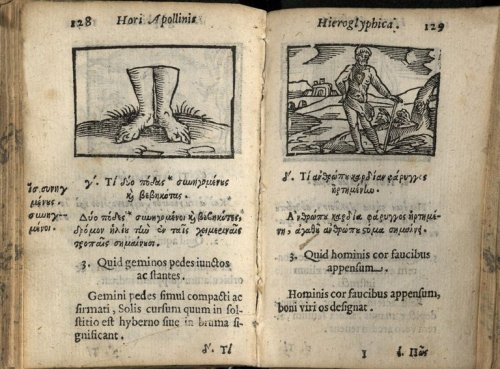
Horapollo (c. 5th century CE), Hori Apollinis selecta hieroglyphica, Romae: sumtibus Iulij Francescschini, ex typographia Aloysij Zanetti, 1599, pp. 128-9. Brooklyn Museum Libraries, Wilbur Library of Egyptology, Special Collections, call number PE40 H78 F84. This work is in the public domain in its country of origin and other countries and areas where the copyright term is the author’s life plus 100 years or less.
“Alciati’s commentary refers to the passage describing the stork in the Hieroglyphica. Yet we have just seen that there is no reference either to the feeding of the young or to the transport of the parents. These features are, however, mentioned in a fourth century AD text, the Hexaemeron of Basil (VIII, 5).
In other words, the information contained in the Hieroglyphica was already at the disposal of European culture. A search for traces of the stork from the Renaissance backwards is filled with pleasant surprises.
In the Cambridge Bestiary (twelfth century CE), we read that storks nourish their young with exemplary affection, and that “they incubate the nests so tirelessly that they lose their own feathers. What is more, when they have moulted in this way, they in turn are looked after by the babies, for a time corresponding in length to the time which they themselves have spent in bringing up and cherishing their offspring.” (The Bestiary, T.H. White, ed., New York: Putnam’s Sons, 1960: pp. 117-8).
The accompanying image shows a stork that carries a frog in its beak, obviously a dainty morsel for its young.
The Cambridge Bestiary has taken this idea from Isidore of Seville, who, in the Etymologiarum (XII, vii), says more or less the same. Who then are Isidore’s sources? St. Basil we have already seen; there was St. Ambrose as well (Hexaemeron, V, 16, 53), and possibly also Celsus (cited in Origen, Contra Celsum, IV, 98) and Porphyry (De abstinentia, III, 23, 1). These, in their turn, used Pliny’s Naturalis historia (X, 32) as their source.
Pliny, of course, could have been drawing on an Egyptian tradition, if Aelian, in the second to third century AD, could claim (though without citing Pliny by name) that “Storks are venerated among the Egyptians because they nourish and honor their parents when they grow old” (De animalium natura, X, 16).
But the idea can be traced back even further. The same notion is to be found in Plutarch (De solertia animalium, 4), Cicero (De finibus bonorum et malorum, II, 110), Aristotle (Historia animalium, IX, 7, 612b, 35), Plato (Alcibiades, 135 E), Aristophanes (The Birds, 1355), and finally in Sophocles (Electra, 1058).
There is nothing to prevent us from imagining that Sophocles himself was drawing on ancient Egyptian tradition; but, even if he were, it is evident that the story of the stork has been part of occidental culture for as long as we care to trace it.
It follows that Horapollo did not reveal anything hot. Moreover, the origin of this symbol seems to have been Semitic, given that, in Hebrew, the word for stork means “the one who has filial piety.”
Read by anyone familiar with medieval and classical culture, Horapollo’s booklet seems to differ very little from the bestiaries current in the preceding centuries. It merely adds some information about specifically Egyptian animals, such as the ibis and the scarab and neglects make certain of the standard moralizing comments or biblical references.
This was clear even to the Renaissance. In his Hieroglyphica sive de sacris Aegyptorum aliarumque gentium literis of 1556, Pierio Valeriano never tired of employing his vast stock of knowledge of classical and Christian sources to note the occasions where the assertions of Horapollo might be confirmed.
Yet instead of reading Horapollo in the light of a previous tradition, he revisits this whole tradition in the light of Horapollo.
With a barrage of citations from Latin and Greek authors, Giulio Cesare Capaccio displayed, in his Delle imprese of 1592, his perfect mastery of older traditions. Yet fashion now demanded that he interpreted this tradition in a Egyptian key.
“Without hieroglyphic observation,” and without having recourse to the Monas hieroglyphica “quel Giovanni Dee da Londino,” it was impossible, he said, to endow these images (coming from centuries of western culture) with their proper recondite meanings.
We are speaking of the “rereading” of a text (or of a network of texts) which had not been changed during the centuries. So what has changed? We are here witnessing a semiotic incident which, as paradoxical as some of its effects may have been, was, in terms of its own dynamic, quite easy to explain.
Horapollo’s text (qua text) differs but little from other similar writings, which were previously known. None the less, the humanists read it as a series of unprecedented statements. The reason is simply that the readers of the fifteenth century saw is as coming from a different author.
The text had not changed, but the “voice” supposed to utter it was endowed with a different charisma. This changed the way in which the text was received and the way in which it was consequently interpreted.
Thus, as old and familiar as these images were, the moment they appeared as transmitted not by the familiar Christian and pagan sources, but by the ancient Egyptian divinities themselves, they took on a fresh, and radically different, meaning.
For the missing scriptural commentaries there were substituted allusions to vague religions mysteries. The success of the book was due to its polysemy. Hieroglyphs were regarded as initiatory symbols.
They were symbols, that is, expressions that referred to an occult, unknown and ambivalent content. In contradistinction to conjecture, in which we take a visible symptom and infer from it its cause, Kircher defined a symbol as:
“a nota significativa of mysteries, that is to say, that it is the nature of a symbol to lead our minds, by means of certain similarities, to the understanding of things vastly different from the things that are offered to our external senses, and whose property it is to appear hidden under the veil of an obscure expression. [ . . . ] Symbols cannot be translated by words, but expressed only by marks, characters, and figures. (Obeliscus Pamphilius, II, 5, 114-20).”
These symbols were initiatory, because the allure of Egyptian culture was given by the promise of a knowledge that was wrapped in an impenetrable and indecipherable enigma so as to protect it from the idle curiosity of the vulgar multitudes.
The hieroglyph, Kircher reminds us, was the symbol of a sacred truth (thus, though all hieroglyphs are symbols, it does not follow that all symbols are hieroglyphs) whose force derived from its impenetrability to the eyes of the profane.”
Umberto Eco, The Search for the Perfect Language, translated by James Fentress, Blackwell. Oxford, 1995, pp. 151-4.
(Editorial Note: I must mention Mr. William Thayer, whose LacusCurtius site at the University of Chicago links to a whopping 51 complete texts by ancient authors and more. I stumbled across Mr. Thayer’s page as I linked to classical writers, and I find it to be both indispensable and a staggering contribution to online scholarship.
Thank you for this work, Mr. Thayer. I am one of the crazy ones out here in internet-land who realizes what you have done. With my best regards.)
 Samizdat