
Samizdat

Publishing the Forbidden. All Rights Reserved. © Samizdat 2014-2025.

Tag: Brazilian

Eco: Theoretical Objections and Counter-objections

Projet_d'éléments_d'idéologie_par_le_[...]Destutt_de_bpt6k10455061

Antoine-Louis-Claude Destutt de Tracy (1754-1836), Projet d’éléments d’idéologie, Paris, 1801. This copy in the Bibliothèque nationale de France. This work is in the public domain in its country of origin and other countries and areas where the copyright term is the author’s life plus 100 years or less. 

“A fundamental objection that can be applied to any of the a posteriori projects generically is that they can make no claim to having identified and artificially reorganized a content system.

They simply provide an expression system which aims at being easy and flexible enough to express the contents normally expressed in a natural language. Such a practical advantage is also a theoretical limit. If the a priori languages were too philosophical, their a posteriori successors are not philosophical enough.

The supporters of an IAL have neither paid attention to the problem of linguistic relativism, nor ever been worried by the fact that different languages present the world in different ways, sometimes mutually incommensurable.

They have usually taken it for granted that synonymous expressions exist from language to language, and the vast collection of books that have been translated into Esperanto from various of the world’s languages is taken as proof of the complete “effability” of this language (this point has been discussed, from opposite points of view, by two authors who are both traditionally considered as relativist, that is, Sapir and Whorfcf. Pellerey 1993: 7).

To accept the idea that there is a content system which is the same for all languages means, fatally, to take surreptitiously for granted that such a model is the western one. Even if it tries to distance itself in certain aspects from the Indo-European model, Esperanto, both in its lexicon and in its syntax, remains basically an Indo-European tongue.

As Martinet observed, “the situation would have been different if the language had been invented by a Japanese” (1991: 681).

One is free to regard all these objections as irrelevant. A theoretical weak point may even turn out to be a practical advantage. One can hold that linguistic unification must, in practice, accept the use of the Indo-European languages as the linguistic model (cf. Carnap in Schlipp 1963:71).

It is a view that seems to be confirmed by actual events; for the moment (at least) the economic and technological growth of Japan is based on Japanese acceptance of an Indo-European language (English) as a common vehicle.

Both natural tongues and some “vehicular” languages have succeeded in becoming dominant in a given country or in a larger area mainly for extra-linguistic reasons. As far as the linguistic reasons are concerned (easiness, economy, rationality and so on), there are so many variables that there are no “scientific” criteria whereby we might confute the claim of Goropius Becanus that sixteenth century Flemish was the easiest, most natural, sweetest and most expressive language in the entire universe.

The predominate position currently enjoyed by English is a historical contingency arising from the mercantile and colonial expansion of the British Empire, which was followed by American economic and technological hegemony.

Of course, it may also be maintained that English has succeeded because it is rich in monosyllables, capable of absorbing foreign words and flexible in forming neologisms, etc.: yet had Hitler won World War II and had the USA been reduced to a confederation of banana republics, we would probably today use German as a universal vehicular language, and Japanese electronics firms would advertise their products in Hong Kong airport duty-free shops (Zollfreie Waren) in German.

Besides, on the arguable rationality of English, and of any other vehicular language, see the criticism of Sapir (1931).

There is no reason why an artificial language like Esperanto might not function as an international language, just as certain natural languages (such as Greek, Latin, French, English, Swahili) have in different historical periods.

We have already encountered in Destutt de Tracy an extremely powerful objection: a universal language, like perpetual motion, is impossible for a very “peremptory” reason: “Even were everybody on earth to agree to speak the same language from today onwards, they would rapidly discover that, under the influence of their own use, the single language had begun to change, to modify itself in thousands of different ways in each different country, until it produced in each a different dialect which gradually grew away from all the others” (Eléments d’idéologie, II, 6, 569).

It is true that, just for the above reasons, the Portuguese of Brazil today differs from the Portuguese spoken in Portugal so much that Brazilian and Portuguese publishers publish two different translations of the same foreign book, and it is a common occurrence for foreigners who have learned their Portuguese in Rio to have difficulty understanding what they hear on the streets of Lisbon.

Against this, however, one can point out the Brazilians and Portuguese still manage to understand each other well enough in practical, everyday matters. In part, this is because the mass media help the speakers of each variety to follow the transformations taking place on the other shore.

Supporters of Esperanto like Martinet (1991: 685) argue that it would be, to say the least, naive to to suppose that, as an IAL diffused into new areas, it would be exempt from the process through which languages evolve and split up into varieties of dialects.

Yet in so far as an IAL remained an auxiliary language, rather than the primary language of everyday exchange, the risks of such a parallel evolution would be diminished.

The action of the media, which might reflect the decisions of a sort of international supervisory association, could also contribute to the establishment and maintenance of standards, or, at least, to keeping evolution under control.”

Umberto Eco, The Search for the Perfect Language, translated by James Fentress, Blackwell. Oxford, 1995, pp. 330-2.
Eco: Kircher’s Polygraphy

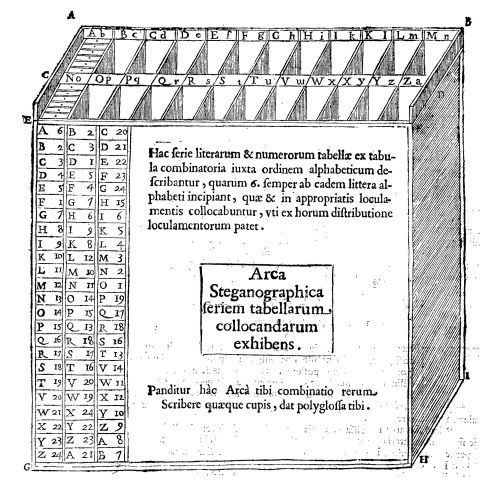
Kircher, the Steganographic Ark, from Polygraphia Nova, p. 130

Athanasius Kircher (1602-80), the steganographic ark, Polygraphia nova et universalis ex combinatoria arte detecta, 1663. This work is in the public domain in its country of origin and other countries and areas where the copyright term is the author’s life plus 100 years or less. 

Kircher wrote his Polygraphia nova et universalis ex combinatoria arte detecta in 1663, several years after his early works on Egypt and hieroglyphics, but he was concerned with the problem of universal writing from the beginning of the decade, and it seems evident that he was at the same time fascinated by the hieroglyphic mysteries and the polygraphic publicity.

It is also significant that in this same volume Kircher designed not only a polygraphy, or international language open to all, but also, in the wake of Trithemius, a steganography, or secret language in which to cipher messages.

What (at the end of the previous chapter) seemed to us a contradiction appeared to Kircher rather as a natural connection. He cited, at the outset, an Arab proverb: if you have a secret, hide it or reveal it (“si secretum tibi sit, tege illud, vel revela“).

Such a decision was not so obvious, after all, since in his works on Egyptology Kircher had chosen a “fifty-fifty solution,” saying something by concealing it, alluding without revealing.

Finally, the second part of the title of Kircher’s work reveals that, in designing his polygraphy, Kircher was also using Lull’s art of combination (contrary to the opinion of Knowlson 1975: 107-8).

In the enthusiastic preface that the author addressed to the emperor Ferdinand III, he celebrated polygraphy as “all languages reduced to one” (“linguarum omnium ad nam reductio“).

Using polygraphy, “anyone, even someone who knows nothing other than his own vernacular, will be able to correspond and exchange letters with anybody else, of whatever their nationality.”

Thus Kircher’s polygraphy was in reality a pasigraphy, that is, a project for a written language, or international alphabet, which was not required to be spoken.

It is easy to confuse Kircher’s project with a double pentaglottic dictionary, in A and B versions (both in Latin, Italian, Spanish, French and German). In Kircher’s time, English was not considered an important international language, and, in his Character, Becher had assumed that French was sufficient, as a vehicular language, for English, Italian, Spanish and Portuguese native speakers.

Ideally, Kircher thought (p. 7) that his dictionary should also include Hebrew, Greek, Bohemian, Polish, Lithuanian, Hungarian, Dutch, English and Irish (“linguae doctrinales omnibus communes“)–as well as Nubian, Ethiopic, Egyptian, Congolese, Angolan, Chaldean, Arabic, Armenian, Persian, Turkish, Tartar, Chinese, Mexican, Peruvian, Brazilian and Canadian.

Kircher did not, it seems, feel himself ready to confront such a gigantic task; perhaps he intuited that the missionary activity, followed eventually by colonialism, would drastically simplify the problem (transforming many exotic languages into mere ethnological remnants): Spanish would substitute for Mexican, French for Canadian, Portuguese for Brazilian, and various pidgins would substitute for all the rest.

Kircher’s A and B dictionaries each contain 1,228 items. The grounds for selection were purely empirical: Kircher chose the words that seemed to him most commonly used.

Dictionary A served to encode messages. It started with a list of common nouns and verbs, in alphabetical order. There followed alphabetic lists of proper nouns (regions, cities, persons), and of adverbs and prepositions.

Added to this there was also a list of the conjugations of both the verbs to be and to have. The whole material was subdivided into 32 tables, marked by Roman numerals, while every item of each table was marked by an Arabic numeral.

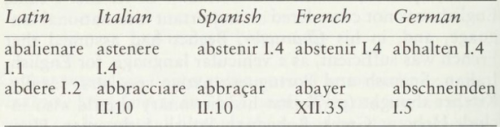
The dictionary was set out in five columns, one for each of the five languages, and the words in each language were listed in their proper alphabetical order. Consequently, there is no necessary semantic correspondence between the terms recorded on the same line, and only the terms scored with the same Roman and Arabic numbers were to be considered synonymous.

We can see this best by giving the first two lines of the dicti0nary:

Umberto Eco, The Search for the Perfect Language, p. 198

Umberto Eco, The Search for the Perfect Language, p. 198. 

The Roman numerals refer to tables found in dictionary B; the Arabic numerals refer to the items themselves. Latin acts as the parameter language: for each specific term, the numbers refer to the Latin alphabetic ordering.

For example, the code for the French word abstenir is I.4, which indicates that the position of its Latin synonym, abstinere, is fourth in the Latin column I (obviously, to encode the Latin word abstinere, one also writes I.4).

To decode the message, it was necessary to use dictionary B. This too was arranged in 32 tables, each assigned a Roman numeral. But for each column (or language) the words did not follow their alphabetic order (except the Latin one), while the Arabic numbers marking each term were in an increasing arithmetical order.

Thus all the terms on the same line were synonymous and each synonym was marked by the same Arabic number.

Again, it is easiest to see how this worked by citing the first two lines of the first table:

Umberto Eco, The Search for the Perfect Language, p. 199

Umberto Eco, The Search for the Perfect Language, p. 199. 

Thus, if one wants to send the Latin word abdere (to hide), according to the dictionary A one encodes it as I.2. A German addressee, receiving the message I.2, goes to dictionary B, first table, German column, and looks for the second word, which is exactly verbergen (to hide).

If the same addressee wants to know how to translate this term in Spanish, one finds in the same line that the synonymous term is esconder.

However, Kircher found that a simple lexicon did not suffice; he was forced to invent 44 supplementary signs (notae) which indicated the tense, mood and number of verbs, plus 12 more signs which indicated declensions (nominative, genitive, dative, etc., both singular and plural).

Thus, to understand the following example, the sign N meant nominative, while a sign like a D indicated the third person singular of the past tense. In this way, the ciphered expression “XXVII.36N, XXX.21N, II.5N, XXIII.8D, XXVIII.10, XXX.20” can be decoded as “Petrus noster amicus, venit ad nos” (literally, “Peter our friend came to us”), and on the basis of Latin, can be transformed into an equivalent sentence in any of the other four languages.

Kircher proudly claims that, by dictionary A, we can write in any language even though though we know only our own, as well as that, with dictionary B, we can understand a text written in an unknown language.

The system also works when we receive a non-ciphered text written in a natural foreign language. All we have to do is to look up the reference numbers for each foreign word in dictionary A (where they are listed in alphabetical order), then, with the reference numbers, find the corresponding words in dictionary B, in the column for our own language.

Not only was this process laborious, but the entire project was based on the assumption that all other languages could be directly reduced to the Latin grammar. One can imagine the results of such a method if one thinks of translating literally, word by word, a German sentence into an English one.

Kircher never confronted the problem of why an item-by-item translation should be syntactically correct, or even comprehensible, in the new language. He seemed to rely on the good will and good sense of whoever used his system.

Yet even the most willing users might slip up. In August 1663, after reading the Polygraphia, Juan Caramuel y Lobkowitz wrote to Kircher to congratulate him on his wonderful invention (Mss Chigiani f. 59 v., Biblioteca Apostolica Vaticana; cf. Casciato et al. 1986: table 5).

Appropriately, Caramuel chose to congratulate Kircher in his own polygraphy. Yet his first problem was that Kircher’s own first name, Athanasius, did not appear in the list of proper names. Adopting the principle that where a term is missing, an analogous one must be sought, Caramuel addressed his letter to “Anastasia.”

Moreover, there are passages that can be decoded fairly easily, while for others one suspects that the labor of consulting the dictionary to obtain reference numbers for every word proved so tedious that even Caramuel began to nod.

Thus we find ourselves in front of a passage which, in Latin, would need to be translated as follows: “Dominus + sign of vocative, Amicus + sign of vocative, multum sal + sign of vocative, Anastasia, a me + sign of accusative, ars + sign of accusative, ex illius + sign of ablative, discere posse + sign of second person plural, future active, non est loqui vel scribere sub lingua + ablative, communis + ablative.”

After many heroic efforts, one can try to render it (in a sort of “Me Tarzan-You Jane” language) as “O Lord and Friend, O witty Athanasius, to me (?) you could learn from him an art (which) is not speaking and writing under a common language.”

Umberto Eco, The Search for the Perfect Language, translated by James Fentress, Blackwell. Oxford, 1995, pp. 196-200.
