Samizdat

Publishing the Forbidden. All Rights Reserved. © Samizdat 2014-2025.

Tag: bīnūt apsê

Kvanvig: The Bīt Mēseri Ritual

“The study of F.A.M. Wiggermann on protective spirits has contributed considerably to the understanding of the apkallus in Bīt Mēseri.

(Wiggermann, Mesopotamian Protective Spirits; Wiggermann deals with Bīt Mēseri especially on p. 105f. The connection between the apkallus and prophylactic rituals was already noticed by Oliver Robert Gurney, “Babylonian Prophylactic Figures and their Rituals,” Annals of Archeology and Anthropology 22, Liverpool University Press, 1935, pp. 35-96.)
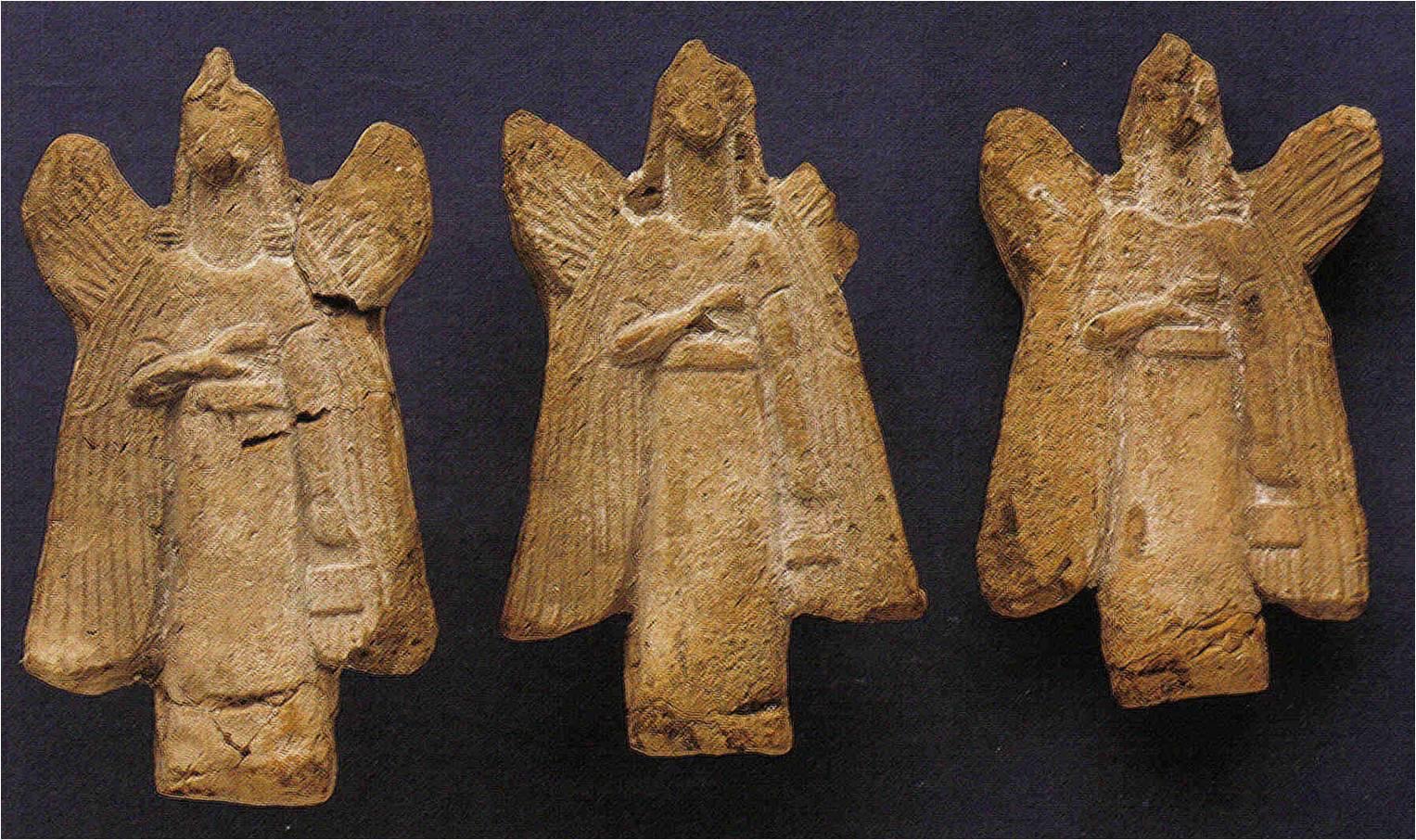
Bird-Apkallū statuettes in characteristic poses, right hands on their breasts, banduddu buckets in their left hands.

Bird-Apkallū statuettes in characteristic poses, right hands on their breasts, banduddu buckets in their left hands.

In Bīt Mēseri it is clear that there is already a sick man in the house. The ritual prescribes both how paintings of protective figures and small statues of them should be placed in the room of the sick man, and what incantations should be used. The ritual should be performed by the āšipu, the magician or exorcist operating against evil spirits causing diseases.

Three kinds of apkallus are also represented in Bīt Mēseri: ūmu-apkallus, fish-apkallus, and bird-apkallus. The designation ūmu can mean both “light” and “day;” Wiggermann opts for the second solution; they are “day-apkallus.”

Fish-Apkallū statuettes of the type that were buried in the foundations of buildings. The so-called purādu-fish apkallū were the seven antediluvian sages of Sumeria.

Fish-Apkallū statuettes of the type that were buried in the foundations of buildings.
The so-called purādu-fish apkallū were the seven antediluvian sages of Sumeria.

The fish-apkallus and the bird-apkallus are bīnūt apsê, “creatures of apsû.” They have divine origin.

Nothing similar is said about the day-apkallus. They seem to be of human descent. Nevertheless, Wiggermann considers them to have their origin from the antediluvian period as well.

The instructions concerning the invocation of the apkallus are introduced in the following way in Bit Meseri:

“To the seven figures of carp apkallus, painted with gypsum and black paste that are drawn at the side of the bedroom at the wall.

To the seven figures of apkallus of consecrated cornel; they stand in the gate of the bedroom nearest the sick man at the head of the bed.

To the seven figures of apkallus of tamarisk, kneeling, that stand at the foot of the bed.”

Thus, protective spirits surrounded the sick man. The first group is fish-apkallus, which is explicitly mentioned; the second is day-apkallus, on the basis of the material used; most likely the third is the bird-apkallus.

This well-preserved bas relief retains incredible detail. The daggers carried in the Umu-Apkallu's waistband are clear, as is the rosette styling on his wristbands. The earrings are more distinct than most other examples, and the headdress appears to be of the horned-tiara type. The umu-apkallu appears to wear bracelets on his upper arms. Tassels are apparent on the fringes of his robe, as well as behind the neck.

This well-preserved bas relief retains incredible detail. The daggers carried in the Umu-Apkallu’s waistband are clear, as is the rosette styling on his wristbands. The earrings are more distinct than most other examples, and the headdress appears to be of the horned-tiara type. The umu-apkallu appears to wear bracelets on his upper arms. Tassels are apparent on the fringes of his robe, as well as behind the neck.

The list of seven and the subsequent four apkallus that we have been dealing with come after the first invocation. We therefore notice that these apkallus are fish-apkallus, which also is apparent in the description of them in the list. There is, however, an incongruity between the invocation and the list.

The invocation deals with seven apkallus; the list has in total eleven. This seems to indicate that the list is adapted into the ritual from another source.”

Helge Kvanvig, Primeval History: Babylonian, Biblical, and Enochic: An Intertextual Reading, Brill, 2011, p. 131.

Statues in Private Rooms, the apkallū, “Sages.”

“In the bedroom (kummu, cf. III.B.6), the “place of life” (AAA 22 88:146f.), at the head of the bed of the threatened man, the seven anthropomorphic ūmu-apkallū, the “leading sages” (cf. II.A.3.1), are stationed. The seven bird-apkallū are buried against the wall at the head of the bed, but in an adjoining room (uncertain, cf. II.A.3.9).

This depiction of a fish-apkallū (Apkallu, Abkallu) guarded the entrance to the temple of Ninurta at Nimrud. A fish's head can be seen on Apkallu's head, and its skin hangs down over the back of Apkallu's body.  Neo-Assyrian era, 865-860 BCE. From the Temple of Ninurta, Nimrud (ancient Kalhu; Biblical Calah), northern Mesopotamia, Iraq. (The British Museum, London). Osama Shukir Muhammed Amin FRCP (Glasg) http://www.ancient.eu/image/2708/

This depiction of a fish-apkallū (Apkallu, Abkallu) guarded the entrance to the temple of Ninurta at Nimrud. A fish’s head can be seen on Apkallu’s head, and its skin hangs down over the back of Apkallu’s body.
Neo-Assyrian era, 865-860 BCE. From the Temple of Ninurta, Nimrud (ancient Kalhu; Biblical Calah), northern Mesopotamia, Iraq. (The British Museum, London).
Osama Shukir Muhammed Amin FRCP (Glasg)
http://www.ancient.eu/image/2708/

At the threshold of the bedroom seven fish-apkallū guard the entrance; two further groups of seven fish-apkallū are buried in front of, and behind the chair. The chair may have been in the bedroom or perhaps rather in an adjoining living-room or dining-room (the furniture of a dining room in the Neo-Assyrian period has been studied by K. Deller and I. Finkel in ZA 74 86f.; it includes a kussiu, “chair”, but no bed).

Material: the ūmu-apkallū are made of e’ru, a kind of wood well known for its magical properties, but as yet not identified with certainty; Thompson DAB 298f.: “Laurel”, CAD E 318ff.: a variety of cornel (followed by AHw 247a), Salonen Wasserfahrzeuge 99, 152: “Lorbeer” (cf., Oppenheim Eames 54), Civil apud Landsberger Datepalm 26: “(dwarf)ash” (followed by CAD M/1 221a, M/2 220b, S 202a, AHw 676a), see further Sollberger Genava 26 61 and Snell Ledgers and Prices 211.

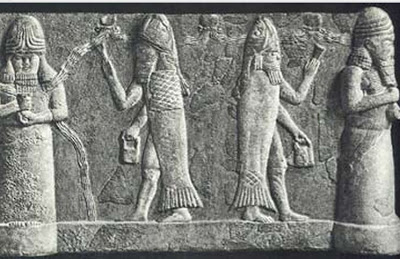
The god Ea is portrayed at far left, with water coursing from his shoulders.  Two fish-apkallu hold banduddu buckets. This bas relief is atypical in that the left-side fish-apkallu holds his banduddu in his right hand, rather than the left, as is portrayed in most other depictions.  This bas relief is also unusual in that it portrays the fish-apkallu with different objects in their raised hands. The raised hand of the fish-apkallu on the left is indistinct, partially covered by the water flowing from the shoulders of the god Ea, while the other fish-apkallu raises an object that I have not yet identified.

The god Ea is portrayed at far left, with water coursing from his shoulders.
Two fish-apkallu hold banduddu buckets. This bas relief is atypical in that the left-side fish-apkallu holds his banduddu in his right hand, rather than the left, as is portrayed in most other depictions.
This bas relief is also unusual in that it portrays the fish-apkallu with different objects in their raised hands. The raised hand of the fish-apkallu on the left is indistinct, partially covered by the water flowing from the shoulders of the god Ea, while the other fish-apkallu raises an object that I have not yet identified.

In the incantation UDUG HUL EDiN.NA DAGAL LA (cf. text III.C), that accompanies the fabrication of the statues of the ūmu apkallū, the e’ru of which they are to be made is called: gis HUL.DÚB.BA GIŠ NAM.TI.LA, “mace that hits evil (cf. Grayson Iraq 37 69), wood of life” (AAA 22 88:152f.).

Analogous to the designation of the tamarisk of which the gods were made as the “bone of divinity” (above A), the designation of the material of the ūmu apkallū reveals something of their character: they chase evil away, and procure life.

Probably relevant is the “mystical” commentary (cf. below note 3e) gis TUKUL MA.NU: VII u4-mu gis TUKUL dAMAR.UTU, “the mace of e’ru: the seven ūmu-demons, the mace of Marduk“. Here “the mace of cornel” may refer to the seven ūmu-apkallū holding an e’ru stick or mace in their right hands. In straight-forward ritual contexts (notes 2, 13c, d, e) “mace of cornel” is rather an alternative designation of the e’ru (stick/mace) itself.

The ūmu-apkallū certainly did not belong to the bīnūt apsê, “creatures of apsû” (I 144); they probably did not belong to the bīnūt šamê, “creatures of heaven”, either, since the preceding designation salmī annūti, “these statues”, refers to the statues of tamarisk made the same day, and not to the statues of cornel made the day before (I 143).

The line closing the description of the statues of cornel does not contain a general term analogous to I 143 closing the tamarisk section; perhaps I 28 did contain such a term, or perhaps no such term was used.

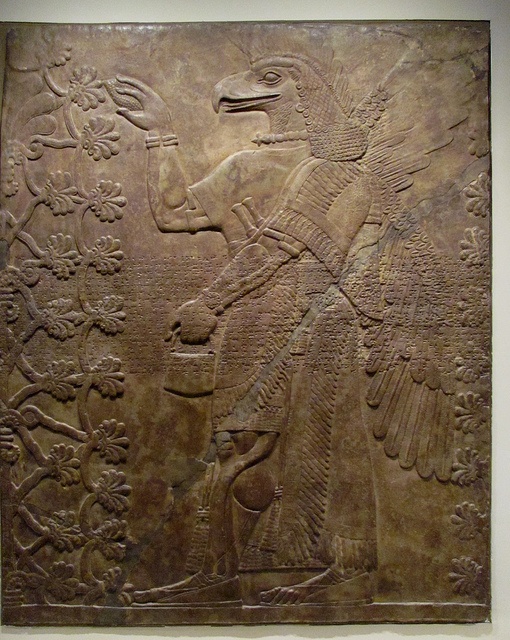
A bas relief in the Louvre.  In this case the bird-apkallū tends to a sacred tree. Considering the mullilu in his right hand and the banduddu in his left, (tree cone and water bucket), he is engaged in a water ritual intended to sanctify the sacred tree. This is a common motif in Sumerian and Neo-Assyrian idols.  This bas relief is in the Louvre.  Primary publicationNimrud NW Palace I-24 = RIMA 2.0.101.023, ex. 189 (f) Collection	Nimrud, Iraq (a); British Museum, London, UK (b); Louvre Museum, Paris, France (c); Nimrud, Iraq (d); Detroit Institute of Arts, Detroit, Michigan, USA (e); British Museum, London, UK; Louvre Museum, Paris, France  Museum no.	Nimrud fragment no. 42 (a); BM 098061 (b); AO 22198 (c); Nimrud fragment no. 43 and 45 (d); DIA 47.181 (e) (photo: DIA); AO 19849  Accession no.	1903-10-10, 0002 (b) Provenience	Kalhu (mod. Nimrud) Period	Neo-Assyrian (ca. 911-612 BC)

A bas relief in the Louvre.
In this case the bird-apkallū tends to a sacred tree. Considering the mullilu in his right hand and the banduddu in his left, (tree cone and water bucket), he is engaged in a water ritual intended to sanctify the sacred tree. This is a common motif in Sumerian and Neo-Assyrian idols.
This bas relief is in the Louvre.
Primary publication Nimrud NW Palace I-24 = RIMA 2.0.101.023, ex. 189 (f)
Collection Nimrud, Iraq (a); British Museum, London, UK (b); Louvre Museum, Paris, France (c); Nimrud, Iraq (d); Detroit Institute of Arts, Detroit, Michigan, USA (e); British Museum, London, UK; Louvre Museum, Paris, France
Museum no. Nimrud fragment no. 42 (a); BM 098061 (b); AO 22198 (c); Nimrud fragment no. 43 and 45 (d); DIA 47.181 (e) (photo: DIA); AO 19849
Accession no. 1903-10-10, 0002 (b)
Provenience Kalhu (mod. Nimrud)
Period Neo-Assyrian (ca. 911-612 BC)

The bird- and fish-apkallū are made of clay, and are included among the bīnūt apsê, “the creatures of apsû” (I 144). They and the other statues of clay are the salmū sākip lemnūti ša Ea u Marduk, “the statues repelling the evil ones, of Ea and Marduk“, stationed in the house “to expel the foot of evil” (I 160f. 165f.). The bird- and fish-apkallū are separated, however, from the other figures of clay by a line indicating the end of a section (I 183).

In text I the clay of the bird-apkallū is mixed with wax.”

F.A.M. Wiggermann, Mesopotamian Protective Spirits: The Ritual Texts, STYX&PP Publications, Groningen, 1992, p. 65.