Samizdat

Publishing the Forbidden. All Rights Reserved. © Samizdat 2014-2025.

Tag: Bel

Boundary Stone of Ritti-Marduk (British Museum, No. 90,858)

The accompanying illustration, which is reproduced from the Boundary Stone of Ritti-Marduk (Brit. Mus., No. 90,858), supplies much information about the symbols of the gods, and of the Signs of the Zodiac in the reign of Nebuchadnezzar I, King of Babylon, about 1120 B.C.
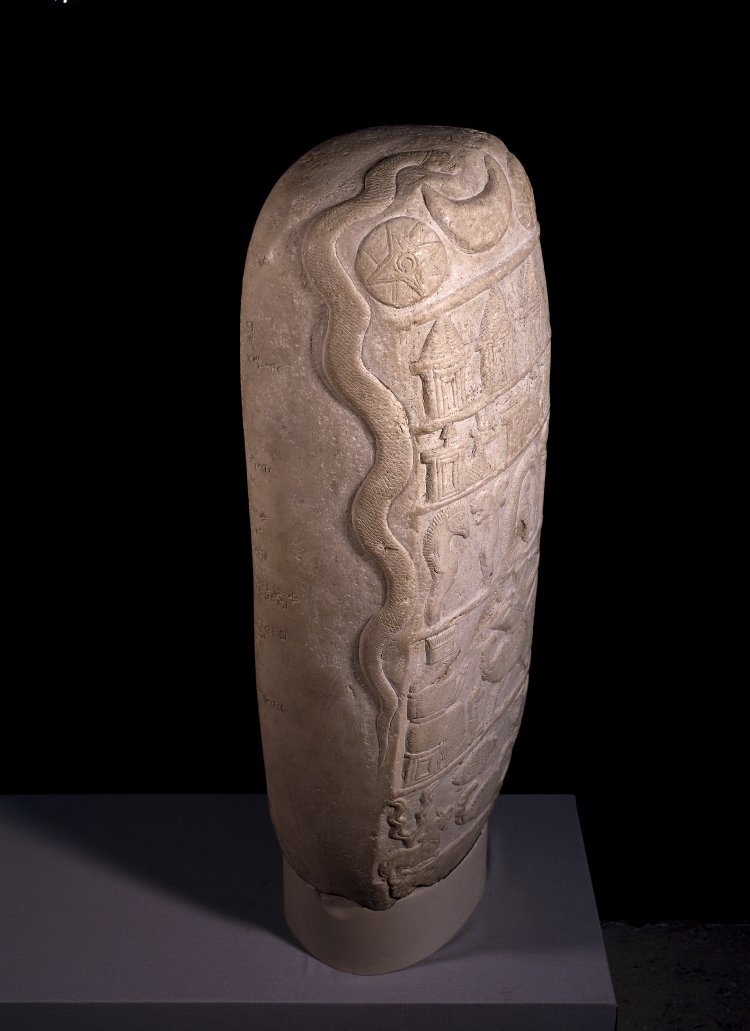
British Museum number 90858 Description 3/4: Right Limestone stela in the form of a boundary-stone: consisting of a block of calcareous limestone, shaped and prepared on four sides to take sculptures and inscriptions. It is now mounted on a stone plinth.  Faces B and C each bear a single column of inscription, the lines running the full width of the stone.  The top of the stone and Face D have been left blank, except for the serpent, which has been carved to the left of the emblems on Face A.  Inscribed with a Charter from the reign of Nebuchadnezzar I.

British Museum number 90858
Description 3/4: Right
Limestone stela in the form of a boundary-stone: consisting of a block of calcareous limestone, shaped and prepared on four sides to take sculptures and inscriptions. It is now mounted on a stone plinth.
Faces B and C each bear a single column of inscription, the lines running the full width of the stone.
The top of the stone and Face D have been left blank, except for the serpent, which has been carved to the left of the emblems on Face A.
Inscribed with a Charter from the reign of Nebuchadnezzar I.

Thus in Register 1, we have the Star of Ishtar, the crescent of the Moon-god Sin, and the disk of Shamash the Sun-god. In Reg. 2 are three stands (?) surmounted by tiaras, which represent the gods Anu, Enlil (Bel) and Ea respectively. In Reg. 3 are three altars (?) or shrines (?) with a monster in Nos. 1 and 2. Over the first is the lance of Marduk, over the second the mason’s square of Nabû, and over the third is the symbol of the goddess Ninkharsag, the Creatress. In Reg. 4 are a standard with an animal’s head, a sign of Ea; a two-headed snake = the Twins; an unknown symbol with a horse’s head, and a bird, representative of Shukamuna and Shumalia. In Reg. 5 are a seated figure of the goddess Gula and the Scorpion-man. In Reg. 6 are forked lightning, symbol of Adad, above a bull, the Tortoise, symbol of Ea (?), the Scorpion of the goddess Ishkhara, and the Lamp of Nusku, the Fire-god.  Down the left-hand side is the serpent-god representing the constellation of the Hydra.

Thus in Register 1, we have the Star of Ishtar, the crescent of the Moon-god Sin, and the disk of Shamash the Sun-god.
In Reg. 2 are three stands (?) surmounted by tiaras, which represent the gods Anu, Enlil (Bel) and Ea respectively.
In Reg. 3 are three altars (?) or shrines (?) with a monster in Nos. 1 and 2. Over the first is the lance of Marduk, over the second the mason’s square of Nabû, and over the third is the symbol of the goddess Ninkharsag, the Creatress.
In Reg. 4 are a standard with an animal’s head, a sign of Ea; a two-headed snake = the Twins; an unknown symbol with a horse’s head, and a bird, representative of Shukamuna and Shumalia.
In Reg. 5 are a seated figure of the goddess Gula and the Scorpion-man.
In Reg. 6 are forked lightning, symbol of Adad, above a bull, the Tortoise, symbol of Ea (?), the Scorpion of the goddess Ishkhara, and the Lamp of Nusku, the Fire-god.
Down the left-hand side is the serpent-god representing the constellation of the Hydra.

The mutilated text of the Fifth Tablet makes it impossible to gain further details in connection with Marduk’s work in arranging the heavens. We are, however, justified in assuming that the gaps in it contained statements about the grouping of the gods into triads.

In royal historical inscriptions the kings often invoke the gods in threes, though they never call any one three a triad or trinity. It seems as if this arrangement of gods in threes was assumed to be of divine origin.

In the Fourth Tablet of Creation, one triad “Anu-Bel-Ea” is actually mentioned, and in the Fifth Tablet, another is indicated, “Sin-Shamash-Ishtar.”

In these triads Anu represents the sky or heaven, Bel or Enlil the region under the sky and including the earth, Ea the underworld, Sin the Moon, Shamash the Sun, and Ishtar the star Venus.

When the universe was finally constituted several other great gods existed, e.g., Nusku, the Fire-god, Enurta, a solar god, Nergal, the god of war and handicrafts, Nabu, the god of learning, Marduk of Babylon, the great national god of Babylonia, and Ashur, the great national god of Assyria.

E.A. Wallis Budge, et al, & the British Museum, The Babylonian Legends of the Creation & the Fight Between Bel & the Dragon Told by Assyrian Tablets from Nineveh (BCE 668-626), 1901, pp. 11-2.

More on the Babylonian Zodiac

” … Then returning to the dead body of Tiâmat he smashed her skull with his club and scattered her blood to the north wind, and as a reward for his destruction of their terrible foe, he received gifts and presents from the gods his fathers.

The text then goes on to say that Marduk “devised a cunning plan,” i.e., he determined to carry out a series of works of creation.

He split the body of Tiâmat into two parts; out of one half he fashioned the dome of heaven, and out of the other he constructed the abode of Nudimmud, or Ea, which he placed over against Apsu, i.e., the deep.

He also formulated regulations concerning the maintenance of the same. By this “cunning plan” Marduk deprived the powers of darkness of the opportunity of repeating their revolt with any chance of success.

Having established the framework of his new heaven and earth Marduk, acting as the celestial architect, set to work to furnish them. In the first place he founded E-Sharra, or the mansion of heaven, and next he set apart and arranged proper places for the old gods of the three realms–Anu, Bel and Ea.

Illustration: Tablet sculptured with a scene representing the worship of the Sun-god in the Temple of Sippar.  The Sun-god is seated on a throne within a pavilion holding in one hand a disk and bar which may symbolize eternity.  Above his head are the three symbols of the Moon, the Sun, and the planet Venus.  On a stand in front of the pavilion rests the disk of the Sun, which is held in position by ropes grasped in the hands of two divine beings who are supported by the roof of the pavilion.  The pavilion of the Sun-god stands on the Celestial Ocean, and the four small disks indicate either the four cardinal points or the tops of the pillars of the heavens.  The three figures in front of the disk represent the high priest of Shamash, the king (Nabu-aplu-iddina, about 870 B.C.) and an attendant goddess. [No. 91,000.]

Illustration: Tablet sculptured with a scene representing the worship of the Sun-god in the Temple of Sippar.
The Sun-god is seated on a throne within a pavilion holding in one hand a disk and bar which may symbolize eternity.
Above his head are the three symbols of the Moon, the Sun, and the planet Venus.
On a stand in front of the pavilion rests the disk of the Sun, which is held in position by ropes grasped in the hands of two divine beings who are supported by the roof of the pavilion.
The pavilion of the Sun-god stands on the Celestial Ocean, and the four small disks indicate either the four cardinal points or the tops of the pillars of the heavens.
The three figures in front of the disk represent the high priest of Shamash, the king (Nabu-aplu-iddina, about 870 B.C.) and an attendant goddess. [No. 91,000.]

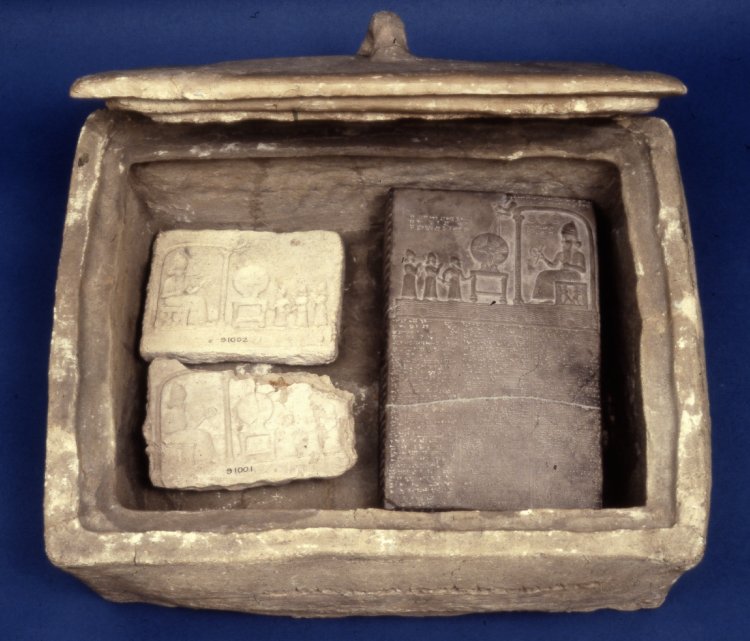
Museum number 91000 The engraved text contains a record of Nabu-apla-iddina's re-endowment of the Sun-Temple at Sippar. The inscription is engraved in six columns, three upon the obverse and three upon the reverse; and the upper part of the obverse is occupied by a scene sculptured in low relief; the edges of the tablet are bevelled.

Museum number 91000
The engraved text contains a record of Nabu-apla-iddina’s re-endowment of the Sun-Temple at Sippar. The inscription is engraved in six columns, three upon the obverse and three upon the reverse; and the upper part of the obverse is occupied by a scene sculptured in low relief; the edges of the tablet are bevelled.

Museum number 91000 Group of Objects Pottery box and the limestone sun-god tablet and its covers deposited in it by Nabopolassar.

Museum number 91000
Group of Objects
Pottery box and the limestone sun-god tablet and its covers deposited in it by Nabopolassar.

The text of the Fifth Tablet, which would undoubtedly have supplied details as to Marduk’s arrangement and regulations for the sun, the moon, the stars, and the Signs of the Zodiac in the heavens is wanting.

The prominence of the celestial bodies in the history of creation is not to be wondered at, for the greater number of the religious beliefs of the Babylonians are grouped round them. Moreover, the science of astronomy had gone hand in hand with the superstition of astrology in Mesopotamia from time immemorial; and at a very early period the oldest gods of Babylonia were associated with the heavenly bodies.

Thus the Annunaki and the Igigi, who are bodies of deified spirits, were identified with the stars of the northern and southern heaven, respectively. And all the primitive goddesses coalesced and were grouped to form the goddess Ishtar, who was identified with the Evening and Morning Star, or Venus.

The Babylonians believed that the will of the gods was made known to men by the motions of the planets, and that careful observation of them would enable the skilled seer to recognize in the stars favourable and unfavourable portents. Such observations, treated from a magical point of view, formed a huge mass of literature which was being added to continually.

From the nature of the case this literature enshrined a very considerable number of facts of pure astronomy, and as early as the period of the First Dynasty (about 2000 B.C.), the Babylonians were able to calculate astronomical events with considerable accuracy, and to reconcile the solar and lunar years by the use of epagomenal months.

They had by that time formulated the existence of the Zodiac, and fixed the “stations” of the moon, and the places of the planets with it; and they had distinguished between the planets and the fixed stars. In the Fifth Tablet of the Creation Series (l. 2) the Signs of the Zodiac are called Lumashi, but unfortunately no list of their names is given in the context.

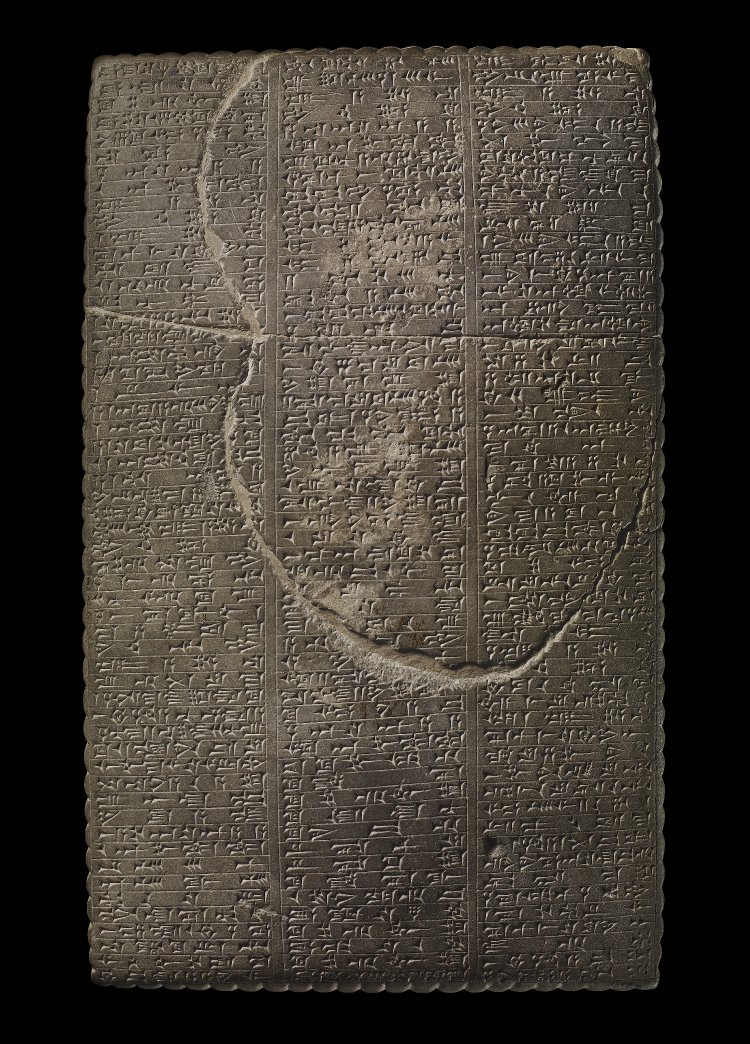
 Illustration: Tablet inscribed with a list of the Signs of the Zodiac. [No. 77,821.]


Illustration: Tablet inscribed with a list of the Signs of the Zodiac. [No. 77,821.]

Now these are supplied by the little tablet (No. 77,821) of the Persian Period of which a reproduction is here given. It has been referred to and discussed by various scholars, and its importance is very great. The transcript of the text, which is now published (see p. 68) for the first time, will be acceptable to the students of the history of the Zodiac.

Egyptian, Greek, Syriac and Arabic astrological and astronomical texts all associate with the Signs of the Zodiac twelve groups, each containing three stars, which are commonly known as the “Thirty-six Dekans.”

The text of line 4 of the Fifth Tablet of the Creation Series proves that the Babylonians were acquainted with these groups of stars, for we read that Marduk “set up for the twelve months of the year three stars apiece.” In the List of Signs of the Zodiac here given, it will be seen that each Sign is associated with a particular month.

At a later period, say about 500 B.C., the Babylonians made some of the gods regents of groups of stars, for Enlil ruled 33 stars, Anu 23 stars, and Ea 15 stars. They also possessed lists of the fixed stars, and drew up tables of the times of their heliacal risings.

Such lists were probably based upon very ancient documents, and prove that the astral element in Babylonian religion was very considerable.”

E.A. Wallis Budge, et al, & the British Museum, The Babylonian Legends of the Creation & the Fight Between Bel & the Dragon Told by Assyrian Tablets from Nineveh (BCE 668-626), 1901, pp. 10-11.

The Sumerians Considered the Deluge an Historic Event

” … It is, at all events, well known that the Sumerians regarded the Deluge as an historic event, which they were, practically, able to date, for some of their records contain lists of kings who reigned before the Deluge, though it must be confessed that the lengths assigned to their reigns are incredible. After their rule it is expressly noted that the Flood occurred, and that, when it passed away, kingship came down again from on high.

It is not too much to assume that the original event commemorated in the Legend of the Deluge was a serious and prolonged inundation or flood in Lower Babylonia, which was accompanied by great loss of life and destruction of property.

The Babylonian versions state that this inundation or flood was caused by rain, but passages in some of them suggest that the effects of the rainstorm were intensified bv other physical happenings connected with the earth, of a most destructive character.

The Hebrews also, as we may see from the Bible, had alternative views as to the cause of the Deluge. According to one, rain fell upon the earth for forty days and forty nights (Gen. vii, 12), and according to the other the Deluge came because “all the fountains of the great deep” were broken up, and “the flood-gates of heaven were opened” (Gen. vii, ii).

The latter view suggests that the rain flood was joined by the waters of the sea. Later tradition, derived partly from Babylonian and partly from Hebrew sources, asserts, e.g., in the Cave of Treasures, a Syriac treatise composed probably at Edessa about the fifth or sixth century A.D., that when Noah had entered the Ark and the door was shut …

“… the floodgates of the heavens were opened it and the foundations of the earth were rent asunder,” and that “the ocean, that great sea which surroundeth the whole world, poured forth its floods. And whilst the floodgates of heaven were open, and the foundations of the earth were rent asunder, the storehouses of the winds burst their bolts, and storms and whirlwinds swept forth, and ocean roared and hurled its floods upon the earth.”

The ark was steered over the waters by an angel who acted as pilot, and when that had come to rest on the mountains of Kardô (Ararat),

“God commanded the waters and they became separated from each other. The celestial waters were taken up and ascended to their own place above the heavens whence they came. The waters which had risen up from the earth returned to the lowermost abyss, and those which belonged to the ocean returned to the innermost part thereof.”

Many authorities seeking to find a foundation of fact for the Legend of the Deluge in Mesopotamia have assumed that the rain-flood was accompanied either by an earthquake or a tidal-wave, or by both. There is no doubt that the cities of Lower Babylonia were nearer the sea in the Sumerian Period than they are at present, and it is a generally accepted view that the head of the Persian Gulf lay farther to the north at that time. A cyclone coupled with a tidal wave is a sufficient base for any of the forms of the Legend now known.

A comparison of the contents of the various Sumerian and Babylonian versions of the Deluge that have come down to us shows us that they are incomplete. And as none of them tells so connected and full a narrative of the prehistoric shipbuilder as Berosus, a priest of Bêl, the great god of Babylon, it seems that the Mesopotamian scribes were content to copy the Legend in an abbreviated form.”

E.A. Wallis Budge, The Babylonian Story of the Deluge and the Epic of Gilgamish1929, pp. 27-8.

Bel-Merodach Returns to Babylon

” … Babylon welcomed its new king–a Babylonian by birth and the son of a Babylonian princess. The ancient kingdom rejoiced that it was no longer to be ruled as a province; its ancient dignities and privileges were being partially restored.

But one great and deep-seated grievance remained. The god Merodach was still a captive in the temple of Ashur.

No king could reign aright if Merodach were not restored to E-sagila. Indeed he could not be regarded as the lord of the land until he had “taken the hands of Bel.”

The ceremony of taking the god’s hands was an act of homage. When it was consummated the king became the steward or vassal of Merodach, and every day he appeared before the divine one to receive instructions and worship him. The welfare of the whole kingdom depended on the manner in which the king acted towards the god.

If Merodach was satisfied with the king he sent blessings to the land; if he was angry he sent calamities. A pious and faithful monarch was therefore the protector of the people.

This close association of the king with the god gave the priests great influence in Babylon. They were the power behind the throne. The destinies of the royal house were placed in their hands; they could strengthen the position of a royal monarch, or cause him to be deposed if he did not satisfy their demands.

A king who reigned over Babylon without the priestly party on his side occupied an insecure position. Nor could he secure the co-operation of the priests unless the image of the god was placed in the temple. Where king was, there Merodach had to be also.

Shamash-shum-ukin pleaded with his royal brother and overlord to restore Bel Merodach to Babylon. Ashur-bani-pal hesitated for a time; he was unwilling to occupy a less dignified position, as the representative of Ashur, than his distinguished predecessor, in his relation to the southern kingdom.

At length, however, he was prevailed upon to consult the oracle of Shamash, the solar lawgiver, the revealer of destiny. The god was accordingly asked if Shamash-shum-ukin could “take the hands of Bel” in Ashur’s temple, and then proceed to Babylon as his representative.

In response, the priests of Shamash informed the emperor that Bel Merodach could not exercise sway as sovereign lord so long as he remained a prisoner in a city which was not his own.

Ashur-bani-pal accepted the verdict, and then visited Ashur’s temple to plead with Bel Merodach to return to Babylon.

“Let thy thoughts,” he cried, “dwell in Babylon, which in thy wrath thou didst bring to naught. Let thy face be turned towards E-sagila, thy lofty and divine temple. Return to the city thou hast deserted for a house unworthy of thee. O Merodach! lord of the gods, issue thou the command to return again to Babylon.”

Thus did Ashur-bani-pal make pious and dignified submission to the will of the priests. A favourable response was, of course, received from Merodach when addressed by the emperor, and the god’s image was carried back to E-sagila, accompanied by a strong force.

Ashur-bani-pal and Shamash-shum-ukin led the procession of priests and soldiers, and elaborate ceremonials were observed at each city they passed, the local gods being carried forth to do homage to Merodach.

Babylon welcomed the deity who was thus restored to his temple after the lapse of about a quarter of a century, and the priests celebrated with unconcealed satisfaction and pride the ceremony at which Shamash-shum-ukin “took the hands of Bel.”

The public rejoicings were conducted on an elaborate scale. Babylon believed that a new era of prosperity had been inaugurated, and the priests and nobles looked forward to the day when the kingdom would once again become free and independent and powerful.”

Donald A. Mackenzie, Myths of Babylonia and Assyria, 1915, pp. 480-2.

The Assassination of Sargon

Thus “Sargon the Later” entered at length into full possession of the empire of Sargon of Akkad. In Babylonia he posed as an incarnation of his ancient namesake, and had similarly Messianic pretensions which were no doubt inspired by the Babylonian priesthood. Under him Assyria attained its highest degree of splendour.

He recorded proudly not only his great conquests but also his works of public utility: he restored ancient cities, irrigated vast tracts of country, fostered trade, and promoted the industries. Like the pious Pharaohs of Egypt he boasted that he fed the hungry and protected the weak against the strong.

” … Sargon found time during his strenuous career as a conqueror to lay out and build a new city, called Dur-Sharrukin, “the burgh of Sargon,” to the north of Nineveh. It was completed before he undertook the Babylonian campaign. The new palace was occupied in 708 B.C. Previous to that period he had resided principally at Kalkhi, in the restored palace of Ashur-natsir-pal III.

He was a worshipper of many gods. Although he claimed to have restored the supremacy of Ashur “which had come to an end,” he not only adored Ashur but also revived the ancient triad of Anu, Bel, and Ea, and fostered the growth of the immemorial “mother-cult” of Ishtar.

Before he died he appointed one of his sons, Sennacherib, viceroy of the northern portion of the empire. He was either assassinated at a military review or in some frontier war. As much is suggested by the following entry in an eponym list.

Eponymy of Upahhir-belu, prefect of the city of Amedu …

According to the oracle of the Kulummite(s)…. A soldier

(entered) the camp of the king of Assyria (and killed him?), month

Ab, day 12th, Sennacherib (sat on the throne).

The fact that Sennacherib lamented his father’s sins suggests that the old king had in some manner offended the priesthood. Perhaps, like some of the Middle Empire monarchs, he succumbed to the influence of Babylon during the closing years of his life.

It is stated that “he was not buried in his house,” which suggests that the customary religious rites were denied him, and that his lost soul was supposed to be a wanderer which had to eat offal and drink impure water like the ghost of a pauper or a criminal.”

Donald A. Mackenzie, Myths of Babylonia and Assyria, 1915, pp. 462-4.

The Babylonian Account of the Deluge

The story of the Deluge which was related to Gilgamesh by Pir-napishtim runs as follows:–

“Hear me, O Gilgamesh, and I will make revelation regarding the hidden doings of the high gods. As thou knowest, the city of Shurippak is situated upon the bank of the Euphrates. The gods were within it: there they assembled together in council.

Anu, the father, was there, and Bel the counsellor and warrior, Ninip the messenger, and Ennugi the governor. Ea, the wise lord, sat also with them. In their hearts the gods agreed together to send a great deluge.

“Thereafter Ea made known the purpose of the divine rulers in the hut of reeds, saying: ‘O hut of reeds, hear; O wall, understand … O man of Shurippak, son of Umbara Tutu, tear down thy house and build a ship; leave all thou dost possess and save thy life, and preserve in the ship the living seed of every kind. The ship that thou wilt build must be of goodly proportions in length and height. It must be floated on the great deep.’

“I heard the command of Ea and understood, and I made answer, saying, ‘O wise lord, as thou hast said so will I do, for thy counsel is most excellent. But how shall I give reason for my doings to the young men and the elders?’

“Ea opened his mouth and said unto me, his servant: ‘What thou shalt say unto them is this…. It hath been revealed unto me that Bel doth hate me, therefore I cannot remain any longer in his domain, this city of Shurippak, so I must depart unto the domain of Ea and dwell with him…. Unto you will Bel send abundance of rain, so that you may obtain birds and fishes in plenty and have a rich harvest. But Shamash hath appointed a time for Ramman to pour down destruction from the heavens.‘”

Ea then gave instructions to Pir-napishtim how to build the ship in which he should find refuge. So far as can be gathered from the fragmentary text, it appears that this vessel was to have a deck house six stories high, with nine apartments in each story. According to another account, Ea drew a plan of the great ship upon the sand.

Pir-napishtim set to work and made a flat-bottomed vessel, which was 120 cubits wide and 120 cubits in height. He smeared it with bitumen inside and pitch outside; and on the seventh day it was ready. Then he carried out Ea’s further instructions. Continuing his narrative to Gilgamesh, he said:

“I gathered together all that I possessed, my silver and gold and seeds of every kind, and my goods also. These I placed in the ship. Then I caused to go aboard all my family and house servants, the animals of the field and the beasts of the field and the workers–every one of them I sent up.

“The god Shamash appointed the time, saying: ‘I will cause the Night Lord to send much rain and bring destruction. Then enter thou the ship and shut thy door.’

“At the appointed time the Night Lord sent at even-time much rain. I saw the beginning of the deluge and I was afraid to look up. I entered the ship and shut the door. I appointed Buzur-Kurgala, the sailor, to be captain, and put under his command the great vessel and all that it contained.

“At the dawn of day I saw rising athwart the heavens a dark cloud, and in the midst of it Ramman thundered. Nebo and Merodach went in front, speeding like emissaries over hills and plains. The cables of the ship were let loose.

“Then Ninip, the tempest god, came nigh, and the storm broke in fury before him. All the earth spirits leapt up with flaming torches and the whole land was aflare. The thunder god swept over the heavens, blotting out the sunlight and bringing thick darkness.

Rain poured down the whole day long, and the earth was covered with water; the rivers were swollen; the land was in confusion; men stumbled about in the darkness, battling with the elements.

Brothers were unable to see brothers; no man could recognize his friends…. The spirits above looked down and beheld the rising flood and were afraid: they fled away, and in the heaven of Anu they crouched like to hounds in the protecting enclosures.

“In time Ishtar, the lady of the gods, cried out distressfully, saying: ‘The elder race hath perished and turned to clay because that I have consented to evil counsel in the assembly of the gods. Alas! I have allowed my people to be destroyed. I gave being to man, but where is he? Like the offspring of fish he cumbers the deep.’

“The earth spirits were weeping with Ishtar: they sat down cowering with tightened lips and spake not; they mourned in silence.

“Six days and six nights went past, and the tempest raged over the waters which gradually covered the land. But when the seventh day came, the wind fell, the whirling waters grew peaceful, and the sea retreated. The storm was over and the rain of destruction had ceased. I looked forth. I called aloud over the waters. But all mankind had perished and turned to clay. Where fields had been I saw marshes only.

“Then I opened wide the window of the ship, and the sunlight suffused my countenance. I was dazzled and sank down weeping and the tears streamed over my face. Everywhere I looked I saw water.

“At length, land began to appear. The ship drifted towards the country of Nitsir, and then it was held fast by the mountain of Nitsir. Six days went past and the ship remained stedfast. On the seventh day I sent forth a dove, and she flew away and searched this way and that, but found no resting place, so she returned.

I then sent forth a swallow, and she returned likewise. Next I sent forth a raven, and she flew away. She saw that the waters were shrinking, and gorged and croaked and waded, but did not come back. Then I brought forth all the animals into the air of heaven.

“An offering I made on the mountain. I poured out a libation. I set up incense vessels seven by seven on heaped-up reeds and used cedar wood with incense. The gods smelt the sweet savour, and they clustered like flies about the sacrificer.

“Thereafter Ishtar (Sirtu) drew nigh. Lifting up the jewels, which the god Anu had fashioned for her according to her desire, she spake, saying: ‘Oh! these gods! I vow by the lapis lazuli gems upon my neck that I will never forget! I will remember these days for ever and ever. Let all the gods come hither to the offering, save Bel (Enlil) alone, because that he ignored my counsel, and sent a great deluge which destroyed my people.’

“But Bel Enlil came also, and when he beheld the ship he paused. His heart was filled with wrath against the gods and the spirits of heaven. Angrily he spake and said: ‘Hath one escaped? It was decreed that no human being should survive the deluge.’

“Ninip, son of Bel, spoke, saying: ‘Who hath done this save Ea alone? He knoweth all things.’

“Ea, god of the deep, opened his mouth and said unto the warrior Bel: ‘Thou art the lord of the gods, O warrior. But thou wouldst not hearken to my counsel and caused the deluge to be. Now punish the sinner for his sins and the evil doer for his evil deed, but be merciful and do not destroy all mankind. May there never again be a flood.

Let the lion come and men will decrease. May there never again be a flood. Let the leopard come and men will decrease. May there never again be a flood. Let famine come upon the land; let Ura, god of pestilence, come and snatch off mankind…. I did not reveal the secret purpose of the mighty gods, but I caused Atra-chasis (Pir-napishtim) to dream a dream in which he had knowledge of what the gods had decreed.’

“Having pondered a time over these words, Bel entered the ship alone. He grasped my hand and led me forth, even me, and he led forth my wife also, and caused her to kneel down beside me. Then he stood between us and gave his blessing.

He spoke, saying: ‘In time past Pir-napishtim was a man. Henceforth Pir-napishtim and his wife will be like unto deities, even us. Let them dwell apart beyond the river mouths.’

“Thereafter Bel carried me hither beyond the mouths of rivers.”

Donald A. Mackenzie, Myths of Babylonia and Assyria, 1915.

Excerpts from the Epic of Gilgamesh

” … Pir-napishtim made answer, reminding the pilgrim that all men must die. Men built houses, sealed contracts, disputed one with another, and sowed seeds in the earth, but as long as they did so and the rivers rose in flood, so long would their fate endure. Nor could any man tell when his hour would come. The god of destiny measured out the span of life: he fixed the day of death, but never revealed his secrets.

Gilgamesh then asked Pir-napishtim how it chanced that he was still alive. “Thou hast suffered no change,” he said, “thou art even as I am. Harden not thy heart against me, but reveal how thou hast obtained divine life in the company of the gods.”

Pir-napishtim thereupon related to his descendant the story of the deluge … The gods had resolved to destroy the world, and Ea in a dream revealed unto Pir-napishtim how he could escape. He built a ship which was tossed about on the waters, and when the world had been destroyed, Bel discovered him and transported him to that island in the midst of the Sea of Death.

Gilgamesh sat in the boat listening to the words of his ancestor. When the narrative was ended, Pir-napishtim spoke sympathetically and said: “Who among the gods will restore thee to health, O Gilgamesh? Thou hast knowledge of my life, and thou shalt be given the life thou dost strive after. Take heed, therefore, to what I say unto thee. For six days and seven nights thou shalt not lie down, but remain sitting like one in the midst of grief.”

Gilgamesh sat in the ship, and sleep enveloped him like to a black storm cloud.

Pir-napishtim spoke to his wife and said: “Behold the hero who desireth to have life. Sleep envelops him like to a black storm cloud.”

To that lone man his wife made answer: “Lay thine hand upon him so that he may have perfect health and be enabled to return to his own land. Give him power to pass through the mighty door by which he entered.”

Then Pir-napishtim addressed his wife, saying: “His sufferings make me sad. Prepare thou for him the magic food, and place it near his head.”

On the day when Gilgamesh lay down, the food was prepared by seven magic processes, and the woman administered it while yet he slept. Then Pir-napishtim touched him, and he awoke full of life.

Gilgamesh spake unto Pir-napishtim and said: “I was suddenly overcome by sleep…. But thou didst awaken me by touching me, even thou…. Lo! I am bewitched. What hast thou done unto thy servant?”

Then Pir-napishtim told Gilgamesh that he had been given to eat of the magic food. Afterwards he caused Arad Ea to carry Gilgamesh to a fountain of healing, where his disease-stricken body was cleansed. The blemished skin fell from him, and he was made whole.

Thereafter Gilgamesh prepared to return to his own land. Ere he bade farewell, however, Pir-napishtim revealed unto him the secret of a magic plant which had power to renew life and give youth and strength unto those who were old.

Arad Ea conducted the hero to the island where the plant grew, and when Gilgamesh found it he rejoiced, and said that he would carry it to Erech, his own city, where he would partake of it and restore his youth.

So Gilgamesh and Arad Ea went on their way together, nor paused until they came to a well of pure water. The hero stooped down to draw water. But while he was thus engaged that demon, the Earth Lion, crept forth as a serpent, and, seizing the magic plant of life, carried it away. Stricken with terror, Gilgamesh uttered a curse. Then he sat down and wept bitterly, and the tears streamed over his face. To Arad Ea he spake, saying: “Why has my health been restored to me? Why should I rejoice because that I live? The benefit which I should have derived for myself has now fallen to the Earth Lion.”

The two travellers then resumed their journey, performing religious acts from time to time; chanting dirges and holding feasts for the dead, and at length Gilgamesh returned to Erech. He found that the city walls were crumbling, and he spake regarding the ceremonies which had been performed while yet he was in a far-distant country.

During the days which followed Gilgamesh sorrowed for his lost friend Ea-bani, whose spirit was in the Underworld, the captive of the spirits of death. “Thou canst not draw thy bow now,” he cried, “nor raise the battle shout. Thou canst not kiss the woman thou hast loved; thou canst not kiss the child thou hast loved, nor canst thou smite those whom thou hast hated.”

In vain Gilgamesh appealed to his mother goddess to restore Ea-bani to him. Then he turned to the gods, and Ea heard him. Thereafter Nergal, god of death, caused the grave to yawn, and the spirit of Ea-bani arose like a wind gust.

Gilgamesh, still dreading death, spoke to the ghost of his friend, saying: “Tell me, my friend, O tell me regarding the land in which thou dost dwell.”

Ea-bani made answer sorrowfully: “Alas! I cannot tell thee, my friend. If I were to tell thee all, thou wouldst sit down and weep.”

Said Gilgamesh: “Let me sit down and weep, but tell me regarding the land of spirits.”

The text is mutilated here, but it can be gathered that Ea-bani described the land where ill-doers were punished, where the young were like the old, where the worm devoured, and dust covered all. But the state of the warrior who had been given burial was better than that of the man who had not been buried, and had no one to lament or care for him.

“He who hath been slain in battle,” the ghost said, “reposeth on a couch drinking pure water–one slain in battle as thou hast seen and I have seen. His head is supported by his parents: beside him sits his wife. His spirit doth not haunt the earth.

But the spirit of that man whose corpse has been left unburied and uncared for, rests not, but prowls through the streets eating scraps of food, the leavings of the feast, and drinking the dregs of vessels.”

So ends the story of Gilgamesh in the form which survives to us.”

Donald A. Mackenzie, Myths of Babylonia and Assyria, 1915.