Samizdat

Publishing the Forbidden. All Rights Reserved. © Samizdat 2014-2026.

Tag: Babylonia

Twins

“The close association of Enkidu and Gilgamesh which becomes one of the striking features in the combination of the tales of these two heroes naturally recalls the “Heavenly Twins” motif, which has been so fully and so suggestively treated by Professor J. Rendell Harris in his Cult of the Heavenly Twins, (London, 1906).

Professor Harris has conclusively shown how widespread the tendency is to associate two divine or semi-divine beings in myths and legends as inseparable companions or twins, like Castor and Pollux, Romulus and Remus, the Acvins in the Rig-Veda, Cain and Abel, Jacob and Esau in the Old Testament, the Kabiri of the Phoenicians, Herakles and Iphikles in Greek mythology, Ambrica and Fidelio in Teutonic mythology, Patollo and Potrimpo in old Prussian mythology, Cautes and Cautopates in Mithraism, Jesus and Thomas (according to the Syriac Acts of Thomas), and the various illustrations of “Dioscuri in Christian Legends,” set forth by Dr. Harris in his work under this title, which carries the motif far down into the period of legends about Christian Saints who appear in pairs, including the reference to such a pair in Shakespeare’s Henry V:

“And Crispin Crispian shall ne’er go by

From that day to the ending of the world.”

–(Act, IV, 3, 57-58.)

There are indeed certain parallels which suggest that Enkidu-Gilgamesh may represent a Babylonian counterpart to the “Heavenly Twins.” In the Indo-Iranian, Greek and Roman mythology, the twins almost invariably act together. In unison they proceed on expeditions to punish enemies.

But after all, the parallels are of too general a character to be of much moment; and moreover the parallels stop short at the critical point, for Gilgamesh though worsted is not killed by Enkidu, whereas one of the “Heavenly Twins” is always killed by the brother, as Abel is by Cain, and Iphikles by his twin brother Herakles.

Even the trait which is frequent in the earliest forms of the “Heavenly Twins,” according to which one is immortal and the other is mortal, though applying in a measure to Enkidu who is killed by Ishtar, while Gilgamesh the offspring of a divine pair is only smitten with disease, is too unsubstantial to warrant more than a general comparison between the Enkidu-Gilgamesh pair and the various forms of the “twin” motif found throughout the ancient world.

For all that, the point is of some interest that in the Gilgamesh Epic we should encounter two figures who are portrayed as possessing the same traits and accomplishing feats in common, which suggest a partial parallel to the various forms in which the twin-motif appears in the mythologies, folk-lore and legends of many nations; and it may be that in some of these instances the duplication is due, as in the case of Enkidu and Gilgamesh, to an actual transfer of the traits of one figure to another who usurped his place.”

Morris Jastrow (ed.), Albert T. Clay (trans.), An Old Babylonian Version of the Gilgamesh Epic on the Basis of Recently Discovered Texts, 1920, pp. 22-3.

Contrasting Views of Women in Genesis and the Epic of Gilgamesh

“Tablet I, col. 2, 34-35: Creation of Enkidu by Aruru.

36-41: Description of Enkidu’s hairy body and of his life with the animals.

42-50: The hunter sees Enkidu, who shows his anger, as also his woe, at his condition.

3, 1-12: The hunter tells his father of the strange being who pulls up the traps which the hunter digs, and who tears the nets so that the hunter is unable to catch him or the animals.

19-24: The father of the hunter advises his son on his next expedition to take a woman with him in order to lure the strange being from his life with the animals.

Line 25, beginning “On the advice of his father,” must have set forth, in the original form of the episode, how the hunter procured the woman and took her with him to meet Enkidu.

Column 4 gives in detail the meeting between the two, and naïvely describes how the woman exposes her charms to Enkidu, who is captivated by her and stays with her six days and seven nights. The animals see the change in Enkidu and run away from him. He has been transformed through the woman.  . In the Assyrian version there follows an address of the woman to Enkidu beginning (col. 4, 34):

“Beautiful art thou, Enkidu, like a god art thou.”

We find her urging him to go with her to Erech, there to meet Gilgamesh and to enjoy the pleasures of city life with plenty of beautiful maidens. Gilgamesh, she adds, will expect Enkidu, for the coming of the latter to Erech has been foretold in a dream.  

The address of the woman begins in line 51 of the Pennsylvania tablet:

“I gaze upon thee, Enkidu, like a god art thou.”

This corresponds to the line in the Assyrian version (I, 4, 34) as given above, just as lines 52-53: “Why with the cattle Dost thou roam across the field?” correspond to I, 4, 35, of the Assyrian version.

There follows in both the old Babylonian and the Assyrian version the appeal of the woman to Enkidu, to allow her to lead him to Erech where Gilgamesh dwells (Pennsylvania tablet lines 54-61 = Assyrian version I, 4, 36-39); but in the Pennsylvania tablet we now have a second speech (lines 62-63) beginning like the first one with al-ka, “come:”

“Come, arise from the accursed ground.”

Enkidu consents, and now the woman takes off her garments and clothes the naked Enkidu, while putting another garment on herself.

She takes hold of his hand and leads him to the sheepfolds (not to Erech!!), where bread and wine are placed before him. Accustomed hitherto to sucking milk with cattle, Enkidu does not know what to do with the strange food until encouraged and instructed by the woman.

The entire third column is taken up with this introduction of Enkidu to civilized life in a pastoral community, and the scene ends with Enkidu becoming a guardian of flocks. Now all this has nothing to do with Gilgamesh, and clearly sets forth an entirely different idea from the one embodied in the meeting of the two heroes.

In the original Enkidu tale, the animal-man is looked upon as the type of a primitive savage, and the point of the tale is to illustrate in the naïve manner characteristic of folklore the evolution to the higher form of pastoral life. …

We now obtain, thanks to the new section revealed by the Pennsylvania tablet, a further analogy with the story of Adam and Eve, but with this striking difference, that whereas in the Babylonian tale the woman is the medium leading man to the higher life, in the Biblical story the woman is the tempter who brings misfortune to man.

This contrast is, however, not inherent in the Biblical story, but due to the point of view of the Biblical writer, who is somewhat pessimistically inclined and looks upon primitive life, when man went naked and lived in a garden, eating of fruits that grew of themselves, as the blessed life in contrast to advanced culture which leads to agriculture and necessitates hard work as the means of securing one’s substance.

Hence the woman through whom Adam eats of the tree of knowledge and becomes conscious of being naked is looked upon as an evil tempter, entailing the loss of the primeval life of bliss in a gorgeous Paradise.

The Babylonian point of view is optimistic. The change to civilized life–involving the wearing of clothes and the eating of food that is cultivated (bread and wine) is looked upon as an advance. Hence the woman is viewed as the medium of raising man to a higher level.

The feature common to the Biblical and Babylonian tales is the attachment of a lesson to early folk-tales. The story of Adam and Eve, as the story of Enkidu and the woman, is told with a purpose. Starting with early traditions of men’s primitive life on earth, that may have arisen independently, Hebrew and Babylonian writers diverged, each group going its own way, each reflecting the particular point of view from which the evolution of human society was viewed.

Leaving the analogy between the Biblical and Babylonian tales aside, the main point of value for us in the Babylonian story of Enkidu and the woman is the proof furnished by the analysis, made possible through the Pennsylvania tablet, that the tale can be separated from its subsequent connection with Gilgamesh.

We can continue this process of separation in the fourth column, where the woman instructs Enkidu in the further duty of living his life with the woman decreed for him, to raise a family, to engage in work, to build cities and to gather resources.

All this is looked upon in the same optimistic spirit as marking progress, whereas the Biblical writer, consistent with his point of view, looks upon work as a curse, and makes Cain, the murderer, also the founder of cities.

The step to the higher forms of life is not an advance according to the J document. It is interesting to note that even the phrase the “cursed ground” occurs in both the Babylonian and Biblical tales; but whereas in the latter (Gen. 3, 17) it is because of the hard work entailed in raising the products of the earth that the ground is cursed, in the former (lines 62-63) it is the place in which Enkidu lives before he advances to the dignity of human life that is “cursed,” and which he is asked to leave. Adam is expelled from Paradise as a punishment, whereas Enkidu is implored to leave it as a necessary step towards progress to a higher form of existence.

The contrast between the Babylonian and the Biblical writer extends to the view taken of viniculture. The Biblical writer (again the J document) looks upon Noah’s drunkenness as a disgrace. Noah loses his sense of shame and uncovers himself (Genesis 9, 21), whereas in the Babylonian description Enkidu’s jolly spirit after he has drunk seven jars of wine meets with approval. The Biblical point of view is that he who drinks wine becomes drunk; the Babylonian says, if you drink wine you become happy.”

Morris Jastrow (ed.), Albert T. Clay (trans.), An Old Babylonian Version of the Gilgamesh Epic on the Basis of Recently Discovered Texts, 1920, pp. 17-8.

More on the Babylonian Zodiac

” … Then returning to the dead body of Tiâmat he smashed her skull with his club and scattered her blood to the north wind, and as a reward for his destruction of their terrible foe, he received gifts and presents from the gods his fathers.

The text then goes on to say that Marduk “devised a cunning plan,” i.e., he determined to carry out a series of works of creation.

He split the body of Tiâmat into two parts; out of one half he fashioned the dome of heaven, and out of the other he constructed the abode of Nudimmud, or Ea, which he placed over against Apsu, i.e., the deep.

He also formulated regulations concerning the maintenance of the same. By this “cunning plan” Marduk deprived the powers of darkness of the opportunity of repeating their revolt with any chance of success.

Having established the framework of his new heaven and earth Marduk, acting as the celestial architect, set to work to furnish them. In the first place he founded E-Sharra, or the mansion of heaven, and next he set apart and arranged proper places for the old gods of the three realms–Anu, Bel and Ea.

Illustration: Tablet sculptured with a scene representing the worship of the Sun-god in the Temple of Sippar.  The Sun-god is seated on a throne within a pavilion holding in one hand a disk and bar which may symbolize eternity.  Above his head are the three symbols of the Moon, the Sun, and the planet Venus.  On a stand in front of the pavilion rests the disk of the Sun, which is held in position by ropes grasped in the hands of two divine beings who are supported by the roof of the pavilion.  The pavilion of the Sun-god stands on the Celestial Ocean, and the four small disks indicate either the four cardinal points or the tops of the pillars of the heavens.  The three figures in front of the disk represent the high priest of Shamash, the king (Nabu-aplu-iddina, about 870 B.C.) and an attendant goddess. [No. 91,000.]

Illustration: Tablet sculptured with a scene representing the worship of the Sun-god in the Temple of Sippar.
The Sun-god is seated on a throne within a pavilion holding in one hand a disk and bar which may symbolize eternity.
Above his head are the three symbols of the Moon, the Sun, and the planet Venus.
On a stand in front of the pavilion rests the disk of the Sun, which is held in position by ropes grasped in the hands of two divine beings who are supported by the roof of the pavilion.
The pavilion of the Sun-god stands on the Celestial Ocean, and the four small disks indicate either the four cardinal points or the tops of the pillars of the heavens.
The three figures in front of the disk represent the high priest of Shamash, the king (Nabu-aplu-iddina, about 870 B.C.) and an attendant goddess. [No. 91,000.]

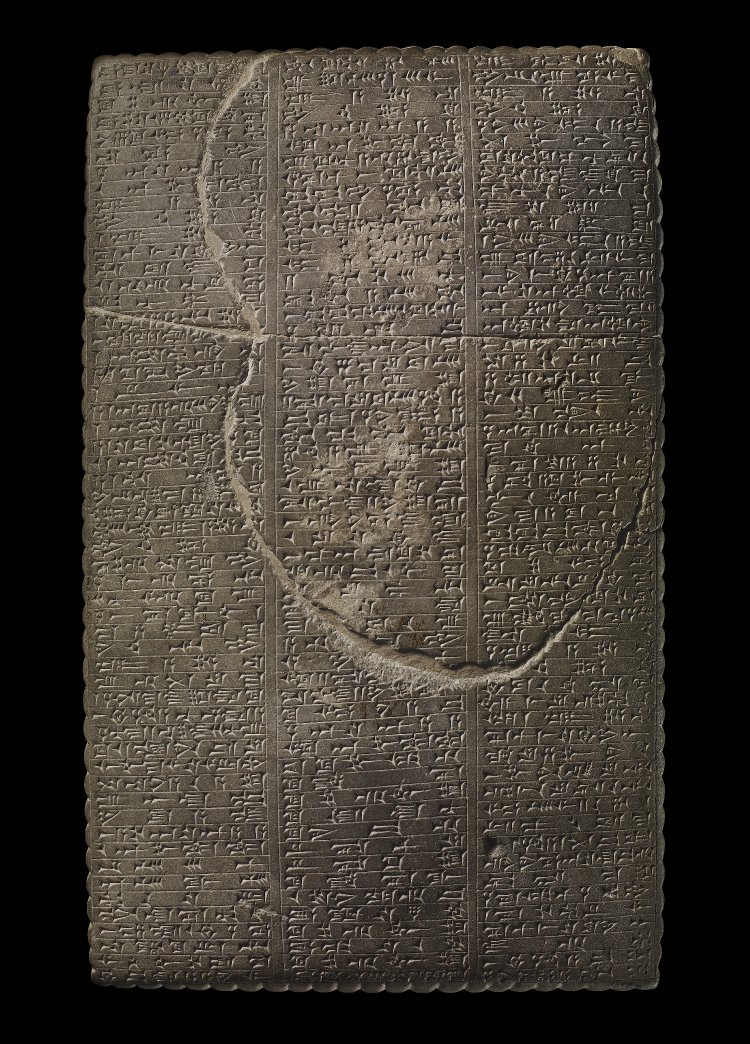
Museum number 91000 The engraved text contains a record of Nabu-apla-iddina's re-endowment of the Sun-Temple at Sippar. The inscription is engraved in six columns, three upon the obverse and three upon the reverse; and the upper part of the obverse is occupied by a scene sculptured in low relief; the edges of the tablet are bevelled.

Museum number 91000
The engraved text contains a record of Nabu-apla-iddina’s re-endowment of the Sun-Temple at Sippar. The inscription is engraved in six columns, three upon the obverse and three upon the reverse; and the upper part of the obverse is occupied by a scene sculptured in low relief; the edges of the tablet are bevelled.

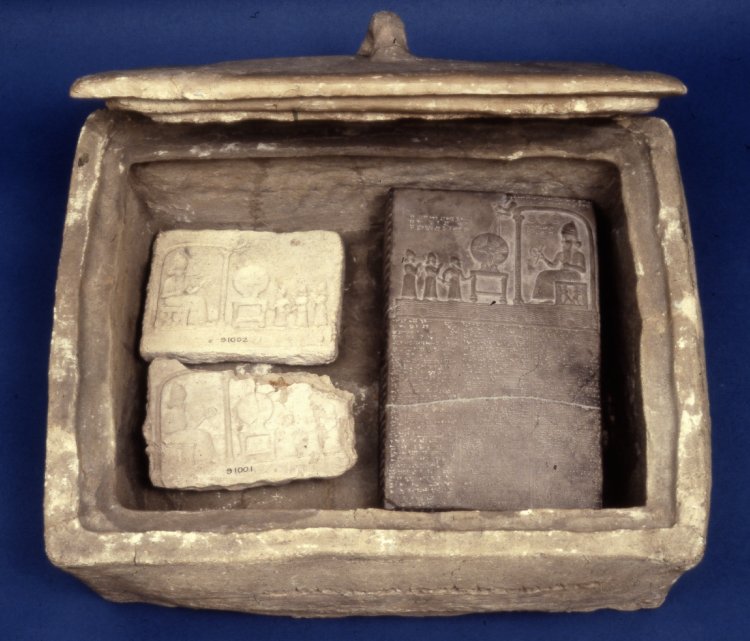
Museum number 91000 Group of Objects Pottery box and the limestone sun-god tablet and its covers deposited in it by Nabopolassar.

Museum number 91000
Group of Objects
Pottery box and the limestone sun-god tablet and its covers deposited in it by Nabopolassar.

The text of the Fifth Tablet, which would undoubtedly have supplied details as to Marduk’s arrangement and regulations for the sun, the moon, the stars, and the Signs of the Zodiac in the heavens is wanting.

The prominence of the celestial bodies in the history of creation is not to be wondered at, for the greater number of the religious beliefs of the Babylonians are grouped round them. Moreover, the science of astronomy had gone hand in hand with the superstition of astrology in Mesopotamia from time immemorial; and at a very early period the oldest gods of Babylonia were associated with the heavenly bodies.

Thus the Annunaki and the Igigi, who are bodies of deified spirits, were identified with the stars of the northern and southern heaven, respectively. And all the primitive goddesses coalesced and were grouped to form the goddess Ishtar, who was identified with the Evening and Morning Star, or Venus.

The Babylonians believed that the will of the gods was made known to men by the motions of the planets, and that careful observation of them would enable the skilled seer to recognize in the stars favourable and unfavourable portents. Such observations, treated from a magical point of view, formed a huge mass of literature which was being added to continually.

From the nature of the case this literature enshrined a very considerable number of facts of pure astronomy, and as early as the period of the First Dynasty (about 2000 B.C.), the Babylonians were able to calculate astronomical events with considerable accuracy, and to reconcile the solar and lunar years by the use of epagomenal months.

They had by that time formulated the existence of the Zodiac, and fixed the “stations” of the moon, and the places of the planets with it; and they had distinguished between the planets and the fixed stars. In the Fifth Tablet of the Creation Series (l. 2) the Signs of the Zodiac are called Lumashi, but unfortunately no list of their names is given in the context.

 Illustration: Tablet inscribed with a list of the Signs of the Zodiac. [No. 77,821.]


Illustration: Tablet inscribed with a list of the Signs of the Zodiac. [No. 77,821.]

Now these are supplied by the little tablet (No. 77,821) of the Persian Period of which a reproduction is here given. It has been referred to and discussed by various scholars, and its importance is very great. The transcript of the text, which is now published (see p. 68) for the first time, will be acceptable to the students of the history of the Zodiac.

Egyptian, Greek, Syriac and Arabic astrological and astronomical texts all associate with the Signs of the Zodiac twelve groups, each containing three stars, which are commonly known as the “Thirty-six Dekans.”

The text of line 4 of the Fifth Tablet of the Creation Series proves that the Babylonians were acquainted with these groups of stars, for we read that Marduk “set up for the twelve months of the year three stars apiece.” In the List of Signs of the Zodiac here given, it will be seen that each Sign is associated with a particular month.

At a later period, say about 500 B.C., the Babylonians made some of the gods regents of groups of stars, for Enlil ruled 33 stars, Anu 23 stars, and Ea 15 stars. They also possessed lists of the fixed stars, and drew up tables of the times of their heliacal risings.

Such lists were probably based upon very ancient documents, and prove that the astral element in Babylonian religion was very considerable.”

E.A. Wallis Budge, et al, & the British Museum, The Babylonian Legends of the Creation & the Fight Between Bel & the Dragon Told by Assyrian Tablets from Nineveh (BCE 668-626), 1901, pp. 10-11.

Marduk Kills Tiâmat

” … When Anu reported his inability to deal with Tiâmat, a council of the gods was called, and Ea induced his son, Marduk to be present.

We next find Anshar in converse with the god Marduk, who offers to act as the champion of the gods and to fight Tiâmat and her allies. Marduk being a form of the Sun-god, the greatest of all the powers of light, thus becomes naturally the protagonist of the gods, and the adversary of Tiâmat and her powers of darkness.

Then Anshar summoned a great council of the gods, who forthwith met in a place called “Upshukkinaku,” which may be described as the Babylonian Olympus. It was all-important for Marduk to appear at the council of the gods before he undertook his task, because it was necessary for him to be formally recognised by them as their champion, and he needed to be endowed by them with magical powers.

The primitive gods Lakhmu and Lakhamu, and the Igigi, who may be regarded as star-gods, were also summoned. A banquet was prepared, and the gods attended, and having met and kissed each other they sat down, and ate bread and drank hot and sweet sesame wine.

The fumes of the wine confused their senses, but they continued to drink, and at length “their spirits were exalted.” They appointed Marduk to be their champion officially, and then they proceeded to invest him with the power that would cause every command he spake to be followed immediately by the effect which he intended it to produce.

Next Marduk, with the view of testing the new power which had been given him, commanded a garment to disappear and it did so; and when he commanded it to reappear it did so.

Illustration: Shamash the Sun-god setting (?) on the horizon. In his right he holds a tree (?), and in his left a ... with a serrated edge. Above the horizon is a goddess who holds in her left hand an ear of corn. On the right is a god who seems to be setting free a bird from his right hand. Round him is a river with fish in it, and behind him is an attendant god; under his foot is a young bull. To the right of the goddess stand a hunting god, with a bow and lasso, and a lion. From the seal-cylinder of Adda ..., in the British Museum. About 2500 B.C. [No. 89,115.]

Illustration: Shamash the Sun-god setting (?) on the horizon. In his right he holds a tree (?), and in his left a … with a serrated edge. Above the horizon is a goddess who holds in her left hand an ear of corn. On the right is a god who seems to be setting free a bird from his right hand. Round him is a river with fish in it, and behind him is an attendant god; under his foot is a young bull. To the right of the goddess stand a hunting god, with a bow and lasso, and a lion. From the seal-cylinder of Adda …, in the British Museum. About 2500 B.C. [No. 89,115.]

Then the gods saluted him as their king, and gave him the insignia of royalty, namely, the sceptre, the throne and the pala, whatever that may be. And as they handed to him these things they commanded him to go and hack the body of Tiâmat in pieces, and to scatter her blood to the winds.

Thereupon Marduk began to arm himself for the fight. He took a bow, a spear, and a club; he filled his body full of fire and set the lightning before him. He took in his hands a net wherewith to catch Tiâmat, and he placed the four winds near it, to prevent her from escaping from it when he had snared her.

He created mighty winds and tempests to assist him, and grasped the thunderbolt in his hand; and then, mounting upon the Storm, which was drawn by four horses, he went out to meet and defeat Tiâmat. It seems pretty certain that this description of the equipment of Marduk was taken over from a very ancient account of the Fight with Tiâmat in which the hero was Enlil, i.e., the god of the air, or of the region which lies between heaven and hell.

Marduk approached and looked upon the “Middle” or “Inside” or “Womb” of Tiâmat, and divined the plan of Kingu who had taken up his place therein.

In the Seventh Tablet (l. 108) Marduk is said to have “entered into the middle of Tiâmat,” and because he did so he is called “Nibiru,” i.e., “he who entered in,” and the “seizer of the middle.” What the words “middle of Tiâmat” meant to the Babylonian we are not told, but it is clear that Marduk’s entry into it was a signal mark of the triumph of the god.

When Kingu from the “middle of Tiâmat” saw Marduk arrayed in his terrible panoply of war, he was terrified and trembled, and staggered about and lost all control of his legs; and at the mere sight of the god all the other fiends and devils were smitten with fear and reduced to helplessness.

Tiâmat saw Marduk and began to revile him, and when he challenged her to battle she flew into a rage and attempted to overthrow him by reciting an incantation, thinking that her words of power would destroy his strength. Her spell had no effect on the god, who at once cast his net over her.

At the same moment he made a gale of foul wind to blow on her face, and entering through her mouth it filled her body; whilst her body was distended he drove his spear into her, and Tiâmat split asunder, and her womb fell out from it.

Marduk leaped upon her body and looked on her followers as they attempted to escape. But the Four Winds which he had stationed round about Tiâmat made all their efforts to flee of no effect. Marduk caught all the Eleven allies of Tiâmat in his net, and he trampled upon them as they lay in it helpless.

Marduk then took the TABLET OF DESTINIES from Kingu’s breast, and sealed it with his seal and placed it on his own breast.”

E.A. Wallis Budge, et al, & the British Museum, The Babylonian Legends of the Creation & the Fight Between Bel & the Dragon Told by Assyrian Tablets from Nineveh (BCE 668-626), 1901, pp. 9-10.

The 11th Tablet of the Epic of Gilgamesh and the Quest for Human Immortality

THE BABYLONIAN LEGEND OF THE DELUGE AS TOLD TO THE HERO GILGAMISH BY HIS ANCESTOR UTA-NAPISHTIM, WHO HAD BEEN MADE IMMORTAL BY THE GODS.

“The form of the Legend of the Deluge given below is that which is found on the Eleventh of the Series of Twelve Tablets in the Royal Library at Nineveh, which described the life and exploits of Gilgamish, an early king of the city of Erech.

As we have seen above, the Legend of the Deluge has probably no original connection with the Epic of Gilgamish, but was introduced into it by the editors of the Epic at a comparatively late period, perhaps even during the reign of Ashur-bani-pal (B.C. 669-626).

… It is … only necessary to state here that Gilgamish, who was horrified and almost beside himself when his bosom friend and companion Enkidu died, meditated deeply how he could escape death himself. He knew that his ancestor Uta-Napishtim had become immortal, therefore he determined to set out for the place where Uta-Napishtim lived so that he might obtain from him the secret of immortality.

Guided by a dream, Gilgamish set out for the Mountain of the Sunset, and, after great toil and many difficulties, came to the shore of a vast sea. Here he met Ur-Shanabi, the boatman of Uta-Napishtim, who was persuaded to carry him in his boat over the “waters of death,” and at length he landed on the shore of the country of Uta-Napishtim.

The immortal came down to the shore and asked the newcomer the object of his visit, and Gilgamish told him of the death of his great friend Enkidu, and of his desire to escape from death and to find immortality. Uta-Napishtim having made to Gilgamish some remarks which seem to indicate that in his opinion death was inevitable,

1. Gilgamish said unto him, to Uta-Napishtim the remote:

2. “I am looking at thee, Uta-Napishtim.

3. Thy person is not altered; even as am I so art thou.

4. Verily, nothing about thee is changed; even as am I so art thou.

5. A heart to do battle doth make thee complete,

6. Yet at rest (?) thou dost lie upon thy back.

7. How then hast thou stood the company of the gods and sought life?”

Thereupon Uta-Napishtim related to Gilgamish the Story of the Deluge, and the Eleventh Tablet continues thus

8. Uta-Napishtim said unto him, to Gilgamish:

9. “I will reveal unto thee, O Gilgamish, a hidden mystery,

10. And a secret matter of the gods I will declare unto thee.

11. Shurippak, a city which thou thyself knowest,

12. On [the bank] of the river Puratti (Euphrates) is situated,

13. That city is old; and the gods [dwelling] within it

14. Their hearts induced the great gods to make a windstorm (a-bu-bi),

15. There was their father Anu,

16. Their counsellor, the warrior Enlil,

17. Their messenger En-urta [and]

18. Their prince Ennugi.

19. Nin-igi-ku, Ea, was with them [in council] and

20. reported their word to a house of reeds.”

E.A. Wallis Budge, The Babylonian Story of the Deluge and the Epic of Gilgamish1929, pp. 30-2.

The Legend of the Deluge According to Berossus

” … Berosus, it is true, is not a very ancient authority, for he was not born until the reign of Alexander the Great, but he was a learned man and was well acquainted with the Babylonian language, and with the ancient literature of his country, and he wrote a history of Babylonia, some fragments of which have been preserved to us in the works of Alexander Polyhistor, Eusebius, and others.

The following is a version of the fragment which describes the flood that took place in the days of Xisuthras, the tenth King of the Chaldeans, and is of importance for comparison with the rendering of the Legend of the Deluge, as found on the Ninevite tablets, which follows immediately after.

THE LEGEND OF THE DELUGE ACCORDING TO BEROSUS.

“After the death of Ardates, his son Xisuthrus reigned eighteen sari. In his time happened a great Deluge; the history of which is thus described. The Deity, Cronus, appeared to him in a vision, and warned him that upon the 15th day of the month Daesius there would be a flood, by which mankind would be destroyed.

He therefore enjoined him to write a history of the beginning, procedure and conclusion of all things; and to bury it in the city of the Sun at Sippara; and to build a vessel, and take with him into it his friends and relations; and to convey on board everything necessary to sustain life, together with all the different animals, both birds and quadrupeds, and trust himself fearlessly to the deep.

Having asked the Deity, whither he was to sail? he was answered, ‘To the Gods ‘: upon which he offered up a prayer for the good of mankind. He then obeyed the divine admonition; and built a vessel 5 stadia in length, and 2 in breadth.

Into this he put everything which he had prepared; and last of all conveyed into it his wife, his children, and his friends.

After the flood had been upon the earth, and was in time abated, Xisuthrus sent out birds from the vessel; which, not finding any food nor any place whereupon they might rest their feet, returned to him again. After an interval of some days, he sent them forth a second time; and they now returned with their feet tinged with mud. He made a trial a third time with these birds; but they returned to him no more: from whence he judged that the surface of the earth had appeared above the waters.

He therefore made an opening in the vessel, and upon looking out found that it was stranded upon the side of some mountain; upon which he immediately quitted it with his wife, his daughter, and the pilot.

Xisuthrus then paid his adoration to the earth, and, having constructed an altar, offered sacrifices to the gods, and, with those who had come out of the vessel with him, disappeared.

They, who remained within, finding that their companions did not return, quitted the vessel with many lamentations, and called continually on the name of Xisuthrus.

Him they saw no more; but they could distinguish his voice in the air, and could hear him admonish them to pay due regard to religion; and likewise informed them that it was upon account of his piety that be was translated to live with the gods; that his wife and daughter, and the pilot, had obtained the same honour.

To this he added that they should return to Babylonia; and, it was ordained, search for the writings at Sippara, which they were to make known to mankind: moreover that the place, wherein they then were, was the land of Armenia. The rest having heard these words, offered sacrifices to the gods; and taking a circuit journeyed towards Babylonia.” (Cory, Ancient Fragments, London, 1832, p. 26 ff.)

E.A. Wallis Budge, The Babylonian Story of the Deluge and the Epic of Gilgamish1929, pp. 28-30.

The Sumerians Considered the Deluge an Historic Event

” … It is, at all events, well known that the Sumerians regarded the Deluge as an historic event, which they were, practically, able to date, for some of their records contain lists of kings who reigned before the Deluge, though it must be confessed that the lengths assigned to their reigns are incredible. After their rule it is expressly noted that the Flood occurred, and that, when it passed away, kingship came down again from on high.

It is not too much to assume that the original event commemorated in the Legend of the Deluge was a serious and prolonged inundation or flood in Lower Babylonia, which was accompanied by great loss of life and destruction of property.

The Babylonian versions state that this inundation or flood was caused by rain, but passages in some of them suggest that the effects of the rainstorm were intensified bv other physical happenings connected with the earth, of a most destructive character.

The Hebrews also, as we may see from the Bible, had alternative views as to the cause of the Deluge. According to one, rain fell upon the earth for forty days and forty nights (Gen. vii, 12), and according to the other the Deluge came because “all the fountains of the great deep” were broken up, and “the flood-gates of heaven were opened” (Gen. vii, ii).

The latter view suggests that the rain flood was joined by the waters of the sea. Later tradition, derived partly from Babylonian and partly from Hebrew sources, asserts, e.g., in the Cave of Treasures, a Syriac treatise composed probably at Edessa about the fifth or sixth century A.D., that when Noah had entered the Ark and the door was shut …

“… the floodgates of the heavens were opened it and the foundations of the earth were rent asunder,” and that “the ocean, that great sea which surroundeth the whole world, poured forth its floods. And whilst the floodgates of heaven were open, and the foundations of the earth were rent asunder, the storehouses of the winds burst their bolts, and storms and whirlwinds swept forth, and ocean roared and hurled its floods upon the earth.”

The ark was steered over the waters by an angel who acted as pilot, and when that had come to rest on the mountains of Kardô (Ararat),

“God commanded the waters and they became separated from each other. The celestial waters were taken up and ascended to their own place above the heavens whence they came. The waters which had risen up from the earth returned to the lowermost abyss, and those which belonged to the ocean returned to the innermost part thereof.”

Many authorities seeking to find a foundation of fact for the Legend of the Deluge in Mesopotamia have assumed that the rain-flood was accompanied either by an earthquake or a tidal-wave, or by both. There is no doubt that the cities of Lower Babylonia were nearer the sea in the Sumerian Period than they are at present, and it is a generally accepted view that the head of the Persian Gulf lay farther to the north at that time. A cyclone coupled with a tidal wave is a sufficient base for any of the forms of the Legend now known.

A comparison of the contents of the various Sumerian and Babylonian versions of the Deluge that have come down to us shows us that they are incomplete. And as none of them tells so connected and full a narrative of the prehistoric shipbuilder as Berosus, a priest of Bêl, the great god of Babylon, it seems that the Mesopotamian scribes were content to copy the Legend in an abbreviated form.”

E.A. Wallis Budge, The Babylonian Story of the Deluge and the Epic of Gilgamish1929, pp. 27-8.

The Library of the Temple of Nebo in Nineveh

NEBO AND HIS LIBRARY AT NINEVEH.

“Nothing is known of the early history of the Library of the Temple of Nebo at Nineveh, but there is little doubt that it was in existence in the reign of Sargon II.

Authorities differ in their estimate of the attributes that were assigned to Nebo (Nabu) in Pre-Babylonian times, and “cannot decide whether he was a water-god, or a fire-god, or a corn-god, but he was undoubtedly associated with Marduk, either as his son or as a fellow-god.

It is certain that as early as B.C. 2000 he was regarded as one of the “Great Gods” of Babylonia, and in the fourteenth century B.C. his cult was already established in Assyria. He had a temple at Nimrûd in the ninth century B.C., and King Adad-nirari (B.C. 811-783) set up six statues in it to the honour of the god; two of these statues are now in the British Museum.

The same Adad-nirari also repaired the Nebo temple at Nineveh. Under the last Assyrian Empire Nebo was believed to possess the wisdom of all the gods, and to be the “All-wise ” and “All-knowing.” He was the inventor of all the arts and sciences, and the source of inspiration in wise and learned men, and he was the divine scribe and past master of all the mysteries connected with literature and the art of writing (dup-sharrute).

Ashur-bani-pal addresses him as “Nebo, the mighty son, the director of the whole of heaven and of earth, holder of the tablet, bearer of the writing-reed of the tablet of destiny, lengthener of days, vivifier of the dead, stablisher of light for the men who are troubled.”

In the reign of Sargon II the Temple of Nebo at Kuyûnjik was repaired, and probably at that time a library was housed in it. Layard found some of the remains of Nebo’s Library in the South West Palace, but it must have been transferred thither, for the temple of Nebo lay farther north, near the south corner of Ashur-bani-pal’s palace.

Nebo’s temple at Nineveh bore the same name as his very ancient temple at Borsippa (the modem Birs-i-Nimrûd), viz., “E-ZIDA.”

Sumerian Sacred Stories, c. 3500 BCE

” … it is quite as obvious that for the history of the progress of our civilization as we see and know it today, it is the tone and temper, the word and spirit of the ancient mythologies, those of the Greeks and Hebrews, of the Hindus and Iranians, of the Babylonians and Egyptians, which are of prime significance. It is the spiritual and religious concepts revealed in these ancient literatures which permeate the modern civilized world.

Still almost entirely unknown to this very moment is Sumerian mythology, the sacred stories of the non-Semitic, non-Indo-European people which in historical times, from approximately 3500 to 2000 B.C., inhabited Sumer, the relatively small land situated between the Tigris and Euphrates Rivers and stretching from the Persian Gulf northward approximately as far as modern Bagdad; a land that may be aptly described as the culture cradle of the entire Near East.

Should the reader turn, for example, to Hastings’ Encyclopedia of Religion and Ethics29 and examine the very long article on the cosmogonic or creation myths of the world, he will find a large and relatively exhaustive list of peoples, ancient and modern, cultured and primitive, whose cosmogonic concepts are described and analyzed. But he will look in vain for Sumerian cosmogony.

Similarly, the collection entitled Mythology of All the Races 30 devotes thirteen volumes to an analysis of the more important mythologies in the world; here, too, however, there will be found few traces of Sumerian mythology. Whatever little is known of Sumerian mythology is largely surmised from the modified, redacted, and in a sense, garbled versions of the Babylonians who conquered the Sumerians toward the very end of the third millennium B.C., and who used the Sumerian stories and legends as a basis and nucleus for the development of their own myths.

But it is a known fact that in the long stretch of time between approximately 3500 and 2000 B.C. it was the Sumerians who represented the dominant cultural group of the entire Near East. It was the Sumerians who developed and probably invented the cuneiform system of writing; who developed a well integrated pantheon together with spiritual and religious concepts which influenced profoundly all the peoples of the Near East; who, finally, created and developed a literature rich in content and effective in form.

Moreover, the following significant fact must be borne in mind. By the end of the third millennium B.C. Sumer had already ceased to exist as a political entity and Sumerian had already become a dead language, for by that time Sumer had been overrun and conquered by the Semites, and it is the Semitic Accadian language which gradually became the living, spoken tongue of the land.

Nevertheless Sumerian continued to be used as the literary and religious language of the Semitic conquerors for many centuries to come, like Greek in the Roman period and like Latin in the Middle Ages. Indeed for many centuries the study of the Sumerian language and literature remained the basic pursuit of the scribal schools and intellectual and spiritual centers not only of the Babylonians and Assyrians, but also of the many surrounding peoples such as the Elamites, Hurrians, Hittites, and Canaanites.

Obviously, then, both because of their content as well as because of their age, the Sumerian mythological tales and concepts must have penetrated and permeated those of the entire Near East. A knowledge of the Sumerian myths and legends is therefore a prime and basic essential for a proper approach to a scientific study of the mythologies current in the ancient Near East, for it illuminates and clarifies to no small extent the background behind their origin and development.” i

Samuel Noah Kramer, Sumerian Mythology, 1944, pp. 27-9.

On the Literature of Ancient Sumer

” … Now let us compare this date with that of the various ancient literatures known to us at present.

In Egypt, for example, one might have expected an ancient written literature commensurate with its high cultural development. And, indeed, to judge from the pyramid inscriptions, the Egyptians in all probability did have a well developed written literature in the third millennium B. C.

Unfortunately it must have been written largely on papyrus, a readily perishable material, and there is little hope that enough of it will ever be recovered to give a reasonably adequate cross-section of the Egyptian literature of that ancient period.

Then, too, there is the hitherto unknown ancient Canaanite literature which has been found inscribed on tablets excavated in the past decade by the French at Rash-esh-Shamra in northern Syria.

These tablets, relatively few in number, indicate that the Canaanites, too, had a highly developed literature at one time. They are dated approximately 1400 B. C., that is, they were inscribed over half a millennium later than our Sumerian literary tablets. 21

As for the Semitic Babylonian literature as exemplified by such works as the Epic of Creation, the Epic of Gilgamesh, etc., it is not only considerably later than our Sumerian literature, but also includes much that is borrowed directly from it. 22

We turn now to the ancient literatures which have exercised the most profound influence on the more spiritual aspects of our civilization. These are the Bible, which contains the literary creations of the Hebrews; the Iliad and Odyssey, which are filled with the epic and mythic lore of the Greeks; the Rig-veda, which contains the literary products of ancient India; and the Avesta, which contains those of ancient Iran.

None of these literary collections were written down in their present form before the first half of the first millennium B. C.

Our Sumerian literature, inscribed on tablets dating from approximately 2000 B.C., therefore antedates these literatures by more than a millennium. Moreover, there is another vital difference.

pl04

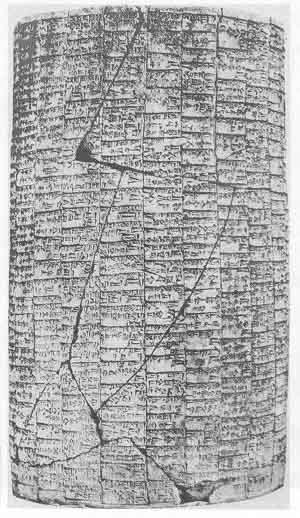
"To judge from the script, the Nippur cylinder illustrated on this plate 
(8383 in the Nippur collection of the University Museum) may date as early 
as 2500 B. C. Although copied and published by the late George Barton as 
early as 1918, its contents, which center about the Sumerian air-god Enlil 
and the goddess Ninhursag, are still largely unintelligible. Nevertheless, 
much that was unknown or misunderstood at the time of its publication is now 
gradually becoming clarified, and there is good reason to hope that the not 
too distant future will see the better part of its contents ready for 
translation."

-Samuel Noah Kramer, Sumerian Mythology, 1944, p. 18.

The texts of the Bible, of the Iliad and Odyssey, and of the Rig-veda and Avesta, as we have them, have been modified, edited, and redacted by compilers and redactors with varied motives and diverse points of view.

Not so our Sumerian literature; it has come down to us as actually inscribed by the ancient scribes of four thousand years ago, unmodified and uncodified by later compilers and commentators.”

Samuel Noah Kramer, Sumerian Mythology, 1944, pp. 19-20.

On the Deluge, from Berosus, via Alexander Polyhistor

” … Belus also formed the stars, and the sun and the moon, together with the five planets. (In the second book was the history of the ten kings of the Chaldeans, and the periods of each reign, which consisted collectively of one hundred and twenty-sari, or 432,000 years, reaching to the time of the Flood.

For Alexander, surnamed Polyhistor, as from the writings of the Chaldeans, enumerating the kings from the ninth, Ardates, to Xisuthrus, who is called by them the tenth, proceeds in this manner:)

After the death of Ardates, his son, Xisuthrus, succeeded, and reigned eighteen sari. In his time happened the great Deluge; the history of which is given in this manner. The Deity, Kronus, appeared to him in a vision, and gave him notice, that upon the fifteenth day of the month Daesia103 there would be a flood, by which mankind would be destroyed.

He therefore enjoined him to commit to writing a history of the beginning, progress, and final conclusion of all things, down to the present term; and to bury these accounts securely in the city of the Sun104 at Sippara; and to build a vessel, and to take with him into it his friends and relations; and to convey on board everything necessary to sustain life, and to take in also all species of animals that either fly, or rove upon the earth; and trust himself to the deep.

Having asked the Deity, whither he was to sail? he was answered, “To the Gods:” upon which he offered up a prayer for the good of mankind. And he obeyed the divine admonition: and built a vessel five stadia in length, and in breadth two. Into this he put everything which he had got ready; and last of all conveyed into it his wife, children, and friends.

After the Flood had been upon the earth, and was in time abated, Xisuthrus sent out some birds105 from the vessel, which, not finding any food, nor any place to rest their feet, returned to him again. After an interval of some days, he sent them forth a second time, and they now returned with their feet tinged with mud.

He made a trial a third time with these birds, but they returned to him no more; from whence he formed a judgment, that the surface of the earth was now above the waters. Having, therefore, made an opening in the vessel, and finding, upon looking out, that the vessel was driven to the side of a mountain, he immediately quitted it, being attended by his wife, his daughter, and the pilot.

Xisuthrus immediately paid his adoration to the earth, and, having constructed an altar, offered sacrifices106 to the gods.

These things being duly performed, both Xisuthrus, and those who came out of the vessel with him, disappeared. They who remained in the vessel, finding that the others did not return, came out, with many lamentations, and called continually on the name of Xisuthrus.

They saw him no more, but could distinguish his voice in the air, and could hear him admonish them to pay due regard to the gods. He likewise informed them that it was upon account of his piety that he was translated107 to live with the gods; that his wife and daughter, with the pilot, had obtained the same honour.

To this he added that he would have them make the best of their way to Babylonia, and search for the writings at Sippara, which were to be made known to all mankind: and that the place where they then were was the land of Armenia.108 The remainder having heard these words, offered sacrifices to the gods; and taking a circuit, journeyed towards Babylonia.

The vessel, being thus stranded in Armenia, some part of it yet remains in the Gordyaean 109 mountains in Armenia; and the people scrape off the bitumen,110 with which it had been outwardly coated, and make use of it by way of an alexipharmic 111 and amulet.

In this manner they returned to Babylon; and having found the writings at Sippara, they set about building cities, and erecting temples: and Babylon was thus inhabited again.” ―Syncellus. Chron. 28. Eusebius. Chron. 5, 8.

E. Edmond Hodges, Cory’s Ancient Fragments, 3d ed., 1876, pp. 60-3.

On Oannes, from Berosus, via Alexander Polyhistor

“BEROSUS, in his first book concerning the history of Babylonia, informs us that he lived in the time of Alexander, the son of Philip. And he mentions that there were written accounts preserved at Babylon with the greatest care, comprehending a term of fifteen myriads of years. These writings contained a history of the heavens and the sea; of the birth of mankind; also of those who had sovereign rule; and of the actions achieved by them.

And, in the first place, he describes Babylonia as a country which lay between the Tigris and Euphrates. [ … ]

The part of Babylonia which bordered upon Arabia was barren, and without water; but that which lay on the other side had hills, and was fruitful. At Babylon there was (in these times) a great resort of people of various nations, who inhabited Chaldea, and lived without rule and order, like the beasts of the field.

In the first year there made its appearance, from a part of the Erythraean sea which bordered upon Babylonia, an animal endowed with reason, who was called Oannes. (According to the account of Apollodorus) the whole body of the animal was like that of a fish; and had under a fish’s head another head, and also feet below, similar to those of a man, sub-joined to the fish’s tail. His voice, too, and language was articulate and human; and a representation of him is preserved even to this day.

This Being, in the day-time, used to converse with men; but took no food at that season; and he gave them an insight into letters, and sciences, and every kind of art. He taught them to construct houses, to build temples, to compile laws, and explained to them the principles of geometrical knowledge. He made them distinguish the seeds of the earth, and showed them how to collect fruits.

In short, he instructed them in everything which could tend to soften manners and humanise mankind. From that time, so universal were his instructions, nothing material has been added by way of improvement.

When the sun set it was the custom of this Being to plunge again into the sea, and abide all night in the deep; for he was amphibious.

After this, there appeared other animals, like Oannes, of which Berosus promises to give an account when he comes to the history of the kings.”

E. Edmond Hodges, Cory’s Ancient Fragments, 3d ed., 1876, pp. 56-8.

Ashur-bani-pal

” … The records of Ashur-bani-pal cease after 640 B.C., so that we are unable to follow the events of his reign during its last fourteen years. Apparently peace prevailed everywhere. The great monarch, who was a pronounced adherent of the goddess cults, appears to have given himself up to a life of indulgence and inactivity.

Under the name Sardanapalus he went down to tradition as a sensual Oriental monarch who lived in great pomp and luxury, and perished in his burning palace when the Medes revolted against him. It is evident, however, that the memory of more than one monarch contributed to the Sardanapalus legend, for Ashur-bani-pal had lain nearly twenty years in his grave before the siege of Nineveh took place.

In the Bible he is referred to as “the great and noble Asnapper,” and he appears to have been the emperor who settled the Babylonian, Elamite, and other colonists “in the cities of Samaria.”

He erected at Nineveh a magnificent palace, which was decorated on a lavish scale. The sculptures are the finest productions of Assyrian art, and embrace a wide variety of subjects–battle scenes, hunting scenes, and elaborate Court and temple ceremonies. Realism is combined with a delicacy of touch and a degree of originality which raises the artistic productions of the period to the front rank among the artistic triumphs of antiquity.

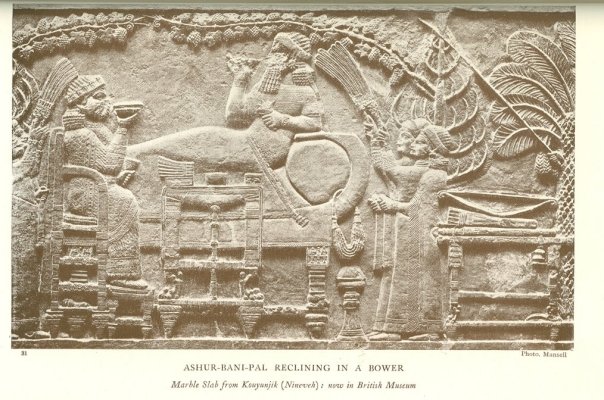
Ashur-bani-pal in the palace of Nineveh.

Ashur-bani-pal boasted of the thorough education which he had received from the tutors of his illustrious father, Esarhaddon. In his palace he kept a magnificent library. It contained thousands of clay tablets on which were inscribed and translated the classics of Babylonia.

To the scholarly zeal of this cultured monarch is due the preservation of the Babylonian story of creation, the Gilgamesh and Etana legends, and other literary and religious products of remote antiquity. Most of the literary tablets in the British Museum were taken from Ashur-bani-pal’s library.”

Donald A. Mackenzie, Myths of Babylonia and Assyria, 1915, pp. 486-7.

I.P Cory on Berossus

” … In the fragments of Berossus again we have perhaps some few traces of the antediluvian world. Like Sanchoniatho, Berossus seems to have composed his work with a serious regard for truth. He was a Babylonian by birth, and flourished in the reign of Alexander the Great, and resided for some years at Athens.

As a priest of Belus, he possessed every advantage which the records of the temple and the learning and traditions of the Chaldæans could afford. He appears to have sketched his history of the earlier times from the representations upon the walls of the temple. From written and traditionary knowledge he must have learned several points too well authenticated. to be called in question; and correcting the one by the other, and at the same time blending them as usual with Mythology, he has produced the strange history before us.

The first fragment preserved by Alexander Polyhistor is extremely valuable, and contains a store of very curious information. The first book of the history apparently opens naturally enough with a description of Babylonia. Then referring to the paintings, the author finds the first series a kind of preface to the rest.

All men of every nation appear assembled in Chaldæa: among them is introduced a personage who is represented as their instructor in the arts and sciences, and informing them of the events which had previously taken place. Unconscious that Noah is represented under the character of Oannes, Berossus describes him, from the hieroglyphical delineation, as a being literally compounded of a fish and a man, and as passing the natural, instead of the diluvian night in the ocean, with other circumstances indicative of his character and life.

The instructions of the Patriarch are detailed in the next series of paintings. In the first of which, I conceive, the Chaos is pourtrayed by the confusion of the limbs of every kind of animal: the second represents the creation of the universe: the third the formation of mankind: others again that of animals, and of the heavenly bodies.

The second book appears to have comprehended the history of the antediluvian world: and of this the two succeeding fragments seem to have been extracts. The historian, as usual, has appropriated the history of the world to Chaldæa.

He finds nine persons, probably represented as kings, preceding Noah, who is again introduced under the name Xisuthrus, and he supposes that the representation was that of the first dynasty of the Chaldæan kings.

From the universal consent of history and tradition he was well assured that Alorus or Orion, the Nimrod of the Scriptures, was the founder of Babylon and the first king: consequently he places him at the top, and Xisuthrus follows as the tenth.

The destruction of the records by Nabonasar left him to fill up the intermediate names as he could: and who are inserted, is not easy so to determine.2

Berossus has given also a full and accurate description of the deluge, which is wonderfully consonant with the Mosaic account. We have also a similar account, or it may be an epitome of the same from the Assyrian history of Abydenus, who was a disciple of Aristotle, and a copyist from Berossus. I have given also a small extract from the Fragments of Nicholaus Damascenus, relative to the deluge and the ark, whose wreck is said by him as well as Berossus, Chrysostom, and other writers, to have remained upon Ararat even at the very time in which they wrote.”

I.P. Cory, Ancient Fragments, 1832, Introduction.

Destroyer of Babylon

” … In 691 B.C. Sennacherib again struck a blow for Babylonia, but was unable to depose Mushezib-Merodach. His opportunity came, however, in 689 B.C. Elam had been crippled by raids of the men of Parsua (Persia), and was unable to co-operate with the Chaldaean king of Babylon.

Sennacherib captured the great commercial metropolis, took Mushezib-Merodach prisoner, and dispatched him to Nineveh.

Then he wreaked his vengeance on Babylon.

For several days the Assyrian soldiers looted the houses and temples, and slaughtered the inhabitants without mercy. E-sagila was robbed of its treasures, images of deities were either broken in pieces or sent to Nineveh: the statue of Bel-Merodach was dispatched to Asshur so that he might take his place among the gods who were vassals of Ashur.

“The city and its houses,” Sennacherib recorded, “from foundation to roof, I destroyed them, I demolished them, I burned them with fire; walls, gateways, sacred chapels, and the towers of earth and tiles, I laid them low and cast them into the Arakhtu.”

“So thorough was Sennacherib’s destruction of the city in 689 B.C.,” writes Mr. King, “that after several years of work, Dr. Koldewey concluded that all traces of earlier buildings had been destroyed on that occasion. More recently some remains of earlier strata have been recognized, and contract-tablets have been found which date from the period of the First Dynasty.

Moreover, a number of earlier pot-burials have been unearthed, but a careful examination of the greater part of the ruins has added little to our knowledge of this most famous city before the Neo-Babylonian period.”

[ … ]

Sennacherib’s palace was the most magnificent building of its kind ever erected by an Assyrian emperor. It was lavishly decorated, and its bas-reliefs display native art at its highest pitch of excellence.

The literary remains of the time also give indication of the growth of culture: the inscriptions are distinguished by their prose style. It is evident that men of culture and refinement were numerous in Assyria. The royal library of Kalkhi received many additions during the reign of the destroyer of Babylon.

46800

Like his father, Sennacherib died a violent death. According to the Babylonian Chronicle he was slain in a revolt by his son “on the twentieth day of Tebet” (680 B.C). The revolt continued from the “20th of Tebet” (early in January) until the 2nd day of Adar (the middle of February). On the 18th of Adar, Esarhaddon, son of Sennacherib, was proclaimed king.

Berosus states that Sennacherib was murdered by two of his sons, but Esarhaddon was not one of the conspirators. The Biblical reference is as follows:

“Sennacherib … dwelt at Nineveh. And it came to pass, as he was worshipping in the house of Nisroch (?Ashur) his god, that Adrammelech and Sharezer (Ashur-shar-etir) his sons smote him with the sword: and they escaped into the land of Armenia (Urartu). And Esarhaddon his son reigned in his stead.”

Ashur-shar-etir appears to have been the claimant to the throne.

Donald A. Mackenzie, Myths of Babylonia and Assyria, 1915, pp. 468-70.

The Assassination of Sargon

Thus “Sargon the Later” entered at length into full possession of the empire of Sargon of Akkad. In Babylonia he posed as an incarnation of his ancient namesake, and had similarly Messianic pretensions which were no doubt inspired by the Babylonian priesthood. Under him Assyria attained its highest degree of splendour.

He recorded proudly not only his great conquests but also his works of public utility: he restored ancient cities, irrigated vast tracts of country, fostered trade, and promoted the industries. Like the pious Pharaohs of Egypt he boasted that he fed the hungry and protected the weak against the strong.

” … Sargon found time during his strenuous career as a conqueror to lay out and build a new city, called Dur-Sharrukin, “the burgh of Sargon,” to the north of Nineveh. It was completed before he undertook the Babylonian campaign. The new palace was occupied in 708 B.C. Previous to that period he had resided principally at Kalkhi, in the restored palace of Ashur-natsir-pal III.

He was a worshipper of many gods. Although he claimed to have restored the supremacy of Ashur “which had come to an end,” he not only adored Ashur but also revived the ancient triad of Anu, Bel, and Ea, and fostered the growth of the immemorial “mother-cult” of Ishtar.

Before he died he appointed one of his sons, Sennacherib, viceroy of the northern portion of the empire. He was either assassinated at a military review or in some frontier war. As much is suggested by the following entry in an eponym list.

Eponymy of Upahhir-belu, prefect of the city of Amedu …

According to the oracle of the Kulummite(s)…. A soldier

(entered) the camp of the king of Assyria (and killed him?), month

Ab, day 12th, Sennacherib (sat on the throne).

The fact that Sennacherib lamented his father’s sins suggests that the old king had in some manner offended the priesthood. Perhaps, like some of the Middle Empire monarchs, he succumbed to the influence of Babylon during the closing years of his life.

It is stated that “he was not buried in his house,” which suggests that the customary religious rites were denied him, and that his lost soul was supposed to be a wanderer which had to eat offal and drink impure water like the ghost of a pauper or a criminal.”

Donald A. Mackenzie, Myths of Babylonia and Assyria, 1915, pp. 462-4.

The Ten Lost Tribes

” … Shalmaneser died before Samaria was captured, and may have been assassinated. The next Assyrian monarch, Sargon II (722-705 B.C.), was not related to either of his two predecessors. He is referred to by Isaiah, and is the Arkeanos of Ptolemy. He was the Assyrian monarch who deported the “Lost Ten Tribes.”

“In the ninth year of Hoshea” (and the first of Sargon) “the king of Assyria took Samaria, and carried Israel away into Assyria, and placed them in Halah and in Habor by the river of Gozan, and in the cities of the Medes.”

In all, according to Sargon’s record, “27,290 people dwelling in the midst of it (Samaria) I carried off.”

They (the Israelites) left all the commandments of the Lord their God, and made them molten images, even two calves, and made a grove, and worshipped all the host of heaven (the stars), and served Baal.

And they caused their sons and their daughters to pass through the fire, and used divination and enchantments, and sold themselves to do evil in the sight of the Lord, to provoke him to anger. Therefore the Lord was very angry with Israel, and removed them out of his sight: there was none left but the tribe of Judah only.

And the king of Assyria brought men from Babylon, and from Cuthah, and from Ava, and from Hamath, and from Sepharvaim, and placed them in the cities of Samaria instead of the children of Israel: and they possessed Samaria, and dwelt in the cities thereof….

And the men of Babylon made Succoth-benoth, and the men of Cuth (Cuthah) made Nergal, and the men of Hamath made Ashima, and the Avites made Nibhaz and Tartak, and the Sepharites burnt their children in fire to Adram-melech and Anam-melech, the gods of Sepharvaim.

A number of the new settlers were slain by lions, and the king of Assyria ordered that a Samaritan priest should be sent to “teach them the manner of the God of the land.” This man was evidently an orthodox Hebrew, for he taught them “how they should fear the Lord…. So they feared the Lord,” but also “served their own gods … their graven images.”

There is no evidence to suggest that the “Ten Lost Tribes,” “regarding whom so many nonsensical theories have been formed,” were not ultimately absorbed by the peoples among whom they settled between Mesopotamia and the Median Highlands.

The various sections must have soon lost touch with one another. They were not united like the Jews (the people of Judah), who were transported to Babylonia a century and a half later, by a common religious bond, for although a few remained faithful to Abraham’s God, the majority of the Israelites worshipped either the Baal or the Queen of Heaven.”

Donald A. Mackenzie, Myths of Babylonia and Assyria, 1915, pp. 455-6.

The Legends of Queen Semiramis

The legends of Semiramis indicate that Sammu-rammat was associated like Queen Tiy with the revival of mother worship.

As we have said, she went down to tradition as the daughter of the fish goddess, Derceto. Pliny identified that deity with Atargatis of Hierapolis.

In Babylonia the fish goddess was Nina, a developed form of Damkina, spouse of Ea of Eridu. In the inscription on the Nebo statue, that god is referred to as the “son of Nudimmud” (Ea). Nina was the goddess who gave her name to Nineveh, and it is possible that Nebo may have been regarded as her son during the Semiramis period.

The story of Semiramis’s birth is evidently of great antiquity. It seems to survive throughout Europe in the nursery tale of the “Babes in the Wood.” A striking Indian parallel is afforded by the legend of Shakuntala, which may be first referred to for the purpose of comparative study.

Shakuntala was the daughter of the rishi, Viswamitra, and Menaka, the Apsara (celestial fairy). Menaka gave birth to her child beside the sacred river Malini.

“And she cast the new-born infant on the bank of that river and went away. And beholding the newborn infant lying in that forest destitute of human beings but abounding with lions and tigers, a number of vultures sat around to protect it from harm.”

A sage discovered the child and adopted her. “Because,” he said, “she was surrounded by Shakuntas (birds), therefore hath she been named by me Shakuntala (bird protected).”

Semiramis was similarly deserted at birth by her Celestial mother. She was protected by doves, and her Assyrian name, Sammu-rammat, is believed to be derived from “Summat“–“dove,” and to signify “the dove goddess loveth her.”

Simmas, the chief of royal shepherds, found the child and adopted her. She was of great beauty like Shakuntala, the maiden of “perfect symmetry,” “sweet smiles,” and “faultless features,” with whom King Dushyanta fell in love and married in Gandharva fashion.

Semiramis became the wife of Onnes, governor of Nineveh, and one of the generals of its alleged founder, King Ninus. She accompanied her husband to Bactria on a military campaign, and is said to have instructed the king how that city should be taken.

Ninus fell in love with Semiramis, and Onnes, who refused to give her up, went and hanged himself. The fair courtesan then became the wife of the king.

The story proceeds that Semiramis exercised so great an influence over the impressionable King Ninus, that she persuaded him to proclaim her Queen of Assyria for five days. She then ascended the throne decked in royal robes. On the first day she gave a great banquet, and on the second thrust Ninus into prison, or had him put to death. In this manner she secured the empire for herself. She reigned for over forty years.

Professor Frazer inclines to the view that the legend is a reminiscence of the custom of appointing a mock king and queen to whom the kingdom was yielded up for five days. Semiramis played the part of the mother goddess, and the priestly king died a violent death in the character of her divine lover.

“The mounds of Semiramis which were pointed out all over Western Asia were said to have been the graves of her lovers whom she buried alive…. This tradition is one of the surest indications of the identity of the mythical Semiramis with the Babylonian goddess Ishtar or Astarte.”

As we have seen, Ishtar and other mother goddesses had many lovers whom they deserted like La Belle Dame sans Merci (pp. 174-175).

As Queen of Assyria, Semiramis was said to have cut roads through mountainous districts and erected many buildings. According to one version of the legend she founded the city of Babylon. Herodotus, however, says in this connection:

“Semiramis held the throne for five generations before the later princess (Nitocris)…. She raised certain embankments, well worthy of inspection, in the plain near Babylon, to control the river (Euphrates), which, till then, used to overflow and flood the whole country round about.”

Lucian, who associates the famous queen with “mighty works in Asia,” states that she was reputed by some to be the builder of the ancient temple of Aphrodite in the Libanus, although others credited it to Cinyras, or Deukalion.

Several Median places bear her name, and according to ancient Armenian tradition she was the founder of Van, which was formerly called “Shamiramagerd.” Strabo tells that unidentified mountains in Western Asia were named after Semiramis.

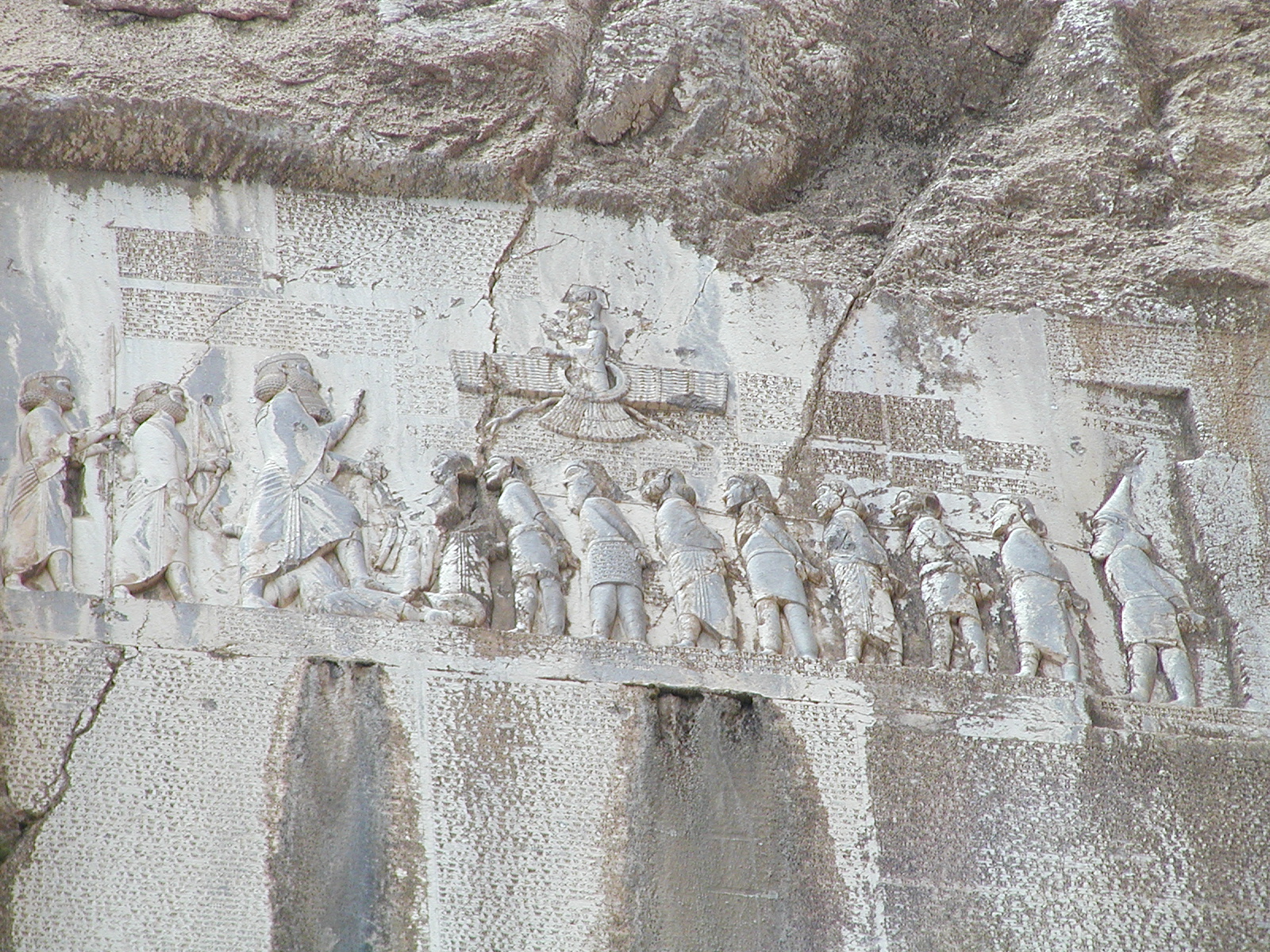
Indeed, many of the great works in the Tigro-Euphrates valley, not excepting the famous inscription of Darius, were credited to the legendary queen of Babylonia and Assyria. She was the rival in tradition of the famous Sesostris of Egypt as a ruler, builder, and conqueror.

All the military expeditions of Semiramis were attended with success, except her invasion of India. She was supposed to have been defeated in the Punjab. After suffering this disaster she died, or abdicated the throne in favour of her son Ninyas.

The most archaic form of the legend appears to be that she was turned into a dove and took flight to heaven in that form. After her death she was worshipped as a dove goddess like “Our Lady of Trees and Doves” in Cyprus, whose shrine at old Paphos was founded, Herodotus says, by Phoenician colonists from Askalon.

Fish and doves were sacred to Derceto (Attar), who had a mermaid form. “I have beheld”, says Lucian, “the image of Derceto in Phoenicia. A marvellous spectacle it is. One half is a woman, but the part which extends from thighs to feet terminates with the tail of a fish.”

Donald A. Mackenzie, Myths of Babylonia and Assyria, 1915, pp. 423-6.

The Royal Library of Kalkhi

” … The prominence given to Nebo, the god of Borsippa, during the reign of Adad-nirari IV is highly significant.

He appears in his later character as a god of culture and wisdom, the patron of scribes and artists, and the wise counsellor of the deities. He symbolized the intellectual life of the southern kingdom, which was more closely associated with religious ethics than that of war-loving Assyria.

A great temple was erected to Nebo at Kalkhi, and four statues of him were placed within it, two of which are now in the British Museum. On one of these was cut the inscription, from which we have quoted, lauding the exalted and wise deity and invoking him to protect Adad-nirari and the lady of the palace, Sammu-rammat, and closing with the exhortation, “Whoso cometh in after time, let him trust in Nebo and trust in no other god.”

The priests of Ashur in the city of Asshur must have been as deeply stirred by this religious revolt at Kalkhi as were the priests of Amon when Akhenaton turned his back on Thebes and the national god to worship Aton in his new capital at Tell-el-Amarna.

It would appear that this sudden stream of Babylonian culture had begun to flow into Assyria as early as the reign of Shalmaneser III, and it may be that it was on account of that monarch’s pro-Babylonian tendencies that his nobles and priests revolted against him.

Shalmaneser established at Kalkhi a royal library which was stocked with the literature of the southern kingdom. During the reign of Adad-nirari IV this collection was greatly increased, and subsequent additions were made to it by his successors, and especially Ashur-nirari IV, the last monarch of the Middle Empire.

The inscriptions of Shamshi-Adad, son of Shalmaneser III, have literary qualities which distinguish them from those of his predecessors, and may be accounted for by the influence exercised by Babylonian scholars who migrated northward.

To the reign of Adad-nirari belongs also that important compilation the Synchronistic History of Assyria and Babylonia, which deals with the relations of the two kingdoms and refers to contemporary events and rulers.”

Donald A. Mackenzie, Myths of Babylonia and Assyria, 1915, pp. 422-3.

Human Sacrifice in Ancient Babylon

” … All the younger gods, who displaced the elder gods as one year displaces another, were deities of fertility, battle, lightning, fire, and the sun; it is possible, therefore, that Ashur was like Merodach, son of Ea, god of the deep, a form of Tammuz in origin.

His spirit was in the solar wheel which revolved at times of seasonal change. In Scotland it was believed that on the morning of May Day (Beltaine) the rising sun revolved three times. The younger god was a spring sun god and fire god. Great bonfires were lit to strengthen him, or as a ceremony of riddance; the old year was burned out.

Indeed the god himself might be burned (that is, the old god), so that he might renew his youth. Melkarth was burned at Tyre. Hercules burned himself on a mountain top, and his soul ascended to heaven as an eagle.

These fiery rites were evidently not unknown in Babylonia and Assyria. When, according to Biblical narrative, Nebuchadnezzar “made an image of gold” which he set up “in the plain of Dura, in the province of Babylon,” he commanded:

“O people, nations, and languages… at the time ye hear the sound of the cornet, flute, harp, sackbut, psaltery, dulcimer, and all kinds of musick… fall down and worship the golden image.”

Certain Jews who had been “set over the affairs of the province of Babylonia,” namely, “Shadrach, Meshach, and Abed-nego,” refused to adore the idol.

They were punished by being thrown into “a burning fiery furnace”, which was heated “seven times more than it was wont to be heated.” They came forth uninjured.

In the Koran it is related that Abraham destroyed the images of Chaldean gods; he “brake them all in pieces except the biggest of them; that they might lay the blame on that.” According to the commentators the Chaldaeans were at the time “abroad in the fields, celebrating a great festival.”

To punish the offender Nimrod had a great pyre erected at Cuthah.

“Then they bound Abraham, and putting him into an engine, shot him into the midst of the fire, from which he was preserved by the angel Gabriel, who was sent to his assistance.”

Eastern Christians were wont to set apart in the Syrian calendar the 25th of January to commemorate Abraham’s escape from Nimrod’s pyre.

It is evident that the Babylonian fire ceremony was observed in the spring season, and that human beings were sacrificed to the sun god. A mock king may have been burned to perpetuate the ancient sacrifice of real kings, who were incarnations of the god.

Isaiah makes reference to the sacrificial burning of kings in Assyria:

“For through the voice of the Lord shall the Assyrian be beaten down, which smote with a rod. And in every place where the grounded staff shall pass, which the Lord shall lay upon him, it shall be with tabrets and harps: and in battles of shaking will he fight with it.

For Tophet is ordained of old; yea, for the king it is prepared: he hath made it deep and large: the pile thereof is fire and much wood: the breath of the Lord, like a stream of brimstone, doth kindle it.”

When Nineveh was about to fall, and with it the Assyrian Empire, the legendary king, Sardanapalus, who was reputed to have founded Tarsus, burned himself, with his wives, concubines, and eunuchs, on a pyre in his palace. Zimri, who reigned over Israel for seven days, “burnt the king’s house over him with fire.”

Saul, another fallen king, was burned after death, and his bones were buried “under the oak in Jabesh”.

In Europe the oak was associated with gods of fertility and lightning, including Jupiter and Thor. The ceremony of burning Saul is of special interest. Asa, the orthodox king of Judah, was, after death, “laid in the bed which was filled with sweet odours and divers kinds of spices prepared by the apothecaries’ art: and they made a very great burning for him” (2 Chronicles, xvi, 14).

Jehoram, the heretic king of Judah, who “walked in the way of the kings of Israel,” died of “an incurable disease. And his people made no burning for him like the burning of his fathers” (2 Chronicles, xxi, 18, 19).

The conclusion suggested by the comparative study of the beliefs of neighbouring peoples, and the evidence afforded by Assyrian sculptures, is that Ashur was a highly developed form of the god of fertility, who was sustained, or aided in his conflicts with demons, by the fires and sacrifices of his worshippers.”

Donald A. Mackenzie, Myths of Babylonia and Assyria, 1915, pp. 348-51.

The Zodiac is Babylonian

” … Each month was also controlled by a zodiacal constellation.

In the Creation myth of Babylon it is stated that when Merodach engaged in the work of setting the Universe in order he “set all the great gods in their several stations,” and “also created their images, the stars of the Zodiac, and fixed them all.”

Our signs of the Zodiac are of Babylonian origin. They were passed on to the Greeks by the Phoenicians and Hittites. “There was a time,” says Professor Sayce, “when the Hittites were profoundly affected by Babylonian civilization, religion, and art….”

They “carried the time-worn civilizations of Babylonia and Egypt to the furthest boundary of Egypt, and there handed them over to the West in the grey dawn of European history…. Greek traditions affirmed that the rulers of Mykenae had come from Lydia, bringing with them the civilization and treasures of Asia Minor.

The tradition has been confirmed by modern research. While certain elements belonging to the prehistoric culture of Greece, as revealed at Mykenae and elsewhere, were derived from Egypt and Phoenicia, there are others which point to Asia Minor as their source. And the culture of Asia Minor was Hittite.”

The early Babylonian astronomers did not know, of course, that the earth revolved round the sun. They believed that the sun travelled across the heavens flying like a bird or sailing like a boat. In studying its movements they observed that it always travelled from west to east along a broad path, swinging from side to side of it in the course of the year.

This path is the Zodiac–the celestial “circle of necessity.” The middle line of the sun’s path is the Ecliptic. The Babylonian scientists divided the Ecliptic into twelve equal parts, and grouped in each part the stars which formed their constellations; these are also called “Signs of the Zodiac.” Each month had thus its sign or constellation.”

Donald A. Mackenzie, Myths of Babylonia and Assyria, 1915, pp. 305-7.

Legal Rights of Women and Vestal Virgins

” … A girl might also obtain a limited degree of freedom by taking vows of celibacy and becoming one of the vestal virgins, or nuns, who were attached to the temple of the sun god. She did not, however, live a life of entire seclusion.

If she received her due proportion of her father’s estate, she could make business investments within certain limits. She was not, for instance, allowed to own a wineshop, and if she even entered one she was burned at the stake. Once she took these vows she had to observe them until the end of her days.

If she married, as she might do to obtain the legal status of a married woman and enjoy the privileges of that position, she denied her husband conjugal rites, but provided him with a concubine who might bear him children, as Sarah did to Abraham.

These nuns must not be confused with the unmoral women who were associated with the temples of Ishtar and other love goddesses of shady repute.

The freedom secured by a married woman had its legal limitations. If she became a widow, for instance, she could not remarry without the consent of a judge, to whom she was expected to show good cause for the step she proposed to take.

Punishments for breaches of the marriage law were severe. Adultery was a capital crime; the guilty parties were bound together and thrown into the river.

If it happened, however, that the wife of a prisoner went to reside with another man on account of poverty, she was acquitted and allowed to return to her husband after his release. In cases where no plea of poverty could be urged the erring women were drowned.

The wife of a soldier who had been taken prisoner by an enemy was entitled to a third part of her husband’s estate if her son was a minor, the remainder was held in trust. The husband could enter into possession of all his property again if he happened to return home.

Divorce was easily obtained. A husband might send his wife away either because she was childless or because he fell in love with another woman. Incompatibility of temperament was also recognized as sufficient reason for separation. A woman might hate her husband and wish to leave him.

“If,” the Code sets forth, “she is careful and is without blame, and is neglected by her husband who has deserted her,” she can claim release from the marriage contract. But if she is found to have another lover, and is guilty of neglecting her duties, she is liable to be put to death.

A married woman possessed her own property. Indeed, the value of her marriage dowry was always vested in her. When, therefore, she divorced her husband, or was divorced by him, she was entitled to have her dowry refunded and to return to her father’s house. Apparently she could claim maintenance from her father.

A woman could have only one husband, but a man could have more than one wife. He might marry a secondary wife, or concubine, because he was without offspring, but “the concubine,” the Code lays down, “shall not rank with the wife.”

Another reason for second marriage recognized by law was a wife’s state of health. In such circumstances a man could not divorce his sickly wife. He had to support her in his house as long as she lived.

[ … ]

The legal rights of a vestal virgin were set forth in detail. If she had received no dowry from her father when she took vows of celibacy, she could claim after his death one-third of the portion of a son. She could will her estate to anyone she favoured, but if she died intestate her brothers were her heirs.

When, however, her estate consisted of fields or gardens allotted to her by her father, she could not disinherit her legal heirs. The fields or gardens might be worked during her lifetime by her brothers if they paid rent, or she might employ a manager on the “share system.”

Vestal virgins and married women were protected against the slanderer. Any man who “pointed the finger” against them unjustifiably was charged with the offense before a judge, who could sentence him to have his forehead branded.

It was not difficult, therefore, in ancient Babylonia to discover the men who made malicious and unfounded statements regarding an innocent woman. Assaults on women were punished according to the victim’s rank; even slaves were protected.

Women appear to have monopolized the drink traffic. At any rate, there is no reference to male wine sellers. A female publican had to conduct her business honestly, and was bound to accept a legal tender. If she refused corn and demanded silver, when the value of the silver by “grand weight” was below the price of corn, she was prosecuted and punished by being thrown into the water. Perhaps she was simply ducked.

As much may be inferred from the fact that when she was found guilty of allowing rebels to meet in her house, she was put to death.”

Donald A. Mackenzie, Myths of Babylonia and Assyria, 1915.

Marriage Babylonian Style

” Of special interest are the laws which relate to the position of women. In this connection reference may first be made to the marriage-by-auction custom, which Herodotus described as follows:

“Once a year in each village the maidens of age to marry were collected all together into one place, while the men stood round them in a circle. Then a herald called up the damsels one by one, and offered them for sale. He began with the most beautiful. When she was sold for no small sum of money, he offered for sale the one who came next to her in beauty. All of them were sold to be wives.

The richest of the Babylonians who wished to wed bid against each other for the loveliest maidens, while the humbler wife-seekers, who were indifferent about beauty, took the more homely damsels with marriage portions.

For the custom was that when the herald had gone through the whole number of the beautiful damsels, he should then call up the ugliest–a cripple, if there chanced to be one–and offer her to the men, asking who would agree to take her with the smallest marriage portion. And the man who offered to take the smallest sum had her assigned to him.

The marriage portions were furnished by the money paid for the beautiful damsels, and thus the fairer maidens portioned out the uglier. No one was allowed to give his daughter in marriage to the man of his choice, nor might anyone carry away the damsel whom he had purchased without finding bail really and truly to make her his wife; if, however, it turned out that they did not agree, the money might be paid back. All who liked might come, even from distant villages, and bid for the women.”

This custom is mentioned by other writers, but it is impossible to ascertain at what period it became prevalent in Babylonia and by whom it was introduced. Herodotus understood that it obtained also in “the Illyrian tribe of the Eneti,” which was reputed to have entered Italy with Antenor after the fall of Troy, and has been identified with the Venetians of later times. But the ethnic clue thus afforded is exceedingly vague.

There is no direct reference to the custom in the Hammurabi Code, which reveals a curious blending of the principles of “Father right” and “Mother right.” A girl was subject to her father’s will; he could dispose of her as he thought best, and she always remained a member of his family; after marriage she was known as the daughter of so and so rather than the wife of so and so. But marriage brought her freedom and the rights of citizenship. The power vested in her father was never transferred to her husband.

A father had the right to select a suitable spouse for his daughter, and she could not marry without his consent. That this law did not prevent “love matches” is made evident by the fact that provision was made in the Code for the marriage of a free woman with a male slave, part of whose estate in the event of his wife’s death could be claimed by his master.

When a betrothal was arranged, the father fixed the “bride price,” which was paid over before the contract could be concluded, and he also provided a dowry. The amount of the “bride price” might, however, be refunded to the young couple to give them a start in life.

If, during the interval between betrothal and marriage, the man “looked upon another woman,” and said to his father-in-law, “I will not marry your daughter,” he forfeited the “bride price” for breach of promise of marriage.”

Donald A. Mackenzie, Myths of Babylonia and Assyria, 1915.

Desecration of the Dead, Depredations of the Dead

” … Sometimes the bodies of the Sumerians were placed in sarcophagi of clay. The earlier type was of “bath-tub” shape, round and flat-bottomed, with a rounded lid, while the later was the “slipper-shaped coffin,” which was ornamented with charms. There is a close resemblance between the “bath-tub” coffins of Sumeria and the Egyptian pottery coffins of oval shape found in Third and Fourth Dynasty tombs in rock chambers near Nuerat. Certain designs on wooden coffins, and tombs as early as the First Dynasty, have direct analogies in Babylonia.

No great tombs were erected in Sumeria. The coffins were usually laid in brick vaults below dwellings, or below temples, or in trenches outside the city walls. On the “stele of victory,” which belongs to the period of Eannatum, patesi of Lagash, the dead bodies on the battlefield are piled up in pairs quite naked, and earth is being heaped over them; this is a specimen of mound burial.

According to Herodotus the Babylonians “buried their dead in honey, and had funeral lamentations like the Egyptians.” The custom of preserving the body in this manner does not appear to have been an ancient one, and may have resulted from cultural contact with the Nile valley during the late Assyrian period. So long as the bones were undisturbed, the spirit was supposed to be assured of rest in the Underworld. This archaic belief was widespread …

… In Babylonia the return of the spirits of the dead was greatly dreaded. Ishtar once uttered the terrible threat: “I will cause the dead to rise; they will then eat and live. The dead will be more numerous than the living.”

When a foreign country was invaded, it was a common custom to break open the tombs and scatter the bones they contained. Probably it was believed, when such acts of vandalism were committed, that the offended spirits would plague their kinsfolk.

Ghosts always haunted the homes they once lived in, and were as malignant as demons. It is significant to find in this connection that the bodies of enemies who were slain in battle were not given decent burial, but mutilated and left for birds and beasts of prey to devour.

The demons that plagued the dead might also attack the living. A fragmentary narrative, which used to be referred to as the Cuthean Legend of Creation, and has been shown by Mr. L.W. King to have no connection with the struggle between Merodach and the dragon, deals with a war waged by an ancient king against a horde of evil spirits, led by “the lord of heights, lord of the Anunaki (earth spirits).” Some of the supernatural warriors had bodies like birds; others had “raven faces,” and all had been “suckled by Tiamat.”

For three years the king sent out great armies to attack the demons, but “none returned alive.” Then he decided to go forth himself to save his country from destruction. So he prepared for the conflict, and took the precaution of performing elaborate and therefore costly religious rites so as to secure the cooperation of the gods.

His expedition was successful, for he routed the supernatural army. On his return home, he recorded his great victory on tablets which were placed in the shrine of Nergal at Cuthah.

This myth may be an echo of Nergal’s raid against Eresh-ki-gal. Or, being associated with Cuthah, it may have been composed to encourage burial in that city’s sacred cemetery, which had been cleared by the famous old king of the evil demons which tormented the dead and made seasonal attacks against the living.”

Donald A. Mackenzie, Myths of Babylonia and Assyria, 1915.

Prehistoric Sumerian Burial Customs, Magical Talismans and Amulets

” … The conservative element in Babylonian religion is reflected by the burial customs. These did not change greatly after the Neolithic period. Prehistoric Sumerian graves resemble closely those of pre-Dynastic Egypt.

The bodies of the dead were laid on their sides in crouching posture, with a “beaker,” or “drinking cup” urn, beside the right hand. Other vessels were placed near the head. In this connection it may be noted that the magic food prepared for Gilgamesh by Pir-napishtim’s wife, when he lay asleep, was also placed near his head.

The corpse was always decked with various ornaments, including rings, necklaces, and armlets. As has been indicated, these were worn by the living as charms, and, no doubt, they served the same purpose for the dead.

This charm-wearing custom was condemned by the Hebrew teachers. On one occasion Jacob commanded his household to “put away the strange gods which were in their hand, and all the ear-rings which were in their ears; and Jacob buried them under the oak which was by Shechem.”

To Jacob, personal ornaments had quite evidently an idolatrous significance.”

Donald A. Mackenzie, Myths of Babylonia and Assyria, 1915.

The Extortionate Costs of Funerary Rites in Ancient Babylonia

” … It seems remarkable that the doctrine of Eternal Bliss, which obtained in Egypt on the one hand and in India on the other, should never have been developed among the Babylonians. Of course, our knowledge in this connection is derived from the orthodox religious texts.

Perhaps the great thinkers, whose influence can be traced in the tendencies towards monotheism which became marked at various periods, believed in a Heaven for the just and good. If they did, their teachings must have been suppressed by the mercenary priests.

It was extremely profitable for these priests to perpetuate the belief that the spirits of the dead were consigned to a gloomy Hades, where the degree of suffering which they endured depended on the manner in which their bodies were disposed of upon earth.

An orthodox funeral ceremony was costly at all times. This is made evident by the inscriptions which record the social reforms of Urukagina, the ill-fated patesi of Lagash. When he came to the throne he cut down the burial fees by more than a half.

“In the case of an ordinary burial,” writes Mr. King, “when a corpse was laid in a grave, it had been the custom for the presiding priest to demand as a fee for himself seven urns of wine or strong drink, four hundred and twenty loaves of bread, one hundred and twenty measures of corn, a garment, a kid, a bed, and a seat.”

The reformer reduced the perquisites to “three urns of wine, eighty loaves of bread, a bed, and a kid, while the fee of his (the priest’s) assistant was cut down from sixty to thirty measures of corn.”

Donald A. Mackenzie, Myths of Babylonia and Assyria, 1915.

Nether Cuthah

” … In the Descent of Ishtar the Babylonian Underworld is called Cuthah.

This city had a famous cemetery, like Abydos in Egypt, where many pious and orthodox worshippers sought sepulture. The local god was Nergal, who symbolized the destructive power of the sun and the sand storm; he was a gloomy, vengeful deity, attended by the spirits of tempest, weariness, pestilence, and disease, and was propitiated because he was dreaded.

In Nether Cuthah, as Ea-bani informed Gilgamesh, the worm devoured the dead amidst the dust and thick darkness.

It is evident that this Underworld was modelled on the grave. In early times men believed that the spirits of the dead hovered in or about the place of sepulture. They were therefore provided with “houses” to protect them, in the same manner as the living were protected in their houses above the ground.

The enemies of the human ghosts were the earth spirits. Weapons were laid beside the dead in their graves so that they might wage war against demons when necessary.

The corpse was also charmed, against attack, by the magical and protecting ornaments which were worn by the living–necklaces, armlets, ear-rings, &c.

Even face paint was provided, probably as a charm against the evil eye and other subtle influences.

So long as corpses were left in their graves, the spirits of the dead were, it would appear, believed to be safe. But they required food and refreshment. Food vessels and drinking urns were therefore included in the funerary furniture, and the dead were given food offerings at regular intervals.

Once a year the living held feasts in the burial ground, and invited the ghosts to share in the repast. This custom was observed in Babylonia, and is not yet obsolete in Egypt; Moslems and Coptic Christians alike hold annual all-night feasts in their cemeteries.

[ … ]

According to Babylonian belief, the dead who were not properly buried roamed through the streets searching for food, eating refuse and drinking impure water.”

Donald A. Mackenzie, Myths of Babylonia and Assyria, 1915.

An Underworld Love Story

“The Persephone of the Babylonian Underworld was Eresh-ki-gal, who was also called Allatu. A myth, which was found among the Egyptian Tel-el-Amarna Letters, sets forth that on one occasion the Babylonian gods held a feast.

All the deities attended it, except Eresh-ki-gal. She was unable to leave her gloomy Underworld, and sent her messenger, the plague demon Namtar, to obtain her share.

The various deities honoured Namtar, except Nergal, by standing up to receive him. When Eresh-ki-gal was informed of this slight she became very angry, and demanded that Nergal should be delivered up to her so that he might be put to death.

The storm god at once hastened to the Underworld, accompanied by his own group of fierce demons, whom he placed as guardians at the various doors so as to prevent the escape of Eresh-ki-gal.

Then he went boldly towards the goddess, clutched her by the hair, and dragged her from her throne.

After a brief struggle, she found herself overpowered. Nergal made ready to cut off her head, but she cried for mercy and said: “Do not kill me, my brother! Let me speak to thee.”

This appeal indicated that she desired to ransom her life–like the hags in the European folk tales–so Nergal unloosed his hold.

Then Eresh-ki-gal continued: “Be thou my husband and I will be thy wife. On thee I confer sovereignty over the wide earth, giving thee the tablet of wisdom. Thou shalt be my lord and I will be thy lady.”

Nergal accepted these terms by kissing the goddess. Affectionately drying her tears, he spoke, saying: “Thou shalt now have from me what thou hast demanded during these past months.”

In other words, Nergal promises to honour her as she desired, after becoming her husband and equal.”

Donald A. Mackenzie, Myths of Babylonia and Assyria, 1915.

Hades, Nifelhel, Put, Underworld.

“There was no Heaven for the Babylonian dead.

All mankind were doomed to enter the gloomy Hades of the Underworld, “the land of darkness and the shadow of death; a land of darkness, as darkness itself; and of the shadow of death, without any order, and where the light is darkness,” as Job exclaimed in the hour of despair, lamenting his fate.

This gloomy habitation of the dead resembles the Greek Hades, the Teutonic Nifelhel, and the Indian Put. No detailed description of it has been found.

The references, however, in the Descent of Ishtar and the Gilgamesh epic suggest that it resembled the hidden regions of the Egyptians, in which souls were tortured by demons who stabbed them, plunged them in pools of fire, and thrust them into cold outer darkness where they gnashed their teeth, or into places of horror swarming with poisonous reptiles.

Ishtar was similarly tortured by the plague demon, Namtar, when she boldly entered the Babylonian Underworld to search for Tammuz. Other sufferings were, no doubt, in store for her, resembling those, perhaps, with which the giant maid in the Eddic poem Skirnismal was threatened when she refused to marry Frey, the god of fertility and harvest:

Trolls shall torment thee from morn till eve

In the realms of the Jotun race,

Each day to the dwellings of Frost giants must thou

Creep helpless, creep hopeless of love;

Thou shalt weeping have in the stead of joy,

And sore burden bear with tears….

May madness and shrieking, bondage and yearning

Burden thee with bondage and tears.

In like manner, too, the inhabitants of the Indian Hell suffered endless and complicated tortures.”

Donald A. Mackenzie, Myths of Babylonia and Assyria, 1915.

Only Two Residents of the Babylonian Paradise

“Leaving, meantime, the many problems which arise from consideration of the Deluge legends and their connection with primitive agricultural myths, the attention of readers may be directed to the Babylonian conception of the Otherworld.

Pir-napishtim, who escaped destruction at the Flood, resides in an Island Paradise, which resembles the Greek “Islands of the Blessed”, and the Irish “Tir nan og” or “Land of the Young,” situated in the western ocean, and identical with the British …

… island-valley of Avilion,

Where falls not hail, or rain, or any snow,

Nor ever wind blows loudly, but it lies

Deep meadow’d, happy, fair with orchard lawns

And bowery hollows crowned with summer sea.

Only two human beings were permitted to reside on the Babylonian island paradise, however. These were Pir-napishtim and his wife.

Apparently Gilgamesh could not join them there. His gods did not transport heroes and other favoured individuals to a happy isle or isles like those of the Greeks and Celts and Aryo-Indians.”

Donald A. Mackenzie, Myths of Babylonia and Assyria, 1915.

Questing for Immortality

” … Pir-napishtim, the Babylonian Noah, and the semi-divine Gilgamesh appear to be represented in Vedic mythology by Yama, god of the dead. Yama was “the first man,” and, like Gilgamesh, he set out on a journey over mountains and across water to discover Paradise.

He is lauded in the Vedic hymns as the explorer of “the path” or “way” to the “Land of the Pitris” (Fathers), the Paradise to which the Indian un-cremated dead walked on foot. Yama never lost his original character. He is a traveller in the Epics as in the Vedas.

Him who along the mighty heights departed,

Him who searched and spied the path for many,

Son of Vivasvat, gatherer of the people,

Yama, the King, with sacrifices worship.

Rigveda, x, 14, 1.

To Yama, mighty King, be gifts and homage paid,

He was the first of men that died,

the first to brave Death’s rapid rushing stream,

the first to point the road

To heaven, and welcome others to that bright abode.

Sir M. Monier Williams’ Translation.

Yama and his sister Yami were the first human pair. They are identical with the Persian Celestial twins, Yima and Yimeh. Yima resembles Mitra (Mithra); Varuna, the twin brother of Mitra, in fact, carries the noose associated with the god of death.

The Indian Yama, who was also called Pitripati, “lord of the fathers,” takes Mitra’s place in the Paradise of Ancestors beside Varuna, god of the sky and the deep. He sits below a tree, playing on a flute and drinking the Soma drink which gives immortality. When the descendants of Yama reached Paradise they assumed shining forms “refined and from all taint set free.”

In Persian mythology “Yima,” says Professor Moulton, “reigns over a community which may well have been composed of his own descendants, for he lived yet longer than Adam. To render them immortal, he gives them to eat forbidden food, being deceived by the Daevas (demons). What was this forbidden food? May we connect it with another legend whereby, at the Regeneration, Mithra is to make men immortal by giving them to eat the fat of the Ur-Kuh, the primeval cow from whose slain body, according to the Aryan legends adopted by Mithraism, mankind was first created?”

Yima is punished for “presumptuously grasping at immortality for himself and mankind, on the suggestion of an evil power, instead of waiting Ahura’s good time.” Professor Moulton wonders if this story, which he endeavours to reconstruct, “owed anything to Babylon?”

Donald A. Mackenzie, Myths of Babylonia and Assyria, 1915.

The Unearthly Lotuses of Life

” … The quest of the plant, flower, or fruit of life is referred to in many folk tales.

In the Mahabharata, Bhima, the Indian Gilgamesh or Hercules, journeys to north-eastern Celestial regions to find the lake of the god Kuvera (Kubera), on which grow the “most beautiful and unearthly lotuses,” which restore health and give strength to the weary.

As Gilgamesh meets with Pir-napishtim, who relates the story of the Deluge which destroyed the “elder race,” Bhima meets with Hanuman, who informs him regarding the Ages of the Universe and the races which were periodically destroyed by deluges.

When Bhima reaches the lotus lake he fights with demons. To heal his wounds and recover strength he plunges into the lake. “As he drank of the waters, like unto nectar, his energy and strength were again fully restored.”

Hercules similarly sets out to search for the golden apples which grow in

” … those Hesperian gardens famed of old,

Fortunate fields, and groves and flowery vales.”

As Bhima slew Yakshas which guarded the lotuses, Hercules slew Ladon, the guardian of the apples. Other heroes kill treasure-protecting dragons of various kinds.

There is a remarkable resemblance between the Babylonian account of Gilgamesh’s journey through the mountain tunnel to the garden and seashore, and the Indian story of the demigod Hanuman passing through the long cavern to the shoreland palace of the female ascetic, when he was engaged searching for Sita, the wife of Rama, who had been carried away by Ravana, the demon king of Ceylon.

In the version of the latter narrative which is given in the Mahabharata, Hanuman says:

“I bring thee good news, O Rama; for Janaka’s daughter hath been seen by me. Having searched the southern region with all its hills, forests, and mines for some time, we became very weary. At length we beheld a great cavern. And having beheld it, we entered that cavern which extended over many yojanas. It was dark and deep, and overgrown with trees and infested by worms.

And having gone a great way through it, we came upon sunshine and beheld a beautiful palace. It was the abode of the Daitya (sea demon) Maya. And there we beheld a female ascetic named Parbhvati engaged in ascetic austerities. And she gave us food and drink of various kinds. And having refreshed ourselves therewith and regained our strength, we proceeded along the way shown by her. At last we came out of the cavern and beheld the briny sea, and on its shores, the Sahya, the Malaya, and the great Dardura mountains.

And ascending the mountains of Malaya, we beheld before us the vast ocean (or, “the abode of Varuna”). And beholding it, we felt sorely grieved in mind…. We despaired of returning with our lives…. We then sat together, resolved to die there of starvation.”

Hanuman and his friends, having had, so far, experiences similar to those of Gilgamesh, next discovered the eagle giant which had burned its wings when endeavouring to soar to the sun. This great bird, which resembles the Etana eagle, expressed the opinion that Sita was in Lanka (Ceylon), whither she must have been carried by Ravana. But no one dared to cross the dangerous ocean.

Hanuman at length, however, obtained the assistance of Vayu, the wind god, his divine father, and leapt over the sea, slaying monsters as he went. He discovered where the fair lady was concealed by the king of demons.”

Donald A. Mackenzie, Myths of Babylonia and Assyria, 1915.

The Immemorial Practices of Folk Religion

“Reference has been made to the introduction of Tammuz worship into Jerusalem. Ishtar, as Queen of Heaven, was also adored by the backsliding Israelites as a deity of battle and harvest. When Jeremiah censured the people for burning incense and serving gods “whom they knew not,” he said, “neither they, ye, nor your fathers,” they made answer: “Since we left off to burn incense to the queen of heaven, and to pour out drink offerings unto her, we have wanted all things, and have been consumed by the sword and the famine.”

The women took a leading part in these practices, but refused to accept all the blame, saying, “When we burned incense to the queen of heaven, and poured out drink offerings unto her, did we make our cakes and pour out drink offerings unto her without our men?” That the husbands, and the children even, assisted at the ceremony is made evident in another reference to goddess worship: “The children gather wood, and the fathers kindle the fire, and the women knead the dough, to make cakes to the queen of heaven.”

Jastrow suggests that the women of Israel wept for Tammuz, offered cakes to the mother goddess, &c., because “in all religious bodies … women represent the conservative element; among them religious customs continue in practice after they have been abandoned by men.”

The evidence of Jeremiah, however, shows that the men certainly co-operated at the archaic ceremonials. In lighting the fires with the “vital spark,” they apparently acted in imitation of the god of fertility. The women, on the other hand, represented the reproductive harvest goddess in providing the food supply. In recognition of her gift, they rewarded the goddess by offering her the cakes prepared from the newly ground wheat and barley–the “first fruits of the harvest.”

As the corn god came as a child, the children began the ceremony by gathering the wood for the sacred fire. When the women mourned for Tammuz, they did so evidently because the death of the god was lamented by the goddess Ishtar. It would appear, therefore, that the suggestion regarding the “conservative element” should really apply to the immemorial practices of folk religion.

These differed from the refined ceremonies of the official cult in Babylonia, where there were suitable temples and organized bands of priests and priestesses. But the official cult received no recognition in Palestine; the cakes intended for a goddess were not offered up in the temple of Abraham’s God, but “in the streets of Jerusalem” and those of other cities.

The obvious deduction seems to be that in ancient times women everywhere played a prominent part in the ceremonial folk worship of the Great Mother goddess, while the men took the lesser part of the god whom she had brought into being and afterwards received as “husband of his mother.”

This may account for the high social status of women among goddess worshippers, like the representatives of the Mediterranean race, whose early religion was not confined to temples, but closely associated with the acts of everyday life.”

Donald A. Mackenzie, Myths of Babylonia and Assyria, 1915.

Human Sacrifice

“The goddesses of classic mythology had similar reputations. Aphrodite (Venus) had many divine and mortal lovers. She links closely with Astarte and Ashtoreth (Ishtar), and reference has already been made to her relations with Adonis (Tammuz). These love deities were all as cruel as they were wayward. When Ishtar wooed the Babylonian hero, Gilgamesh, he spurned her advances, as has been indicated, saying:

On Tammuz, the spouse of thy youth,

Thou didst lay affliction every year.

Thou didst love the brilliant Allalu bird

But thou didst smite him and break his wing;

He stands in the woods and cries “O my wing.”

He likewise charged her with deceiving the lion and the horse, making reference to obscure myths:

Thou didst also love a shepherd of the flock,

Who continually poured out for thee the libation,

And daily slaughtered kids for thee;

But thou didst smite him and didst change him into a leopard,

So that his own sheep boy hunted him,

And his own hounds tore him to pieces.

These goddesses were ever prone to afflict human beings who might offend them or of whom they wearied. Demeter (Ceres) changed Ascalaphus into an owl and Stellio into a lizard. Rhea (Ops) resembled

The tow’red Cybele,

Mother of a hundred gods,

the wanton who loved Attis (Adonis). Artemis (Diana) slew her lover Orion, changed Actaeon into a stag, which was torn to pieces by his own dogs, and caused numerous deaths by sending a boar to ravage the fields of Oeneus, king of Calydon.

Human sacrifices were frequently offered to the bloodthirsty “mothers.” The most famous victim of Artemis was the daughter of Agamemnon, “divinely tall and most divinely fair.” Agamemnon had slain a sacred stag, and the goddess punished him by sending a calm when the war fleet was about to sail for Troy, with the result that his daughter had to be sacrificed.

Artemis thus sold breezes like the northern wind hags and witches.”

Donald A. Mackenzie, Myths of Babylonia and Assyria, 1915.

Revolting Unmoral Rites

“There is another phase, however, to the character of the mother goddess which explains the references to the desertion and slaying of Tammuz by Ishtar. “She is,” says Jastrow, “the goddess of the human instinct, or passion which accompanies human love. Gilgamesh … reproaches her with abandoning the objects of her passion after a brief period of union.” At Ishtar’s temple “public maidens accepted temporary partners, assigned to them by Ishtar.”

The worship of all mother goddesses in ancient times was accompanied by revolting unmoral rites which are referred to in condemnatory terms in various passages in the Old Testament, especially in connection with the worship of Ashtoreth, who was identical with Ishtar and the Egyptian Hathor.

Ishtar in the process of time overshadowed all the other female deities of Babylonia, as did Isis in Egypt. Her name, indeed, which is Semitic, became in the plural, Ishtar·te, a designation for goddesses in general. But although she was referred to as the daughter of the sky, Anu, or the daughter of the moon, Sin or Nannar, she still retained traces of her ancient character.

Originally she was a great mother goddess, who was worshipped by those who believed that life and the universe had a female origin in contrast to those who believed in the theory of male origin. Ishtar is identical with Nina, the fish goddess, a creature who gave her name to the Sumerian city of Nina and the Assyrian city of Nineveh.

Other forms of the Creatrix included Mama, or Mami, or Ama, “mother,” Aruru, Bau, Gula, and Zerpanitum. These were all “Preservers” and healers. At the same time they were “Destroyers,” like Nin-sun and the Queen of Hades, Eresh-ki-gal or Allatu.

They were accompanied by shadowy male forms ere they became wives of strongly individualized gods, or by child gods, their sons, who might be regarded as “brothers” or “husbands of their mothers,” to use the paradoxical Egyptian term.

Similarly Great Father deities had vaguely defined wives. The “Semitic” Baal, “the lord,” was accompanied by a female reflection of himself–Beltu, “the lady.” Shamash, the sun god, had for wife the shadowy Aa.

As has been shown, Ishtar is referred to in a Tammuz hymn as the mother of the child god of fertility. In an Egyptian hymn the sky goddess Nut, “the mother” of Osiris, is stated to have “built up life from her own body.” Sri or Lakshmi, the Indian goddess, who became the wife of Vishnu, as the mother goddess Saraswati, a tribal deity, became the wife of Brahma, was, according to a Purana commentator, “the mother of the world … eternal and undecaying.”

The gods, on the other hand, might die annually: the goddesses alone were immortal. Indra was supposed to perish of old age, but his wife, Indrani, remained ever young. There were fourteen Indras in every “day of Brahma”, a reference apparently to the ancient conception of Indra among the Great Mother-worshipping sections of the Aryo-Indians.

In the Mahabharata the god Shiva, as Mahadeva, commands Indra on “one of the peaks of Himavat,” where they met, to lift up a stone and join the Indras who had been before him. “And Indra on removing that stone beheld a cave on the breast of that king of mountains in which were four others resembling himself.”

Indra exclaimed in his grief, “Shall I be even like these?” These five Indras, like the “Seven Sleepers,” awaited the time when they would be called forth. They were ultimately reborn as the five Pandava warriors.”

Donald A. Mackenzie, Myths of Babylonia and Assyria, 1915.

The Amorous Queen of Heaven Sat as One in Darkness

“It is evident that there were various versions of the Tammuz myth in Ancient Babylonia. In one the goddess Ishtar visited Hades to search for the lover of her youth. A part of this form of the legend survives in the famous Assyrian hymn known as The Descent of Ishtar. It was first translated by the late Mr. George Smith, of the British Museum.

A box containing inscribed tablets had been sent from Assyria to London, and Mr. Smith, with characteristic patience and skill, arranged and deciphered them, giving to the world a fragment of ancient literature infused with much sublimity and imaginative power.

Ishtar is depicted descending to dismal Hades, where the souls of the dead exist in bird forms:

I spread like a bird my hands.

I descend, I descend to the house of darkness, the dwelling of the god Irkalla:

To the house out of which there is no exit,

To the road from which there is no return:

To the house from whose entrance the light is taken,

The place where dust is their nourishment and their food mud.

Its chiefs also are like birds covered with feathers;

The light is never seen, in darkness they dwell….

Over the door and bolts is scattered dust.

When the goddess reaches the gate of Hades she cries to the porter:

Keeper of the waters, open thy gate,

Open thy gate that I may enter.

If thou openest not the gate that I may enter

I will strike the door, the bolts I will shatter,

I will strike the threshold and will pass through the doors;

I will raise up the dead to devour the living,

Above the living the dead shall exceed in numbers.

The porter answers that he must first consult the Queen of Hades, here called Allatu, to whom he accordingly announces the arrival of the Queen of Heaven. Allatu’s heart is filled with anger, and makes reference to those whom Ishtar caused to perish:

Let me weep over the strong who have left their wives,

Let me weep over the handmaidens who have lost the embraces of their husbands,

Over the only son let me mourn, who ere his days are come is taken away.

Then she issues abruptly the stern decree:

Go, keeper, open the gate to her,

Bewitch her according to the ancient rules;

that is, “Deal with her as you deal with others who come here.”

As Ishtar enters through the various gates she is stripped of her ornaments and clothing. At the first gate her crown was taken off, at the second her ear-rings, at the third her necklace of precious stones, at the fourth the ornaments of her breast, at the fifth her gemmed waist-girdle, at the sixth the bracelets of her hands and feet, and at the seventh the covering robe of her body.

Ishtar asks at each gate why she is thus dealt with, and the porter answers, “Such is the command of Allatu.”

After descending for a prolonged period the Queen of Heaven at length stands naked before the Queen of Hades. Ishtar is proud and arrogant, and Allatu, desiring to punish her rival whom she cannot humble commands the plague demon, Namtar, to strike her with disease in all parts of her body. The effect of Ishtar’s fate was disastrous upon earth: growth and fertility came to an end.

Meanwhile Pap-sukal, messenger of the gods, hastened to Shamash, the sun deity, to relate what had occurred. The sun god immediately consulted his lunar father, Sin, and Ea, god of the deep. Ea then created a man lion, named Nadushu-namir, to rescue Ishtar, giving him power to pass through the seven gates of Hades. When this being delivered his message …

Allatu … struck her breast; she bit her thumb,

She turned again: a request she asked not.

In her anger she cursed the rescuer of the Queen of Heaven.

May I imprison thee in the great prison,

May the garbage of the foundations of the city be thy food,

May the drains of the city be thy drink,

May the darkness of the dungeon be thy dwelling,

May the stake be thy seat,

May hunger and thirst strike thy offspring.

She was compelled, however, to obey the high gods, and addressed Namtar, saying:

Unto Ishtar give the waters of life and bring her before me.

Thereafter the Queen of Heaven was conducted through the various gates, and at each she received her robe and the ornaments which were taken from her on entering. Namtar says:

Since thou hast not paid a ransom for thy deliverance to her (Allatu), so to her again turn back,

For Tammuz the husband of thy youth.

The glistening waters (of life) pour over him…

In splendid clothing dress him, with a ring of crystal adorn him.

Ishtar mourns for “the wound of Tammuz,” smiting her breast, and she did not ask for “the precious eye-stones, her amulets,” which were apparently to ransom Tammuz. The poem concludes with Ishtar’s wail:

O my only brother (Tammuz) thou dost not lament for me.

In the day that Tammuz adorned me, with a ring of crystal,

With a bracelet of emeralds, together with himself, he adorned me,

With himself he adorned me; may men mourners and women mourners

On a bier place him, and assemble the wake.

A Sumerian hymn to Tammuz throws light on this narrative. It sets forth that Ishtar descended to Hades to entreat him to be glad and to resume care of his flocks, but Tammuz refused or was unable to return.

His spouse unto her abode he sent back.

She then instituted the wailing ceremony:

The amorous Queen of Heaven sits as one in darkness.”

Donald A. Mackenzie, Myths of Babylonia and Assyria, 1915.

The Legend of the Usurper King Sargon of Akkad

“That there existed in Babylonia at an extremely remote period an agricultural myth regarding a Patriarch of divine origin who was rescued from a boat in his childhood, is suggested by the legend which was attached to the memory of the usurper King Sargon of Akkad. It runs as follows:

“I am Sargon, the mighty King of Akkad. My mother was a vestal (priestess), my father an alien, whose brother inhabited the mountain…. When my mother had conceived me, she bare me in a hidden place. She laid me in a vessel of rushes, stopped the door thereof with pitch, and cast me adrift on the river…. The river floated me to Akki, the water drawer, who, in drawing water, drew me forth. Akki, the water drawer, educated me as his son, and made me his gardener. As a gardener, I was beloved by the goddess Ishtar.”

It is unlikely that this story was invented by Sargon. Like the many variants of it found in other countries, it was probably founded on a form of the Tammuz-Adonis myth. Indeed, a new myth would not have suited Sargon’s purpose so well as the adaptation of an old one, which was more likely to make popular appeal when connected with his name.

The references to the goddess Ishtar, and Sargon’s early life as a gardener, suggest that the king desired to be remembered as an agricultural Patriarch, if not of divine, at any rate of semi-divine origin.”

Donald A. Mackenzie, Myths of Babylonia and Assyria, 1915.

The Attis Cult and the Baptism of Blood

“Tammuz died with the dying vegetation, and Diarmid expired when the hills apparently were assuming their purple tints. The month of Tammuz wailings was from 20th June till 20th July, when the heat and dryness brought forth the demons of pestilence. The mourners chanted:

He has gone, he has gone to the bosom of the earth,

And the dead are numerous in the land….

Men are filled with sorrow: they stagger by day in gloom …

In the month of thy year which brings not peace hast thou gone.

Thou hast gone on a journey that makes an end of thy people.

The following extract contains a reference to the slaying of the god:

The holy one of Ishtar, in the middle of the year the fields languish…

The shepherd, the wise one, the man of sorrows, why have they slain?…

In his temple, in his inhabited domain,

The child, lord of knowledge, abides no more…

In the meadows, verily, verily, the soul of life perishes.

There is wailing for Tammuz “at the sacred cedar, where the mother bore thee,” a reference which connects the god, like Adonis and Osiris, with tree worship:

The wailing is for the herbs: the first lament is, “they are not produced.”

The wailing is for the grain, ears are not produced.

The wailing is for the habitations, for the flocks which bring forth no more.

The wailing is for the perishing wedded ones; for the perishing children; the dark-headed people create no more.

The wailing is also for the shrunken river, the parched meadows, the fish pools, the cane brakes, the forests, the plains, the gardens, and the palace, which all suffer because the god of fertility has departed. The mourner cries:

How long shall the springing of verdure be restrained?

How long shall the putting forth of leaves be held back?

Whither went Tammuz? His destination has already been referred to as “the bosom of the earth,” and in the Assyrian version of the “Descent of Ishtar” he dwells in “the house of darkness” among the dead, “where dust is their nourishment and their food mud,” and “the light is never seen”–the gloomy Babylonian Hades.

In one of the Sumerian hymns, however, it is stated that Tammuz “upon the flood was cast out.” The reference may be to the submarine “house of Ea,” or the Blessed Island to which the Babylonian Noah was carried. In this Hades bloomed the nether “garden of Adonis.”

The following extract refers to the garden of Damu (Tammuz):–

Damu his youth therein slumbers …

Among the garden flowers he slumbers; among the garden flowers he is cast away …

Among the tamarisks he slumbers, with woe he causes us to be satiated.

Although Tammuz of the hymns was slain, he returned again from Hades. Apparently he came back as a child. He is wailed for as “child, Lord Gishzida,” as well as “my hero Damu.”

In his lunar character the Egyptian Osiris appeared each month as “the child surpassingly beautiful;” the Osiris bull was also a child of the moon; “it was begotten”, says Plutarch, “by a ray of generative light falling from the moon.”

When the bull of Attis was sacrificed his worshippers were drenched with its blood, and were afterwards ceremonially fed with milk, as they were supposed to have “renewed their youth” and become children.

The ancient Greek god Eros (Cupid) was represented as a wanton boy or handsome youth. Another god of fertility, the Irish Angus, who resembles Eros, is called “the ever young;” he slumbers like Tammuz and awakes in the Spring.

Apparently it was believed that the child god, Tammuz, returned from the earlier Sumerian Paradise of the Deep, and grew into full manhood in a comparatively brief period, like Vyasa and other super-men of Indian mythology. A couplet from a Tammuz hymn says tersely:

In his infancy in a sunken boat he lay.

In his manhood in the submerged grain he lay.

The “boat” may be the “chest” in which Adonis was concealed by Aphrodite when she confided him to the care of Persephone, queen of Hades, who desired to retain the young god, but was compelled by Zeus to send him back to the goddess of love and vegetation.

The fact that Ishtar descended to Hades in quest of Tammuz may perhaps explain the symbolic references in hymns to mother goddesses being in sunken boats also when their powers were in abeyance, as were those of the god for part of each year.

It is possible, too, that the boat had a lunar and a solar significance. Khonsu, the Egyptian moon god, for instance, was associated with the Spring sun, being a deity of fertility and therefore a corn spirit; he was a form of Osiris, the Patriarch, who sojourned on earth to teach mankind how to grow corn and cultivate fruit trees.

In the Egyptian legend Osiris received the corn seeds from Isis, which suggests that among Great-Mother-worshipping peoples, it was believed that agricultural civilization had a female origin.

The same myths may have been attached to corn gods and corn goddesses, associated with water, sun, moon, and stars.”

Donald A. Mackenzie, Myths of Babylonia and Assyria, 1915.

Tammuz, Attis, Osiris, Adonis, Diarmid Derive from a More Ancient God of Fertility

“The Babylonian myth of Tammuz, the dying god, bears a close resemblance to the Greek myth of Adonis. It also links with the myth of Osiris. According to Professor Sayce, Tammuz is identical with “Daonus or Daos, the shepherd of Pantibibla,” referred to by Berosus as the ruler of one of the mythical ages of Babylonia. We have therefore to deal with Tammuz in his twofold character as a patriarch and a god of fertility.

The Adonis version of the myth may be summarized briefly. Ere the god was born, his mother, who was pursued by her angry sire, as the river goddesses of the folk tales are pursued by the well demons, transformed herself into a tree.

Adonis sprang from the trunk of this tree, and Aphrodite, having placed the child in a chest, committed him to the care of Persephone, queen of Hades, who resembles the Babylonian Eresh-ki-gal. Persephone desired to retain the young god, and Aphrodite (Ishtar) appealed to Zeus (Anu), who decreed that Adonis should spend part of the year with one goddess and part of the year with the other.

It is suggested that the myth of Adonis was derived in post-Homeric times by the Greeks indirectly from Babylonia through the Western Semites, the Semitic title “Adon,” meaning “lord,” having been mistaken for a proper name. This theory, however, cannot be accepted without qualifications.

It does not explain the existence of either the Phrygian myth of Attis, which was developed differently from the Tammuz myth, or the Celtic story of “Diarmid and the boar,” which belongs to the archaeological “Hunting Period.”

There are traces in Greek mythology of pre-Hellenic myths about dying harvest deities, like Hyakinthos and Erigone, for instance, who appear to have been mourned for. There is every possibility, therefore, that the Tammuz ritual may have been attached to a harvest god of the pre-Hellenic Greeks, who received at the same time the new name of Adonis.

Osiris of Egypt resembles Tammuz, but his Mesopotamian origin has not been proved. It would appear probable that Tammuz, Attis, Osiris, and the deities represented by Adonis and Diarmid were all developed from an archaic god of fertility and vegetation, the central figure of a myth which was not only as ancient as the knowledge and practice of agriculture, but had existence even in the “Hunting Period.”

Traces of the Tammuz-Osiris story in various forms are found all over the area occupied by the Mediterranean or Brown race from Sumeria to the British Isles. Apparently the original myth was connected with tree and water worship and the worship of animals.

Adonis sprang from a tree; the body of Osiris was concealed in a tree which grew round the sea-drifted chest in which he was concealed. Diarmid concealed himself in a tree when pursued by Finn.

The blood of Tammuz, Osiris, and Adonis reddened the swollen rivers which fertilized the soil. Various animals were associated with the harvest god, who appears to have been manifested from time to time in different forms, for his spirit pervaded all nature. In Egypt the soul of Osiris entered the Apis bull or the ram of Mendes.

Tammuz in the hymns is called “the pre-eminent steer of heaven,” and a popular sacrifice was “a white kid of the god Tammuz,” which, however, might be substituted by a sucking pig. Osiris had also associations with swine, and the Egyptians, according to Herodotus, sacrificed a pig to him annually.

When Set at full moon hunted the boar in the Delta marshes, he probably hunted the boar form of Osiris, whose human body had been recovered from the sacred tree by Isis.

As the soul of Bata, the hero of the Egyptian folk tale, migrated from the blossom to the bull, and the bull to the tree, so apparently did the soul of Osiris pass from incarnation to incarnation. Set, the demon slayer of the harvest god, had also a boar form; he was the black pig who devoured the waning moon and blinded the Eye of Ra.

In his character as a long-lived patriarch, Tammuz, the King Daonus or Daos of Berosus, reigned in Babylonia for 36,000 years. When he died, he departed to Hades or the Abyss. Osiris, after reigning over the Egyptians, became Judge of the Dead.”

Donald A. Mackenzie, Myths of Babylonia and Assyria, 1915.

Tammuz

“Among the gods of Babylonia none achieved wider and more enduring fame than Tammuz, who was loved by Ishtar, the amorous Queen of Heaven–the beautiful youth who died and was mourned for and came to life again. He does not figure by his popular name in any of the city pantheons, but from the earliest times of which we have knowledge until the passing of Babylonian civilization, he played a prominent part in the religious life of the people.

Tammuz, like Osiris of Egypt, was an agricultural deity, and as the Babylonian harvest was the gift of the rivers, it is probable that one of his several forms was Dumu-zi-abzu, “Tammuz of the Abyss.” He was also “the child,” “the heroic lord,” “the sentinel,” “the healer,” and the patriarch who reigned over the early Babylonians for a considerable period.

“Tammuz of the Abyss” was one of the members of the family of Ea, god of the Deep, whose other sons, in addition to Merodach, were Nira, an obscure deity; Ki-gulla, “world destroyer,” Burnunta-sa, “broad ear,” and Bara and Baragulla, probably “revealers” or “oracles.” In addition there was a daughter, Khi-dimme-azaga, “child of the renowned spirit”. She may have been identical with Belit-sheri, who is referred to in the Sumerian hymns as the sister of Tammuz.

This family group was probably formed by symbolizing the attributes of Ea and his spouse Damkina. Tammuz, in his character as a patriarch, may have been regarded as a hostage from the gods: the human form of Ea, who instructed mankind, like King Osiris, how to grow corn and cultivate fruit trees. As the youth who perished annually, he was the corn spirit. He is referred to in the Bible by his Babylonian name.

When Ezekiel detailed the various idolatrous practices of the Israelites, which included the worship of the sun and “every form of creeping things and abominable beasts”–a suggestion of the composite monsters of Babylonia–he was brought “to the door of the gate of the Lord’s house, which was towards the north; and, behold, there sat women weeping for Tammuz.”

The weeping ceremony was connected with agricultural rites. Corn deities were weeping deities, they shed fertilizing tears; and the sowers simulated the sorrow of divine mourners when they cast seed in the soil “to die,” so that it might spring up as corn. This ancient custom, like many others, contributed to the poetic imagery of the Bible. “They that sow in tears,” David sang, “shall reap in joy. He that goeth forth and weepeth, bearing precious seed, shall doubtless come again with rejoicing, bringing his sheaves with him.”

In Egypt the priestesses who acted the parts of Isis and Nepthys, mourned for the slain corn god Osiris.

Gods and men before the face of the gods are weeping for

thee at the same time, when they behold me!…

All thy sister goddesses are at thy side and behind thy couch,

Calling upon thee with weeping–yet thou are prostrate upon thy bed!…

Live before us, desiring to behold thee.

It was believed to be essential that human beings should share the universal sorrow caused by the death of a god. If they remained unsympathetic, the deities would punish them as enemies. Worshippers of nature gods, therefore, based their ceremonial practices on natural phenomena.

“The dread of the worshippers that the neglect of the usual ritual would be followed by disaster, is particularly intelligible,” writes Professor Robertson Smith, “if they regarded the necessary operations of agriculture as involving the violent extinction of a particle of divine life.”

By observing their ritual, the worshippers won the sympathy and co-operation of deities, or exercised a magical control over nature.”

Donald A. Mackenzie, Myths of Babylonia and Assyria, 1915.

Lilith

“Some of the supernatural beings resemble our elves and fairies and the Indian Rakshasas. Occasionally they appear in comely human guise; at other times they are vaguely monstrous. The best known of this class is Lilith, who, according to Hebrew tradition, preserved in the Talmud, was the demon lover of Adam. She has been immortalized by Dante Gabriel Rossetti:

Of Adam’s first wife Lilith, it is told

(The witch he loved before the gift of Eve)

That, ere the snake’s, her sweet tongue could deceive,

And her enchanted hair was the first gold.

And still she sits, young while the earth is old,

And, subtly of herself contemplative,

Draws men to watch the bright web she can weave,

heart and body and life are in its hold.

The rose and poppy are her flowers; for where

Is he not found, O Lilith, whom shed scent

And soft shed kisses and soft sleep shall snare?

Lo! as that youth’s eyes burned at thine, so went

Thy spell through him, and left his straight neck bent

And round his heart one strangling golden hair.

Lilith is the Babylonian Lilithu, a feminine form of Lilu, the Sumerian Lila. She resembles Surpanakha of the Ramayana, who made love to Rama and Lakshmana, and the sister of the demon Hidimva, who became enamoured of Bhima, one of the heroes of the Mahabharata, and the various fairy lovers of Europe who lured men to eternal imprisonment inside mountains, or vanished for ever when they were completely under their influence, leaving them demented.

The elfin Lilu similarly wooed young women, like the Germanic Laurin of the “Wonderful Rose Garden,” who carried away the fair lady Kunhild to his underground dwelling amidst the Tyrolese mountains, or left them haunting the place of their meetings, searching for him in vain:

A savage place! as holy and enchanted

As ere beneath the waning moon was haunted

By woman wailing for her demon lover…

His flashing eyes, his floating hair!

Weave a circle round him thrice,

And close your eyes with holy dread,

For he on honey dew hath fed

And drunk the milk of Paradise.

Coleridge’s Kubla Khan.

Another materializing spirit of this class was Ardat Lili, who appears to have wedded human beings like the swan maidens, the mermaids, and Nereids of the European folk tales, and the goddess Ganga, who for a time was the wife of King Shantanu of the Mahabharata.

The Labartu, to whom we have referred, was a female who haunted mountains and marshes; like the fairies and hags of Europe, she stole or afflicted children, who accordingly had to wear charms round their necks for protection. Seven of these supernatural beings were reputed to be daughters of Anu, the sky god.

The Alu, a storm deity, was also a spirit which caused nightmare. It endeavoured to smother sleepers like the Scandinavian hag Mara, and similarly deprived them of power to move. In Babylonia this evil spirit might also cause sleeplessness or death by hovering near a bed. In shape it might be as horrible and repulsive as the Egyptian ghosts which caused children to die from fright or by sucking out the breath of life.”

Donald A. Mackenzie, Myths of Babylonia and Assyria, 1915.

Ancient Animism

” … The memorable sermon preached by Paul to the Athenians when he stood “in the midst of Mars’ hill,” could have been addressed with equal appropriateness to the ancient Sumerians and Akkadians.

“I perceive,” he declared, “that in all things ye are too superstitious…. God that made the world and all things therein, seeing that he is Lord of heaven and earth, dwelleth not in temples made with hands; neither is worshipped with men’s hands as though he needed any thing, seeing he giveth to all life, and breath, and all things … for in him we live, and move, and have our being; as certain also of your own poets have said, For we are also his offspring. Forasmuch then as we are the offspring of God, we ought not to think that the Godhead is like unto gold, or silver, or stone, graven by art and man’s device.”

Babylonian temples were houses of the gods in the literal sense; the gods were supposed to dwell in them, their spirits having entered into the graven images or blocks of stone.

It is probable that like the Ancient Egyptians they believed a god had as many spirits as he had attributes. The gods, as we have said, appear to have evolved from early spirit groups. All the world swarmed with spirits, which inhabited stones and trees, mountains and deserts, rivers and ocean, the air, the sky, the stars, and the sun and moon.

The spirits controlled Nature: they brought light and darkness, sunshine and storm, summer and winter; they were manifested in the thunderstorm, the sandstorm, the glare of sunset, and the wraiths of mist rising from the steaming marshes.

They controlled also the lives of men and women. The good spirits were the source of luck. The bad spirits caused misfortunes, and were ever seeking to work evil against the Babylonian. Darkness was peopled by demons and ghosts of the dead. The spirits of disease were ever lying in wait to clutch him with cruel invisible hands.”

Donald A. Mackenzie, Myths of Babylonia and Assyria, 1915.

The Behistun Inscription

“In 1854 Sir Henry Rawlinson superintended diggings at Birs Nimrud (Borsippa, near Babylon), and excavated relics of the Biblical Nebuchadrezzar. This notable archaeologist began his career in the East as an officer in the Bombay army. He distinguished himself as a political agent and diplomatist. While resident at Baghdad, he devoted his leisure time to cuneiform studies.

One of his remarkable feats was the copying of the famous trilingual rock inscription of Darius the Great on a mountain cliff at Behistun, in Persian Kurdistan (the Behistun Inscription). This work was carried out at great personal risk, for the cliff is 1700 feet high and the sculptures and inscriptions are situated about 300 feet from the ground.

The Behistun Inscription

Bisotun Iran Relief Achamenid Period” by Hara1603 – Own work. Licensed under Public Domain via Wikimedia Commons.

Darius was the first monarch of his line to make use of the Persian cuneiform script, which in this case he utilized in conjunction with the older and more complicated Assyro-Babylonian alphabetic and syllabic characters to record a portion of the history of his reign.

Rawlinson’s translation of the famous inscription was an important contribution towards the decipherment of the cuneiform writings of Assyria and Babylonia.”

Donald A. Mackenzie, Myths of Babylonia and Assyria, 1915.

Babylon

“Ancient Babylonia has made stronger appeal to the imagination of Christendom than even Ancient Egypt, because of its association with the captivity of the Hebrews, whose sorrows are enshrined in the familiar psalm:

By the rivers of Babylon, there we sat down;

Yea, we wept, when we remembered Zion.

We hanged our harps upon the willows….

In sacred literature proud Babylon became the city of the anti-Christ, the symbol of wickedness and cruelty and human vanity. Early Christians who suffered persecution compared their worldly state to that of the oppressed and disconsolate Hebrews, and, like them, they sighed for Jerusalem–the new Jerusalem. When St. John the Divine had visions of the ultimate triumph of Christianity, he referred to its enemies–the unbelievers and persecutors–as the citizens of the earthly Babylon, the doom of which he pronounced in stately and memorable phrases:

Babylon the great is fallen, is fallen,

And is become the habitation of devils,

And the hold of every foul spirit,

And a cage of every unclean and hateful bird….

For her sins have reached unto heaven

And God hath remembered her iniquities….

The merchants of the earth shall weep and mourn over her,

For no man buyeth their merchandise any more.

“At the noise of the taking of Babylon,” cried Jeremiah, referring to the original Babylon, “the earth is moved, and the cry is heard among the nations…. It shall be no more inhabited forever; neither shall it be dwelt in from generation to generation.” The Christian Saint rendered more profound the brooding silence of the desolated city of his vision by voicing memories of its beauty and gaiety and bustling trade:

The voice of harpers, and musicians, and of pipers and trumpeters

shall be heard no more at all in thee;

And no craftsman, of whatsoever craft he be, shall be found any more in thee;

And the light of a candle shall shine no more at all in thee;

And the voice of the bridegroom and of the bride shall be heard no more at all in thee:

For thy merchants were the great men of the earth;

For by thy sorceries were all nations deceived.

And in her was found the blood of prophets, and of saints,

And of all that were slain upon the earth.

So for nearly two thousand years has the haunting memory of the once-powerful city pervaded Christian literature, while its broken walls and ruined temples and palaces lay buried deep in desert sand. The history of the ancient land of which it was the capital survived in but meagre and fragmentary form, mingled with accumulated myths and legends. A slim volume contained all that could be derived from references in the Old Testament and the compilations of classical writers.”

Donald A. Mackenzie, Myths of Babylonia and Assyria, 1915.

Osiris, Tammuz, Adonis, Attis

“Under the names of Osiris, Tammuz, Adonis, and Attis, the peoples of Egypt and Western Asia represented the yearly decay and revival of life, especially of vegetable life, which they personified as a god who annually died and rose again from the dead. In name and detail the rites varied from place to place: in substance they were the same. The supposed death and resurrection of this oriental deity, a god of many names but of essentially one nature, is now to be examined. We begin with Tammuz or Adonis.

The worship of Adonis was practised by the Semitic peoples of Babylonia and Syria, and the Greeks borrowed it from them as early as the seventh century before Christ. The true name of the deity was Tammuz: the appellation of Adonis is merely the Semitic Adon, “lord,” a title of honour by which his worshippers addressed him. But the Greeks through a misunderstanding converted the title of honour into a proper name.

In the religious literature of Babylonia Tammuz appears as the youthful spouse or lover of Ishtar, the great mother goddess, the embodiment of the reproductive energies of nature. The references to their connexion with each other in myth and ritual are both fragmentary and obscure, but we gather from them that every year Tammuz was believed to die, passing away from the cheerful earth to the gloomy subterranean world, and that every year his divine mistress journeyed in quest of him “to the land from which there is no returning, to the house of darkness, where dust lies on door and bolt.”

During her absence the passion of love ceased to operate: men and beasts alike forgot to reproduce their kinds: all life was threatened with extinction. So intimately bound up with the goddess were the sexual functions of the whole animal kingdom that without her presence they could not be discharged.

A messenger of the great god Ea was accordingly despatched to rescue the goddess on whom so much depended. The stern queen of the infernal regions, Allatu or Eresh-Kigal by name, reluctantly allowed Ishtar to be sprinkled with the Water of Life and to depart, in company probably with her lover Tammuz, that the two might return together to the upper world, and that with their return all nature might revive.

[ … ]

The tragical story and the melancholy rites of Adonis are better known to us from the descriptions of Greek writers than from the fragments of Babylonian literature or the brief reference of the prophet Ezekiel, who saw the women of Jerusalem weeping for Tammuz at the north gate of the temple.

Mirrored in the glass of Greek mythology, the oriental deity appears as a comely youth beloved by Aphrodite. In his infancy the goddess hid him in a chest, which she gave in charge to Persephone, queen of the nether world. But when Persephone opened the chest and beheld the beauty of the babe, she refused to give him back to Aphrodite, though the goddess of love went down herself to hell to ransom her dear one from the power of the grave.

The dispute between the two goddesses of love and death was settled by Zeus, who decreed that Adonis should abide with Persephone in the under world for one part of the year, and with Aphrodite in the upper world for another part.

At last the fair youth was killed in hunting by a wild boar, or by the jealous Ares, who turned himself into the likeness of a boar in order to compass the death of his rival. Bitterly did Aphrodite lament her loved and lost Adonis.

In this form of the myth, the contest between Aphrodite and Persephone for the possession of Adonis clearly reflects the struggle between Ishtar and Allatu in the land of the dead, while the decision of Zeus that Adonis is to spend one part of the year under ground and another part above ground is merely a Greek version of the annual disappearance and reappearance of Tammuz.”

James George Frazer, The Golden Bough: A Study in Magic and Religion, 1922, The Myth of Adonis, np.

The Weeping of the Infant Christ and the Lament for Adonis

” … When we reflect how often the Church has skilfully contrived to plant the seeds of the new faith on the old stock of paganism, we may surmise that the Easter celebration of the dead and risen Christ was grafted upon a similar celebration of the dead and risen Adonis, which, as we have seen reason to believe, was celebrated in Syria at the same season.

The type, created by Greek artists, of the sorrowful goddess with her dying lover in her arms, resembles and may have been the model of the Pietà of Christian art, the Virgin with the dead body of her divine Son in her lap, of which the most celebrated example is the one by Michael Angelo in St. Peters. That noble group, in which the living sorrow of the mother contrasts so wonderfully with the languor of death in the son, is one of the finest compositions in marble. Ancient Greek art has bequeathed to us few works so beautiful, and none so pathetic.

In this connexion a well-known statement of Jerome may not be without significance. He tells us that Bethlehem, the traditionary birthplace of the Lord, was shaded by a grove of that still older Syrian Lord, Adonis, and that where the infant Jesus had wept, the lover of Venus was bewailed.

Though he does not expressly say so, Jerome seems to have thought that the grove of Adonis had been planted by the heathen after the birth of Christ for the purpose of defiling the sacred spot. In this he may have been mistaken. If Adonis was indeed, as I have argued, the spirit of the corn, a more suitable name for his dwelling-place could hardly be found than Bethlehem, “the House of Bread,” and he may well have been worshipped there at his House of Bread long ages before the birth of Him who said, “I am the bread of life.”

Even on the hypothesis that Adonis followed rather than preceded Christ at Bethlehem, the choice of his sad figure to divert the allegiance of Christians from their Lord cannot but strike us as eminently appropriate when we remember the similarity of the rites which commemorated the death and resurrection of the two.

One of the earliest seats of the worship of the new god was Antioch, and at Antioch, as we have seen, the death of the old god was annually celebrated with great solemnity. A circumstance which attended the entrance of Julian into the city at the time of the Adonis festival may perhaps throw some light on the date of its celebration. When the emperor drew near to the city he was received with public prayers as if he had been a god, and he marvelled at the voices of a great multitude who cried that the Star of Salvation had dawned upon them in the East.

This may doubtless have been no more than a fulsome compliment paid by an obsequious Oriental crowd to the Roman emperor. But it is also possible that the rising of a bright star regularly gave the signal for the festival, and that as chance would have it the star emerged above the rim of the eastern horizon at the very moment of the emperor’s approach. The coincidence, if it happened, could hardly fail to strike the imagination of a superstitious and excited multitude, who might thereupon hail the great man as the deity whose coming was announced by the sign in the heavens.

Or the emperor may have mistaken for a greeting to himself the shouts which were addressed to the star. Now Astarte, the divine mistress of Adonis, was identified with the planet Venus, and her changes from a morning to an evening star were carefully noted by the Babylonian astronomers, who drew omens from her alternate appearance and disappearance.

Hence we may conjecture that the festival of Adonis was regularly timed to coincide with the appearance of Venus as the Morning or Evening Star. But the star which the people of Antioch saluted at the festival was seen in the East; therefore, if it was indeed Venus, it can only have been the Morning Star.

At Aphaca in Syria, where there was a famous temple of Astarte, the signal for the celebration of the rites was apparently given by the flashing of a meteor, which on a certain day fell like a star from the top of Mount Lebanon into the river Adonis. The meteor was thought to be Astarte herself, and its flight through the air might naturally be interpreted as the descent of the amorous goddess to the arms of her lover.

At Antioch and elsewhere the appearance of the Morning Star on the day of the festival may in like manner have been hailed as the coming of the goddess of love to wake her dead leman from his earthy bed. If that were so, we may surmise that it was the Morning Star which guided the wise men of the East to Bethlehem, the hallowed spot which heard, in the language of Jerome, the weeping of the infant Christ and the lament for Adonis.”

James George Frazer, The Golden Bough: A Study in Magic and Religion  (1922)
Chapter 33:: The Gardens of Adonis, np. 

Conjuring Shaddiel

“In the middle of the thirteenth century there lived in Narbonne an old kabbalist, also a disciple of Eleazar of Worms, “of whose teacher it was attested [that is, by the people of Narbonne, and not only by the former student himself] that Elijah, may his memory be blessed, revealed himself to him every Day of Atonement.”

Whether this teacher was the Eleazar just named or some other Provençal kabbalist is not clear. But the identity of the teacher is of less importance for us than the information concerning the date when the prophet Elijah regularly appeared to him. In the Talmud such an appearance of Elijah on the Day of Atonement is mentioned, to my knowledge, only once in passing ( Yoma 19b) and not as something that is repeated periodically. This revelation, whose supreme value is thrown into sharp relief by the fact of its occurrence on the most sacred day of the year, was certainly attained only after spiritual preparation and special concentration.

We possess two texts that give an exact description of the magic rituals for conjuring up the archon who is in charge of the mysteries of the Torah. These rituals take place precisely during the night of the Day of Atonement. The first of these texts is a responsum attributed to two fictitious Babylonian geonim of the eleventh century that appears to have been composed in Provence around 1200 in an artificial Aramaic.

We are given here, among other things, an utterly fantastic report concerning a very peculiar procedure that the scholars of earlier times supposedly followed on that night in order to conjure up “Shaddiel, the great king of the demons (shedim) who rule in the air,” thereby to acquire possession and knowledge of “all the mysteries of heaven.”

This mixture of angelology and demonology is very strange. It seems to me impossible that this ritual, transferred in this instance to Babylonia, was ever really practiced. But it does indicate the mood of the group from which it stems.

The second part likewise contains theurgic instructions, but these, we may assume, describe a ritual that was actually performed. These directions constitute only one link in a long chain of incantations given since very early times for conjuring up the “archons of the Torah.”

At the end of the “Greater Hekhaloth” there is a text, Sar Torah, that is also found independently and has the same aim. We possess several other conjurations of this kind that originated in the Orient and passed, in part, into the manuscripts of the German Hasidim. This text too, which similarly prescribes the eve and the night of the Day of Atonement as the time for the performance of these rituals, certainly originated in materials that came from Babylonia through Italy to France.

But the content, half conjuration and half prayer, leaves no doubt that in its extant form it was edited in France. The text contains a long list of things that one of these perushim wished to learn from the archon of the Torah. He desires that his heart be opened to the study of the Torah, with special emphasis on the various types of gematria and number-mysticism and on the comprehension of various talmudic disciplines—such as cosmogony, the Merkabah, the divine glory, the kabhod—as well as many other specific subjects of the talmudic tradition that the author considered worth knowing.

There is nothing to indicate the author’s acquaintance with the Kabbalah; his area of interest coincides, regarding theosophical matters as well, with that of the German and French Hasidim. At the same time, we learn that in those circles too one hoped for revelations concerning the exoteric and esoteric Torah during the night of the Day of Atonement. We have before us, therefore, the sort of prayer that Jacob the Nazirite might have recited had he wished to prepare himself for a revelation of this kind.”

Gershom Scholem, Origins of the Kabbalah, pp. 240-2.

The Shekhinah is Bakol

“The pseudepigraphic disguise that lends it the appearance of an ancient teaching cannot deceive us concerning the true character of this dictum. “The rabbis have taught: Kol, Abraham’s daughter, is not dead. She still exists, and whoever sees her has made a great find, as it is said [Prov. 8:17]: and those who seek me will find me.”

By means of this verse from Proverbs, the daughter is clearly identified as the hokhmah or Sophia, which would be in accord with the symbolism of the Shekhinah in the Bahir, itself related to the mysticism of the Sophia (see following).

It is quite possible that the author of this dictum, preserved only in the Yemenite midrash, knew of an interpretation similar to the one that we read in the Bahir, and which must therefore already have been known in the Orient. But it is just as possible that he produced a similar interpretation quite independently stimulated by the desire to allegorize a strange phrase.

The tradition of the German Hasidim, around 1250, also shows familiarity with older materials that dealt with the interpretation of the Bakol of Genesis 24:1, though in a direction somewhat different from that taken in the Bahir. In connection with this same verse, Ephraim ben Shimshon (ca. 1240) cited a dictum of the adepts of esotericism, ba ‘ale ha-sod, according to which this blessing consisted in God’s charge to the “Prince of the Divine Presence” to grant Abraham’s every wish.

The role of the Shekhinah in the Book Bahir is here assumed by the angel Yahoel, the oldest name of Metatron, prince of the angels, whose relation to the patriarch is not only known from the Apocalypse of Abraham (early second century C.E.), but was also familiar to the German Hasidim of the twelfth century.

However, the particular exegesis relating the word Bakol to Yahoel probably originated in Germany, for it is based on the gematria method of interpretation practiced there at that time.

Whether there is a relation between the Bahir’s reference to the Shekhinah and the idea of the universal presence of the Shekhinah as current at the time particularly among the German Hasidim I would not venture to decide. Such a connection, if it exists, would rest upon a punning interpretation of the Talmud: “The Shekhinah is in every place” (Baba Bathra 25a). By abridging this phrase to shekhinah bakol, “the Shekhinah is in all things,” an association is suggested with the bakol in Genesis 24:1: the Shekhinah is Bakol.

Another example of such a reinterpretation can be found in section 126. The Talmud relates a dictum of the Babylonian amora R. Assi: “The son of David will not come until all the souls in the ‘body’ are exhausted” (Yebamoth 62a, 63b). Here “body” means the storehouse of the préexistent, unborn souls. This traditional interpretation was evidently also known to the Bahir. But there this dictum is further interpreted as a cue for the doctrine of the transmigration of souls: the “body” mentioned there would be the body of man, through which the souls must wander.”

Gershom Scholem, Origins of the Kabbalah, pp. 88-90.

Letters by Means of Which Heaven and Earth Were Created

The last six sefiroth are defined in an entirely different way; they represent the six dimensions of space, though it is not expressly stated that they emanated from the earlier elements. Nevertheless, it is said of the totality of these sefiroth that their beginning and their end were connected with each other and merged one into the other.

The primal decade thus constitutes a unity—although its nature is not sufficiently defined—but is by no means identical with the deity. The author, no doubt intentionally, employs expressions borrowed from the description of the hayyoth, the animals bearing the Throne in Ezekiel’s vision of the Merkabah. Hayyoth means literally “living beings,” and it can be said of the sefiroth that they are the “living numerical beings,” but nonetheless creatures:

“Their appearance is like that of a flash of lightning and their goal is without end. His word is in them when they come forth [from Him] and when they return. At His bidding do they speed swiftly as a whirlwind, and before His throne they prostrate themselves” (1:6).

They are the “depths” of all things:

“The depth of the beginning and the depth of the end, the depth of good and the depth of evil, the depth of above and the depth of below—and a single Master, God, the faithful king, rules over all of them from His holy abode” (1:5).

The fact that the theory of the significance of the twenty-two consonants as the fundamental elements of all creatures in the second chapter partly conflicts with the first chapter has caused some scholars (for example, Louis Ginzberg) to attribute to the author the conception of a kind of double creation: the one ideal and pure brought about by means of the sefiroth, which are conceived in a wholly ideal and abstract manner; the other one effected by the interconnection of the elements of speech. According to some views, the obscure word belimah, which always accompanies the word sefiroth, is simply a composite of beli mah—without anything, without actuality, ideal.

However, judging from the literal meaning, it would seem that it should be understood as signifying “closed,” that is, closed within itself. I am inclined to believe that here, too, an as yet unidentified Greek term underlies the expression.

The text offers no more detailed statement of the relationship between the sefiroth and the letters, and the sefiroth are not referred to again. While the numerical-mystical speculation on the sefiroth probably has its origin in neo-Pythagorean sources—Nikomachos of Gerasa, the celebrated author of a mystical arithmology who lived around 140 C.E., came from Palestine east of the Jordan—the idea of “letters by means of which heaven and earth were created” may well come from within Judaism itself.

In the first half of the third century it is encountered in a statement of the Babylonian amora, Rab, originally of Palestine. It is perfectly conceivable that two originally different theories were fused or juxtaposed in the author’s doctrine concerning the thirty-two paths. This range of ideas would fit well in the second or third century in Palestine or its immediate environs.”

–Gershom Scholem, Origins of the Kabbalah, 1987, pp. 27-9.

More on the Shekhinah

“Some late midrashic compilations use the term “shekhinah” to designate an entity that is separate from God himself. Rav Saadia Gaon, the great leader of the Jews in Babylonia, made a clear theological statement to this effect in the first half of the tenth century. In his philosophical work, “Beliefs and Ideas,” written in Arabic around 930 CE … Saadia could not accept physical references to the infinite, perfect God, so he postulated that all such references relate not to God himself but to a created angel, supreme and brilliant but still a creature, which is called kavod (glory, honor) in the Bible and shekhinah by the rabbis. Since Saadia, therefore, the shekhinah is conceived in Jewish writings as a lower power, separate from God, which has its main function in the process of revelation to the prophets. It can assume physical characteristics, and it can be envisioned by human eyes … By the late twelfth century the shekhinah was conceived as a separate, emanated divine power that is revealed to the prophets and assumes other worldly functions. In all these sources there is no hint of this entity being feminine.”

–Joseph Dan, Kabbalah: A Very Short Introduction, 2006, pp. 47.