Samizdat

Publishing the Forbidden. All Rights Reserved. © Samizdat 2014-2026.

Tag: Babylonia

The Influence of Babylonian Religion on Judaism

“But, it will be asked, what interest can the religions of Babylonia and Assyria have for us, much more an inquiry into their nature and origin? They have long since perished, like the people who professed them, and have left no apparent traces of their influence upon the nations about whom we know and care most.

The Greeks and Romans concerned themselves so little with these Eastern barbarians as neither to read nor to preserve the only Greek history of Chaldaea (ed. note: referring to Berossus) which was written by a native and professed to be derived from native accounts; we owe the fragments we have of it to the apologetic zeal of Christian controversialists.

Still less would it appear that these old people of Babylonia and Assyria can have had any influence upon the world of to-day, or have served to mould the ideas and the society of modern Europe. Such questions may be asked, and until lately it would have been hard to answer them.

And yet a moment’s consideration might have shown that there was one nation at all events which has exercised, and still exercises, a considerable intluence upon our own thought and life, and which had been brought into close contact with the religion and culture of Babylonia at a critical epoch in its history.

The influence of Jewish religion upon Christianity, and consequently upon the races that have been moulded by Christianity, has been lasting and profound. Now Jewish religion was intimately bound up with Jewish history, more intimately perhaps than has been the case with any other great religion of the world.

It took its colouring from the events that marked the political life of the Hebrew people; it developed in unison with their struggles and successes, their trials and disappointments. Its great devotional utterance, the Book of Psalms, is national, not individual; the individual in it has merged his own aspirations and sufferings into those of the whole community.

The course of Jewish prophecy is equally stamped with the impress of the national fortunes. It grows clearer and more catholic as the intercourse of the Jewish people with those around them becomes wider; and the lesson is taught at last that the God of the Jews is the God also of the whole world.

Now the chosen instruments for enforcing this lesson, as we are expressly told, were the Assyrian and the Babylonian. The Assyrian was the rod of God’s anger, while the Babylonish exile was the bitter punishment meted out to Judah for its sins.

The captives who returned again to their own land came back with changed hearts and purified minds; from henceforward Jerusalem was to be the unrivalled dwelling-place of “the righteous nation which keepeth the truth.”

Apart, therefore, from any influence which the old religious beliefs of Babylonia may have had upon the Greeks, and which, as we shall see, was not so wholly wanting as was formerly imagined, their contact with the religious conceptions of the Jewish exiles must, to say the least, have produced an effect which it is well worth our while to study.

Hitherto, the traditional view has been that this effect exhibited itself wholly on the antagonistic side; the Jews carried nothing away from the land of their captivity except an intense hatred of idolatry, more especially Babylonian, as well as of the beliefs and practices associated therewith.

Now and then, it is true, some bold spirit, like Bishop Warburton, may have ventured to propound the paradox that the doctrine of the resurrection was first learnt by the Jews in Babylonia, but it was treated generally as a paradox, and of late years, if admitted at all, was considered a proof of the influence not of the Babylonians but of their Persian conquerors.”

A.H. Sayce, Lectures on the Origin and Growth of Religion as Illustrated by the Religion of the Ancient Babylonians, 5th ed., London, 1898, pp. 38-40.

Diorite Statues

“The land of Magána was already known to the inhabitants of Babylonia. The earliest Chaldaean monuments yet discovered are those which have been excavated at Tel-loh in southern Chaldaea by a Frenchman, M. de Sarzec, and are now deposited in the Louvre.

Some of them go back almost to the very beginnings of Chaldaean art and cuneiform writing. Indeed, the writing is hardly yet cuneiform; the primitive pictorial forms of many of the characters are but thinly disguised, and the vertical direction they originally followed, like Chinese, is still preserved.

The language and art alike are Proto-Chaldaean: there is as yet no sign that the Semite was in the land. Among the monuments are seated figures carved out of stone. The stone in several instances is diorite, a stone so hard that even the modern workman may well despair of chiselling it into the lineaments of the human form.

Seated diorite statue of Gudea, prince of Lagash, dedicated to the god Ningishzida, neo-Sumerian period. Marie-Lan Nguyen (2011) https://en.wikipedia.org/wiki/Statues_of_Gudea#/media/File:Gudea_of_Lagash_Girsu.jpg

Seated diorite statue of Gudea, prince of Lagash, dedicated to the god Ningishzida, neo-Sumerian period.
Marie-Lan Nguyen (2011)
https://en.wikipedia.org/wiki/Statues_of_Gudea#/media/File:Gudea_of_Lagash_Girsu.jpg

Now an inscription traced upon one of the figures tells us that the stone was brought from the land of Magan. Already, therefore, before the time of Sargon and the rise of Semitic supremacy and civilisation, the peninsula of Sinai was not only known to the inhabitants of Chaldaea, but blocks of stone were transported from it to the stoneless plain of Babylonia, and there made plastic under the hand of the sculptor.

I have already alluded to the fact that the quarries of Sinai had been known to the Egyptians and worked by them as early as the epoch of the Third Dynasty, some 6000 years ago. Is it more than a coincidence that one of the most marvellous statues in the world, and the chief ornament of the Museum of Bulâq, is a seated figure of king Khephrên of the Fourth Dynasty, carved out of green diorite, like the statues of Tel-loh, and representing the monarch in almost the same attitude?

 Statue of Khafre in diorite. Valley Temple of Khafra, Giza. Egyptian Museum, Cairo.  Main floor - room 42. Diorite: height 168 cm, width 57 cm, depth 96 cm. JE 10062 - CG 14. https://en.wikipedia.org/wiki/Khafra#/media/File:Khafre_statue.jpg Jon Bodsworth - http://www.egyptarchive.co.uk/html/cairo_museum_10.html


Statue of Khafre in diorite. Valley Temple of Khafra, Giza. Egyptian Museum, Cairo.
Main floor – room 42. Diorite: height 168 cm, width 57 cm, depth 96 cm. JE 10062 – CG 14.
https://en.wikipedia.org/wiki/Khafra#/media/File:Khafre_statue.jpg
Jon Bodsworth – http://www.egyptarchive.co.uk/html/cairo_museum_10.html

The Babylonian work is ruder than the Egyptian work, it is true; but if we place them side by side, it is hard to resist the conviction that both belong to the same school of sculpture, and that the one is but a less skilful imitation of the other.

The conviction grows upon us when we find that diorite is as foreign to the soil of Egypt as it is to that of Babylonia, and that the standard of measurement marked upon the plan of the city, which one of the figures of Tel-loh holds upon his lap, is the same as the standard of measurement of the Egyptian pyramid-builders–the kings of the fourth and two following dynasties.

 Egyptian research has independently arrived at the conclusion that the pyramid-builders were at least as old as the fourth millennium before the Christian era. Thc great pyramids of Gizeh were in course of erection, the hieroglyphic system of writing was already fully developed, Egypt itself was thoroughly organised and in the enjoyment of a high culture and civilisation, at a time when, according to Archbishop Usher’s chronology, the world was being created.

The discoveries at Tel-loh have revealed to us a corresponding period in the history of Babylonia, earlier considerably than the age of Sargon of Accad, in which we seem to find traces of contact between Babylonia and the Egyptians of the Old Empire.

It would even seem as if the conquests of Naram-Sin in Sinai were due to the fall of the Sixth Dynasty and the overthrow of the power of the old Egyptian empire. For some centuries after that event Egypt is lost to history, and its garrisons and miners in the Sinai peninsula must have been recalled to serve against enemies nearer home.”

A.H. Sayce, Lectures on the Origin and Growth of Religion as Illustrated by the Religion of the Ancient Babylonians, 5th ed., London, 1898, pp. 31-4.

More on Sargon

“But in spite of the atmosphere of myth which came to enshroud him, as it enshrouded the persons of Kyros, of Charlemagne, and of other heroes of popular history, Sargon was a historical monarch and the founder of a really great empire.

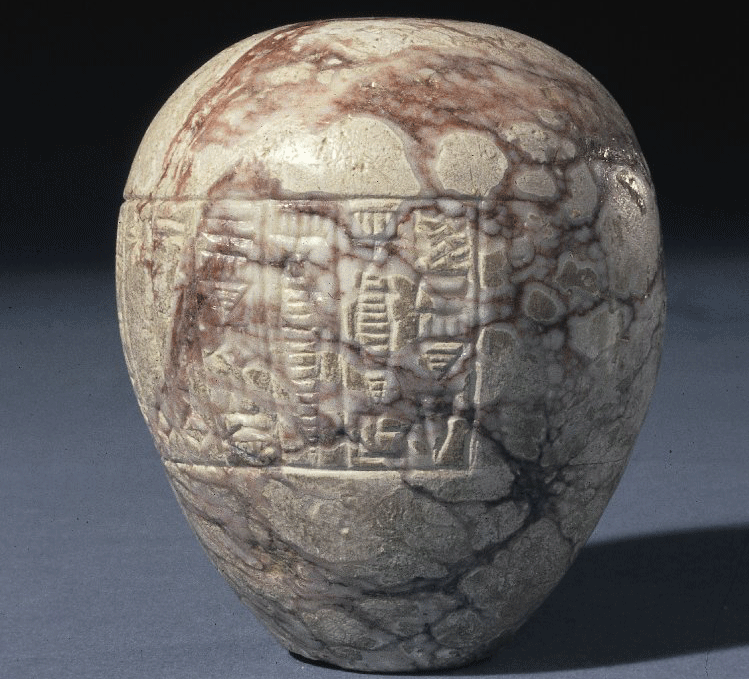
The British Museum actually possesses an inscribed egg of veined marble which he dedicated to the Sun-god of Sippara (ed note: Shamash), and the seal of his librarian Ibni-sarru is in the hands of M. Le Clercq of Paris. What may be termed the scientific literature of the library of Nineveh makes frequent reference to him, and we learn that it was for the great library which he established in his capital city of Accad that the two standard Babylonian works on astronomy and terrestrial omens were originally compiled.

Sargon's inscribed egg for the Sun God Shamash at Sippara in the British Museum.

Sargon’s inscribed egg for the Sun God Shamash at Sippara in the British Museum.

 The work on astronomy was entitled The Observations of Bel, and consisted of no less than seventy-two books, dealing with such matters as the conjunction of the sun and moon, the phases of Venus, and the appearances of comets.

It was translated in later days into Greek by the historian Berossus and though supplemented by numerous additions in its passage through the hands of generations of Babylonian astronomers, the original work contained so many records of eclipses as to demonstrate the antiquity of Babylonian astronomy even in the remote age of Sargon himself.

But besides our knowledge of Sargon’s patronage of learning, we also know something about the civil history of his reign. A copy of its annals has come down to us. We gather from these that he was not only successful in overthrowing all opposition at home, he was also equally successful abroad.

His first campaign was against the powerful kingdom of Elam in the East, where he overthrew the enemy and mutilated their slain. Next he turned to the West, laying his yoke on Syria, and subjugating “the four quarters” of the world. Then the rival kings of Babylon and other Chaldean cities felt his power; and out of the spoil of the vanquished he built the city of Accad and gave it its name.

From this time forward his attention was chiefly devoted to the West. Year after year he penetrated into Syria, until at last, we are told, “he had neither equal nor rival;” he crossed the Mediterranean to the island we now call Cyprus, and “in the third year,” at the bounds of the setting sun, his hands conquered all peoples and his mouth decreed a single empire.

Here on the shores of Cyprus the great conqueror erected images of himself, and then carried the booty of the island to the opposite coast of Asia. Such a glimpse into the history of what became afterwards a Grecian sea, when as yet no Greeks had made their ray to their later home, is startling to those whose conceptions of authentic history have been limited by the narrow horizon of the classical world. Its trustworthiness, however, has been curiously verified by a discovery made by General de Cesnola in the treasure-vaults of a Kyprian temple among the ruins of the ancient Kurion.

A god in horned cap brandishes a mace and the forked lightening of Iva-Vul, Thunder God, and sets foot on a recumbent bull.  Behind him is a leaping ibex. In front, a man, perhaps the king, in a short coat, standing full face. Behind him a man on bended knee, possibly the owner of the cylinder. Above him, a small deer is recumbent and inverted.  Then a figure in a long garment, and 3 rows of cuneiform writing:  "Arba Istar: son of Ibu Beled: servant of the god Naram-Sin."  The king Naram-Sin, to whom a divine determinative prefix is given here, reigned in Babylonia no later than 2600 BCE.  Cyprus, plate 4300.  John L. Myres, Handbook of the Cesnola Collection of Antiquities from Cyprus, 1914.

A god in horned cap brandishes a mace and the forked lightening of Iva-Vul, Thunder God, and sets foot on a recumbent bull.
Behind him is a leaping ibex. In front, a man, perhaps the king, in a short coat, standing full face. Behind him a man on bended knee, possibly the owner of the cylinder. Above him, a small deer is recumbent and inverted.
Then a figure in a long garment, and 3 rows of cuneiform writing:
“Arba Istar: son of Ibu Beled: servant of the god Naram-Sin.”
The king Naram-Sin, to whom a divine determinative prefix is given here, reigned in Babylonia no later than 2600 BCE.
Cyprus, plate 4300.
John L. Myres, Handbook of the Cesnola Collection of Antiquities from Cyprus, 1914.

Here, among other hematite cylinders of early Babylonian origin, he found one the first owner of which describes himself as a ” servant” or ”worshipper” of “the deified Naram- Sin.” Naram-Sin was the son and successor of Sargon, and it is not likely that he would have received divine honours after the fall of the dynasty to which he belonged.

The fact that the cylinder was discovered in Cyprus seems to show that even after Sargon’s death a connection continued to exist between Cyprus and the imperial power of Babylonia. Naram-Sin, however, was more bent on the conquest of Magána, or the Sinaitic Peninsula, than upon further campaigns in the West.

Sinai, with its mines of turquoise and copper, had been a prize coveted by the Egyptians ever since the age of the Third Dynasty, and one of the first efforts of the rising rival power on the banks of the Euphrates was to gain possession of the same country.

Naram-Sin, so runs the annalistic tablet, “marched to the land of Magána; the land of Magána he conquered, and overcame its king.”

A.H. Sayce, Lectures on the Origin and Growth of Religion as Illustrated by the Religion of the Ancient Babylonians, 5th ed., London, 1898, pp. 29-31.

Intimations of Antediluvian Kings

“Now the annalistic tablet takes us back reign by reign, dynasty by dynasty, to about the year 2400 B.C. Among the monarchs mentioned upon it is Khammuragas, whose reign is placed 112 years later (B.C. 2290). Of Sargon and his son Naram-Sin, however, there is no trace.

But this is not all. On the shelves of the British Museum you may see huge sun-dried bricks, on which are stamped the names and titles of kings who erected or repaired the temples where they have been found. In the dynasties of the annalistic tablet their names are as much absent as is the name of Sargon.

They must have belonged to an earlier period than that with which the list of the tablet begins, and have reigned before the time when, according to the margins of our Bibles, the flood of Noah was covering the earth, and reducing such bricks as these to their primeval slime.

But the kings who have recorded their constructive operations on the bricks are seldom connected with one another. They are rather the isolated links of a broken chain, and thus presuppose a long period of time during which their reigns must have fallen.

This conclusion is verified by another document, also coming from Babylonia and also first published by Mr. Pinches. This document contains a very long catalogue of royal names, not chronologically arranged, as is expressly stated, but drawn up for a philological purpose–that of explaining in Assyrian the Accadian and Kossaean names of the non-Semitic rulers of Babylonia.

Though the document is imperfect it embodies about sixty names which do not occur on the annalistic tablet, and must therefore be referred to an earlier epoch than that with which the latter begins.

[ … ]

Moreover, whatever might have been the original character of the Semitic occupation of Babylonia, from the time of Sargon I downwards it was of a more or less peaceable nature; Accadians and Semites mingled together, and from the mixture sprang the peculiar civilisation of Babylonia, and the peculiar type of its people.”

A.H. Sayce, Lectures on the Origin and Growth of Religion as Illustrated by the Religion of the Ancient Babylonians, 5th ed., London, 1898, pp. 23-6.

The Genesis of the Kings List

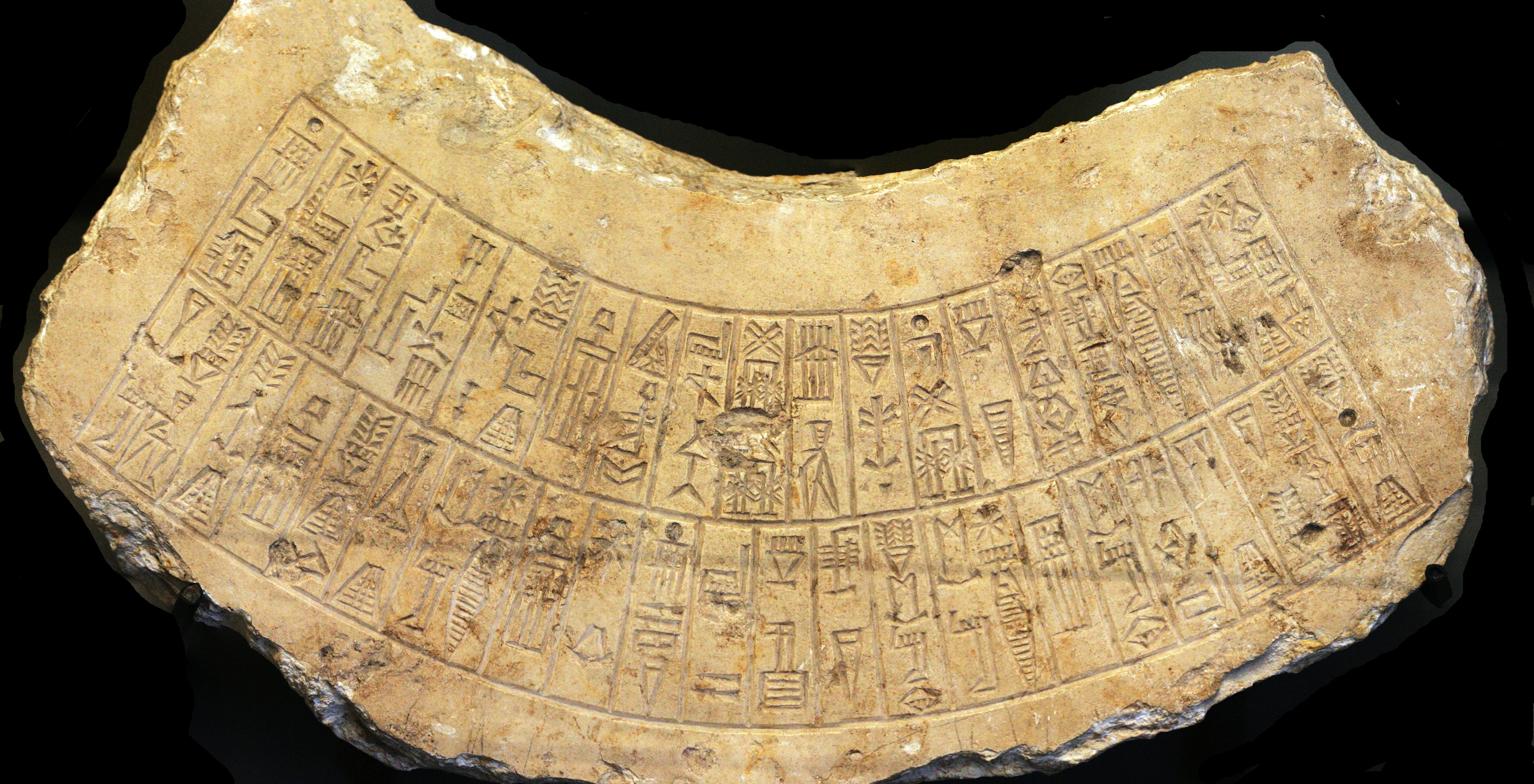
“The single fact which has shaken it to its very foundations is the discovery of the date to which the reign of Sargon of Accad must be assigned. The last king of of Babylonia, Nabonidos, had antiquarian tastes, and busied himself not only with the restoration of the old temples of his country, but also with the disinterment of the memorial cylinders which their builders and restorers had buried beneath their foundations.

It was known that the great temple of the Sun-god at Sippara, where the mounds of Abu-Habba now mark its remains, had been originally erected by Naram-Sin the son of Sargon, and attempts had been already made to find the records which, it was assumed, he had entombed under its angles. With true antiquarian zeal, Nabonidos continued the search, and did not desist until, like the Dean and Chapter of some modern cathedral, he had lighted upon “the foundation-stone” of Naram-Sin himself.

The Foundation Stone of Naram-Sin.

The Foundation Stone of Naram-Sin.

 This “foundation-stone,” he tells us, had been seen by none of his predecessors for 3200 years. In the opinion, accordingly, of Nabonidos, a king who was curious about the past history of his country, and whose royal position gave him the best possible opportunities for learning all that could be known about it, Naram-Sin and his father Sargon I, lived 3200 years before his own time, or 3750 B.C.

The date is so remote and so contrary to all our preconceived ideas regarding the antiquity of the Babylonian monarchy, that I may be excused if at first I expressed doubts as to its accuracy. We are now accustomed to contemplate with equanimity the long chronology which the monuments demand for the history of Pharaonic Egypt, but we had also been accustomed to regard the history of Babylonia as beginning at the earliest in the third millennium before our era. Assyrian scholars had inherited the chronological prejudices of a former generation, and a starveling chronology seemed to be confirmed by the statements of Greek writers.

I was, however, soon forced to re-consider the reasons of my scepticism. The cylinder on which Nabonidos accounts his discovery of the foundation-stone of Naram-Sin was brought from the excavations of Mr. Hormuzd Rassam in Babylonia, and explained by Mr. Pinches six years ago.

Soon afterwards, Mr. Pinches was fortunate enough to find among some other inscriptions from Babylonia fragments of three different lists, in one of which the kings of Babylonia were arranged in dynasties, and the number of years each king reigned was stated, as well as the number of years the several dynasties lasted.

An Assyrian copy of a similar list had been already discovered by Mr. George Smith, who, with his usual quickness of perception, saw that it must have resembled the lists from which Berossos, the Greek historian of Chaldaea, drew the materials of his chronology; but the copy was so mere a fragment that the chronological position of the kings mentioned upon it was a matter of dispute.

Happily this is not the case with the principal test published by Mr. Pinches. It had been compiled by a native of Babylon, who consequently began with the first dynasty which made Babylon the capital of the kingdom, and who seems to have flourished in the time of Nabonidos. We can check the accuracy of his statements in a somewhat curious way.

One of the two other texts brought to light by Mr. Pinches is a schoolboy’s exercise copy of the first two dynasties mentioned on the annalistic tablet. There are certain variations between thc two texts, however, which show that the schoolboy or his master must have used some other list of the early kings than that which was employed by the compiler of the tablet; nevertheless, the names and the regnal years, with one exception, agree exactly in each.

In Assyria, an accurate chronology was kept by means of certain officers, the so-called Eponyms, who were changed every year and gave their names to the year over which they presided. We have at present no positive proof that the years were dated in the same way in Babylonia; but since most Assyrian institutions were of Babylonian origin, it is probable that they were.

At all events, the scribes of a later day believed that they had trustworthy chronological evidence extending back into a dim antiquity; and when we remember the imperishable character of the clay literature of the country, and the fact that the British Museum actually contains deeds and other legal documents dated in the rein of Khammuragas, more than four thousand years ago, there is no reason why we should not consider the belief to have been justified.”

A.H. Sayce, Lectures on the Origin and Growth of Religion as Illustrated by the Religion of the Ancient Babylonians, 5th ed., London, 1898, pp. 21-3.

Ishtar and Tammuz are Composite Deities

“If it be granted, then, that Ishtar and Tammuz are deities of vegetation, it is possible still further to narrow their sphere by associating them particularly with the corn. Adonis and Aphrodite are connected with the growth of the crops. Ceres, who forbids the corn to spring while her daughter is in the realm of Pluto, is undoubtedly a corn-mother, and Proserpine evidently partakes of the same nature.

Osiris was the culture-deity who introduced corn into Egypt. A representation of him in the temple of Isis at Philas depicts corn-stalks growing out of his dead body—the body of Osiris (the grain) is torn to pieces, scattered through the land, and the pieces buried (or planted) in the earth, when the corn sprouts from it.

Moreover, Tammuz himself was cruelly disposed of by his lord, who “ground his bones in a mill, and then scattered them to the wind”—plainly a type of the treatment meted out to the corn. An Arabic writer relates that Tammuz was cruelly killed several times, but that he always came to life again, a story which recalls Robert Burns’ John Barleycorn, itself perhaps based on mythical matter.

May not these examples suggest an elucidation on animistic lines? Deities of the Tammuz type appear to symbolize the corn-grain and nothing more— cut down, bruised and beaten, buried in the earth, and finally springing to renewed life.

Who, then, are the goddesses, likewise identified with the corn, who seek in the underworld for lover or child, endeavouring with tears to ransom the corn from the dark earth? Are they not the primitive corn-spirits, the indwelling animistic spirits of the standing grain, doomed at the harvest to wander disconsolately through the earth till the sprouting of the corn once more gives them an opportunity to materialize?

The stories of the mutilation and dispersion of the bodies of Tammuz and Osiris, and of the many deaths of the former god, furnish a basis for yet another explanation of the Tammuz myth. Sir James Frazer brings forward the theory that the ‘Lamentations’ of the ancient Babylonians were intended not for mourning for the decay of vegetation, but to bewail the cruel treatment of the grain at harvest-time, and cites in this connexion the ballad of John Barleycorn, which, we are told, was based on an early English poem, probably itself of mythological origin.

It is, however, most likely that the myth of Tammuz and Ishtar is of a composite nature, as has already been indicated. Possibly a myth of the sun-god and earth-goddess has been superimposed on the early groundwork of the corn-spirit seeking the corn.

It would certainly seem that Ishtar in her descent into Aralu typified the earth, shorn of her covering of vegetation. Then in time she might come to symbolize the vegetation itself, or the fertility which produced it, and so would gain new attributes, and new elements would enter into the myths concerning her. Only by regarding her as a composite deity is it possible to reach an understanding of the principles underlying these myths.”

Lewis Spence, Myths and Legends of Babylonia and Assyria, 1917, pp. 138-40.

Interpretations of the Myth of Ishtar and Tammuz

“A truly allegorical elucidation of the myth of Ishtar’s descent into Hades would depict Ishtar, as the goddess of fertility, seeking in the underworld for her husband, the sun-god, slain by the icy breath of winter. During her sojourn in the nether regions all fertility ceases on the earth, to be resumed only when she returns as the joyful bride of the springtide sun.

The surrender of her clothing and jewels at the seven gates of Aralu represents the gradual decay of vegetation on the earth, and the resumption of her garments the growing beauty and verdure which mark her return.

Another hypothesis identifies Ishtar with Dawkina, goddess of the earth, wife of Ea and therefore mother as well as consort of Tammuz. According to this view Ishtar represents not the fertility of the earth, but the earth itself, deprived of its adornments of flowers and leafage by the approach of winter, or variously, by the burning heat of summer.

The waters of life, with which she sprinkles and restores her husband,[8] are the revivifying rains which give to the sun-god his youthful vigour and glory. Against this view it has been urged (e.g. by Sir James Frazer) that “there is nothing in the sun’s annual course within the temperate and tropical zones to suggest that he is dead for half or a third of the year, and alive for the other half or two-thirds.”

Alternatively it is suggested that Tammuz is a god of vegetation, and that Ishtar doubles the role. The slaying of Tammuz and the journey of Ishtar would thus represent two distinct myths, each typifying the decay and subsequent revival of vegetation. Other instances may be recalled in which two myths of the same class have become fused into one.

This view, then, presents some elements of probability; not only Tammuz but most of his variants appear to possess a vegetable significance, while the Ishtar type is open to interpretation on the same lines. Thus Adonis is associated with the myrrh-tree, from whose trunk he was born, and Osiris with the tamarisk, used in the ritual connected with his cult, while Attis after his death became a pine-tree.

Tammuz himself was conceived of as dwelling in the midst of a great world-tree, whose roots extended down to the underworld, while its branches reached to the heavens. This tree appears to have been the cedar, for which the ancient Babylonians had an especial reverence.

One feature which leads us to identify the deities of this class, both male and female, with gods of vegetation is their association with the moon. Osiris is regarded, and with much reason, as a moon-god; in one of her aspects Aphrodite is a lunar deity, while a like significance belongs to Proserpine and to the Phoenician Ashtoreth. Ishtar herself, it is true, was never identified with the moon, which in Babylonia was a male divinity; yet she was associated with him as his daughter.

Among primitive peoples the moon is believed to exercise a powerful influence on vegetation, and indeed on all manner of growth and productivity. The association of a god with the moon therefore argues for him also a connexion with vegetation and fertility.

It may be remarked, in passing, that a lunar significance has been attached by some authorities to the story of Ishtar’s descent into Hades, and to kindred myths. It is held that the sojourn of the goddess in Aralu typifies a lunar eclipse, or perhaps the period between the waning of the old moon and the appearance of the new.

But, as has been said, the ancient Babylonians saw in the luminary of night a male deity, so that any lunar characteristics pertaining to Ishtar must be regarded as of merely secondary importance.”

Lewis Spence, Myths and Legends of Babylonia and Assyria, 1917, pp. 136-8.

Tammuz and Ishtar, Adonis and Aphrodite, Attis and Cybele, Isis and Osiris

As has been indicated already, the myth of Tammuz and Ishtar furnished the groundwork for certain myths of classic Greece and Rome.

The Phoenician Astarte (Ashtoreth), a development of Ishtar, became in time the Aphrodite of the Greeks, a deity who plays a part in the Adonis legend analogous to that of Ishtar in the Tammuz story. The name Adonis itself is derived from Adoni (‘my lord’), the word with which the Phoenician worshippers of Tammuz hailed the setting sun.

The myth of Adonis is perhaps the most nearly related of any to that of Tammuz, since its chief characters are acknowledged counterparts of those in the Babylonian legend, while the tale of Ishtar’s descent into Hades may be regarded as a sequel to the Greek story, or rather to an early Babylonian variant thereof.

Briefly outlined, the story runs as follows: Adonis was the fruit of an unnatural union between the Syrian king Theias and his daughter Smyrna (Myrrha). Theias pursued the princess, intending to take her life for the crime, but the pity of the gods turned her into a tree from which, at the end of ten months, Adonis was born. It is said that a boar rent open the tree-trunk with its tusk, and thus enabled the divine infant to see the light.

Aphrodite, charmed with the beauty of the child, gave him into the care of Persephone, who was so enamoured of her charge that she afterwards refused to give him up. The goddesses appealed to Zeus, who decreed that Adonis should spend six months of each year with Aphrodite and six with Persephone in the underworld; or, according to another version, four months were to be passed with Aphrodite and four with Persephone, while the remaining four were to be at his own disposal.

He was afterwards slain by a boar sent against him by Artemis (herself, by the way, a development of Ishtar). It may be remarked that Aphrodite, who figures, like Ishtar, as the goddess of love and beauty, is also closely associated with the nether regions, perhaps because she was identified with the Babylonian goddess in her journey to Hades in search of her spouse.

Akin to Adonis is the god Attis, who likewise, according to one version of his myth, is slain by a boar. After his death he becomes a pine-tree, and from his blood violets spring. He is beloved of Cybele, the mother-goddess, who laments his untimely end.

In the Adonis legend there is evidence of some overlapping. Persephone, or Proserpine, who here corresponds to the Allatu of the Babylonian variant, figures in another well-known myth as the prototype of Tammuz. When she is carried off to the nether-world by Pluto, her mother, Ceres, will not suffer the corn to grow while her daughter remains a prisoner. Like Ishtar in search of her spouse, the mother-goddess seeks her child with weeping and lamentation. Through the eating of a pomegranate seed, Proserpine is finally obliged to pass four (or six) months of every year with her dark captor, as his consort.

Another myth which has affinities with the tale of Tammuz and Ishtar is the Egyptian one which deals with the quest of Isis. The god Osiris is slain through the machinations of his brother Set (who, being identified elsewhere with a black hog, recalls the boar which slew Adonis and Attis), and his body, enclosed in a chest, is cast into the Nile.

Afterwards the chest is thrown up by the waves, and round it springs miraculously a tamarisk tree. Meanwhile Isis, wife and sister to Osiris, travels hither and thither in search of his remains, which in due time she finds. However, the chest is stolen from her by Set, who, taking therefrom the body of Osiris, tears the corpse into fourteen pieces, which he scatters through the land. Isis still pursues her quest, till she has found all the portions and buried them.

These tales were the mythical correlates of certain ritualistic practices designed to bring about the change of seasons, and other natural phenomena, by means of sympathetic magic. The burden of a great duty falls upon the shoulders of primitive man; with his rites and spells and magic arts he must assist the universe in its course.

His esoteric plays, typifying the mysterious fact of growth, are necessary to ensure the sprouting of the corn; his charms and incantations are essential even for the rising of the sun; lacking the guarantee of science that one season shall follow another in its proper order, he goes through an elaborate performance symbolizing the decay and revival of vegetation, believing that only thus can the natural order be maintained. Through the force of sympathetic magic he sees his puny efforts related to the mighty results which follow them.

This, then, is the origin of the ritual of the Tammuz festival, which may conceivably have had an existence prior to that of the myth itself. The representation of the death and resurrection of the god, whether in myth or ritual, had undoubtedly a seasonal significance, wherefore the date of his festival varied in the different localities.

In Babylonia it was celebrated in June, thus showing that the deity was slain by the fierce heat of the sun, burning up all the springtide vegetation. Ishtar’s sojourn in Hades would thus occupy the arid months of summer.

In other and more temperate climes winter would be regarded as the enemy of Tammuz. An interesting account of the Tammuz festival is that given by an Arabic author writing in the tenth century, and quoted by Sir James Frazer in his Golden Bough.

Tammuz (July). In the middle of this month is the festival of el-Būgāt, that is, of the weeping women, and this is the Ta-uz festival, which is celebrated in honour of the god Ta-uz. The women bewail him, because his lord slew him so cruelly, ground his bones in a mill, and then scattered them to the wind. The women (during this festival) eat nothing which has been ground in a mill, but limit their diet to steeped wheat, sweet vetches, dates, raisins, and the like.”

The material for this description was furnished by the Syrians of Harran. Of the curious legend attaching to the mourning rites more will be said later.”

Lewis Spence, Myths and Legends of Babylonia and Assyria, 1917, pp. 131-5.

Myths of Tammuz and Ishtar

“The myth of Tammuz is one of high antiquity, dating possibly from 4000 b.c. or even earlier.

Both Tammuz and Ishtar were originally non-Semitic, the name of the former deity being derived from the Akkadian Dumu-zi, ‘son of life,’ or ‘the only son,’ perhaps a contraction of Dumu-zi-apsu, ‘offspring of the spirit of the deep,’ as Professor Sayce indicates. The ‘spirit of the deep’ is, of course, the water-god Ea, and Tammuz apparently typifies the sun, though he is not, as will presently be seen, a simple solar deity, but a god who unites in himself the attributes of various departmental divinities.

An ancient Akkadian hymn addresses Tammuz as “Shepherd and lord, husband of Ishtar the lady of heaven, lord of the under-world, lord of the shepherd’s seat;” as grain which lies unwatered in the meadow, which beareth no green blade; as a sapling planted in a waterless place; as a sapling torn out by the root.

Professor Sayce identifies him with that Daonus, or Daos, whom Berossus states to have been the sixth king of Babylonia during the mythical period. Tammuz is the shepherd of the sky, and his flocks and herds, like those of St. Ilya in Slavonic folk-lore, are the cloud-cattle and the fleecy vapours of the heavens.

Ishtar has from an early period been associated with Tammuz as his consort, as she has, indeed, with Merodach and Assur and other deities. Yet she is by no means a mere reflection of the male divinity, but has a distinct individuality of her own, differing in this from all other Babylonian goddesses and betraying her non-Semitic origin.

The widespread character of the worship of Ishtar is remarkable. None of the Babylonian or Assyrian deities were adopted into the pantheons of so many alien races. From the Persian Gulf to the pillars of Hercules she was adored as the great mother of all living. She has been identified with Dawkina, wife of Ea, and is therefore mother of Tammuz as well as his consort.

This dual relationship may account for that which appears in later myths among the Greeks, where Smyrna, mother of Adonis, is also his sister. Ishtar was regarded sometimes as the daughter of the sky-god Anu, and sometimes as the child of Sin, the lunar deity.

Her worship in Babylonia was universal, and in time displaced that of Tammuz himself. The love of Ishtar for Tammuz represents the wooing of the sun-god of spring-time by the goddess of fertility; the god is slain by the relentless heat of summer, and there is little doubt that Ishtar enters Aralu in search of her youthful husband.

The poem we are about to consider briefly deals with a part only of the myth— the story of Ishtar’s descent into Aralu. It opens thus :

“To the land of No-return, the region of darkness, Ishtar, the daughter of Sin, turned her ear, even Ishtar, the daughter of Sin, turned her ear, to the abode of darkness, the dwelling of Irkalla, to the house whose enterer goes not forth, to the road whence the wayfarer never returns, to the house whose inhabitants see no light, to the region where dust is their bread and their food mud; they see no light, they dwell in darkness, they are clothed, like the birds, in a garment of feathers. On the door and the bolt hath the dust fallen.”

The moral contained in this passage is a gloomy one for mortal man; he who enters the dread precincts of Aralu goes not forth, he is doomed to remain for ever in the enveloping darkness, his sustenance mud and dust. The mention of the dust which lies “on door and bolt” strikes a peculiarly bleak and dreary note; like other primitive races the ancient Babylonians painted the other world not definitely as a place of reward or punishment, but rather as a weak reflection of the earth-world, a region of darkness and passive misery which must have offered a singularly uninviting prospect to a vigorous human being.

The garment of feathers is somewhat puzzling. Why should the dead wear a garment of feathers? Unless it be that the sun-god, identified in some of his aspects with the eagle, descends into the underworld in a dress of feathers, and that therefore mortals who follow him must appear in the nether regions in similar guise.

The description above quoted of the Babylonian Hades tallies with that given in dream to Eabani by the temple-maiden Ukhut (Gilgamesh epic, tablet VII).”

Lewis Spence, Myths and Legends of Babylonia and Assyria, 1917, pp. 126-9.

The View of Babylon at the Near End of History

“The influence and prestige of Mesopotamia ensured that its myths, legends, and history were widely disseminated in the Near East and beyond. Many elements of Assyrian and Babylonian legal institutions and laws, science, astronomy, mathematics and medicine, calendar and the division of time, as well as magical and ritual beliefs and practices such as divination were widely adopted, as can be seen in Classical and Hellenistic Greek literature and in the Bible.

Whereas the early Greeks knew of Mesopotamia at one remove, the Israelites had direct and often painful experience of the Mesopotamians. Mesopotamian myths and history are interwoven with biblical accounts of the early days of the world: for example, the story of the Tower of Babel in Genesis 11. From the mid-ninth century B.C.E., the biblical kingdoms of Israel and Judah suffered from Assyrian expansionism, and revolts against Assyrian, and later, Babylonian, rule led to the sack of their cities and the deportation of many of their citizens. The climax came in 588–587 B.C.E., when Jerusalem was put to the torch, the Temple destroyed, and its notables exiled to Babylon.

Although a substantial Jewish community flourished in Babylon for many centuries, becoming familiar with Babylonian traditions, it is the purple prose of the traditionalists who returned to Judah that formed the picture of Mesopotamia that passed into Western consciousness via the Bible. Centuries of conflict had produced a very hostile biblical view of Mesopotamian culture and civilization, especially of Babylon “the mother of harlots and of the abominations of the earth” (Revelation 17:5), ruled by supposedly corrupt and decadent rulers like Belshazzar, who was “weighed in the balance and found wanting” (Daniel 5:27).

Although the Greeks had no such political axe to grind, they also gave the Mesopotamians a bad press, contrasting their alien practices with the civilized behavior epitomized in the Greek mind by the Greeks. Thus, for example, Herodotus draws attention to the practice of sacred prostitution. He also gives an anecdotal and fanciful account of Mesopotamian history. In contrast, his descriptions of the cities of Babylonia, and particularly Babylon itself, are both accurate and informative.

Nevertheless, contemporaries came to doubt his accounts, which conflicted with those in the twenty-three-volume Persica of Ctesias, a Greek doctor at the Persian court in the fifth century B.C.E. In fact, Ctesias’s account is far less reliable than that of Herodotus, being filtered through the attitudes and knowledge of Mesopotamia’s Persian conquerors. Unfortunately, it was upon Ctesias’s work that later Classical scholars based their writings about Mesopotamia.

This was despite the existence of a far better account, a three-volume work by the third century B.C.E. Babylonian scholar Berossus. A native of Babylon, Berossus wrote in Greek but had access to many cuneiform texts that provided detailed and accurate information on Mesopotamian history and culture. Berossus’s Babyloniaca, which ran from the Creation to Alexander’s conquest, was copied and circulated for a few centuries but by the first century B.C.E. had been largely superseded by a digest in which a Greek scholar, Alexander Polyhistor, uncritically assembled material from a number of different and conflicting texts, including Berossus and Ctesias. Information was drawn from Berossus’s work to calculate chronology, particularly the dates of the Creation and the Flood, but his original was otherwise neglected. Little of it survived the Classical period.

The Hellenistic Greeks took an active interest in the visible relics of Mesopotamia’s past. Alexander the Great began reconstructing the ziggurat of Marduk (the Tower of Babel), although work ceased upon his death. His successors carried out restorations in the precinct of Marduk and of the temple of Nabu in Borsippa. The Hanging Gardens of Babylon, reputedly built by Nebuchadrezzar for his Median queen, Amyitis, were regarded as one of the Seven Wonders of the World, their fame long outlasting their physical existence. Some versions of the list of Seven Wonders also included the great walls of Babylon, said by Herodotus to be wide enough to turn a four-horse chariot on.”

Jane R. McIntosh, Ancient Mesopotamia, 2005, pp. 21-3.

Lady Ishtar, Goddess

Ishtar was undoubtedly a goddess of Semitic origin and symbolized the fertility of the earth. She was the great mother’ who fostered all vegetation and agriculture.

It is probable that her cult originated at Erech, and in the course of centuries and under many nominal changes dispersed itself throughout the length and breadth of western Asia and even into Greece and Egypt. It is probable that a number of lesser goddesses, such as Nana and Anunit, may have become merged in the conception of this divinity, and that lesser local deities of the same character as herself may have taken her name and assisted to swell her reputation.

She is frequently addressed as ‘mother of the gods,’ and indeed the name ‘Ishtar’ became a generic designation for ‘goddess.’ But these were later honours. When her cult centred at Erech, it appears to have speedily blossomed out in many directions, and, as has been said, lesser cults probably eagerly identified themselves with that of the great earth-mother, so that in time her worship became more than a Babylonian cult.

Indeed, wherever people of Semitic speech were to be found, there was the worship of Ishtar. As Ashteroth, or Astarte, she was known to Canaanites, Phoenicians, and Greeks, and there is some likelihood that the cult of Aphrodite had also its beginnings in that of Ishtar. We shall enquire later whether she can be the Esther of the Scriptures.

Astrologically she was identified with the planet Venus, but so numerous were the attributes surrounding her taken from other goddesses with which she had become identified that they threatened to overshadow her real character, which was that of the great and fertile mother. More especially did her identification with Nin-lil, the consort of En-lil, the storm-god, threaten to alter her real nature, as in this guise she was regarded as a goddess of war.

It is seldom that a goddess of fertility or love achieves such a distinction. Gods possessing an agricultural significance are nearly always war-gods, but that is because they bring the fertilizing thunder-clouds and therefore possess the lightning arrow or spear. But Ishtar is specifically a goddess of the class of Persephone or Isis, and her identification with battle must be regarded as purely accidental.

In later times in Assyria she was conceived as the consort of Asshur, head of the Assyrian pantheon, in days when a god or goddess who did not breathe war was of little use to a people like the Assyrians, who were constantly employed in hostilities, and this circumstance naturally heightened her reputation as a warlike divinity.

But it is at present her original character with which we are occupied, indeed in some texts we find that, so far from being able to protect herself, Ishtar and her property are made the prey of the savage En-lil, the storm-god.

“His word sent me forth,” she complains; “as often as it comes to me it casts me prostrate upon my face. The unconsecrated foe entered my courts, placed his unwashed hands upon me, and caused me to tremble. Putting forth his hand he smote me with fear. He tore away my robe and clothed his wife therein : he stripped off my jewels and placed them upon his daughter. Like a quivering dove upon a beam I sat. Like a fleeing bird from my cranny swiftly I passed. From my temple like a bird they caused me to fly.”

Such is the plaint of Ishtar, who in this case appears to be quite helpless before the enemy.”

Lewis Spence, Myths and Legends of Babylonia and Assyria, 1917, pp. 123-5.

There Were Giants

“It is strange that the dispersion of tribes at Babel should be connected with the name of Nimrod, who figures in Biblical as well as Babylonian tradition as a mighty hunter.

Epiphanius states that from the very foundation of this city (Babylon) there commenced an immediate scene of conspiracy, sedition, and tyranny, which was carried on by Nimrod, the son of Chus the Ethiopian. Around this dim legendary figure a great deal of learned controversy has raged. Before we examine his legendary and mythological significance, let us see what legend and Scripture say of him.

In the Book of Genesis (chap. x, 8,  ff.) he is mentioned as “a mighty hunter before Yahweh: wherefore it is said, Even as Nimrod the mighty hunter before the Lord.” He was also the ruler of a great kingdom. “The beginning of his kingdom was Babel, and Erech, and Accad, and Calneh in the land of Shinar. Out of that land went forth Asshur” (that is, by compulsion of Nimrod) “and builded Nineveh,” and other great cities.

In the Scriptures Nimrod is mentioned as a descendant of Ham, but this may arise from the reading of his father’s name as Cush, which in the Scriptures indicates a coloured race. The name may possibly be Cash and should relate to the Cassites.

It appears then that the sons of Cush or Chus, the Cassites, according to legend, did not partake of the general division of the human race after the fall of Babel, but under the leadership of Nimrod himself remained where they were. After the dispersion, Nimrod built Babylon and fortified the territory around it. It is also said that he built Nineveh and trespassed upon the land of Asshur, so that at last he forced Asshur to quit that territory.[3]

The Greeks gave him the name of Nebrod or Nebros, and preserved or invented many tales concerning him and his apostasy, and concerning the tower which he is supposed to have erected. He is described as a gigantic person of mighty bearing, and a contemner of everything divine; his followers are represented as being equally presumptuous and overbearing. In fact he seems to have appeared to the Greeks very much like one of their own Titans.

Nimrod has been identified both with Merodach, the tutelar god of Babylon, and with Gilgamesh, the hero of the epic of that name, with Orion, and with others. The name, according to Petrie, has even been found in Egyptian documents of the XXII Dynasty as ‘Nemart.’

Nimrod seems to be one of those giants who rage against the gods, as do the Titans of Greek myth and the Jotunn of Scandinavian story. All are in fact earth-gods, the disorderly forces of nature, who were defeated by the deities who stood for law and order. The derivation of the name Nimrod may mean ‘rebel.’

In all his later legends, for instance, those of them that are related by Philo in his De Gigantibus (a title which proves that Nimrod was connected with the giant race by tradition), he appears as treacherous and untrustworthy. The theory that he is Merodach has no real foundation either in scholarship or probability. As a matter of fact the Nimrod legend seems to be very much more archaic than any piece of tradition connected with Merodach, who indeed is a god of no very great antiquity.”

Lewis Spence, Myths and Legends of Babylonia and Assyria, 1917, pp. 49-51.

On the Tower of Babel and the Confusion of Tongues

“Many attempts have been made to attach the legend of the confusion of tongues to certain ruined towers in Babylonia, especially to that of E-Sagila, the great temple of Merodach, and some remarks upon this most interesting tale may not be out of place at this point. The myth is not found in Babylonia itself, and in its best form may be discovered in Scripture. In the Bible story we are told that every region was of one tongue and mode of speech.

As men journeyed westward from their original home in the East, they encountered a plain in the land of Shinar where they settled. In this region they commenced building operations, constructed a city, and laid the foundations of a tower, the summit of which they hoped would reach to heaven itself.

It would appear that this edifice was constructed with the object of serving as a great landmark to the people so that they should not be scattered over the face of the earth, and the Lord came down to view the city and the tower, and he considered that as they were all of one language this gave them undue power, and that what they imagined to themselves under such conditions they would be able to achieve.

So the Lord scattered them abroad from thence over the face of every region, and the building of the tower ceased and the name of it was called ‘Babel,’ because at that place the single language of the people was confounded.

Of course it is merely the native name of Babylon, which translated means ‘gate of the god,’ and has no such etymology as the Scriptures pretend,—the Hebrews confusing their verb balal, ‘to confuse or confound,’ with the word babel.

The story was no doubt suggested by one of the temple towers of Babylon. Over and over again we find in connexion with the Jewish religion that anything which savours of presumption or unnatural aspiration is strongly condemned. The ambitious effort of the Tower of Babel would thus seem abhorrent to the Hebrews of old.

The strange thing is that these ancient towers or zikkurats, as the Babylonians called them, were intended to serve as a link between heaven and earth, just as does the minaret of the Mahommedan mosque.

The legend of the confusion of tongues is to be traced in other folk-lores than that of Babylon. It is found in Central America, where the story runs that Xelhua, one of the seven giants rescued from the deluge, built the great pyramid of Cholula in order to besiege heaven.

The structure was, however, destroyed by the gods, who cast down fire upon it and confounded the language of its builders. Livingstone found some such myth among the African tribes around Lake Ngami, and certain Australian and Mongolian peoples possess a similar tradition.”

Lewis Spence, Myths and Legends of Babylonia and Assyria, 1917, pp. 47-9.

Comparative Myths of the Deluge

“It is interesting to note that Sisuthrus, the hero of this deluge story, was also the tenth Babylonian king, just as Noah was the tenth patriarch. The birds sent out by Sisuthrus strongly recall the raven and dove despatched by Noah; but there are several American myths which introduce this conception.

Birds and beasts in many cosmologies provide the nucleus of the new world which emerges from the waters which have engulfed the old. Perhaps it is the beaver or the muskrat which dives into the abyss and brings up a piece of mud, which gradually grows into a spacious continent; but sometimes birds carry this nucleus in their beaks. In the myth under consideration they return with mud on their feet, which is obviously expressive of the same idea. Attempts have been made to show that a great difference exists between the Babylonian and Hebrew story. Undoubtedly the two stories have a common origin.

The first Babylonian version of the myth dates from about 2000 b.c. and its text is evidently derived from a still older tablet. It seems likely that this was in turn indebted to a still more archaic version, which probably recounted the earliest type of the myth.

This perhaps related how the earth and its inhabitants were not to the liking of the Creator, and how he resolved to recreate the whole. The great ocean-dragon was therefore called in to submerge the world, after which the Creator re-moulded it and set the survivor and his family upon it as the ancestors of a new human race. It is possible also that the great sea-dragon, or serpent, which was slain by the Creator, may have flooded the earth with his blood as he expired: there is an Algonquin Indian myth to this effect.

In an old cuneiform text, in fact, the year of the deluge is alluded to as “the year of the raging serpent.” The wise man who takes refuge in the ship or ark is warned by a dream of the forthcoming deluge. In some North American Indian myths he is warned by friendly animals. The mountain, too, as a place of refuge for the ark, is fairly common in myth.

We have dealt in Chapter II with the creation myth found in Berossus, and with this ends the part of his history which is of any importance.”

Lewis Spence, Myths and Legends of Babylonia and Assyria, 1917, pp. 45-6.

Berossus on the Babylonian Account of the Deluge

“More important is his account of the deluge. There is more than one Babylonian version of the deluge: that which is to be found in the Gilgamesh Epic is given in the chapter dealing with that poem. As Berossus’ account is quite as important, we shall give it in his own words before commenting upon it:

“ After the death of Ardates, his son (Sisuthrus) succeeded and reigned eighteen sari. In his time happened the great deluge; the history of which is given in this manner. The Deity, Cronus, appeared to him in a vision; and gave him notice, that upon the fifteenth day of the month Dsesius there would be a flood, by which mankind would be destroyed. He therefore enjoined him to commit to writing a history of the beginning, procedure, and final conclusion of all things, down to the present term; and to bury these accounts securely in the City of the Sun at Sippara. He then ordered Sisuthrus to build a vessel, and to take with him into it his friends and relations; and trust himself to the deep. The latter implicitly obeyed: and having conveyed on board every thing necessary to sustain life, he took in also all species of animals, that either fly, or rove upon the surface of the earth.

Having asked the Deity whither he was to go, he was answered, To the gods: upon which he offered up a prayer for the good of mankind. Thus he obeyed the divine admonition: and the vessel, which he built, was five stadia in length, and in breadth two. Into this he put every thing which he had got ready; and last of all conveyed into it his wife, children, and friends. After the flood had been upon the earth, and was in time abated, Sisuthrus sent out some birds from the vessel; which not finding any food, nor any place to rest their feet, returned to him again. After an interval of some days; he sent them forth a second time: and they now returned with their feet tinged with mud.

He made trial a third time with these birds : but they returned to him no more: from whence he formed a judgment, that the surface of the earth was now above the waters. Having therefore made an opening in the vessel, and finding upon looking out, that the vessel was driven to the side of a mountain, he immediately quitted it, being attended with his wife, children, and the pilot. Sisuthrus immediately paid his adoration to the earth: and having constructed an altar, offered sacrifices to the gods. These things being duly performed, both Sisuthrus, and those who came out of the vessel with him, disappeared. They, who remained in the vessel, finding that the others did not return, came out with many lamentations and called continually on the name of Sisuthrus.

Him they saw no more; but they could distinguish his voice in the air, and could hear him admonish them to pay due regard to the gods; and likewise inform them, that it was upon account of his piety that he was translated to live with the gods; that his wife and children, with the pilot, had obtained the same honour. To this he added, that he would have them make the best of their way to Babylonia, and search for the writings at Sippara, which were to be made known to all mankind. The place where these things happened was in Armenia. The remainder having heard these words, offered sacrifices to the gods; and, taking a circuit, journeyed towards Babylonia.”

Berossus adds, that the remains of the vessel were to be seen in his time upon one of the Corcyrean mountains in Armenia; and that people used to scrape off the bitumen, with which it had been outwardly coated, and made use of it by way of an antidote for poison or amulet. In this manner they returned to Babylon; and having found the writings at Sippara, they set about building cities and erecting temples; and Babylon was thus inhabited again.”

Lewis Spence, Myths and Legends of Babylonia and Assyria, 1917, pp. 42-5.

Tablets of Astrology and Omens in the Royal Library of Nineveh

“When Assurbanipal, king of Assyria, b.c. 668-626, added to the royal library at Nineveh, his contribution of tablets included many series of documents which related exclusively to the astrology of the ancient Babylonians, who in turn had borrowed it with modifications from the Sumerian invaders of the country.

Among these must be mentioned the Series which was commonly called The Day of Bel, and which was declared by the learned of the time to have been written in the time of the great Sargon I, king of Agade, c. 3800 B.C.

With such ancient works as these to guide them, the profession of deducing omens from daily events reached such a pitch of importance in the last Assyrian Empire, that a system of making periodical reports came into being, and by these the king was informed of all occurrences in the heavens and on the earth, and the results of astrological studies in respect to future events. The heads of the astrological profession were men of high rank and position, and their office was hereditary (see Diod., II, 29).

[ … ]

The variety of the information contained in these reports is best gathered from the fact that they were sent from cities so far removed from each other as Assur in the north and Erech in the south, and it can only be assumed that they were dispatched by runners or men mounted on swift horses.

As reports also come from Dilbat, Kutha, Nippur and Borsippa, all cities of ancient foundation, the king was probably well acquainted with the general course of events in his empire.”

Reginald Campbell Thompson, The Reports of the Magicians and Astrologers of Nineveh and Babylon, Vol. II, London, 1900. pp. xv-xvi, xvii.

The Twilight of Babylon

“Nabonidus (555-539 b.c.) was the last of the Babylonian kings—a man of a very religious disposition and of antiquarian tastes. He desired to restore the temple of the moon-god at Harran and to restore such of the images of the gods as had been removed to the ancient shrines. But first he desired to find out whether this procedure would meet with the approval of the god Merodach. To this end he consulted the augurs, who opened the liver of a sheep and drew thence favourable omens.

But on another occasion he aroused the hostility of the god and incidentally of the priests of E-Sagila by preferring the sun-god to the great Bel of Babylon. He tells us in an inscription that when restoring the temple of Shamash at Sippar he had great difficulty in unearthing the old foundation-stone, and that, when at last it was unearthed, he trembled with awe as he read thereon the name of Naram-sin, who, he says, ruled 3200 years before him.

But destiny lay in wait for him, for Cyrus the Persian invaded Babylonia in 538 b.c., and after defeating the native army at Opis he pressed on to Babylon, which he entered without striking a blow. Nabonidus was in hiding, but his place of concealment was discovered. Cyrus, pretending to be the avenger of Bel-Merodach for the slights the unhappy Nabonidus had put upon the god, had won over the people, who were exceedingly wroth with their monarch for attempting to remove many images of the gods from the provinces to the capital.

Cyrus placed himself upon the throne of Babylon and about a year before his death (529 b.c.) transferred the regal power to his son, Cambyses.

Assyrian-Babylonian history here ceases and is merged into Persian. Babylonia recovered its independence after the death of Darius. A king styling himself Nebuchadrezzar III arose, who reigned for about a year (521-520 b.c.), at the end of which time the Persians once more returned as conquerors. A second revolt in 514 b.c. caused the partial destruction of the walls, and finally the great city of Babylon became little better than a quarry out of which the newer city of Seleucia and other towns were built.”

Lewis Spence, Myths and Legends of Babylonia and Assyria, 1917, pp. 40-2.

Chaldean Astronomy and Magic

“For more than two thousand years the records of Babylonian and Assyrian astronomy lay buried and forgotten under the ruins of Assyrian palaces, and all that was known of the subject came from a few passages in the Bible and in the works of Greek and Roman writers.

To the Hebrews the sorceries of Babylon were an accursed thing, and the prophet Isaiah scoffs at them in these words:

“Stand now with thine enchantments, and with the multitude of thy sorceries, wherein thou hast laboured from thy youth; if so be thou shalt be able to profit, if so be thou mayest prevail.

Thou art wearied in the multitude of thy counsels. Let now the astrologers, the stargazers, the monthly prognosticators, stand up, and save thee from these things that shall come upon thee.” (Isaiah 47:12).

Among Greek writers Strabo (died a.d. 24) asserted that the Chaldeans were skilled in astronomy and the casting of horoscopes, and Aelian (3rd century a.d.) mentions the fact that both the Babylonians and Chaldeans enjoyed a reputation for possessing a knowledge of astronomy.

Achilles Tatius  (6th century) reports the existence of a tradition to the effect that the Egyptians mapped the heavens, and that they inscribed their knowledge on their pillars; the same tradition declared that the Chaldeans claimed the glory of this science, the foundation of which they attributed to the god Bel.

For this last belief there seems to be some evidence in a statement of Berosus, to the effect that the god Bel created the stars and sun and moon, and the five planets. Diodorus Siculus, a contemporary of Augustus, tells us that the Babylonian priests observed the position of certain stars in order to cast horoscopes, and that they interpreted dreams and derived omens from the movement of birds and from eclipses and earthquakes.

The general evidence of serious writers leads us to believe that astrology formed part of the religious system of the Babylonians, and it certainly exercised considerable influence over the minds of the dwellers between the Tigris and the Euphrates.

In any case, the reputation of the Chaldeans, i.e., the Babylonians and Assyrians, for possessing magical powers was so widespread, that the very name Chaldean at a comparatively early date became synonymous with magician.”

Reginald Campbell Thompson, The Reports of the Magicians and Astrologers of Nineveh and Babylon, Vol. II, London, 1900. pp. xiii-xiv.

Ashurbanipal’s Great Library of Nineveh

“But if Assur-bani-pal was effeminate and lax in government, he was the first great patron of literature. It is to his magnificent library at Nineveh that we owe practically all that we have preserved of the literature that was produced in Babylonia.

He saw that the southern part of his empire was far more intellectual and cultured than Assyria, and he despatched numerous scribes to the temple schools of the south, where they copied extensively from their archives every description of literary curiosity— hymns, legends, medical prescriptions, myths and rituals were all included in the great library at Nineveh. These through the labours of Layard and Rassam have been restored to us.

It is a most extraordinary instance of antiquarian zeal in an epoch which we regard as not far distant from the beginnings of verifiable history. Nearly twenty thousand fragments of brick, bearing the results of Assur-bani-pal’s researches, are housed in the British Museum, and this probably represents only a portion of his entire collection.

Political motives have been attributed to Assur-bani-pal in thus bringing together such a great library. It has been argued that he desired to make Assyria the centre of the religious influence of the empire. This would derogate greatly from the view that sees in him a king solely fired with the idea of preserving and retaining all that was best in ancient Babylonian literature in the north as well as in the south, and having beside him for his own personal use those records which many circumstances prove he was extremely desirous of obtaining. Thus we find him sending officials on special missions to obtain copies of certain works.

It is also significant that Assur-bani-pal placed his collection in a library and not in a temple—a fact which, discounts the theory that his collection of literature had a religious-political basis.”

Lewis Spence, Myths and Legends of Babylonia and Assyria, 1917, pp. 35-6.

Sargon: Conquerer, Librarian

“But the first great Semitic empire in Babylonia was that founded by the famous Sargon of Akkad. As is the case with many popular heroes and monarchs whose deeds are remembered in song and story— for example, Perseus, Oedipus, Cyrus, Romulus, and our own King Arthur—the early years of Sargon were passed in obscurity.

Sargon is, in fact, one of the ‘fatal children.’ He was, legend stated, born in concealment and sent adrift, like Moses, in an ark of bulrushes on the waters of the Euphrates, whence he was rescued and brought up by one Akki, a husbandman.

But the time of his recognition at length arrived, and he received the crown of Babylonia. His foreign conquests were extensive. On four successive occasions he invaded Syria and Palestine, which he succeeded in welding into a single empire with Babylonia. Pressing his victories to the margin of the Mediterranean, he erected upon its shores statues of himself as an earnest of his conquests. He also overcame Elam and northern Mesopotamia and quelled a rebellion of some magnitude in his own dominions.

His son, Naram-Sin, claimed for himself the title of “King of the Four Zones,” and enlarged the empire left him by his father, penetrating even into Arabia. A monument unearthed by J. de Morgan at Susa depicts him triumphing over the conquered Elamites. He is seen passing his spear through the prostrate body of a warrior whose hands are upraised as if pleading for quarter. His head-dress is ornamented with the horns emblematic of divinity, for the early Babylonian kings were the direct vicegerents of the gods on earth.

The brilliance of Naram-Sin's reign is reflected in the execution of this stele, which commemorated his victory over Satuni, king of the Lullubi.  The Akkadian army is climbing the steep slopes of the Zagros Mountains, home to the Lullubi. This upward march sweeps aside all resistance. To the right of a line of trees clinging to the mountainside, defeated enemies are depicted in a posture of submission. Those who have been killed are trampled underfoot by the Akkadian soldiers or drop over the precipice. These mountain people are clad in a tunic of hide and wear their long hair tied back. The composition is dominated by the lofty figure of the king, to whom all eyes - those of the Akkadian soldiers and of their Lullubi enemies - are turned. The triumphant sovereign, shown taller than the other men in the traditional manner, leads his army in the attack on the mountain.  He is followed by standard bearers who march before helmeted soldiers carrying bows and axes. Naram-Sin tramples the bodies of his enemies, while a kneeling Lullubi tries to tear out the arrow piercing his throat. Another raises his hands to his mouth, begging the Akkadian king for mercy.  But the conqueror's gaze is directed toward the top of the mountain. Above Naram-Sin, solar disks seem to radiate their divine protection toward him, while he rises to meet them. The Akkadian sovereign wears a conical helmet with horns - a symbol traditionally the privilege of the gods - and is armed with a large bow and an axe. This victorious ascension chiseled in stone thus celebrates a sovereign who considers himself on an equal footing with the gods. In official inscriptions, Naram-Sin's name was therefore preceded with a divine determinative.  He pushed back the frontiers of the empire farther than they had ever been, from Ebla in Syria to Susa in Elam, and led his army

The brilliance of Naram-Sin’s reign is reflected in the execution of this stele, which commemorated his victory over Satuni, king of the Lullubi.
The Akkadian army is climbing the steep slopes of the Zagros Mountains, home to the Lullubi. This upward march sweeps aside all resistance. To the right of a line of trees clinging to the mountainside, defeated enemies are depicted in a posture of submission. Those who have been killed are trampled underfoot by the Akkadian soldiers or drop over the precipice. These mountain people are clad in a tunic of hide and wear their long hair tied back.
The composition is dominated by the lofty figure of the king, to whom all eyes – those of the Akkadian soldiers and of their Lullubi enemies – are turned. The triumphant sovereign, shown taller than the other men in the traditional manner, leads his army in the attack on the mountain.
He is followed by standard bearers who march before helmeted soldiers carrying bows and axes. Naram-Sin tramples the bodies of his enemies, while a kneeling Lullubi tries to tear out the arrow piercing his throat. Another raises his hands to his mouth, begging the Akkadian king for mercy.
But the conqueror’s gaze is directed toward the top of the mountain. Above Naram-Sin, solar disks seem to radiate their divine protection toward him, while he rises to meet them. The Akkadian sovereign wears a conical helmet with horns – a symbol traditionally the privilege of the gods – and is armed with a large bow and an axe.
This victorious ascension chiseled in stone thus celebrates a sovereign who considers himself on an equal footing with the gods. In official inscriptions, Naram-Sin’s name was therefore preceded with a divine determinative.
He pushed back the frontiers of the empire farther than they had ever been, from Ebla in Syria to Susa in Elam, and led his army “where no other king had gone before him.”
He now appears as a universal monarch, as proclaimed by his official title “King of the Four Regions” – namely, of the whole world.
http://www.louvre.fr/en/oeuvre-notices/victory-stele-naram-sin

Even at this comparatively early time (c . 3800 b.c.) the resources of the country had been well exploited by its Semitic conquerors, and their absorption of the Sumerian civilization had permitted them to make very considerable progress in the enlightened arts. Some of their work in bas-relief, and even in the lesser if equally difficult craft of gem-cutting, is among the finest efforts of Babylonian art.

Nor were they deficient in more utilitarian fields. They constructed roads through the most important portions of the empire, along which a service of posts carried messages at stated intervals, the letters conveyed by these being stamped or franked by clay seals, bearing the name of Sargon.

Sargon is also famous as the first founder of a Babylonian library. This library appears to have contained works of a most surprising nature, having regard to the period at which it was instituted.

One of these was entitled The Observations of Bel, and consisted of no less than seventy-two books dealing with astronomical matters of considerable complexity; it registered and described the appearances of comets, conjunctions of the sun and moon, and the phases of the planet Venus, besides recording many eclipses. This wonderful book was long afterward translated into Greek by the Babylonian historian Berossus, and it demonstrates the great antiquity of Babylonian astronomical science even at this very early epoch.

Another famous work contained in the library of Sargon dealt with omens, the manner of casting them, and their interpretation—a very important side-issue of Babylonian magico-religious practice.

Among the conquests of this great monarch, whose splendour shines through the shadows of antiquity like the distant flash of arms on a misty day, was the fair island of Cyprus. Even imagination reels at the well-authenticated assertion that five thousand seven hundred years ago the keels of a Babylonian conqueror cut the waves of the Mediterranean and landed upon the shores of flowery Cyprus stern Semitic warriors, who, loading themselves with loot, erected statues of their royal leader and returned with their booty.

A god in horned cap brandishes a mace and the forked lightening of Iva-Vul, Thunder God, and sets foot on a recumbent bull.  Behind him is a leaping ibex. In front, a man, perhaps the king, in a short coat, standing full face. Behind him a man on bended knee, possibly the owner of the cylinder. Above him, a small deer is recumbent and inverted.  Then a figure in a long garment, and 3 rows of cuneiform writing:

A god in horned cap brandishes a mace and the forked lightening of Iva-Vul, Thunder God, and sets foot on a recumbent bull.
Behind him is a leaping ibex. In front, a man, perhaps the king, in a short coat, standing full face. Behind him a man on bended knee, possibly the owner of the cylinder. Above him, a small deer is recumbent and inverted.
Then a figure in a long garment, and 3 rows of cuneiform writing:
“Arba Istar: son of Ibu Beled: servant of the god Naram-Sin.”
The king Naram-Sin, to whom a divine determinative prefix is given here, reigned in Babylonia no later than 2600 BCE.
Cyprus, plate 4300.
John L. Myres, Handbook of the Cesnola Collection of Antiquities from Cyprus, 1914.

In a Cyprian temple De Cesnola discovered, down in the lowest vaults, a haematite cylinder which described its owner as a servant of Naram-Sin, the son of Sargon, so that a certain degree of communication must have been kept up between Babylonia and the distant island, just as early Egypt and Crete were bound to each other by ties of culture and commerce.

Lewis Spence, Myths and Legends of Babylonia and Assyria, 1917, pp. 16-9.

Mesopotamian Religion is Undefinable

“Mesopotamian religion includes certain beliefs and practices of the Sumerians, Akkadians, Assyrians, Babylonians and other peoples who lived at various times in different parts of ancient Mesopotamia, the region corresponding roughly to modern Iraq, from the fourth through the first millennia BCE.

The history and cultures of these peoples were mostly forgotten during the early Christian era, save for brief historical narratives of famous kings and cities in the Hebrew Bible, in classical authors such as Herodotus, Diodorus and Josephus, and in scattered excerpts from a lost book by Berossus, a Babylonian writing in Greek in the third century BCE.

Beginning in the nineteenth century CE, with the discovery and excavation of ancient Mesopotamian sites and decipherment of Mesopotamian languages such as Sumerian and Akkadian, European and American scholars identified texts, objects and architecture as religious in nature. They used these to reconstruct ancient Mesopotamian religious beliefs and practices in the absence of any continuous or living tradition from ancient times to the present.

Inevitably the intellectual concerns of successive generations of scholars, their personal religious commitments and their individual stances, such as piety, scepticism or anticlericalism, had their effect on agendas of research and modes of presentation of Mesopotamian religion in modern studies. Many scholars of an earlier generation took for granted, for example, a higher degree of religious preoccupation and expression among ‘ancient Oriental’ or ‘Semitic peoples’ than among other ancient peoples such as the Greeks and Romans, but generalizations on this order are no longer the basis for serious research.

Some scholars imagined, for example, that the priesthood was primarily responsible for preserving culture, while others claimed that priests resisted change and development, suppressed writings unacceptable to them, and generally stood in the way of progress.

Pioneering studies of Mesopotamian religion tended to be comprehensive, such as that by M. Jastrow (1898, partially revised German edition 1912, with a volume of illustrations, 1912). Its fundamental thesis was that ancient Mesopotamian religion derived from local animistic cults that grew and merged into a larger, more complex interlocking set of religious practices and beliefs.

Similar views were set forth by R. W. Rogers (1908) in a volume that treated Mesopotamian religion as a sort of prelude to Judaism, itself a prelude to Christianity. E. Dhorme (1945, not available in English) wrote a concise and well-documented descriptive study.

The most influential writer in English on Mesopotamian religion was Thorkild Jacobsen. He developed a view that ancient Mesopotamian religion derived from a person’s sense of the ‘other’ in the natural world around him, leading to feelings of fear and awe. People perceived active will in natural events, processes and phenomena. This sense of the other was expressed, using metaphorical terms, in myth and theology and was acted upon in cult and ritual.

We have a comprehensive presentation of his views (Jacobsen 1976) and a later summary statement of his work (Jacobsen 1987). Bottéro (2001) stressed spiritual values and a phenomenological rather than a schematic, theoretical approach; for a summary of its main theses see Bottéro (1992: 201–31).

Economic and ritual aspects of Mesopotamian religion are presented by Oppenheim (1977), professing disdain for a historical approach to the subject. He contributed a brief but suggestive essay to a collection edited by Ferm (1950: 65–79). A more detailed, primarily bibliographical survey was offered by Römer (1969). There are numerous technical studies of aspects of Mesopotamian religion in the scientific literature of Assyriology, but few of them are in English.

Many presentations of Mesopotamian religion rely on retellings of ancient literary works that modern scholars classify as mythology. Authoritative presentations of Mesopotamian and other ancient Near Eastern mythologies were made in Kramer (1961 and 1969), as well as in a major treatment of Mesopotamian mythological texts jointly with Bottéro (1989, not available in English). Recent English translations of Akkadian mythology are found in Dalley (1989) and Foster (1996). Important Sumerian myths and other religious texts are translated in Jacobsen (1987).

No ancient Mesopotamian term corresponds to the modern concept of ‘religion,’ nor is there any ancient scripture, systematic treatise or general description of religious belief or activity from any period of Mesopotamian history. This means that definition of Mesopotamian religion can at best be only a modern mode of selecting and interpreting ancient writings and material culture using modern humanistic categories for which there may not have been ancient counterparts. Although the Mesopotamians recognized certain matters as ‘pertaining to the gods’, a distinction between religious and secular matters may not have been always fully comprehensible in the context of Mesopotamian culture.”

Benjamin R. Foster, “Sources,” John R. Hinnells, ed., A Handbook of Ancient Religions, 2007, pp. 161-5.

Mesopotamian Cosmology

“In literature and magic spells, Mesopotamians referred to the beginnings of the world. The various accounts were quite different, so there was no one story that should be considered standard or universally accepted.

The most comprehensive and ambitious of the accounts of creation, contained in the Babylonian Epic of Creation, refers to a time before the present generation of gods in which there were two waters, male and female, commingling with no distinct separation. Rather than the ‘chaos’ which it is often considered, this combination was dynamic and productive, yielding several pairs of older gods, male and female, and ultimately a much larger number of younger gods, on whom the narrative focuses.

The successive generations of gods were progressively stronger and greater than the preceding ones, suggesting that the Mesopotamians visualized a dynamic past development of their universe, culminating in a present order that was stable and unchanging (Foster 1996: 350):

When on high no name was given to heaven,

Nor below was the netherworld called by name,

Primeval Apsu was their progenitor,

And matrix-Tiamat was she who bore them all,

They were mingling their waters together,

No canebrake was intertwined nor thicket matted close.

When no gods at all had been brought forth,

None called by names, none destinies ordained,

Then were the gods formed within these two.

The Babylonian Epic of Creation ascribed to Marduk, god of Babylon, the reorganization of the cosmos into the form the Babylonians knew it, including the motions of the stars, a firmament above the earth, rivers and mountains of the earth, the phases of the moon, and so forth. Since this account dates only to the second half of the second millennium BCE and presupposes a cosmos centred on Babylon, there is no reason to assign it universal validity in Mesopotamia. The poem appears to contain a variety of earlier materials worked into a coherent narrative.

The universe was visualized as circular, with a firmament below heaven and a corresponding surface above the netherworld. Some speculative texts proposed several layers in the cosmos (Lambert 1975). In any case, heaven was so remote from earth that the land was not visible to a human observer who had risen so high, such as the mythologized king Etana, who flew up to heaven on an eagle, or the sage Adapa, who was summoned to heaven after interfering with the wind.

In later periods, heaven and netherworld were thought to be organized like urban earth, with gates, defences, and large residences for the gods containing reception areas, sleeping quarters, baths and other amenities.”

Benjamin R. Foster, “Cosmology,” John R. Hinnells, ed., A Handbook of Ancient Religions, 2007, pp. 183-4.

Mesopotamian End Times

“Mesopotamia offers little evidence for a belief in a future end of the world. The only clear reference to this occurs in a third-century BCE work in Greek by Berossus, reputedly a Babylonian priest. He stated that the earth was in danger of ending in fire or flood when the planets were gathered in a straight line in the constellations Cancer or Capricorn.

No earlier Mesopotamian reference to this belief has been identified, so its authenticity as a native Mesopotamian tradition is disputed. Although there are references to good and bad times and to the impermanence of political power in any one city or dynasty, these changes were described not as cyclical but as the result of divine favour or disfavour to individual rulers or their cities.

The Mesopotamians viewed the world in which they lived as different from that of very ancient times, which were separated from the more recent past by the flood. The Mesopotamians believed that the flood would not recur; therefore, in effect the end of the world had already taken place.

They expected the world to endure in the form they knew it, despite individual triumphs and destructions of cities and states. Since the flood had shown that the human race was essential to maintain the living standards of the gods, the gods might reduce the human population through plague or famine, but would never again attempt to eliminate it entirely.”

Benjamin R. Foster, “End of the World,” John R. Hinnells, ed., A Handbook of Ancient Religions, 2007, pp. 184-5.

Creation of Man

“According to the Babylonian Flood Story, the gods created the human race in order for it to maintain them in a comfortable and luxurious living standard. In this account, the first human was made in collaboration by the birth-goddess, Mami or Nintu, and Enki, god of wisdom. They took a piece of clay, kneaded it with divine spittle, then mixed in the spirit, flesh and blood of a slain rebellious god (Foster 1996: 168):

“They slaughtered Aw-ilu, who had the inspiration [for the revolt against the gods], in their assembly.

The [birth-goddess] Nintu mixed clay with his flesh and blood.

That same god and man were thoroughly mixed in the clay.

For the rest of time they would hear the drum,

From the flesh of the god the spirit remained.

It would make the living know its sign,

Lest he be allowed to be forgotten, the spirit remained.”

To sustain the human race, birth, maturity, marriage and procreation were instituted. Later, when the population had grown too great, celibacy, infertility, still birth and social restrictions against childbirth for certain groups of people were imposed on the human race.

This was not the only Mesopotamian story of how human beings were created. In a Sumerian account, the god of wisdom produced various experimental but defective human beings until a satisfactory human was brought forth (Kramer 1961: 68–70). In another Sumerian creation story, human beings grew from the earth after Enlil struck it with a pickaxe. Then he handed them the pickaxe and they set to work (Farber in Hallo 1997: 511–13). In the Babylonian Epic of Creation, Enki/Ea’s role in creating the human race is subordinated to Marduk, who is said to have had the original idea for it (Foster 1996: 383):

“I shall compact blood, I shall cause bones to be.

I shall make stand a human being, let ‘Man’ be its name.

I shall create human kind.

They shall bear the gods’ burden that those may rest.”

Humans in Mesopotamian thought were differentiated from animals in that they ate prepared foods, such as bread and beer, in preference to uncooked wild plants and water. Humans, unlike animals, wore clothes and treated and adorned their bodies with alien substances, such as oils and cosmetics, and cut their hair, rather than letting it grow to a natural length.

Humans were different from gods in that they had inferior mental and physical powers and had limited lifespans. What some later peoples deemed human characteristics, such as an immortal soul, language, social organization and use of implements, seemed to the Mesopotamians to be developments of human potential rather than distinguishing features of the race.”

Benjamin R. Foster, “Gods and the Human Race,” John R. Hinnells, ed., A Handbook of Ancient Religions, 2007, pp. 185-6.

Semites vs. Sumerians

“Each new discovery of cuneiform tablets elicits a wave of publications asserting biblical ‘parallels,’ many of them uncertain and farfetched, even when a millennium or more may have elapsed between the tablets and the relevant portion of the Bible.

The biblical scholar M. Dahood, for example, saw parallels betwen the Bible and cuneiform tablets from Ebla in northern Syria, which date to approximately 1300 years before the kingdom of David. E. A. Speiser insisted that the ‘patriarchal age’ of the Bible was reflected in tablets from Nuzi in northern Mesopotamia (early fourteenth century BCE), although most of his analogies have been discarded in recent years.

The discovery of prophetic documents at Mari (eighteenth century BCE) attracted much discussion, as did comparison of ancient treaties with the biblical covenant.

A subtler interconnection between the worlds of the Hebrews and of the Babylonians was provided by what might be called ‘Pan-Semitism,’ the idea that the Semitic peoples had certain innate mental and emotional characteristics and limitations in common that conditioned their religious values.

A concise statement of this view, which is traceable, for example, to the works of the influential French thinker Ernest Renan, will be found in S. A. Cook’s contribution ‘The Semites, Temperament and Thought’ in the Cambridge Ancient History (1924), chapter V.

Cook held that Semitic thought was verbal rather than visual, emotional rather than systematic or speculative, and so could not have created such a grand astral system of beliefs as the Pan-Babylonianists had imagined underlay modern Christianity, Judaism and Islam.

To Pan-Semitists, Greece, with its alleged superior visual and speculative thought, albeit comparatively shallow religion, was as essential to understanding Christianity as was Judaism.

Scholars wrote of the ‘Hebrew’ and the ‘Greek’ element in Christianity and European culture. The Pan-Semitists bracketed Judaism, Islam and Babylonia as ‘Semitic’ in type, but not Christianity. This left the place of the Sumerians in the equation Babylonian = Semitic difficult to define.

The early twentieth-century historian Eduard Meyer, for example, therefore argued that the Semites were the original inhabitants of Mesopotamia and the Sumerians were later invaders, thereby maintaining the originally ‘Semitic’ character of Mesopotamian civilization.

In the period after World War I, some scholars tried to distinguish ‘Sumerian’ from ‘Semitic’ thought in Mesopotamian culture. Thus discussion of the relations between Babylonia and the Bible proceeded in an atmosphere charged with faith, scepticism and anti-Semitism.”

Benjamin R. Foster, “Mesopotamian Religion and the Bible,” John R. Hinnells, ed., A Handbook of Ancient Religions, 2007, pp. 208-9.

Assyro-Babylonian Studies in Modern Context

“Mesopotamian religion has been of interest to biblical scholars since the discovery in 1872 by George Smith of a flood story in an Assyrian tablet. This proved that non-biblical ancient Near Eastern documents contained material directly pertinent to the Bible. To some thinkers, the uniqueness and integrity of the Bible could therefore no longer be maintained.

Leading philologists, especially in Germany, such as Hugo Winckler, Hermann Gunkel, Heinrich Zimmern and Friedrich Delitzsch, staked out different and sometimes contradictory positions in what became known as ‘Pan-Babylonianism’ or the ‘Astral-mythological’ school. The basic tenet of this group was that the civilization of Israel was essentially Babylonian in origin, including its religious ideas, such as monotheism.

Winckler, for example, argued that Joshua, Saul and David were actually Babylonian astral deities. Zimmern went on to suggest that Marduk was a forerunner of Jesus. Peter Jensen, a distinguished Assyriologist, argued that Abraham, Jesus and John the Baptist, for example, were borrowed from Babylonian mythology and that the Gilgamesh epic, to him a kind of astral saga, was the basis for the New Testament and the Koran.

Outside of Germany more moderate positions were taken, but still implying a strong cultural and religious dependency of Israel upon Babylonia. The extravagant claims of the Pan-Babylonianists eventually collapsed and are not taken seriously today.

A broader and more moderate view held that Babylonia was part of the ancient Near Eastern context of the Hebrew Bible (Lambert 1988). Committed Christian and Jewish scholars, for example, often put the Bible first, so to them ancient Near Eastern ‘parallels’ helped to clarify or even ‘prove’ the validity of the Bible because they were independent witness to biblical passages.

Mesopotamian studies, especially in the United States, became effectively an adjunct of biblical studies. In the period 1880–1940 the majority of leading American scholars in the discipline were Protestant clergymen, very much interested in possible biblical connections.

To some scholars, such as W. F. Albright, the ‘biblical world’ came to include the whole of the ancient Near East. There was therefore no need to separate Mesopotamian studies from biblical studies; they were aspects of the same agenda. In this spirit, Albright could entitle one of his most popular books From the Stone Age to Christianity (Albright 1940).

According to this, Mesopotamian religion was a ‘preparatio’ for the more profound religion of Israel, itself a preparation for Christianity. Today, because of the accumulation of new material, a panoramic grasp of the languages and civilizations of the ancient Near East such as Albright enjoyed is impossible to attain, but Albright’s fundamental approach remains influential, especially among conservative Christian scholars.”

Benjamin R. Foster, “Mesopotamian Religion and the Bible,” John R. Hinnells, ed., A Handbook of Ancient Religions, 2007, pp. 207-8.

The Rise of the Priests

” … Corresponding to the growth of the temples, we find the organization of the cult extending its scope; and with this extension, the steadily increasing power and authority of the priests. In the small beginnings of the Euphratean cities, the priestly and secular functions no doubt rested in one and the same person.

The ruler of a city or district, as we have seen, [3] was regarded as the representative of the deity. As such he stood in a special relation to the deity, acting as a mediator between the latter and the people, while upon his good standing with the god, the general welfare of the people depended. On the very ancient monument of Ur-Nina [4] we find the ruler himself offering the libation to the god, though behind him stands an attendant who is probably a priest to assist in carrying out the rite.

As early, however, as the days of Gudea (c. 2450 B.C.) the ruler himself is led into the presence of the deity through the mediation of a priest. Gudea is so depicted on seal cylinders and other monuments, and presumably therefore the marked differentiation between priest and ruler thus illustrated was at the time an established custom of long standing.

The mediatorship may, indeed, be set down as the chief prerogative of the priest in Babylonia and Assyria. With this as a starting-point, his other functions as sacrificer, as exerciser, as inspector of the liver for the purpose of ascertaining the disposition of the deity, as astrologer and as diviner in general, interpreting birth-signs, dreams, and furnishing the answer as to the meaning of all kinds of occurrences that deviated from the normal or that in any way aroused attention, may be derived.

The people could proceed as far as the inner court of the temples, where an altar stood, but beyond that the priests alone could venture, and the rulers only if accompanied by a priest who as the privileged servitor of the deity had access to the divine presence.

Intercession is thus a distinguishing function of the priest, as a corollary to his role as mediator.”

Morris Jastrow, The Civilization of Babylonia and Assyria, 1915, pp. 271-2.

Divination and Dreams

“The three systems of divination which we have analyzed all entered directly into the religious life of the people and illustrate some of the religious practises which were maintained, like the incantation rituals, throughout all periods. The longing to pierce the unknown future, to pull aside the veil which separates us from a knowledge of coming events, is so strong in man as to have all the force of an innate quality an instinct of which he himself only gradually becomes fully conscious.

It plays an unusually prominent part in the religion of Babylonia and Assyria, indeed so prominent as to justify us in asserting that by the side of the ever present fear of the demons, the significance attached to omens was the most conspicuous outward manifestation of the religious spirit of the people taken as a whole.

This conclusion is strengthened by the knowledge that we now have of other forms of divination, such as pouring a few drops of oil into a basin of water, and according to the action of the oil in forming rings and bubbles that sink and rise and the directions in which they spread, conclusions were drawn of a more or less specific character, and suggested by a more or less artificial association of ideas with the action of the oil bearing either on public affairs or on private matters, according to the questions asked of the diviners, to which they were expected to give an answer. [1]

Within the other category of involuntary divination where the sign is obtruded on your notice, falls the importance attached to dreams, the interpretation of which formed in fact one of the most important functions of the Babylonian-Assyrian priests acting as diviners. References to dreams are frequent both in the older and later inscriptions of Babylonian and Assyrian rulers. [2]

A majestic figure reaching from earth to heaven appears to Ghidea in a dream ; it turns out to be the god Ningirsu. A female figure also rises up with a tablet and a stylus who is the goddess Nisaba.

The sun mounting up from the earth is explained to be the god of vegetation, Ningishzida. Various utensils and building material and an ass to carry burdens which the ruler sees in his dream leave no doubt as to the interpretation of the vision. It is the order to Gudea to build a temple according to the plan drawn on a tablet by a second male figure appearing to him, and who turns out to be the god Nin-dub. The interpretation is given to the ruler in this instance by the goddess Nina as whose son he designates himself.

Ordinarily, however, it is to a priest to whom rulers and people go to learn the meaning of dreams, in the belief that dreams are omens or signs sent by the gods as a means of indicating what is about to happen ; and even in Gudea’s case we may safely assume that the interpretation ascribed to the goddess directly was furnished to him through the mediation of the priests.

At the other end of Babylonian history, we find Nebuchadnezzar and a goddess appearing to Nabonnedos, the last king of Babylonia, in dreams to explain certain strange signs that had lately been reported. In the inscriptions of Ashurbanapal, the great king of Assyria, there are several references to dreams.”

Morris Jastrow, The Civilization of Babylonia and Assyria, 1915, pp. 266-7.

Chimeras in Babylonian-Assyrian Divination

” … The factor of fancy manifests itself in these handbooks of the Babylonian-Assyrian diviners in a form which is especially interesting, because of the explanation it affords for the widespread belief in antiquity in hybrid creatures such as satyrs, mermaids, fauns, harpies, sphinxes, winged serpents and the many fabulous monsters of mythology and folk-lore.

We have long lists of the young of animals having the features or parts of the body of another animal. Instead, however, of being recorded as a mere resemblance, an ewe giving birth to a lamb having a head which suggests that of a lion, or of a dog, an ass, of a fox or a gazelle, or ears or eyes which suggest those of another animal, it is stated that the ewe has given birth to a lion, dog, ass, fox gazelle, as the case may be.

In the same way, since it often happens that the face of an infant suggests a bird, a dog, a pig, a lamb, or what not, the fancied resemblance leads to the statement that a woman has given birth to the animal in question, which thus becomes an omen, the interpretation of which varies according to the ideas associated with the particular animal.

A lion suggests power and enlargement, and therefore a lamb or an infant with a lion-like face points to increase and prosperity in the land and to the growing strength of the ruler, and is also a favorable sign for the stall or house in which such a creature is born.

PLATE XXXIII

The Tree of Life with Assyrian King and with winged creature as guardian and fertilizer of the Tree — Symmetrically repeated.

The Tree of Life with Assyrian King and with winged creature as guardian and fertilizer of the Tree — Symmetrically repeated.

Favorable ideas, though of a different order, are associated with the lamb, pig, ox and ass, whereas with the dog as an unclean animal in the ancient as well as in the modern Orient, the association of ideas was unfavorable, and similarly with the serpent, wild cow and certain other animals, the interpretation refers to some misfortune, either of a public or private character, and occasionally of both.

This feature of a fancied resemblance between one animal and another and between an infant and some animal was the starting-point which led, through the further play of the imagination, to the belief in hybrid creatures and all kinds of monstrosities. The case of an infant being born with feet united so as to suggest the tail of a fish is actually recorded in our lists of birth-signs, and from such an anomaly to the belief in mermaids and tritons, half human and half fish, is only a small step, rendered still more credible by the representation in art which convents the resemblance to a fish tail into a real tail.

Since we have the direct proof [2] of the spread of the Babylonian-Assyrian system of divination from birth-omens, as of the two other systems above discussed, to Asia Minor, Greece and Rome, there is every reason to believe that we are justified in tracing back to this system the belief in fabulous beings of all kinds, though it may of course be admitted that there are also other factors involved.

We find this belief in Babylonia and Assyria, where we encounter in the ancient art hippocentaurs as well as bulls and eagles with human faces, and in the Assyrian art the winged monsters with human faces and the bodies of bulls or winged human figures with eagle faces. The process once begun would naturally lead to all kinds of ramifications and combinations.”

Morris Jastrow, The Civilization of Babylonia and Assyria, 1915, pp. 263-6.

The Demons Named

” … The existence of several elaborate incantation series in Ashurbanapal’s library, prescribing a large number of formulas to be recited in connection with symbolical rites to get rid of the demons, furnishes the proof for the practical significance attached to incantations in both Babylonia and Assyria.

These series, Babylonian in origin, revert to Sumerian prototypes and represent compilations stretching over a long period, with additions intended to adapt them to conditions prevailing in Assyria.

The scribes of Ashurbanapal were not indulging in a purely academic exercise in copying the archives of Babylonian temples ; their purpose, as was also the aim of the king, was to make Nineveh the central religious authority as well as the political mistress by having in their control the accumulated experience of the past, in dealing with the religious needs and problems of their own age.

A feature which these incantation series [1] have in common is the recognition of a large number of demons, with special functions assigned in many cases to the one class or the other.

So, for example, there is a demon Labartu, represented as a horrible monster with swine sucking at her breasts, [2] who threatens the life of the mother at childbirth; a group known as Ashakku who cause varieties of wasting diseases, another demon Ti’u, whose special function was to cause diseases, manifesting themselves by headaches accompanied by fever, and so on through a long list. It will be apparent that there is no differentiation between the demon and the disease. The one is the synonym of the other, and accordingly in medical texts the demons are introduced as the designations of the diseases themselves.

The names given to the demons in many cases convey the “strength” or “size” ascribed to them, such as Utukku, Alu, Shedu, Gallu, or they embody a descriptive epithet like AkKkhazu, “seizer” (also the name of a form of jaundice); ‘Eabisu, the one lying-in-wait; Labasu, “overthrower”; Lilu and the feminine Lilitu, “night-spirit;” Etimmu, ghost or shade, suggesting an identification of some demons with the dead who return to plague the living, Namtar, “pestilence,” and more the like.

The descriptions given of them, cruel, horrible of aspect, blood-thirsty, flying through space, generally invisible though sometimes assuming human or animal shape or a mixture of the two, further illustrate the conceptions popularly held.”

Morris Jastrow, The Civilization of Babylonia and Assyria, 1915, pp. 241-3.

Assyro-Babylonian Demonology

“From this point of view it is therefore significant to find the large place taken in the practice of the religion by incantation rituals and divination practices. It is inconceivable that the hymns and the incantations should be the product of the same order of thought, and as we proceed in our study of the religion of Babylonia and Assyria the evidence increases for the thesis that the incantation texts, growing by accumulation from age to age, represent the older products which are retained by the side of compositions expressive of more advanced thought.

The power appealed to to furnish relief must be addressed, and naturally the priests will endeavor to embody in this address the conceptions of the god or goddess that have been developed as a result of their speculations and attempts at systematization. The technical term shiptu for “incantation” is therefore attached to the hymns as a further indication that they form an ingredient part of this subdivision of the religious literature.

Taking up the incantations proper, we find the basic idea to be the theory that sickness and all forms of bodily suffering are due to the activity of demons that have either of their own accord entered the body of the victim, or that have been induced to do so through the power exercised by a special class of sorcerers or sorceresses who are able to bewitch one with the aid of the demons. This theory of ailments of the flesh is of course the one commonly held among people in a primitive stage of culture, and which is carried over to the higher phases.

That aches and fevers should be ascribed to the activity of demoniac forces within one is a natural corollary to the animistic conception controlling the religion of Babylonia and Assyria, and which ascribes life to everything that manifests power. A cramp, a throbbing of the head, a shooting pain, a burning fever naturally give the impression that something to speak indefinitely is inside of you producing the symptoms; and modern science curiously enough with its germ theory to account for so many diseases comes to the aid of the primitive notion of demoniac possession.

To secure relief, it was therefore necessary to get rid of the demon to exorcise the mischievous being. It was also natural to conclude that the demons, ordinarily invisible, lurking in the corners, gliding through doors, hiding in out of the way places to pounce upon their victims unawares, should be under the control of the gods as whose messengers they thus acted. The presence of a demon in the body was therefore a form of punishment sent by a deity, angered because of some sin committed.

But besides the gods, certain individuals were supposed to have the power over the demons to superinduce them to lay hold of their victims.

Giants and dwarfs, the crippled and deformed, persons with a strange expression in their eyes, inasmuch as they represented deviations from the normal, were regarded as imbued with such power, and curiously enough women were more commonly singled out than men, perhaps because of the mysterious function of the female in harboring the new life in her womb. As a survival from this point of view, we find the witch far down into the Middle Ages a commoner figure than the sorcerer, and in fact surviving the belief in the latter.

In whatever way the demon may have found his way into the victim, the appeal had to be made to a god or goddess to drive him out; nor was the theory that the demon represented the punishment sent by an angered deity affected by the power ascribed to certain individuals to bewitch individuals, for it was also in this case because the deity was offended that the sorcerer or sorceress could exercise his or her power. With the good will and favor of the gods assured, one was secure from demons and sorcerers alike.”

Morris Jastrow, The Civilization of Babylonia and Assyria, 1915, pp. 239-41.

Ishtar

” … Both phases of the goddess, as the gracious mother and as the grim Amazon, are dwelt upon in one of the finest specimens of the religious literature of Babylonia in which a penitent sufferer, bowed down with sickness and misfortune, implores Ishtar to grant relief. [3] The hymn is addressed to the goddess of Uruk but she has become the general mother-goddess and is instead of Nana addressed as Ishtar. Ishtar is here identified with the planet Venus and assigned to a place therefore in the heavens.

As such she is called “the daughter of Sin,” the moon-god. She is thus the daughter of Anu, of Enlil and of Sin at one and the same time, a further indication that such epithets merely symbolize a relationship to various gods, according to the traits assigned to her. The composition, too long to quote entirely, begins:

“I pray to thee, mistress of mistresses, goddess of goddesses,
Ishtar, queen of all habitations, guide of mankind,
Irnini [4] praised be thou, greatest among the Igigi [5]
Powerful art thou, ruler art thou, exalted is thy name,
Thou art the light of heaven and earth, mighty daughter of Sin,
Thou directest the weapons, arrangest the battle array,
Thou givest commands, decked with the crown of rulership,
lady, resplendent is thy greatness, supreme over all gods.

Where is thy name not! Where is thy command not!
Where are images of thee not made! Where are thy shrines not erected!
Where art thou not great? Where not supreme!
Anu, Enlil and Ea have raised thee to mighty rulership among the gods,
Have raised thee aloft and exalted thy station among all the Igigi.
At the mention of thy name, heaven and earth quake,
The gods tremble, the Anunnaki quake.
To thy awe-inspiring name mankind gives heed,
Great and exalted art thou!
All dark-headed ones, [6] living beings, mankind pay homage to thy power.

I moan like a dove night and day,
I am depressed and weep bitterly,
With woe and pain my liver is in anguish.
What have I done, my god and my goddess — I ?
As though I did not reverence my god and my goddess, am I treated.

I experience, my mistress, dark days, sad months, years of misfortune.”

As the planet Venus, the movements of Ishtar in the heavens form a basis for divining what the future has in store. [7] The prominent part taken by the observation of Venus-Ishtar in Babylonian-Assyrian astrology is reflected in many of the hymns to her. The influence of the priestly speculations in thus combining the popular animistic conceptions of the gods and goddesses with points of view derived from the projection of the gods on to the starry heavens is one of the features of the religion of Babylonia and Assyria.

Ishtar under one name or the other becomes a favorite subject for myths symbolizing the change of seasons, her period of glory when the earth is in full bloom being the summer followed by the rainy and winter months when nature decays, and which was pictured as due to the imprisonment of the goddess in the nether world. She takes her place in popular tales, half legendary and half mythical, and we have a number of compositions [8] further illustrating how the popular myths and tales were embodied into the cult.”

Morris Jastrow, The Civilization of Babylonia and Assyria, 1915, pp. 234-6.

Mother Goddess of Love, Goddess of War

” … The oldest cult of the mother goddess, so far as our material goes, appears indeed to have been in Uruk where she is known as Nana, but we may be quite sure that the cult was never limited to one place. The special place which Nana has in the old Babylonian pantheon is probably due to the peculiar development taken by the chief deity of that centre, Anu, who as we have seen became an abstraction, the god of heaven, presiding over the upper realm of the universe. Her temple at Uruk known as E-anna “the heavenly house” and revealing the association of the goddess with Anu as a solar deity became one of the most famous in the Euphrates Valley.

It is in connection with the cult of Nana that we learn of a phase of the worship of the mother-goddess which degenerates into the obscene rites that call forth the amazement of Herodotus. [1] As the mother-goddess, Nana or Ishtar is not only the source of the fertility displayed by the earth and the kind, gracious mother of mankind, but also the goddess of love, the Aphrodite of Babylonia. The mysterious process of conception and the growth of the embryo in the mother’s womb gave rise at an early period to rites in connection with the cult of the mother-goddess that symbolized the fructification through the combination with the male element.

There is, however, another side to Ishtar which comes particularly to the fore in Assyria, though it is also indigenous to Babylonia. She is not only the loving mother but, as the protector of her offspring, a warlike figure armed for the fray and whose presence is felt in the midst of the battle. She appears to her favorites in dreams and encourages them to give battle. It is she who places in the hands of the rulers the weapons with which they march to victory. To Ashurbanapal she thus appears armed with bow and arrow and reassures him: “Whithersoever thou goest, I go with thee”. [2] As far back as the days of Hammurapi, Ishtar is thus viewed as the one who encourages her followers for contest and battle.”

Morris Jastrow, The Civilization of Babylonia and Assyria, 1915, pp. 223-4.

Seize the Day

“Death in Mesopotamian religious thought did not mean the total extinction of the individual, only of the physical self and of those qualities of a person that made him productive and attractive to other human beings (Bottéro 1992: 268– 86).

A recognizable winged spirit, resembling a dove, passed to the netherworld. This was a dreary, sombre domain ruled by a pitiless hierarchy of deities and demons. There the spirit languished, often in hunger, thirst and misery, unless family or friends remembered to leave offerings of food and drink for the spirit to partake of and prayed for the spirit’s rest and contentment (Foster 1996: 403):

Dust is their sustenance and clay their food,

They see no light but dwell in darkness,

They are clothed like birds in wings for garments,

And dust has gathered on the door and bolt.

A Sumerian poem recounting a visit to the netherworld refers to the dependence of the dead upon the living (Foster 2001: 141):

Did you see the ghost of him who has no one to make funerary offerings?

I saw him. He eats table scraps and bread crusts thrown into the street.

Ghosts and spectres of the dead could trouble the living, sometimes for no apparent reason, sometimes because they had not been properly interred or were discontented because of some human action or neglect. The city Cutha, in northern Babylonia, was considered the city of the dead and the centre of the cult of death.

The netherworld was organized like an earthly or heavenly kingdom, surrounded by walls with seven gates (Lambert 1990). A popular Mesopotamian poem (Dalley 1989: 163–81; Foster 1996: 410–28) told how the netherworld had once been ruled by a queen alone, Ereshkigal, but that she eventually found a husband, Nergal or Erra.

In one version of the story, he forces himself into the netherworld by violence and threatens her into submission. In another, he breaks her loneliness and sexual frustration with a passionate relationship that finally results in their marriage.

The gods of heaven and netherworld, separated, according to the Babylonian Epic of Creation, into two groups of 600 each, could not visit each other, though they could exchange messengers. Even the great gods feared the netherworld, which barred countless human dead from swarming onto the earth to devour the living in their eternal, unsatiated hunger.

The dead entered the netherworld naked and relinquished all hope of returning to life. How their ghosts escaped to plague the living is not clear. Various Mesopotamian stories told of human beings who learned what happened after a person died.

In one, the Sumerian hero Enkidu volunteered in a fit of bravado to go down to the netherworld to retrieve a favourite athletic object of the king, Gilgamesh. This was apparently a stick and a ball or puck that had fallen down there at the pleas of the people who were oppressed by the violent game that made use of them. The losers resented Gilgamesh’s bullying tactics in the game.

Enkidu recognized his relatives and saw certain distinctions among the dead: heroes were treated better than common folk, for example, and stillborn children had a sort of play area with miniature furniture. He barely escaped alive and forgot in the stress of the moment to bring back the objects (Foster 2001: 129–43).

Much later, an Assyrian dignitary described a vision of the netherworld that included an array of monsters, composites of humans and animals in shape. He, like Enkidu, recognized a dead spirit, but fled in an ecstasy of terror and grief, narrowly escaping permanent confinement (Foster 1996: 715–22):

He darted out into the street like an arrow and scooped up dirt from alley and square in his mouth, all the while setting up a frightful clamor, ‘Woe! Alas! Why have you ordained this for me?’

Mesopotamians honoured the dead of their families with a regular ceremony of remembrance and offering. Dead and sometimes even living kings were accorded divine honours and observances in special sanctuaries. Rulers and other powerful people could be buried in lavish tombs with grave gifts, perhaps more as a splendid way of dying than out of hope that they would need such gifts in the afterlife.

Some Sumerian rulers had chariots, animals and even court attendants buried with them; Assyrian queens might be buried with their finest jewelry. Clay or metal vessels might hold food, drink and cosmetics. Burial might be in vaults in royal palaces, under the floor of homes (especially for children) or in cemeteries outside the city.

Graves were not marked on the surface, so far as is known, and funerary inscriptions, naming the deceased or invoking blessings upon them from future descendants or passers-by, were very rare. One literary text describes an excavation to open an ancient tomb and the horrible shock the investigators felt when they beheld and reflected on the fate in store for them (Foster 1996: 436).

One of the major literary achievements of ancient Mesopotamia, the Akkadian Epic of Gilgamesh (George 1999; Foster 2001), tells the story of Gilgamesh, king of Uruk, who sought immortal life. This was based on older Sumerian poems about various episodes in Gilgamesh’s life.

In the epic, Gilgamesh’s beloved friend, the wild man Enkidu, dies as the result of an expedition to achieve eternal fame for Gilgamesh by slaying a distant monster and cutting down a great tree. Terrified of dying himself, Gilgamesh abandons all in a desperate quest to find the survivor of the flood, Utanapishtim, to ask him his secret of immortality.

Gilgamesh eventually reaches Utanapishtim after unexampled heroism and hardships, not to mention the timely intervention of several kind-hearted women, but learns that his hope is vain – Utanapishtim was granted immortality for surviving the flood, but this was a one-time event that would not be repeated for Gilgamesh’s sake.

Neither he nor any other human being had any hope of achieving immortality. This poem was popular in learned circles; manuscripts have turned up throughout Mesopotamia, and from Syria and Asia Minor, dating to a time span of 1500 years.

There was no Mesopotamian paradise, no return of the soul in another body for another life, no judgement, and no sense that death might eventually end in a final consummation. Some Mesopotamians responded to this outlook by suggesting that the good for a human being was to enjoy life, love, family and vitality while they were within reach, for even a modest life was better than a grand death, as a tavern keeper advises Gilgamesh (Foster 2001: 75):

When the gods created mankind,

They established death for mankind,

And withheld eternal life for themselves.

As for you, Gilgamesh, let your stomach be full,

Always be happy, night and day.

Make every day a delight,

Night and day play and dance.

Your clothes should be clean,

Your head should be washed,

You should bathe in water,

Look proudly on the little one holding your hand,

Let your mate be always blissful in your loins,

This, then, is the work of mankind.”

Benjamin R. Foster, “Mesopotamia,” in John R. Hinnels, ed., A Handbook of Ancient Religions, Cambridge, 2007, pp. 188-90.

On the Mesopotamian Gods and Mankind

“According to the Babylonian Flood Story, the gods created the human race in order for it to maintain them in a comfortable and luxurious living standard. In this account, the first human was made in collaboration by the birth-goddess, Mami or Nintu, and Enki, god of wisdom.

They took a piece of clay, kneaded it with divine spittle, then mixed in the spirit, flesh and blood of a slain rebellious god (Foster 1996: 168):

They slaughtered Aw-ilu, who had the inspiration [for the revolt against the gods], in their assembly.

The [birth-goddess] Nintu mixed clay with his flesh and blood.

That same god and man were thoroughly mixed in the clay.

For the rest of time they would hear the drum,

From the flesh of the god the spirit remained.

It would make the living know its sign,

Lest he be allowed to be forgotten, the spirit remained.

To sustain the human race, birth, maturity, marriage and procreation were instituted. Later, when the population had grown too great, celibacy, infertility, still birth and social restrictions against childbirth for certain groups of people were imposed on the human race.

This was not the only Mesopotamian story of how human beings were created. In a Sumerian account, the god of wisdom produced various experimental but defective human beings until a satisfactory human was brought forth (Kramer 1961: 68–70).

In another Sumerian creation story, human beings grew from the earth after Enlil struck it with a pickaxe. Then he handed them the pickaxe and they set to work (Farber in Hallo 1997: 511–13).

In the Babylonian Epic of Creation, Enki/Ea’s role in creating the human race is subordinated to Marduk, who is said to have had the original idea for it (Foster 1996: 383):

I shall compact blood,

I shall cause bones to be.

I shall make stand a human being, let ‘Man’ be its name.

I shall create human kind.

They shall bear the gods’ burden that those may rest.

Humans in Mesopotamian thought were differentiated from animals in that they ate prepared foods, such as bread and beer, in preference to uncooked wild plants and water. Humans, unlike animals, wore clothes and treated and adorned their bodies with alien substances, such as oils and cosmetics, and cut their hair, rather than letting it grow to a natural length.

Humans were different from gods in that they had inferior mental and physical powers and had limited lifespans. What some later peoples deemed human characteristics, such as an immortal soul, language, social organization and use of implements, seemed to the Mesopotamians to be developments of human potential rather than distinguishing features of the race.”

Benjamin R. Foster, “Mesopotamia,” in John R. Hinnels, ed., A Handbook of Ancient Religions, Cambridge, 2007, pp. 185-6.

Cult of Sin, Moon God

“The cult of the moon-god was one of the most popular in Babylonia, the chief seat of his worship being at Uru (now Muqayyar) the Biblical Ur of the Chaldees. The origin of the name Sin is unknown, but it is thought that it may be a corruption of Zu-ena, “knowledge-lord,” as the compound ideograph expressing his name may be read and translated.

Besides this compound ideograph, the name of the god Sin was also expressed by the character for “30,” provided with the prefix of divinity, an ideograph which is due to the thirty days of the month, and is thought to be of late date.

With regard to Nannar, Jastrow explains it as being for Narnar, and renders it “light-producer.” In a long hymn to this god he is described in many lines as “the lord, prince of the gods, who in heaven alone is supreme,” and as “father Nannar.”

Among his other descriptive titles are “great Anu” (Sumerian /ana gale/, Semitic Babylonian /Anu rabû/)–another instance of the identification of two deities. He was also “lord of Ur,” “lord of the temple Gišnu-gala,” “lord of the shining crown,” etc.

He is also said to be “the mighty steer whose horns are strong, whose limbs are perfect, who is bearded with a beard of lapis-stone, [*] who is filled with beauty and fullness (of splendour).”

[*] Probably of the colour of lapis only, not made of the stone itself.

Besides Babylonia and Assyria, he was also worshipped in other parts of the Semitic east, especially at Harran, to which city Abraham migrated, scholars say, in consequence of the patron-deity being the same as at Ur of the Chaldees, where he had passed the earlier years of his life. The Mountain of Sinai and the Desert of Sin, both bear his name.

According to king Dungi (about 2700 B.C.), the spouse of Sin or Nannara was Nin-Uruwa, “the lady of Ur.” Sargon of Assyria (722-705 B.C.) calls her Nin-gala.

Theophilus G. Pinches, The Religion of Babylonia and Assyria, London, 1906, pp. 81-3.

Nineveh, Cult Center of Ishtar Worship

“From the name /Nin/, which Ištar bore, there is hardly any doubt that she acquired the identification with Nina, which is provable as early as the time of the Lagašite kings, Lugal-anda and Uru-ka-gina.

As identified with Aruru, the goddess who helped Merodach to create mankind, Ištar was also regarded as the mother of all, and in the Babylonian story of the Flood, she is made to say that she had begotten man, but like “the sons of the fishes,” he filled the sea.

Nina, then, as another form of Ištar, was a goddess of creation, typified in the teeming life of the ocean, and her name is written with a character standing for a house or receptacle, with the sign for “fish” within.

Her earliest seat was the city of Nina in southern Babylonia, from which place, in all probability, colonists went northwards, and founded another shrine at Nineveh in Assyria, which afterwards became the great centre of her worship, and on this account the city was called after her Ninaa or Ninua.

As their tutelary goddess, the fishermen in the neighbourhood of the Babylonian Nina and Lagaš were accustomed to make to her, as well as to Innanna or Ištar, large offerings of fish.

As the masculine deities had feminine forms, so it is not by any means improbable that the goddesses had masculine forms, and if that be the case, we may suppose that it was a masculine counterpart of Nina who founded Nineveh, which, as is well known, is attributed to Ninos, the same name as Nina with the Greek masculine termination.”

Theophilus G. Pinches, The Religion of Babylonia and Assyria, London, 1906, pp. 75-6.

The Myth of Tammuz, or Adonis

“The date of the rise of the myth of Tammuz is uncertain, but as the name of this god is found on tablets of the time of Lugal-anda and Uru-ka-gina (about 3500 B.C.), it can hardly be of later date than 4000 B.C., and may be much earlier.

As he is repeatedly called “the shepherd,” and had a domain where he pastured his flock, Professor Sayce sees in Tammuz “Daonus or Daos, the shepherd of Pantibibla,” who, according to Berosus, ruled in Babylonia for 10 /sari/, or 36,000 years, and was the sixth king of the mythical period.

According to the classic story, the mother of Tammuz had unnatural intercourse with her own father, being urged thereto by Aphrodite whom she had offended, and who had decided thus to avenge herself.

Being pursued by her father, who wished to kill her for this crime, she prayed to the gods, and was turned into a tree, from whose trunk Adonis was afterwards born.

Aphrodite was so charmed with the infant that, placing him in a chest, she gave him into the care of Persephone, who, however, when she discovered what a treasure she had in her keeping, refused to part with him again.

Zeus was appealed to, and decided that for four months in the year Adonis should be left to himself, four should be spent with Aphrodite, and four with Persephone; or, as a variant account makes it, he should spend six months with Persephone, and six with Aphrodite on earth. He was afterwards slain, whilst hunting, by a wild boar.

Nothing has come down to us as yet concerning this legend except the incident of his dwelling in Hades, whither Ištar, the Babylonian Venus, went in search of him.

It is not by any means unlikely, however, that the whole story existed in Babylonia, and thence spread to Phœnicia, and afterwards to Greece. In Phœnicia it was adapted to the physical conditions of the country, and the place of Tammuz’s encounter with the boar was said to be the mountains of Lebanon, whilst the river named after him, Adonis (now the Nahr Ibrahim), which ran red with the earth washed down by the autumn rains, was said to be so coloured in consequence of being mingled with his blood.

The descent of Tammuz to the underworld, typified by the flowing down of the earth-laden waters of the rivers to the sea, was not only celebrated by the Phœnicians, but also by the Babylonians, who had at least two series of lamentations which were used on this occasion, and were probably the originals of those chanted by the Hebrew women in the time of Ezekiel (about 597 B.C.).”

Theophilus G. Pinches, The Religion of Babylonia and Assyria, London, 1906, pp. 69-70.

Were the Babylonian Kings … Gods?

“Though there is no proof that ancestor-worship in general prevailed at any time in Babylonia, it would seem that the worship of heroes and prominent men was common, at least in early times.

The tenth chapter of Genesis tells us of the story of Nimrod, who cannot be any other than the Merodach of the Assyro-Babylonian inscriptions; and other examples, occurring in semi-mythological times, are /En-we-dur-an-ki/, the Greek Edoreschos, and /Gilgameš/, the Greek Gilgamos, though Aelian’s story of the latter does not fit in with the account as given by the inscriptions.

In later times, the divine prefix is found before the names of many a Babylonian ruler–Sargon of Agadé,[*] Dungi of Ur (about 2500 B.C.), Rim-Sin or Eri-Aku (Arioch of Ellasar, about 2100 B.C.), and others.

It was doubtless a kind of flattery to deify and pay these rulers divine honours during their lifetime, and on account of this, it is very probable that their godhood was utterly forgotten, in the case of those who were strictly historical, after their death.

The deification of the kings of Babylonia and Assyria is probably due to the fact, that they were regarded as the representatives of God upon earth, and being his chief priests as well as his offspring (the personal names show that it was a common thing to regard children as the gifts of the gods whom their father worshipped), the divine fatherhood thus attributed to them naturally could, in the case of those of royal rank, give them a real claim to divine birth and honours.

An exception is the deification of the Babylonian Noah, Ut-napištim, who, as the legend of the Flood relates, was raised and made one of the gods by Aa or Ea, for his faithfulness after the great catastrophe, when he and his wife were translated to the “remote place at the mouth of the rivers.”

The hero Gilgameš, on the other hand, was half divine by birth, though it is not exactly known through whom his divinity came.”

[*] According to Nabonidus’s date 3800 B.C., though many Assyriologists regard this as being a millennium too early.”

Theophilus G. Pinches, The Religion of Babylonia and Assyria, London, 1906, pp. 13-4.

Was Marduk the Founder of Astronomy?

“In consequence of the determinative prefix for a god or a goddess being, in the oldest form, a picture of an eight-rayed star, it has been assumed that Assyro-Babylonian mythology is, either wholly or partly, astral in origin.

This, however, is by no means certain, the character for “star” in the inscriptions being a combination of three such pictures, and not a single sign. The probability therefore is, that the use of the single star to indicate the name of a divinity arises merely from the fact that the character in question stands for /ana/, “heaven.”

Deities were evidently thus distinguished by the Babylonians because they regarded them as inhabitants of the realms above–indeed, the heavens being the place where the stars are seen, a picture of a star was the only way of indicating heavenly things.

That the gods of the Babylonians were in many cases identified with the stars and planets is certain, but these identifications seem to have taken place at a comparatively late date. An exception has naturally to be made in the case of the sun and moon, but the god Merodach, if he be, as seems certain, a deified Babylonian king, must have been identified with the stars which bear his name after his worshippers began to pay him divine honours as the supreme deity, and naturally what is true for him may also be so for the other gods whom they worshipped.

The identification of some of the deities with stars or planets is, moreover, impossible, and if Êa, the god of the deep, and Anu, the god of the heavens, have their representatives among the heavenly bodies, this is probably the result of later development.[*]

[*] If there be any historical foundation for the statement that Merodach arranged the sun, the moon, the planets, and the stars, assigning to them their proper places and duties–a tradition which would make him the founder of the science of astronomy during his life upon earth–this, too, would tend to the probability that the origin of the gods of the Babylonians was not astral, as has been suggested, but that their identification with the heavenly bodies was introduced during the period of his reign.”

Theophilus G. Pinches, The Religion of Babylonia and Assyria, London, 1906, pp. 11-3.

Origins of the Jews?

“Babylonia, on the other hand, continued the even tenor of her way. More successful at the end of her independent political career than her northern rival had been, she retained her faith, and remained the unswerving worshipper of Merodach, the great god of Babylon, to whom her priests attributed yet greater powers, and with whom all the other gods were to all appearance identified.

This tendency to monotheism, however, never reached the culminating point–never became absolute–except, naturally, in the minds of those who, dissociating themselves, for philosophical reasons, from the superstitious teaching of the priests of Babylonia, decided for themselves that there was but one God, and worshipped Him.

That orthodox Jews at that period may have found, in consequence of this monotheistic tendency, converts, is not by any means improbable–indeed, the names met with during the later period imply that converts to Judaism were made.

Thus we see, from the various inscriptions, both Babylonian and Assyrian–the former of an extremely early period–the growth and development, with at least one branching off, of one of the most important religious systems of the ancient world.

It is not so important for modern religion as the development of the beliefs of the Hebrews, but as the creed of the people from which the Hebrew nation sprang, and from which, therefore, it had its beginnings, both corporeal and spiritual, it is such as no student of modern religious systems can afford to neglect.

Its legends, and therefore its teachings, as will be seen in these pages, ultimately permeated the Semitic West, and may in some cases even had penetrated Europe, not only through heathen Greece, but also through the early Christians, who, being so many centuries nearer the time of the Assyro-Babylonians, and also nearer the territory which they anciently occupied, than we are, were far better acquainted than the people of the present day with the legends and ideas which they possessed.”

Theophilus G. Pinches, The Religion of Babylonia and Assyria, London, 1906, pp. 7-9.

Primacy of Marduk of Babylon

“Of equal antiquity with the religion of Egypt, that of Babylonia and Assyria possesses some marked differences as to its development.

Beginning among the non-Semitic Sumero-Akkadian population, it maintained for a long time its uninterrupted development, affected mainly by influences from within, namely, the homogeneous local cults which acted and reacted upon each other.

The religious systems of other nations did not greatly affect the development of the early non-Semitic religious system of Babylonia. A time at last came, however, when the influence of the Semitic inhabitants of Babylonia and Assyria was not to be gainsaid, and from that moment, the development of their religion took another turn.

In all probably this augmentation of Semitic religious influence was due to the increased numbers of the Semitic population, and at the same period the Sumero-Akkadian language began to give way to the Semitic idiom which they spoke.

When at last the Semitic Babylonian language came to be used for official documents, we find that, although the non-Semitic divine names are in the main preserved, a certain number of them have been displaced by the Semitic equivalent names, such as Šamaš for the sun-god, with Kittu and Mêšaru (“justice and righteousness”) his attendants; Nabú (“the teacher” = Nebo) with his consort Tašmêtu (“the hearer”); Addu, Adad, or Dadu, and Rammanu, Ramimu, or Ragimu = Hadad or Rimmon (“the thunderer”); Bêl and Bêltu (Beltis = “the lord” and “the lady” /par excellence/), with some others of inferior rank.

In place of the chief divinity of each state at the head of each separate pantheon, the tendency was to make Merodach, the god of the capital city Babylon, the head of the pantheon, and he seems to have been universally accepted in Babylonia, like Aššur in Assyria, about 2000 B.C. or earlier.”

Theophilus G. Pinches, The Religion of Babylonia and Assyria, London, 1906, pp. 4-5.

Babylonian Religion

” … Outside the inscriptions of Babylonia and Assyria, there is but little bearing upon the religion of those countries, the most important fragment being the extracts from Berosus and Damascius referred to above.

Among the Babylonian and Assyrian remains, however, we have an extensive and valuable mass of material, dating from the fourth or fifth millennium before Christ until the disappearance of the Babylonian system of writing about the beginning of the Christian era.

The earlier inscriptions are mostly of the nature of records, and give information about the deities and the religion of the people in the course of descriptions of the building and rebuilding of temples, the making of offerings, the performance of ceremonies, etc.

Purely religious inscriptions are found near the end of the third millennium before Christ, and occur in considerable numbers, either in the original Sumerian text, or in translations, or both, until about the third century before Christ.

Among the more recent inscriptions–those from the library of the Assyrian king Aššur-bani-âpli and the later Babylonian temple archives–there are many lists of deities, with numerous identifications with each other and with the heavenly bodies, and explanations of their natures.

It is needless to say that all this material is of enormous value for the study of the religion of the Babylonians and Assyrians, and enables us to reconstruct at first hand their mythological system, and note the changes which took place in the course of their long national existence.”

Theophilus G. Pinches, The Religion of Babylonia and Assyria, London, 1906, pp. 2-4.

Hebrew and Babylonian Creation Myths

” … For the local Babylonian colouring of the stories, and the great age to which their existence can be traced, extending back to the time of the Sumerian inhabitants of Mesopotamia, 3 are conclusive evidence ….

On the other hand, it is equally unnecessary to cite the well-known arguments to prove the existence among the Hebrews of Creation legends similar to those of Babylonia for centuries before the Exile.

The allusions to variant Hebrew forms of the Babylonian Dragon-Myth in Amos ix, 3, Isaiah li, 9, Psalm lxxiv, 13 f., and lxxxix, 9 f., and Job xxvi, 12 f., and ix, 13, may be cited as sufficient proof of the early period at which the borrowing from Babylonian sources must have taken place; and the striking differences between the Biblical and the known Babylonian versions of the legends prove that the Exilic and post-Exilic Jews must have found ready to their hand ancient Hebrew versions of the stories, and that the changes they introduced must in the main have been confined to details of arrangement and to omissions necessitated by their own more spiritual conceptions and beliefs.

The discovery of the Tell el-Amarna tablets proved conclusively that Babylonian influence extended throughout Egypt and Western Asia in the fifteenth century B.C., and the existence of legends among the letters demonstrated the fact that Babylonian mythology exerted an influence coextensive with the range of her political ties and interests.

We may therefore conjecture that Babylonian myths had become naturalized in Palestine before the conquest of that country by the Israelites. Many such Palestinian versions of Babylonian myths the Israelites no doubt absorbed; while during the subsequent period of the Hebrew kings Assyria and Babylonia exerted a direct influence upon them.

It is clear, therefore, that at the time of their of Babylonian exile the captive Jews did not find in Babylonian mythology an entirely new and unfamiliar subject, but recognized in it a series of kindred beliefs, differing much from their own in spiritual conceptions, but presenting a startling resemblance on many material points.”

Leonard William King, The Seven Tablets of Creation, London, 1902, pp. xcv-xcvii.

Points of Correspondence Between Genesis and the Enuma Elish

” … It would be tempting to trace the framework of the Seven Days of Creation, upon which the narrative in Genesis is stretched, to the influence of the Seven Tablets of Creation, of which we now know that the great Creation Series was composed. The reasons for the employment of the Seven Days in the Hebrew account are, however, not the same which led to the arrangement of the Babylonian poem upon Seven Tablets.

In the one the writer’s intention is to give the original authority for the observance of the Sabbath; in the other there appears to have been no special reason for this arrangement of the poem beyond the mystical nature of the number “seven.”

Moreover, acts of creation are recorded on all of the first six Days in the Hebrew narrative, while in the Babylonian poem the creation only begins at the end of the Fourth Tablet. 1 The resemblance, therefore, is somewhat superficial, but it is possible that the employment of the number “seven” in the two accounts was not fortuitous.

Whether the Sabbath was of Babylonian origin (as seems probable) or not, it is clear that the writer of the narrative in Genesis was keenly interested in its propagation and its due observance. Now in Exilic and post-Exilic times the account of the Creation most prevalent in Babylonia was that in the poem Enuma elish, the text of which was at this time absolutely fixed and its arrangement upon Seven Tablets invariable.

That the late revival of mythology among the Jews was partly due to their actual study of the Babylonian legends at this period is sufficiently proved by the minute points of resemblance between the accounts of the Deluge in Genesis and in the poem of Gilgamesh. 1

It is probable, therefore, that the writer who was responsible for the final form of Gen. i-ii, 4a, was familiar with the Babylonian legend of Creation in the form in which it has come down to us. The supposition, then, is perhaps not too fanciful, that the connection of the Sabbath with the story of Creation was suggested by the mystical number of the Tablets upon which the Babylonian poem was inscribed.

Further resemblances to the Babylonian Creation legends may be traced in the second Hebrew account of the Creation which follows the first in Gen. ii, 4b-7. According to this version man was formed from the dust of the ground, which may be compared to the mixing of Bel’s blood with earth according to the account of Berossus, the use of the Creator’s blood in the one account being paralleled by the employment of His breath in the other for the purpose of giving life to the dust or earth.

Earth is not mentioned in the recovered portion of the Sixth Tablet, but its use in the creation of men is fully in accordance with Babylonian beliefs. Thus, according to the second Babylonian account of the Creation, 1 Marduk formed man by pouring out dust beside a reed which he had set upon the face of the waters. Clay is also related to have been employed in the creation of special men and heroes; thus it was used in Ea-bani’s creation by Arum, 2 and it is related to have been mixed with divine blood for a similar purpose in the fragmentary legend Bu. 91-5-9, 269. 3

To the account of the creation of woman in Gen. ii, 18 ff. we find a new parallel in l. 5 of the Sixth Tablet of the Creation Series, in the use of the word issimtu, “bone,” corresponding to the Hebrew ‘esem which occurs in the phrase “bone of my bones” in Gen. ii, 23.

In addition to the Babylonian colouring of much of the story of Paradise we may now add a new parallel from the Babylonian address to a mythical River of Creation, inscribed on S. 1704 and the Neo-Babylonian Tablet 82-9-18, 5311. 1

This short composition is addressed to a River to whom the creation of all things is ascribed, 2 and with this river we may compare the mythical river of Paradise which watered the garden, and on leaving it was divided into four branches.

That the Hebrew River of Paradise is Babylonian in character is clear; and the origin of the Babylonian River of Creation is also to be found in the Euphrates, from whose waters southern Babylonia derived its great fertility. 3 The life-giving stream of Paradise is met with elsewhere in the Old Testament, as, for instance, in Ezekiel xlvii, and it is probable that we may trace its influence in the Apocalypse.”1

Leonard William King, The Seven Tablets of Creation, London, 1902. pp. xci-xcv.

Creation of Mankind in Genesis and the Enuma Elish

” … The account of the creation of man, which is recorded as the eighth and last act of creation in the Hebrew account (Gen. i, 26-31), at length finds its parallel in the Babylonian poem upon the new fragment of the Sixth Tablet, No. 92,629. 2

It has already been pointed out that the Babylonian account closely follows the version of the story handed down to us from Berossus, 3 and it may here be added that the employment by Marduk, the Creator, of his own blood in the creation of man may perhaps be compared to the Hebrew account of the creation of man in the image and after the likeness of Elohim. 4

Moreover, the use of the plural in the phrase “Let us make man” in Gen. i, 26, may be compared with the Babylonian narrative which relates that Marduk imparted his purpose of forming man to his father Ea, whom he probably afterwards instructed to carry out the actual work of man’s creation. 1

A parallel to the charge which, according to the Hebrew account, Elohim gave to man and woman after their creation, has hitherto been believed to exist on the tablet K. 3,364, which was supposed to contain a list of the duties of man as delivered to him after his creation by Marduk.

The new Babylonian duplicate of this text, No. 33,851, proves that K. 3,364 is not part of the Creation Series, but is merely a tablet of moral precepts, so that its suggested resemblance to the Hebrew narrative must be given up. It is not improbable, however, that a missing portion of the Sixth Tablet did contain a short series of instructions by Marduk to man, since man was created with the special object of supplying the gods with worshippers and building shrines in their honour.

That to these instructions to worship the gods was added the gift of dominion over beasts, birds, and vegetation is possible, but it must be pointed out that the Babylonian version of man’s creation is related from the point of view of the gods, not from that of man.

Although his creation forms the culmination of Marduk’s work, it was conceived, not as an end and aim in itself, but merely as an expedient to satisfy the discontented gods. 2 This expedient is referred to in the Seventh Tablet, l. 29, in the phrase “For their forgiveness (i.e., the forgiveness of the gods) did he create mankind,” and other passages in the Seventh Tablet tend to show that Marduk’s mercy and goodness are extolled in his relations, not to mankind, but to the gods. 1

In one passage man’s creation is referred to, but it is in connection with the charge that he forget not the deeds of his Creator. 2

The above considerations render it unlikely that the Babylonian poem contained an exact parallel to the exalted charge of Elohim in which He placed the rest of creation under man’s dominion.

It is possible, however, that upon the new fragment of the Seventh Tablet, K. 12,830 (restored from the commentary K. 8,299) 3 we have a reference to the superiority of man over animals, in the phrase “mankind [he created], [and upon] him understanding [he bestowed (?) . . .]”; and if this be so, we may compare it to Gen. i, 286.

Moreover, if my suggested restoration of the last word in l. 7 of the Sixth Tablet be correct, so that it may read “I will create man who shall inhabit [the earth], 4” we may compare it to Gen. i, 28a in which man is commanded to be fruitful, and multiply, and replenish the earth.” 1

Leonard William King, The Seven Tablets of Creation, London, 1902. pp. lxxxvii-xc.

Parallels Between the Enuma Elish and Genesis

“The close relation existing between the Babylonian account of the Creation and the narrative in Genesis i, 1-11, 4a has been recognized from the time of the first discovery of the former, 1 and the old and new points of resemblance between them may here be briefly discussed.

According to each account the existence of a watery chaos preceded the creation of the universe; and the Hebrew word tehôm, translated “the deep” in Gen. i, 2, is the equivalent of the Babylonian Tiamat, the monster of the deep personifying chaos and confusion.

In the details of the Creation there is also a close resemblance between the two accounts. In the Hebrew narrative the first act of creation is that of light (Gen. i, 3-5), and it has been suggested that a parallel possibly existed in the Babylonian account, in that the creation of light may have been the cause of the revolt of Tiamat.

From the new fragments of the poem we now know that the rebellion of the forces of disorder, which was incited by Apsû and not Tiamat, was due, not to the creation of light, but to his hatred of the way of the gods which produced order in place of chaos 2

A parallelism may still be found, however; in the original form of the Babylonian myth, according to which the conqueror of the dragon was undoubtedly a solar deity. 3 Moreover, as has been pointed out above, 4 day and night are vaguely conceived in the poem as already in existence at the time of Apsû’s revolt, so that the belief in the existence of light before the creation of the heavenly bodies is a common feature of the Hebrew and the Babylonian account.

The second act of creation in the Hebrew narrative is that of a firmament which divided the waters that were under the firmament from the waters that were above the firmament (Gen. i, 6-8).

In the Babylonian poem the body of Tiamat is divided by Marduk, and from one-half of her he formed a covering or dome for heaven, i.e. a firmament, which kept her upper waters in place. Moreover, on the fragment S. 2,013 1 we find mention of a Ti-amat e-Zi-ti and a Ti-amat shap-li-ti, that is, an Upper Tiamat (or Ocean) and a Lower Tiamat (or Ocean), which are the exact equivalents of the waters above and under the firmament. 2

The third and fourth acts of creation, as narrated in Gen. i, 9-13, are those of the earth and of vegetation. Although no portion of the Babylonian poem has yet been recovered which contains the corresponding account, it is probable that these acts of creation were related on the Fifth Tablet of the series. 1

Berossus expressly states that Bel formed the earth out of one half of Omorka’s body, and as his summary of the Babylonian Creation story is proved to be correct wherever it can be controlled, it is legitimate to assume that he is correct in this detail also.

Moreover, in three passages in the Seventh Tablet the creation of the earth by Marduk is referred to: … “Since he created the heaven and fashioned the firm earth”; 2 the new fragment … states, “He named the four quarters (of the world)”; 3 and another new fragment … definitely ascribes to Marduk the title “Creator of the earth.” 4

That the creation of vegetation by Marduk was also recorded in the poem may be concluded from the opening lines of the Seventh Tablet, which are inscribed on the new fragment … and … ascribe to him the titles “Bestower of planting,” “Founder of sowing,” ” Creator of grain and plants,” and add that he “caused the green herb to spring up.” 1

Leonard William King, The Seven Tablets of Creation, London, 1902. pp. lxxxi-lxxxv.

Babylonian Creation Myths Echo Down the Centuries

” … The evidence furnished by these recently discovered tablets with regard to the date of Babylonian legends in general may be applied to the date of the Creation legends.

While the origin of much of the Creation legends may be traced to Sumerian sources, 1 it is clear that the Semitic inhabitants of Mesopotamia at a very early period produced their own versions of the compositions which they borrowed, modifying and augmenting them to suit their own legends and beliefs.

The connection of Marduk with the Dragon-Myth, and with the stories of the creation of the world and man, may with considerable probability be assigned to the subsequent period during which Babylon gradually attained to the position of the principal city in Mesopotamia.

On tablets inscribed during the reigns of kings of the First Dynasty we may therefore expect to find copies of the Creation legends corresponding closely with the text of the series Enuma elish. It is possible that the division of the poem into seven sections, inscribed upon separate tablets, took place at a later period; but, be this as it may, we may conclude with a considerable degree of confidence that the bulk of the poem, as we know it from late Assyrian and Neo-Babylonian copies, was composed at a period not later than B.C. 2000.

The political influence which the Babylonians exerted over neighbouring nations during long periods of their history was considerable, and it is not surprising that their beliefs concerning the origin of the universe should have been partially adopted by the races with whom they came in contact.

That Babylonian elements may be traced in the Phoenician cosmogony has long been admitted, but the imperfect, and probably distorted, form in which the latter has come down to us renders uncertain any comparison of details. 1

Some of the beliefs concerning the creation of the world which were current among the Egyptians bear a more striking resemblance to the corresponding legends of Babylonia. Whether this resemblance was due to the proto-Semitic strain which probably existed in the ancient Egyptian race, 1 or is to be explained as the result of later Babylonian influence from without, is yet uncertain.

But, whatever explanation be adopted, it is clear that the conception of chaos as a watery mass out of which came forth successive generations of primeval gods is common to both races. 2

It is in Hebrew literature, however, that the most striking examples of the influence of the Babylonian Creation legends are to be found.”

Leonard William King, The Seven Tablets of Creation, London, 1902. pp. lxxix-lxxxi.

The Cuneiform Puzzle of the Creation

” …  George Smith recovered the opening lines of the First Tablet, which describes the condition of things before Creation when the primeval water-gods, Apsû and Tiamat, personifying chaos, mingled their waters in confusion.

The text then briefly relates how to Apsû and Tiamat were born the oldest of the gods, the first pair, Lahmu and Lahamu, being followed after a long interval by Anshar and Kishar, and after a second interval by other deities, of whose names the text … only preserves that of Anu.

George Smith perceived that this theogony had been reproduced by Damascius in his summary of the beliefs of the Babylonians concerning the creation of the world. 1

Now, since Damascius mentions Ἴλλινος and Ἀός along with Ἀνός, it was clear that the text of the poem included a description of the birth of the elder Bel (i.e. Enlil or Illil) and of Ea in the passage in which Anu’s name occurs. But as the text … breaks off … the course of the story after this point has hitherto been purely a matter for conjecture.

It appeared probable that the lines which followed contained a full account of the origin of the younger gods, and from the fact that Damascius states that Βῆλος, the Creator of the world, was the son of (i.e. Ea) and Δαύκη (i.e. Damkina), it has been concluded that at any rate special prominence was given to the birth of Bel, i.e. Marduk, who figures so prominently in the story from the close of the Second Tablet onwards.

The new fragments of the First Tablet show that the account of the birth of the gods in the Creation Series is even shorter than that given by Damascius, for the poem contains no mention of the birth and parentage of Marduk.

After mentioning the birth of Nudimmud (i.e. Ea), 2 the text proceeds to describe his marvellous wisdom and strength, and states that he had no rival among the gods; the birth of no other god is recorded after that of Ea, and, when Marduk is introduced later on, his existence, like that of Mummu and of Gaga, appears to be tacitly assumed.

It would seem, therefore, that the reference made by Damascius to Marduk’s parentage was not derived from the text of the Creation Series, but was added by him to complete his summary of the Babylonian beliefs concerning the origin of the gods.”

Leonard William King, The Seven Tablets of Creation, London, 1902. pp. xxxiii-xxxvii.

The Enuma Elish

“THE great Assyrian poem, or series of legends, which narrates the story of the Creation of the world and man, was termed by the Assyrians and Babylonians Enuma elish, “When in the height,” from the two opening words of the text.

The poem consisted of some nine hundred and ninety-four lines, and was divided into seven sections, each of which was inscribed upon a separate Tablet. The Tablets were numbered by the Assyrian scribes, and the separate sections of the poem written upon them do not vary very much in length.

The shortest Tablet contains one hundred and thirty-eight lines, and the longest one hundred and forty-six, the average length of a Tablet being about one hundred and forty-two lines.

The poem embodies the beliefs of the Babylonians and Assyrians concerning the origin of the universe; it describes the coming forth of the gods from chaos, and tells the story of how the forces of disorder, represented by the primeval water-gods Apsû and Tiamat, were overthrown by Ea and Marduk respectively, and how Marduk, after completing the triumph of the gods over chaos, proceeded to create the world and man.

The poem is known to us from portions of several Assyrian and late-Babylonian copies of the work, and from extracts from it written out upon the so-called “practice-tablets,” or students’ exercises, by pupils of the Babylonian scribes.

The Assyrian copies of the work are from the great library which was founded at Nineveh by Ashur-bani-pal, king of Assyria from B.C. 668 to about B.C. 626; the Babylonian copies and extracts were inscribed during the period of the kings of the Neo-Babylonian and Persian periods; and one copy of the Seventh Tablet may probably be assigned to as late a date as the period of the Arsacidae.

All the tablets and fragments, which have hitherto been identified as inscribed with portions of the text of the poem, are preserved in the British Museum.”

Leonard William King, The Seven Tablets of Creation, London, 1902. pp. xxv-xxvi.