
Samizdat

Publishing the Forbidden. All Rights Reserved. © Samizdat 2014-2026.

Tag: Assyria

Human Sacrifice in Ancient Babylon

” … All the younger gods, who displaced the elder gods as one year displaces another, were deities of fertility, battle, lightning, fire, and the sun; it is possible, therefore, that Ashur was like Merodach, son of Ea, god of the deep, a form of Tammuz in origin.

His spirit was in the solar wheel which revolved at times of seasonal change. In Scotland it was believed that on the morning of May Day (Beltaine) the rising sun revolved three times. The younger god was a spring sun god and fire god. Great bonfires were lit to strengthen him, or as a ceremony of riddance; the old year was burned out.

Indeed the god himself might be burned (that is, the old god), so that he might renew his youth. Melkarth was burned at Tyre. Hercules burned himself on a mountain top, and his soul ascended to heaven as an eagle.

These fiery rites were evidently not unknown in Babylonia and Assyria. When, according to Biblical narrative, Nebuchadnezzar “made an image of gold” which he set up “in the plain of Dura, in the province of Babylon,” he commanded:

“O people, nations, and languages… at the time ye hear the sound of the cornet, flute, harp, sackbut, psaltery, dulcimer, and all kinds of musick… fall down and worship the golden image.”

Certain Jews who had been “set over the affairs of the province of Babylonia,” namely, “Shadrach, Meshach, and Abed-nego,” refused to adore the idol.

They were punished by being thrown into “a burning fiery furnace”, which was heated “seven times more than it was wont to be heated.” They came forth uninjured.

In the Koran it is related that Abraham destroyed the images of Chaldean gods; he “brake them all in pieces except the biggest of them; that they might lay the blame on that.” According to the commentators the Chaldaeans were at the time “abroad in the fields, celebrating a great festival.”

To punish the offender Nimrod had a great pyre erected at Cuthah.

“Then they bound Abraham, and putting him into an engine, shot him into the midst of the fire, from which he was preserved by the angel Gabriel, who was sent to his assistance.”

Eastern Christians were wont to set apart in the Syrian calendar the 25th of January to commemorate Abraham’s escape from Nimrod’s pyre.

It is evident that the Babylonian fire ceremony was observed in the spring season, and that human beings were sacrificed to the sun god. A mock king may have been burned to perpetuate the ancient sacrifice of real kings, who were incarnations of the god.

Isaiah makes reference to the sacrificial burning of kings in Assyria:

“For through the voice of the Lord shall the Assyrian be beaten down, which smote with a rod. And in every place where the grounded staff shall pass, which the Lord shall lay upon him, it shall be with tabrets and harps: and in battles of shaking will he fight with it.

For Tophet is ordained of old; yea, for the king it is prepared: he hath made it deep and large: the pile thereof is fire and much wood: the breath of the Lord, like a stream of brimstone, doth kindle it.”

When Nineveh was about to fall, and with it the Assyrian Empire, the legendary king, Sardanapalus, who was reputed to have founded Tarsus, burned himself, with his wives, concubines, and eunuchs, on a pyre in his palace. Zimri, who reigned over Israel for seven days, “burnt the king’s house over him with fire.”

Saul, another fallen king, was burned after death, and his bones were buried “under the oak in Jabesh”.

In Europe the oak was associated with gods of fertility and lightning, including Jupiter and Thor. The ceremony of burning Saul is of special interest. Asa, the orthodox king of Judah, was, after death, “laid in the bed which was filled with sweet odours and divers kinds of spices prepared by the apothecaries’ art: and they made a very great burning for him” (2 Chronicles, xvi, 14).

Jehoram, the heretic king of Judah, who “walked in the way of the kings of Israel,” died of “an incurable disease. And his people made no burning for him like the burning of his fathers” (2 Chronicles, xxi, 18, 19).

The conclusion suggested by the comparative study of the beliefs of neighbouring peoples, and the evidence afforded by Assyrian sculptures, is that Ashur was a highly developed form of the god of fertility, who was sustained, or aided in his conflicts with demons, by the fires and sacrifices of his worshippers.”

Donald A. Mackenzie, Myths of Babylonia and Assyria, 1915, pp. 348-51.
Hammurabi Restored the Temples

” … Hammurabi’s reign was long as it was prosperous. There is no general agreement as to when he ascended the throne–some say in 2123 B.C., others hold that it was after 2000 B.C.–but it is certain that he presided over the destinies of Babylon for the long period of forty-three years.

There are interesting references to the military successes of his reign in the prologue to the legal Code. It is related that when he “avenged Larsa,” the seat of Rim-Sin, he restored there the temple of the sun god.

Other temples were built up at various ancient centres, so that these cultural organizations might contribute to the welfare of the localities over which they held sway. At Nippur he thus honoured Enlil, at Eridu the god Ea, at Ur the god Sin, at Erech the god Anu and the goddess Nana (Ishtar), at Kish the god Zamama and the goddess Ma-ma, at Cuthah the god Nergal, at Lagash the god Nin-Girsu, while at Adab and Akkad, “celebrated for its wide squares,” and other centres he carried out religious and public works.

In Assyria he restored the colossus of Ashur, which had evidently been carried away by a conqueror, and he developed the canal system of Nineveh.

[ … ]

Hammurabi referred to himself in the Prologue as “a king who commanded obedience in all the four quarters.” He was the sort of benevolent despot whom Carlyle on one occasion clamoured vainly for–not an Oriental despot in the commonly accepted sense of the term.

As a German writer puts it, his despotism was a form of Patriarchal Absolutism. “When Marduk (Merodach),” as the great king recorded, “brought me to direct all people, and commissioned me to give judgment, I laid down justice and right in the provinces, I made all flesh to prosper.”

That was the keynote of his long life; he regarded himself as the earthly representative of the Ruler of all–Merodach, “the lord god of right,” who carried out the decrees of Anu, the sky god of Destiny.”

Donald A. Mackenzie, Myths of Babylonia and Assyria, 1915.

Desecration of the Dead, Depredations of the Dead

” … Sometimes the bodies of the Sumerians were placed in sarcophagi of clay. The earlier type was of “bath-tub” shape, round and flat-bottomed, with a rounded lid, while the later was the “slipper-shaped coffin,” which was ornamented with charms. There is a close resemblance between the “bath-tub” coffins of Sumeria and the Egyptian pottery coffins of oval shape found in Third and Fourth Dynasty tombs in rock chambers near Nuerat. Certain designs on wooden coffins, and tombs as early as the First Dynasty, have direct analogies in Babylonia.

No great tombs were erected in Sumeria. The coffins were usually laid in brick vaults below dwellings, or below temples, or in trenches outside the city walls. On the “stele of victory,” which belongs to the period of Eannatum, patesi of Lagash, the dead bodies on the battlefield are piled up in pairs quite naked, and earth is being heaped over them; this is a specimen of mound burial.

According to Herodotus the Babylonians “buried their dead in honey, and had funeral lamentations like the Egyptians.” The custom of preserving the body in this manner does not appear to have been an ancient one, and may have resulted from cultural contact with the Nile valley during the late Assyrian period. So long as the bones were undisturbed, the spirit was supposed to be assured of rest in the Underworld. This archaic belief was widespread …

… In Babylonia the return of the spirits of the dead was greatly dreaded. Ishtar once uttered the terrible threat: “I will cause the dead to rise; they will then eat and live. The dead will be more numerous than the living.”

When a foreign country was invaded, it was a common custom to break open the tombs and scatter the bones they contained. Probably it was believed, when such acts of vandalism were committed, that the offended spirits would plague their kinsfolk.

Ghosts always haunted the homes they once lived in, and were as malignant as demons. It is significant to find in this connection that the bodies of enemies who were slain in battle were not given decent burial, but mutilated and left for birds and beasts of prey to devour.

The demons that plagued the dead might also attack the living. A fragmentary narrative, which used to be referred to as the Cuthean Legend of Creation, and has been shown by Mr. L.W. King to have no connection with the struggle between Merodach and the dragon, deals with a war waged by an ancient king against a horde of evil spirits, led by “the lord of heights, lord of the Anunaki (earth spirits).” Some of the supernatural warriors had bodies like birds; others had “raven faces,” and all had been “suckled by Tiamat.”

For three years the king sent out great armies to attack the demons, but “none returned alive.” Then he decided to go forth himself to save his country from destruction. So he prepared for the conflict, and took the precaution of performing elaborate and therefore costly religious rites so as to secure the cooperation of the gods.

His expedition was successful, for he routed the supernatural army. On his return home, he recorded his great victory on tablets which were placed in the shrine of Nergal at Cuthah.

This myth may be an echo of Nergal’s raid against Eresh-ki-gal. Or, being associated with Cuthah, it may have been composed to encourage burial in that city’s sacred cemetery, which had been cleared by the famous old king of the evil demons which tormented the dead and made seasonal attacks against the living.”

Donald A. Mackenzie, Myths of Babylonia and Assyria, 1915.

Revolting Unmoral Rites

“There is another phase, however, to the character of the mother goddess which explains the references to the desertion and slaying of Tammuz by Ishtar. “She is,” says Jastrow, “the goddess of the human instinct, or passion which accompanies human love. Gilgamesh … reproaches her with abandoning the objects of her passion after a brief period of union.” At Ishtar’s temple “public maidens accepted temporary partners, assigned to them by Ishtar.”

The worship of all mother goddesses in ancient times was accompanied by revolting unmoral rites which are referred to in condemnatory terms in various passages in the Old Testament, especially in connection with the worship of Ashtoreth, who was identical with Ishtar and the Egyptian Hathor.

Ishtar in the process of time overshadowed all the other female deities of Babylonia, as did Isis in Egypt. Her name, indeed, which is Semitic, became in the plural, Ishtar·te, a designation for goddesses in general. But although she was referred to as the daughter of the sky, Anu, or the daughter of the moon, Sin or Nannar, she still retained traces of her ancient character.

Originally she was a great mother goddess, who was worshipped by those who believed that life and the universe had a female origin in contrast to those who believed in the theory of male origin. Ishtar is identical with Nina, the fish goddess, a creature who gave her name to the Sumerian city of Nina and the Assyrian city of Nineveh.

Other forms of the Creatrix included Mama, or Mami, or Ama, “mother,” Aruru, Bau, Gula, and Zerpanitum. These were all “Preservers” and healers. At the same time they were “Destroyers,” like Nin-sun and the Queen of Hades, Eresh-ki-gal or Allatu.

They were accompanied by shadowy male forms ere they became wives of strongly individualized gods, or by child gods, their sons, who might be regarded as “brothers” or “husbands of their mothers,” to use the paradoxical Egyptian term.

Similarly Great Father deities had vaguely defined wives. The “Semitic” Baal, “the lord,” was accompanied by a female reflection of himself–Beltu, “the lady.” Shamash, the sun god, had for wife the shadowy Aa.

As has been shown, Ishtar is referred to in a Tammuz hymn as the mother of the child god of fertility. In an Egyptian hymn the sky goddess Nut, “the mother” of Osiris, is stated to have “built up life from her own body.” Sri or Lakshmi, the Indian goddess, who became the wife of Vishnu, as the mother goddess Saraswati, a tribal deity, became the wife of Brahma, was, according to a Purana commentator, “the mother of the world … eternal and undecaying.”

The gods, on the other hand, might die annually: the goddesses alone were immortal. Indra was supposed to perish of old age, but his wife, Indrani, remained ever young. There were fourteen Indras in every “day of Brahma”, a reference apparently to the ancient conception of Indra among the Great Mother-worshipping sections of the Aryo-Indians.

In the Mahabharata the god Shiva, as Mahadeva, commands Indra on “one of the peaks of Himavat,” where they met, to lift up a stone and join the Indras who had been before him. “And Indra on removing that stone beheld a cave on the breast of that king of mountains in which were four others resembling himself.”

Indra exclaimed in his grief, “Shall I be even like these?” These five Indras, like the “Seven Sleepers,” awaited the time when they would be called forth. They were ultimately reborn as the five Pandava warriors.”

Donald A. Mackenzie, Myths of Babylonia and Assyria, 1915.

The Amorous Queen of Heaven Sat as One in Darkness

“It is evident that there were various versions of the Tammuz myth in Ancient Babylonia. In one the goddess Ishtar visited Hades to search for the lover of her youth. A part of this form of the legend survives in the famous Assyrian hymn known as The Descent of Ishtar. It was first translated by the late Mr. George Smith, of the British Museum.

A box containing inscribed tablets had been sent from Assyria to London, and Mr. Smith, with characteristic patience and skill, arranged and deciphered them, giving to the world a fragment of ancient literature infused with much sublimity and imaginative power.

Ishtar is depicted descending to dismal Hades, where the souls of the dead exist in bird forms:

I spread like a bird my hands.

I descend, I descend to the house of darkness, the dwelling of the god Irkalla:

To the house out of which there is no exit,

To the road from which there is no return:

To the house from whose entrance the light is taken,

The place where dust is their nourishment and their food mud.

Its chiefs also are like birds covered with feathers;

The light is never seen, in darkness they dwell….

Over the door and bolts is scattered dust.

When the goddess reaches the gate of Hades she cries to the porter:

Keeper of the waters, open thy gate,

Open thy gate that I may enter.

If thou openest not the gate that I may enter

I will strike the door, the bolts I will shatter,

I will strike the threshold and will pass through the doors;

I will raise up the dead to devour the living,

Above the living the dead shall exceed in numbers.

The porter answers that he must first consult the Queen of Hades, here called Allatu, to whom he accordingly announces the arrival of the Queen of Heaven. Allatu’s heart is filled with anger, and makes reference to those whom Ishtar caused to perish:

Let me weep over the strong who have left their wives,

Let me weep over the handmaidens who have lost the embraces of their husbands,

Over the only son let me mourn, who ere his days are come is taken away.

Then she issues abruptly the stern decree:

Go, keeper, open the gate to her,

Bewitch her according to the ancient rules;

that is, “Deal with her as you deal with others who come here.”

As Ishtar enters through the various gates she is stripped of her ornaments and clothing. At the first gate her crown was taken off, at the second her ear-rings, at the third her necklace of precious stones, at the fourth the ornaments of her breast, at the fifth her gemmed waist-girdle, at the sixth the bracelets of her hands and feet, and at the seventh the covering robe of her body.

Ishtar asks at each gate why she is thus dealt with, and the porter answers, “Such is the command of Allatu.”

After descending for a prolonged period the Queen of Heaven at length stands naked before the Queen of Hades. Ishtar is proud and arrogant, and Allatu, desiring to punish her rival whom she cannot humble commands the plague demon, Namtar, to strike her with disease in all parts of her body. The effect of Ishtar’s fate was disastrous upon earth: growth and fertility came to an end.

Meanwhile Pap-sukal, messenger of the gods, hastened to Shamash, the sun deity, to relate what had occurred. The sun god immediately consulted his lunar father, Sin, and Ea, god of the deep. Ea then created a man lion, named Nadushu-namir, to rescue Ishtar, giving him power to pass through the seven gates of Hades. When this being delivered his message …

Allatu … struck her breast; she bit her thumb,

She turned again: a request she asked not.

In her anger she cursed the rescuer of the Queen of Heaven.

May I imprison thee in the great prison,

May the garbage of the foundations of the city be thy food,

May the drains of the city be thy drink,

May the darkness of the dungeon be thy dwelling,

May the stake be thy seat,

May hunger and thirst strike thy offspring.

She was compelled, however, to obey the high gods, and addressed Namtar, saying:

Unto Ishtar give the waters of life and bring her before me.

Thereafter the Queen of Heaven was conducted through the various gates, and at each she received her robe and the ornaments which were taken from her on entering. Namtar says:

Since thou hast not paid a ransom for thy deliverance to her (Allatu), so to her again turn back,

For Tammuz the husband of thy youth.

The glistening waters (of life) pour over him…

In splendid clothing dress him, with a ring of crystal adorn him.

Ishtar mourns for “the wound of Tammuz,” smiting her breast, and she did not ask for “the precious eye-stones, her amulets,” which were apparently to ransom Tammuz. The poem concludes with Ishtar’s wail:

O my only brother (Tammuz) thou dost not lament for me.

In the day that Tammuz adorned me, with a ring of crystal,

With a bracelet of emeralds, together with himself, he adorned me,

With himself he adorned me; may men mourners and women mourners

On a bier place him, and assemble the wake.

A Sumerian hymn to Tammuz throws light on this narrative. It sets forth that Ishtar descended to Hades to entreat him to be glad and to resume care of his flocks, but Tammuz refused or was unable to return.

His spouse unto her abode he sent back.

She then instituted the wailing ceremony:

The amorous Queen of Heaven sits as one in darkness.”

Donald A. Mackenzie, Myths of Babylonia and Assyria, 1915.

The Attis Cult and the Baptism of Blood

“Tammuz died with the dying vegetation, and Diarmid expired when the hills apparently were assuming their purple tints. The month of Tammuz wailings was from 20th June till 20th July, when the heat and dryness brought forth the demons of pestilence. The mourners chanted:

He has gone, he has gone to the bosom of the earth,

And the dead are numerous in the land….

Men are filled with sorrow: they stagger by day in gloom …

In the month of thy year which brings not peace hast thou gone.

Thou hast gone on a journey that makes an end of thy people.

The following extract contains a reference to the slaying of the god:

The holy one of Ishtar, in the middle of the year the fields languish…

The shepherd, the wise one, the man of sorrows, why have they slain?…

In his temple, in his inhabited domain,

The child, lord of knowledge, abides no more…

In the meadows, verily, verily, the soul of life perishes.

There is wailing for Tammuz “at the sacred cedar, where the mother bore thee,” a reference which connects the god, like Adonis and Osiris, with tree worship:

The wailing is for the herbs: the first lament is, “they are not produced.”

The wailing is for the grain, ears are not produced.

The wailing is for the habitations, for the flocks which bring forth no more.

The wailing is for the perishing wedded ones; for the perishing children; the dark-headed people create no more.

The wailing is also for the shrunken river, the parched meadows, the fish pools, the cane brakes, the forests, the plains, the gardens, and the palace, which all suffer because the god of fertility has departed. The mourner cries:

How long shall the springing of verdure be restrained?

How long shall the putting forth of leaves be held back?

Whither went Tammuz? His destination has already been referred to as “the bosom of the earth,” and in the Assyrian version of the “Descent of Ishtar” he dwells in “the house of darkness” among the dead, “where dust is their nourishment and their food mud,” and “the light is never seen”–the gloomy Babylonian Hades.

In one of the Sumerian hymns, however, it is stated that Tammuz “upon the flood was cast out.” The reference may be to the submarine “house of Ea,” or the Blessed Island to which the Babylonian Noah was carried. In this Hades bloomed the nether “garden of Adonis.”

The following extract refers to the garden of Damu (Tammuz):–

Damu his youth therein slumbers …

Among the garden flowers he slumbers; among the garden flowers he is cast away …

Among the tamarisks he slumbers, with woe he causes us to be satiated.

Although Tammuz of the hymns was slain, he returned again from Hades. Apparently he came back as a child. He is wailed for as “child, Lord Gishzida,” as well as “my hero Damu.”

In his lunar character the Egyptian Osiris appeared each month as “the child surpassingly beautiful;” the Osiris bull was also a child of the moon; “it was begotten”, says Plutarch, “by a ray of generative light falling from the moon.”

When the bull of Attis was sacrificed his worshippers were drenched with its blood, and were afterwards ceremonially fed with milk, as they were supposed to have “renewed their youth” and become children.

The ancient Greek god Eros (Cupid) was represented as a wanton boy or handsome youth. Another god of fertility, the Irish Angus, who resembles Eros, is called “the ever young;” he slumbers like Tammuz and awakes in the Spring.

Apparently it was believed that the child god, Tammuz, returned from the earlier Sumerian Paradise of the Deep, and grew into full manhood in a comparatively brief period, like Vyasa and other super-men of Indian mythology. A couplet from a Tammuz hymn says tersely:

In his infancy in a sunken boat he lay.

In his manhood in the submerged grain he lay.

The “boat” may be the “chest” in which Adonis was concealed by Aphrodite when she confided him to the care of Persephone, queen of Hades, who desired to retain the young god, but was compelled by Zeus to send him back to the goddess of love and vegetation.

The fact that Ishtar descended to Hades in quest of Tammuz may perhaps explain the symbolic references in hymns to mother goddesses being in sunken boats also when their powers were in abeyance, as were those of the god for part of each year.

It is possible, too, that the boat had a lunar and a solar significance. Khonsu, the Egyptian moon god, for instance, was associated with the Spring sun, being a deity of fertility and therefore a corn spirit; he was a form of Osiris, the Patriarch, who sojourned on earth to teach mankind how to grow corn and cultivate fruit trees.

In the Egyptian legend Osiris received the corn seeds from Isis, which suggests that among Great-Mother-worshipping peoples, it was believed that agricultural civilization had a female origin.

The same myths may have been attached to corn gods and corn goddesses, associated with water, sun, moon, and stars.”

Donald A. Mackenzie, Myths of Babylonia and Assyria, 1915.

Comparative Mythology

” … Of special interest in this connection are the resemblances between some of the Indian and Babylonian myths. The writer has drawn upon that “great storehouse” of ancient legends, the voluminous Indian epic, the Mahabharata, and it is shown that there are undoubted links between the Garuda eagle myths and those of the Sumerian Zu bird and the Etana eagle, while similar stories remain attached to the memories of “Sargon of Akkad” and the Indian hero Karna, and of Semiramis (who was Queen Sammu-ramat of Assyria) and Shakuntala.

The Indian god Varuna and the Sumerian Ea are also found to have much in common, and it seems undoubted that the Manu fish and flood myth is a direct Babylonian inheritance, like the Yuga (Ages of the Universe) doctrine and the system of calculation associated with it. It is of interest to note, too, that a portion of the Gilgamesh epic survives in the Ramayana story of the monkey god Hanuman’s search for the lost princess Sita; other relics of similar character suggest that both the Gilgamesh and Hanuman narratives are derived in part from a very ancient myth.

Gilgamesh also figures in Indian mythology as Yama, the first man, who explored the way to the Paradise called “The Land of Ancestors”, and over which he subsequently presided as a god. Other Babylonian myths link with those found in Egypt, Greece, Scandinavia, Iceland, and the British Isles and Ireland. The Sargon myth, for instance, resembles closely the myth of Scyld (Sceaf), the patriarch, in the Beowulf epic, and both appear to be variations of the Tammuz-Adonis story. Tammuz also resembles in one of his phases the Celtic hero Diarmid, who was slain by the “green boar” of the Earth Mother, as was Adonis by the boar form of Ares, the Greek war god.”

Donald A. Mackenzie, Myths of Babylonia and Assyria, 1915.

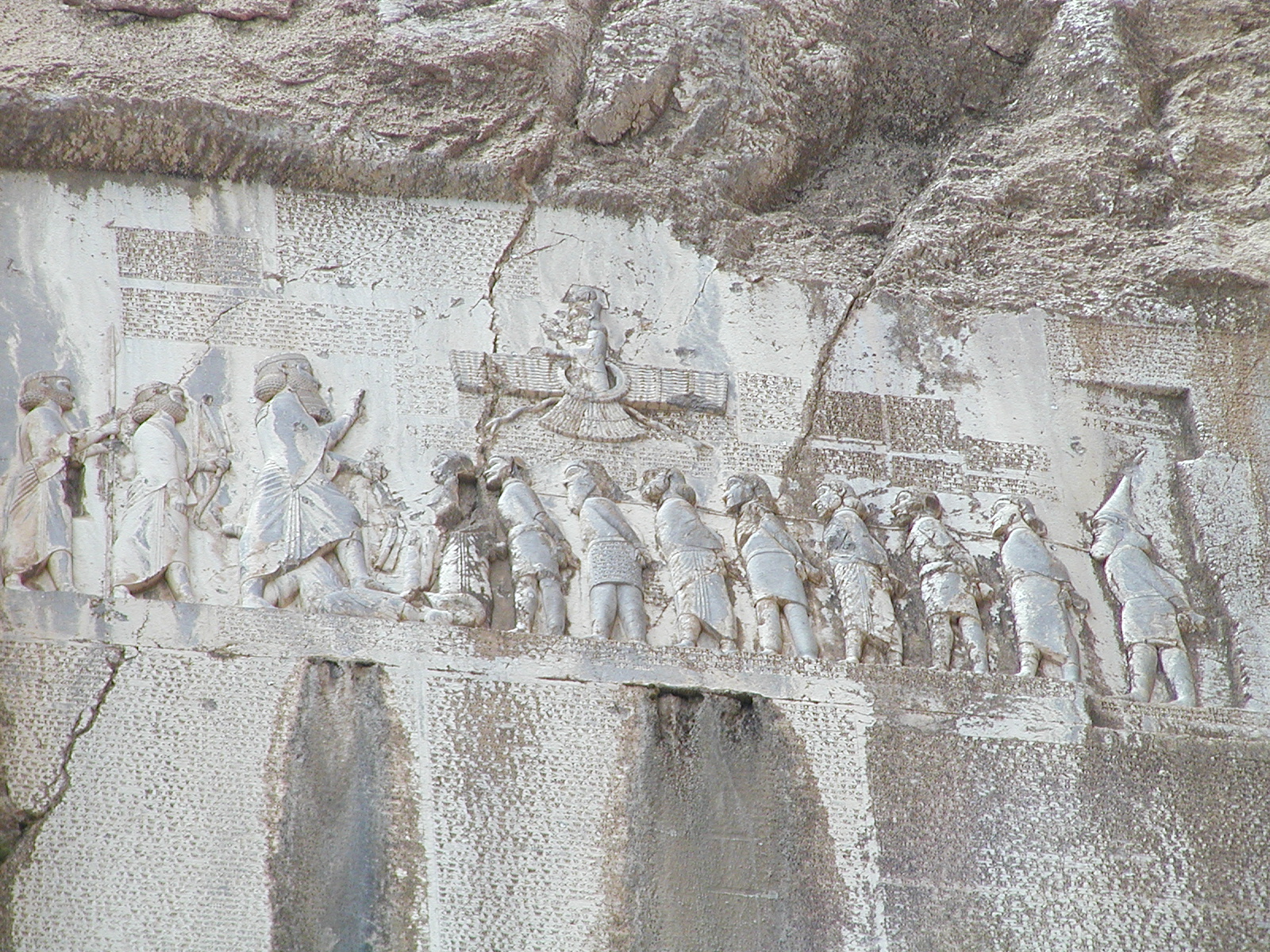
The Behistun Inscription

“In 1854 Sir Henry Rawlinson superintended diggings at Birs Nimrud (Borsippa, near Babylon), and excavated relics of the Biblical Nebuchadrezzar. This notable archaeologist began his career in the East as an officer in the Bombay army. He distinguished himself as a political agent and diplomatist. While resident at Baghdad, he devoted his leisure time to cuneiform studies.

One of his remarkable feats was the copying of the famous trilingual rock inscription of Darius the Great on a mountain cliff at Behistun, in Persian Kurdistan (the Behistun Inscription). This work was carried out at great personal risk, for the cliff is 1700 feet high and the sculptures and inscriptions are situated about 300 feet from the ground.

The Behistun Inscription

Bisotun Iran Relief Achamenid Period” by Hara1603 – Own work. Licensed under Public Domain via Wikimedia Commons.

Darius was the first monarch of his line to make use of the Persian cuneiform script, which in this case he utilized in conjunction with the older and more complicated Assyro-Babylonian alphabetic and syllabic characters to record a portion of the history of his reign.

Rawlinson’s translation of the famous inscription was an important contribution towards the decipherment of the cuneiform writings of Assyria and Babylonia.”

Donald A. Mackenzie, Myths of Babylonia and Assyria, 1915.

Killing the Divine King

“At Babylon, within historical times, the tenure of the kingly office was in practice lifelong, yet in theory it would seem to have been merely annual. For every year at the festival of Zagmuk the king had to renew his power by seizing the hands of the image of Marduk in his great temple of Esagil at Babylon.

Even when Babylon passed under the power of Assyria, the monarchs of that country were expected to legalise their claim to the throne every year by coming to Babylon and performing the ancient ceremony at the New Year festival, and some of them found the obligation so burdensome that rather than discharge it they renounced the title of king altogether and contented themselves with the humbler one of Governor.

Further, it would appear that in remote times, though not within the historical period, the kings of Babylon or their barbarous predecessors forfeited not merely their crown but their life at the end of a year’s tenure of office. At least this is the conclusion to which the following evidence seems to point.

According to the historian Berosus, who as a Babylonian priest spoke with ample knowledge, there was annually celebrated in Babylon a festival called the Sacaea. It began on the sixteenth day of the month Lous, and lasted for five days, during which masters and servants changed places, the servants giving orders and the masters obeying them.

A prisoner condemned to death was dressed in the king’s robes, seated on the king’s throne, allowed to issue whatever commands he pleased, to eat, drink, and enjoy himself, and to lie with the king’s concubines. But at the end of the five days he was stripped of his royal robes, scourged, and hanged or impaled. During his brief term of office he bore the title of Zoganes.

This custom might perhaps have been explained as merely a grim jest perpetrated in a season of jollity at the expense of an unhappy criminal. But one circumstance–the leave given to the mock king to enjoy the king’s concubines–is decisive against this interpretation. Considering the jealous seclusion of an oriental despot’s harem we may be quite certain that permission to invade it would never have been granted by the despot, least of all to a condemned criminal, except for the very gravest cause.

This cause could hardly be other than that the condemned man was about to die in the king’s stead, and that to make the substitution perfect it was necessary he should enjoy the full rights of royalty during his brief reign. There is nothing surprising in this substitution. The rule that the king must be put to death either on the appearance of any symptom of bodily decay or at the end of a fixed period is certainly one which, sooner or later, the kings would seek to abolish or modify.

We have seen that in Ethiopia, Sofala, and Eyeo the rule was boldly set aside by enlightened monarchs; and that in Calicut the old custom of killing the king at the end of twelve years was changed into a permission granted to any one at the end of the twelve years’ period to attack the king, and, in the event of killing him, to reign in his stead; though, as the king took care at these times to be surrounded by his guards, the permission was little more than a form.

Another way of modifying the stern old rule is seen in the Babylonian custom just described. When the time drew near for the king to be put to death (in Babylon this appears to have been at the end of a single year’s reign) he abdicated for a few days, during which a temporary king reigned and suffered in his stead. At first the temporary king may have been an innocent person, possibly a member of the king’s own family; but with the growth of civilisation the sacrifice of an innocent person would be revolting to the public sentiment, and accordingly a condemned criminal would be invested with the brief and fatal sovereignty.

In the sequel we shall find other examples of a dying criminal representing a dying god. For we must not forget that, as the case of the Shilluk kings clearly shows, the king is slain in his character of a god or a demigod, his death and resurrection, as the only means of perpetuating the divine life unimpaired, being deemed necessary for the salvation of his people and the world.”

James George Frazer, The Golden Bough: A Study in Magic and Religion, 1922, The Killing of the Divine King, np.

Name Magic

” … In Egypt attempts like that of Isis to appropriate the power of a high god by possessing herself of his name were not mere legends told of the mythical beings of a remote past; every Egyptian magician aspired to wield like powers by similar means.

For it was believed that he who possessed the true name possessed the very being of god or man, and could force even a deity to obey him as a slave obeys his master. Thus the art of the magician consisted in obtaining from the gods a revelation of their sacred names, and he left no stone unturned to accomplish his end. When once a god in a moment of weakness or forgetfulness had imparted to the wizard the wondrous lore, the deity had no choice but to submit humbly to the man or pay the penalty of his contumacy.

The belief in the magic virtue of divine names was shared by the Romans. When they sat down before a city, the priests addressed the guardian deity of the place in a set form of prayer or incantation, inviting him to abandon the beleaguered city and come over to the Romans, who would treat him as well as or better than he had ever been treated in his old home.

Hence the name of the guardian deity of Rome was kept a profound secret, lest the enemies of the republic might lure him away, even as the Romans themselves had induced many gods to desert, like rats, the falling fortunes of cities that had sheltered them in happier days.

Nay, the real name, not merely of its guardian deity, but of the city itself, was wrapt in mystery and might never be uttered, not even in the sacred rites. A certain Valerius Soranus, who dared to divulge the priceless secret, was put to death or came to a bad end.

In like manner, it seems, the ancient Assyrians were forbidden to mention the mystic names of their cities; and down to modern times the Cheremiss of the Caucasus keep the names of their communal villages secret from motives of superstition.”

James George Frazer, The Golden Bough: A Study in Magic and Religion, 1922, Tabooed Words, np.

Persistence of the Cult of the Great Mother

“But the Great Mother lived on, being the goddess of the land. Her cult, modified, in some cases profoundly, by time and changed political circumstances, was found surviving at the dawn of Greek history in several places in the interior. Prominent among these sites is Pessinus in Phrygia, a sacred city, with which the legend of Kybele and Attis is chiefly associated.

Other districts developed remarkable and even abnormal tendencies in myth and worship. At Comana, in the Taurus, where the Assyrian armies were resisted to the last, and the ancient martial spirit still survives, she became, like Isthar, a goddess of war, identified by the Romans with Bellona: 50 In Syria, again, a different temper and climate emphasized the sensuous tendency of human passions.

In all these cases, however, there survived some uniformity of ceremonial and custom. At each shrine numerous priests, called Galli, numbering at Comana as many as 5,000, took part in the worship. Women dedicated their persons as an honourable custom, which in some cases was not even optional, to the service of the goddess. The great festivals were celebrated at regular seasons with revelry, music, and dancing, as they had been of old, coupled with customs which tended to become, in the course of time, more and more orgiastic.

These are, however, matters of common knowledge and may be studied in the classical writings. Lucian himself adds considerably to our understanding of these institutions; indeed his tract has been long one of the standard sources of information, supplying details which have been applied, perhaps too freely, to the character of the general cult.

Religion in the East is a real part of life, not tending so much as in the West to become stereotyped or conventionalized, but changing with changes of conditions, adapted to the circumstances and needs of the community. 51 So, wherever the goddess was worshipped there would be variety of detail. It is, however, remarkable in this case, that throughout the Hittite period, though wedded and in a sense subordinate to a dominant male deity, and subsequently down to the age at which Lucian wrote, she maintained, none the less, her individuality and comprehensive character.

Thus, while Lucian is concerned in his treatise with the cult of an apparently local goddess of northern Syria, we recognize her as a localised aspect of the Mother-goddess, whose worship in remoter times had already been spread wide, and so explain at once the points of clear resemblance in character and in worship to other nature-goddesses of Syria and Asia Minor.”

Herbert A. Strong and John Garstang, trans., The Syrian Goddess, by Lucian, 1913, pp. 17-20.

Joseph Dan, Kabbalah: A Very Short Introduction

 Joseph Dan says that Kabbalah can be considered:

a. The essence of Assyrian religion (!?). 

b. The essence of Christianity. 

c. Mysticism. A form of mysticism. 

d. A secret magical tradition. 

“Mysticism” is completely absent from both Jewish and Islamic cultures until the 19th century. The concept of mysticism derives from Christianity, referring to the mystical way of life, prayer and devotion that leads to a mystical union with God. 

Traditional definitions of the term describe “mysticism” as the aspiration and sometime achievement of a direct, experiential relationship with God. One characteristic of mysticism is the denial of language’s ability to express religious truth. “In mysticism, language is apophatic, a “language of unsaying,” language that denies its own communicative message.” Religion can be communicated using words. Mysticism cannot.  

Kabbalah is Jewish. Sufism is Islamic. Christianity was allegedly the original form of mysticism. And yet, “the concept of ancient tradition that permeates the kabbalah, and the sack that early Islamic Sufis wore, which probably gave them this appellation, have no parallel in Christian mysticism.”

–Joseph Dan, Kabbalah: A Very Short Introduction, 2006. Ppg. 8-10.