
Eco: Esperanto
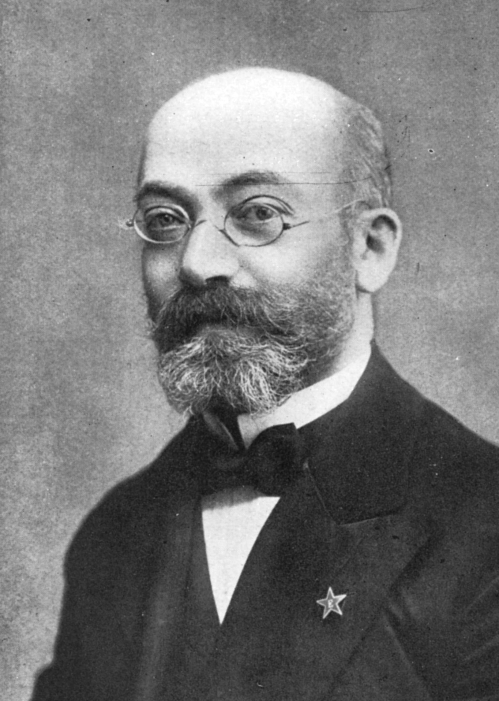
L.L. Zamenhof (1859-1917), creator of the IAL Esperanto. This photo from the Congressional Book of the 4th World Esperanto Congress in Dresden, 1908. This work is in the public domain in its country of origin and other countries and areas where the copyright term is the author’s life plus 100 years or less.
“Esperanto was first proposed in 1887 in a book, written in Russian and published in Warsaw at the Kelter Press, entitled The International Language. Preface and Complete Manual (for Russians). The author’s name was Dr. Ledger Ludwik Zamenhof; yet he wrote the book under the pseudonym Dr. Esperanto (Dr. Hopeful), and this was soon adopted as the name of his language.
Zamenhof, born in 1859, had been fascinated with the idea of an international language since adolescence. When his uncle Josef asked him what was the non-Hebrew name he had, according to custom, chosen for his contacts with Gentiles, the seventeen year old Zamenhof replied that he had chosen Ludwik because he had found a reference to Lodwick (also spelled Lodowick) in a work by Comenius (letter of 31 March 1876; see Lamberti 1990: 49).
Zamenhof’s origins and personality helped shape both his conception of the new language and its eventual success. Born of a Jewish family in Bialystok, an area of Polish Lithuania then part of the Tsarist empire, Zamenhof passed his childhood in a crucible of races and languages continually shaken by nationalist ferment and lasting waves of anti-Semitism.
The experience of oppression, followed by the persecution of intellectuals, especially Jewish, at the hands of the Tsarist government, ensured that Zamenhof’s particular fascination with international languages would become mixed with a desire for peace between peoples.
Besides, although Zamenhof felt solidarity towards his fellow Jews and forecast their return to Palestine, his form of secular religiosity prevented him from fully supporting Zionist ideas; instead of thinking of the end of the Diaspora as a return to Hebrew, Zamenhof hoped that all the Jews could be, one day, reunited in an entirely new language.
In the same years in which, starting in the Slavic-speaking lands, Esperanto began its spread throughout Europe–while philanthropists, linguists and learned societies followed its progress with interest, devoting international conferences to the phenomenon–Zamenhof had also published an anonymous pamphlet, which extolled a doctrine of international brotherhood, homaranism.
Some of his followers successfully insisted on keeping the Esperanto movement independent of ideological commitments, arguing that if Esperanto were to succeed, it would do so only by attracting to its cause men and women of different religious, political and philosophical opinions.
They even sought to avoid any public reference to Zamenhof’s own Jewish origins, given that–it must be remembered–just at that historical moment there was growing up the theory of a great “Jewish conspiracy.”
Even so, despite the movement’s insistence on its absolute neutrality, the philanthropic impulse and the non-confessional religious spirit that animated it could not fail to influence the followers of the new language–or samideani, that is, participating in the same ideal.
In the years immediately following its emergence, moreover, the language and its supporters were almost banned by the Tsarist government, congenitally suspicious towards idealism of any sort, especially after Esperanto had had the fortune / misfortune to obtain the passionate support of Tolstoy, whose brand of humanist pacifism the government regarded as a dangerous form of revolutionary ideology.
Even the Nazis followed suit, persecuting Esperanto speakers in the various lands under their occupation (cf. Lins 1988). Persecution, however, only reinforces an idea: the majority of international languages represented themselves as nothing more than instruments of practical utility; Esperanto, by contrast, came increasingly to gather in its folds those religious and pacifist tensions which had been characteristics of many quests for a perfect language, at least until the end of the seventeenth century.
Esperanto came to enjoy the support and sympathy of many illustrious figures–linguists such as Baudoin de Courtenay and Otto Jespersen, scientists such as Peano, or philosophers such as Russell. Rudolf Carnap‘s comments are particularly revealing; in his Autobiography (in Schilpp 1963: 70) he described feeling moved by a sense of solidarity when he found himself able to converse with people of other countries in a common tongue.
He noted the quality of this living language which managed to unify a surprising degree of flexibility in its means of expression with a great structural simplicity. Simplest perhaps was the lapidary formulation of Antoine Meillet: “Toute discussion théoretique est vaine: l’Esperanto fonctionne” (Meillet 1918: 268).
Today the existence of the Universala Esperanto-Asocio in all of the principal cities of the world still testifies to the success of Zamenhof’s invention. Over one hundred periodicals are currently published in Esperanto, there is an original production of poetry and narrative, and most of the world literature has been translated into this language, from the Bible to the tales of Hans Christian Andersen.
Like Volapük, however, especially in the first decades, the Esperanto movement was nearly torn apart by battles raging over proposed lexical and grammatical reforms. In 1907, Couturat, as the founder and secretary of the Delégation pour l’adoption d’une langue auxiliaire internationale, attempted what Zamenhof considered a coup de main: he judged Esperanto to be the best IAL, but only in its approved version, that is, only in the version that had been reformed by the French Esperanto enthusiast, Louis De Beaufront, and renamed Ido.
The majority of the movement resisted the proposed modifications, according to a principle stated by Zamenhof: Esperanto might accept enrichments and lexical improvements, but it must always remain firmly attached to what we might call the “hard core” as set down by its founder in Fundamento de Esperanto (1905).
Umberto Eco, The Search for the Perfect Language, translated by James Fentress, Blackwell. Oxford, 1995, pp. 324-6.
 Samizdat