
Samizdat

Publishing the Forbidden. All Rights Reserved. © Samizdat 2014-2025.

Tag: ANET

Melvin: Human Civilization is a Gift of the gods

“At other times, the gods create civilization directly, either through the birth of the patron deities of aspects of civilization (e.g., agriculture) or by means of themes.

(This phenomenon is especially prevalent in Sumerian creation accounts, which often emphasize the importance of agricultural technology by placing the creation of tools prior to and even necessary for the creation of humans (see, for example, The Song of the Hoe [COS 1.157]) and by presenting the development of agriculture as a theogony in which the patron deities of various agricultural technologies are born. See Cattle and Grain in Samuel N. Kramer, Sumerian Mythology: A Study of Spiritual and Literary Achievement in the Third Millennium B.C. (rev. ed.; New York: Harper & Brothers, 1961), 72–73.)

(See Enki and Inanna (COS 1.161). See also Kramer, Sumerian Mythology, 64–68; Bottéro, 238–39.)

In The Song of the Hoe, Enlil invents the hoe, first, in order to prepare the ground for sprouting humans, and second, for humans to use in their work of temple-building.

(In Mesopotamian Creation myths, the origin of humans is usually described in one of two ways. The first is that they are fashioned from clay, usually mixed with the blood of a slain god (cf. Enuma Elish; Atrahasis). The second is that they sprout up from the ground like plants, as is the case here.)

Similarly, in Cattle and Grain the arts of animal husbandry and agriculture are tied to their patron deities, Lahar and Ashnan. In another text, Enki decrees the fates of the cities of Sumer, blessing them and causing civilization to develop.

Batto notes that a number of texts present the earliest humans (i.e., humans prior to the divine bestowal of the gift of civilization) as animal-like. Thus, in Cattle and Grain, early humans walk about naked, eat grass like sheep, and drink water from ditches.
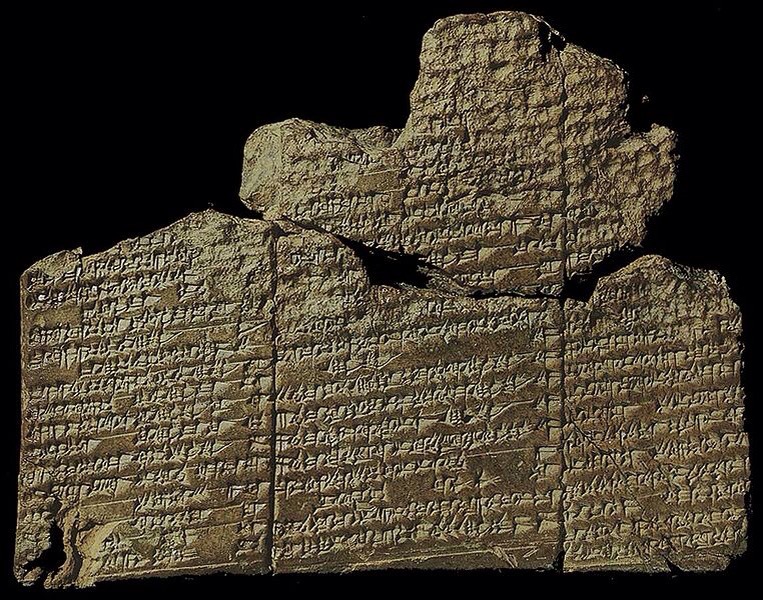
A fragment of The Eridu Genesis. <br />  The earliest recorded Sumerian creation myth is The Eridu Genesis, known from a cuneiform tablet excavated from Nippur, a fragment from Ur, and a bilingual fragment in Sumerian with Akkadian, from the Library of Ashurbanipal dated 600 BCE. The main fragment from Nippur (depicted above) is dated to 1600 BCE. <br />  http://etcsl.orinst.ox.ac.uk/cgi-bin/etcsl.cgi?text=t.1.7.4# <br />  https://en.wikipedia.org/wiki/Sumerian_creation_myth <br />  It was Thorkild Jacobsen who named this fragment. As he says, “…it deals with the creation of man, the institution of kingship, the founding of the first cities and the great flood. Thus it is a story of beginnings, a Genesis, and, as I will try to show in detail later, it prefigures so to speak, the biblical Genesis in its structure. <br />  The god Enki and his city Eridu figure importantly in the story, Enki as savior of mankind, Eridu as the first city. Thus “The Eridu Genesis” seems appropriate." <br />  In a footnote, Jacobsen observes, “The tablet was found at Nippur during the third season’s work of the Expedition of the University of Pennsylvania (1893-6) but was not immediately recognized for what it was. The box in which it was kept was labeled “incantation.” Thus it was not until 1912, when Arno Poebel went through the tablet collection, that its true nature was discovered.” <br />  He continues, “Poebel published it in hardcopy ... and furnished a transliteration, translation and penetrating analysis .... He convincingly dated the tablet (pp. 66-9) on epigraphical and other grounds to the latter half of the First Dynasty of Babylon.” <br />  “Little further work of consequence was done on the text for thirty-six years—a detailed bibliography may be found in Rykle Borger, Handbuch der Keilschriftliteratur I (Berlin: de Gruyter, p. 411 ... but in 1950 Samuel N. Kramer’s translation was published in ANET (pp. 43-4) and again, almost twenty years later, Miguel Civil restudied the text in his chapter on Atra-hasīs (pp. 138-47). <br />  The interpretation here offered owes much to our predecessors, far more than would appear from our often very different understanding of the text." <br />  https://books.google.co.uk/books?id=g5MGVP6gAPkC&amp;pg=PA129&amp;dq=Eridu+Genesis.+Nippur&amp;hl=en&amp;sa=X&amp;ved=0CCEQ6AEwAGoVChMI4ImL2PiCxwIVhNWACh01nwD6#v=onepage&amp;q=Eridu%20Genesis.%20Nippur&amp;f=false

A fragment of The Eridu Genesis.
The earliest recorded Sumerian creation myth is The Eridu Genesis, known from a cuneiform tablet excavated from Nippur, a fragment from Ur, and a bilingual fragment in Sumerian with Akkadian, from the Library of Ashurbanipal dated 600 BCE. The main fragment from Nippur (depicted above) is dated to 1600 BCE.
http://etcsl.orinst.ox.ac.uk/cgi-bin/etcsl.cgi?text=t.1.7.4#
https://en.wikipedia.org/wiki/Sumerian_creation_myth
It was Thorkild Jacobsen who named this fragment. As he says, “…it deals with the creation of man, the institution of kingship, the founding of the first cities and the great flood. Thus it is a story of beginnings, a Genesis, and, as I will try to show in detail later, it prefigures so to speak, the biblical Genesis in its structure.
The god Enki and his city Eridu figure importantly in the story, Enki as savior of mankind, Eridu as the first city. Thus “The Eridu Genesis” seems appropriate.”
In a footnote, Jacobsen observes, “The tablet was found at Nippur during the third season’s work of the Expedition of the University of Pennsylvania (1893-6) but was not immediately recognized for what it was. The box in which it was kept was labeled “incantation.” Thus it was not until 1912, when Arno Poebel went through the tablet collection, that its true nature was discovered.”
He continues, “Poebel published it in hardcopy … and furnished a transliteration, translation and penetrating analysis …. He convincingly dated the tablet (pp. 66-9) on epigraphical and other grounds to the latter half of the First Dynasty of Babylon.”
“Little further work of consequence was done on the text for thirty-six years—a detailed bibliography may be found in Rykle Borger, Handbuch der Keilschriftliteratur I (Berlin: de Gruyter, p. 411 … but in 1950 Samuel N. Kramer’s translation was published in ANET (pp. 43-4) and again, almost twenty years later, Miguel Civil restudied the text in his chapter on Atra-hasīs (pp. 138-47).
The interpretation here offered owes much to our predecessors, far more than would appear from our often very different understanding of the text.”
https://books.google.co.uk/books?id=g5MGVP6gAPkC&pg=PA129&dq=Eridu+Genesis.+Nippur&hl=en&sa=X&ved=0CCEQ6AEwAGoVChMI4ImL2PiCxwIVhNWACh01nwD6#v=onepage&q=Eridu%20Genesis.%20Nippur&f=false

Both The Rulers of Lagash and The Eridu Genesis present early humanity as similar to animals in that they slept on straw beds in pens because they did not know how to build houses and also lived at the mercy of the rains because they did not know how to dig canals for irrigation.

Batto concludes that Mesopotamian literature depicts the advancement of early humans as their evolution from a low, animal-like state to a higher, “civilized” state by means of gifts from the gods.

A further illustration of the role of the gods in the rise of civilization in Sumer is the myth Innana and Enki􏰓􏰋􏰎􏰋􏰋􏰎􏰃􏰎􏰋􏰐􏰃􏰔􏰋􏰝􏰉. In this text, Inanna steals the mes (in this case, corresponding to the arts of civilization) from Enki in Eridu and brings them to Uruk, thus transferring civilization to Uruk. The text mentions 94 individual elements of civilization, including:

“… the craft of the carpenter, the craft of the copper-smith, the art of the scribe, the craft of the smith, the craft of the leather-worker, the craft of the fuller, the craft of the builder, the craft of the mat-weaver, understanding, knowledge, purifying washing rites, the house of the shepherd,…kindling of fire, extinguishing of fire….”

Key in this myth is the fact that it is the divine mes, originally bestowed by Enki upon Eridu alone but subsequently transferred to Uruk by Inanna, which give rise to civilization.

What is nearly universal in the Mesopotamian literature, as far as the available texts indicate, is that the source of human civilization is divine, with humans acting primarily as recipients of divine knowledge.

Because of its divine origin and the clear benefits which it provides for humans—at least for those favored humans on whom the gods bestow it—civilization is portrayed in an overwhelmingly positive manner in these texts.”

David P. Melvin, “Divine Mediation and the Rise of Civilization in Mesopotamian Literature and in Genesis 1-11,” Journal of Hebrew Scriptures, 2010, pp. 6-7.

On the Ummânu

“Such an association of the apkallu’s with kings of renown is singularly striking in view of the ancient near eastern motif that links a person of superior wisdom with a famous king.

In Egypt, we have the tradition — or fiction — of viziers who are credited with the authorship of “instructions” or “admonitions” (see J.A. Wilson, ANET 412 ff. and 432 n. 4, see also H. Brunner in Handbuch der Orientalistik I/2 p. 92 f.); for the Old Testament, references are conveniently collected by J. Lindblom, in Supplements to Vetus Testamentum 3, p. 129 f.

The god Ea at far left, wearing the horned headdress indicative of divinity, with water coursing from his shoulders. 

A fish-apkallū is in the iconic posture with right hand raised in blessing or exorcism, with the banduddu bucket in his left hand. 

The next apkallū wields an indistinct and as yet undefined angular object in his right hand, with the typical banduddu bucket in his left. 

The entity at far right, which appears to be wearing a horned tiara indicative of divinty, remains unidentified and undefined.

The god Ea at far left, wearing the horned headdress indicative of divinity, with water coursing from his shoulders. 

A fish-apkallū is in the iconic posture with right hand raised in blessing or exorcism, with the banduddu bucket in his left hand. 

The next apkallū wields an indistinct and as yet undefined angular object in his right hand, with the typical banduddu bucket in his left. 

The entity at far right, which appears to be wearing a horned tiara indicative of divinty, remains unidentified and undefined.

The most famous figure of such a wise man, whose story is the most wide spread, is Ahiqar, whose Mesopotamian origin has repeatedly been stated (for bibliography see Ginsberg in ANET 427), although no Babylonian prototype of the story as a whole is known.

However, there can be proven for Babylonia the existence of at least the theme that serves as a framework for Ahiqar’s sayings: this theme, the “disgrace and rehabilitation of a minister”, has been discussed, with a good comparative bibliography, by  A.H. Krappe in JAOS 61 (1941) 280-84.

The story is included in the “bilingual proverbs” (latest publication with bibliography, by W.G. Lambert, Babylonian Wisdom Literature 239 ff.), where it comprises a section of fourteen lines (ii 50-63, op. cit., p. 241), the longest of the sayings which usually consist of only two to four lines, although there are some as much as eight lines long.

The umu-apkallū at far left has his right hand raised in the iconic gesture of purification and exorcism, but no mullilu cone appears to be present.<br /> The banduddû bucket is present in the left hand. This umu-apkallū wears a horned tiara, indicative of divinity.<br /> The next entity lacks wings, and so is probably not an umu-apkallū. The mace in the right hand could be an e'ru, as it is not yet clear precisely what e'ru means. I do not understand the object in his left hand. The mace could be an indicator of sovereignty, of kingship.<br /> The next entity holds a bowl and the curved staff, known as the gamlu-curved staff. While this entity wears a headdress, it is not horned, and wings are absent, suggesting that it is human rather than umu-apkallū. This is probably a king, Museum notes suggest Ashurnasirpal.<br /> The entity at far right wields a curved stick in his right hand, I am unsure how Wiggermann defines it, and I am completely stumped by the object in his left hand, which appears to be a ladle. The entity appears to be a priest, blessing an offering from the king in a bowl.<br /> Overall, this frieze supports one theme of Erica Reiner's article on the Seven Sages of Sumeria, which is that each king had his associated advisor in the form of an apkallū.

The umu-apkallū at far left has his right hand raised in the iconic gesture of purification and exorcism, but no mullilu cone appears to be present.
The banduddû bucket is present in the left hand. This umu-apkallū wears a horned tiara, indicative of divinity.
The next entity lacks wings, and so is probably not an umu-apkallū. The mace in the right hand could be an e’ru, as it is not yet clear precisely what e’ru means. I do not understand the object in his left hand. The mace could be an indicator of sovereignty, of kingship.
The next entity holds a bowl and the curved staff, known as the gamlu-curved staff. While this entity wears a headdress, it is not horned, and wings are absent, suggesting that it is human rather than umu-apkallū. This is probably a king, Museum notes suggest Ashurnasirpal.
The entity at far right wields a curved stick in his right hand, I am unsure how Wiggermann defines it, and I am completely stumped by the object in his left hand, which appears to be a ladle. The entity appears to be a priest, blessing an offering from the king in a bowl.
Overall, this frieze supports one theme of Erica Reiner’s article on the Seven Sages of Sumeria, which is that each king had his associated advisor in the form of an apkallū.

Since none of the previous translations does justice to the motif expressed in the relevant passage, I suggest the following (the short lines of the bilingual text disposed in two columns are here restored to their assumed full length):

  • 50-51: “Their gods have returned to the ruin,
  • 52-53: the clamor (of daily life) has filled (lit. entered) the deserted house (again);
  • 54-55: (where) the ingrate is tenant, the wise man does not reach old age.
  • 56-58: The wise vizier, whose wisdom his king (or his lord) has not heeded,
  • 59-61: and any valuable (person) forgotten by his master,
  • 62-63: when a need arises for him (i.e., for his wisdom), he will be reinstated.”

The second half of the “saying” has reference to the disgrace and rehabilitation of a wise vizier, and, unless the first three lines (ii. 50-55) should be taken as a separate saying (so last J. Pereman, The Book of Assyro-Babylonian Proverbs [in Hebrew], p. 58), the reference to the “ingrate” (raggu) would indicate that the other basic theme of the Ahiqar-story, that of the “ungrateful nephew” (see Krappe, loc. cit., p. 281), had already been fused in the Mesopotamian tradition, as in the Ahiqar-story, with that of the “disgrace and rehabilitation of a minister”.

The argument for the existence in Babylonia of a tradition linking wisdom to a high official (“vizier”) of the king can be strengthened by the philological evidence of the alternation of the terms apkallu and ummânu, which has been adduced in other contexts.

In the top register, Ummiamu, (a variant spelling of Reiner's ummânu), human apkallū that are postdiluvian, tend to a sacred tree. In the lower register, antediluvian apkallū with avian heads tend to a sacred tree.<br />  The cones and buckets in their hands are now understood to be standard devices used to sprinkle water. Called mullilu and banduddu, respectively, the water sprinkling ritual was intended to liberate sin, or as part of a rite of exorcism.

In the top register, Ummiamu, (a variant spelling of Reiner’s ummânu), human apkallū that are postdiluvian, tend to a sacred tree. In the lower register, antediluvian apkallū with avian heads tend to a sacred tree.
The cones and buckets in their hands are now understood to be standard devices used to sprinkle water. Called mullilu and banduddu, respectively, the water sprinkling ritual was intended to liberate sin, or as part of a rite of exorcism.

The usual acceptation of the latter is “master craftsman,” often referring to scribes, authors or copyists of literary texts. References to both have been collected by van Dijk, La Sagesse Suméro-Accadienne, p. 20 n. 56, and note that Adapa, besides his more common epithet apkallu, is also called ummânu . . .

Moreover, it has been shown the term ummânu serves not only as the designation of a learned man or craftsman, but also refers, although in late texts, to a high official . . . In our connection most relevant is the mention of the ummânu beside the king in the Synchronistic King List (see simply Oppenheim in ANET 272 ff.), and the passage from the Fürstenspiegel (see now Lambert, BWL 112:5): šarru . . . ana UM.ME A la iqūl “if the king does not heed the vizier (or wise man).”

Note in the same text . . . is most likely to be read apkallišu.”

Erica Reiner, “The Etiological Myth of the “Seven Sages,” Orientalia, v. 30, No. 1, 1961, pp. 7-9.

Each King had his Apkallu

“The fish-figurines would seem to confirm the theory attractively put forward by Zimmern (KAT 535 ff. and subsequently ZA 35 151 ff.), that the apkallu’s, often occurring in groups of seven and sometimes identified with purādu-fish (Sumerian s u h u r . k u), represent Oannes and the other fish-like monsters who, according to Berosso’s account, taught mankind all crafts and civilization.

This depiction of a fish-apkallū (Apkallu, Abkallu) guarded the entrance to the temple of Ninurta at Nimrud. A fish's head can be seen on Apkallu's head, and its skin hangs down over the back of Apkallu's body.  Neo-Assyrian era, 865-860 BCE. From the Temple of Ninurta, Nimrud (ancient Kalhu; Biblical Calah), northern Mesopotamia, Iraq. (The British Museum, London). Osama Shukir Muhammed Amin FRCP (Glasg) http://www.ancient.eu/image/2708/

This depiction of a fish-apkallū (Apkallu, Abkallu) guarded the entrance to the temple of Ninurta at Nimrud. A fish’s head can be seen on Apkallu’s head, and its skin hangs down over the back of Apkallu’s body.
Neo-Assyrian era, 865-860 BCE. From the Temple of Ninurta, Nimrud (ancient Kalhu; Biblical Calah), northern Mesopotamia, Iraq. (The British Museum, London).
Osama Shukir Muhammed Amin FRCP (Glasg)
http://www.ancient.eu/image/2708/

Furthermore, the apkallu-figurines of the ritual KAR 298 discussed by Zimmern loc. cit. (see also Gurney, AAA 22 38 ff.) are each associated with a city in Mesopotamia and addressed as ūmu; Güterbock’s suggestion that the element p i r i g in the names of three apkallu’s in our text corresponds to this ūmu and refers to their character as mythological creatures (ZA 42 10 n. 3) would thus strengthen the argument in favor of the identification of the apkallu’s with the monsters described by Berossos.

What in the Greek account clearly reflects an etiological myth finds no correspondence in any of the texts dealing with apkallu’s in Mesopotamia. The exploits of the apkallu’s, as we shall see, are on a different mythological plane.

Nergal appears at the top, leering over a top register which contains the eight-pointed star of Ishtar and the inverted half-moon crescent of the Moon God Sin.  In the second register, seven demons appear to support the heavens.  The middle register depicts the burial rites for new arrivals in the underworld, presided over by two fish-apkallū.  The lower register depicts the goddess Allat, or Ereshkigal, sister of Ishtar, who reigns in the underworld. She kneels upon a horse, which appears to be oppressed by her burden, in a boat which floats upon the waters of life. Note the lion pups suckling at her breast.  Drawn by Faucher-Gudin, from a bronze plaque of which an engraving was published by Clermont-Ganneau.  The original, which belonged to M. Péretié, is now in the collection of M. de Clercq. http://www.gutenberg.org/files/17323/17323-h/17323-h.htm#linkBimage-0039

Nergal appears at the top, leering over a top register which contains the eight-pointed star of Ishtar and the inverted half-moon crescent of the Moon God Sin.
In the second register, seven demons appear to support the heavens.
The middle register depicts the burial rites for new arrivals in the underworld, presided over by two fish-apkallū.
The lower register depicts the goddess Allat, or Ereshkigal, sister of Ishtar, who reigns in the underworld. She kneels upon a horse, which appears to be oppressed by her burden, in a boat which floats upon the waters of life. Note the lion pups suckling at her breast.
Drawn by Faucher-Gudin, from a bronze plaque of which an engraving was published by Clermont-Ganneau.
The original, which belonged to M. Péretié, is now in the collection of M. de Clercq.
http://www.gutenberg.org/files/17323/17323-h/17323-h.htm#linkBimage-0039

The connection between them and wisdom and the crafts lies in the term ummânu, which is one of their epithets, and to which I shall presently return.

First, however, we shall have to dispel the misconception originating with Zimmern’s article in KAT, and repeated in the discussions connected with the apkallu’s by others, namely, the assumed identity of the “wise men” — or some of them — with the early kings.

Besides a certain juggling of names inevitable when dealing with Berossos, the allusion to the “man who ascended to heaven” in the text published by Gurney, JRAS 1935 459 ff., was taken to refer to Etana, the more easily so since the phrase used in the Sumerian version, l ú a n . š è  b a . a n . e x (DU+DU) echoes the very words of the Sumerian King List: E t a n a   s i p a  l ú  a n . š è  b a . e x . d è (see Jacobsen, AS 11 p. 80: 16 f. and n. 67).

Antediluvian apkallu portrayed as fish-men, such mixed-species creatures were the teachers of men.

Antediluvian apkallu portrayed as fish-men, such mixed-species creatures were the teachers of men. Small figurines of this type were buried beneath doorways and beneath walls for prophylactic purposes, warding off evil. In some cases, they were buried in a set of seven statuettes, indicative of the so-called “Seven Sages” of Sumeria.

The view of Güterbock, ZA 42 9f., that the tradition of the apkallu’s is separate from that of the historical kings, and his assumption that the phrase “who ascended to heaven” refers to Adapa — of whom the same words are used in one of the versions of the Adapa legend (PSBA 16 [1894] 275:14, latest translation by Speiser, ANET 101 ff.) — is vindicated against his critics by the structure of the present text.

Since each personage is described by a group of at least four lines, the third and fourth lines, “[ . . . ] who ascended to heaven”, must be part of the description of the same person mentioned in the first and second lines as the purification priest of Eridu (išippu Eridu).

Because this is a well-known title of Adapa, the section must refer to him rather than to Etana. Indeed, none of the apkallu’s mentioned is himself a king, but is only associated with a famed king of old: the text states clearly that Nunpiriggaldim was the apkallu of Enmerkar, that Lu-Nanna was apkallu under Šulgi, allowing us only to conjecture that each was a noted person during a particular reign, excelling in superior wisdom — a topos later taken up by the Assyrian kings when they boast of being endowed with a wisdom equal to that of the apkallu’s.”

Erica Reiner, “The Etiological Myth of the “Seven Sages,” Orientalia, v. 30, No. 1, 1961, pp. 6-7.