An Old Post on Babylonian Composite Creatures
“Composite creatures are found on various cosmic levels. For that reason, Mesopotamian Cosmic Geography, by Wayne Horowitz (1998; rev. 2011), has informed the present study, especially with regard to the “Babylonian Map of the World” and Enuma Elish texts, which mention a significant number of mixed beings found in the Neo-Babylonian iconographic repertoire.

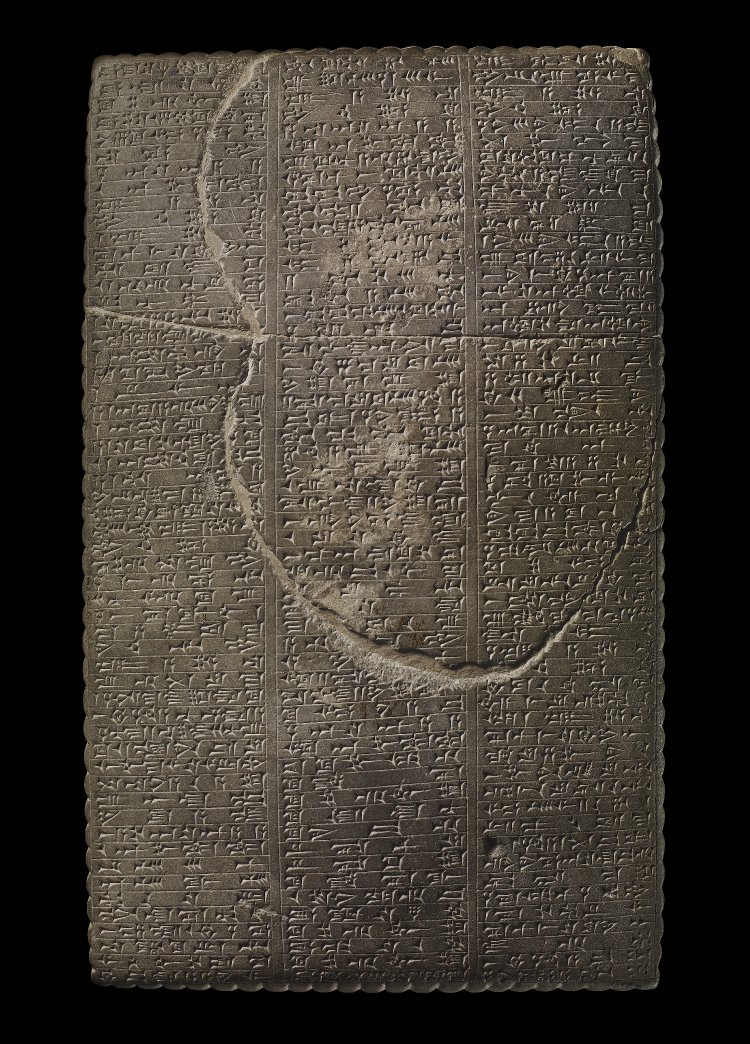
This cuneiform inscription and map of the Mesopotamian world depicts Babylon in the center, ringed by a global ocean termed the “salt sea.” The map portrays eight regions, though portions are missing, while the text describes the regions, and the mythological creatures and legendary heroes that live in them. Sippar, Babylonia, 700 – 500 BCE. Photo by Osama Shukir Muhammed Amin. Licensed under the Creative Commons: Attribution-NonCommercial-ShareaAlike license. http://www.ancient.eu/image/2287/
(Wayne Horowitz, Mesopotamian Cosmic Geography (Mesopotamian Civilizations 8; Winona Lake, Ind.: Eisenbrauns, 1998).
Regarding Sumero-Babylonian religion in ancient Mesopotamia, two foundational studies are Wilfred Lambert’s essay on “The Historical Development of the Mesopotamian Pantheon: A Study in Sophisticated Polytheism” (1975) and Thorkild Jacobsen’s trail-blazing book titled The Treasures of Darkness (1976).
(Wilfred G. Lambert, “The Historical Development of the Mesopotamian Pantheon: A Study in Sophisticated Polytheism,” in Unity in Diversity: Essays in the History, Literature, and Religion of the Ancient Near East (ed. Hans Goedicke and J. J. M. Roberts; Baltimore: Johns Hopkins University Press, 1975), pp. 191-200.
Thorkild Jacobsen, The Treasures of Darkness (New Haven: Yale University Press, 1976).
Since these publications appeared, still others have contributed to a greater understanding of the complexities of Mesopotamian religion, with its thousands of named gods and demons, but a comprehensive, systematic understanding still eludes modern scholarship.
Of particular importance to the methodological framework of the present research are the works of two scholars, Chikako E. Watanabe and Mehmet-Ali Ataç.
Watanabe’s Animal Symbolism in Mesopotamia: A Contextual Approach (2002), drawing upon her doctoral dissertation (University of Cambridge, 1998), aims “to examine how animals are used as ‘symbols’ in Mesopotamian culture and to focus on what is intended by referring to animals in context.”
(Chikako E. Watanabe, Animal Symbolism in Mesopotamia: A Contextual Approach (WOO 1; Vienna: Institut für Orientalistik der Universität Wien, 2002), p. 1.)
The scope of her investigation is limited to the symbolic aspects of two natural animals, the lion and bull, and two composite creatures, the Anzu bird and the horned lion-griffin. Watanabe’s narrow but deep analysis provides an excellent paradigm for study of Mesopotamian iconographic creatures in general.
Watanabe maintains that “the best way to interpret meanings belonging to the past is to pay close attention to the particular contexts in which symbolic agents occur.”
She does this through application of an approach known as the interaction view of metaphor, also called the theory of metaphor, developed by Max Black.
According to Watanabe, this approach aims to interpret the meanings of objects, whether occurring in figurative statements or iconographic representations, from within the contexts of their original functions, “by examining their internal relationships with other ideas or concepts expressed within the same contextual framework.”
As she points out, “the treatment of symbolic phenomena on a superficial level” does “not explain the function of symbolism.”
Constance Ellen Gane, Composite Beings in Neo-Babylonian Art, Doctoral Dissertation, University of California at Berkeley, 2012, pp. 3-4.
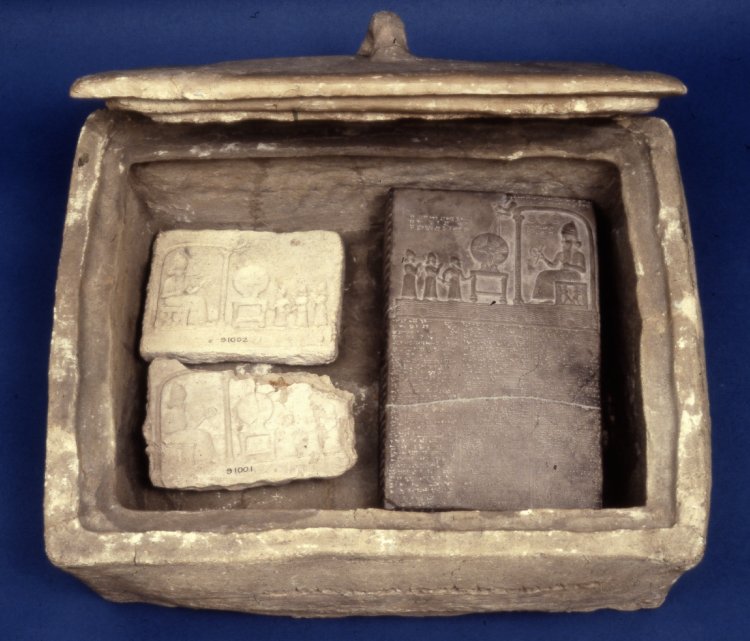
![Illustration: Tablet sculptured with a scene representing the worship of the Sun-god in the Temple of Sippar. The Sun-god is seated on a throne within a pavilion holding in one hand a disk and bar which may symbolize eternity. Above his head are the three symbols of the Moon, the Sun, and the planet Venus. On a stand in front of the pavilion rests the disk of the Sun, which is held in position by ropes grasped in the hands of two divine beings who are supported by the roof of the pavilion. The pavilion of the Sun-god stands on the Celestial Ocean, and the four small disks indicate either the four cardinal points or the tops of the pillars of the heavens. The three figures in front of the disk represent the high priest of Shamash, the king (Nabu-aplu-iddina, about 870 B.C.) and an attendant goddess. [No. 91,000.]](https://therealsamizdat.com/wp-content/uploads/2015/01/an00582752_001_l.jpg)
![Illustration: Tablet inscribed with a list of the Signs of the Zodiac. [No. 77,821.]](https://therealsamizdat.com/wp-content/uploads/2015/01/015.png)
 Samizdat