
Eco:Eighteenth Century Projects
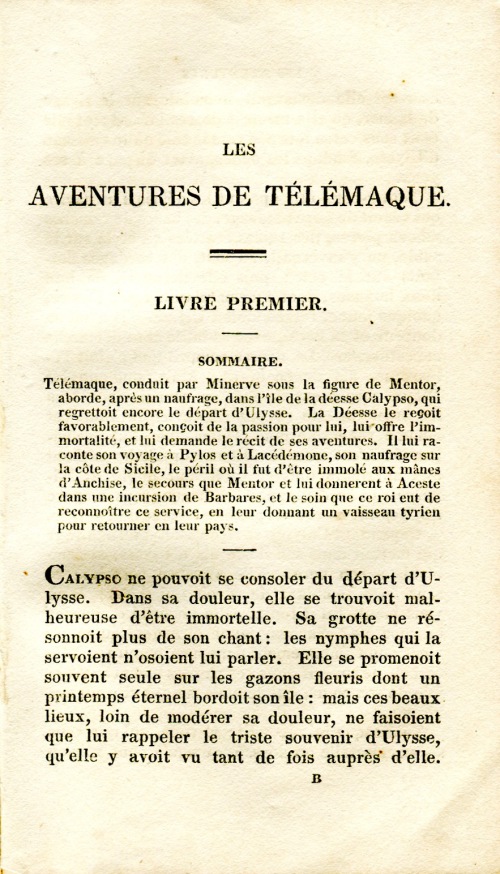
François Fénelon (1651-1715), Telemachus, or the first page of the first book of Les Aventures de Télémaque, first published anonymously in 1699, and translated into English in London in 1715. This work is in the public domain in its country of origin and other countries and areas where the copyright term is the author’s life plus 100 years or less.
“Even under the weight of the Enlightenment critique, the dream of the perfect language refused to die. In 1720 there appeared a “Dialogue sur la facilité qu’il y auroit d’établir un Caractère Universel qui seroit commun à toutes les Langues de l’Europe, et intelligible à différens Peuples, qui le liroient chacun dans la propre Langue” (in the Journal littéraire de l’anné 1720).
As the title itself suggests, the project was for a polygraphy, in the sense we saw in Kircher, and, at most, it is worthy of note in that its attempt to include a contracted grammar points the way to future developments.
In any case, the proposal is distinguished by including an appeal, by the anonymous author, for a commission which would develop the project and for a prince who would impose its adoption.
Such an appeal “cannot help but remind us of a possibility, which must have seemed evident in the year 1720, that a phase of stability for Europe was about to open, and that, consequently, sovereigns might be expected to be more willing to patronize linguistic and intellectual experiments” (cf. Pellerey 1992a: 11).
In his article on “Langue” in the Encyclopédie, even a rationalist like Beauzée had to concede that, since it would be difficult to come to an agreement over a new language, and an international language still seemed to him to be necessary, Latin had to remain the most reasonable candidate.
For their part, the empiricists among the encyclopedists felt duty-bound to consider the idea of a universal language, too. As a sort of coda to the article on “Langue,” Joachim Faiguet wrote four pages on a project for a langue nouvelle. Couturat and Leau (1903: 237) consider this as representing a first attempt at overcoming the problems inherent in the a priori languages and at sketching out an example of the a posteriori languages we will be discussing in the next chapter.
As his model, Faiguet took a natural language–French. He formed his lexicon on French roots, and concentrated on the delineation of a simplified and regularized grammar, or a “laconic” grammar.
Following the authors in the previous century, Faiguet eliminated those grammatical categories that seemed to him redundant: he suppressed the articles, substituted flexions with prepositions (bi for the genitive, bu for the dative, and de and po for the ablative), transformed adjectives (indeclinable) into adverbial forms, standardized all plurals (always expressed by an s); he simplified verb conjugations, making them invariable in number and person, adding endings that designated tenses and modes (I give, you give, he gives became Jo dona, To dona, Lo dona); the subjunctive was formed by adding an r to the stem, the passive by the indicative plus sas (meaning to be: thus to be given became sas dona).
Faiguet’s language appears as wholly regular and without exceptions; every letter or syllable used as endings had a precise and unique grammatical significance. Still, it is parasitic on French in a double sense: not only is it a “laconicized” French at the expression-level; it is French that supplies the content-level as well. Thus Faiguet’s was little less than a sort of easy-to-manage Morse code (Bernadelli 1992).
The most important projects for a priori languages in the eighteenth century were those of Jean Delormel (Projet d’une langue universelle, 1795), of Zalkind Hourwitz (Polygraphie, ou l’art de correspondre à l’aide d’un dictionaire dans toutes les langues, même celles dont on ne possède pas seulement les lettres alphabétiques, 1800), and of Joseph de Maimieux (Pasigraphie, 1797).
As can be seen, De Maimieux’s project was a pasigraphy–that is, a universal written language. Since, however, in 1799 this same author had also formulated a pasilalie–adding rules for pronouncing his language–his project can be considered as an a priori language.
For its part, Hourwitz’s project was for a polygraphy, too–even though he seemed unaware that his was by no means the first project of this type. Still, in its structure, Hourwitz’s polygraphy was an a priori language.
Although all three projects still followed the principles laid down in the seventeenth century tradition, they were different in three fundamental ways: their purposes, the identification of their primitives, and their grammars.
Delormel presented his scheme to the Convention; De Maimieux published his Pasigraphie under the Directory; Hourwitz wrote under the Consulate: every religious motivation had disappeared.
De Maimieux spoke of communication between European nations, between Europeans and Africans, of providing a means of checking the accuracy of translations, of speeding up diplomacy and civil and military undertakings, of a new source of income for teachers, writers and publishers who should “pasigraphize” books written in other languages.
Hourwitz added to this list other purely practical considerations, such as the advantages in the relations between doctors and patients or in courtroom procedures. As one symptom of a new political and cultural atmosphere, instead of using the Lord’s Prayer as a sample translation, Hourwitz chose the opening of Fénelon’s Aventures de Télemaque–a work which, despite its moralizing bent, was still a piece of secular literature portraying pagan gods and heroes.
The revolutionary atmosphere imposed, or at least encouraged, considerations of fraternité. Thus Delormel could claim that:
“in this revolutionary moment, when the human spirit, regenerating itself among the French people, leaps forward with renewed energy, is it too much to hope that perhaps [ . . . ] we might offer to the public a new language as well, a language that facilitates new discoveries by bringing students of various nations together, a language that serves as a common term for all languages, a language easy to grasp even for men with but a slight aptitude for instruction, a language, in short, which will soon make out of all the people of mankind a single, grand family? [ . . . ] The Light of Reason brings men together and thus reconciles them; this language, by facilitating its communication, will help to propagate that Light.” (pp. 48-50).
Each of the authors was aware of the objections made by the authors of the Encyclopédie; thus the a priori languages which they proposed were all ordered according to an encyclopedia-like structure, easy to understand and designed upon the model of the eighteenth century system of knowledge.
Gone was the grandiose pansophist afflatus that animated baroque encyclopedias; the criterion of selection was rather that of Leibniz: the inventors of the languages behaved as if they were conscientious librarians hoping to make consultation as easy as possible, without worrying whether or not their ordering corresponded to the theater of the world.
Absent as well was the search for “absolute” primitives; the fundamental categories were the large-scale divisions of knowledge; under these were listed dependent notions attached as sub-headings.
Delormel, for example, assigned different letters of the alphabet to several encyclopedic classes in a way reminiscent not so much of Wilkins as of the anonymous Spaniard–grammar, art of speech, states of things, correlatives, useful, pleasurable, moral, sensations, perception and judgement, passions, mathematics, geography, chronology, physics, astronomy, minerals, etc.”
Umberto Eco, The Search for the Perfect Language, translated by James Fentress, Blackwell. Oxford, 1995, pp. 293-6.
 Samizdat