
Samizdat

Publishing the Forbidden. All Rights Reserved. © Samizdat 2014-2025.

Tag: 1675

Eco: Kircher’s Chinese
kircher_049-826x1024

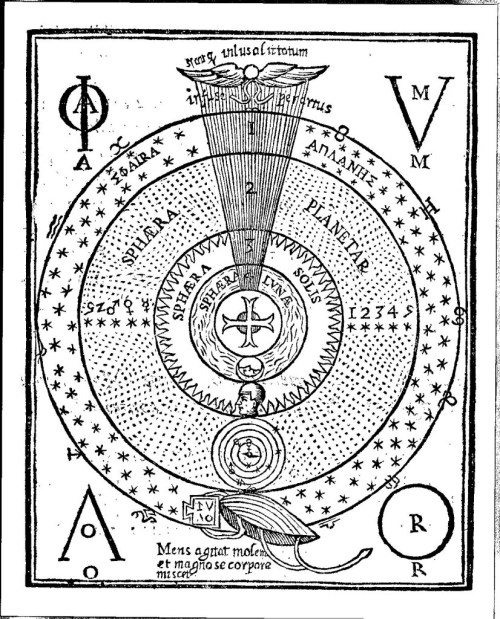
Athanasius Kircher (1602-80), schema of the Egyptian cosmos, Oedipus Aegyptiacus, tom. 2, vol. 1, p. 418. This work is in the public domain in its country of origin and other countries and areas where the copyright term is the author’s life plus 100 years or less.

“In an earlier chapter, we saw the suggestion made that Chinese might be the language of Adam. Kircher lived in a period of exciting discoveries in the Orient. The Spanish, Portuguese, English, Dutch, and, later, French conquered the route to the Indies, the Sunda seas, the way to China and to Japan.

But even more than by merchants, these pathways were traversed by Jesuits, following in the footsteps of Matteo Ricci who, a century before, had brought European culture to the Chinese, and returned to give Europe a deeper understanding of China.

With the publication of the Historia de las cosas más notables, ritos y costumbres del gran reino de la China by Juan Gonzales de Mendoza in 1585, there appeared in print in Europe characters in Chinese script.

In 1615 there finally appeared Ricci’s De christiana expeditione apud Sinas ab Societate Ieus suscepta, in which he explained that in Chinese, there existed as many characters as there were words. He insisted as well on the international character of the Chinese script, which, he wrote, was readily understood not only by the Chinese, but also by the Japanese, the Koreans, the Cochin-Chinese and by the Formosans.

We shall see that this was a discovery that would initiate the search for a real character from Bacon onwards. Already in 1627, in France, Jean Douet published a Proposition présentée au roy, d’une escriture universelle, admirable pour ses effects, très-utile à tous les hommes de la terre, in which Chinese was offered as a model for an international language.

At the same time, there had begun to appear information about the pictographic writings of Amerindians. Attempts at interpretation had yielded contradictory results; and this was discussed in works such as the Historia natural y moral de las Indias by José de Acosta in 1570, and the Relaciòn de las cosas de Yucatàn by Diego de Landa, written in the sixteenth century, although appearing only in the eighteenth; in 1609 there also appeared the Comentarios reales que tratan del origine de los Yncas by Garcilaso de la Vega.

An observation often repeated by these early observers was that contact with the indigenous natives was at first carried out by means of gestures. This awoke an interest in gesture’s potential as a universal language.

The universality of gestures and the universality of images turned out to be related themes (the first treatise on this subject was Giovanni Bonifacio‘s L’arte de’ cenni of 1616; on this topic in general, see Knox 1990).

The reports of his Jesuit brothers gave Kircher an incomparable source of ethnographic and linguistic information (see Simone 1990 on “Jesuit or Vatican linguistics”).

In his Oedipus, Kircher was especially interested in the diffusion of Chinese. He took up the same arguments, in a more elliptical form, in his China monumentis quà sacris quà profanis, nec non variis naturae et artis spectaculis, aliarum rerum memorabilis argumentis illustrata of 1667.

This latter work was more in the nature of a treatise in ethnography and cultural anthropology which, with its splendid and sometimes documented illustrations, collected all the reports that arrived from the missionaries of the Company, and described every aspect of Chinese life, culture and nature.

Only the sixth and last part of the work was dedicated to the alphabet.

Kircher presumed that the mysteries of hieroglyphic writing had been introduced to the Chinese by Noah’s son Ham. In the Arca Noe of 1675 (pp. 210ff) he identified Ham with Zoroaster, the inventor of magic.

But, unlike Egyptian hieroglyphs, Chinese characters were not for Kircher a puzzle. Chinese was a writing system still in use, and the key to its understanding had already been revealed. How could such a comprehensible language be sacred and a vehicle for occult mysteries?

Kircher realized that Chinese characters were originally iconic and only later had grown extremely stylized over time, so as to lose their original similarity with things. He reconstructed after  his own fancy what he took to be the designs of fish and birds that had formed the starting points for current ideograms.

Kircher also realized that these ideograms did not express either letters or syllables, but referred to concepts. He noted that in order to translate our dictionary into their idiom we would need as many different characters as we had words (Oedipus, III, 11).

This led him to reflect on the amount of memory that was necessary for a Chinese scholar to know and remember all these characters.”

Umberto Eco, The Search for the Perfect Language, translated by James Fentress, Blackwell. Oxford, 1995, pp. 158-60.
Eco: The Nationalistic Hypothesis, 2

kircher_087

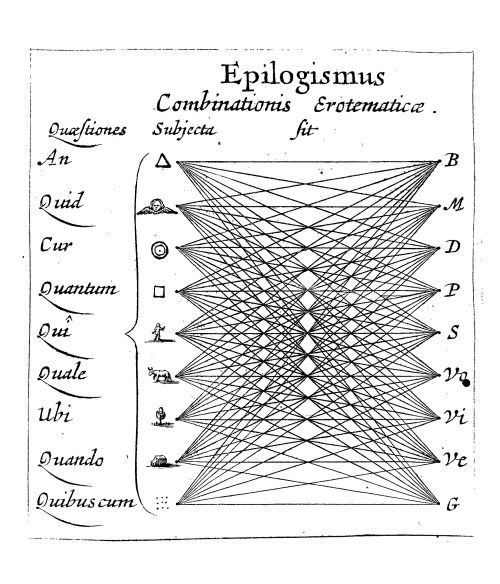
Athanasius Kircher (1602-80), Combinations of the nine universal symbols, from Ars Magna Sciendi Sive Combinatoria, 1669, p. 171. Courtesy of Stanford University.  This work is in the public domain in its country of origin and other countries and areas where the copyright term is the author’s life plus 100 years or less.


“Despite its improbability, the so-called “Flemish thesis” proved remarkably long-lasting. It survived even into the nineteenth century. It did so, however, less on its scientific merits than because it was part of a larger nationalistic polemic.

In his La province de Liège . . . Le flamand langue primordiale, mère de toutes les langues of 1868, the baron de Ryckholt proclaimed that “Flemish is the only language spoken in the cradle of humanity” and that “it alone is a language, while all the rest, dead or living, are but mere dialects or debased forms more or less disguised” (cf. Droixhe 1990: for linguistic follies de grandeur in general, Poliakov 1990).

With such a persistent and ebullient Flemish claim, it can hardly be surprising that there should be a Swedish candidacy as well. In 1671, Georg Stiernhielm wrote his De linguarum origine praefatio.

In 1688, his fellow countryman, Andreas Kempe, wrote Die Sprachen des Paradises; this included a scene in which God and Adam conversed with one another, God speaking in Swedish while Adam spoke in Danish; while they were talking, however, Eve was busy being seduced by a French-speaking serpent (cf. Borst 1957-63: III, 1, 1338; Olender 1989, 1993).

We are, by now, close to parody; yet we should not overlook the fact that these claims were made precisely in Sweden’s period as a major power on the European chessboard.

Olaus Rudbeck, in his Atlantica sive Mannheim vera Japheti posterorum sedes ac patria of 1675, demonstrated that Sweden was the home of Japheth and his line, and that from this racial and linguistic stock all the Gothic idioms were born.

Rudbeck identified Sweden, in fact, as the mythical Atlantis, describing it as the ideal land, the land of the Hesperides, from which civilization had spread to the entire world.

This was an argument that Isidore himself had already used. In his Etymologiarum, IX, ii, 26-7, he had suggested that the progenitor of the Goths was another of Japheth’s sons–Magog. Vico was later to comment acidly on all such claims (Scienza nuova seconda, 1744: II, 2.4, 430):

“Having now to enter upon a discussion of this matter, we shall give a brief sample of the opinions that have been held respecting it–opinions so numerous, inept, frivolous, pretentious or ridiculous, and so numerous, that we need not relate them.

By way of sample then: because in the returned barbarian times Scandinavia by the conceit of the nations was called vagina gentium and was believed to be the mother of all other nations of the world, therefore by the conceit of the scholars Johannes and Olaus Magnus were of the opinion that their Goths had preserved them from the beginning of the world the letters divinely inspired by Adam.

This dream was laughed at by all the scholars, but this did not keep Johannes van Gorp from following suit and going one better by claiming his own Dutch language, which is not much different from Saxon, has come down from the Earthly Paradise and is the mother of all other languages. [ . . . ]

And yet this conceit swelled to bursting point in the Atlantica of Olaus Rudbeck, who will have it that the Greek letters came from the runes; that the Phoenician letters, to which Cadmus gave the order and values those of the Hebrew, were inverted runes; and that the Greeks finally straightened them here and rounded them there by rule and compass.

And because the inventor is Merkurssman among the Scandinavians, he will have it that the Mercury who invented letters for the Egyptians was a Goth.”

Already by the fourteenth century, the idea of a German linguistic primacy was shaking the German-speaking world. The idea later appeared in Luther, for whom German was the language closest to God.

In 1533 Konrad Pelicanus (Commentaria bibliorum) set out the analogies between German and Hebrew, without, however, coming to a final judgement over which of the two was truly the Ursprache (cf. Borst 1957-63: III/1, 2).

In the baroque period, Georg Philipp Harsdörffer (Frauenzimmer Gesprächspiele, 1641, Niemayer Tübingen, ed., 1968: 335ff) claimed that the German language:

“speaks in the languages of nature, quite perceptibly expressing all its sounds. [ . . . ]

It thunders with the heavens, flashes lightening with the quick moving clouds, radiates with the hail, whispers with the winds, foams with the waves, creaks with the locks, sounds with the air, explodes with the cannons; it roars like the lion, lows like the oxen, snarls like the bear, bells like the stag, bleats like the sheep, grunts like the pig, barks like the dog, whinnies like the horse, hisses like the snake, meows like the cat, honks like the goose, quacks like the duck, buzzes like the bumble bee, clucks like the hen, strikes its beak like the stork, caws like the crow, coos like the swallow, chirps like the sparrow. [ . . . ]

On all those occasions in which nature gives things their own sound, nature speaks in our own German tongue. For this, many have wished to assert that the first man, Adam, would not have been able to name the birds and all the other beasts of the fields in anything but our words, since he expressed, in a manner conforming to their nature, each and every innate property and inherent sound; and thus it is not surprising that the roots of the larger part of our words coincide with the sacred language.”

German had remained in a state of perfection because Germany had never been subjected to the yoke of a foreign ruler. Lands that had been subjected had inevitably adapted their customs and language to fit those of the victor.

This was also the opinion of Kircher. French, for example, was a mix of Celtic, Greek and Latin. The German language, by contrast, was richer in terms than Hebrew, more docile than Greek, mightier than Latin, more magnificent in its pronunciations than Spanish, more gracious than French, and more correct than Italian.”

Umberto Eco, The Search for the Perfect Language, translated by James Fentress, Blackwell. Oxford, 1995, pp. 97-9.