
Samizdat

Publishing the Forbidden. All Rights Reserved. © Samizdat 2014-2025.

Tag: 1595

Eco: Horapollo’s Hieroglyphica
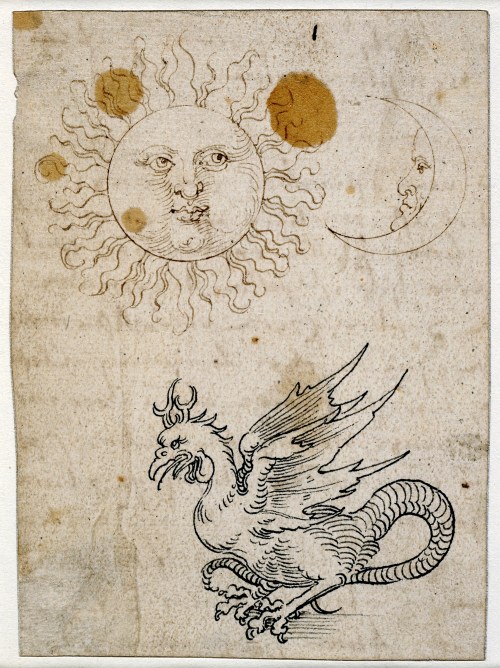
Duerer, Albrecht (1471-1528)

Albrecht Dürer (1471-1528), The Sun, the Moon and a Basilisk, circa 1512. The Sun, the Moon and the Basilisk (half eagle, half serpent, hatched from a cock’s egg by a serpent), represent Eternity. This drawing from a fragment is on the back of a manuscript translation of the Hieroglyphica by Horapollo translated by Willibald Pirkheimer, an associate of Dürer. Alexander Cory’s 1840 edition is posted on the Sacred Texts site, and the 1595 Mercier and Hoeschel edition in Latin and Greek is hosted on Archive.org due to the kind courtesy of the Getty Research Institute and the Sloan Foundation. This work is in the public domain in its country of origin and other countries and areas where the copyright term is the author’s life plus 100 years or less.  

“In 1419 Cristoforo de’ Buondelmonti acquired from the island of Andros a mysterious manuscript that was soon to excite the curiosity of philosophers such as Ficino: the manuscript was the Greek translation (by a certain Philippos) of the Horapòllonos Neiloùs ieroglyphikà.

The original author, Horapollo–or Horus Apollos, or Horapollus–was thus qualified as “Nilotic.” Although it was taken as genuinely archaic throughout the Renaissance, scholars now believe this text to be a late Hellenistic compilation, dating from as late as the fifth century AD.

As we shall see, although certain passages indicate that the author did possess exact information about Egyptian hieroglyphs, the text was written at a time when hieroglyphic writing had certainly fallen out of use. At best, the Hieroglyphica seems to be based on some texts written a few centuries before.

The original manuscript contained no images. Illustrations appeared only in later editions: for instance, though the first translation into Italian in 1547 is still without illustrations, the 1514 translation into Latin was illustrated by Dürer.

The text is divided into short chapters in which it is explained, for example, that the Egyptians represented age by depicting the sun and the moon, or the month by a palm branch.

There follows in each case a brief description of the symbolic meaning of each figure, and in many cases its polysemic value: for example, the vulture is said to signify mother, sight, the end of a thing, knowledge of the future, year, sky, mercy, Minerva, Juno, or two drachmas.

Sometimes the hieroglyphic sign is a number: pleasure, for example, is denoted by the number 16, because sexual activity begins at the age of sixteen. Since it takes two to have intercourse, however, this is denoted by two 16’s.

Humanist philosophical culture was immediately fascinated by this text: hieroglyphs were regarded as the work of the great Hermes Trismegistus himself, and therefore as a source of inexhaustible wisdom.

To understand the impact of Horopollo’s text on Europe, it is first necessary to understand what, in reality, these mysterious symbols were. Horopollo was describing a writing system, whose last example (as far as Egyptologists can trace) is on the Theodosius temple (AD 394).

Even if these inscriptions were still similar to those elaborated three thousand years before, the Egyptian language of the fifth century had changed radically. Thus, when Horopollo wrote his text, the key to understanding hieroglyphs had long been lost.”

Umberto Eco, The Search for the Perfect Language, translated by James Fentress, Blackwell. Oxford, 1995, pp. 145-6.
Eco: Side-Effects

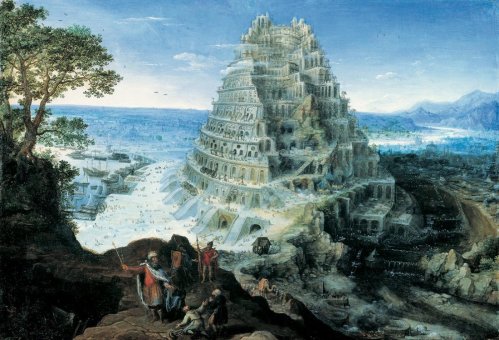
valckenborch_babel_1595_grt

Lucas van Valckenborch (1535-97), The Tower of Babel (1595), held in the Mittelrhein-Museum in Koblenz as Accession Number M31. This work is in the public domain in its country of origin and other countries and areas where the copyright term is the author’s life plus 100 years or less.   

“The story of the search for the perfect language is the story of a dream and of a series of failures. Yet that is not to say that a story of failures must itself be a failure. Though our story be nothing but the tale of the obstinate pursuit of an impossible dream, it is still of some interest to know how this dream originated, as well as uncovering the hopes that sustained the pursuers throughout their secular course.

Put in this light, our story represents a chapter in the history of European culture. It is a chapter, moreover, with a particular interest today when the peoples of Europe–as they discuss the whys and wherefores of a possible commercial and political union–not only continue to speak different languages, but speak them in greater number than ten years ago, and even, in certain places, arm against one another for the sake of their ethno-linguistic differences.

We shall see that the dream of a perfect language has always been invoked as a solution to religious or political strife. It has even been invoked as the way to overcome simple difficulties in commercial exchange. The history of the reasons why Europe thought that it needed a perfect language can thus tell us a good deal about the cultural history of that continent.

Besides, even if our story is nothing but a series of failures, we shall see that each failure produced its own side-effects. Punctually failing to come to fruition, each of the projects left a train of beneficial consequences in its wake.

Each might thus be viewed as a sort of serendipitous felix culpa: many of today’s theories, as well as many of the practices which we theorize (from taxonomy in the natural sciences to comparative linguistics, from formal languages to artificial intelligence and to the cognitive sciences), were born as side-effects of the search for a perfect language.

It is only fair, then, that we acknowledge these pioneers: they have given us a lot, even if it was not what they promised.

Finally, through examining the defects of the perfect languages, conceived in order to eliminate the defects of the natural ones, we shall end up by discovering that these natural languages of ours contain some unexpected virtues. This can finally serve us as consolation for the curse of Babel.”

Umberto Eco, The Search for the Perfect Language, translated by James Fentress, Blackwell. Oxford, 1995, pp. 19-20.

Editorial Note

This concludes my coverage of Chapter 1, From Adam to Confusio Linguarum, omitting in its entirety a section that Eco titled A Semiotic Model for Natural Language, pages 20-4.

I omit this section because it is Eco getting into the weeds of his semiotic method, and while he explains himself clearly, I find it boring. Should you need these pages, just ask. I have screenshots of them, and I can either post them as illustrations or attach them to an email. I am not in the mood to rekey these pages as text. Please accept my apologies.

Besides, Eco’s next chapter is titled The Kabbalistic Pansemioticism, and it is fascinating. With no further ado, I will resume there, with his Chapter 2.