
Samizdat

Publishing the Forbidden. All Rights Reserved. © Samizdat 2014-2025.

Tag: 1520

Eco: The Egyptian vs. The Chinese Way
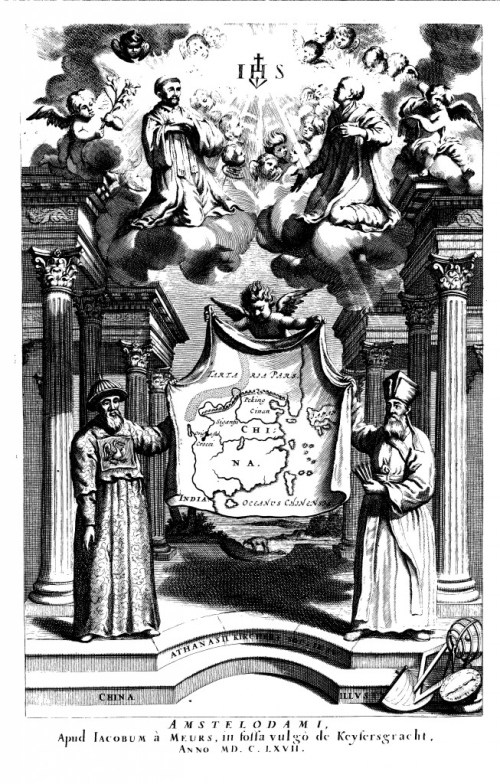
kircher_093-653x1024

Athanasius Kircher (1602-80), frontispiece depicting Adam Schall and Matteo Ricci holding a map of China, China Illustrata, 1667, courtesy of Stanford University. This work is in the public domain in its country of origin and other countries and areas where the copyright term is the author’s life plus 100 years or less.

“Although today many are still of the opinion that images provide a means of communication that can overcome language barriers, the explanation of the way in which images can accomplish this by now takes one of two forms: the Egyptian and the Chinese way.

The Egyptian way today belongs only to art history. We believe that visual media such as paintings, sequences in films, etc. are “texts” which convey emotions and feelings that could not be expressed verbally: we cannot represent by mere words Mona Lisa to a blind person.

The meanings that such texts can express are multiple, because there is no universal code: the rules of representation (and of recognizability) for an Egyptian mural, an Arab miniature, a painting by Turner or a comic strip are simply not the same in each case.

It is true that some ideograms have been used as characters of a universal code, for instances many road signals; in the same vein we are using more or less universal pictograms (think of the schematic crossed knives and forks which signal a restaurant in an airport, or of the stylized “ladies” and “gentlemen” on public lavatory doors).

Sometimes visual signs are merely substituting alphabetical letters, as happens with semaphores or flag signals; sometimes a yellow flag meaning “contagious disease on board” simply stands for a verbal sentence (cf. Prieto 1966).

Likewise, the gestural languages of Trappist monks, Indian merchants, gypsies or thieves, as well as the drummed and whistled languages of certain tribes (cf. Le Barre 1964), are equally dependent on the model of natural languages.

As useful, convenient and ingenious as some of these systems of communication may be, they make no claims to being “perfect” languages in which philosophers might one day wish to compose a treatise.

Any language of images is based on the alleged fact that images exhibit some properties of the represented things. Yet in any representable thing there will always be a multitude of properties, and there are infinite points of view under which an image can be judged similar to something else. Moreover, “that a picture looks like nature often means only that it looks the way nature is usually painted” (Goodman 1968: 39).

We can see this by looking at the various versions of a semiotic apparatus (if not a true language) which remained alive for centuries and which flowered in the same period when the western culture was looking for perfect visual languages: the arts of memory (cf. Rossi 1960; Yates 1966).

An art of memory establishes at its expression-plane a system of loci (that is, of places in the literal sense of the word) which may be imagined as the rooms of a building or palace, or as an urban street or square.

This system of loci is destined to house a set of images, drawn from the same iconographical field, which will play the role of lexical units. The content-plane is given by a system of res memoranda, in other words, of things to be remembered, usually belonging to the same conceptual framework. In this way, an art of memory is a semiotic system.

For instance, in mnemonic systems like those presented by the Congestorius artificiosae memoriae by Romberch (1520), the Dialogo del modo di accrescerce e conservare la memoria by Dolce (1575), or the Artificiosae memoriae fundamenta by Paepp (1619), the system of grammatical cases is expressed (and thus recalled) by the different parts of the human body.

Not only is this a case of one system expressing another system; it is also a case where the two planes are (in Hjelmslev‘s sense) conformal. It is not arbitrary that the head stands for nominative, the chest, which can receive blows, stands for accusative, and the hands, which possess and offer, stand for genitive and dative, and so on.

This shows that a mnemonic image, in order to express its content easily, should evoke it by similarity. But no mnemonic system was ever able to find a univocal criterion of resemblance.

The criteria are the same as those that linked the signature to its signatum. If we look back and see (ch. 6) what Paracelsus had to say about the language of Adam, the Protoplastus, we see that he represented him as naming one animal on the basis of a morphological similarity (from which a virtue derived), while, in another case, the name derived directly from a virtue not manifested by the form of the object.

In other cases, the name that Adam gave reflected neither morphology nor causal relations, but was inferred symptomatically: for instance, the horn of the stag permitted us to infer the age of the animal from the complexity of its branching.”

Umberto Eco, The Search for the Perfect Language, translated by James Fentress, Blackwell. Oxford, 1995, pp. 168-71.

Eco: Lullian Kabbalism

Roma1493

Unknown artist, Roma 1493, depicting the city of Rome as it appeared in that year. This woodcut was published in Hartmann Schedel (1440-1514), Schedelsche Weltchronik, Nürnberg, 1493, on folio lvii verso and lviii recto. Known in English as the Nuremberg Chronicle, or Schedel’s World Chronicle, the work commissioned by Sebald Schreyer (1446-1520) and Sebastian Kammermeister (1446-1503) was lushly illustrated with the first depictions of many cities. This work is in the public domain in its country of origin and other countries and areas where the copyright term is the author’s life plus 100 years or less. 

“We have now reached a point where we must collect what seem the various membra disiecta of the traditions we have been examining and see how they combined to produce a Lullian revival.

We can begin with Pico della Mirandola: he cited Lull in his Apologia of 1487. Pico, of course, would have been aware that there existed analogies between the permutational techniques of Lull and the temurah (which he called “revolutio alphabetaria“).

He was acute enough, however, to realize that they were two different things. In the Quaestio Sexta of the Apologia, where Pico proved that no science demonstrates the divinity of Christ better than magic and the kabbala, he distinguished two doctrines which might be termed kabbalist only in a figurative (transumptive) sense: one was the supreme natural magic; the other was the hokmat ha-zeruf of Abulafia that Pico termed an “ars combinandi,” adding that “apud nostros dicitur ars Raymundi licet forte diverso modo procedat” (“it is commonly designated as the art of Raymond, although it proceeds by a different method”).

Despite Pico’s scruples, a confusion between Lull and the kabbala was, by now, inevitable. It is from this time that the pathetic attempts of the Christian kabbalists to give Lull a kabbalistic reading begin.

In the 1598 edition of Lull’s works there appeared, under Lull’s name, a short text entitled De auditu kabbalistico: this was nothing other than Lull’s Ars brevis into which had been inserted a number of kabbalistic references.

It was supposedly first published in Venice in 1518 as an opusculum Raimundicum. Thorndike (1923-58: v, 325) has discovered the text, however, in manuscript form, in the Vatican Library, with a different title and with an attribution to Petrus de Maynardis.

The manuscript is undated, but, according to Thorndike, its calligraphy dates it to the fifteenth century. The most likely supposition is that it is a composition from the end of that century in which the suggestions first made by Pico were taken up and mechanically applied (Scholem et al. 1979: 40-1).

In the following century, the eccentric though sharp-witted Tommaso Garzoni di Bagnacavallo saw through the imposture. In his Piazza universale du tutte le arti (1589: 253), he wrote:

“The science of Raymond, known to very few, might be described with the term, very improper in itself, of Cabbala. About this, there is a notion common to all scholars, indeed, to the whole world, that in the Cabbala can be found teachings concerning everything [ . . . ] and for this reason one finds in print a little booklet ascribed to him [Lull] (though on this matter people beyond the Alps write many lies) bearing the title De Auditu Cabalistico. This is nothing but a brief summary of the Arte Magna as abbreviated, doubtlessly by Lull himself, into the Arte Breve.”

Still, the association persisted. Among various examples, we might cite Pierre Morestel, who published an Artis kabbalisticae, sive sapientiae diviniae academia in 1621, no more than a modest compilation from the De auditu.

Except for the title, and the initial identification of the Ars of Lull with the kabbala, there was nothing kabbalistic in it. Yet Morestel still thought it appropriate to include the preposterous etymology for the word kabbala taken from De auditu: “cum sit nomen compositum ex duabus dictionibus, videlicet abba et ala. Abba enim arabice idem quod pater latine, et ala arabice idem est quod Deus meus” (“as this name is composed of two terms, that is abba and ala. Abba is an Arabic word meaning Latin pater; ala is also Arabic, and means Deus meus“).

For this reason, kabbala means “Jesus Christ.”

The cliché of Lull the kabbalist reappears with only minimum variation throughout the writings of the Christian kabbalists. Gabriel Naudé, in his Apologie pour tous les grands hommes qui ont esté accuséz de magie (1625), energetically rebutted the charge that the poor Catalan mystic engaged in the black arts.

None the less, French (1972: 49) has observed that by the late Renaissance, the letters from B to K, used by Lull, had become associated with Hebrew letters, which for the kabbalists were names of angels or of divine attributes.”

Umberto Eco, The Search for the Perfect Language, translated by James Fentress, Blackwell. Oxford, 1995, pp. 128-30.

(Editorial Note: wallowing in the bibliography of Raimon Llull is not for the meek. I encountered many culs-de-sac and could not find digital versions of many of the works mentioned by Eco in this segment. If you have URLs to works which are not linked in this excerpt from Eco, please share them using the comment feature. Thank you.)