
Samizdat

Publishing the Forbidden. All Rights Reserved. © Samizdat 2014-2025.

Category: ummānu

Kvanvig: Bīt Mēseri and the Adapa Myth

“The exact form and meaning of the name of the first apkallu is not easy to decide. There are several reasons for this. On the one hand there seems to be a connection in the cuneiform sources between Uan as the name is given in the Uruk tablet and Bīt Mēseri, and the Adapa known from the myth.

Second, there is a connection between the name as attested in cuneiform sources and the Greek name Oannes in Berossos.

Third, there is a combined name that first seems to appear in the Catalogue of Texts and Authors I, 6, “ūma-an-na a-da-pà, which seems to play on both Uan and adapa (sic) in some mysterious way.

Fourth, there is a connection in the meaning of the name and the fate, related to the seventh apkallu, Utuabzu, and the first apkallu, Uan.
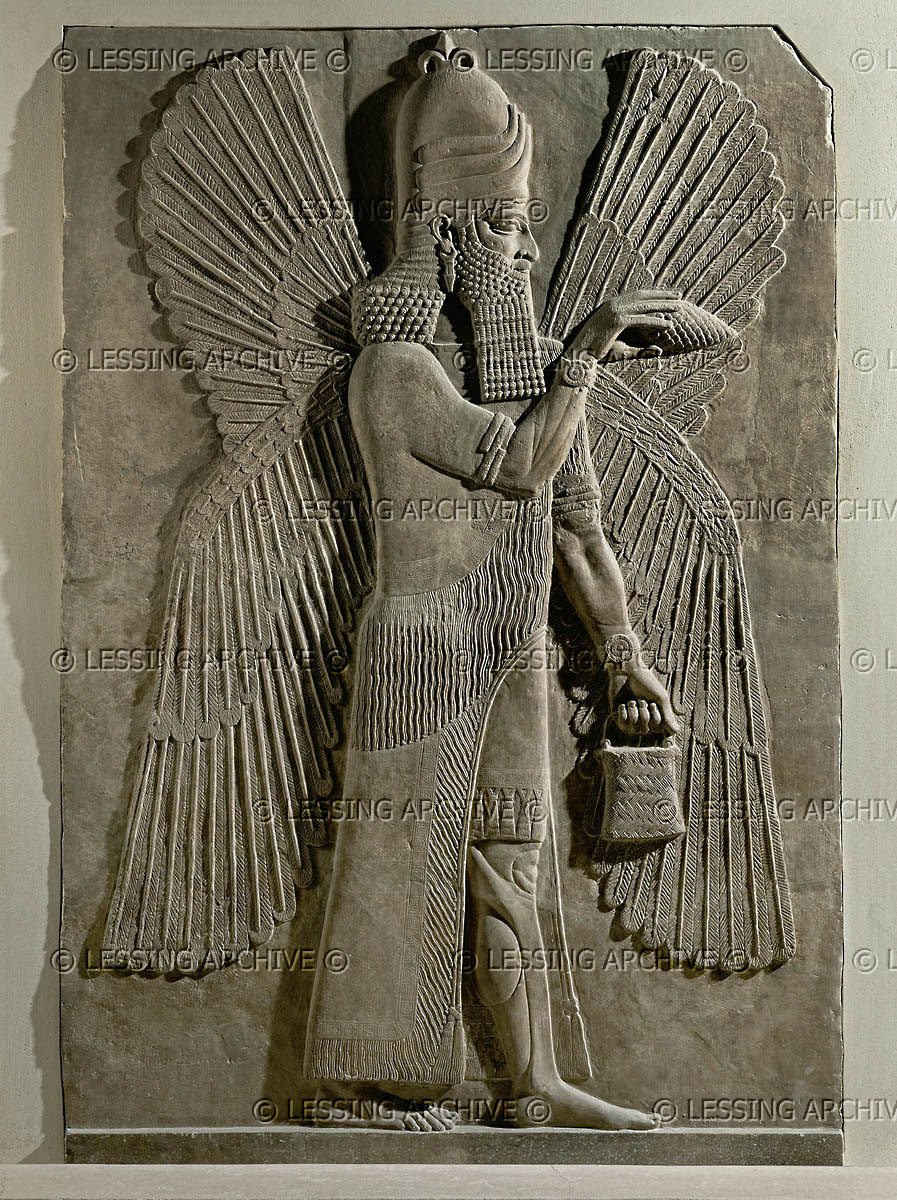
Now compare this Nimrud bas relief from the Louvre: an ummânū sprinkles water with a mullilu cone in his right hand, holding his banduddu bucket in his left. This ummânū wears bracelets with a concentric circular design, and rosettes are not apparent. This ummânū also wears the common horned headdress of Anu, but with three stacked layers of horns. As noted elsewhere, this headdress is surmounted by an object that resembles a partial fleur de lis. From Nimrud, capital of king Ashurnarzipal.  Louvre, AO 19845

Now compare this Nimrud bas relief from the Louvre: an ummânū sprinkles water with a mullilu cone in his right hand, holding his banduddu bucket in his left.
This ummânū wears bracelets with a concentric circular design, and rosettes are not apparent.
This ummânū also wears the common horned headdress of Anu, but with three stacked layers of horns.
As noted elsewhere, this headdress is surmounted by an object that resembles a partial fleur de lis.
From Nimrud, capital of king Ashurnarzipal.
Louvre, AO 19845

To the first issue, R. Borger, supported by F. Wiggermann, has claimed that Adapa from the myth and Uan from the lists were originally two separate figures. If this is the case, we first have to explain the meaning of the short form of the name, i.e. Uan, then the combination with adapu.

The short name form, Uan, in the two cuneiform lists is most easy (sic) explained as a Sumerian genitive, simply meaning “Light of An.” Since An is written with the Sumerian determinative for “god,” An is here the god of heaven.

Given the general and somewhat vague resemblances between the cuneiform and Greek names, we think Uan alone very well could form the background for Oannes in Berossos. Lambert has called attention to the fact that in a list of adjectives for “wise” the Sumerian ù.tu.a.an.ba, “born in the water,” is equated with a-da-pu.

The same Akkadian word is used in a royal prayer in which the king speaks of himself as “your wise (a-da-pà) slave.”  This could point in the direction that Uan is the proper name and adapu is an epithet designating Uan as “wise.” It is, however, difficult to equate myths with lexical texts and draw certain conclusions.

Reading the Adapa Myth from the Old Babylonian period clearly evokes the impression that Adapa was a proper name, and this proper name of the foremost wise among humans (sic) could very well have caused the use of the name as an epithet.
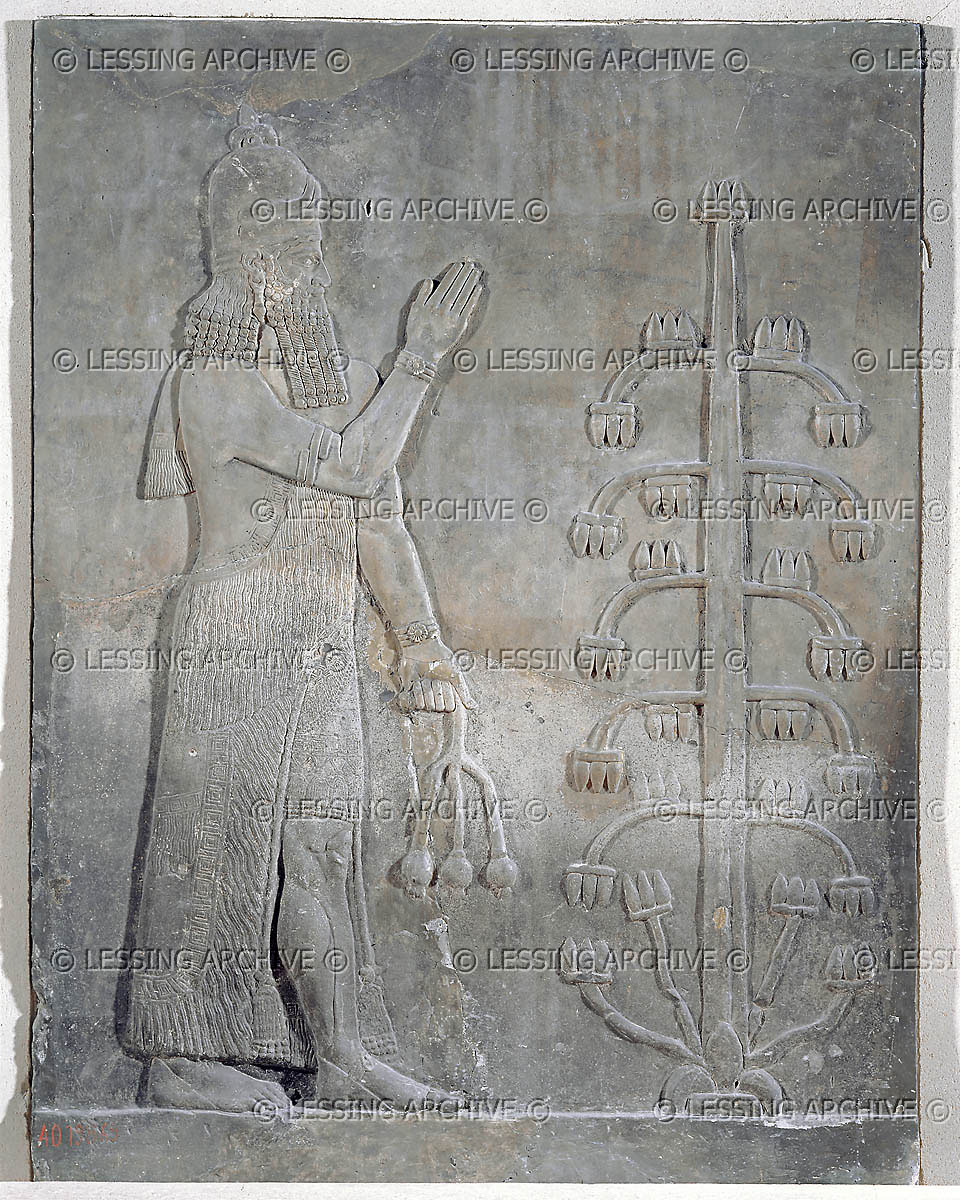
Finally compare this representation. Wings are missing. The horned headdress has two levels of horns, and is again surmounted with what appears to be a fleur-de-lis.  Like other examples, this figure holds what appear to be poppy bulbs, and raises his right hand in the greeting gesture.  Bracelets with rosettes are present, as are armlets on the upper arms.  The sacred tree before the figure varies from other depictions, as well.  It is not certain that this figure depicts an ummânū at all. It could portray a king. The lack of wings is clearly deliberate.  Bas-relief, Louvre, AO 19869

Finally compare this representation. Wings are missing. The horned headdress has two levels of horns, and is again surmounted with what appears to be a fleur-de-lis.
Like other examples, this figure holds what appear to be poppy bulbs, and raises his right hand in the greeting gesture.
Bracelets with rosettes are present, as are armlets on the upper arms.
The sacred tree before the figure varies from other depictions, as well.
It is not certain that this figure depicts an ummânū at all. It could portray a king. The lack of wings is clearly deliberate.
Bas-relief, Louvre, AO 19869

(Cf. the discussion in S. Izre’el, Adapa and the South Wind. Language Has the Power of Life and Death, ed. J.S. Cooper, vol. 10, Mciv. Winona Lake 2001, 1-2.)

The combined name “‘ūma-an-na a-da-pà (sic) is a riddle. Adapa at the end can be part of the name, or it can be an epithet, “the wise one;” if so the real name is ūmanna. This name does not tell us anything, except that it could be an odd spelling of ummānu, “craftsman or scholar.” But why should the foremost sage, designated apkallu, bear a name similar to an expert of lower rank?

This points in the direction that both words belong together in the name. We see that the only element in the first name that separates from the name of the first sage in the Akkadian lists is the nasalization of u in um, umanna instead of uanna.

Why this is done is hard to figure out. It could have been to create a pun between the primeval Uan, “the light of heaven,” patron of the scholars, and these succeeding scholars, designated as ummānū.

In any case the proper name of the primary sage in the Catalogue would be Uanadapa, a combination of the first apkallu Uan from the lists and Adapa from the myth.”

Helge Kvanvig, Primeval History: Babylonian, Biblical, and Enochic: An Intertextual Reading, Brill, 2011, pp. 117-9.
Lenzi: the Apkallū and the Ummânū May Be Artificially Related

“Considering only the evidence of DT 1, I think there is internal evidence in line 26 for the proper reading of NUN.ME in both lines 4 and 10. In line 26 Marduk is called the NUN.ME DINGIR.MEŠ (apkal ilī, “sage of the gods”) and the NUN (rubû, “prince”). These epithets are even adjacent to one another in the line.

It is clear therefore that the text knew the distinction and the potential ambiguity between the words apkallū and rubû. Moreover, lines 4 and 10 could have made the reading rubû—if that is what was intended— unambiguous if it had wanted to. But it did not.

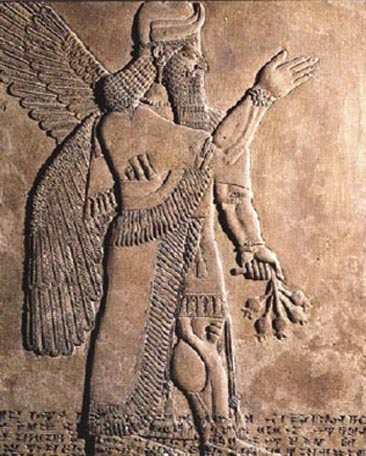
This exemplar of an Ummânū raises his right hand in the greeting gesture and holds what appear to be poppy bulbs in his left hand.  Rosette bracelets are apparent on his wrists, and he wears the horned tiara indicative of divinity.

This exemplar of an Ummânū raises his right hand in the greeting gesture and holds what appear to be poppy bulbs in his left hand.
Rosette bracelets are apparent on his wrists, and he wears the horned tiara indicative of divinity.

Therefore, I think, NUN.ME should be read as apkallū in DT 1. On this reading, there is a clear parallel established between an apkallū and ummânū in the Ninevite Version of the text.

The answer to the contextual and practical problems presented by the resulting parallelism in lines 4 and 5 comes from the duplicate published by Cole.

(Cole, Nippur IV, 268-74 (OIP 114 128). Hurowitz, through whom I became acquainted with this issue, points out the contextual difficulties with this reading nicely.

Now compare this Nimrud bas relief from the Louvre: an ummânū sprinkles water with a mullilu cone in his right hand, holding his banduddu bucket in his left. This ummânū wears bracelets with a concentric circular design, and rosettes are not apparent. This ummânū also wears the common horned headdress, but with three stacked layers of horns. As noted elsewhere, this headdress is surmounted by an object that resembles a partial fleur de lis. From Nimrud, capital of king Ashurnarzipal.  Louvre, AO 19845

Now compare this Nimrud bas relief from the Louvre: an ummânū sprinkles water with a mullilu cone in his right hand, holding his banduddu bucket in his left.
This ummânū wears bracelets with a concentric circular design, and rosettes are not apparent.
This ummânū also wears the common horned headdress, but with three stacked layers of horns.
As noted elsewhere, this headdress is surmounted by an object that resembles a partial fleur de lis.
From Nimrud, capital of king Ashurnarzipal.
Louvre, AO 19845

Although he recognizes that “apkallū is an excellent parallel for ummānu” since “(b)oth refer to sages and masters of the basic fields of wisdom,” he goes on to say the following: “[w]hile the later [sic., latter; the ummânū could be courtiers who could proffer advice at court and be heeded by the king, the former [the apkallū can impart their wisdom only in an indirect manner [i.e., because they were mythological sages], and the king could not be expected to really heed them.

The reading apkallū would therefore be problematic on practical grounds if the text is not to be considered as speaking metaphorically” (Victor Hurowitz, “Advice to a Prince: A Message from Ea,” State Archives of Assyria Bulletin 12 [1998], 49, n.23). I would add to this that apkallū does not seem an appropriate parallel term to dayyānū in line 10.)

OIP 114 128 (the Nippur version)

If) he does not listen to his princes, his days will be short.
(If) he does not listen to (his) scholar, his land will rebel against him.

Lines 4 and 11 (= DT’s line 10) in the Nippur version of the text have the unambiguous reading NUN.MEŠ-šú, i.e., rubîšu, “his nobles.”

Finally compare this representation. Wings are missing. The horned headdress has two levels of horns, and is again surmounted with what appears to be a fleur-de-lis.  Like other examples, this figure holds what appear to be poppy bulbs, and raises his right hand in the greeting gesture.  Bracelets with rosettes are present, as are armlets on the upper arms.  The sacred tree before the figure varies from other depictions, as well.  It is not certain that this figure depicts an ummânū at all. It could portray a king. The lack of wings is clearly deliberate.  Bas-relief, Louvre, AO 19869

Finally compare this representation. Wings are missing. The horned headdress has two levels of horns, and is again surmounted with what appears to be a fleur-de-lis.
Like other examples, this figure holds what appear to be poppy bulbs, and raises his right hand in the greeting gesture.
Bracelets with rosettes are present, as are armlets on the upper arms.
The sacred tree before the figure varies from other depictions, as well.
It is not certain that this figure depicts an ummânū at all. It could portray a king. The lack of wings is clearly deliberate.
Bas-relief, Louvre, AO 19869

This is probably the better reading of the two versions since it fits the social situation envisioned by the text much better than the mythological sage-figures of the Ninevite version. Moreover, rubîšu provides a suitable parallel for the terms in both lines 5 (ummânū) and 10 (dayyānū).

So why was apkallū employed in parallel to ummânū in line 4 of the Nineveh version? It seems the composition did not always do so.

The reading in the Nineveh version is either a graphic corruption of the original reading (it left out three Winkelhaken in the MES sign twice, in lines 4 and 10, thereby forming ME) or, more likely, there was a deliberate, if small, alteration to the text that was ideologically motivated.

(Cole, Nippur IV, 274 mentions the possibility, based on a mistake in the text, that the Nippur tablet was a practice tablet written from dictation. If that is so, then it is unlikely that the confusion between apkallū and rubû could be attributed to a simple graphic error.)

If Hurowitz is correct in seeing a relationship between the “Advice to a Prince” and Ea, then this text would be a significant and appropriate textual location to assert a connection between the apkallū and their descendants, the ummânū.

Bringing them together may have seemed an almost “natural” thing to do in this text in light of the “mythology.”

Significantly, the “Advice to a Prince” explicitly sets the identification of the apkallū and ummânū within the context of royal advising.

In this regard, our text shows another conceptual continuity with the ULKS and suggests that the apkallū are not found exclusively in ritual contexts during the early first millennium.”

Alan Lenzi, The Uruk List of Kings and Sages and Late Mesopotamian ScholarshipJANER 8.2, Brill, Leiden, 2008. pp. 148-9.