Samizdat

Publishing the Forbidden. All Rights Reserved. © Samizdat 2014-2025.

Category: tupšarru

Kvanvig: The Sacred Tree

“Parpola discusses the role of these experts in relation to the king. Did the experts form a clique that was in the position to manipulate the king according to its own agenda? Parpola denies this possibility; on the one hand the “inner circle” was not permanently present at the court; on the other hand there was clearly rivalry between the scholars. In addition, the advisory role of the scholars was overwhelmingly passive and “academic.”

The cuneiform tablet (IM 65066) is in the Bagdad Museum.

 A.K. Grayson, from the Reallexikon der Assyriologie, s.v. "Königslisten und Chroniken". A.K. Grayson, 'Assyrian and Babylonian King Lists,' in: Lišan mithurti. (Festschrift Von Soden) (Kevelaer : Neukirchen-Vluyn : Butzon & Bercker; 1969) Plate III.

 http://www.livius.org/source-content/uruk-king-list/

The cuneiform tablet (IM 65066) is in the Bagdad Museum.


A.K. Grayson, from the Reallexikon der Assyriologie, s.v. “Königslisten und Chroniken”.
A.K. Grayson, ‘Assyrian and Babylonian King Lists,’ in: Lišan mithurti. (Festschrift Von Soden) (Kevelaer : Neukirchen-Vluyn : Butzon & Bercker; 1969) Plate III.


http://www.livius.org/source-content/uruk-king-list/

Nevertheless, the importance of the scholars for the king must not be underestimated. They represented a wisdom going back to the seven apkallus from before the flood, and this wisdom was indispensable for the king. The experts provided the royal family with medical care (physicians and exorcists), protection against demons and angry gods (exorcists and chanters), and they provided the king with insight into the future (haruspices and astrologers).

This appears to be an ummanu without wings, blessing the sacred tree with his right hand raised in the greeting gesture and his lowered left hand holding drooping poppy bulbs. This depiction of an apkallu wears a dual-horned tiara indicative of divinity or semi-divinity, but lacks all other indicators like wings. As the typical mullilu cone and banduddu bucket are absent, this could depict a king saluting the tree. Still, the figure wears a horned tiara, which is reserved for apkallu, and not worn by kings. <br />  The horned tiara is atypical with a distinctive fleur de lis at the apex. Indeed this frieze is remarkably detailed, with three separate bands visible on the rosette bracelets, and individual strands visible on the tasseled garment. <br />  The sacred tree is sparse and stark in comparison to other renditions, though it appears to be blossoming from a fleur de lis base.<br />  (Génie tenant une fleur de pavot - Genie carrying a poppy flower.)<br />  Bas-relief, 144 x 17cm.<br />  Louvre, AO 19869

This appears to be an ummanu without wings, blessing the sacred tree with his right hand raised in the greeting gesture and his lowered left hand holding drooping poppy bulbs. This depiction of an apkallu wears a dual-horned tiara indicative of divinity or semi-divinity, but lacks all other indicators like wings. As the typical mullilu cone and banduddu bucket are absent, this could depict a king saluting the tree. Still, the figure wears a horned tiara, which is reserved for apkallu, and not worn by kings.
The horned tiara is atypical with a distinctive fleur de lis at the apex. Indeed this frieze is remarkably detailed, with three separate bands visible on the rosette bracelets, and individual strands visible on the tasseled garment.
The sacred tree is sparse and stark in comparison to other renditions, though it appears to be blossoming from a fleur de lis base.
(Génie tenant une fleur de pavot – Genie carrying a poppy flower.)
Bas-relief, 144 x 17cm.
Louvre, AO 19869

Both on Assyrian reliefs and cylinder seals depictions of the apkallus together with a date palm, and in some instances the king, are common. The date palm is here a holy tree, the Tree of Life. It symbolizes the benefits the gods and kings were expected to supply for the people.

(Click to zoom in)<br />  On the imprint from this chalcedony cylinder seal dated to the 9th Century BCE, an umu-apkallu, an ummanu, winged with mullilu and banduddu bucket, blesses (or pollinates) the sacred tree with an undefined female figure.<br />  Note that this more or less symmetrical rendition of the sacred tree is mounted on a pedestal with bulbs that resemble cones.<br />  Cylinder seal and imprint: Cult of the sacred tree. Chalcedony,<br />  H: 3,2 cm<br />  Louvre: AO 22348

(Click to zoom in)
On the imprint from this chalcedony cylinder seal dated to the 9th Century BCE, an umu-apkallu, an ummanu, winged with mullilu and banduddu bucket, blesses (or pollinates) the sacred tree with an undefined female figure.
Note that this more or less symmetrical rendition of the sacred tree is mounted on a pedestal with bulbs that resemble cones.
Cylinder seal and imprint: Cult of the sacred tree. Chalcedony,
H: 3,2 cm
Louvre: AO 22348

(“This palm in art then is not the symbol of a god or the whole pantheon of gods, but is a symbol of the benefits which gods and kings were expected to supply.” W.G. Lambert, “The Background of the Neo-Assyrian Sacred Tree,” in S. Parpola and R.M. Whiting, eds., Sex and Gender in the Ancient Near East, XLVIIe Recontre Assyriologique Internationale, Helsinki, 2002, pp. 321-6.)

The role of the apkallus is to pollinate the tree. Through this guest (sic), fertility, vitality, and power were transferred to the tree; in the scenes where the king is present, he is a receiver of these benefits from apkallus.

(Cf. Kolbe, Die Reliefprogramme, 21, 29, pp. 83-8).

Parpola returns to this mythological representation of the role of the king in his new edition of the letters. The Assyrian kings had the position of the god’s representative on earth. This position was above all symbolized through the Tree of Life.

(Parpola, Letters from Assyrian and Babylonian Scholars, XIII-XXXV.)

Three superposed lotus flowers forming a "Sacred tree." Ivory (open-work, fragment)<br /> Right: Lotus flower with 5 petals.<br /> 11.3 x 3 cm, Louvre AO 11481;<br /> Left: Ivory plaque with top and bottom border from Arslan Tash, ancient Hadatu, Northern Syria.<br /> 7.6 x 2.1 cm, Louvre AO 11482.<br /> I believe that the sacred tree fragment on the left is upside down. The blossoms should be oriented upwards.

Three superposed lotus flowers forming a “Sacred tree.” Ivory (open-work, fragment)
Right: Lotus flower with 5 petals.
11.3 x 3 cm, Louvre AO 11481;
Left: Ivory plaque with top and bottom border from Arslan Tash, ancient Hadatu, Northern Syria.
7.6 x 2.1 cm, Louvre AO 11482.
I believe that the sacred tree fragment on the left is upside down. The blossoms should be oriented upwards.

The tree represented the divine world order maintained by the king. At the same time the symbolism of the tree was projected upon the king as the perfect image of the god. A king who could not conform to this role would automatically disrupt the cosmic harmony.

To execute this duty the king needed experts who could interpret the signs of the god. Therefore he needed the advisory circle of scholars: the tupšarru, “astrologer, scribe;” bārû, “haruspex / diviner;” āšipu, “exorcist / magician;” asû, “physician;” and kalû, “lamentation chanter.”

A memorandum from the reign of Ashurbanipal names 45 scholars from these professions. The scholars were mostly native, but could also include foreigners, such as Syrian, Anatolian, and Egyptian.

(Parpola, Letters from Assyrian and Babylonian Scholars, XIV.)

Click to zoom in.<br />  This reproduction of the bas reliefs in Room I of the Northwestern Palace of King Ashurnasirpal at Nimrud is remarkable for the sheer number of apkallus portrayed interacting with endless renditions of the sacred tree.<br /> All apkallu are winged, even the beardless specimens in I-16. All others are either bearded males, or griffin-headed bird apkallus.<br /> Samuel M. Paley and R.P. Sobolewski, The Reconstruction of the Relief Representations and Their Positions in the Northwest Palace at Kalhu (Nimrud) II. (The Principal Entrances and Courtyards). Mainz am Rhein: Verlag Philipp von Zabern, 1992.<br /> From Mehmet-Ali Atac, The Mythology of Kingship in Neo-Assyrian Art, Cambridge University Press, 2010, p. 100.

Click to zoom in.
This reproduction of the bas reliefs in Room I of the Northwestern Palace of King Ashurnasirpal at Nimrud is remarkable for the sheer number of apkallus portrayed interacting with endless renditions of the sacred tree.
All apkallu are winged, even the beardless specimens in I-16. All others are either bearded males, or griffin-headed bird apkallus.
Samuel M. Paley and R.P. Sobolewski, The Reconstruction of the Relief Representations and Their Positions in the Northwest Palace at Kalhu (Nimrud) II. (The Principal Entrances and Courtyards). Mainz am Rhein: Verlag Philipp von Zabern, 1992.
From Mehmet-Ali Atac, The Mythology of Kingship in Neo-Assyrian Art, Cambridge University Press, 2010, p. 100.

The Catalogue of Texts and Authors shows that the actual scholars at the royal court stood in a line of transmission; they performed a profession, the wisdom of which went back to famous ummanus of the past, and ultimately to the antediluvian apkallus.

These apkallus were, as we have seen in the rituals, imagined in three shapes. The fish-garb symbolized the connection with apsû, the ocean of wisdom; the head and wings of the eagle symbolized their connection to heaven.

The genies symbolizing the human apkallus often have crowned horns, indicating divine status. Parpola thinks that this symbolized their transformation from humans to saints after their death. (Ibid., XX). “

Helge Kvanvig, Primeval History: Babylonian, Biblical, and Enochic: An Intertextual Reading, Brill, 2011, pp. 143-4.

Kvanvig: Five Specialties of Sages Communicating with the Divine

“There is no doubt that these assertions by the kings are tendentious; and one can discuss how wise the kings in reality were. They needed high competence in practical affairs; this is a matter of fact. They administered empires, warfare, economy, building of temples, palaces; this is not done without a high degree of skill.

(Cf. R.F.G. Sweet, “The Sage in Mesopotamian Palaces and Royal Courts,” in J.G. Gammie and L.G. Perdue, eds., The Sage in Israel and the Ancient Near East, Winona Lake, 1990, pp. 99-107, 99f.)

Nevertheless, the kings boast of knowledge of a higher order, a knowledge that shares in the divine wisdom, either represented through the gods themselves, or through the apkallus. This at least included knowledge about reading and writing.

(Click to zoom in). <br /> A king depicted with the sacred tree and his ummanu standing behind him with mullilu cone and banduddu bucket.<br />  Some analysts consider the cone blessing gesture to be fertilization or pollination of the stylized date palm.<br />  It is interesting to note that the depictions of the king mirror one another, but with differences.<br />  In both, symbols of sovereignty are grasped in their left hands. A scepter or mace, in either case. The other hand, the right hand, plucks or blesses the tree.<br />  The winged conveyance hovers above the tree. Note that the kings wear indistinct caps, while the ummanus wear horned crowns indicative of divinity. Also, the ummanu have wings.<br />  From the Northwest palace at Nimrud. Held in the collection of the British Museum, BM 6657.

(Click to zoom in).
A king depicted with the sacred tree and his ummanu standing behind him with mullilu cone and banduddu bucket.
Some analysts consider the cone blessing gesture to be fertilization or pollination of the stylized date palm.
It is interesting to note that the depictions of the king mirror one another, but with differences.
In both, symbols of sovereignty are grasped in their left hands. A scepter or mace, in either case. The other hand, the right hand, plucks or blesses the tree.
The winged conveyance hovers above the tree. Note that the kings wear indistinct caps, while the ummanus wear horned crowns indicative of divinity. Also, the ummanu have wings.
From the Northwest palace at Nimrud. Held in the collection of the British Museum, BM 6657.

As far as we know, only three kings claim to have been literate in two thousand years of Mesopotamian history: Šulgi, Lipit-Ištar, and Ashurbanipal.

(Sweet, “The Sage in Akkadian Literature,” p. 65.)

The kings claimed obviously to share in this higher degree of wisdom, not only because of personal reasons, but because of the royal ideology according to which they ruled.

The wisdom they needed was not only insight into how to rule a country, but insight into the divine realm, to read the signs of the gods, to appease the gods when necessary, and to secure divine assistance to conquer demonic attacks.

To secure this kind of wisdom the king associated with a body of experts professionalized in various fields of this higher form of wisdom that demanded communication with the divine. This is the ideology of the pairing of kings and sages / scholars in Berossos and more extensively in the Uruk tablet.

In order to rule, a king needed a scholar at his side. In a chronographic composition from about 640 BCE, listing the kings of Assyria and Babylon together, the kings are listed together with one or two ummanus.

(Cf. S. Parpola, Letters from Assyrian Scholars to the Kings Esarhaddon and Assurbanipal. Part II: Commentary and Appendices, vol. 5/2, AOAT, Neukirchen-Vluyn, 1983, pp. 448-9.)

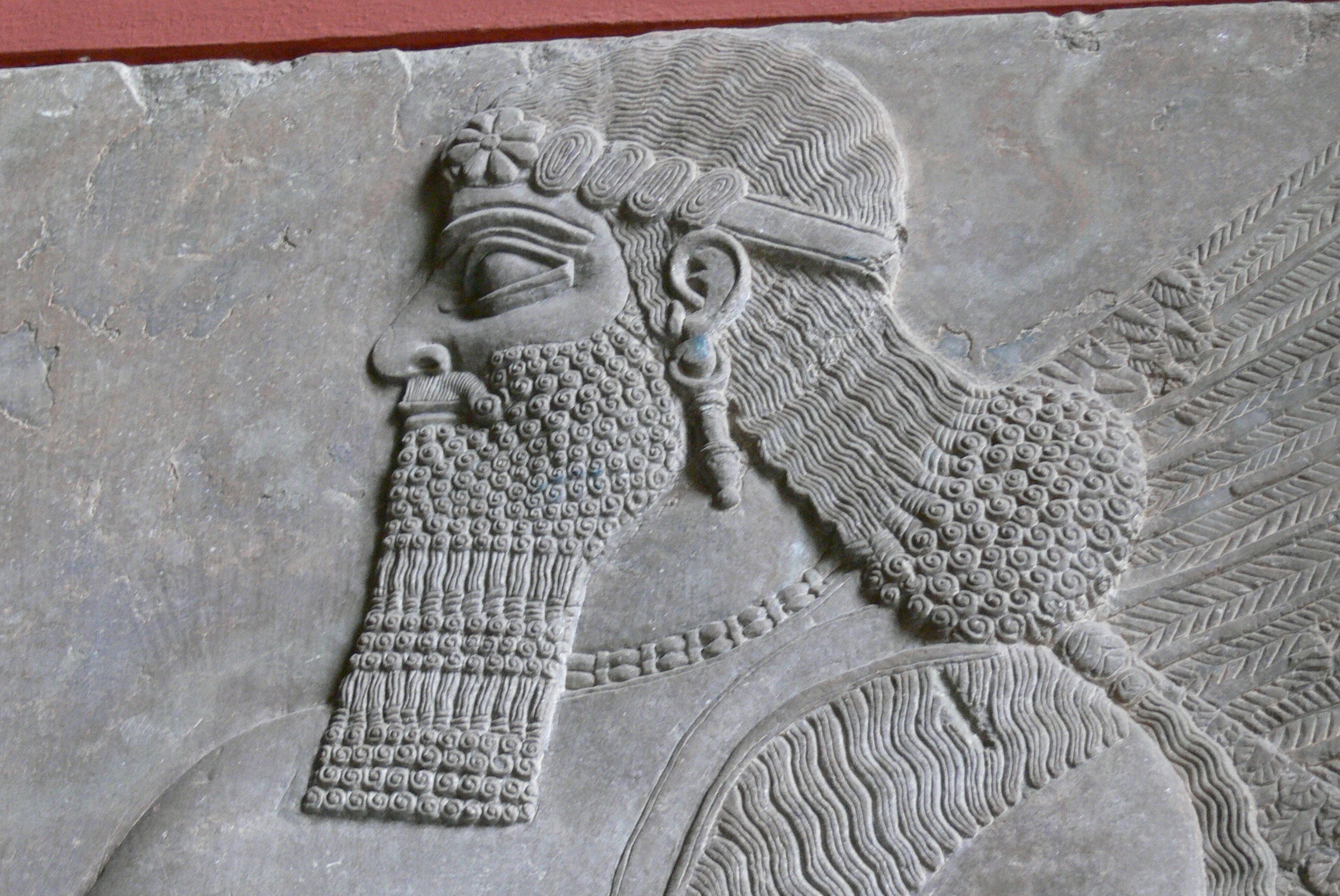
An ummanu. In this case, the ummanu wears a headband with a rosette, rather than the usual horned tiara indicative of divinity, or semi-divinity. This must be an apkallu, an umu-apkallu, as it has wings, an indicator of supernatural status.

An ummanu. In this case, the ummanu wears a headband with a rosette, rather than the usual horned tiara indicative of divinity, or semi-divinity. This must be an apkallu, an umu-apkallu, as it has wings, an indicator of supernatural status.

Here we are in the historical reality lying behind the imagination of parallel kings and apkallus in antediluvian time. Historically, there existed ummanus of such a high rank that they were included in a list of rulers.

Due to the finding of numerous letters from the Assyrian royal court between the kings and these experts, we have gained profound insight into the duties of the experts. S. Parpola, who edited the letters, found that there are five special fields of expertise:

  1. “Scribe” (tupšarru)–expert in the art of interpreting celestial, terrestrial and teratological portents, and establishing the calendar and the ominous significance of days and months.
  2. “Haruspex” (bārû)–expert in the art of prognosticating the future, primarily by studying the exta of sheep sacrificed to oracle gods.
  3. “Exorcist” (āšipu)–expert in the art of manipulating supernatural forces (such as illness-causing demons) by magical means.
  4. “Physician” (asû)–expert in the art of curing diseases by means of drugs and other physical remedies.
  5. “Chanters” (kalû)–experts in the art of soothing angered gods (and thus averting calamities) by means of elaborate chants and lamentations.

Based on this correspondence, Parpola found that the experts could be divided into two groups, forming an “inner” and an “outer” circle in relation to the king.

During the reign of Esarhaddon and Ashurbanipal there were 16 men forming the “inner circle.” They were quite generally designated with the title rab, “chief:” rab tupšarrī, rab bārê, rab āšipī, etc.

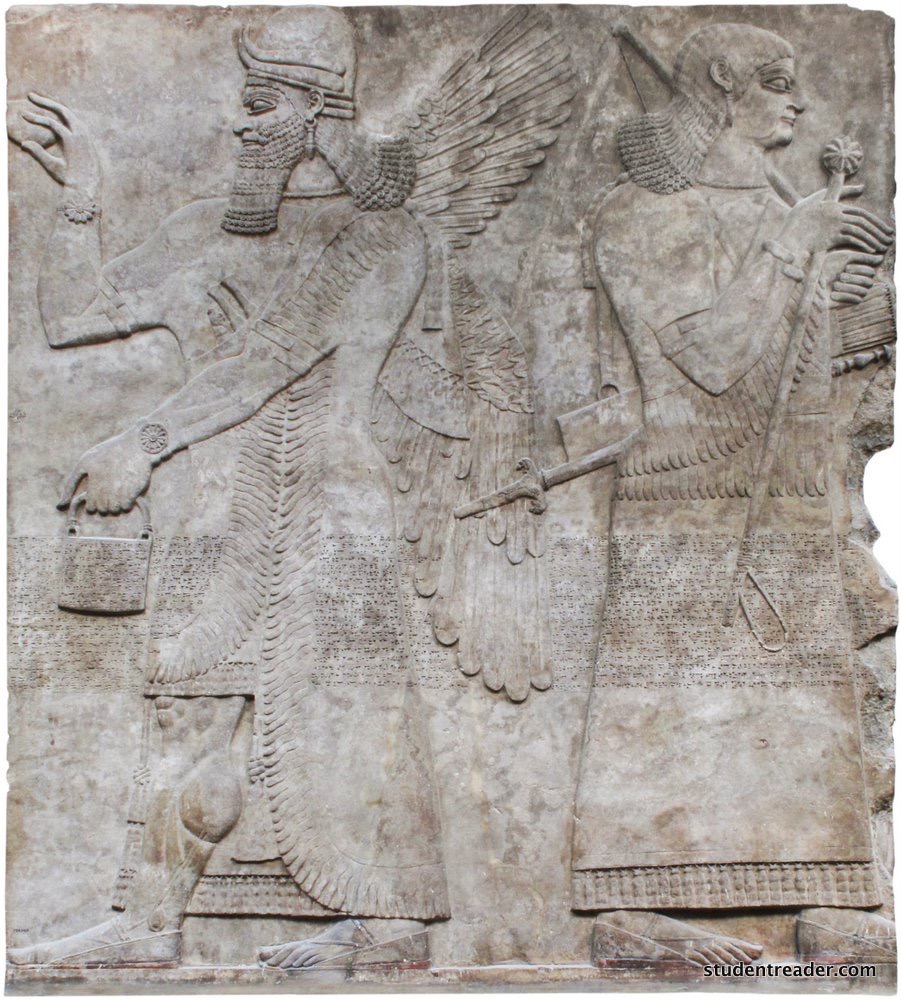
An umu-apkallu at far left, with horned tiara indicative of divinity. The mullilu cone and banduddu bucket are in their customary places, rosette bracelets are displayed, and this ummanu is winged.<br />  This frieze is unusual for the fine detail lavished on the fringe and tassels of the garments. The sandals are portrayed with uncommon precision. <br />  On the right side, an ambiguous figure, perhaps a lesser order of ummanu, a specialist sage in service to the king. Beardless, the figure could be a eunuch, raising a royal mace or scepter surmounted with a rosette in its right hand. Could this be a woman at court? The facial characteristics are intriguing, the figure appears to wear a long fringed skirt rather than the robe portrayed on the apkallu at left, and appears to bear both a sword and a bow with a quiver of arrows. Perhaps this is the arms bearer of the king, holding the royal scepter for his convenience.<br />  From the Northwest Palace at Nimrud, in the collection of the British Museum.<br />  BM 6642.

An umu-apkallu at far left, with horned tiara indicative of divinity. The mullilu cone and banduddu bucket are in their customary places, rosette bracelets are displayed, and this ummanu is winged.
This frieze is unusual for the fine detail lavished on the fringe and tassels of the garments. The sandals are portrayed with uncommon precision.
On the right side, an ambiguous figure, perhaps a lesser order of ummanu, a specialist sage in service to the king. Beardless, the figure could be a eunuch, raising a royal mace or scepter surmounted with a rosette in its right hand. Could this be a woman at court? The facial characteristics are intriguing, the figure appears to wear a long fringed skirt rather than the robe portrayed on the apkallu at left, and appears to bear both a sword and a bow with a quiver of arrows. Perhaps this is the arms bearer of the king, holding the royal scepter for his convenience.
From the Northwest Palace at Nimrud, in the collection of the British Museum.
BM 6642.

The examination of their names and position demonstrated that they were high ranking men, and that only these few select “wise men” could be engaged in any sort of “regular” correspondence with the king.

Among the members of the “inner circle” there were several instances of family ties, giving the impression that these important court offices of scholarly advisors were in the hand of a few privileged families, “a veritable scholarly “mafia,” which monopolized these offices from generation to generation.”

The men of the “inner circle” did not reside in the palace area but in their own houses situated in downtown Nineveh. Occasionally they could leave their houses for visits to the palace and the king.”

Helge Kvanvig, Primeval History: Babylonian, Biblical, and Enochic: An Intertextual Reading, Brill, 2011, pp. 141-3.