
Evolution of Tammuz
“We can draw but one conclusion from all this. The resurrection of Tammuz had once been commemorated as well as his death, and the festivals had been identified, not only with that of the Egyptian Osiris, as at Gebal, but also with those of other Semitic forms of the Sun-god, of Hadad and of Rimmon.
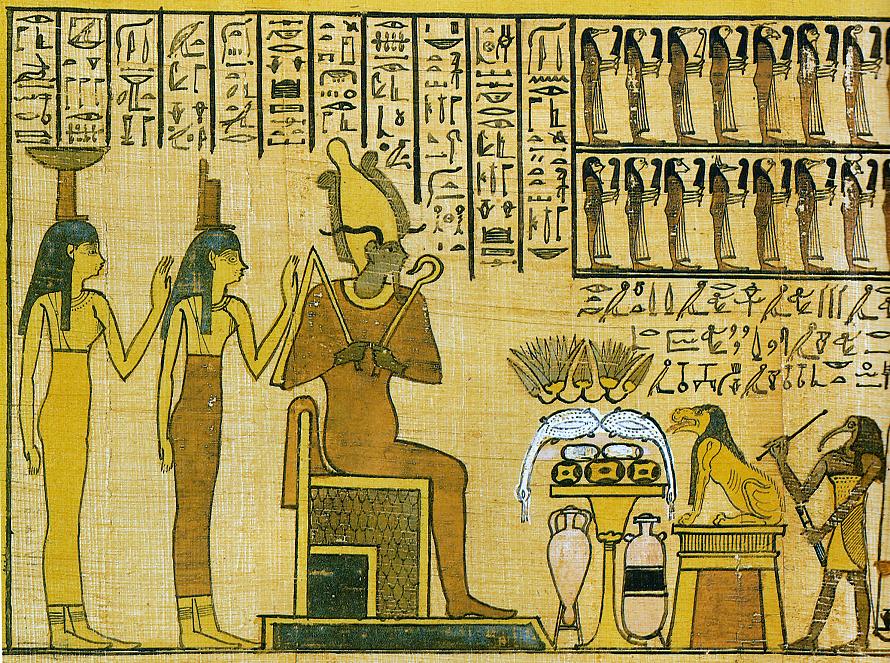
Sarcophagus of Psusennes 1 (early 10th century BCE) formed as Osiris, with crook and frail placed to form a cross. From National Museum, Cairo.
http://i-cias.com/e.o/osiris.htm
When Macrobius states that Adad meant “the only one” in Syrian, he implies that Adad or Hadad--the Sun-god whose festival fell after the harvests of autumn–was identical with Tammuz.
In Babylonia, Tammuz was the Sun-god of spring; his foe was the summer heat; his death was mourned in the month of June. If there was another feast in which grief gave place to joy at his restoration to life, it was separate from that which celebrated his death, and must have taken place at a different time of the year.
In its transplantation to the west, however, the cult of Tammuz–Adonis underwent a change. He was identified with other forms of the solar deity; his festivals were merged into theirs; and, except in places like Gebal, where a natural phenomenon prevented the alteration, the anniversary of his death was shifted to the fall of the year.
He ceased to be the Sun-god of spring, and became the Sun-god of summer. In the highlands of Syria the summer was not the dangerous foe it was in Babylonia; it was, on the contrary, a kindly friend, whose heats quickened and fostered the golden grain. Winter, and not summer, was the enemy who had slain the god.
The story of Tammuz was not of Semitic invention, however much it may owe, in the form in which we know it, to Semitic imagination. The month of Tammuz was called in the Accadian calendar “the month of the errand of Istar,” a clear proof that the legend of the Descent of the goddess into Hades was already known.
Nor is the name of Tammuz itself of Semitic origin. The Semites did not agree about the precise form which it should assume, and it is probable that the form (Tammuz) which prevailed in the west was due to a “popular etymology.” At all events, the Assyro-Babylonian form is not Tammuz, but Duzu, itself contracted from Duwuzu, and a fair representative of the original Accadian Dumu-zi or Duwu-zi, “the son of life.”
The word was interpreted by the Semites as meaning the “offspring,” “the only son;” but it may be merely a shortened form of the name Dumu-zi-apzu, “the son of the spirit of the deep.” The “spirit of the deep” is of course Ea, as is expressly stated in a mythological tablet, where Dumu-zi-apzu is given as the name of one of his six sons.

Professor Langdon suggested that the below seated deity might be Tammuz as a god of grain and vegetation. Ears of grain grow from his shoulders (cf. p. 90. Stephen Herbert Langdon. The Mythology of All Races- Semitic. Vol. 5. Boston. Marshall Jones Company. 1931).
Langdon noted that Tammuz/Dumuzi had many roles and manifestations. He was not only associated with dying and resurrected vegetation, he was also identified with freshwater, for water was essential in the irrigation canals of lower Mesopotamia to sustain life. A number of hymns ask Damu/Dumuzi to “arise from the river,” to a degree, the annual flooding or rising of the Euphrates and Tigris rivers would assure plentiful water for crops.
“O man, my Damu, my irrigator thou art.” (p. 343, Langdon)
http://www.bibleorigins.net/TammuzGrainGodSeal.html
How early the designation must be, is shown by the fact that Ea appears in it as not yet a god, but as a spirit only. We are carried back to the first dawn of Chaldean religious belief. The name was translated by the Semites “Timmuz (or Dimmuz) of the flood” (H.C. Rawlinson, The Cuneiform Inscriptions of Western Asia, 1886, ii. 47, 29), and the solar character of the deity was indicated by writing his name with ideographs that signified “the maker of fire” (tim-izí).
But this very mode of writing the name, which probably grew up in the court of Sargon of Accad, proves that already the name had lost its last element. The “son of the spirit of the deep” had become “the son of life,” “the only son” of the god Ea.
It is thus that a mythological tablet gives “the River-god,” who is but Ea under another title, a single son Duzi, where the name has assumed its contracted Semitic form, and is written with ideographs that mean “the heart of life.”
A.H. Sayce, Lectures on the Origin and Growth of Religion as Illustrated by the Religion of the Ancient Babylonians, 5th ed., London, 1898, pp. 231-3.
 Samizdat