Samizdat

Publishing the Forbidden. All Rights Reserved. © Samizdat 2014-2025.

Category: Sun God

On the Rejection of the Goddess Ishtar

“If, now, Enkidu is not only the older figure but the one who is the real hero of the most notable episode in the Gilgamesh Epic; if, furthermore, Enkidu is the Hercules who kills lions and dispatches the bull sent by an enraged goddess, what becomes of Gilgamesh? What is left for him?

In the first place, he is definitely the conqueror of Erech. He builds the wall of Erech, and we may assume that the designation of the city as Uruk supûri, “the walled Erech,” rests upon this tradition. He is also associated with the great temple Eanna, “the heavenly house,” in Erech.

To Gilgamesh belongs also the unenviable tradition of having exercised his rule in Erech so harshly that the people are impelled to implore Aruru to create a rival who may rid the district of the cruel tyrant, who is described as snatching sons and daughters from their families, and in other ways terrifying the population–an early example of “Schrecklichkeit.”

Tablets II to V inclusive of the Assyrian version being taken up with the Huwawa episode, modified with a view of bringing the two heroes together, we come at once to the sixth tablet, which tells the story of how the goddess Ishtar wooed Gilgamesh, and of the latter’s rejection of her advances.

This tale is distinctly a nature myth … The goddess Ishtar symbolizes the earth which woos the sun in the spring, but whose love is fatal, for after a few months the sun’s power begins to wane. Gilgamesh, who in incantation hymns is invoked in terms which show that he was conceived as a sun-god, recalls to the goddess how she changed her lovers into animals, like Circe of Greek mythology, and brought them to grief.

Enraged at Gilgamesh’s insult to her vanity, she flies to her father Anu and cries for revenge. At this point the episode of the creation of the bull is introduced, but if the analysis above given is correct it is Enkidu who is the hero in dispatching the bull, and we must assume that the sickness with which Gilgamesh is smitten is the punishment sent by Anu to avenge the insult to his daughter.

This sickness symbolizes the waning strength of the sun after midsummer is past. The sun recedes from the earth, and this was pictured in the myth as the sun-god’s rejection of Ishtar; Gilgamesh’s fear of death marks the approach of the winter season, when the sun appears to have lost its vigor completely and is near to death.

The entire episode is, therefore, a nature myth, symbolical of the passing of spring to midsummer and then to the bare season. The myth has been attached to Gilgamesh as a favorite figure, and then woven into a pattern with the episode of Enkidu and the bull. The bull episode can be detached from the nature myth without any loss to the symbolism of the tale of Ishtar and Gilgamesh.

As already suggested, with Enkidu’s death after this conquest of the bull the original Enkidu Epic came to an end. In order to connect Gilgamesh with Enkidu, the former is represented as sharing in the struggle against the bull.

Enkidu is punished with death, while Gilgamesh is smitten with disease. Since both shared equally in the guilt, the punishment should have been the same for both. The differentiation may be taken as an indication that Gilgamesh’s disease has nothing to do with the bull episode, but is merely part of the nature myth.”

Morris Jastrow (ed.), Albert T. Clay (trans.), An Old Babylonian Version of the Gilgamesh Epic on the Basis of Recently Discovered Texts, 1920, pp. 19-20.

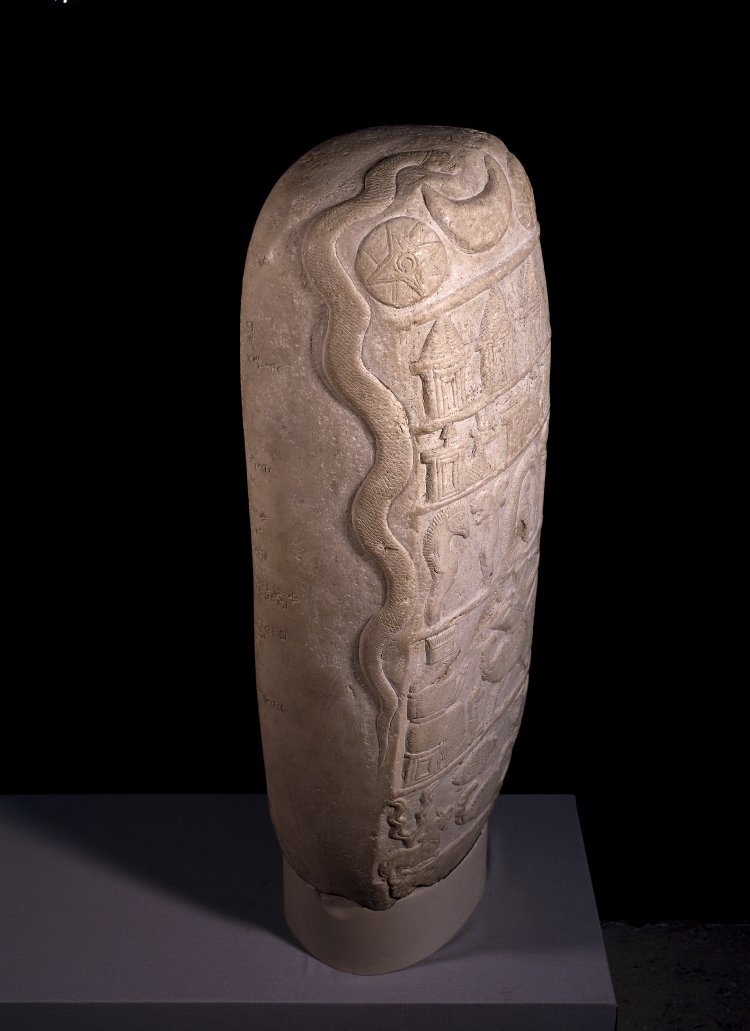
Boundary Stone of Ritti-Marduk (British Museum, No. 90,858)

The accompanying illustration, which is reproduced from the Boundary Stone of Ritti-Marduk (Brit. Mus., No. 90,858), supplies much information about the symbols of the gods, and of the Signs of the Zodiac in the reign of Nebuchadnezzar I, King of Babylon, about 1120 B.C.

British Museum number 90858 Description 3/4: Right Limestone stela in the form of a boundary-stone: consisting of a block of calcareous limestone, shaped and prepared on four sides to take sculptures and inscriptions. It is now mounted on a stone plinth.  Faces B and C each bear a single column of inscription, the lines running the full width of the stone.  The top of the stone and Face D have been left blank, except for the serpent, which has been carved to the left of the emblems on Face A.  Inscribed with a Charter from the reign of Nebuchadnezzar I.

British Museum number 90858
Description 3/4: Right
Limestone stela in the form of a boundary-stone: consisting of a block of calcareous limestone, shaped and prepared on four sides to take sculptures and inscriptions. It is now mounted on a stone plinth.
Faces B and C each bear a single column of inscription, the lines running the full width of the stone.
The top of the stone and Face D have been left blank, except for the serpent, which has been carved to the left of the emblems on Face A.
Inscribed with a Charter from the reign of Nebuchadnezzar I.

Thus in Register 1, we have the Star of Ishtar, the crescent of the Moon-god Sin, and the disk of Shamash the Sun-god. In Reg. 2 are three stands (?) surmounted by tiaras, which represent the gods Anu, Enlil (Bel) and Ea respectively. In Reg. 3 are three altars (?) or shrines (?) with a monster in Nos. 1 and 2. Over the first is the lance of Marduk, over the second the mason’s square of Nabû, and over the third is the symbol of the goddess Ninkharsag, the Creatress. In Reg. 4 are a standard with an animal’s head, a sign of Ea; a two-headed snake = the Twins; an unknown symbol with a horse’s head, and a bird, representative of Shukamuna and Shumalia. In Reg. 5 are a seated figure of the goddess Gula and the Scorpion-man. In Reg. 6 are forked lightning, symbol of Adad, above a bull, the Tortoise, symbol of Ea (?), the Scorpion of the goddess Ishkhara, and the Lamp of Nusku, the Fire-god.  Down the left-hand side is the serpent-god representing the constellation of the Hydra.

Thus in Register 1, we have the Star of Ishtar, the crescent of the Moon-god Sin, and the disk of Shamash the Sun-god.
In Reg. 2 are three stands (?) surmounted by tiaras, which represent the gods Anu, Enlil (Bel) and Ea respectively.
In Reg. 3 are three altars (?) or shrines (?) with a monster in Nos. 1 and 2. Over the first is the lance of Marduk, over the second the mason’s square of Nabû, and over the third is the symbol of the goddess Ninkharsag, the Creatress.
In Reg. 4 are a standard with an animal’s head, a sign of Ea; a two-headed snake = the Twins; an unknown symbol with a horse’s head, and a bird, representative of Shukamuna and Shumalia.
In Reg. 5 are a seated figure of the goddess Gula and the Scorpion-man.
In Reg. 6 are forked lightning, symbol of Adad, above a bull, the Tortoise, symbol of Ea (?), the Scorpion of the goddess Ishkhara, and the Lamp of Nusku, the Fire-god.
Down the left-hand side is the serpent-god representing the constellation of the Hydra.

The mutilated text of the Fifth Tablet makes it impossible to gain further details in connection with Marduk’s work in arranging the heavens. We are, however, justified in assuming that the gaps in it contained statements about the grouping of the gods into triads.

In royal historical inscriptions the kings often invoke the gods in threes, though they never call any one three a triad or trinity. It seems as if this arrangement of gods in threes was assumed to be of divine origin.

In the Fourth Tablet of Creation, one triad “Anu-Bel-Ea” is actually mentioned, and in the Fifth Tablet, another is indicated, “Sin-Shamash-Ishtar.”

In these triads Anu represents the sky or heaven, Bel or Enlil the region under the sky and including the earth, Ea the underworld, Sin the Moon, Shamash the Sun, and Ishtar the star Venus.

When the universe was finally constituted several other great gods existed, e.g., Nusku, the Fire-god, Enurta, a solar god, Nergal, the god of war and handicrafts, Nabu, the god of learning, Marduk of Babylon, the great national god of Babylonia, and Ashur, the great national god of Assyria.

E.A. Wallis Budge, et al, & the British Museum, The Babylonian Legends of the Creation & the Fight Between Bel & the Dragon Told by Assyrian Tablets from Nineveh (BCE 668-626), 1901, pp. 11-2.

More on the Babylonian Zodiac

” … Then returning to the dead body of Tiâmat he smashed her skull with his club and scattered her blood to the north wind, and as a reward for his destruction of their terrible foe, he received gifts and presents from the gods his fathers.

The text then goes on to say that Marduk “devised a cunning plan,” i.e., he determined to carry out a series of works of creation.

He split the body of Tiâmat into two parts; out of one half he fashioned the dome of heaven, and out of the other he constructed the abode of Nudimmud, or Ea, which he placed over against Apsu, i.e., the deep.

He also formulated regulations concerning the maintenance of the same. By this “cunning plan” Marduk deprived the powers of darkness of the opportunity of repeating their revolt with any chance of success.

Having established the framework of his new heaven and earth Marduk, acting as the celestial architect, set to work to furnish them. In the first place he founded E-Sharra, or the mansion of heaven, and next he set apart and arranged proper places for the old gods of the three realms–Anu, Bel and Ea.

Illustration: Tablet sculptured with a scene representing the worship of the Sun-god in the Temple of Sippar.  The Sun-god is seated on a throne within a pavilion holding in one hand a disk and bar which may symbolize eternity.  Above his head are the three symbols of the Moon, the Sun, and the planet Venus.  On a stand in front of the pavilion rests the disk of the Sun, which is held in position by ropes grasped in the hands of two divine beings who are supported by the roof of the pavilion.  The pavilion of the Sun-god stands on the Celestial Ocean, and the four small disks indicate either the four cardinal points or the tops of the pillars of the heavens.  The three figures in front of the disk represent the high priest of Shamash, the king (Nabu-aplu-iddina, about 870 B.C.) and an attendant goddess. [No. 91,000.]

Illustration: Tablet sculptured with a scene representing the worship of the Sun-god in the Temple of Sippar.
The Sun-god is seated on a throne within a pavilion holding in one hand a disk and bar which may symbolize eternity.
Above his head are the three symbols of the Moon, the Sun, and the planet Venus.
On a stand in front of the pavilion rests the disk of the Sun, which is held in position by ropes grasped in the hands of two divine beings who are supported by the roof of the pavilion.
The pavilion of the Sun-god stands on the Celestial Ocean, and the four small disks indicate either the four cardinal points or the tops of the pillars of the heavens.
The three figures in front of the disk represent the high priest of Shamash, the king (Nabu-aplu-iddina, about 870 B.C.) and an attendant goddess. [No. 91,000.]

Museum number 91000 The engraved text contains a record of Nabu-apla-iddina's re-endowment of the Sun-Temple at Sippar. The inscription is engraved in six columns, three upon the obverse and three upon the reverse; and the upper part of the obverse is occupied by a scene sculptured in low relief; the edges of the tablet are bevelled.

Museum number 91000
The engraved text contains a record of Nabu-apla-iddina’s re-endowment of the Sun-Temple at Sippar. The inscription is engraved in six columns, three upon the obverse and three upon the reverse; and the upper part of the obverse is occupied by a scene sculptured in low relief; the edges of the tablet are bevelled.

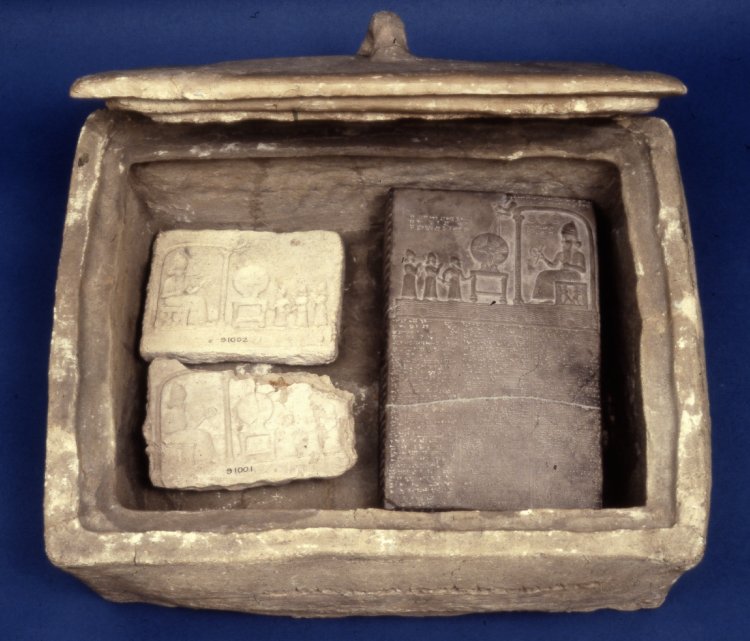
Museum number 91000 Group of Objects Pottery box and the limestone sun-god tablet and its covers deposited in it by Nabopolassar.

Museum number 91000
Group of Objects
Pottery box and the limestone sun-god tablet and its covers deposited in it by Nabopolassar.

The text of the Fifth Tablet, which would undoubtedly have supplied details as to Marduk’s arrangement and regulations for the sun, the moon, the stars, and the Signs of the Zodiac in the heavens is wanting.

The prominence of the celestial bodies in the history of creation is not to be wondered at, for the greater number of the religious beliefs of the Babylonians are grouped round them. Moreover, the science of astronomy had gone hand in hand with the superstition of astrology in Mesopotamia from time immemorial; and at a very early period the oldest gods of Babylonia were associated with the heavenly bodies.

Thus the Annunaki and the Igigi, who are bodies of deified spirits, were identified with the stars of the northern and southern heaven, respectively. And all the primitive goddesses coalesced and were grouped to form the goddess Ishtar, who was identified with the Evening and Morning Star, or Venus.

The Babylonians believed that the will of the gods was made known to men by the motions of the planets, and that careful observation of them would enable the skilled seer to recognize in the stars favourable and unfavourable portents. Such observations, treated from a magical point of view, formed a huge mass of literature which was being added to continually.

From the nature of the case this literature enshrined a very considerable number of facts of pure astronomy, and as early as the period of the First Dynasty (about 2000 B.C.), the Babylonians were able to calculate astronomical events with considerable accuracy, and to reconcile the solar and lunar years by the use of epagomenal months.

They had by that time formulated the existence of the Zodiac, and fixed the “stations” of the moon, and the places of the planets with it; and they had distinguished between the planets and the fixed stars. In the Fifth Tablet of the Creation Series (l. 2) the Signs of the Zodiac are called Lumashi, but unfortunately no list of their names is given in the context.

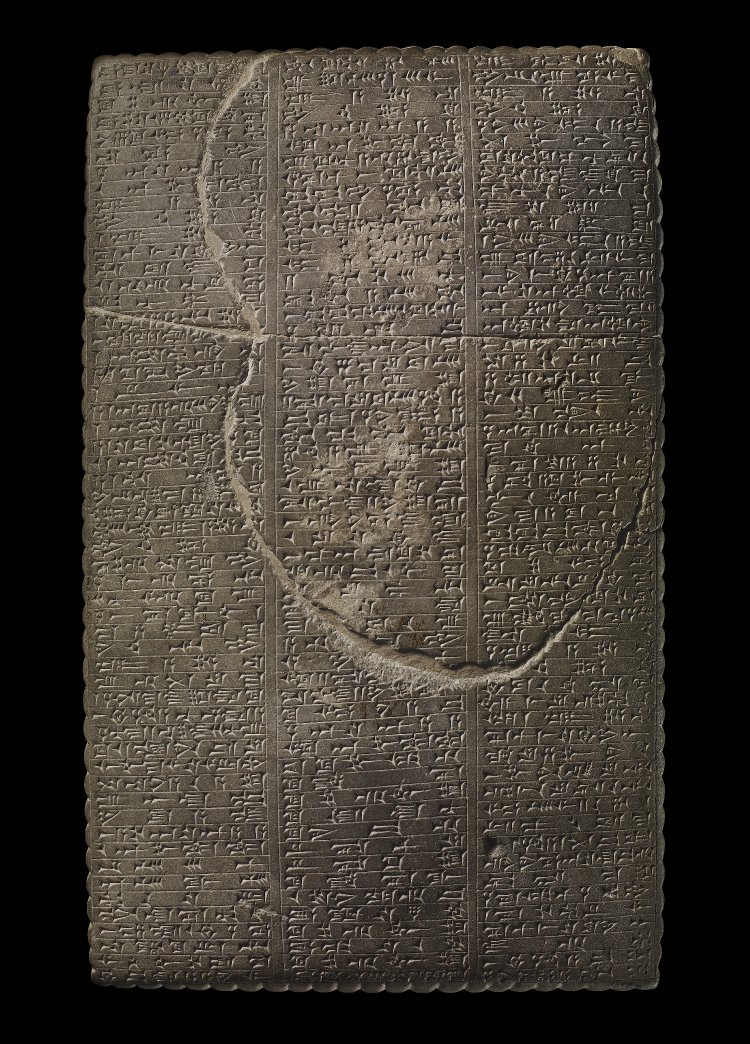
 Illustration: Tablet inscribed with a list of the Signs of the Zodiac. [No. 77,821.]


Illustration: Tablet inscribed with a list of the Signs of the Zodiac. [No. 77,821.]

Now these are supplied by the little tablet (No. 77,821) of the Persian Period of which a reproduction is here given. It has been referred to and discussed by various scholars, and its importance is very great. The transcript of the text, which is now published (see p. 68) for the first time, will be acceptable to the students of the history of the Zodiac.

Egyptian, Greek, Syriac and Arabic astrological and astronomical texts all associate with the Signs of the Zodiac twelve groups, each containing three stars, which are commonly known as the “Thirty-six Dekans.”

The text of line 4 of the Fifth Tablet of the Creation Series proves that the Babylonians were acquainted with these groups of stars, for we read that Marduk “set up for the twelve months of the year three stars apiece.” In the List of Signs of the Zodiac here given, it will be seen that each Sign is associated with a particular month.

At a later period, say about 500 B.C., the Babylonians made some of the gods regents of groups of stars, for Enlil ruled 33 stars, Anu 23 stars, and Ea 15 stars. They also possessed lists of the fixed stars, and drew up tables of the times of their heliacal risings.

Such lists were probably based upon very ancient documents, and prove that the astral element in Babylonian religion was very considerable.”

E.A. Wallis Budge, et al, & the British Museum, The Babylonian Legends of the Creation & the Fight Between Bel & the Dragon Told by Assyrian Tablets from Nineveh (BCE 668-626), 1901, pp. 10-11.

Marduk Kills Tiâmat

” … When Anu reported his inability to deal with Tiâmat, a council of the gods was called, and Ea induced his son, Marduk to be present.

We next find Anshar in converse with the god Marduk, who offers to act as the champion of the gods and to fight Tiâmat and her allies. Marduk being a form of the Sun-god, the greatest of all the powers of light, thus becomes naturally the protagonist of the gods, and the adversary of Tiâmat and her powers of darkness.

Then Anshar summoned a great council of the gods, who forthwith met in a place called “Upshukkinaku,” which may be described as the Babylonian Olympus. It was all-important for Marduk to appear at the council of the gods before he undertook his task, because it was necessary for him to be formally recognised by them as their champion, and he needed to be endowed by them with magical powers.

The primitive gods Lakhmu and Lakhamu, and the Igigi, who may be regarded as star-gods, were also summoned. A banquet was prepared, and the gods attended, and having met and kissed each other they sat down, and ate bread and drank hot and sweet sesame wine.

The fumes of the wine confused their senses, but they continued to drink, and at length “their spirits were exalted.” They appointed Marduk to be their champion officially, and then they proceeded to invest him with the power that would cause every command he spake to be followed immediately by the effect which he intended it to produce.

Next Marduk, with the view of testing the new power which had been given him, commanded a garment to disappear and it did so; and when he commanded it to reappear it did so.

Illustration: Shamash the Sun-god setting (?) on the horizon. In his right he holds a tree (?), and in his left a ... with a serrated edge. Above the horizon is a goddess who holds in her left hand an ear of corn. On the right is a god who seems to be setting free a bird from his right hand. Round him is a river with fish in it, and behind him is an attendant god; under his foot is a young bull. To the right of the goddess stand a hunting god, with a bow and lasso, and a lion. From the seal-cylinder of Adda ..., in the British Museum. About 2500 B.C. [No. 89,115.]

Illustration: Shamash the Sun-god setting (?) on the horizon. In his right he holds a tree (?), and in his left a … with a serrated edge. Above the horizon is a goddess who holds in her left hand an ear of corn. On the right is a god who seems to be setting free a bird from his right hand. Round him is a river with fish in it, and behind him is an attendant god; under his foot is a young bull. To the right of the goddess stand a hunting god, with a bow and lasso, and a lion. From the seal-cylinder of Adda …, in the British Museum. About 2500 B.C. [No. 89,115.]

Then the gods saluted him as their king, and gave him the insignia of royalty, namely, the sceptre, the throne and the pala, whatever that may be. And as they handed to him these things they commanded him to go and hack the body of Tiâmat in pieces, and to scatter her blood to the winds.

Thereupon Marduk began to arm himself for the fight. He took a bow, a spear, and a club; he filled his body full of fire and set the lightning before him. He took in his hands a net wherewith to catch Tiâmat, and he placed the four winds near it, to prevent her from escaping from it when he had snared her.

He created mighty winds and tempests to assist him, and grasped the thunderbolt in his hand; and then, mounting upon the Storm, which was drawn by four horses, he went out to meet and defeat Tiâmat. It seems pretty certain that this description of the equipment of Marduk was taken over from a very ancient account of the Fight with Tiâmat in which the hero was Enlil, i.e., the god of the air, or of the region which lies between heaven and hell.

Marduk approached and looked upon the “Middle” or “Inside” or “Womb” of Tiâmat, and divined the plan of Kingu who had taken up his place therein.

In the Seventh Tablet (l. 108) Marduk is said to have “entered into the middle of Tiâmat,” and because he did so he is called “Nibiru,” i.e., “he who entered in,” and the “seizer of the middle.” What the words “middle of Tiâmat” meant to the Babylonian we are not told, but it is clear that Marduk’s entry into it was a signal mark of the triumph of the god.

When Kingu from the “middle of Tiâmat” saw Marduk arrayed in his terrible panoply of war, he was terrified and trembled, and staggered about and lost all control of his legs; and at the mere sight of the god all the other fiends and devils were smitten with fear and reduced to helplessness.

Tiâmat saw Marduk and began to revile him, and when he challenged her to battle she flew into a rage and attempted to overthrow him by reciting an incantation, thinking that her words of power would destroy his strength. Her spell had no effect on the god, who at once cast his net over her.

At the same moment he made a gale of foul wind to blow on her face, and entering through her mouth it filled her body; whilst her body was distended he drove his spear into her, and Tiâmat split asunder, and her womb fell out from it.

Marduk leaped upon her body and looked on her followers as they attempted to escape. But the Four Winds which he had stationed round about Tiâmat made all their efforts to flee of no effect. Marduk caught all the Eleven allies of Tiâmat in his net, and he trampled upon them as they lay in it helpless.

Marduk then took the TABLET OF DESTINIES from Kingu’s breast, and sealed it with his seal and placed it on his own breast.”

E.A. Wallis Budge, et al, & the British Museum, The Babylonian Legends of the Creation & the Fight Between Bel & the Dragon Told by Assyrian Tablets from Nineveh (BCE 668-626), 1901, pp. 9-10.

Death is the Fate of Mankind in the 10th Tablet of the Epic of Gilgamesh

THE TENTH TABLET.

“In the region to which Gilgamish had come stood the palace or fortress of the goddess Siduri, who was called the “hostess,” or “ale-wife,” and to this he directed his steps with the view of obtaining help to continue his journey.

The goddess wore a veil and sat upon a throne by the side of the sea, and when she saw him coming towards her palace, travel-stained and clad in the ragged skin of some animal, she thought that he might prove an undesirable visitor, and so ordered the door of her palace to be closed against him.

But Gilgamish managed to obtain speech with her, and having asked her what ailed her, and why she had closed her door, he threatened to smash the bolt and break down the door. In answer Siduri said to him:–

“Why is thy vigour wasted? Thy face is bowed down,

Thine heart is sad, thy form is dejected,

And there is lamentation in thy heart.”

And she went on to tell him that he had the appearance of one who had travelled far, that he was a painful sight to look upon, that his face was burnt, and finally seems to have suggested that he was a runaway trying to escape from the country. To this Gilgamish replied:–

“Nay, my vigour is not wasted, my face not bowed down,

My heart not sad, my form not dejected.”

And then he told the goddess that his ill-looks and miserable appearance were due to the fact that death had carried off his dear friend Enkidu, the “panther of the desert,” who had traversed the mountains with him and had helped him to overcome Khumbaba in the cedar forest, and to slay the bull of heaven, Enkidu his dear friend who had fought with lions and killed them, and who had been with him in all his difficulties; and, he added, “I wept over him for six days and nights . . . . before I would let him be buried.”

Continuing his narrative, Gilgamish said to Siduri:

“I was horribly afraid . . .

I was afraid of death, and therefore I wander over the country.

The fate of my friend lieth heavily upon me,

Therefore am I travelling on a long journey through the country.

The fate of my friend lieth heavily upon me,

Therefore am I travelling on a long journey through the country.

How is it possible for me to keep silence? How is it possible for me to cry out?

My friend whom I loved hath become like the dust.

Enkidu, my friend whom I loved hath become like the dust.

Shall not I myself also be obliged to lay me down

And never again rise up to all eternity?”

To this complaint the ale-wife replied that the quest of eternal life was vain, since death was decreed to mankind by the gods at the time of creation. She advised him, therefore, to enjoy all mortal pleasures while life lasted and to abandon his hopeless journey.

But Gilgamish still persisted, and asked how he might reach Uta-Napishtim, for thither he was determined to go, whether across the ocean or by land.

Then the ale-wife answered and said to Gilgamish:

“There never was a passage, O Gilgamish,

And no one, who from the earliest times came hither, hath crossed the sea.

The hero Shamash (the Sun-god) hath indeed crossed the sea, but who besides him could do so?

The passage is hard, and the way is difficult,

And the Waters of Death which bar its front are deep.

If, then, Gilgamish, thou art able to cross the sea,

When thou arrivest at the Waters of Death what wilt thou do?”

Siduri then told Gilgamish that Ur-Shanabi, the boatman of Uta-Napishtim, was in the place, and that he should see him, and added:

“If it be possible cross with him, and if it be impossible turn back.”

Gilgamish left the goddess and succeeded in finding Ur-Shanabi, the boatman, who addressed to him words similar to those of Siduri quoted above. Gilgamish answered him as he had answered Siduri, and then asked him for news about the road to Uta-Napishtim.

In reply Ur-Shanabi told him to take his axe and to go down into the forest and cut a number of poles 60 cubits long; Gilgamish did so, and when he returned with them he went up into the boat with Ur-Shanabi, and they made a voyage of one month and fifteen days; on the third day they reached the [limit of the] Waters of Death, which Ur-Shanabi told Gilgamish not to touch with his hand.

Meanwhile, Uta-Napishtim had seen the boat coming and, as something in its appearance seemed strange to him, he went down to the shore to see who the newcomers were. When he saw Gilgamish he asked him the same questions that Siduri and Ur-Shanabi had asked him, and Gilgamish answered as he had answered them, and then went on to tell him the reason for his coming.

He said that he had determined to go to visit Uta-Napishtim, the remote, and had therefore journeyed far, and that in the course of his travels he had passed over difficult mountains and crossed the sea. He had not succeeded in entering the house of Siduri, for she had caused him to be driven from her door on account of his dirty, ragged, and travel-stained apparel. He had eaten birds and beasts of many kinds, the lion, the panther, the jackal, the antelope, mountain goat, etc., and, apparently, had dressed himself in their skins.

A break in the text makes it impossible to give the opening lines of Uta-Napishtim’s reply, but he mentions the father and mother of Gilgamish, and in the last twenty lines of the Tenth Tablet he warns Gilgamish that on earth there is nothing permanent, that Mammitum, the arranger of destinies, has settled the question of the death and life of man with the Anunnaki, and that none may find out the day of his death or escape from death.”

E.A. Wallis Budge, The Babylonian Story of the Deluge and the Epic of Gilgamish1929, pp. 51-3.

Gilgamesh Sees the Tree of the Gods in the 9th Tablet of the Epic of Gilgamesh

THE NINTH TABLET.

“In bitter grief Gilgamish wandered about the country uttering lamentations for his beloved companion, Enkidu. As he went about he thought to himself,

“I myself shall die, and shall not I then be as Enkidu?

Sorrow hath entered into my soul,

Because I fear death do I wander over the country.”

His fervent desire was to escape from death, and remembering that his ancestor Uta-Napishtim, the son of Ubara-Tutu, had become deified and immortal, Gilgamish determined to set out for the place where he lived in order to obtain from him the secret of immortality.

Where Uta-Napishtim lived was unknown to Gilgamish, but he seems to have made up his mind that he would have to face danger in reaching the place, for he says, “I will set out and travel quickly. I shall reach the defiles in the mountains by night, and if I see lions, and am terrified at them, I shall lift up my head and appeal to the Moon-god, and to (Ishtar, the Lady of the Gods), who is wont to hearken to my prayers.”

After Gilgamish set out to go to the west he was attacked either by men or animals, but he overcame them and went on until he arrived at Mount Mashu, where it would seem the sun was thought both to rise and to set.

The approach to this mountain was guarded by Scorpion-men, whose aspect was so terrible that the mere sight of it was sufficient to kill the mortal who beheld them; even the mountains collapsed under the glance of their eyes.

When Gilgamish saw the Scorpion-men he was smitten with fear, and under the influence of his terror the colour of his face changed, and he fell prostrate before them.

Then a Scorpion-man cried out to his wife, saying, “The body of him that cometh to us is the flesh of the gods,” and she replied, “Two-thirds of him is god, and the other third is man.”

The Scorpion-man then received Gilgamish kindly, and warned him that the way which he was about to travel was full of danger and difficulty. Gilgamish told him that he was in search of his ancestor, Uta-Napishtim, who had been deified and made immortal by the gods, and that it was his intention to go to him to learn the secret of immortality.

The Scorpion-man in answer told him that it was impossible for him to continue his journey through that country, for no man had ever succeeded in passing through the dark region of that mountain, which required twelve double-hours to traverse.

Nothing dismayed, Gilgamish set out on the road through the mountains, and the darkness increased in density every hour, but he struggled on, and at the end of the twelfth hour he arrived at a region where there was bright daylight, and he entered a lovely garden, filled with trees loaded with luscious fruits, and he saw the “tree of the gods.” Here the Sun-god called to him that his quest must be in vain, but Gilgamish replied that he would do anything to escape death.”

E.A. Wallis Budge, The Babylonian Story of the Deluge and the Epic of Gilgamish1929, pp. 49-51.

Gilgamesh Recites the Iniquities of the Goddess Ishtar, the Sixth Tablet of the Epic of Gilgamesh

THE SIXTH TABLET.

“The scene now returns to Erech, whither the heroes returned after their glorious exploit. As Gilgamish was washing himself and dressing himself in splendid attire the goddess Ishtar saw his comeliness and desired him to be her lover, saying,

Go to, Gilgamish, do thou be (my) bridegroom,

Give me freely the fruit (of thy body).

Be thou my husband, I will be thy wife,

(So) will I make them yoke for thee a chariot of lapis-lazuli and gold,

Its wheels of gold, and its horns of electrum.

Every day shalt thou harness great mules thereto.

Enter (then) our house with the perfume of cedar.

When thou enterest our house

Threshold and dais shall kiss thy feet,

Beneath thee shall kings, lords and princes do homage,

Bringing thee as tribute the yield of the mountains and plains,

Thy she-goats shall bring forth abundantly, thy ewes bear twins,

Thine asses shall be (each) as great as a mule,

Thy horses in the chariot shall be famous for their swiftness,

Thy mules in the yoke shall not have a peer.

In answer to this invitation, Gilgamish made a long speech, in which he reviewed the calamities of those who had been unfortunate enough to attract the love of the goddess. To be her husband would be a burdensome privilege, and her love was deceptive, a ruin that gave no shelter, a door that let in the storm, a crazy building, a pitfall, defiling pitch, a leaky vessel, a crumbling stone, a worthless charm, an ill-fitting shoe.

“Who was ever thy lord that had advantage thereby? Come, I will unfold the tale of thy lovers.”

He refers to Tammuz, the lover of her youth, for whom year by year she causes wailing. Every creature that fell under her sway suffered mutilation or death; the bird’s wings were broken, the lion destroyed, the horse driven to death with whip and spur.

Her human lovers fared no better, for a shepherd, once her favourite, was turned by her into a jackal and torn by his own dogs, and Ishullanu, her father’s gardener, was turned into a spider (?) because he refused her advances.

“So, too,” said Gilgamish, “would’st thou love me, and (then) make me like unto them.”

When Ishtar heard these words she was filled with rage, and went up to heaven, and complained to Anu her father and Antu her mother that Gilgamish had blasphemed her, and revealed all her iniquitous deeds.

Anu replied, in effect, that it was her own fault, but she insisted in the request that he should create a heavenly bull to destroy Gilgamish. This he finally agreed to do, and the bull appeared before the citizens of Erech, and destroyed one, two and three hundred men who were sent out against him.

At length Enkidu and Gilgamish attacked the bull themselves, and after a hard fight: the details of which are lost, they slew him, and offered his heart together with a libation to the Sun-god. As soon as Ishtar heard of the bull’s death she rushed out on the battlements of the wall of Erech and cursed Gilgamish for destroying her bull.

When Enkidu heard what Ishtar said, he tore out the member of the bull and threw it before the goddess, saying, “Could I but get it at thee, I would serve thee like him; I would hang his it entrails about thee.”

Then Ishtar gathered together all her temple-women and harlots, and with them made lamentation over the member of the bull.

And Gilgamish called together the artisans of Erech, who came and marvelled at the size of the bull’s horns, for each of them was in bulk equal to 30 minas of lapis-lazuli, their thickness two finger-breadths, and together they contained six kur measures of oil.

These Gilgamish dedicated in the temple of his god Lugalbanda, to hold the god’s unguent, and, having made his offering, he and Enkidu washed their hands in the Euphrates, took their way back to the city, and rode through the streets of Erech, the people thronging round to admire them.

Gilgamish put forth a question to the people, saying

Who is splendid among men?

Who is glorious among heroes?

And the answer was:

[Gilgamish] is splendid among men,

[Enkidu] is glorious among heroes.

Gilgamish made a great feast in his palace, and after it all lay down to sleep. Enkidu also slept and had a vision, so he rose up and related it to Gilgamish.”

E.A. Wallis Budge, The Babylonian Story of the Deluge and the Epic of Gilgamish1929, p. 45-8.

Comparative Deluge Myths

Flood myths are found in many mythologies both in the Old World and the New.

The violent and deceitful men of the mythical Bronze Age of Greece were destroyed by a flood. It is related that Zeus said on one occasion to Hermes:

“I will send a great rain, such as hath not been since the making of the world, and the whole race of men shall perish.

I am weary of their iniquity.”

For receiving with hospitable warmth these two gods in human guise, Deucalion, an old man, and his wife Pyrrha were spared, however. Zeus instructed his host to build an ark of oak, and store it well with food. When this was done, the couple entered the vessel and shut the door. Then Zeus “broke up all the fountains of the deep, and opened the well springs of heaven, and it rained for forty days and forty nights continually.”

The Bronze folk perished: not even those who fled to the hilltops could escape. The ark rested on Parnassus, and when the waters ebbed the old couple descended the mountain and took up their abode in a cave.

In Indian mythology the world is destroyed by a flood at the end of each Age of the Universe. There are four ages: the Krita or Perfect Age, the Treta Age, the Dwapara Age, and the Kali or Wicked Age. These correspond closely to the Greek and Celtic ages.

There are also references in Sanskrit literature to the destruction of the world because too many human beings lived upon it.

“When the increase of population had been so frightful,” a sage related, “the Earth, oppressed with the excessive burden, sank down for a hundred Yojanas. Suffering pain in all her limbs, and being deprived of her senses by excessive pressure, the Earth in distress sought the protection of Narayana, the foremost of the gods.”

Manu’s account of the flood has been already referred to (Chapter II). The god in fish shape informed him:

“The time is ripe for purging the world…. Build a strong and massive ark, and furnish it with a long rope….”

When the waters rose the horned fish towed the ark over the roaring sea, until it grounded on the highest peak of the Himavat, which is still called Naubandha (the harbour). Manu was accompanied by seven rishis.

In the Celtic (Irish) account of the flood, Cessair, granddaughter of Noah, was refused a chamber for herself in the ark, and fled to the western borders of the world as advised by her idol. Her fleet consisted of three ships, but two foundered before Ireland was reached. The survivors in addition to Cessair were, her father Bith, two other men, Fintan and Ladru, and fifty women.

All of these perished on the hills except Fintan, who slept on the crest of a great billow, and lived to see Partholon, the giant, arriving from Greece.

There is a deluge also in Egyptian mythology. When Ra, the sun god, grew old as an earthly king, men began to mutter words against him. He called the gods together and said: “I will not slay them (his subjects) until I have heard what ye say concerning them.”

Nu, his father, who was the god of primeval waters, advised the wholesale destruction of mankind.

Said Ra: “Behold men flee unto the hills; their heart is full of fear because of that which they said.”

The goddess Hathor-Sekhet, the Eye of Ra, then went forth and slew mankind on the hills. Thereafter Ra, desiring to protect the remnant of humanity, caused a great offering to be made to the goddess, consisting of corn beer mixed with herbs and human blood. This drink was poured out during the night.

“And the goddess came in the morning; she found the fields inundated, she rejoiced thereat, she drank thereof, her heart was rejoiced, she went about drunken and took no more cognizance of men.”

Donald A. Mackenzie, Myths of Babylonia and Assyria, 1915.

Revolting Unmoral Rites

“There is another phase, however, to the character of the mother goddess which explains the references to the desertion and slaying of Tammuz by Ishtar. “She is,” says Jastrow, “the goddess of the human instinct, or passion which accompanies human love. Gilgamesh … reproaches her with abandoning the objects of her passion after a brief period of union.” At Ishtar’s temple “public maidens accepted temporary partners, assigned to them by Ishtar.”

The worship of all mother goddesses in ancient times was accompanied by revolting unmoral rites which are referred to in condemnatory terms in various passages in the Old Testament, especially in connection with the worship of Ashtoreth, who was identical with Ishtar and the Egyptian Hathor.

Ishtar in the process of time overshadowed all the other female deities of Babylonia, as did Isis in Egypt. Her name, indeed, which is Semitic, became in the plural, Ishtar·te, a designation for goddesses in general. But although she was referred to as the daughter of the sky, Anu, or the daughter of the moon, Sin or Nannar, she still retained traces of her ancient character.

Originally she was a great mother goddess, who was worshipped by those who believed that life and the universe had a female origin in contrast to those who believed in the theory of male origin. Ishtar is identical with Nina, the fish goddess, a creature who gave her name to the Sumerian city of Nina and the Assyrian city of Nineveh.

Other forms of the Creatrix included Mama, or Mami, or Ama, “mother,” Aruru, Bau, Gula, and Zerpanitum. These were all “Preservers” and healers. At the same time they were “Destroyers,” like Nin-sun and the Queen of Hades, Eresh-ki-gal or Allatu.

They were accompanied by shadowy male forms ere they became wives of strongly individualized gods, or by child gods, their sons, who might be regarded as “brothers” or “husbands of their mothers,” to use the paradoxical Egyptian term.

Similarly Great Father deities had vaguely defined wives. The “Semitic” Baal, “the lord,” was accompanied by a female reflection of himself–Beltu, “the lady.” Shamash, the sun god, had for wife the shadowy Aa.

As has been shown, Ishtar is referred to in a Tammuz hymn as the mother of the child god of fertility. In an Egyptian hymn the sky goddess Nut, “the mother” of Osiris, is stated to have “built up life from her own body.” Sri or Lakshmi, the Indian goddess, who became the wife of Vishnu, as the mother goddess Saraswati, a tribal deity, became the wife of Brahma, was, according to a Purana commentator, “the mother of the world … eternal and undecaying.”

The gods, on the other hand, might die annually: the goddesses alone were immortal. Indra was supposed to perish of old age, but his wife, Indrani, remained ever young. There were fourteen Indras in every “day of Brahma”, a reference apparently to the ancient conception of Indra among the Great Mother-worshipping sections of the Aryo-Indians.

In the Mahabharata the god Shiva, as Mahadeva, commands Indra on “one of the peaks of Himavat,” where they met, to lift up a stone and join the Indras who had been before him. “And Indra on removing that stone beheld a cave on the breast of that king of mountains in which were four others resembling himself.”

Indra exclaimed in his grief, “Shall I be even like these?” These five Indras, like the “Seven Sleepers,” awaited the time when they would be called forth. They were ultimately reborn as the five Pandava warriors.”

Donald A. Mackenzie, Myths of Babylonia and Assyria, 1915.

Gods, Goddesses, Demons

” … In the early stages of Sumerian culture, the gods and goddesses who formed groups were indistinguishable from demons. They were vaguely defined, and had changing shapes. When attempts were made to depict them they were represented in many varying forms. Some were winged bulls or lions with human heads; others had even more remarkable composite forms. The “dragon of Babylon”, for instance, which was portrayed on walls of temples, had a serpent’s head, a body covered with scales, the fore legs of a lion, hind legs of an eagle, and a long wriggling serpentine tail. Ea had several monster forms. The following description of one of these is repulsive enough:–

The head is the head of a serpent,

From his nostrils mucus trickles,

His mouth is beslavered with water;

The ears are like those of a basilisk,

His horns are twisted into three curls,

He wears a veil in his head band,

The body is a suh-fish full of stars,

The base of his feet are claws,

The sole of his foot has no heel,

His name is Sassu-wunnu,

A sea monster, a form of Ea.

R.C. Thompson’s Translation.

Even after the gods were given beneficent attributes to reflect the growth of culture, and were humanized, they still retained many of their savage characteristics. Bel Enlil and his fierce son, Nergal, were destroyers of mankind; the storm god desolated the land; the sky god deluged it with rain; the sea raged furiously, ever hungering for human victims; the burning sun struck down its victims; and the floods played havoc with the dykes and houses of human beings.

In Egypt the sun god Ra was similarly a “producer of calamity,” the composite monster god Sokar was “the lord of fear”. Osiris in prehistoric times had been “a dangerous god,” and some of the Pharaohs sought protection against him in the charms inscribed in their tombs.

The Indian Shiva, “the Destroyer”, in the old religious poems has also primitive attributes of like character.

The Sumerian gods never lost their connection with the early spirit groups. These continued to be represented by their attendants, who executed a deity’s stern and vengeful decrees. In one of the Babylonian charms the demons are referred to as “the spleen of the gods”–the symbols of their wrathful emotions and vengeful desires.

Bel Enlil, the air and earth god, was served by the demons of disease, “the beloved sons of Bel,” which issued from the Underworld to attack mankind. Nergal, the sulky and ill-tempered lord of death and destruction, who never lost his demoniac character, swept over the land, followed by the spirits of pestilence, sunstroke, weariness, and destruction.

Anu, the sky god, had “spawned” at creation the demons of cold and rain and darkness. Even Ea and his consort, Damkina, were served by groups of devils and giants, which preyed upon mankind in bleak and desolate places when night fell. In the ocean home of Ea were bred the “seven evil spirits” of tempest–the gaping dragon, the leopard which preyed upon children, the great Beast, the terrible serpent, &c.

In Indian mythology Indra was similarly followed by the stormy Maruts, and fierce Rudra by the tempestuous Rudras.

In Teutonic mythology Odin is the “Wild Huntsman in the Raging Host.”

In Greek mythology the ocean furies attend upon fickle Poseidon.

Other examples of this kind could be multiplied.”

Donald A. Mackenzie, Myths of Babylonia and Assyria, 1915.

What was the Third Image?

” … In this shrine are placed the statues, one of which is Hera, the other Zeus, though they call him by another name. Both of these are golden, both are sitting; Hera is supported by lions, Zeus is sitting on bulls. The effigy of Zeus recalls Zeus in all its details—his head, his robes, his throne; nor even if you wished it could you take him for another deity. 43

Hera, however, as you look at her will recall to you a variety of forms. Speaking generally she is undoubtedly Hera, but she has something of the attributes of Athene, and of Aphrodite, and of Selene, and of Rhea, and of Artemis, and of Nemesis, and of The Fates.

In one of her hands she holds a sceptre, in the other a distaff; on her head she bears rays and a tower and she has a girdle wherewith they adorn none but Aphrodite of the sky. 44 And without she is gilt with gold, and gems of great price adorn her, some white, some sea-green, others wine-dark, others flashing like fire. Besides these there are many onyxes from Sardinia and the jacinth and emeralds, the offerings of the Egyptians and of the Indians, Ethiopians, Medes, Armenians, and Babylonians.

But the greatest wonder of all I will proceed to tell: she bears a gem on her head called a Lychnis; it takes its name from its attribute. From this stone flashes a great light in the night-time, so that the whole temple gleams brightly as by the light of myriads of candles, but in the day-time the brightness grows faint; the gem has the likeness of a bright fire. There is also another marvel in this image: if you stand over against it, it looks you in the face, and as you pass it the gaze still follows you, and if another approaching from a different quarter looks at it, he is similarly affected.

Between the two there stands another image of gold, no part of it resembling the others. This possesses no special form of its own, but recalls the characteristics of other gods. The Assyrians themselves speak of it as a symbol, but they have assigned to it no definite name. They have nothing to tell us about its origin, nor its form: some refer it to Dionysus; others to Deukalion; others to Semiramis; for its summit is crowned by a golden pigeon, 45 and this is why they allege that it is the effigy of Semiramis. It is taken down to the sea twice in every year to bring up the water of which I have spoken. 46

In the body of the temple, as you enter, there stands on the left hand side, a throne for the Sun god; but there is no image upon it, for the effigies of the Sun and Moon are not exhibited. I have learnt, however, the reasons of this practice. They say that religion does not forbid making effigies of the other deities, for the outward form of these deities is known to all; but the Sun and Moon are plain for all to see, and all men behold them. What boots it, therefore, to make effigies of those deities who offer themselves for all to gaze on?”

Herbert A. Strong and John Garstang, trans., The Syrian Goddess, by Lucian, 1913, pp. 70-4.

The Most Religious Nation of Antiquity

“Now the Egyptians believed that as the souls of the departed could assume the form of any living thing or plant, so the “gods,” who in many respects closely resembled them, could and did take upon themselves the forms of birds and beasts; this was the fundamental idea of the so-called “Egyptian animal worship,” which provoked the merriment of the cultured Greek, and drew down upon the Egyptians the ridicule and abuse of the early Christian writers.

But if the matter be examined closely its apparent stupidity disappears. The Egyptians paid honour to certain birds, and animals, and reptiles, because they considered that they possessed certain of the characteristics of the gods to whom they made them sacred.

The bull was a type of the strength and procreative power of the god of reproduction in nature, and the cow was the type of his female counterpart; every sacred animal and living thing possessed some quality or attribute which was ascribed to some god, and as each god was only a form of Râ, the quality or attribute ascribed to him was that of the Sun-god himself.

The educated Egyptian never worshipped an animal as an animal, but only as an incarnation of a god, and the reverence paid to animals in Egypt was in no way different from that paid to the king, who was regarded as “divine” and as an incarnation of Râ the Sun-god, who was the visible symbol of the Creator.

The relation of the king to Râ was identical with that of Râ to God. The Hebrews, Greeks, and Romans never understood the logical conception which underlay the reverence with which the Egyptians regarded certain animals, and as a result they grossly misrepresented their religion.

The ignorant people, no doubt, often mistook the symbol for what it symbolized, but it is wrong to say that the Egyptians worshipped animals in the ordinary sense of the word, and this fact cannot be too strongly insisted on.

Holding the views he did about transformations there was nothing absurd in the reverence which the Egyptian paid to animals. When a sacred animal died the god whom it represented sought out another animal of the same species in which to renew his incarnation, and the dead body of the animal, inasmuch as it had once been the dwelling-place of a god, was mummified and treated in much the same way as a human body after death, in order that it might enjoy immortality.

These views seem strange, no doubt, to us when judged by modern ideas, but they formed an integral part of the religious beliefs of the Egyptians, from the earliest to the latest times.

What is remarkable, however, is the fact that, in spite of invasions, and foreign wars, and internal dissensions, and external influences of all kinds, the Egyptians clung to their gods and the sometimes childish and illogical methods which they adopted in serving them with a conservatism and zeal which have earned for them the reputation of being at once the most religious and most superstitious nation of antiquity.

Whatever literary treasures may be brought to light in the future as the result of excavations in Egypt, it is most improbable that we shall ever receive from that country any ancient Egyptian work which can properly be classed among the literature of atheism or freethought; the Egyptian might be more or less religious according to his nature and temperament, but, judging, from the writings of his priests and teachers which are now in our hands, the man who was without religion and God in some form or other was most rare, if not unknown.”

E.A. Wallis Budge, Egyptian Magic, London, 1901. Pp. 232-4.

The Seven Hathors

“It is probable that Chapters CLXIL-CLXV were composed at a comparatively late date.

Yet another example of the magical pictures of the Book of the Dead must here be given. The vignette of Chapter CXLVIII. contains pictures of seven cows “and their bull,” and of four rudders; the seven cows have reference to the seven Hathor goddesses, the bull is, of course, a form of Râ, and the four rudders refer to the four quarters of the earth and to the four cardinal points.

The text of the Chapter contains the names of the cows and of the bull, and of the rudders, and certain prayers for sepulchral offerings. Now the deceased would be provided with “abundance of food regularly and continually for ever,” if the following things were done for him.

Figures of the cows and of their bull and of the rudders were to be painted in colours upon a board (?), and when Râ, the Sun-god, rose upon them the friends of the deceased were to place offerings before them; these offerings would be received mystically by the gods and goddesses whom the figures represented, and in return they would bestow upon the deceased all the offerings or gifts of meat and drink which he would require.

Moreover, “if this be done,” we are told, “Râ shall be a rudder for the deceased, and he shall be a strength protecting him, and he shall make an end of all his enemies for him in the underworld, and in heaven, and upon earth, and in every place wherever he may enter.”

We have seen above, in the description of the amulets which the Egyptians used, how both the substance of the amulet and the words which were inscribed upon it possessed magical powers, but we may learn from several instances given in the papyri that the written words alone were sufficient in some cases to produce remarkable effects.

This is, of course, a very natural development, and charms or words of power which needed nothing but to be written on papyrus or linen to produce a magical effect would be popular with all classes of men and women, and especially among the poor and the ignorant.”

E.A. Wallis Budge, Egyptian Magic, London, 1901. Pp. 123-4.

Legend of the Destruction of Mankind

THE LEGEND OF THE DESTRUCTION OF MANKIND.
The text containing the Legend of the Destruction of Mankind is written in hieroglyphs, and is found on the four walls of a small chamber which is entered from the “hall of columns” in the tomb of Seti I., which is situated on the west bank of the Nile at Thebes.

On the wall facing the door of this chamber is painted in red the figure of the large “Cow of Heaven.” The lower part of her belly is decorated with a series of thirteen stars, and immediately beneath it are the two Boats of Ra, called Semketet and Mantchet, or Sektet and Matet.

Each of her four legs is held in position by two gods, and the god Shu, with outstretched uplifted arms, supports her body. The Cow was published by Champollion, [Monuments, tom., iii., p. 245] without the text.

[ … ]

The legend takes us back to the time when the gods of Egypt went about in the country, and mingled with men and were thoroughly acquainted with their desires and needs. The king who reigned over Egypt was Ra, the Sun-god, who was not, however, the first of the Dynasty of Gods who ruled the land.

His predecessor on the throne was Hephaistos, who, according to Manetho, reigned 9000 years, whilst Ra reigned only 992 years; Panodorus makes his reign to have lasted less than 100 years.

Be this as it may, it seems that the “self-created and self-begotten” god Ra had been ruling over mankind for a very long time, for his subjects were murmuring against him, and they were complaining that he was old, that his bones were like silver, his body like gold, and his hair like lapis-lazuli.

When Ra heard these murmurings he ordered his bodyguard to summon all the gods who had been with him in the primeval World-ocean, and to bid them privately to assemble in the Great House, which can be no other than the famous temple of Heliopolis. This statement is interesting, for it proves that the legend is of Heliopolitan origin, like the cult of Ra itself, and that it does not belong, at least in so far as it applies to Ra, to the Predynastic Period.

When Ra entered the Great Temple, the gods made obeisance to him, and took up their positions on each side of him, and informed him that they awaited his words. Addressing Nu, the personification of the World-ocean, Ra bade them to take notice of the fact that the men and women whom his Eye had created were murmuring against him. He then asked them to consider the matter and to devise a plan of action for him, for he was unwilling to slay the rebels without hearing what his gods had to say.

In reply the gods advised Ra to send forth his Eye to destroy the blasphemers, for there was no eye on earth that could resist it, especially when it took the form of the goddess Hathor. Ra accepted their advice and sent forth his Eye in the form of Hathor to destroy them, and, though the rebels had fled to the mountains in fear, the Eye pursued them and overtook them and destroyed them.

Hathor rejoiced in her work of destruction, and on her return was praised by Ra, for what she had done. The slaughter of men began at Suten-henen (Herakleopolis), and during the night Hathor waded about in the blood of men. Ra asserted his intention of being master of the rebels, and this is probably referred to in the Book of the Dead, Chapter XVII., in which it is said that Ra rose as king for the first time in Suten-henen.

Osiris also was crowned at Suten-henen, and in this city lived the great Bennu bird, or Phoenix, and the “Crusher of Bones” mentioned in the Negative Confession.

E.A. Wallis Budge, Legends of the Gods: The Egyptian Texts, edited with Translations, London, 1912. (No page numbers are given in my edition).

The Legend of Ra and Isis

This version of the Legend of Ra and Isis is from the classic by E.A. Wallis Budge, Egyptian Book of the Dead, the Papyrus of Ani, 1895. pg. xc-xci.

I have edited the version with paragraph breaks to ease readability, and inserted sparing editorial notes. Care has been taken to preserve Budge’s precise translation, using capital G’s for the word “God” and lowercase g’s for the words “gods” and “goddesses.”

Source text can be found at the following URL:

http://www.sacred-texts.com/

“Now Isis was a woman who possessed words of power; her heart was wearied with the millions of men, and she chose the millions of the gods, but she esteemed more highly the millions of the khu’s. And she meditated in her heart, saying “Cannot I by means of the sacred name of God make myself mistress of the earth and become a goddess like unto “Ra in heaven and upon earth?”

The Legend continues,

“Now, behold, each day Ra entered at the head of his holy mariners and established himself upon the throne of the two horizons. The holy one had grown old, he dribbled at the mouth, his spittle fell upon the dirt, and his slobbering dropped upon the ground.”

“And Isis kneaded it with earth in her hand, and formed thereof a sacred serpent in the form of a spear; she set it not upright before her face, but let it lie upon the ground in the path whereby the great god went forth, according to his heart’s desire, into his double kingdom.

(So Isis set him up to be ambushed by her serpent, which included the spittle of Ra.)

“Now the holy god arose, and the gods who followed him as though he were Pharaoh went with him; and he came forth according to his daily wont; and the sacred serpent bit him.”

After Ra was bit:

“The flame of life departed from him, and he who dwelt among the cedars (Budge inserts a ? here) was overcome.

Budge continues:

“The holy god opened his mouth, and the cry of his majesty reached unto heaven. His company of gods said, “What hath happened?” and his gods exclaimed, “What is it?”

But Ra could not answer, for his jaws trembled and all his members quaked; the poison spread quickly through his flesh just as the Nile invadeth all his land.”

“When the great god had stablished his heart, he cried unto those who were in his train, saying, “Come unto me, O ye who have come into being from my body, ye gods who have come forth from me, make ye known unto Khepera that a dire calamity had fallen upon me.”

Ra continues,

“My heart perceiveth it, but my eyes see it not; my hand hath not caused it, nor do I know who had done this unto me. Never have I felt such pain, neither can sickness cause more woe than this.”

“I am a prince, the son of a prince, a sacred essence which hath proceeded from God. (Note: Budge has a capital G God, not god).

“I am a great one, the son of a great one, and my father planned my name; I have multitudes of names and multitudes of forms, and my existence is in every god.”

“I have been proclaimed by the heralds Tmu (Atum) and Horus, and my father and my mother uttered my name; but it hath been hidden within me by him that begat me, who would not that the words of power of any seer should have dominion over me.”

“I came forth to look upon that which I had made, I was passing through the world that I created, when lo! something stung me, but what I know not.”

“Is it fire? Is it water? My heart is on fire, my flesh quaketh, and trembling hath seized all my limbs.”

“Let there be brought unto me the children of the gods with healing words and with lips that know, and with power which reacheth unto heaven.”

“The children of every god came unto him in tears, Isis came with her healing words and with her mouth full of the breath of life, with her enchantments which destroy sickness, and with her words of power which make the dead to live.”

“And she spake, saying, “What hath come to pass, O holy father? What hath happened? A serpent hath bitten thee, and a thing which though hast created hath lifted up his head against thee.”

“Verily it shall be cast forth by my healing words of power, and I will drive it away from before the sight of thy sunbeams.”

Ra replied,

“The holy god opened his mouth and said, “I was passing along my path, and I was going through the two regions of my lands according to my heart’s desire, to see that which I had created, when lo! I was bitten by a serpent which I saw not. Is it fire? Is it water? I am colder than water, I am hotter than fire. All my flesh sweateth, I quake, my eye hath no strength, I cannot see the sky, and the sweat rusheth to my face even as in the time of summer.”

“Then said Isis unto Ra, “O tell me thy name, holy father, for whosoever shall be delivered by thy name shall live.”

[And Ra said], “I have made the heavens and the earth, I have ordered the mountains, I have created all that is above them, I have made the water, I have made to come into being the great and wide sea, I have made the “Bull of his mother,” from who spring the delights of love.”

Ra continues:

“I have made the heavens, I have stretched out the two horizons like a curtain, and I have placed the soul of the gods within them.”

“I am he who, if he openeth his eyes, doth make the light, and, if he closeth them, darkness cometh into being. At his command the Nile riseth, and the gods know not his name.”

“I have made the hours, I have created the days, I bring forward the festivals of the year, I create the Nile-flood. I make the fire of life, and I provide food in the houses. I am Khepera in the morning. I am Ra at noon, and I am Tmu (Atum) at evening.”

“Meanwhile the poison was not taken away from his body, but it pierced deeper, and the great god could no longer walk.

“Then said Isis unto Ra, “What thou has said is not thy name. O tell it unto me, and the poison shall depart; for he shall live whose name shall be revealed.”

Now the poison burned like fire, and it was fiercer than the flame and the furnace, and the majesty of god said, “I consent that Isis shall search into me, and that my name shall pass from me into her.”

“Then the god hid himself from the gods, and his place in the boat of millions of years was empty.

“And when the time arrived for the heart of Ra to come forth, Isis spake unto her son Horus, saying, “The god hath bound himself by an oath to deliver up his two eyes” (i.e., the sun and the moon).

“Thus was the name of the great god taken from him, and Isis, the lady of enchantments, said, “Depart, poison, go forth from Ra. O eye of Horus, go forth from the god, and shine outside his mouth. It is I who work, it is I who make to fall down upon the earth the vanquished poison; for the name of the great god hath been taken away from him.”

“May Ra live!”

“These are the words of Isis, the great goddess, the queen of the gods, who knew Ra by his own name.”

Budge concludes: “Thus we see that even to the great god Ra were attributed all the weakness and frailty of mortal man; and that “gods” and “goddesses” were classed with beasts and reptiles, which could die and perish.”

“As a result, it seems that the word “God” should be reserved to express the name of the Creator of the Universe, and that neteru, usually rendered “gods,” should be translated by some other word, but what that word should be is almost impossible to say.”

Legend of Ra and Isis from E.A. Wallis Budge, Egyptian Book of the Dead, the Papyrus of Ani, 1895. pg. xc-xci.

http://www.sacred-texts.com/