Samizdat

Publishing the Forbidden. All Rights Reserved. © Samizdat 2014-2025.

Category: Scorpion-Man

Boundary Stone of Ritti-Marduk (British Museum, No. 90,858)

The accompanying illustration, which is reproduced from the Boundary Stone of Ritti-Marduk (Brit. Mus., No. 90,858), supplies much information about the symbols of the gods, and of the Signs of the Zodiac in the reign of Nebuchadnezzar I, King of Babylon, about 1120 B.C.
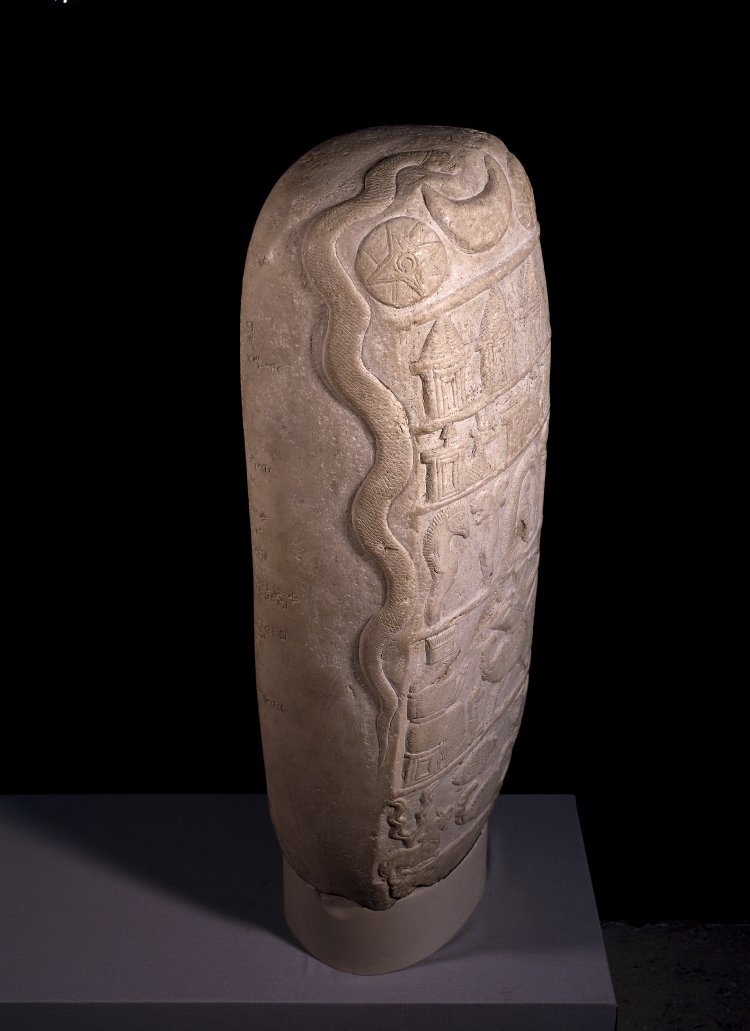
British Museum number 90858 Description 3/4: Right Limestone stela in the form of a boundary-stone: consisting of a block of calcareous limestone, shaped and prepared on four sides to take sculptures and inscriptions. It is now mounted on a stone plinth.  Faces B and C each bear a single column of inscription, the lines running the full width of the stone.  The top of the stone and Face D have been left blank, except for the serpent, which has been carved to the left of the emblems on Face A.  Inscribed with a Charter from the reign of Nebuchadnezzar I.

British Museum number 90858
Description 3/4: Right
Limestone stela in the form of a boundary-stone: consisting of a block of calcareous limestone, shaped and prepared on four sides to take sculptures and inscriptions. It is now mounted on a stone plinth.
Faces B and C each bear a single column of inscription, the lines running the full width of the stone.
The top of the stone and Face D have been left blank, except for the serpent, which has been carved to the left of the emblems on Face A.
Inscribed with a Charter from the reign of Nebuchadnezzar I.

Thus in Register 1, we have the Star of Ishtar, the crescent of the Moon-god Sin, and the disk of Shamash the Sun-god. In Reg. 2 are three stands (?) surmounted by tiaras, which represent the gods Anu, Enlil (Bel) and Ea respectively. In Reg. 3 are three altars (?) or shrines (?) with a monster in Nos. 1 and 2. Over the first is the lance of Marduk, over the second the mason’s square of Nabû, and over the third is the symbol of the goddess Ninkharsag, the Creatress. In Reg. 4 are a standard with an animal’s head, a sign of Ea; a two-headed snake = the Twins; an unknown symbol with a horse’s head, and a bird, representative of Shukamuna and Shumalia. In Reg. 5 are a seated figure of the goddess Gula and the Scorpion-man. In Reg. 6 are forked lightning, symbol of Adad, above a bull, the Tortoise, symbol of Ea (?), the Scorpion of the goddess Ishkhara, and the Lamp of Nusku, the Fire-god.  Down the left-hand side is the serpent-god representing the constellation of the Hydra.

Thus in Register 1, we have the Star of Ishtar, the crescent of the Moon-god Sin, and the disk of Shamash the Sun-god.
In Reg. 2 are three stands (?) surmounted by tiaras, which represent the gods Anu, Enlil (Bel) and Ea respectively.
In Reg. 3 are three altars (?) or shrines (?) with a monster in Nos. 1 and 2. Over the first is the lance of Marduk, over the second the mason’s square of Nabû, and over the third is the symbol of the goddess Ninkharsag, the Creatress.
In Reg. 4 are a standard with an animal’s head, a sign of Ea; a two-headed snake = the Twins; an unknown symbol with a horse’s head, and a bird, representative of Shukamuna and Shumalia.
In Reg. 5 are a seated figure of the goddess Gula and the Scorpion-man.
In Reg. 6 are forked lightning, symbol of Adad, above a bull, the Tortoise, symbol of Ea (?), the Scorpion of the goddess Ishkhara, and the Lamp of Nusku, the Fire-god.
Down the left-hand side is the serpent-god representing the constellation of the Hydra.

The mutilated text of the Fifth Tablet makes it impossible to gain further details in connection with Marduk’s work in arranging the heavens. We are, however, justified in assuming that the gaps in it contained statements about the grouping of the gods into triads.

In royal historical inscriptions the kings often invoke the gods in threes, though they never call any one three a triad or trinity. It seems as if this arrangement of gods in threes was assumed to be of divine origin.

In the Fourth Tablet of Creation, one triad “Anu-Bel-Ea” is actually mentioned, and in the Fifth Tablet, another is indicated, “Sin-Shamash-Ishtar.”

In these triads Anu represents the sky or heaven, Bel or Enlil the region under the sky and including the earth, Ea the underworld, Sin the Moon, Shamash the Sun, and Ishtar the star Venus.

When the universe was finally constituted several other great gods existed, e.g., Nusku, the Fire-god, Enurta, a solar god, Nergal, the god of war and handicrafts, Nabu, the god of learning, Marduk of Babylon, the great national god of Babylonia, and Ashur, the great national god of Assyria.

E.A. Wallis Budge, et al, & the British Museum, The Babylonian Legends of the Creation & the Fight Between Bel & the Dragon Told by Assyrian Tablets from Nineveh (BCE 668-626), 1901, pp. 11-2.

The First Zodiac

” … Not content with Ummu-Khubur’s brood of devils, Tiâmat called the stars and powers of the air to her aid, for she “set up” …

(1) the Viper,

(2) the Snake,

(3) the god Lakhamu,

(4) the Whirlwind,

(5) the ravening Dog,

(6) the Scorpion-man,

(7) the mighty Storm-wind,

(8) the Fish-man, and

(9) the Horned Beast.

These bore (10) the “merciless, invincible weapon,” and were under the command of (11) Kingu, whom Tiâmat calls “her husband.”

Thus Tiâmat had Eleven mighty Helpers besides the devils spawned by Ummu-Khubur. We may note in passing that some of the above-mentioned Helpers appear among the Twelve Signs of the Zodiac which Marduk “set up” after his conquest of Tiâmat, e.g., the Scorpion-man, the Horned Beast, etc.

This fact suggests that the first Zodiac was “set up” by Tiâmat, who with her Eleven Helpers formed the Twelve Signs; the association of evil with certain stars may date from that period. That the Babylonians regarded the primitive gods as powers of evil is clear from the fact that Lakhamu, one of them, is enumerated among the allies of Tiâmat.

The helpers of Tiâmat were placed by her under the command of a god called KINGU who is TAMMUZ. He was the counterpart, or equivalent, of ANU, the Sky-god, in the kingdom of darkness, for it is said in the text “Kingu was exalted and received the power of Anu,” i.e., he possessed the same power and attributes as Anu.

When Tiâmat appointed Kingu to be her captain, she recited over him a certain spell or incantation, and then she gave him the TABLET OF DESTINIES and fastened it to his breast, saying, “Whatsoever goeth forth from thy mouth shall be established.”

Armed with all the magical powers conferred upon him by this Tablet, and heartened by all the laudatory epithets which his wife Tiâmat heaped upon him, Kingu went forth at the head of his devils.

When Ea heard that Tiâmat had collected her forces and was determined to continue the fight against the gods which Apsû and Mummu had begun, and that she had made her husband Kingu her champion, he was “afflicted” and “sat in sorrow.” He felt unable to renew the fight against the powers of darkness, and he therefore went and reported the new happenings to Anshar, representative of the “host of heaven,” and took counsel with him.

When Anshar heard the matter he was greatly disturbed in mind and bit his lips, for he saw that the real difficulty was to find a worthy antagonist for Kingu and Tiâmat. A gap in the text here prevents us from knowing exactly what Anshar said and did, but the context suggests that he summoned Anu, the Sky-god, to his assistance. Then, having given him certain instructions, he sent him on an embassy to Tiâmat with the view of conciliating her.

When Anu reached the place where she was he found her in a very wrathful state, and she was muttering angrily; Anu was so appalled at the sight of her that he turned and fled. It is impossible at present to explain this interlude, or to find any parallel to it in other ancient Oriental literature.”

Illustration: Shamash the Sun-god rising on the horizon, flames of fire ascending from his shoulder. The two portals of the dawn, each surmounted by a lion, are being drawn open by attendant gods. From a Babylonian seal cylinder in the British Museum. [No. 89,110.]

Illustration: Shamash the Sun-god rising on the horizon, flames of fire ascending from his shoulder. The two portals of the dawn, each surmounted by a lion, are being drawn open by attendant gods. From a Babylonian seal cylinder in the British Museum. [No. 89,110.]

E.A. Wallis Budge, et al, & the British Museum, The Babylonian Legends of the Creation & the Fight Between Bel & the Dragon Told by Assyrian Tablets from Nineveh (BCE 668-626), 1901, pp. 8-9.