
Samizdat

Publishing the Forbidden. All Rights Reserved. © Samizdat 2014-2025.

Category: Of Heroes and Sages

Selz: Patriarchs and Sages

“A central figure in the discussion about the alleged Mesopotamian model for the antediluvian patriarchs soon became Enoch, who lived for 365 (364) years and of whom we read in Genesis 5:24: “Enoch walked with God then he was no more, because God took him away.”

The verb lāqah in this context has received numerous comments. Biblical sources offer three interpretations:

a) The liberation of a dead person from the power of the underworld;

b) A final removal from earth (cf. Elijah); or

c) An act of temporal transference, as in dream visions.
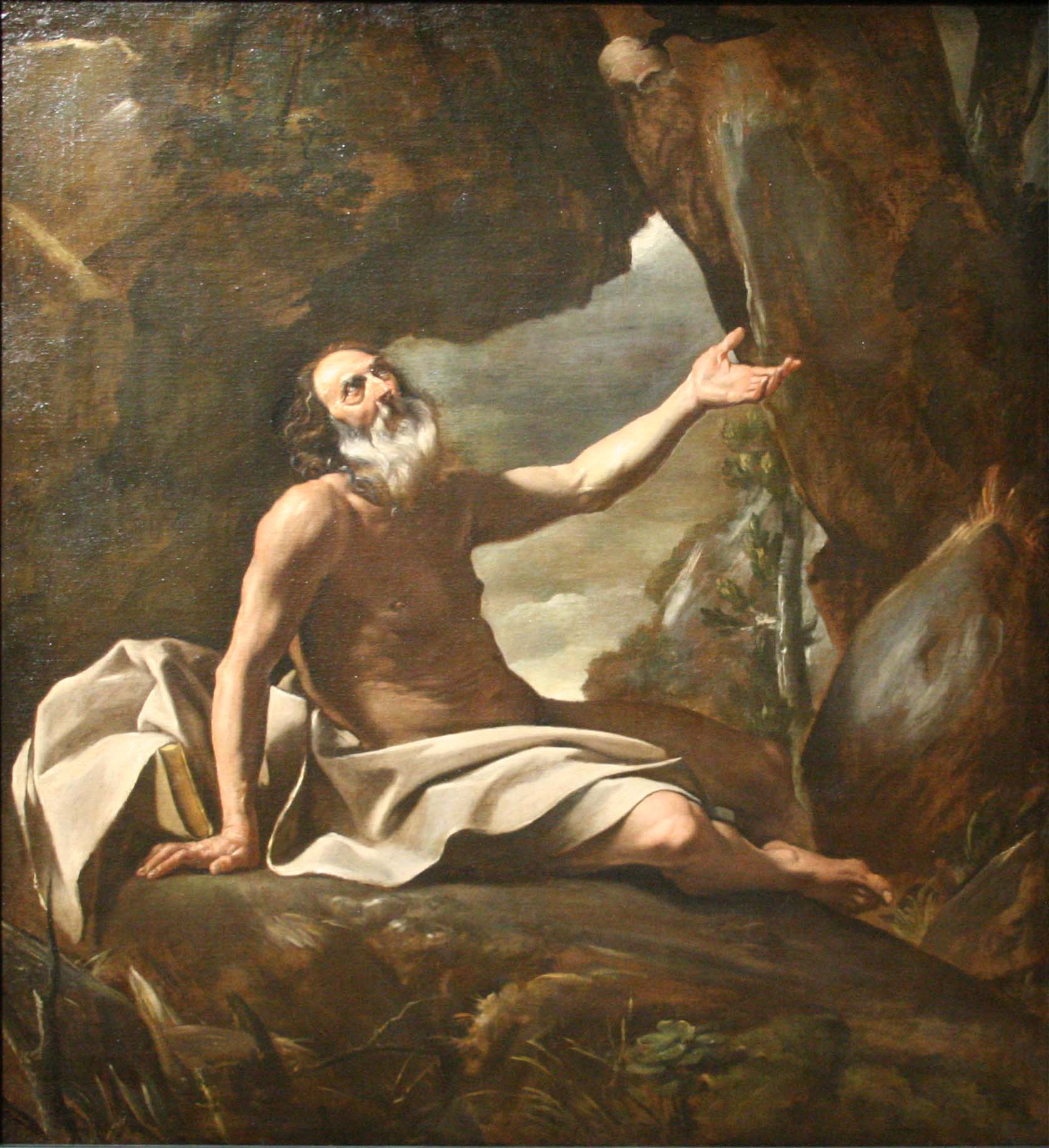
Giovanni Lanfranco (1582-1647 CE), Elie nourri par le corbeau, 1624-5 CE. Oil on canvas, held at the Musée des Beaux-Arts de Marseille, Accession number BA 451, photographed by Rvalette.  This faithful photographic reproduction of an original two-dimensional work of art is in the public domain where the copyright term is the author’s life plus 100 years or less.

Giovanni Lanfranco (1582-1647 CE), Elie nourri par le corbeau, 1624-5 CE. Oil on canvas, held at the Musée des Beaux-Arts de Marseille, Accession number BA 451, photographed by Rvalette.
This faithful photographic reproduction of an original two-dimensional work of art is in the public domain where the copyright term is the author’s life plus 100 years or less.

The name Enoch has found several interpretations: It has been argued that J derived the name from hānaq, “to dedicate” and “to train” which comes close to an interpretation of “the sage” (cf. also Arabic Idris!), and it may well be that the two values attributed to Enoch in Genesis are a “babilistic” interpretation of “a man dedicated to and trained by God.”

In the light of Genesis 4:17 the name was also thought to convey the meaning of “founder,” referring to the eponymous city Enoch. This Enoch is possibly entering the rank of those patriarchs who, according to biblical tradition, were perceived as a sort of cultural heroes.
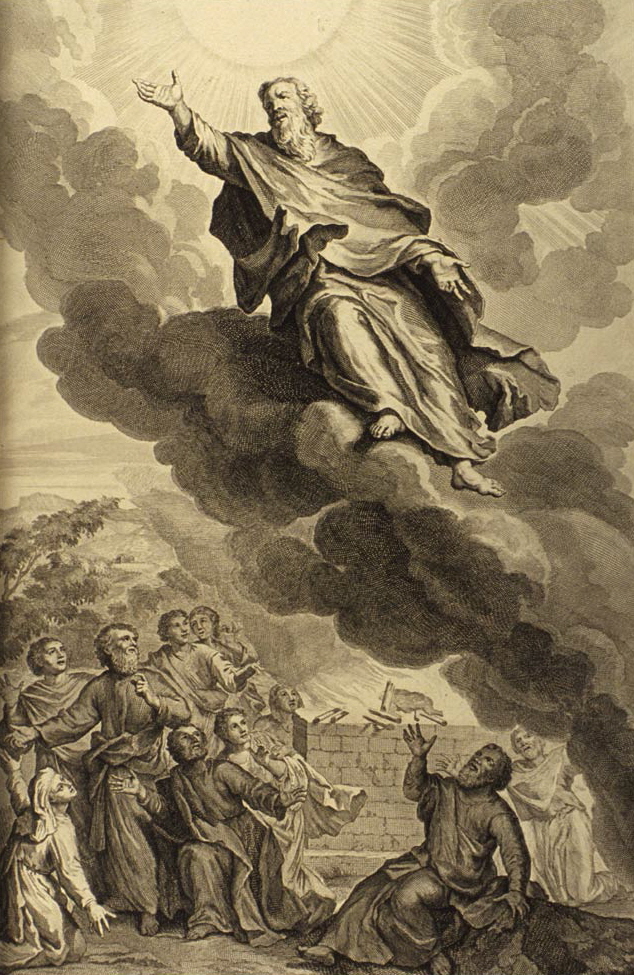
Gerard Hoet (1648-1733 CE), Illustrators of the Figures de la Bible, P. de Hondt, The Hague, 1728 CE. God took Enoch, as in Genesis 5:24: "And Enoch walked with God: and he was not; for God took him." (KJV) illustration from the 1728 Figures de la Bible; illustrated by Gerard Hoet (1648–1733) and others, and published by P. de Hondt in The Hague; image courtesy Bizzell Bible Collection, University of Oklahoma Libraries. This work is in the public domain in its country of origin and other countries and areas where the copyright term is the author's life plus 70 years or less. https://commons.wikimedia.org/wiki/File:Figures_God_took_Enoch.jpg

Gerard Hoet (1648-1733 CE), Illustrators of the Figures de la Bible, P. de Hondt, The Hague, 1728 CE.
God took Enoch, as in Genesis 5:24: “And Enoch walked with God: and he was not; for God took him.” (KJV) illustration from the 1728 Figures de la Bible; illustrated by Gerard Hoet (1648–1733) and others, and published by P. de Hondt in The Hague; image courtesy Bizzell Bible Collection, University of Oklahoma Libraries.
This work is in the public domain in its country of origin and other countries and areas where the copyright term is the author’s life plus 70 years or less.
https://commons.wikimedia.org/wiki/File:Figures_God_took_Enoch.jpg

(Westermann, Genesis, pp. 443-45 suggests that Enoch may refer to the foundation of a city or sanctuary. Westermann writes: “In Israel wurde die Erinnerung daran bewahrt, daß der Städtebau zum dem gehört, was vor und außerhalb der Geschichte Israels geschah. Die Gründung der ersten Stadt gehört der Urgeschichte an” (p. 444).

("In Israel, the memory was preserved because of urban development, 
what happened before and outside of history. 
The founding of the first city belongs to prehistory.")

Discussing Genesis 4:17 most exegetes remark that it seems unlikely that Kain, the tiller, condemmed to a nomadic life, could be renowned as the founder of a city. In an attempt to harmonize the alleged discrepancies, they even assume that the said founder was originally Enoch (cf. e.g. Westermann, Genesis, p. 443).

With the publication of a Seleucid text from Uruk, W 20030,7 the comparison between Berossos, the Old Testament, and the Sumerian King List reached a new level:

Seleucid text, Uruk, W 20030,7.  Excerpt from Selz, Of Heroes and Sages, 2011, p. 793.

Seleucid text, Uruk, W 20030,7. Published by J.J.A. van Dijk, “Die Tontafeln aus dem Resch-Heiligtum,” in Uruk-Wanka Vorberichte 18 (1962): pp. 43-52, from which this transcription is taken. Also on Samizdat, in Lenzi: The Uruk List of Kings and Sages.
Excerpt from Selz, Of Heroes and Sages, 2011, p. 793.

This document establishes an important link between Berossos’ account of the primeval kings and his story of the sage Oannes.

In this text the names of Mesopotamian rulers are accompanied by names of advisors, sages, the so-called apkallū which play an important role in Mesopotamian iconography and have been known, up until now, chiefly from the so-called Etiological Myth of the “Seven Sages” studied by Erica Reiner in 1961.

(E. Reiner, “The Etiological Myth of the ‘Seven Sages,’Orientalia 30 (1961): 1-11; eadem, Astral Magic in Babylonia (Transactions of the American Philosophical Society 85.4; Philadelphia: American Philosophical Society, 1995).

(See further S. Parpola, “Mesopotamian Astrology and Astronomy as Domains of the Mesopotamian ‘Wisdom,’” in Die Rolle der Astronomie in den Kulturen Mesopotamiens: Beiträge zum 3. Grazer Morgenländischen Symposium (ed. H. Galter and B. Scholz; Grazer Morgenländische Studien 3; Graz: RM Druck-und Verlagsgesellschaft, 1993), pp. 23-7.)

This list is certainly fictional, it is, however, based on scholarly traditions: the name of the well-known compiler of the standard version of the Gilgamesh Epic, dsîn-liq-unninnī, functions as an apkallu to Gilgamesh himself.

Further, a certain Kabtu-il-Marduk, perhaps referring to the author of the Erra Epic Kabti-ilāni-Marduk, is mentioned as a sage during the reign of Ibbi-Sîn (ca. 2028-2004 BCE), unlucky last king of the Ur III empire.”

Gebhard J. Selz, “Of Heroes and Sages–Considerations of the Early Mesopotamian Background of Some Enochic Traditions,” in Armin Lange, et alThe Dead Sea Scrolls in Context, v. 2, Brill, 2011, pp. 792-4.

Selz: Enūma Anu Enlil and MUL.APIN

“My contribution is an outsider’s view, neither pretending to do justice to the ongoing discussions in biblical studies, in particular in the studies of the Dead Sea Scrolls, nor dwelling on the highly complicated matter of the Babylonian background of the astronomical Enoch tradition.

O. Neugebauer, one of the pioneers working on Babylonian astronomical texts wrote in 1981:

“The search for time and place of origin of this primitive picture of the cosmic order can hardly be expected to lead to definitive results. The use of 30-day schematic months could have been inspired, e.g., by Babylonian arithmetical schemes (of the type of ‘Mul-Apin’), or by the Egyptian calendar.”

He then continues: “But [sc. in Astronomical Enoch] there is no visible trace of the sophisticated Babylonian astronomy of the Persian or Seleucid-Parthian period.”

The Neo-Assyrian star map K 8538, from H. Hunger, ed., Astrological Reports to Assyrian Kings (SAA 8, Helsinki: Helsinki University Press: 1992), p. 46.<br /> K8538 is held in the British Museum collection, excavated by Austen Henry Layard from the Library of Ashurbanipal in Nineveh.<br /> The curator's comments state that the text and depicted constellations are interpreted in Koch, 1989.<br /> A celestial planisphere with eight sections, representing the night sky of 3-4 January 650 BCE over Nineveh.<br /> Also Figure 1, Gebhard Selz, Of Heroes and Sages, p. 785. http://www.britishmuseum.org/research/collection_online/collection_object_details.aspx?objectId=303316&partId=1

The Neo-Assyrian star map K 8538, from H. Hunger, ed., Astrological Reports to Assyrian Kings (SAA 8, Helsinki: Helsinki University Press: 1992), p. 46.
K8538 is held in the British Museum collection, excavated by Austen Henry Layard from the Library of Ashurbanipal in Nineveh.
The curator’s comments state that the text and depicted constellations are interpreted in Koch, 1989.
A celestial planisphere with eight sections, representing the night sky of 3-4 January 650 BCE over Nineveh.
Also Figure 1, Gebhard Selz, Of Heroes and Sages, p. 785. http://www.britishmuseum.org/research/collection_online/collection_object_details.aspx?objectId=303316&partId=1

(Cf. M. Albani, Astronomie und Schöpfungsglaube: Untersuchungen zum astronomischen Henochbuch (WMANT 68; Neukirchen-Vluyn: Neukirche 1994), pp. 1-29; cf. furthermore the works of Milik, Books of Enoch, and O. Neugebauer, The “Astronomical” Chapters of the Ethiopic Book of Enoch (72 to 82) Det Kongelige Danske Videnskabernes Selskab: Matematisk-fysiske Meddelelser 40.10; Copenhagen: Munksgaard, 1981).

The opinion “that the astronomical part of the Book of Enoch is based on concepts extant in the Old Testament is simply incorrect: the Enoch year is not an old semitic calendaric unit; the schematic alternation between hollow and full months is not a real lunar calendar, and there exists no linear scheme in the Old Testament for the length of daylight, or patterns for ‘gates,’ for winds, or for ‘thousands’ of stars, related to the schematic year. The whole Enochian astronomy is clearly an ad hoc construction and not the result of a common semitic tradition.

Neugebauer’s opinion sharply contrasts the statement of VanderKam that “Enoch’s science is a Judaized refraction of an early stage in the development of Babylonian astronomy—a stage that finds varied expression in texts such as the astrolabes, Enūma Anu Enlil, and mul APIN.

Enuma Anu Enlil is a series of about 70 tablets dealing with Babylonian astrology. These accounts were found in the early 19th century by excavation in Niniveh, near present day Bagdad. The bulk of the work is a substantial collection of omens, estimated to number between 6500 and 7000, which interpret a wide variety of celestial and atmospheric phenomena in terms relevant to the king and state. The tablets presumably date back to about 650 BCE, but several of the omens may be as old as 1646 BCE. Many of the reports found on the tablets represent ‘astrometeorological’ forecasts (Rasmussen 2010).<br /> http://www.climate4you.com/ClimateAndHistory%205000-0%20BC.htm

Enuma Anu Enlil is a series of about 70 tablets dealing with Babylonian astrology. These accounts were found in the early 19th century by excavation in Niniveh, near present day Bagdad. The bulk of the work is a substantial collection of omens, estimated to number between 6500 and 7000, which interpret a wide variety of celestial and atmospheric phenomena in terms relevant to the king and state. The tablets presumably date back to about 650 BCE, but several of the omens may be as old as 1646 BCE. Many of the reports found on the tablets represent ‘astrometeorological’ forecasts (Rasmussen 2010).
http://www.climate4you.com/ClimateAndHistory%205000-0%20BC.htm

In it astronomical and astrological concepts are intermingled and schematic arrangements at times predominate over facts.”

Here VanderKam comes back to an early view of H. Zimmern from 1901, who saw the Enochic tradition anchored in stories around the primeval king Enmeduranki, to whom the gods granted mantic (related to divination or prophecy) and astronomical wisdom.

BM 86378, cuneiform tablets from the library of King Ashurbanipal, circa 687 BCE, held in the British Museum.<br /> MUL.APIN includes a list of thirty-six stars, three stars for each month of the year. The stars are those having a helical rise in a particular month. The first line lists the three stars, which have the helical rise in the first month of the year, Nisannu, which is associated with the vernal equinox. <br /> In the second line, three other stars are listed, with a helical rise in the second month, Ayyāru, and so on.<br /> I MUL.APIN sono testi antichi su tavolette di argilla, comprendono un elenco di trentasei stelle, tre stelle per ogni mese dell’anno. <br /> Le stelle sono quelle aventi ciascuna la levata eliaca in un particolare mese. Si ha perciò questo schema: nella prima riga sono elencate tre stelle, che hanno la levata eliaca nel primo mese dell'anno, Nīsannu (quello associato all'epoca dell'equinozio di primavera). <br /> Nella seconda riga sono elencate altre tre stelle, ancora ciascuna avente levata eliaca nel secondo mese, Ayyāru, e così via.<br /> http://www.lavia.org/italiano/archivio/calendarioakkadit.htm

BM 86378, cuneiform tablets from the library of King Ashurbanipal, circa 687 BCE, held in the British Museum.
MUL.APIN includes a list of thirty-six stars, three stars for each month of the year. The stars are those having a helical rise in a particular month. The first line lists the three stars, which have the helical rise in the first month of the year, Nisannu, which is associated with the vernal equinox.
In the second line, three other stars are listed, with a helical rise in the second month, Ayyāru, and so on.
I MUL.APIN sono testi antichi su tavolette di argilla, comprendono un elenco di trentasei stelle, tre stelle per ogni mese dell’anno.
Le stelle sono quelle aventi ciascuna la levata eliaca in un particolare mese. Si ha perciò questo schema: nella prima riga sono elencate tre stelle, che hanno la levata eliaca nel primo mese dell’anno, Nīsannu (quello associato all’epoca dell’equinozio di primavera).
Nella seconda riga sono elencate altre tre stelle, ancora ciascuna avente levata eliaca nel secondo mese, Ayyāru, e così via.
http://www.lavia.org/italiano/archivio/calendarioakkadit.htm

(VanderKam, Enoch and the Growth, p. 101. H. Zimmern, Beiträge zur Kenntnis der babylonischen Religion: Die Beschwörungstafeln Šurpu, Ritualtafeln für den Wahrsager, Beschwörer und Sänger (Assyriologische Bibliothek 12; Leipzig: Hinrichs, 1901).

The main arguments against Neugebauer’s position are provided by the Enochic Aramaic fragments from Cave 4, the careful evaluation of which prompted Milik already in 1976 to suggest that the astronomical parts of the Enoch tradition do belong to the oldest stratum of the Enoch literature in concordance to the  (originally) year life span allotted to Enoch in Genesis 5:23.”

Gebhard J. Selz, “Of Heroes and Sages–Considerations of the Early Mesopotamian Background of Some Enochic Traditions,” in Armin Lange, et alThe Dead Sea Scrolls in Context, v. 2, Brill, 2011, pp. 784-6.