
Babylon, Fallen
“Although in all the articles and discussions concerning cultic prostitution the preeminence of Babylon as the “mother of harlots” is never mentioned; it is an unarticulated assumption underlying their arguments.
“The woman was dressed in purple and scarlet and glittered with gold and jewels and pearls, and she was holding a gold winecup filled with the disgusting filth of her prostitution; on her forehead was written a name, a cryptic name: “Babylon the Great, the mother of the prostitutes and all the filthy practices on the earth.” (Revelations 17:4-5, NJB)
This popular identification of harlotry with Babylon appears to stem from Revelation, a widely read and quoted book in our Western Christianized civilization, a quotation from which opens this article. The persistence of such views to the present is illustrated in this graphic depiction of Babylon by Joan Oates:
So wrote a New Testament prophet, and, although the allusion was to Rome, the sentiment accurately expressed the ancient world’s view of Babylon. Today, 2000 years after the city was “cast down and found no more,” the name still conjures up in our minds a vision of opulence and splendour stained with the smear of pagan decadence so enthusiastically applied by the writers of the Hebrew world. (Joan Oates, Babylon (London: Thames & Hudson, 1979), p. 9.)
This common misconception arose because of the lack of awareness that the reference–as Joan Oates seems to realize–is of Hebraic origin and alludes exclusively to the practices of then-existing decadent Rome and not to those of a Babylon of an earlier period.
The authentic Greek view of Babylon, though running parallel to that of Revelation, is found typically in the words of older writers such as Herodotus and reflects their derogatory perception of women and barbarians.
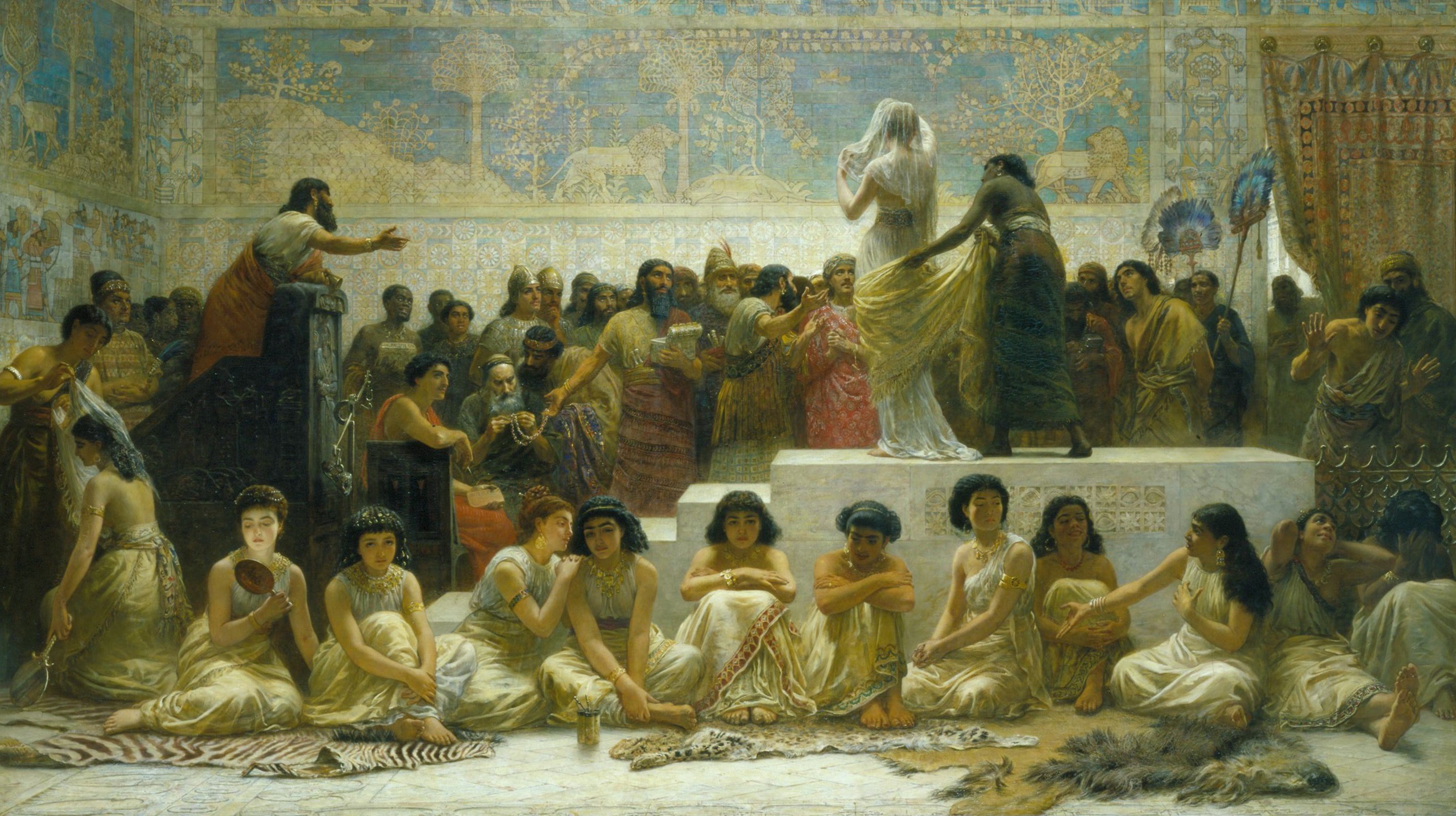
Edwin Long (1829–1891) wikidata:Q3042629
The Babylonian Marriage Market
Royal Holloway College (London).
23 May 2007 (original upload date). Original uploader was Briangotts at en.wikipedia
Permission
(Reusing this file) PD-US.
http://en.wikipedia.org/wiki/File:Babylonian_marriage_market.jpg
The Babylonian Marriage Market is an 1875 painting by the British painter Edwin Long of young women being auctioned into marriage. It received attention for its provocative depiction of women being sold and its attention to historical detail. It was inspired by a passage in the Histories by Herodotus, and the artist painstakingly copied some of the images from Assyrian artifacts.
It is currently held in the Picture Gallery of Royal Holloway College, after being bought by Thomas Holloway in 1882, where it fetched a then-record price for a painting by a living artist at £6,615.
http://en.wikipedia.org/wiki/The_Babylonian_Marriage_Market
The truly Hebraic or Judean view toward ancient Babylon in the world of the Old Testament is revealed through numerous references to Babylon both in the historical and in the literary texts. The most elaborate portrayal is given in the description of the fall of Babylon in Deutero-Isaiah whose people lived closer in time, in territory and in kinship to those of Babylonia.
There Babylon is distinguished by the epithet  , “the virgin daughter of Babylon”–an epithet by which Jerusalem is often esteemed,
  , “the virgin daughter of Zion.”
Note in the following passage rather than being “stained with the smear of pagan decadence,” Babylon is honored and dignified with the rank of a queen who has been sheltered, veiled, and protected from any type of manual labor:
Come down, sit in the dust, virgin daughter of Babylon! Sit on the ground dethroned, daughter of the Chaldeans! For no longer will they call you soft and dainty. Take the millstones, grind the meal, take off your veil; strip off your skirt, bare the thigh, cross the rivers. Let your nudity be displayed–yes, let your sex appear; I will take vengeance, I will not entreat man…. Sit in silence, enter into darkness, daughter of the Chaldeans: For no longer will they call you the mistress of kingdoms. (Isaiah 47:1 – 5)
In the succeeding lines, Babylon stands accused not of harlotry but of spells and sorceries, and can expect punishment in the form of evils and disasters which cannot be conjured away or averted.
This reflects a clear picture of Babylonian practice–a reliance on incantations (spells for positive and negative results) and divination (sorceries to tell the future) and namburbi, and other rituals to avert predicted disasters.
In light of its ethnic, cultural, and linguistic proximity, the Hebrew Bible could portray a more accurate understanding of Babylon and its culture.
Thus, we have come full circle from using Mesopotamian material to explain the Bible to using biblical material to depict Babylon. Both traditions are firmly rooted in the ancient Near East.
It is the Greeks and their denigration of the female sex and of barbarians that caused them to lump together the negative attributes of both groups in their description of Babylon and its cultic rites.”
Joan Goodnick Westenholz, “Tamar, Qēdēšā, Qadištu, and Sacred Prostitution in Mesopotamia,” The Harvard Theological Review, Vol. 82, No. 3 (July, 1989), pp. 264-5.
 Samizdat
