Samizdat

Publishing the Forbidden. All Rights Reserved. © Samizdat 2014-2025.

Category: Mesopotamia

The Sumerians Considered the Deluge an Historic Event

” … It is, at all events, well known that the Sumerians regarded the Deluge as an historic event, which they were, practically, able to date, for some of their records contain lists of kings who reigned before the Deluge, though it must be confessed that the lengths assigned to their reigns are incredible. After their rule it is expressly noted that the Flood occurred, and that, when it passed away, kingship came down again from on high.

It is not too much to assume that the original event commemorated in the Legend of the Deluge was a serious and prolonged inundation or flood in Lower Babylonia, which was accompanied by great loss of life and destruction of property.

The Babylonian versions state that this inundation or flood was caused by rain, but passages in some of them suggest that the effects of the rainstorm were intensified bv other physical happenings connected with the earth, of a most destructive character.

The Hebrews also, as we may see from the Bible, had alternative views as to the cause of the Deluge. According to one, rain fell upon the earth for forty days and forty nights (Gen. vii, 12), and according to the other the Deluge came because “all the fountains of the great deep” were broken up, and “the flood-gates of heaven were opened” (Gen. vii, ii).

The latter view suggests that the rain flood was joined by the waters of the sea. Later tradition, derived partly from Babylonian and partly from Hebrew sources, asserts, e.g., in the Cave of Treasures, a Syriac treatise composed probably at Edessa about the fifth or sixth century A.D., that when Noah had entered the Ark and the door was shut …

“… the floodgates of the heavens were opened it and the foundations of the earth were rent asunder,” and that “the ocean, that great sea which surroundeth the whole world, poured forth its floods. And whilst the floodgates of heaven were open, and the foundations of the earth were rent asunder, the storehouses of the winds burst their bolts, and storms and whirlwinds swept forth, and ocean roared and hurled its floods upon the earth.”

The ark was steered over the waters by an angel who acted as pilot, and when that had come to rest on the mountains of Kardô (Ararat),

“God commanded the waters and they became separated from each other. The celestial waters were taken up and ascended to their own place above the heavens whence they came. The waters which had risen up from the earth returned to the lowermost abyss, and those which belonged to the ocean returned to the innermost part thereof.”

Many authorities seeking to find a foundation of fact for the Legend of the Deluge in Mesopotamia have assumed that the rain-flood was accompanied either by an earthquake or a tidal-wave, or by both. There is no doubt that the cities of Lower Babylonia were nearer the sea in the Sumerian Period than they are at present, and it is a generally accepted view that the head of the Persian Gulf lay farther to the north at that time. A cyclone coupled with a tidal wave is a sufficient base for any of the forms of the Legend now known.

A comparison of the contents of the various Sumerian and Babylonian versions of the Deluge that have come down to us shows us that they are incomplete. And as none of them tells so connected and full a narrative of the prehistoric shipbuilder as Berosus, a priest of Bêl, the great god of Babylon, it seems that the Mesopotamian scribes were content to copy the Legend in an abbreviated form.”

E.A. Wallis Budge, The Babylonian Story of the Deluge and the Epic of Gilgamish1929, pp. 27-8.

Legends of Creation and Dragons

” … Both the source of the original form of the Legend of the Fight between Ea and Apsu, and Marduk and Tiâmat, and the period of its composition are unknown, but there is no doubt that in one form or another it persisted in Mesopotamia for thousands of years.

The apocryphal book of “Bel and the Dragon” shows that a form of the Legend was in existence among the Babylonian Jews long after the Captivity, and the narrative relating to it associates it with religious observances.

But there is no foundation whatsoever for the assertion which has so often been made that the Two Accounts of the Creation which are given in the early chapters in Genesis are derived from the Seven Tablets of Creation described in the preceding pages. It is true that there are many points of resemblance between the narratives in cuneiform and Hebrew, and these often illustrate each other, but the fundamental conceptions of the Babylonian and Hebrew accounts are essentially different.

In the former the earliest beings that existed were foul demons and devils, and the God of Creation only appears at a later period, but in the latter the conception of God is that of a Being Who existed in and from the beginning, Almighty and Alone, and the devils of chaos and evil are His servants.

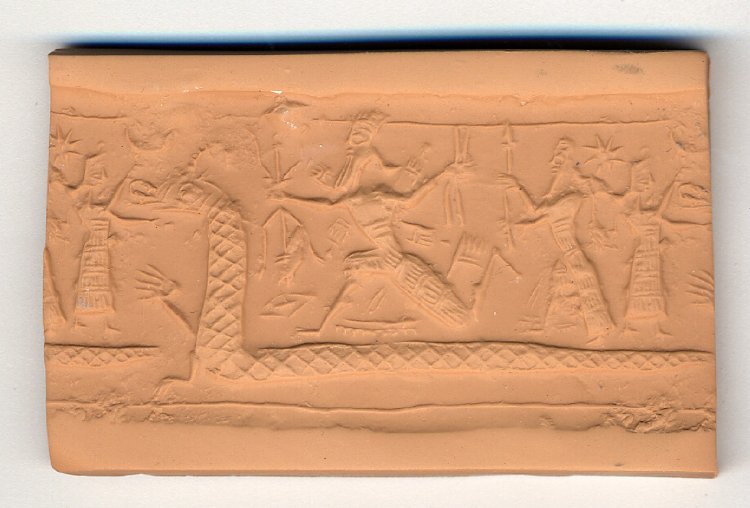
The seal may illustrate a scene from the epic of creation in which the forces of chaos, led by Tiamat, are defeated by a god representing cosmic order, probably Ninurta.

The seal may illustrate a scene from the epic of creation in which the forces of chaos, led by Tiamat, are defeated by a god representing cosmic order, probably Ninurta.

Among the primitive Semitic peoples there were probably many versions of the story of the Creation; and the narrative told by the Seven Tablets is, no doubt, one of them in a comparatively modern form.

It is quite clear that the Account of the Creation given in the Seven Tablets is derived from very ancient sources, and a considerable amount of literary evidence is now available for reconstructing the history of the Legend.

Thus in the Sumerian Account the narrative of the exploits of the hero called ZIUSUDU 19  begins with a description of the Creation and then goes on to describe a Flood, and there is little doubt that certain passages in this text are the originals of the Babylonian version as given in the Seven Tablets.

In the Story of ZIUSUDU, however, there is no mention of any Dragon. And there is reason to think that the Legend of the Dragon had originally nothing whatever to do with the Creation, for the texts of fragments of two distinct Accounts 20 of the Creation describe a fight between a Dragon and some deity other than Marduk.

In other Accounts the Dragon bears a strong resemblance to the Leviathan of Psalm civ, 26; Job xli, 1. In the one text he is said to be 50 biru 21 in length, and 1 biru in thickness; his mouth was 6 cubits (about 9 feet) wide, and the circumference of his ears 12 cubits (18 feet).

He was slain by a god whose name is unknown, and the blood continued to flow from his body for three years, three months, one day and one night.

In the second text the Dragon is 60 biru long and his thickness is 30 biru; the diameter of each eye is half a biru, and his paws are 20 biru long.

Thus there is every reason for believing that the Legend as it is given in the Seven Tablets is the work of some editor, who added the Legend of the Creation to the Legend of the Dragon in much the same way as the editor of the Gilgamish Legends included an account of the Deluge in his narrative of the exploits of his hero.

All forms of the Legend of the Creation and of the Dragon were popular in Babylonia, and one of them achieved so much notoriety that the priest employed recited it as an incantation to charm away the toothache.

The literary form of the text of the Seven Tablets fulfils the requirements of Semitic poetry in general. The lines usually fall into couplets, the second line being the antiphon of the first, e.g.:–

“When in the height heaven was not named,
And the earth beneath did not yet bear a name.”

Thus we have:–

enuma elish || lâ nabû shamamu
shaplish ammatum || shuma lâ zakrat

E.A. Wallis Budge, The Babylonian Legends of the Creation and the Fight Between Bel and the Dragon, 1921.

The Ten Lost Tribes

” … Shalmaneser died before Samaria was captured, and may have been assassinated. The next Assyrian monarch, Sargon II (722-705 B.C.), was not related to either of his two predecessors. He is referred to by Isaiah, and is the Arkeanos of Ptolemy. He was the Assyrian monarch who deported the “Lost Ten Tribes.”

“In the ninth year of Hoshea” (and the first of Sargon) “the king of Assyria took Samaria, and carried Israel away into Assyria, and placed them in Halah and in Habor by the river of Gozan, and in the cities of the Medes.”

In all, according to Sargon’s record, “27,290 people dwelling in the midst of it (Samaria) I carried off.”

They (the Israelites) left all the commandments of the Lord their God, and made them molten images, even two calves, and made a grove, and worshipped all the host of heaven (the stars), and served Baal.

And they caused their sons and their daughters to pass through the fire, and used divination and enchantments, and sold themselves to do evil in the sight of the Lord, to provoke him to anger. Therefore the Lord was very angry with Israel, and removed them out of his sight: there was none left but the tribe of Judah only.

And the king of Assyria brought men from Babylon, and from Cuthah, and from Ava, and from Hamath, and from Sepharvaim, and placed them in the cities of Samaria instead of the children of Israel: and they possessed Samaria, and dwelt in the cities thereof….

And the men of Babylon made Succoth-benoth, and the men of Cuth (Cuthah) made Nergal, and the men of Hamath made Ashima, and the Avites made Nibhaz and Tartak, and the Sepharites burnt their children in fire to Adram-melech and Anam-melech, the gods of Sepharvaim.

A number of the new settlers were slain by lions, and the king of Assyria ordered that a Samaritan priest should be sent to “teach them the manner of the God of the land.” This man was evidently an orthodox Hebrew, for he taught them “how they should fear the Lord…. So they feared the Lord,” but also “served their own gods … their graven images.”

There is no evidence to suggest that the “Ten Lost Tribes,” “regarding whom so many nonsensical theories have been formed,” were not ultimately absorbed by the peoples among whom they settled between Mesopotamia and the Median Highlands.

The various sections must have soon lost touch with one another. They were not united like the Jews (the people of Judah), who were transported to Babylonia a century and a half later, by a common religious bond, for although a few remained faithful to Abraham’s God, the majority of the Israelites worshipped either the Baal or the Queen of Heaven.”

Donald A. Mackenzie, Myths of Babylonia and Assyria, 1915, pp. 455-6.

Tammuz, Attis, Osiris, Adonis, Diarmid Derive from a More Ancient God of Fertility

“The Babylonian myth of Tammuz, the dying god, bears a close resemblance to the Greek myth of Adonis. It also links with the myth of Osiris. According to Professor Sayce, Tammuz is identical with “Daonus or Daos, the shepherd of Pantibibla,” referred to by Berosus as the ruler of one of the mythical ages of Babylonia. We have therefore to deal with Tammuz in his twofold character as a patriarch and a god of fertility.

The Adonis version of the myth may be summarized briefly. Ere the god was born, his mother, who was pursued by her angry sire, as the river goddesses of the folk tales are pursued by the well demons, transformed herself into a tree.

Adonis sprang from the trunk of this tree, and Aphrodite, having placed the child in a chest, committed him to the care of Persephone, queen of Hades, who resembles the Babylonian Eresh-ki-gal. Persephone desired to retain the young god, and Aphrodite (Ishtar) appealed to Zeus (Anu), who decreed that Adonis should spend part of the year with one goddess and part of the year with the other.

It is suggested that the myth of Adonis was derived in post-Homeric times by the Greeks indirectly from Babylonia through the Western Semites, the Semitic title “Adon,” meaning “lord,” having been mistaken for a proper name. This theory, however, cannot be accepted without qualifications.

It does not explain the existence of either the Phrygian myth of Attis, which was developed differently from the Tammuz myth, or the Celtic story of “Diarmid and the boar,” which belongs to the archaeological “Hunting Period.”

There are traces in Greek mythology of pre-Hellenic myths about dying harvest deities, like Hyakinthos and Erigone, for instance, who appear to have been mourned for. There is every possibility, therefore, that the Tammuz ritual may have been attached to a harvest god of the pre-Hellenic Greeks, who received at the same time the new name of Adonis.

Osiris of Egypt resembles Tammuz, but his Mesopotamian origin has not been proved. It would appear probable that Tammuz, Attis, Osiris, and the deities represented by Adonis and Diarmid were all developed from an archaic god of fertility and vegetation, the central figure of a myth which was not only as ancient as the knowledge and practice of agriculture, but had existence even in the “Hunting Period.”

Traces of the Tammuz-Osiris story in various forms are found all over the area occupied by the Mediterranean or Brown race from Sumeria to the British Isles. Apparently the original myth was connected with tree and water worship and the worship of animals.

Adonis sprang from a tree; the body of Osiris was concealed in a tree which grew round the sea-drifted chest in which he was concealed. Diarmid concealed himself in a tree when pursued by Finn.

The blood of Tammuz, Osiris, and Adonis reddened the swollen rivers which fertilized the soil. Various animals were associated with the harvest god, who appears to have been manifested from time to time in different forms, for his spirit pervaded all nature. In Egypt the soul of Osiris entered the Apis bull or the ram of Mendes.

Tammuz in the hymns is called “the pre-eminent steer of heaven,” and a popular sacrifice was “a white kid of the god Tammuz,” which, however, might be substituted by a sucking pig. Osiris had also associations with swine, and the Egyptians, according to Herodotus, sacrificed a pig to him annually.

When Set at full moon hunted the boar in the Delta marshes, he probably hunted the boar form of Osiris, whose human body had been recovered from the sacred tree by Isis.

As the soul of Bata, the hero of the Egyptian folk tale, migrated from the blossom to the bull, and the bull to the tree, so apparently did the soul of Osiris pass from incarnation to incarnation. Set, the demon slayer of the harvest god, had also a boar form; he was the black pig who devoured the waning moon and blinded the Eye of Ra.

In his character as a long-lived patriarch, Tammuz, the King Daonus or Daos of Berosus, reigned in Babylonia for 36,000 years. When he died, he departed to Hades or the Abyss. Osiris, after reigning over the Egyptians, became Judge of the Dead.”

Donald A. Mackenzie, Myths of Babylonia and Assyria, 1915.

More From the Naassene Fragment, Jesus Says “I am the True Door”

“Lift up the gates, ye who are rulers of you, and be ye lift up ye everlasting gates, and the King of Glory shall come in.” 1

This is a wonder of wonders.

“For who (H. he says) is this King of Glory? 2 A worm 3 and no man, the scorn of men, and the contempt of the people. 4 He is the King of Glory, the Mighty in War.” 5

By “War” he 6 means the “[war] in the body,” for the plasm is compounded of warring elements, as it is written (H. he says):

“Remember the war that is [warred] in the body.” 7

This (H. he says) is the Entrance, and this is the Gate, which Jacob saw, when he journeyed into Mesopotamia. 8

C. Which is the passing from childhood to puberty and manhood; that is, it was made known to him who journeyed into Mesopotamia.

J. And Mesopotamia (H. he says) is the Stream of Great Ocean flowing from the middle of the Perfect Man.

And he 9 marvelled at the Heavenly Gate, saying:

“How terrible [is] this place! This is naught else than the House of God; yea, this [is] the Gate of Heaven.” 10

C. On this account (H. he says) Jesus saith:

“I am the True Door.” 11

J. And he 12 who says these things is (H. he says) the [one] from the Inexpressible Man, expressed from Above—

C. —as the perfect man. The not-perfect man, therefore, cannot be saved unless he be regenerated passing through this Gate.

(21) S. This same [Man] (H. he says) the Phrygians call also Papa; 1 for He calmed 2 all things which, prior to His own manifestation, were in disorderly and inharmonious movement.

For the name Papa (H. he says) is [the] Sound-of-all-things-together in Heaven, and on Earth, and beneath the Earth, saying: “Calm, calm” 3 the discord of the cosmos.

C. And: Make “peace for them that are far”—that is, the material and earthy—“and peace for them that are near” 4—that is, the spiritual and knowing and perfect men.

(22) S. The Phrygians call Him also Dead—when buried in the body as though in a tomb or sepulchre.

C. This (H. he says) is what is said:

“Ye are whited sepulchres, filled (H. he says) within with bones of the dead, 5 for Man, the Living [One] 6 is not in you.”

And again He says:

“The dead shall leap forth from their graves” 7

—that is, from their earthy bodies, regenerated spiritual, not fleshly.

This (H. he says) is the Resurrection which takes place through the Gate of the Heavens, through which all those who do not pass (H. he says) remain Dead.

S. The same Phrygians again call this very same [Man], after the transformation, God [or a God]. 1

C. For he becomes (H. he says) God when, rising from the Dead, through such a Gate, he shall pass into Heaven.

This is the Gate (H. he says) which Paul, the Apostle, knew, setting it ajar in a mystery, and saying that he was caught up by an angel and came to the second, nay the third heaven, into Paradise itself, and saw what he saw, and heard ineffable words, which it is not lawful for man to utter. 2

These (H. he says) are the Mysteries, ineffable [yet] spoken of by all,—

“—which [also we speak, yet] not in words taught of human wisdom, but in [words] taught of Spirit, comparing things spiritual with spiritual things. But the psychic man receiveth not the things of God’s Spirit, for they are foolishness unto him.”3

And these (H. he says) are the Ineffable Mysteries of the Spirit which we alone know.

Concerning these (H. he says) the Saviour said:

“No one is able to come to Me, unless my Heavenly Father draw him.” 4

For it is exceedingly difficult (H. he says) to receive and accept this Great Ineffable Mystery.

And again (H. he says) the Saviour said:

“Not every one that saith unto Me, Lord, Lord! shall enter into the Kingdom of the Heavens, but he who doeth the Will of My Father who is in the Heavens” 5

—which [Will] they must do, and not hear only, to enter into the Kingdom of the Heavens.

And again He said (H. he says):

“The tax-gatherers and harlots go before you into the Kingdom of the Heavens.” 1

For by “tax-gatherers” (τελῶναι) are meant (H. he says) those who receive the consummations 2 (τέλη) of the universal [principles]; and we (H. he says) are the “tax-gatherers” 3 [upon whom the consummations of the æons have come” 4].

For the “consummations” (H. he says) are the Seeds disseminated into the cosmos from the Inexpressible [Man], by means of which the whole cosmos is consummated; for by means of these also it began to be.

And this (H. he says) is what is said:

“The Sower went forth to sow. And some [Seeds] fell by the way-side, and were trodden under foot; and others on stony places, and they sprang up (H. he says), but because they had no depth, they withered and died.

“Others (H. he says) fell on the fair and good ground, and brought forth fruit—one a hundred, another sixty, and another thirty.

“He who hath (H. he says) ears to hear, let him hear!” 5

G.R.S. Mead, Thrice-Greatest HermesVol. 1, 1906, pp. 171-4.

From Hippolytus, Philosophumena; or, Refutation of all Heresies.

An Infamous Case of Demoniacal Possession

“Incidentally, however, we have one interesting proof that foreign peoples believed that the Egyptians were able to cure the diseases caused by demoniacal possession, and the exercise of their power on the occasion described was considered to be so noteworthy that the narrative of it was inscribed upon a stele (originally published by Prisse, Monuments Égyptiens, Paris, 1817, pl. 24) and setup in the temple of the god Khonsu at Thebes, so that all men might read and know what a marvellous cure his priests had effected.

(It is now preserved in the Bibliotèque Nationale at Paris; for a full description and translation of it see E. de Rougé, Étude sur une stele Égyptienne, Paris, 1858).

It appears that king Rameses I was in Mesopotamia “according to his wont, year by year,” and all the chiefs of the countries round about came to pay their respects to him, and they sought to obtain his goodwill and protection, probably even an alliance, by bringing to him gifts of gold, and lapis-lazuli, and turquoise, and of every kind of valuable thing which the land produced, and every man sought to outdo his neighbour by the lavishness of his gifts.

Among others there came the Prince of Bekhten, and at the head of all the offerings which he presented to His Majesty he placed his eldest daughter, who was very beautiful.

When the king saw her he thought her the most beautiful girl he had ever seen, and he bestowed upon her the title of “Royal spouse, chief lady, Râ-neferu” (i.e., “the beauties of Râ,” the Sun-god), and took her to Egypt; and when they arrived in that country the king married her.

One day during the fifteenth year of the king’s reign, when His Majesty was in Thebes celebrating the festival of Amen-Râ, a messenger came to the king and reported the arrival of an ambassador from the Prince of Bekhten who had brought rich gifts for the royal lady Râ-neferu.

When he had been led into the king’s presence, he did homage before him, saying, “Glory and praise be unto thee, O thou Sun of the nations; grant that we may live before thee!”

Having said these words be bowed down and touched the ground with his head three times, and said, “I have come unto thee, O my sovereign Lord, on behalf of the lady Bent-ent-resht, the younger sister of the royal spouse Râ- neferu, for, behold, an evil disease hath laid hold upon her body; I beseech thy Majesty to send a physician (Bekh khet, “knower of things”) to see her.”

Stele recording the casting out of the devil from the Princess of Bekhten. On the right the king is offering Incense to Khonsu Nefer-hetep, and on the left a priest is offering incense to Khonsu, "the great god who driveth away devils." (From Prisse, Monuments, plate 24.)

Stele recording the casting out of the devil from the Princess of Bekhten. On the right the king is offering Incense to Khonsu Nefer-hetep, and on the left a priest is offering incense to Khonsu, “the great god who driveth away devils.” (From Prisse, Monuments, plate 24.)

Then the king straightway ordered the books of the “double house of life” to be brought and the learned men to appear, and when they had come into his presence he ordered them to choose from among their number a man “wise of heart and cunning of finger,” that he might send him to Bekhten; they did so, and their choice fell upon one Tehuti- em-heb.

This sage having come before the king was ordered to set out for Bekhten in company with the ambassador, and he departed; and when they had arrived there the Egyptian priest found the lady Bent-ent-resht to be possessed of a demon or spirit over which he was powerless.”

 E.A. Wallis Budge, Egyptian Magic, London, 1901. Pp. 206-11.

Edenic Origins of the Kabbalah

“The Qabalah is traditionally traced back to Adam and Eve.”

[ … ]

“The disciplines of the Mystical Qabalah are distinct from those practiced by magicians, wizards, and sorcerers who seek to acquire creative and/or destructive power, depending on what paths they traverse on the Tree of Life.

The occult disciplines of wizards and magicians are often called the Practical, Hermetic, or Magical Qabalah. Practical Qabalah has its roots in the “Thirteen Enochian Keys” of Enoch son of Qain, along with a highly admixture of material taken from Egyptian, Mesopotamian and other non-Hebrew sources.

It is important not to confuse Enoch son of Qain with Enoch son of Yared. The former Enoch was the grandson of Adam and the son after whom Qain was said to name a city.

Enoch son of Yared was the great, great, great, great grandson of Adam, and the one who “walked with Elohim” and was transformed into Metatron.”

–Daniel Feldman, Qabalah: The Mystical Heritage of the Children of Abraham, 2001. Pg. 33-4.

On Enoch and the Angel Metatron.

“The disciplines of the Mystical Qabalah are distinct from those practiced by magicians, wizards, and sorcerers who seek to acquire creative and/or destructive power, depending on what paths they traverse on the Tree of Life. The occult disciplines of wizards and magicians are often called the Practical, Hermetic, or Magical Qabalah.

Practical Qabalah has its roots in the “Thirteen Enochian Keys” of Enoch son of Qain, along with a highly admixture of material taken from Egyptian, Mesopotamian and other non-Hebrew sources.

It is important not to confuse Enoch son of Qain with Enoch son of Yared. The former Enoch was the grandson of Adam and the son after whom Qain was said to name a city.

Enoch son of Yared was the great, great, great, great grandson of Adam, and the one who “walked with Elohim” and was transformed into Metatron.”

–Daniel Feldman, Qabalah: The Mystical Heritage of the Children of Abraham, 2001. Pg. 33-4.