Samizdat

Publishing the Forbidden. All Rights Reserved. © Samizdat 2014-2025.

Category: me

Gane: Review of the Literature on Monsters, Demons and gods

“When a monster is associated with an anthropomorphic deity, it operates in the same field of action or part of nature as that of the deity.

Whereas the deity functions in the entire domain of his or her rule, the monster’s activity is limited to only part of the god’s realm. Thus, a monster that is associated with a deity as its attribute creature represents part of the divine nature or a particular aspect of the divine function of the god.

Wiggermann observes that after a developmental period, during which Mesopotamian gods and monsters evolved, they eventually settled into “complementary” opposition in which “the gods represent the lawfully ordered cosmos, monsters represent what threatens it, the unpredictable.”

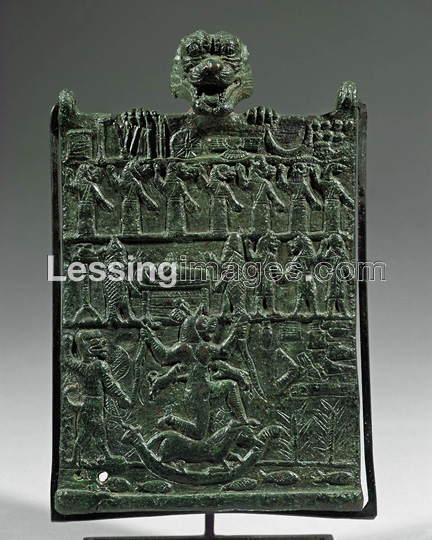
Detail from a drawing of a bronze plaque held in the Louvre.  Puradu-fish apkallu minister to an ill patient in bed. The lamp of Nusku is depicted at far left, and ugallu attack with upraised fists in concert with Lulal, identified by Wiggerman as "a minor apotropaic god." I believe that this plaque portrays an exorcism.  Drawn by Faucher-Gudin, from a bronze plaque of which an engraving was published by Clermont-Ganneau.  The original, which belonged to M. Péretié, is now in the collection of M. de Clercq. http://www.gutenberg.org/files/17323/17323-h/17323-h.htm#linkBimage-0039

Detail from a drawing of a bronze plaque held in the Louvre.
Puradu-fish apkallu minister to an ill patient in bed. The lamp of Nusku is depicted at far left, and ugallu attack with upraised fists in concert with Lulal, identified by Wiggerman as “a minor apotropaic god.”
I believe that this plaque portrays an exorcism.
Drawn by Faucher-Gudin, from a bronze plaque of which an engraving was published by Clermont-Ganneau.
The original, which belonged to M. Péretié, was in the collection of M. de Clercq before it was acquired by the Louvre.
http://www.gutenberg.org/files/17323/17323-h/17323-h.htm#linkBimage-0039%5B/caption%5D

Wiggermann’s 2007 article, “Some Demons of Time and Their Functions in Mesopotamian Iconography,” in Die Welt der Götterbilder, updates research on a number of the hybrid creatures under discussion in the present study.

[caption width="432" id="attachment_2864" align="aligncenter"]This is the actual bronze frieze from which the illustration above is extracted, held in the collection of the Louvre as AO 22205. This is the actual bronze frieze from which the illustration above is extracted, held in the collection of the Louvre as AO 22205.
(Frans A. M. Wiggermann, “Some Demons of Time and Their Functions in Mesopotamian Iconography,” in Die Welt der Götterbilder (ed. Hermann Spieckermann and Brigitte Groneberg; Beihefte zur Zeitschrift für die alttestamentliche Wissenschaft 376; Berlin: Walter de Gruyter, 2007).

The 1992 illustrated dictionary written by Jeremy A. Black and Anthony Green, Gods, Demons and Symbols of Ancient Mesopotamia, has provided an initial launching point for dealing with the maze of interrelated deities, demons, and composite creatures of ancient Mesopotamia.

(Jeremy A. Black and Anthony Green, Gods, Demons and Symbols of Ancient Mesopotamia (illustrated by Tessa Richards); Austin: University of Texas Press, 1992).

While the work is far from exhaustive and does not provide references for its sources, it has proven to be a valuable guide through the daunting complexities of the topic.
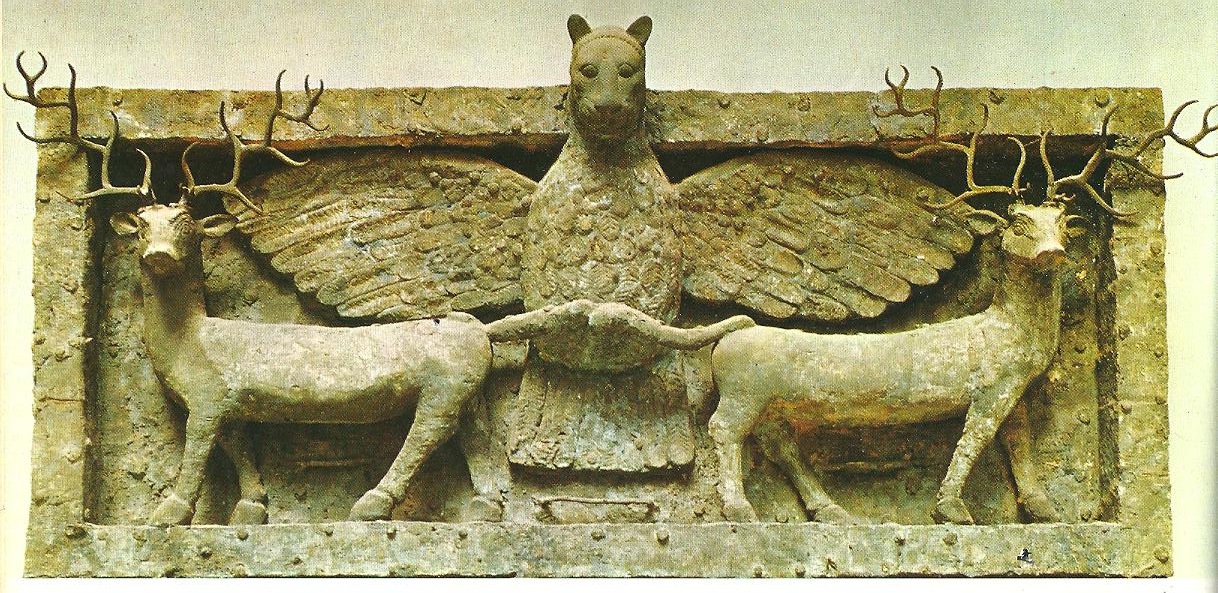
This lion-headed eagle was called Anzu in Akkadian and Imdugud in Sumerian. It was symbolic of the god Ningursu.  In the Myth of Anzu, the Anzu steals the me, the Tablet of Destinies, from the god Ea, when he disrobed to bathe.  The Tablet of Destinies was a cuneiform tablet upon which the fates of all creatures were written, granting its holder supreme power.  It was Ningursu who defeated the Anzu and recovered the me. Other versions of the myth claim that Anzu stole the me from Enlil, with Ninutra recovering it.  Source: Stephanie Dalley, Myths From Mesopotamia: Creation, The Flood, Gilgamesh, and Others, Oxford University Press, 1991.  http://www.piney.com/Babmythanzu.html This panel was excavated from the ruins at the base of the Temple of Goddess Ninhursag at Tell-Al-Ubaid in Southern Mesopotamia (Iraq).  Dated to the Early Dynastic Period, circa 2500 BCE, this artifact is currently held by The British Museum.  Photo by Osama Shukir Myhammed Amin, this file is licensed under the Creative Common Attribution-Share Alike 4.0 International license.  https://commons.wikimedia.org/wiki/File:Frieze_of_Imdugud_(Anzu)_grasping_a_pair_of_deer,_from_Tell_Al-Ubaid..JPG

This lion-headed eagle was called Anzu in Akkadian and Imdugud in Sumerian. It was symbolic of the god Ningursu.
In the Myth of Anzu, the Anzu steals the me, the Tablet of Destinies, from the god Ea, when he disrobed to bathe.
The Tablet of Destinies was a cuneiform tablet upon which the fates of all creatures were written, granting its holder supreme power.
It was Ningursu who defeated the Anzu and recovered the me. Other versions of the myth claim that Anzu stole the me from Enlil, with Ninutra recovering it.
Source: Stephanie Dalley, Myths From Mesopotamia: Creation, The Flood, Gilgamesh, and Others, Oxford University Press, 1991.
http://www.piney.com/Babmythanzu.html
This panel was excavated from the ruins at the base of the Temple of Goddess Ninhursag at Tell-Al-Ubaid in Southern Mesopotamia (Iraq).
Dated to the Early Dynastic Period, circa 2500 BCE, this artifact is currently held by The British Museum.
Photo by Osama Shukir Muhammed Amin, this file is licensed under the Creative Common Attribution-Share Alike 4.0 International license.
https://commons.wikimedia.org/wiki/File:Frieze_of_Imdugud_(Anzu)_grasping_a_pair_of_deer,_from_Tell_Al-Ubaid..JPG%5B/caption%5D

A number of works by Green are formative in the study of composite creatures. He has written numerous articles, among which the most significant are his 1984 article, “Beneficent Spirits and Malevolent Demons: The Iconography of Good and Evil in Ancient Assyria and Babylonia,” and his 1997 RlA article on “Mischwesen. B. Archäologie.”

(Anthony Green, “Beneficent Spirits and Malevolent Demons: The Iconography of Good and Evil in Ancient Assyria and Babylonia,” Visible Religion 3 (1984): pp. 80-105.

Anthony Green, “Mischwesen. B. Archäologie,” Reallexikon der Assyeriologie (RlA) 8: pp. 246-264.)

In 2003, Paul-Alain Beaulieu published The Pantheon of Uruk During the Neo-Babylonian Period. This work provides a systematic, period-specific treatment of Neo-Babylonian religion at the ancient site of Uruk.

(Paul-Alain Beaulieu, The Pantheon of Uruk During the Neo-Babylonian Period (CM 23; Leiden: Brill, 2003.  Note: this book in its entirety is available for free download from archive.org in multiple formats including .pdf. Say thank you to the publishers, Brill.)

One of the most important current resources is Iconography of Deities and Demons in the Ancient Near East, edited by Jürg Eggler, which is still under development, but available in electronic pre-publication form.

(Jürg Eggler, ed., Iconography of Deities and Demons in the Ancient Near East, Electronic Pre-Publication ed., n.p. [cited 11 July 2012 and verified 21 October, 2015]. Online: http://www.religionswissenschaft.uzh.ch/idd/index.php.)

[caption width="600" id="attachment_2344" align="aligncenter"]Amulet with a figure of Lamashtu From Mesopotamia, around 800 BC A demonic divinity who preys on mothers and children This is a protective image of Lamashtu, a fearsome female divinity of the underworld, intended to keep evil at bay. Although she is usually described in modern works as a demon, the writing of her name in cuneiform suggests that in Babylonia and Assyria she was regarded as a kind of goddess. Unlike the majority of demons, who acted only on the commands of the gods, Lamashtu practised evil apparently for its own sake and on her own initiative. There is a cuneiform incantation on the reverse to frighten her away. Lamashtu's principal victims were unborn and new-born babies. Slipping into the house of a pregnant woman, she tries to touch the woman's stomach seven times to kill the unborn baby, or she kidnaps the child. Magical measures against Lamashtu included wearing a bronze head of Pazuzu. Some of these plaques show a bedridden man rather than a pregnant woman, so they seem to relate to Lamashtu as a bringer of disease. Lamashtu is described in texts as having the head of a lion, the teeth of a donkey, naked breasts, a hairy body, stained hands, long fingers and finger nails, and the talons of a bird. Plaques also show her suckling a piglet and a whelp while she holds snakes in her hands. She stands on her sacred animal, the donkey, which is sometimes shown in a boat, riding through the underworld. H.W.F. Saggs, Babylonians (London, The British Museum Press, 1995) J. Black and A. Green, Gods, demons and symbols (London, The British Museum Press, 1992) http://www.britishmuseum.org/explore/highlights/highlight_objects/me/a/amulet_with_figure_of_lamashtu.aspx Amulet with a figure of Lamashtu
From Mesopotamia, around 800 BC
A demonic divinity who preys on mothers and children
This is a protective image of Lamashtu, a fearsome female divinity of the underworld, intended to keep evil at bay. Although she is usually described in modern works as a demon, the writing of her name in cuneiform suggests that in Babylonia and Assyria she was regarded as a kind of goddess. Unlike the majority of demons, who acted only on the commands of the gods, Lamashtu practised evil apparently for its own sake and on her own initiative. There is a cuneiform incantation on the reverse to frighten her away.
Lamashtu’s principal victims were unborn and new-born babies. Slipping into the house of a pregnant woman, she tries to touch the woman’s stomach seven times to kill the unborn baby, or she kidnaps the child. Magical measures against Lamashtu included wearing a bronze head of Pazuzu. Some of these plaques show a bedridden man rather than a pregnant woman, so they seem to relate to Lamashtu as a bringer of disease.
Lamashtu is described in texts as having the head of a lion, the teeth of a donkey, naked breasts, a hairy body, stained hands, long fingers and finger nails, and the talons of a bird. Plaques also show her suckling a piglet and a whelp while she holds snakes in her hands. She stands on her sacred animal, the donkey, which is sometimes shown in a boat, riding through the underworld.
H.W.F. Saggs, Babylonians (London, The British Museum Press, 1995)
J. Black and A. Green, Gods, Demons and Symbols of Ancient Mesopotamia (Austin, University of Texas Press, 1992)
http://www.britishmuseum.org/explore/highlights/highlight_objects/me/a/amulet_with_figure_of_lamashtu.aspx

Its production is a research project of the History of Religions Chair of the University of Zurich, Switzerland, in collaboration with Brill Academic Publishers. I have gained much from this rich and high quality resource as far as it goes, but IDD treatment of many of the composite creatures discussed in my study is still pending.

The 2004 catalogue accompanying the exhibition titled “Dragons, Monsters and Fabulous Beasts in the Bible Lands Museum, Jerusalem” and compiled by Joan Goodnick Westenholz illustrates the formation and function of hybrid creatures in the ancient Near East and the classical world.

The catalogue, following the format of the exhibition, is divided into four main areas: “creatures of the sea, creatures of the earth, creatures of the air, and the battles of the gods and mortals against the monsters.”

(Joan Goodnick Westenholz, Dragons, Monsters and Fabulous Beasts, Rubin Mass, 2007, p. 9.)

The treatment of selected composite beings is detailed, but limited to the examples specific to the exhibit.

A History of the Animal World in the Ancient Near East, edited by Billie Jean Collins (2002), focuses on animals found in Anatolia, Egypt, Mesopotamia, Iran, and Syro-Palestine, with particular attention to the native fauna; animals in art, literature, and religion; and the cultural use of animals.

(Billie Jean Collins, ed., A History of the Animal World in the Ancient Near East (Handbook of Oriental Studies 64; Leiden: Brill, 2002). Note: Chapter 5 by Margaret Cool Root, “Animals in the Art of Ancient Iran,” is available for download from archive.org.)

The volume is more a historical narrative of human relations with animals than a history of animals in the ancient world. As such, it provides insights into rationales behind selection of certain animals to represent particular characteristics of divine or sub-divine beings.

Collins builds on the work of E. Douglas Van Buren, whose formative study, The Fauna of Ancient Mesopotamia as Represented in Art (1939), focuses on forty-eight animal species, but without discussing their significance.”

(E. Douglas Van Buren, The Fauna of Ancient Mesopotamia as Represented in Art (AnOr 18; Rome: Institutum Biblicum, 1939).

Constance Ellen Gane, Composite Beings in Neo-Babylonian Art, Doctoral Dissertation, University of California at Berkeley, 2012, pp. 3-4.

Kvanvig: Dates the apkallu to the Beginning of the 1st Millennium BCE

“Most of the sources we have to these imaginations developed around the apkallus are Assyrian. This does not, however, mean that the imaginations only belonged to Assyrian mythology. Of the three lists of the apkallus known, two are Babylonian, and Bīt Mēseri was known in Babylonia. The most extensive description of their role we find in Berossos and the most systematic transition from apkallus to ummanus exists on the Uruk tablet.

This photograph of Tablet IV of the Poem of Erra is dated to 629-539 BCE.  https://tourguidegirl.files.wordpress.com/2014/11/img_0744.jpg

This photograph of Tablet IV of the Poem of Erra is dated to 629-539 BCE.
https://tourguidegirl.files.wordpress.com/2014/11/img_0744.jpg

The apkallus play an important role in the Poem of Erra, which according to most scholars is Babylonian. The tendency to ascribe compositions to apkallus is also attested in Babylonian sources. Berossos knows the reliefs of fish-apkallus existed. This motif is generally well attested in Late Babylonian representations.

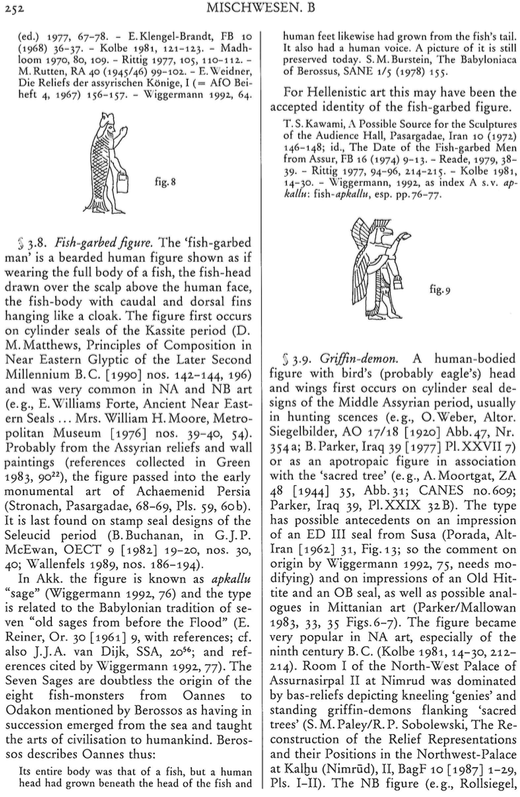
(Cf. Green, “Mischwesen,” p. 252.)

Excerpt from Anthony Green, "Mischwesen. B." (Fish-garbed figure). Reallexikon der Assyriologie, 1994, p. 252.

Excerpt from Anthony Green, “Mischwesen. B.” (Fish-garbed figure). Reallexikon der Assyriologie, 1994, p. 252.

Clay figurines of the apkallus are found at Ur. There is also no reason to think that these imaginations were esoteric, belonging to a limited class of scholars. Imaginations of the apkallus are not limited to a certain genre of literature, but appear in all sorts of written compositions and in a variety of practices and depictions.

(Cf. Rittig, Assyrisch-babylonische Kleinplastik, pp. 72, 83.)

When I first gathered and analyzed the sources to the apkallus preparing for my dissertation in 1984, later published in Roots of Apocalyptic in 1989, I concluded:

“The distinction between the group of seven sages and the group of four in Bīt Mēseri, and between apkallus and ummanus in W 20 030, 7, demonstrates a special way of interpreting history: the primeval history is “the history of revelation,” and the history which follows is the time when this revelation is transmitted and unfolded.”

(Kvanvig, Roots of Apocalyptic, p. 201.)

Parpola explicitly supported this argument in his edition of the Assyrian and Babylonian letters.

(Parpola, Letters from Assyrian and Babylonian Scholars, XVIII.)

The textual and iconographic basis for understanding this part of Assyrian and Babylonian mythology is now considerably widened. But this extension of the source material has not undermined the assumption in the quotation above, but has provided the opportunity to give a much more refined and comprehensive presentation of a fairly late development in Mesopotamian religion.

At the present it is difficult to draw a diachronic picture of the origin and development of the apkallu tradition. We find the oldest reference to the seven apkallus in Eridu in a Sumerian temple hymn, where the tablet is dated to the Old Babylonian period.

(Cf. A.W. Sjöberg and E. Bergmann, The Collection of the Sumerian Temple Hymns, New York, 1969, p. 25.)

The text is hard to interpret, but the context of the apkallus is both the apsû, the me, and Enki’s son Asarluhi. The time is about the same as the date of the Sumerian tablet with the Adapa Myth, Adapa also coming from Eridu. The fact that these two sources are Sumerian does not necessarily indicate that the concept of the apkallus in Eridu is older than the Old Babylonian period.

All the other sources come from the first millennium. The archeological evidence also points in the same direction; the depictions of apkallus in figurines, on cylinder seals and on reliefs start in the beginning of the first millennium.

Bird Apkallū and Fish Apkallū, the so-called purādu-fish, side by side. Apkallū statuettes of this design were buried in appropriate places in the home of a Babylonian exorcist. They were believed to have prophylactic qualities, guarding the home from evil.

Bird Apkallū and Fish Apkallū, the so-called purādu-fish, side by side. Apkallū statuettes of this design were buried in appropriate places in the home of a Babylonian exorcist. They were believed to have prophylactic qualities, guarding the home from evil.

The first textual witness from the first millennium might be the Poem of Erra. Here the apkallus are placed in the framework of primeval history. They were responsible for Marduk’s attire before the flood; they survived the flood and were sent back to the apsû after the flood.

This composition is held to be Babylonian. Thus it is not likely to regard the development of the apkallu tradition as simply an Assyrian matter. The pairing of kings and apkallus as found in the two Babylonian lists, Berossos and the Uruk tablet, seems to reflect the position of the ummanus at the royal courts also in Babylonia.

As shown, there existed a chronography pairing Assyrian kings and ummanus, which demonstrated their position in the first millennium. Thus the expansion of the apkallu tradition seems intimately connected to the increasing importance of the scholarly guilds, in their attempt to systemize and legitimize the lore of their professions from the beginning of the first millennium.”

Helge Kvanvig, Primeval History: Babylonian, Biblical, and Enochic: An Intertextual Reading, Brill, 2011, pp. 156-8.

Kvanvig: Assurbanipal Studied Inscriptions on Stone from Before the Flood

“The first thing to notice is the strange expression salmīšunu, “their images.” The pronoun refers back to the primeval ummanus / apkallus. They had “images,” created by Ea on earth. A line from Bīt Mēseri sheds light on the issue.

šiptu šipat Marduk āšipu salam Marduk

“The incantation is the incantation of Marduk, the āšipu is the image of Marduk.”

(Bīt Mēseri II, 226. Cf. Gerhard Meier, “Die zweite Tafel der Serie bīt mēseri,” AfO 14, 1941-4, pp. 139-52, 150).

In his role as exorcist, the āšipu is here an image of the deity itself. In the Poem of Erra something similar must have been thought. The āšipu and other priests with responsibility for the divine statues were the earthly counterparts of the transcendent ummanus / apkallus. They were their images on earth.

"Sometimes animal hybrids ... appear to take part in rituals....some types are clearly minor deities, since they wear the horned cap as a mark of their divinity...others may be human. A ...winged god, standing or kneeling, holds a bucket and cone ... in the scenes of "ritual" centered on the stylized tree. A similar female figure holds a chaplet of beads....A third figure carries a flowering branch, sometimes also a sacrificial (?) goat. Sometimes he wears the horned cap, and even when does not he often has wings. Presumably, therefore, such figures are also non-mortal; they may represent the Seven Sages in human guise." From Jeremy Black and Anthony Green, Gods, Demons and Symbols of Ancient Mesopotamia, 1992, pp. 86-8.

“Sometimes animal hybrids … appear to take part in rituals….some types are clearly minor deities, since they wear the horned cap as a mark of their divinity…others may be human. A …winged god, standing or kneeling, holds a bucket and cone … in the scenes of “ritual” centered on the stylized tree. A similar female figure holds a chaplet of beads….A third figure carries a flowering branch, sometimes also a sacrificial (?) goat. Sometimes he wears the horned cap, and even when does not he often has wings. Presumably, therefore, such figures are also non-mortal; they may represent the Seven Sages in human guise.”
From Jeremy Black and Anthony Green, Gods, Demons and Symbols of Ancient Mesopotamia, 1992, pp. 86-8.

We must admit that the following text from line 34 is not very clear. Does the ummanus from line 34 mean the primeval apkallus, or does it refer to the priests as ummanus? If we follow the interpretation underlying Foster’s translation, the second option is preferable.

“He himself gave those same (human) craftsmen

great discretion and authority;

he gave them wisdom and great dexterity.

They have made (his) precious image radiant,

even finer than before.”

(Poem of Erra II, pp. 34-6. Foster, Before the Muses, p. 892).

The text thus describes how Ea equips the earthly ummanus with wisdom and dexterity to make them able to restore Marduk’s statue.

To care for the divine statue, to make sure that it is qualified for the manifestation of the divinity, is to secure cosmic stability. This was the great responsibility of the āšipu when they acted as earthly images of the apkallus, the guardians of the cosmic order.

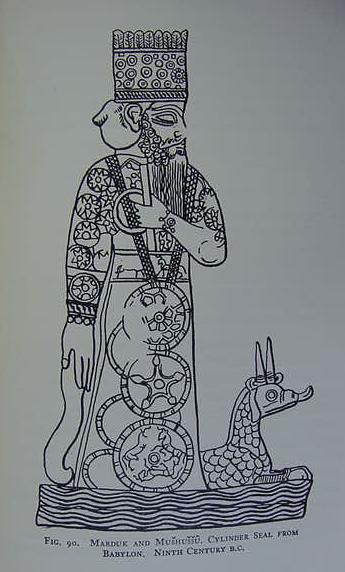
Marduk, the supreme god of Babylon. At his feet the Mushhushshu Serpent-dragon, which he overpowered when he defeated Tiamat, mother of the gods, who sought to destroy the land-dwelling gods.<br /> In this myth the Serpent-dragon was a creature of Tiamat's (for the image cf. p. 301. Stephen Herbert Langdon. The Mythology of All Races- Semitic. Vol. 5. Boston. Marshall Jones Company. 1931).<br /> This drawing is after a 9th century BCE Babylonian cylinder seal. The Assyrians later declared their God Asshur as the god who defeated Tiamat, and Marduk's serpent-dragon was portrayed as accompanying Asshur.<br /> Marduk's robe depicts the heavenly night sky with all its stars.<br /> I believe that the circular medallions hanging from his neck are among the few portrayals of the me, the tablets of destinies, in all Assyrian art.<br /> Marduk was also called "the son of the Sun," "the Sun" and "bull-calf of the Sun" (Babylonian amar-utu).<br /> http://www.bibleorigins.net/SerpentDragonMardukAsshur.html

Marduk, the supreme god of Babylon. At his feet the Mushhushshu Serpent-dragon, which he overpowered when he defeated Tiamat, mother of the gods, who sought to destroy the land-dwelling gods.
In this myth the Serpent-dragon was a creature of Tiamat’s (for the image cf. p. 301. Stephen Herbert Langdon. The Mythology of All Races- Semitic. Vol. 5. Boston. Marshall Jones Company. 1931).
This drawing is after a 9th century BCE Babylonian cylinder seal. The Assyrians later declared their God Asshur as the god who defeated Tiamat, and Marduk’s serpent-dragon was portrayed as accompanying Asshur.
Marduk’s robe depicts the heavenly night sky with all its stars.
I believe that the circular medallions hanging from his neck are among the few portrayals of the me, the tablets of destinies, in all Assyrian art.
Marduk was also called “the son of the Sun,” “the Sun” and “bull-calf of the Sun” (Babylonian amar-utu).
http://www.bibleorigins.net/SerpentDragonMardukAsshur.html

The supreme responsibility on earth for cosmic stability rested on the king. Therefore the king needed to be depicted as wise, having insight into the hidden laws of the cosmos. This is a reoccurring topic in descriptions of kings and their own self-presentations.

It reaches as far back as the third millennium, but shows an increasing tendency in the first millennium.

(Cf. R.F.G. Sweet, “The Sage in Akkadian Literature: A Philological Study,” in The Sage in Israel and the Ancient Near East, eds. J.G. Gammie and L.G. Perdue, Winona Lake, 1990, pp. 45-65, 51-7).

In their boasting of superior wisdom the kings of the first millennium compared their own wisdom with the wisdom of the primary apkallu, Adapa:

Sargon claims to be: “a wise king, skilled in all learning, the equal of

the apkallu, who grew up in wise counsel and attained full stature in good judgement.”

(Cylinder Inscription, 38. Cf. David Gordon Lyon, Keilschriftentexte Sargon’s Königs von Assyrien, (722-705 v. CHR), AB. Leipzig, 1883, pp. 34-5. Translation according to Sweet, “The Sage in Akkadian Literature,” p. 53).

Sennacherib presents himself as one to whom “Ninšiku gave wide understanding and equality with the apkallu, Adapa, and granted profound wisdom.”

(Bull Inscription, 4. Cf. D.D. Luckenbill, The Annals of Senacherib, Chicago, 1924, p. 117; translation according to Sweet, “The Sage in Akkadian Literature,” p. 53).

Prism of Sennacherib, the Oriental Institute at the University of Chicago.  Daniel David Luckenbill, The Annals of Sennacherib, University of Chicago Press, Chicago, 1924. https://oi.uchicago.edu/sites/oi.uchicago.edu/files/uploads/shared/docs/oip2.pdf

Prism of Sennacherib, the Oriental Institute at the University of Chicago.
Daniel David Luckenbill, The Annals of Sennacherib, University of Chicago Press, Chicago, 1924.
https://oi.uchicago.edu/sites/oi.uchicago.edu/files/uploads/shared/docs/oip2.pdf

Assurbanipal describes his comprehensive wisdom in the following way:

Marduk, the apkallu of the gods, gave me wide understanding and extensive intelligence (and) Nabu, the scribe (who knows) everything, granted me his wise teachings ….

I have learned the art of the apkallu, Adapa, (so that now) I am familiar with the secret storehouse of all scribal learning, (including) celestial and terrestrial portents.

I can debate in an assembly of ummanus and discuss with the clever apkal šamni (oil diviners) (the treatise) “if the liver is a replica of the sky.” I used to figure out complicated divisions and multiplications that have no solutions.

Time and again I have read the cleverly written compositions in which the Sumerian is obscure and the Akkadian is difficult to interpret correctly.

I have studied inscriptions on stone from before the Flood which are sealed, obscure and confused.”

(Tablet L4 obv. I, 10-8. Cf. M. Streck, Assurbanipal und die letzen assyrischen König bis zum Untergange Nineveh’s, vol. II, Leipzig, 1916, 254-7.)

Helge Kvanvig, Primeval History: Babylonian, Biblical, and Enochic: An Intertextual Reading, Brill, 2011, pp. 138-9.

Curnow: Boundaries of Legend and History

“In this chapter I shall be concerned with wise characters from myth and legend. I would not wish to pretend that the dividing line between myth, legend and history can be established with any certainty, and it may be that some of the characters who appear here have been unfairly removed from the historical record.

On the other hand, some cases do appear to be clear cut. In the end, if some characters find themselves in the wrong places, no harm is done as everyone who needs to appear somewhere will appear somewhere. Where it is appropriate and available, I have used the distinction between antediluvian and postdiluvian to mark the boundary between legend and history.

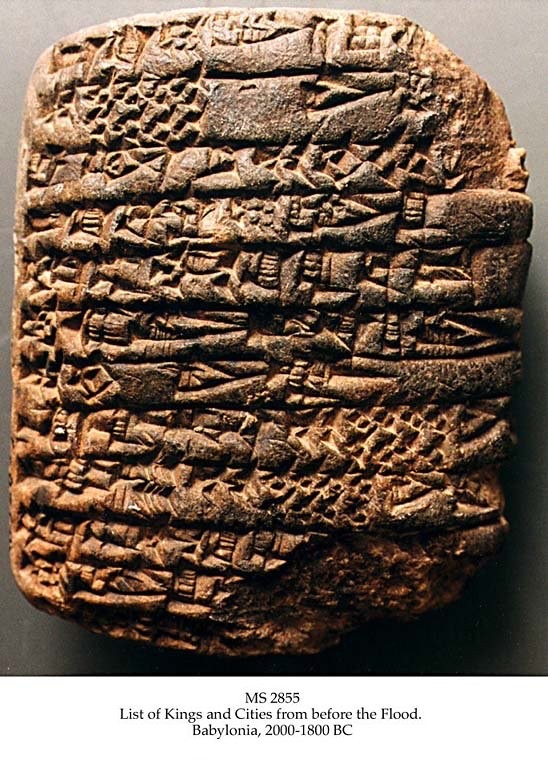
Text:<br />  "IN ERIDU: ALULIM RULED AS KING 28,800 YEARS. ELALGAR RULED 43,200 YEARS. ERIDU WAS ABANDONED. KINGSHIP WAS TAKEN TO BAD-TIBIRA. AMMILU'ANNA THE KING RULED 36,000 YEARS. ENMEGALANNA RULED 28,800 YEARS. DUMUZI RULED 28,800 YEARS. BAD-TIBIRA WAS ABANDONED. KINGSHIP WAS TAKEN TO LARAK. EN-SIPA-ZI-ANNA RULED 13,800 YEARS. LARAK WAS ABANDONED. KINGSHIP WAS TAKEN TO SIPPAR. MEDURANKI RULED 7,200 YEARS. SIPPAR WAS ABANDONED. KINGSHIP WAS TAKEN TO SHURUPPAK. UBUR-TUTU RULED 36,000 YEARS. TOTAL: 8 KINGS, THEIR YEARS: 222,600"<br />  MS in Sumerian on clay, probably Larsa Babylonia, 2000-1800 BC, 1 tablet, 8,1x6,5x2,7 cm, single column, 26 lines in cuneiform script.<br />  5 other copies of the Antediluvian king list are known only: MS 3175, 2 in Oxford: Ashmolean Museum, one is similar to this list, containing 10 kings and 6 cities, the other is a big clay cylinder of the Sumerian King List, on which the kings before the flood form the first section, and has the same 8 kings in the same 5 cities as the present.<br />  A 4th copy is in Berkeley: Museum of the University of California, and is a school tablet. A 5th tablet, a small fragment, is in Istanbul.<br />  The list provides the beginnings of Sumerian and the world’s history as the Sumerians knew it. The cities listed were all very old sites, and the names of the kings are names of old types within Sumerian name-giving. Thus it is possible that correct traditions are contained, though the sequence given need not be correct. The city dynasties may have overlapped.<br />  It is generally held that the Antediluvian king list is reflected in Genesis 5, which lists the 10 patriarchs from Adam to Noah, all living from 365 years (Enoch) to 969 years (Methuselah), altogether 8,575 years.<br />  It is possible that the 222,600 years of the king list reflects a more realistic understanding of the huge span of time from Creation to the Flood, and the lengths of the dynasties involved.<br />  The first of the 5 cities mentioned, Eridu, is Uruk, in the area where the myths place the Garden of Eden, while the last city, Shuruppak, is the city of Ziusudra, the Sumerian Noah.<br />  Jöran Friberg: A Remarkable Collection of Babylonian Mathematical Texts. Springer 2007.<br />  Sources and Studies in the History of Mathematics and Physical Sciences.<br />  Manuscripts in the Schøyen Collection, vol. 6, Cuneiform Texts I. pp. 237-241.  <br /> Andrew George, ed.: Cuneiform Royal Inscriptions and Related Texts in the Schøyen Collection, Cornell University Studies in Assyriology and Sumerology, vol. 17,<br />  Manuscripts in the Schøyen Collection, Cuneiform texts VI. CDL Press, Bethesda, MD, 2011, text 96, pp. 199-200, pls. LXXVIII-LXXIX.<br />  Andrew E. Hill &amp; John H. Walton: A Survey of the Old Testament, 3rd ed., Grand Rapids, Mi., Zondervan Publ. House, 2009, p. 206.<br />  Zondervan Illustrated Bible, Backgrounds, Commentary. John H. Walton, gen. ed. Grand Rapids, Mich., Zondervan, 2009, vol 1, p. 482, vol. 5, p. 398.

Text:
“IN ERIDU: ALULIM RULED AS KING 28,800 YEARS. ELALGAR RULED 43,200 YEARS. ERIDU WAS ABANDONED. KINGSHIP WAS TAKEN TO BAD-TIBIRA. AMMILU’ANNA THE KING RULED 36,000 YEARS. ENMEGALANNA RULED 28,800 YEARS. DUMUZI RULED 28,800 YEARS. BAD-TIBIRA WAS ABANDONED. KINGSHIP WAS TAKEN TO LARAK. EN-SIPA-ZI-ANNA RULED 13,800 YEARS. LARAK WAS ABANDONED. KINGSHIP WAS TAKEN TO SIPPAR. MEDURANKI RULED 7,200 YEARS. SIPPAR WAS ABANDONED. KINGSHIP WAS TAKEN TO SHURUPPAK. UBUR-TUTU RULED 36,000 YEARS. TOTAL: 8 KINGS, THEIR YEARS: 222,600”
MS in Sumerian on clay, probably Larsa Babylonia, 2000-1800 BC, 1 tablet, 8,1×6,5×2,7 cm, single column, 26 lines in cuneiform script.
5 other copies of the Antediluvian king list are known only: MS 3175, 2 in Oxford: Ashmolean Museum, one is similar to this list, containing 10 kings and 6 cities, the other is a big clay cylinder of the Sumerian King List, on which the kings before the flood form the first section, and has the same 8 kings in the same 5 cities as the present.
A 4th copy is in Berkeley: Museum of the University of California, and is a school tablet. A 5th tablet, a small fragment, is in Istanbul.
The list provides the beginnings of Sumerian and the world’s history as the Sumerians knew it. The cities listed were all very old sites, and the names of the kings are names of old types within Sumerian name-giving. Thus it is possible that correct traditions are contained, though the sequence given need not be correct. The city dynasties may have overlapped.
It is generally held that the Antediluvian king list is reflected in Genesis 5, which lists the 10 patriarchs from Adam to Noah, all living from 365 years (Enoch) to 969 years (Methuselah), altogether 8,575 years.
It is possible that the 222,600 years of the king list reflects a more realistic understanding of the huge span of time from Creation to the Flood, and the lengths of the dynasties involved.
The first of the 5 cities mentioned, Eridu, is Uruk, in the area where the myths place the Garden of Eden, while the last city, Shuruppak, is the city of Ziusudra, the Sumerian Noah.
Jöran Friberg: A Remarkable Collection of Babylonian Mathematical Texts. Springer 2007.
Sources and Studies in the History of Mathematics and Physical Sciences.
Manuscripts in the Schøyen Collection, vol. 6, Cuneiform Texts I. pp. 237-241.
Andrew George, ed.: Cuneiform Royal Inscriptions and Related Texts in the Schøyen Collection, Cornell University Studies in Assyriology and Sumerology, vol. 17,
Manuscripts in the Schøyen Collection, Cuneiform texts VI. CDL Press, Bethesda, MD, 2011, text 96, pp. 199-200, pls. LXXVIII-LXXIX.
Andrew E. Hill & John H. Walton: A Survey of the Old Testament, 3rd ed., Grand Rapids, Mi., Zondervan Publ. House, 2009, p. 206.
Zondervan Illustrated Bible, Backgrounds, Commentary. John H. Walton, gen. ed. Grand Rapids, Mich., Zondervan, 2009, vol 1, p. 482, vol. 5, p. 398.

Mesopotamia

I shall begin again in Mesopotamia with the enigmatic figures known as the apkallu. As has been noted [2.2], technically apkallu simply seems to mean “wisest” or “sage.”

However in Mesopotamian mythology, the term is also applied to a strange and complex group of individuals.

Unfortunately, the legends about them survive in only a fragmentary and not entirely coherent form, although the fundamental core of the stories told about them is fairly clear.

In the days between the creation of mankind and the great flood that destroyed nearly all of it, Ea sent seven sages, the apkallu, for the instruction of mankind. There was a tradition that each was a counsellor to an early king, but it is unclear whether this was an original feature of the myth or a later addition.

Central to the myth is the idea that they brought the skills and knowledge necessary for civilization.

The god Ea at far left, wearing the horned headdress indicative of divinity, with water coursing from his shoulders. 

A fish-apkallū is in the iconic posture with right hand raised in blessing or exorcism, with the banduddu bucket in his left hand. 

The next apkallū wields an indistinct and as yet undefined angular object in his right hand, with the typical banduddu bucket in his left. 

The entity at far right, which appears to be wearing a horned tiara indicative of divinty, remains unidentified and undefined.

The god Ea at far left, wearing the horned headdress indicative of divinity, with water coursing from his shoulders. 

A fish-apkallū is in the iconic posture with right hand raised in blessing or exorcism, with the banduddu bucket in his left hand. 

The next apkallū wields an indistinct and as yet undefined angular object in his right hand, with the typical banduddu bucket in his left. 

The entity at far right, which appears to be wearing a horned tiara indicative of divinty, remains unidentified and undefined.

The first of the apkallu was Adapa, a name that itself meant wise (Bottéro 1992, p. 248). He was also known as Uan, perhaps a pun on the word ummanu meaning “craftsman” (Dalley 2000, p. 328). According to the principal source for this, the ancient historian Berossus:

“… he gave them an insight into letters and sciences, and every kind of art. He taught them to construct houses, to found temples, to compile laws, and explained to them the principles of geometrical knowledge. He made them distinguish the seeds of the earth, and showed them how to collect fruits. In short he instructed them in everything which could tend to soften manners and humanise mankind. From that time, so universal were his instructions, nothing material has been added by way of improvement.” (Hodges 1876, p. 57).

These gifts to mankind are sometimes referred to by the Sumerian word “me,” and comprised all that was required for civilization. They were perceived as much as rules for correct living as knowledge, and behind these rules stood the gods as enforcing agents.

In the complex concept of me can be seen, perhaps, a fundamental principle of human social order backed up by divine sanction. Soden (1994, p. 177) suggests that the order associated with me extended far beyond the human and encompassed the entire cosmos.

In any event, the story of Adapa clearly suggests that the wise bring what is required for civilization to exist.”

Trevor Curnow, Wisdom in the Ancient World, Bloomsbury, 2010, pp. 39-40.

Kvanvig: Berossos and Primeval History

“Berossos does not only list the sages in succession. He is especially interesting because of the information he gives about the first sage, Oannes, who parallels Uan in the two other lists. Berossos’ account is here so noteworthy that we quote it as a whole:

“In Babylonia there was a large number of people of different ethnic origins who had settled in Chaldea. They lived without discipline and order, just like animals.

In the very first year there appeared from the Red Sea (the Persian Gulf) in an area bordering Babylonia a frightening monster named Oannes, just as Apollodoros says in his history.

It had the whole body of a fish, but underneath and attached to the head of the fish there was another head, human, and joined to the tail of the fish, feet, like those of a man, and it had a human voice.

Its form has been preserved in sculpture to this day.

Berossos says that this monster spent its days with men, never eating anything, but teaching men the skills necessary for writing and for doing mathematics and for all sorts of knowledge: how to build cities, found temples, and make laws.

It taught men how to determine borders and divide land, also how to plant seeds and then harvest their fruits and vegetables. In short, it taught men all those things conducive to a stalled and civilized life.

Since that time nothing further has been discovered.

At the end of the day, this monster, Oannes, went back to the sea and spent the night. It was amphibious, able to live both on land and in the sea.

Later also other monsters similar to Oannes appeared, about whom Berossos gave more information in his writings on the kings. Berossos says about Oannes that he had written as follows about the creation and government of the world and had given these explanations to man.”

(A creation story based on Enuma Elish follows.)

(Eusebius, (Arm.) Chronicles, p.6, 8-9, 2 and Syncellus p. 49, 19).

It is not difficult to recognize the Sumerian concept of civilization in Berossos’ account. We have met this several times earlier in the way it also permeated some of the Babylonian literature.

Fish-man known as a Kulullû. Terracotta figurine (8th-7th BCE) in the Louvre collection, Nr. 3337.  The Kulullû is distinct from the fish-Apkallū. They are not the same.

Fish-man known as a Kulullû. Terracotta figurine (8th-7th BCE) in the Louvre collection, Nr. 3337.
The Kulullû is distinct from the fish-Apkallū. They are not the same.

In Atrahasis we met it in the relation between the lullû-man and the ilu-man. In the Eridu Genesis we met in it the description of human’s first uncivilized state, before the gods had given the human race kingship and they had established cities.

Sowie Museum 9-1796, sun-dried clay figurine of a suhurmaššu, probably from Aššur. Previously published: H.F. Lutz, University of California Publications in Semitic Philology 9/7 (1930), Rittig, 97.  Sowie Museum 9-1795, sun-dried figurine of a kilīlu, allegedly from Aššur. Previously published: Lutz, op. cit., Rittig, 95f. Plate XV.

Sowie Museum 9-1796, sun-dried clay figurine of a suhurmaššu, probably from Aššur. Previously published: H.F. Lutz, University of California Publications in Semitic Philology 9/7 (1930), Rittig, 97.
Sowie Museum 9-1795, sun-dried figurine of a kilīlu, allegedly from Aššur. Previously published: Lutz, op. cit., Rittig, 95f. Plate XV.

In the Royal Chronicle of Lagash this wrecked state of humankind was transposed to the period after the destruction by the flood. In condensed form, we find it in the Sumerian concept of me, which is linked to the names of both antediluvian kings and sages.

In many ways Berossos’ account is a description of how the me first was bestowed on the human race after they had lived like animals.

In the sources we have dealt with so far, Berossos is the first who explicitly combines the tradition of the apkallus with other blocks of tradition from primeval time. This may be suggested in Bīt Mēseri in the transition from the seven to the four sages, but it is not explicitly stated.”

Helge Kvanvig, Primeval History: Babylonian, Biblical, and Enochic: An Intertextual Reading, Brill, 2011, pp. 113-4.

Kvanvig: Discrepancies Between the Lists

“The Sumerian concept of me, “cosmic ordinances,” has a wide range of meanings connected to culture and human conditions. The myth Inanna and Enki has a list which gives good illustration of what is regarded as me: human relations, cultural relations, political relations, occupations, sciences, crafts, arts, deeds, etc. —in short, all the human characteristics that are connected to civilized life.

(Cf. also W. van Binsbergen and F. Wiggermann, “Magic in History: A Theoretical Perspective, and Its Application to Ancient Mesopotamia,” in Mesopotamian Magic: Textual, Historical, and Interpretative Perspectives, ed. T. Busch and K. van der Toorn, AMD, Groningen 1999, 3-34, 20-25.)

Marduk, the supreme god of Babylon. At his feet the Mushhushshu Serpent-dragon, which he overpowered when he defeated Tiamat, mother of the gods, who sought to destroy the land-dwelling gods.<br />  In this myth the Serpent-dragon was a creature of Tiamat's (for the image cf. p. 301. Stephen Herbert Langdon. The Mythology of All Races- Semitic. Vol. 5. Boston. Marshall Jones Company. 1931).<br />  This drawing is after a 9th century BCE Babylonian cylinder seal. The Assyrians later declared their God Asshur as the god who defeated Tiamat, and Marduk's serpent-dragon was portrayed as accompanying Asshur.<br />  Marduk's robe depicts the heavenly night sky with all its stars.<br />  I believe that the large circular medallions hanging from Marduk's neck are among the few portrayals of the me, the tablets of destinies, in all Assyrian art.<br />  Marduk was also called "the son of the Sun," "the Sun" and "bull-calf of the Sun" (Babylonian amar-utu).<br />  http://www.bibleorigins.net/SerpentDragonMardukAsshur.html

Marduk, the supreme god of Babylon. At his feet the Mushhushshu Serpent-dragon, which he overpowered when he defeated Tiamat, mother of the gods, who sought to destroy the land-dwelling gods.
In this myth the Serpent-dragon was a creature of Tiamat’s (for the image cf. p. 301. Stephen Herbert Langdon. The Mythology of All Races- Semitic. Vol. 5. Boston. Marshall Jones Company. 1931).
This drawing is after a 9th century BCE Babylonian cylinder seal. The Assyrians later declared their God Asshur as the god who defeated Tiamat, and Marduk’s serpent-dragon was portrayed as accompanying Asshur.
Marduk’s robe depicts the heavenly night sky with all its stars.
I believe that the large circular medallions hanging from Marduk’s neck are among the few portrayals of the me, the tablets of destinies, in all Assyrian art.
Marduk was also called “the son of the Sun,” “the Sun” and “bull-calf of the Sun” (Babylonian amar-utu).
http://www.bibleorigins.net/SerpentDragonMardukAsshur.html

These royal names seem to have been reinterpreted in the apkallu-lists: en-me-du-ga, “Lord of the good me;” en-me-galamma, “Lord who perfects me;” en-me-bulùg-gá, “Lord who refines me.”

(Cf. F.A.M. Wiggermann, Mesopotamian Protective Spirits: The Ritual Texts, vol. 1, CM. Groningen, 1992, 77.)

We will return to the names of the significant first and seventh sage in our discussion of Bīt Mēseri below.

The Uruk tablet contains two successive lists: first, the one of the seven apkallus; then, after a clear transition, a new list of ten scholars.

The new list of ten starts with the apkallu Nungalpiriggal who operated during the reign of Enmerkar. We have a similar division into two lists in Bīt Mēseri as well. There we find first a list of seven and then a list of four.

Also in Bīt Mēseri, Nungalpiriggal, operating under Enmerkar, is the first apkallu in the new list. There is a lacuna in the introduction to the second list on the Uruk tablet. Van Dijk restores here “after the flood,” but considers also the possibility “in Uruk,” since Enmerkar was king in Uruk.

The first restoration seems most likely, since the Uruk tablet does not mention cities in any other place. The notice of the flood belongs to the style of the Antediluvian King List, which the Uruk tablet is part of.

It is interesting to notice that also Berossos seems to have started the list of postdiluvian kings with Enmerkar, with the introduction, “after the flood.” Thus, there seems to be a stable tradition in these lists of scholars to start the postdiluvian period with the apkallu operating under Enmerkar, king of Uruk.

This is quite interesting, since it is in opposition to the order of the Sumerian King List, which starts with the dynasty of Kish, and lists Uruk as the second dynasty. Bīt Mēseri indeed includes Kish, but only after Uruk.

The Uruk tablet does not mention Kish, but continues with Gilgamesh as king, who according to the King List ruled in Uruk as well. The reason for this must be that the list of apkallus is generated according to the significance of the sages and only secondarily merged with the King List.

There is a clear division in rank between the scholars of the two lists, although this is expressed differently in Bīt Mēseri and the Uruk tablet. We concentrate first on the Uruk text. All the first seven in the Uruk tablet are designated apkallu, which is the highest honorary title for a wise man, “sage, expert.”

Helge Kvanvig, Primeval History: Babylonian, Biblical, and Enochic: An Intertextual Reading, Brill, 2011, pp. 110-1.

Transcendant Radiance of the Gods

“Although the gods were visualized in anthropomorphic form, with human emotions and physical needs and desires, important distinctions set the gods apart from humanity.

First, they had transcendent divine powers in the universe, over other gods, and over human lives and institutions. Second was the gods’ sublime position in an ordered universe, in which divinity could be expressed in terms of rank and precedence. Sublime power and position inspired fear, trembling and speechlessness in the presence of a god (Jacobsen 1976: 3–5; Bottéro 1992: 210).

Divinity was furthermore revealed by a radiant brightness, not as of heat but as of a gem-like sheen, blinding, pure and holy. This was sometimes seen as separate from the divine being, worn like a brilliant garment or headgear, or set about the features as glories. In art, this property could be represented by brightly coloured inlays on the surface of figures, or rosettes or stars sewn on textiles. In poetry, this concept was expressed by words meaning awe-inspiring radiance and sublime purity.

A distinctive aspect of Sumerian religious thought was the concept called ‘me’, literally ‘is’. This was an individual, differentiated, abstract power that defined and controlled both divine attributes and attributes of human civilization (van Dijk 1971: 440–2).

Thus there was a ‘me’ of individual gods, temples and lands, and of human institutions, states and accomplishments such as kingship, wisdom, music, old age or carpentry. According to the Sumerian myth of Inanna and Enki, Enki controlled these but Inanna got them away from him by getting him drunk then taking them as gifts proffered in his intoxicated state, which he regretted when sober (Farber, in Hallo 1997: 522–6).

The concept of ‘me’ did not carry over into post-Sumerian times, though there was an Akkadian concept called ‘parsu’ which referred to the dynamic existence of gods and temples.”

Benjamin R. Foster, “Properties of Divinity,” John R. Hinnells, ed., A Handbook of Ancient Religions, 2007, pp. 179-80.