Samizdat

Publishing the Forbidden. All Rights Reserved. © Samizdat 2014-2025.

Category: Marduk

Creation of Man

“According to the Babylonian Flood Story, the gods created the human race in order for it to maintain them in a comfortable and luxurious living standard. In this account, the first human was made in collaboration by the birth-goddess, Mami or Nintu, and Enki, god of wisdom. They took a piece of clay, kneaded it with divine spittle, then mixed in the spirit, flesh and blood of a slain rebellious god (Foster 1996: 168):

“They slaughtered Aw-ilu, who had the inspiration [for the revolt against the gods], in their assembly.

The [birth-goddess] Nintu mixed clay with his flesh and blood.

That same god and man were thoroughly mixed in the clay.

For the rest of time they would hear the drum,

From the flesh of the god the spirit remained.

It would make the living know its sign,

Lest he be allowed to be forgotten, the spirit remained.”

To sustain the human race, birth, maturity, marriage and procreation were instituted. Later, when the population had grown too great, celibacy, infertility, still birth and social restrictions against childbirth for certain groups of people were imposed on the human race.

This was not the only Mesopotamian story of how human beings were created. In a Sumerian account, the god of wisdom produced various experimental but defective human beings until a satisfactory human was brought forth (Kramer 1961: 68–70). In another Sumerian creation story, human beings grew from the earth after Enlil struck it with a pickaxe. Then he handed them the pickaxe and they set to work (Farber in Hallo 1997: 511–13). In the Babylonian Epic of Creation, Enki/Ea’s role in creating the human race is subordinated to Marduk, who is said to have had the original idea for it (Foster 1996: 383):

“I shall compact blood, I shall cause bones to be.

I shall make stand a human being, let ‘Man’ be its name.

I shall create human kind.

They shall bear the gods’ burden that those may rest.”

Humans in Mesopotamian thought were differentiated from animals in that they ate prepared foods, such as bread and beer, in preference to uncooked wild plants and water. Humans, unlike animals, wore clothes and treated and adorned their bodies with alien substances, such as oils and cosmetics, and cut their hair, rather than letting it grow to a natural length.

Humans were different from gods in that they had inferior mental and physical powers and had limited lifespans. What some later peoples deemed human characteristics, such as an immortal soul, language, social organization and use of implements, seemed to the Mesopotamians to be developments of human potential rather than distinguishing features of the race.”

Benjamin R. Foster, “Gods and the Human Race,” John R. Hinnells, ed., A Handbook of Ancient Religions, 2007, pp. 185-6.

Assyro-Babylonian Studies in Modern Context

“Mesopotamian religion has been of interest to biblical scholars since the discovery in 1872 by George Smith of a flood story in an Assyrian tablet. This proved that non-biblical ancient Near Eastern documents contained material directly pertinent to the Bible. To some thinkers, the uniqueness and integrity of the Bible could therefore no longer be maintained.

Leading philologists, especially in Germany, such as Hugo Winckler, Hermann Gunkel, Heinrich Zimmern and Friedrich Delitzsch, staked out different and sometimes contradictory positions in what became known as ‘Pan-Babylonianism’ or the ‘Astral-mythological’ school. The basic tenet of this group was that the civilization of Israel was essentially Babylonian in origin, including its religious ideas, such as monotheism.

Winckler, for example, argued that Joshua, Saul and David were actually Babylonian astral deities. Zimmern went on to suggest that Marduk was a forerunner of Jesus. Peter Jensen, a distinguished Assyriologist, argued that Abraham, Jesus and John the Baptist, for example, were borrowed from Babylonian mythology and that the Gilgamesh epic, to him a kind of astral saga, was the basis for the New Testament and the Koran.

Outside of Germany more moderate positions were taken, but still implying a strong cultural and religious dependency of Israel upon Babylonia. The extravagant claims of the Pan-Babylonianists eventually collapsed and are not taken seriously today.

A broader and more moderate view held that Babylonia was part of the ancient Near Eastern context of the Hebrew Bible (Lambert 1988). Committed Christian and Jewish scholars, for example, often put the Bible first, so to them ancient Near Eastern ‘parallels’ helped to clarify or even ‘prove’ the validity of the Bible because they were independent witness to biblical passages.

Mesopotamian studies, especially in the United States, became effectively an adjunct of biblical studies. In the period 1880–1940 the majority of leading American scholars in the discipline were Protestant clergymen, very much interested in possible biblical connections.

To some scholars, such as W. F. Albright, the ‘biblical world’ came to include the whole of the ancient Near East. There was therefore no need to separate Mesopotamian studies from biblical studies; they were aspects of the same agenda. In this spirit, Albright could entitle one of his most popular books From the Stone Age to Christianity (Albright 1940).

According to this, Mesopotamian religion was a ‘preparatio’ for the more profound religion of Israel, itself a preparation for Christianity. Today, because of the accumulation of new material, a panoramic grasp of the languages and civilizations of the ancient Near East such as Albright enjoyed is impossible to attain, but Albright’s fundamental approach remains influential, especially among conservative Christian scholars.”

Benjamin R. Foster, “Mesopotamian Religion and the Bible,” John R. Hinnells, ed., A Handbook of Ancient Religions, 2007, pp. 207-8.

Temples of the Cults

” … We have already indicated, in connection with the discussion of the chief figures in the pantheon, the tendency to group around the cult of the patron deity of an important centre the worship of other gods, and we have seen that this tendency goes hand in hand with the political expansion of such a centre, but that the centre is apt to retain a considerable portion at least of its religious prestige even after the political decline has set in.

The force of tradition, playing so effective a part in religion everywhere, would help to maintain rituals and practices once established, even if the conditions giving rise to such rituals and practices no longer prevailed. Confining ourselves to the larger centres and to those best known to us, like Nippur, Lagash, Uruk, Ur, Kish, Eridu, Sippar, Babylon and Borsippa in the south, and Ashur, Calah and Nineveh in the north, we note the gradual extension of the area within which the main temple stood to become a more or less extensive sacred quarter.

So in Nippur E-kur, the name of Enlil’s sanctuary, becomes such a designation to include the temples and shrines erected to the numerous deities grouped around Enlil and brought into a relationship of subserviency to their master, as his sons, daughters, servants, body-guard, ministers and officials. Similarly in Babylon, E-sagila, as the name of Marduk’s temple, grows to be a spacious quarter with numerous sanctuaries, large and small, to Nabu, Ninmakh (or Ishtar), Shamash, Ea, Nergal, Ninib to name only the most important.

The general arrangement of these temples, as we shall have occasion to see in more detail in the chapter on the architecture and art, [1] was in all cases the same, following an ancient prototype which provided an outer and an inner court of almost parallel dimensions, with a corridor leading from the inner court to the innermost smaller chamber, reserved for the priests and the rulers and in which, enclosed in a niche, the image of the.deity in whose honor the temple was erected stood.

Grouped around the three divisions was a series of rooms, varying in number according to the size and importance of the edifice, for the accommodation of the priests and for the administration of the temple, while in the case of the largest centres, special buildings were erected as store-houses for the temple possessions, stables for the animals, and dwellings for the numerous attendants and officials incident to the growing complications of the larger temple organizations. A feature of the main temple in every centre that was never lacking was a stage-tower, consisting of from two to seven stories, and placed either behind or at the side of the temple proper.” [2]

Morris Jastrow, The Civilization of Babylonia and Assyria, 1915, pp. 269-70.

The Nusku Fire Rite of Exorcism

” … As the Ea ritual revolves around the use of water, in all kinds of variations, so the Nusku ritual is primarily concerned with the use of fire as a means of exorcising the demons, or of destroying the sorcerer and sorceress. The most direct method was to make an image of the demon and burn it, in the hope that the imitation might bring about the reality. [6]

“I raise the torch, their images I burn,
The images of the Utukku, Shedu, Eabisu, Etimmu,
Of Labartu, Labasu, Akhkhazu,
Of Lilu, Lilit and maid of Lilu,
And all evil that seizes men.
Tremble, melt and dissolve,
Your smoke rise to heaven,
Your limbs may the sun-god destroy.
Your strength may Marduk, the chief exerciser, the son of Ea, restrain!”

Or for the sorcerer and sorceress: [7]

“On this day step forward to my judgment,
Suppress the uproar, overpower evil,
As these images flutter, melt and disappear
So may the sorcerer and sorceress flutter, melt and disappear!”

The images were made of various materials such as pitch, clay, dough and bronze. A variation of this fire ritual consisted in taking substances such as onions, dates, palm cones, bits of wool, and seeds, and throwing them into the fire to the accompaniment again of magic formulas. A single specimen of such an incantation will suffice. [8]

“As the onion is peeled and thrown into the fire,
Consumed in the flaming fire,
In a garden will never again be planted,
In furrow and ditch will never be imbedded,
Its root will never again stick in the ground,
Its stalk never grow, never see the light of the sun,
Will never come on the table of a god or king,
So may the curse, ban, pain and torture,
Sickness, aches, misdeed, sin, wrong, transgression,
The sickness in my body, in my flesh, in my muscles,
Be peeled as this onion,
This day be burned in the flaming fire.
May the ban be removed, may I see the light!”

Similar formulas are prescribed for the other substances.”

Morris Jastrow, The Civilization of Babylonia and Assyria, 1915, np.

Exorcising Babylonian Demons

“The methods of obtaining release from the demons are as various as the demons themselves, though they all rest on two motifs: the power supposed to reside in certain formulas urging the demons to leave their victim, and the performance of certain rites based on sympathetic or symbolical magic, either mimicking the hoped-for release or applying certain remedies; but always with the idea that they will drive the demon away, rather than that they will have any direct beneficial effect on the patient.

The magic formulas invariably involve the invocation addressed to some divine agent or to a group of deities. The names of the gods have a certain power, the name being, according to a widely prevalent view, part of the essence of the being.

Besides, words as such are also imbued with power: a thought naturally suggested by the command of a superior which is obeyed by the one dependent upon a chief, and reinforced by the mystery of writing as the reflex of the spoken word.

A few specimens of the formulas will not be out of place. A brief and comprehensive one that is frequently found is:

“By the name of heaven be ye forsworn, by the name of earth be ye forsworn,”

Or the exerciser appeals to all the gods as:

“By the name of the gods, I adjure you”

Or certain gods are specifically named as at the close of a rather elaborate command to the demons to leave the body: [1]

“Away, away, far away, far away,
Be ashamed, be ashamed ! Fly, fly away !
Turn about, go away, far away,
May your evil like the smoke mount to heaven ! [2]
Out of my body away,
Out of my body far away,
Out of my body in shame,
Out of my body fly away,
Out of my body turn away,
Out of my body go away.
To my body do not return,
To my body do not approach,
To my body draw not nigh,
My body do not afflict.
By Shamash, the powerful, be ye forsworn,
By Ea, the lord of the universe, be ye forsworn,
By Marduk, the chief diviner of the great gods, be ye forsworn,
By the fire-god, who consumes you, be ye forsworn,
From my body be ye restrained!”

The magic formulas with the invocation to the gods constitute, however, only half of the exorcising ritual, the other and in many respects more important half being marked by ceremonies, accompanying the formulas, which as suggested either represent dramatically and symbolically the destruction or driving out of the demons, or fall within the category of medicinal charms that are supposed to have a direct effect on the demons.”

Morris Jastrow, The Civilization of Babylonia and Assyria, 1915, np.

Origins of the Name Nina, Synonymous with Ishtar

” … In the case of each triad, a fourth figure is often added, Ninlil, originally the consort of Enlil, or Nin-makh (“the great lady”) to the first, and Belit (“the lady”) or Ishtar to the second, both, however, symbolizing the female element which, fructified by the male, is the indispensable complement to the production of life, vegetation, fertility and all blessings that go with the never ending process of vitality, growth, decay and regeneration in nature.

This leads us to a consideration, before leaving the pantheon, of one notable female figure, the great mother-goddess, frequently identified with the earth viewed as a fruitful mother but who should rather be regarded in a still wider sense as the mother of all that manifests life, embracing therefore the life in man and the animal world as well as in the fields and mountains in nature in general.

This natural association of a female element as a complement to the male one leads to assigning to every deity a consort who, however, has no independent existence. So Enlil has at his side Nin-lil, Ninib has Gula A (“the great one”), Ningirsu has Bau, Shamash has A, Sin has Nin-gul, Nergal has Laz, Anu a female counterpart Antum, to Ea a consort Shala (“the woman”) is given, to Marduk, Sarpanit or Nin-makh (“the great lady”), to Nabu, Tashmit (“obedience”), while Ashur’s consort appears as Nin-lil or Belit and at times as Ishtar.

All these figures with the single exception of Ishtar are merely shadowy reflections of their male masters, playing no part in the cult outside of receiving homage in association with their male partners. Ishtar, however, although assimilated in the Assyrian pantheon as the consort of Ashur, is an independent figure, who has her own temples and her distinct cult. She appears under a variety of names: Nana, Innina, Irnini, Ninni, Nina all of which contain an element having the force of “lady,” as is also the case with Nin-makh and Nin-lil, likewise used as epithets of the great mother-goddess. Corresponding to the Sumerian element, we have in Akkadian Belit, “lady” or “mistress,” as one of the generic designations of Ishtar.

All this confirms the view that Ishtar is merely the symbol of the female element in the production of life, and that the specific name is of secondary significance. The circumstance that Ninlil, the consort of Enlil, is also (though in texts of a later period) identified with the mother-goddess would seem to show that the female associate of the head of the pantheon was always an Ishtar, though in a certain sense, as we have seen, the consorts of all the gods were Ishtars.”

Morris Jastrow, The Civilization of Babylonia and Assyria, 1915, pp. 232-4.

On the Mesopotamian Gods and Mankind

“According to the Babylonian Flood Story, the gods created the human race in order for it to maintain them in a comfortable and luxurious living standard. In this account, the first human was made in collaboration by the birth-goddess, Mami or Nintu, and Enki, god of wisdom.

They took a piece of clay, kneaded it with divine spittle, then mixed in the spirit, flesh and blood of a slain rebellious god (Foster 1996: 168):

They slaughtered Aw-ilu, who had the inspiration [for the revolt against the gods], in their assembly.

The [birth-goddess] Nintu mixed clay with his flesh and blood.

That same god and man were thoroughly mixed in the clay.

For the rest of time they would hear the drum,

From the flesh of the god the spirit remained.

It would make the living know its sign,

Lest he be allowed to be forgotten, the spirit remained.

To sustain the human race, birth, maturity, marriage and procreation were instituted. Later, when the population had grown too great, celibacy, infertility, still birth and social restrictions against childbirth for certain groups of people were imposed on the human race.

This was not the only Mesopotamian story of how human beings were created. In a Sumerian account, the god of wisdom produced various experimental but defective human beings until a satisfactory human was brought forth (Kramer 1961: 68–70).

In another Sumerian creation story, human beings grew from the earth after Enlil struck it with a pickaxe. Then he handed them the pickaxe and they set to work (Farber in Hallo 1997: 511–13).

In the Babylonian Epic of Creation, Enki/Ea’s role in creating the human race is subordinated to Marduk, who is said to have had the original idea for it (Foster 1996: 383):

I shall compact blood,

I shall cause bones to be.

I shall make stand a human being, let ‘Man’ be its name.

I shall create human kind.

They shall bear the gods’ burden that those may rest.

Humans in Mesopotamian thought were differentiated from animals in that they ate prepared foods, such as bread and beer, in preference to uncooked wild plants and water. Humans, unlike animals, wore clothes and treated and adorned their bodies with alien substances, such as oils and cosmetics, and cut their hair, rather than letting it grow to a natural length.

Humans were different from gods in that they had inferior mental and physical powers and had limited lifespans. What some later peoples deemed human characteristics, such as an immortal soul, language, social organization and use of implements, seemed to the Mesopotamians to be developments of human potential rather than distinguishing features of the race.”

Benjamin R. Foster, “Mesopotamia,” in John R. Hinnels, ed., A Handbook of Ancient Religions, Cambridge, 2007, pp. 185-6.

Nineveh, Cult Center of Ishtar Worship

“From the name /Nin/, which Ištar bore, there is hardly any doubt that she acquired the identification with Nina, which is provable as early as the time of the Lagašite kings, Lugal-anda and Uru-ka-gina.

As identified with Aruru, the goddess who helped Merodach to create mankind, Ištar was also regarded as the mother of all, and in the Babylonian story of the Flood, she is made to say that she had begotten man, but like “the sons of the fishes,” he filled the sea.

Nina, then, as another form of Ištar, was a goddess of creation, typified in the teeming life of the ocean, and her name is written with a character standing for a house or receptacle, with the sign for “fish” within.

Her earliest seat was the city of Nina in southern Babylonia, from which place, in all probability, colonists went northwards, and founded another shrine at Nineveh in Assyria, which afterwards became the great centre of her worship, and on this account the city was called after her Ninaa or Ninua.

As their tutelary goddess, the fishermen in the neighbourhood of the Babylonian Nina and Lagaš were accustomed to make to her, as well as to Innanna or Ištar, large offerings of fish.

As the masculine deities had feminine forms, so it is not by any means improbable that the goddesses had masculine forms, and if that be the case, we may suppose that it was a masculine counterpart of Nina who founded Nineveh, which, as is well known, is attributed to Ninos, the same name as Nina with the Greek masculine termination.”

Theophilus G. Pinches, The Religion of Babylonia and Assyria, London, 1906, pp. 75-6.

Were the Babylonian Kings … Gods?

“Though there is no proof that ancestor-worship in general prevailed at any time in Babylonia, it would seem that the worship of heroes and prominent men was common, at least in early times.

The tenth chapter of Genesis tells us of the story of Nimrod, who cannot be any other than the Merodach of the Assyro-Babylonian inscriptions; and other examples, occurring in semi-mythological times, are /En-we-dur-an-ki/, the Greek Edoreschos, and /Gilgameš/, the Greek Gilgamos, though Aelian’s story of the latter does not fit in with the account as given by the inscriptions.

In later times, the divine prefix is found before the names of many a Babylonian ruler–Sargon of Agadé,[*] Dungi of Ur (about 2500 B.C.), Rim-Sin or Eri-Aku (Arioch of Ellasar, about 2100 B.C.), and others.

It was doubtless a kind of flattery to deify and pay these rulers divine honours during their lifetime, and on account of this, it is very probable that their godhood was utterly forgotten, in the case of those who were strictly historical, after their death.

The deification of the kings of Babylonia and Assyria is probably due to the fact, that they were regarded as the representatives of God upon earth, and being his chief priests as well as his offspring (the personal names show that it was a common thing to regard children as the gifts of the gods whom their father worshipped), the divine fatherhood thus attributed to them naturally could, in the case of those of royal rank, give them a real claim to divine birth and honours.

An exception is the deification of the Babylonian Noah, Ut-napištim, who, as the legend of the Flood relates, was raised and made one of the gods by Aa or Ea, for his faithfulness after the great catastrophe, when he and his wife were translated to the “remote place at the mouth of the rivers.”

The hero Gilgameš, on the other hand, was half divine by birth, though it is not exactly known through whom his divinity came.”

[*] According to Nabonidus’s date 3800 B.C., though many Assyriologists regard this as being a millennium too early.”

Theophilus G. Pinches, The Religion of Babylonia and Assyria, London, 1906, pp. 13-4.

Was Marduk the Founder of Astronomy?

“In consequence of the determinative prefix for a god or a goddess being, in the oldest form, a picture of an eight-rayed star, it has been assumed that Assyro-Babylonian mythology is, either wholly or partly, astral in origin.

This, however, is by no means certain, the character for “star” in the inscriptions being a combination of three such pictures, and not a single sign. The probability therefore is, that the use of the single star to indicate the name of a divinity arises merely from the fact that the character in question stands for /ana/, “heaven.”

Deities were evidently thus distinguished by the Babylonians because they regarded them as inhabitants of the realms above–indeed, the heavens being the place where the stars are seen, a picture of a star was the only way of indicating heavenly things.

That the gods of the Babylonians were in many cases identified with the stars and planets is certain, but these identifications seem to have taken place at a comparatively late date. An exception has naturally to be made in the case of the sun and moon, but the god Merodach, if he be, as seems certain, a deified Babylonian king, must have been identified with the stars which bear his name after his worshippers began to pay him divine honours as the supreme deity, and naturally what is true for him may also be so for the other gods whom they worshipped.

The identification of some of the deities with stars or planets is, moreover, impossible, and if Êa, the god of the deep, and Anu, the god of the heavens, have their representatives among the heavenly bodies, this is probably the result of later development.[*]

[*] If there be any historical foundation for the statement that Merodach arranged the sun, the moon, the planets, and the stars, assigning to them their proper places and duties–a tradition which would make him the founder of the science of astronomy during his life upon earth–this, too, would tend to the probability that the origin of the gods of the Babylonians was not astral, as has been suggested, but that their identification with the heavenly bodies was introduced during the period of his reign.”

Theophilus G. Pinches, The Religion of Babylonia and Assyria, London, 1906, pp. 11-3.

Origins of the Jews?

“Babylonia, on the other hand, continued the even tenor of her way. More successful at the end of her independent political career than her northern rival had been, she retained her faith, and remained the unswerving worshipper of Merodach, the great god of Babylon, to whom her priests attributed yet greater powers, and with whom all the other gods were to all appearance identified.

This tendency to monotheism, however, never reached the culminating point–never became absolute–except, naturally, in the minds of those who, dissociating themselves, for philosophical reasons, from the superstitious teaching of the priests of Babylonia, decided for themselves that there was but one God, and worshipped Him.

That orthodox Jews at that period may have found, in consequence of this monotheistic tendency, converts, is not by any means improbable–indeed, the names met with during the later period imply that converts to Judaism were made.

Thus we see, from the various inscriptions, both Babylonian and Assyrian–the former of an extremely early period–the growth and development, with at least one branching off, of one of the most important religious systems of the ancient world.

It is not so important for modern religion as the development of the beliefs of the Hebrews, but as the creed of the people from which the Hebrew nation sprang, and from which, therefore, it had its beginnings, both corporeal and spiritual, it is such as no student of modern religious systems can afford to neglect.

Its legends, and therefore its teachings, as will be seen in these pages, ultimately permeated the Semitic West, and may in some cases even had penetrated Europe, not only through heathen Greece, but also through the early Christians, who, being so many centuries nearer the time of the Assyro-Babylonians, and also nearer the territory which they anciently occupied, than we are, were far better acquainted than the people of the present day with the legends and ideas which they possessed.”

Theophilus G. Pinches, The Religion of Babylonia and Assyria, London, 1906, pp. 7-9.

Primacy of Marduk of Babylon

“Of equal antiquity with the religion of Egypt, that of Babylonia and Assyria possesses some marked differences as to its development.

Beginning among the non-Semitic Sumero-Akkadian population, it maintained for a long time its uninterrupted development, affected mainly by influences from within, namely, the homogeneous local cults which acted and reacted upon each other.

The religious systems of other nations did not greatly affect the development of the early non-Semitic religious system of Babylonia. A time at last came, however, when the influence of the Semitic inhabitants of Babylonia and Assyria was not to be gainsaid, and from that moment, the development of their religion took another turn.

In all probably this augmentation of Semitic religious influence was due to the increased numbers of the Semitic population, and at the same period the Sumero-Akkadian language began to give way to the Semitic idiom which they spoke.

When at last the Semitic Babylonian language came to be used for official documents, we find that, although the non-Semitic divine names are in the main preserved, a certain number of them have been displaced by the Semitic equivalent names, such as Šamaš for the sun-god, with Kittu and Mêšaru (“justice and righteousness”) his attendants; Nabú (“the teacher” = Nebo) with his consort Tašmêtu (“the hearer”); Addu, Adad, or Dadu, and Rammanu, Ramimu, or Ragimu = Hadad or Rimmon (“the thunderer”); Bêl and Bêltu (Beltis = “the lord” and “the lady” /par excellence/), with some others of inferior rank.

In place of the chief divinity of each state at the head of each separate pantheon, the tendency was to make Merodach, the god of the capital city Babylon, the head of the pantheon, and he seems to have been universally accepted in Babylonia, like Aššur in Assyria, about 2000 B.C. or earlier.”

Theophilus G. Pinches, The Religion of Babylonia and Assyria, London, 1906, pp. 4-5.

Points of Correspondence Between Genesis and the Enuma Elish

” … It would be tempting to trace the framework of the Seven Days of Creation, upon which the narrative in Genesis is stretched, to the influence of the Seven Tablets of Creation, of which we now know that the great Creation Series was composed. The reasons for the employment of the Seven Days in the Hebrew account are, however, not the same which led to the arrangement of the Babylonian poem upon Seven Tablets.

In the one the writer’s intention is to give the original authority for the observance of the Sabbath; in the other there appears to have been no special reason for this arrangement of the poem beyond the mystical nature of the number “seven.”

Moreover, acts of creation are recorded on all of the first six Days in the Hebrew narrative, while in the Babylonian poem the creation only begins at the end of the Fourth Tablet. 1 The resemblance, therefore, is somewhat superficial, but it is possible that the employment of the number “seven” in the two accounts was not fortuitous.

Whether the Sabbath was of Babylonian origin (as seems probable) or not, it is clear that the writer of the narrative in Genesis was keenly interested in its propagation and its due observance. Now in Exilic and post-Exilic times the account of the Creation most prevalent in Babylonia was that in the poem Enuma elish, the text of which was at this time absolutely fixed and its arrangement upon Seven Tablets invariable.

That the late revival of mythology among the Jews was partly due to their actual study of the Babylonian legends at this period is sufficiently proved by the minute points of resemblance between the accounts of the Deluge in Genesis and in the poem of Gilgamesh. 1

It is probable, therefore, that the writer who was responsible for the final form of Gen. i-ii, 4a, was familiar with the Babylonian legend of Creation in the form in which it has come down to us. The supposition, then, is perhaps not too fanciful, that the connection of the Sabbath with the story of Creation was suggested by the mystical number of the Tablets upon which the Babylonian poem was inscribed.

Further resemblances to the Babylonian Creation legends may be traced in the second Hebrew account of the Creation which follows the first in Gen. ii, 4b-7. According to this version man was formed from the dust of the ground, which may be compared to the mixing of Bel’s blood with earth according to the account of Berossus, the use of the Creator’s blood in the one account being paralleled by the employment of His breath in the other for the purpose of giving life to the dust or earth.

Earth is not mentioned in the recovered portion of the Sixth Tablet, but its use in the creation of men is fully in accordance with Babylonian beliefs. Thus, according to the second Babylonian account of the Creation, 1 Marduk formed man by pouring out dust beside a reed which he had set upon the face of the waters. Clay is also related to have been employed in the creation of special men and heroes; thus it was used in Ea-bani’s creation by Arum, 2 and it is related to have been mixed with divine blood for a similar purpose in the fragmentary legend Bu. 91-5-9, 269. 3

To the account of the creation of woman in Gen. ii, 18 ff. we find a new parallel in l. 5 of the Sixth Tablet of the Creation Series, in the use of the word issimtu, “bone,” corresponding to the Hebrew ‘esem which occurs in the phrase “bone of my bones” in Gen. ii, 23.

In addition to the Babylonian colouring of much of the story of Paradise we may now add a new parallel from the Babylonian address to a mythical River of Creation, inscribed on S. 1704 and the Neo-Babylonian Tablet 82-9-18, 5311. 1

This short composition is addressed to a River to whom the creation of all things is ascribed, 2 and with this river we may compare the mythical river of Paradise which watered the garden, and on leaving it was divided into four branches.

That the Hebrew River of Paradise is Babylonian in character is clear; and the origin of the Babylonian River of Creation is also to be found in the Euphrates, from whose waters southern Babylonia derived its great fertility. 3 The life-giving stream of Paradise is met with elsewhere in the Old Testament, as, for instance, in Ezekiel xlvii, and it is probable that we may trace its influence in the Apocalypse.”1

Leonard William King, The Seven Tablets of Creation, London, 1902. pp. xci-xcv.

Creation of Mankind in Genesis and the Enuma Elish

” … The account of the creation of man, which is recorded as the eighth and last act of creation in the Hebrew account (Gen. i, 26-31), at length finds its parallel in the Babylonian poem upon the new fragment of the Sixth Tablet, No. 92,629. 2

It has already been pointed out that the Babylonian account closely follows the version of the story handed down to us from Berossus, 3 and it may here be added that the employment by Marduk, the Creator, of his own blood in the creation of man may perhaps be compared to the Hebrew account of the creation of man in the image and after the likeness of Elohim. 4

Moreover, the use of the plural in the phrase “Let us make man” in Gen. i, 26, may be compared with the Babylonian narrative which relates that Marduk imparted his purpose of forming man to his father Ea, whom he probably afterwards instructed to carry out the actual work of man’s creation. 1

A parallel to the charge which, according to the Hebrew account, Elohim gave to man and woman after their creation, has hitherto been believed to exist on the tablet K. 3,364, which was supposed to contain a list of the duties of man as delivered to him after his creation by Marduk.

The new Babylonian duplicate of this text, No. 33,851, proves that K. 3,364 is not part of the Creation Series, but is merely a tablet of moral precepts, so that its suggested resemblance to the Hebrew narrative must be given up. It is not improbable, however, that a missing portion of the Sixth Tablet did contain a short series of instructions by Marduk to man, since man was created with the special object of supplying the gods with worshippers and building shrines in their honour.

That to these instructions to worship the gods was added the gift of dominion over beasts, birds, and vegetation is possible, but it must be pointed out that the Babylonian version of man’s creation is related from the point of view of the gods, not from that of man.

Although his creation forms the culmination of Marduk’s work, it was conceived, not as an end and aim in itself, but merely as an expedient to satisfy the discontented gods. 2 This expedient is referred to in the Seventh Tablet, l. 29, in the phrase “For their forgiveness (i.e., the forgiveness of the gods) did he create mankind,” and other passages in the Seventh Tablet tend to show that Marduk’s mercy and goodness are extolled in his relations, not to mankind, but to the gods. 1

In one passage man’s creation is referred to, but it is in connection with the charge that he forget not the deeds of his Creator. 2

The above considerations render it unlikely that the Babylonian poem contained an exact parallel to the exalted charge of Elohim in which He placed the rest of creation under man’s dominion.

It is possible, however, that upon the new fragment of the Seventh Tablet, K. 12,830 (restored from the commentary K. 8,299) 3 we have a reference to the superiority of man over animals, in the phrase “mankind [he created], [and upon] him understanding [he bestowed (?) . . .]”; and if this be so, we may compare it to Gen. i, 286.

Moreover, if my suggested restoration of the last word in l. 7 of the Sixth Tablet be correct, so that it may read “I will create man who shall inhabit [the earth], 4” we may compare it to Gen. i, 28a in which man is commanded to be fruitful, and multiply, and replenish the earth.” 1

Leonard William King, The Seven Tablets of Creation, London, 1902. pp. lxxxvii-xc.

Parallels Between the Enuma Elish and Genesis

“The close relation existing between the Babylonian account of the Creation and the narrative in Genesis i, 1-11, 4a has been recognized from the time of the first discovery of the former, 1 and the old and new points of resemblance between them may here be briefly discussed.

According to each account the existence of a watery chaos preceded the creation of the universe; and the Hebrew word tehôm, translated “the deep” in Gen. i, 2, is the equivalent of the Babylonian Tiamat, the monster of the deep personifying chaos and confusion.

In the details of the Creation there is also a close resemblance between the two accounts. In the Hebrew narrative the first act of creation is that of light (Gen. i, 3-5), and it has been suggested that a parallel possibly existed in the Babylonian account, in that the creation of light may have been the cause of the revolt of Tiamat.

From the new fragments of the poem we now know that the rebellion of the forces of disorder, which was incited by Apsû and not Tiamat, was due, not to the creation of light, but to his hatred of the way of the gods which produced order in place of chaos 2

A parallelism may still be found, however; in the original form of the Babylonian myth, according to which the conqueror of the dragon was undoubtedly a solar deity. 3 Moreover, as has been pointed out above, 4 day and night are vaguely conceived in the poem as already in existence at the time of Apsû’s revolt, so that the belief in the existence of light before the creation of the heavenly bodies is a common feature of the Hebrew and the Babylonian account.

The second act of creation in the Hebrew narrative is that of a firmament which divided the waters that were under the firmament from the waters that were above the firmament (Gen. i, 6-8).

In the Babylonian poem the body of Tiamat is divided by Marduk, and from one-half of her he formed a covering or dome for heaven, i.e. a firmament, which kept her upper waters in place. Moreover, on the fragment S. 2,013 1 we find mention of a Ti-amat e-Zi-ti and a Ti-amat shap-li-ti, that is, an Upper Tiamat (or Ocean) and a Lower Tiamat (or Ocean), which are the exact equivalents of the waters above and under the firmament. 2

The third and fourth acts of creation, as narrated in Gen. i, 9-13, are those of the earth and of vegetation. Although no portion of the Babylonian poem has yet been recovered which contains the corresponding account, it is probable that these acts of creation were related on the Fifth Tablet of the series. 1

Berossus expressly states that Bel formed the earth out of one half of Omorka’s body, and as his summary of the Babylonian Creation story is proved to be correct wherever it can be controlled, it is legitimate to assume that he is correct in this detail also.

Moreover, in three passages in the Seventh Tablet the creation of the earth by Marduk is referred to: … “Since he created the heaven and fashioned the firm earth”; 2 the new fragment … states, “He named the four quarters (of the world)”; 3 and another new fragment … definitely ascribes to Marduk the title “Creator of the earth.” 4

That the creation of vegetation by Marduk was also recorded in the poem may be concluded from the opening lines of the Seventh Tablet, which are inscribed on the new fragment … and … ascribe to him the titles “Bestower of planting,” “Founder of sowing,” ” Creator of grain and plants,” and add that he “caused the green herb to spring up.” 1

Leonard William King, The Seven Tablets of Creation, London, 1902. pp. lxxxi-lxxxv.

Babylonian Creation Myths Echo Down the Centuries

” … The evidence furnished by these recently discovered tablets with regard to the date of Babylonian legends in general may be applied to the date of the Creation legends.

While the origin of much of the Creation legends may be traced to Sumerian sources, 1 it is clear that the Semitic inhabitants of Mesopotamia at a very early period produced their own versions of the compositions which they borrowed, modifying and augmenting them to suit their own legends and beliefs.

The connection of Marduk with the Dragon-Myth, and with the stories of the creation of the world and man, may with considerable probability be assigned to the subsequent period during which Babylon gradually attained to the position of the principal city in Mesopotamia.

On tablets inscribed during the reigns of kings of the First Dynasty we may therefore expect to find copies of the Creation legends corresponding closely with the text of the series Enuma elish. It is possible that the division of the poem into seven sections, inscribed upon separate tablets, took place at a later period; but, be this as it may, we may conclude with a considerable degree of confidence that the bulk of the poem, as we know it from late Assyrian and Neo-Babylonian copies, was composed at a period not later than B.C. 2000.

The political influence which the Babylonians exerted over neighbouring nations during long periods of their history was considerable, and it is not surprising that their beliefs concerning the origin of the universe should have been partially adopted by the races with whom they came in contact.

That Babylonian elements may be traced in the Phoenician cosmogony has long been admitted, but the imperfect, and probably distorted, form in which the latter has come down to us renders uncertain any comparison of details. 1

Some of the beliefs concerning the creation of the world which were current among the Egyptians bear a more striking resemblance to the corresponding legends of Babylonia. Whether this resemblance was due to the proto-Semitic strain which probably existed in the ancient Egyptian race, 1 or is to be explained as the result of later Babylonian influence from without, is yet uncertain.

But, whatever explanation be adopted, it is clear that the conception of chaos as a watery mass out of which came forth successive generations of primeval gods is common to both races. 2

It is in Hebrew literature, however, that the most striking examples of the influence of the Babylonian Creation legends are to be found.”

Leonard William King, The Seven Tablets of Creation, London, 1902. pp. lxxix-lxxxi.

The Cuneiform Puzzle of the Creation

” …  George Smith recovered the opening lines of the First Tablet, which describes the condition of things before Creation when the primeval water-gods, Apsû and Tiamat, personifying chaos, mingled their waters in confusion.

The text then briefly relates how to Apsû and Tiamat were born the oldest of the gods, the first pair, Lahmu and Lahamu, being followed after a long interval by Anshar and Kishar, and after a second interval by other deities, of whose names the text … only preserves that of Anu.

George Smith perceived that this theogony had been reproduced by Damascius in his summary of the beliefs of the Babylonians concerning the creation of the world. 1

Now, since Damascius mentions Ἴλλινος and Ἀός along with Ἀνός, it was clear that the text of the poem included a description of the birth of the elder Bel (i.e. Enlil or Illil) and of Ea in the passage in which Anu’s name occurs. But as the text … breaks off … the course of the story after this point has hitherto been purely a matter for conjecture.

It appeared probable that the lines which followed contained a full account of the origin of the younger gods, and from the fact that Damascius states that Βῆλος, the Creator of the world, was the son of (i.e. Ea) and Δαύκη (i.e. Damkina), it has been concluded that at any rate special prominence was given to the birth of Bel, i.e. Marduk, who figures so prominently in the story from the close of the Second Tablet onwards.

The new fragments of the First Tablet show that the account of the birth of the gods in the Creation Series is even shorter than that given by Damascius, for the poem contains no mention of the birth and parentage of Marduk.

After mentioning the birth of Nudimmud (i.e. Ea), 2 the text proceeds to describe his marvellous wisdom and strength, and states that he had no rival among the gods; the birth of no other god is recorded after that of Ea, and, when Marduk is introduced later on, his existence, like that of Mummu and of Gaga, appears to be tacitly assumed.

It would seem, therefore, that the reference made by Damascius to Marduk’s parentage was not derived from the text of the Creation Series, but was added by him to complete his summary of the Babylonian beliefs concerning the origin of the gods.”

Leonard William King, The Seven Tablets of Creation, London, 1902. pp. xxxiii-xxxvii.

The Enuma Elish

“THE great Assyrian poem, or series of legends, which narrates the story of the Creation of the world and man, was termed by the Assyrians and Babylonians Enuma elish, “When in the height,” from the two opening words of the text.

The poem consisted of some nine hundred and ninety-four lines, and was divided into seven sections, each of which was inscribed upon a separate Tablet. The Tablets were numbered by the Assyrian scribes, and the separate sections of the poem written upon them do not vary very much in length.

The shortest Tablet contains one hundred and thirty-eight lines, and the longest one hundred and forty-six, the average length of a Tablet being about one hundred and forty-two lines.

The poem embodies the beliefs of the Babylonians and Assyrians concerning the origin of the universe; it describes the coming forth of the gods from chaos, and tells the story of how the forces of disorder, represented by the primeval water-gods Apsû and Tiamat, were overthrown by Ea and Marduk respectively, and how Marduk, after completing the triumph of the gods over chaos, proceeded to create the world and man.

The poem is known to us from portions of several Assyrian and late-Babylonian copies of the work, and from extracts from it written out upon the so-called “practice-tablets,” or students’ exercises, by pupils of the Babylonian scribes.

The Assyrian copies of the work are from the great library which was founded at Nineveh by Ashur-bani-pal, king of Assyria from B.C. 668 to about B.C. 626; the Babylonian copies and extracts were inscribed during the period of the kings of the Neo-Babylonian and Persian periods; and one copy of the Seventh Tablet may probably be assigned to as late a date as the period of the Arsacidae.

All the tablets and fragments, which have hitherto been identified as inscribed with portions of the text of the poem, are preserved in the British Museum.”

Leonard William King, The Seven Tablets of Creation, London, 1902. pp. xxv-xxvi.

We Were Created From the Blood of Kingu

” … When Marduk had arranged heaven and earth, and had established the gods in their places, the gods complained that their existence was barren, because they lacked worshippers at their shrines and offerings.

To make a way out of this difficulty Marduk devised another “cunning plan,” and announced his intention of creating man out of “blood and bone” DAMI ISSIMTUM. We have already quoted (see p. 11) the statement of Berosus that man was created out of the blood of a god mixed with earth; here, then, is the authority for his words.

Marduk made known to Ea his intention of creating man, and Ea suggested that if one of the gods were sacrificed the remainder of them should be set free from service, presumably to Marduk.

Thereupon Marduk summons a council of the gods, and asks them to name the instigator of the fight in which he himself was the victor. In reply the gods named Kingu, Tiâmat’s second husband, whom they seized forthwith, and bound with fetters and carried to Ea, and then having “inflicted punishment upon him they let his blood.” From Kingu’s blood Ea fashioned mankind for the service of the gods.

Now among the texts which have been found on the tablets at Kal’at Sharkât is an account of the creation of man which differs from the version given in the Seven Tablets of Creation, but has two features in common with it.

These two features are: (1) the council of the gods to discuss the creation of man; (2) the sacrifice which the gods had to make for the creation of man. In the variant version two (or more) gods are sacrificed, Ilu Nagar Ilu Nagar, i.e., “the workmen gods,” about whom nothing is known. The place of sacrifice is specified with some care, and it is said to be “Uzu-mu-a, or the bond of heaven and earth.” Uzu-mu-a may be the bolt with which Marduk locked the two halves of Tiâmat into place.

The Anunnaki, wishing to give an expression of their admiration for Marduk’s heroism, decided to build him a shrine or temple. To this Marduk agreed, and chose Babylon, i.e., the “Gate of God,” for its site.

The Anunnaki themselves made the bricks, and they built the great temple of E-Sagila at Babylon. When the temple was finished, Marduk re-enacted the scene of creation; for, as he had formerly assigned to each god his place in the heavens, so now he assigned to each god his place in E-Sagila.

The tablet ends with a long hymn of praise which the Anunnaki sang to Marduk, and describes the summoning of an assembly of the gods to proclaim ceremonially the great Fifty Names of this god. Thus the gods accepted the absolute supremacy of Marduk.”

E.A. Wallis Budge, et al, & the British Museum, The Babylonian Legends of the Creation & the Fight Between Bel & the Dragon Told by Assyrian Tablets from Nineveh (BCE 668-626), 1901, p. 12.

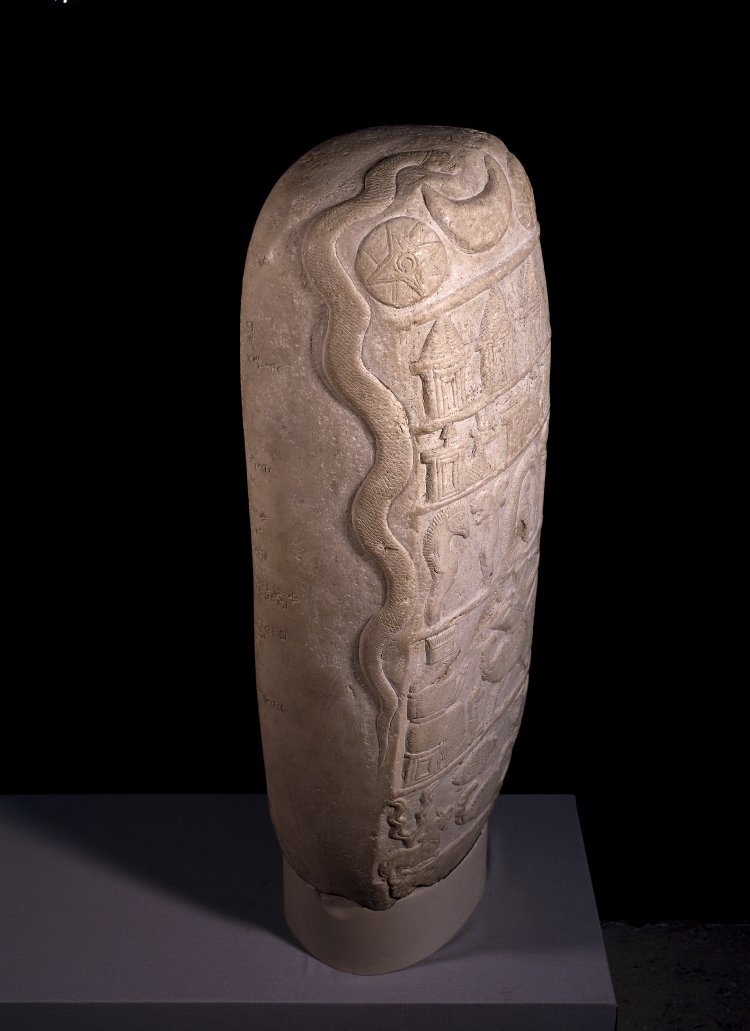
Boundary Stone of Ritti-Marduk (British Museum, No. 90,858)

The accompanying illustration, which is reproduced from the Boundary Stone of Ritti-Marduk (Brit. Mus., No. 90,858), supplies much information about the symbols of the gods, and of the Signs of the Zodiac in the reign of Nebuchadnezzar I, King of Babylon, about 1120 B.C.

British Museum number 90858 Description 3/4: Right Limestone stela in the form of a boundary-stone: consisting of a block of calcareous limestone, shaped and prepared on four sides to take sculptures and inscriptions. It is now mounted on a stone plinth.  Faces B and C each bear a single column of inscription, the lines running the full width of the stone.  The top of the stone and Face D have been left blank, except for the serpent, which has been carved to the left of the emblems on Face A.  Inscribed with a Charter from the reign of Nebuchadnezzar I.

British Museum number 90858
Description 3/4: Right
Limestone stela in the form of a boundary-stone: consisting of a block of calcareous limestone, shaped and prepared on four sides to take sculptures and inscriptions. It is now mounted on a stone plinth.
Faces B and C each bear a single column of inscription, the lines running the full width of the stone.
The top of the stone and Face D have been left blank, except for the serpent, which has been carved to the left of the emblems on Face A.
Inscribed with a Charter from the reign of Nebuchadnezzar I.

Thus in Register 1, we have the Star of Ishtar, the crescent of the Moon-god Sin, and the disk of Shamash the Sun-god. In Reg. 2 are three stands (?) surmounted by tiaras, which represent the gods Anu, Enlil (Bel) and Ea respectively. In Reg. 3 are three altars (?) or shrines (?) with a monster in Nos. 1 and 2. Over the first is the lance of Marduk, over the second the mason’s square of Nabû, and over the third is the symbol of the goddess Ninkharsag, the Creatress. In Reg. 4 are a standard with an animal’s head, a sign of Ea; a two-headed snake = the Twins; an unknown symbol with a horse’s head, and a bird, representative of Shukamuna and Shumalia. In Reg. 5 are a seated figure of the goddess Gula and the Scorpion-man. In Reg. 6 are forked lightning, symbol of Adad, above a bull, the Tortoise, symbol of Ea (?), the Scorpion of the goddess Ishkhara, and the Lamp of Nusku, the Fire-god.  Down the left-hand side is the serpent-god representing the constellation of the Hydra.

Thus in Register 1, we have the Star of Ishtar, the crescent of the Moon-god Sin, and the disk of Shamash the Sun-god.
In Reg. 2 are three stands (?) surmounted by tiaras, which represent the gods Anu, Enlil (Bel) and Ea respectively.
In Reg. 3 are three altars (?) or shrines (?) with a monster in Nos. 1 and 2. Over the first is the lance of Marduk, over the second the mason’s square of Nabû, and over the third is the symbol of the goddess Ninkharsag, the Creatress.
In Reg. 4 are a standard with an animal’s head, a sign of Ea; a two-headed snake = the Twins; an unknown symbol with a horse’s head, and a bird, representative of Shukamuna and Shumalia.
In Reg. 5 are a seated figure of the goddess Gula and the Scorpion-man.
In Reg. 6 are forked lightning, symbol of Adad, above a bull, the Tortoise, symbol of Ea (?), the Scorpion of the goddess Ishkhara, and the Lamp of Nusku, the Fire-god.
Down the left-hand side is the serpent-god representing the constellation of the Hydra.

The mutilated text of the Fifth Tablet makes it impossible to gain further details in connection with Marduk’s work in arranging the heavens. We are, however, justified in assuming that the gaps in it contained statements about the grouping of the gods into triads.

In royal historical inscriptions the kings often invoke the gods in threes, though they never call any one three a triad or trinity. It seems as if this arrangement of gods in threes was assumed to be of divine origin.

In the Fourth Tablet of Creation, one triad “Anu-Bel-Ea” is actually mentioned, and in the Fifth Tablet, another is indicated, “Sin-Shamash-Ishtar.”

In these triads Anu represents the sky or heaven, Bel or Enlil the region under the sky and including the earth, Ea the underworld, Sin the Moon, Shamash the Sun, and Ishtar the star Venus.

When the universe was finally constituted several other great gods existed, e.g., Nusku, the Fire-god, Enurta, a solar god, Nergal, the god of war and handicrafts, Nabu, the god of learning, Marduk of Babylon, the great national god of Babylonia, and Ashur, the great national god of Assyria.

E.A. Wallis Budge, et al, & the British Museum, The Babylonian Legends of the Creation & the Fight Between Bel & the Dragon Told by Assyrian Tablets from Nineveh (BCE 668-626), 1901, pp. 11-2.

More on the Babylonian Zodiac

” … Then returning to the dead body of Tiâmat he smashed her skull with his club and scattered her blood to the north wind, and as a reward for his destruction of their terrible foe, he received gifts and presents from the gods his fathers.

The text then goes on to say that Marduk “devised a cunning plan,” i.e., he determined to carry out a series of works of creation.

He split the body of Tiâmat into two parts; out of one half he fashioned the dome of heaven, and out of the other he constructed the abode of Nudimmud, or Ea, which he placed over against Apsu, i.e., the deep.

He also formulated regulations concerning the maintenance of the same. By this “cunning plan” Marduk deprived the powers of darkness of the opportunity of repeating their revolt with any chance of success.

Having established the framework of his new heaven and earth Marduk, acting as the celestial architect, set to work to furnish them. In the first place he founded E-Sharra, or the mansion of heaven, and next he set apart and arranged proper places for the old gods of the three realms–Anu, Bel and Ea.

Illustration: Tablet sculptured with a scene representing the worship of the Sun-god in the Temple of Sippar.  The Sun-god is seated on a throne within a pavilion holding in one hand a disk and bar which may symbolize eternity.  Above his head are the three symbols of the Moon, the Sun, and the planet Venus.  On a stand in front of the pavilion rests the disk of the Sun, which is held in position by ropes grasped in the hands of two divine beings who are supported by the roof of the pavilion.  The pavilion of the Sun-god stands on the Celestial Ocean, and the four small disks indicate either the four cardinal points or the tops of the pillars of the heavens.  The three figures in front of the disk represent the high priest of Shamash, the king (Nabu-aplu-iddina, about 870 B.C.) and an attendant goddess. [No. 91,000.]
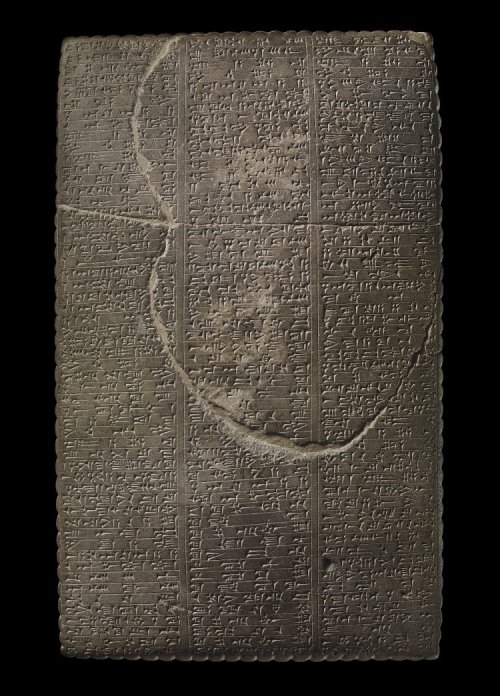
Illustration: Tablet sculptured with a scene representing the worship of the Sun-god in the Temple of Sippar.
The Sun-god is seated on a throne within a pavilion holding in one hand a disk and bar which may symbolize eternity.
Above his head are the three symbols of the Moon, the Sun, and the planet Venus.
On a stand in front of the pavilion rests the disk of the Sun, which is held in position by ropes grasped in the hands of two divine beings who are supported by the roof of the pavilion.
The pavilion of the Sun-god stands on the Celestial Ocean, and the four small disks indicate either the four cardinal points or the tops of the pillars of the heavens.
The three figures in front of the disk represent the high priest of Shamash, the king (Nabu-aplu-iddina, about 870 B.C.) and an attendant goddess. [No. 91,000.]

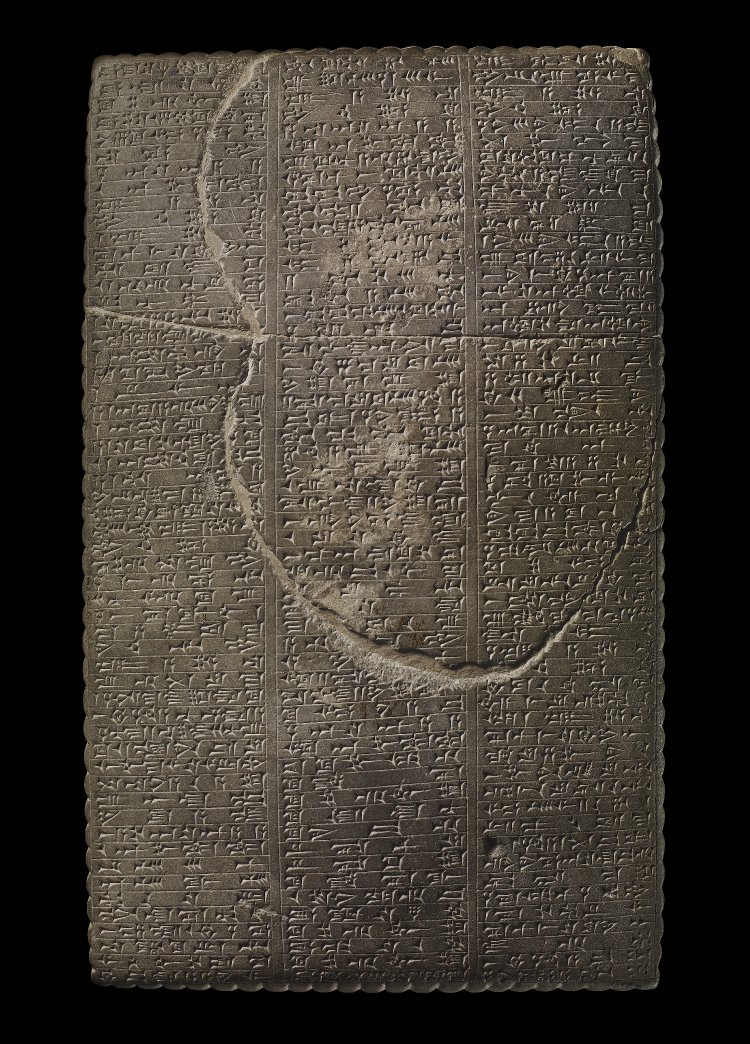
Museum number 91000 The engraved text contains a record of Nabu-apla-iddina's re-endowment of the Sun-Temple at Sippar. The inscription is engraved in six columns, three upon the obverse and three upon the reverse; and the upper part of the obverse is occupied by a scene sculptured in low relief; the edges of the tablet are bevelled.
Museum number 91000
The engraved text contains a record of Nabu-apla-iddina’s re-endowment of the Sun-Temple at Sippar. The inscription is engraved in six columns, three upon the obverse and three upon the reverse; and the upper part of the obverse is occupied by a scene sculptured in low relief; the edges of the tablet are bevelled.

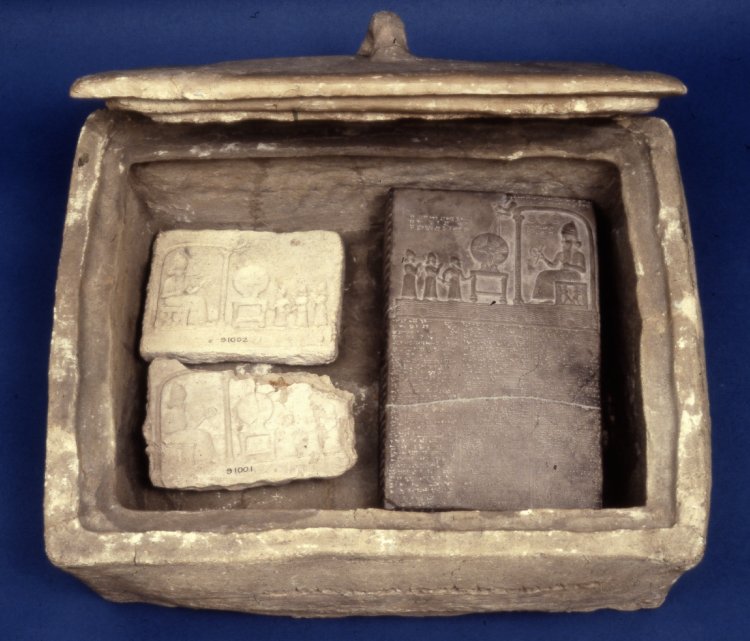
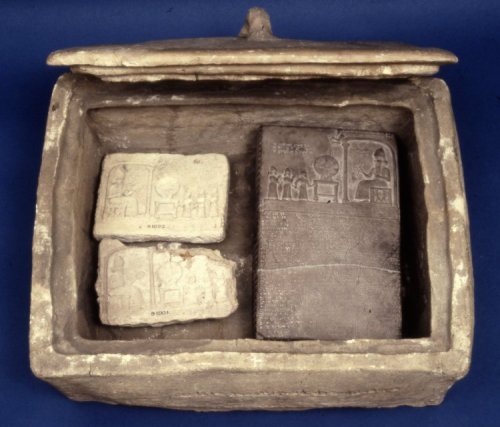
Museum number 91000 Group of Objects Pottery box and the limestone sun-god tablet and its covers deposited in it by Nabopolassar.

Museum number 91000
Group of Objects
Pottery box and the limestone sun-god tablet and its covers deposited in it by Nabopolassar.

The text of the Fifth Tablet, which would undoubtedly have supplied details as to Marduk’s arrangement and regulations for the sun, the moon, the stars, and the Signs of the Zodiac in the heavens is wanting.

The prominence of the celestial bodies in the history of creation is not to be wondered at, for the greater number of the religious beliefs of the Babylonians are grouped round them. Moreover, the science of astronomy had gone hand in hand with the superstition of astrology in Mesopotamia from time immemorial; and at a very early period the oldest gods of Babylonia were associated with the heavenly bodies.

Thus the Annunaki and the Igigi, who are bodies of deified spirits, were identified with the stars of the northern and southern heaven, respectively. And all the primitive goddesses coalesced and were grouped to form the goddess Ishtar, who was identified with the Evening and Morning Star, or Venus.

The Babylonians believed that the will of the gods was made known to men by the motions of the planets, and that careful observation of them would enable the skilled seer to recognize in the stars favourable and unfavourable portents. Such observations, treated from a magical point of view, formed a huge mass of literature which was being added to continually.

From the nature of the case this literature enshrined a very considerable number of facts of pure astronomy, and as early as the period of the First Dynasty (about 2000 B.C.), the Babylonians were able to calculate astronomical events with considerable accuracy, and to reconcile the solar and lunar years by the use of epagomenal months.

They had by that time formulated the existence of the Zodiac, and fixed the “stations” of the moon, and the places of the planets with it; and they had distinguished between the planets and the fixed stars. In the Fifth Tablet of the Creation Series (l. 2) the Signs of the Zodiac are called Lumashi, but unfortunately no list of their names is given in the context.

 Illustration: Tablet inscribed with a list of the Signs of the Zodiac. [No. 77,821.]


Illustration: Tablet inscribed with a list of the Signs of the Zodiac. [No. 77,821.]

Now these are supplied by the little tablet (No. 77,821) of the Persian Period of which a reproduction is here given. It has been referred to and discussed by various scholars, and its importance is very great. The transcript of the text, which is now published (see p. 68) for the first time, will be acceptable to the students of the history of the Zodiac.

Egyptian, Greek, Syriac and Arabic astrological and astronomical texts all associate with the Signs of the Zodiac twelve groups, each containing three stars, which are commonly known as the “Thirty-six Dekans.”

The text of line 4 of the Fifth Tablet of the Creation Series proves that the Babylonians were acquainted with these groups of stars, for we read that Marduk “set up for the twelve months of the year three stars apiece.” In the List of Signs of the Zodiac here given, it will be seen that each Sign is associated with a particular month.

At a later period, say about 500 B.C., the Babylonians made some of the gods regents of groups of stars, for Enlil ruled 33 stars, Anu 23 stars, and Ea 15 stars. They also possessed lists of the fixed stars, and drew up tables of the times of their heliacal risings.

Such lists were probably based upon very ancient documents, and prove that the astral element in Babylonian religion was very considerable.”

E.A. Wallis Budge, et al, & the British Museum, The Babylonian Legends of the Creation & the Fight Between Bel & the Dragon Told by Assyrian Tablets from Nineveh (BCE 668-626), 1901, pp. 10-11.

Marduk Kills Tiâmat

” … When Anu reported his inability to deal with Tiâmat, a council of the gods was called, and Ea induced his son, Marduk to be present.

We next find Anshar in converse with the god Marduk, who offers to act as the champion of the gods and to fight Tiâmat and her allies. Marduk being a form of the Sun-god, the greatest of all the powers of light, thus becomes naturally the protagonist of the gods, and the adversary of Tiâmat and her powers of darkness.

Then Anshar summoned a great council of the gods, who forthwith met in a place called “Upshukkinaku,” which may be described as the Babylonian Olympus. It was all-important for Marduk to appear at the council of the gods before he undertook his task, because it was necessary for him to be formally recognised by them as their champion, and he needed to be endowed by them with magical powers.

The primitive gods Lakhmu and Lakhamu, and the Igigi, who may be regarded as star-gods, were also summoned. A banquet was prepared, and the gods attended, and having met and kissed each other they sat down, and ate bread and drank hot and sweet sesame wine.

The fumes of the wine confused their senses, but they continued to drink, and at length “their spirits were exalted.” They appointed Marduk to be their champion officially, and then they proceeded to invest him with the power that would cause every command he spake to be followed immediately by the effect which he intended it to produce.

Next Marduk, with the view of testing the new power which had been given him, commanded a garment to disappear and it did so; and when he commanded it to reappear it did so.

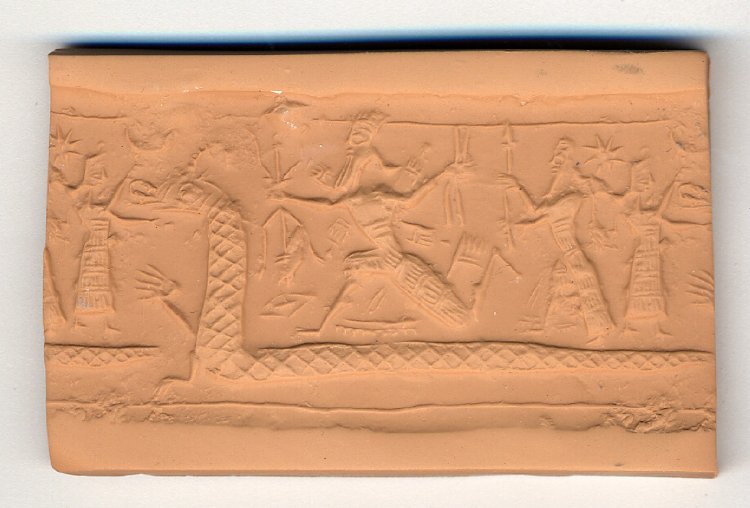
Illustration: Shamash the Sun-god setting (?) on the horizon. In his right he holds a tree (?), and in his left a ... with a serrated edge. Above the horizon is a goddess who holds in her left hand an ear of corn. On the right is a god who seems to be setting free a bird from his right hand. Round him is a river with fish in it, and behind him is an attendant god; under his foot is a young bull. To the right of the goddess stand a hunting god, with a bow and lasso, and a lion. From the seal-cylinder of Adda ..., in the British Museum. About 2500 B.C. [No. 89,115.]

Illustration: Shamash the Sun-god setting (?) on the horizon. In his right he holds a tree (?), and in his left a … with a serrated edge. Above the horizon is a goddess who holds in her left hand an ear of corn. On the right is a god who seems to be setting free a bird from his right hand. Round him is a river with fish in it, and behind him is an attendant god; under his foot is a young bull. To the right of the goddess stand a hunting god, with a bow and lasso, and a lion. From the seal-cylinder of Adda …, in the British Museum. About 2500 B.C. [No. 89,115.]

Then the gods saluted him as their king, and gave him the insignia of royalty, namely, the sceptre, the throne and the pala, whatever that may be. And as they handed to him these things they commanded him to go and hack the body of Tiâmat in pieces, and to scatter her blood to the winds.

Thereupon Marduk began to arm himself for the fight. He took a bow, a spear, and a club; he filled his body full of fire and set the lightning before him. He took in his hands a net wherewith to catch Tiâmat, and he placed the four winds near it, to prevent her from escaping from it when he had snared her.

He created mighty winds and tempests to assist him, and grasped the thunderbolt in his hand; and then, mounting upon the Storm, which was drawn by four horses, he went out to meet and defeat Tiâmat. It seems pretty certain that this description of the equipment of Marduk was taken over from a very ancient account of the Fight with Tiâmat in which the hero was Enlil, i.e., the god of the air, or of the region which lies between heaven and hell.

Marduk approached and looked upon the “Middle” or “Inside” or “Womb” of Tiâmat, and divined the plan of Kingu who had taken up his place therein.

In the Seventh Tablet (l. 108) Marduk is said to have “entered into the middle of Tiâmat,” and because he did so he is called “Nibiru,” i.e., “he who entered in,” and the “seizer of the middle.” What the words “middle of Tiâmat” meant to the Babylonian we are not told, but it is clear that Marduk’s entry into it was a signal mark of the triumph of the god.

When Kingu from the “middle of Tiâmat” saw Marduk arrayed in his terrible panoply of war, he was terrified and trembled, and staggered about and lost all control of his legs; and at the mere sight of the god all the other fiends and devils were smitten with fear and reduced to helplessness.

Tiâmat saw Marduk and began to revile him, and when he challenged her to battle she flew into a rage and attempted to overthrow him by reciting an incantation, thinking that her words of power would destroy his strength. Her spell had no effect on the god, who at once cast his net over her.

At the same moment he made a gale of foul wind to blow on her face, and entering through her mouth it filled her body; whilst her body was distended he drove his spear into her, and Tiâmat split asunder, and her womb fell out from it.

Marduk leaped upon her body and looked on her followers as they attempted to escape. But the Four Winds which he had stationed round about Tiâmat made all their efforts to flee of no effect. Marduk caught all the Eleven allies of Tiâmat in his net, and he trampled upon them as they lay in it helpless.

Marduk then took the TABLET OF DESTINIES from Kingu’s breast, and sealed it with his seal and placed it on his own breast.”

E.A. Wallis Budge, et al, & the British Museum, The Babylonian Legends of the Creation & the Fight Between Bel & the Dragon Told by Assyrian Tablets from Nineveh (BCE 668-626), 1901, pp. 9-10.

The First Zodiac

” … Not content with Ummu-Khubur’s brood of devils, Tiâmat called the stars and powers of the air to her aid, for she “set up” …

(1) the Viper,

(2) the Snake,

(3) the god Lakhamu,

(4) the Whirlwind,

(5) the ravening Dog,

(6) the Scorpion-man,

(7) the mighty Storm-wind,

(8) the Fish-man, and

(9) the Horned Beast.

These bore (10) the “merciless, invincible weapon,” and were under the command of (11) Kingu, whom Tiâmat calls “her husband.”

Thus Tiâmat had Eleven mighty Helpers besides the devils spawned by Ummu-Khubur. We may note in passing that some of the above-mentioned Helpers appear among the Twelve Signs of the Zodiac which Marduk “set up” after his conquest of Tiâmat, e.g., the Scorpion-man, the Horned Beast, etc.

This fact suggests that the first Zodiac was “set up” by Tiâmat, who with her Eleven Helpers formed the Twelve Signs; the association of evil with certain stars may date from that period. That the Babylonians regarded the primitive gods as powers of evil is clear from the fact that Lakhamu, one of them, is enumerated among the allies of Tiâmat.

The helpers of Tiâmat were placed by her under the command of a god called KINGU who is TAMMUZ. He was the counterpart, or equivalent, of ANU, the Sky-god, in the kingdom of darkness, for it is said in the text “Kingu was exalted and received the power of Anu,” i.e., he possessed the same power and attributes as Anu.

When Tiâmat appointed Kingu to be her captain, she recited over him a certain spell or incantation, and then she gave him the TABLET OF DESTINIES and fastened it to his breast, saying, “Whatsoever goeth forth from thy mouth shall be established.”

Armed with all the magical powers conferred upon him by this Tablet, and heartened by all the laudatory epithets which his wife Tiâmat heaped upon him, Kingu went forth at the head of his devils.

When Ea heard that Tiâmat had collected her forces and was determined to continue the fight against the gods which Apsû and Mummu had begun, and that she had made her husband Kingu her champion, he was “afflicted” and “sat in sorrow.” He felt unable to renew the fight against the powers of darkness, and he therefore went and reported the new happenings to Anshar, representative of the “host of heaven,” and took counsel with him.

When Anshar heard the matter he was greatly disturbed in mind and bit his lips, for he saw that the real difficulty was to find a worthy antagonist for Kingu and Tiâmat. A gap in the text here prevents us from knowing exactly what Anshar said and did, but the context suggests that he summoned Anu, the Sky-god, to his assistance. Then, having given him certain instructions, he sent him on an embassy to Tiâmat with the view of conciliating her.

When Anu reached the place where she was he found her in a very wrathful state, and she was muttering angrily; Anu was so appalled at the sight of her that he turned and fled. It is impossible at present to explain this interlude, or to find any parallel to it in other ancient Oriental literature.”

Illustration: Shamash the Sun-god rising on the horizon, flames of fire ascending from his shoulder. The two portals of the dawn, each surmounted by a lion, are being drawn open by attendant gods. From a Babylonian seal cylinder in the British Museum. [No. 89,110.]

Illustration: Shamash the Sun-god rising on the horizon, flames of fire ascending from his shoulder. The two portals of the dawn, each surmounted by a lion, are being drawn open by attendant gods. From a Babylonian seal cylinder in the British Museum. [No. 89,110.]

E.A. Wallis Budge, et al, & the British Museum, The Babylonian Legends of the Creation & the Fight Between Bel & the Dragon Told by Assyrian Tablets from Nineveh (BCE 668-626), 1901, pp. 8-9.

In the End, Dwelling at the Mouth of the Rivers

[THE ABUBU (CYCLONE) AND ITS EFFECTS DESCRIBED.]

“97. As soon as something of dawn shone in the sky

98. A black cloud from the foundation of heaven came up.

99. Inside it the god Adad thundered,

100. The gods Nabû and Sharru (i.e., Marduk) went before,

101. Marching as messengers over high land and plain,

102. Irragal (Nergal) tore out the post of the ship,

103. En-urta went on, he made the storm to descend.

104. The Anunnaki brandished their torches,

105. With their glare they lighted up the land.

106. The whirlwind (or, cyclone) of Adad swept up to heaven.

107. Every gleam of light was turned into darkness.

108. . . . . . the land . . . . . as if had laid it waste.

109. A whole day long [the flood descended] . . .

110. Swiftly it mounted up . . . . . [the water] reached to the mountains

111. [The water] attacked the people like a battle.

112. Brother saw not brother.

113. Men could not be known (or, recognized) in heaven.

114. The gods were terrified at the cyclone.

115. They shrank back and went up into the heaven of Anu.

116. The gods crouched like a dog and cowered by the wall.

117. The goddess Ishtar cried out like a woman in travail.

118. The Lady of the Gods lamented with a sweet voice [saying]:

[ISHTAR’S LAMENT.]

119. May that former day be turned into mud,

120. Because I commanded evil among the company of the gods.

121. How could I command evil among the company of the gods,

122. Command battle for the destruction of my people?

123. Did I of myself bring forth my people

124. That they might fill the sea like little fishes?

[UTA-NAPISHTIM’S STORY CONTINUED.]

125. The gods, the Anunnaki wailed with her.

126. The gods bowed themselves, and sat down weeping.

127. Their lips were shut tight (in distress) . . .

128. For six days and nights

129. The wind, the storm raged, and the cyclone overwhelmed the land.

[THE ABATING OF THE STORM.]

130. When the seventh day came the cyclone ceased, the storm and battle

131. which had fought like an army.

132. The sea became quiet, the grievous wind went down, the cyclone ceased.

133. I looked on the day and voices were stilled,

134. And all mankind were turned into mud,

135. The land had been laid flat like a terrace.

136. I opened the air-hole and the light fell upon my cheek,

137. I bowed myself, I sat down, I cried,

138. My tears poured down over my cheeks.

139. I looked over the quarters of the world, (to] the limits of ocean.

140. At twelve points islands appeared.

141. The ship grounded on the mountain of Nisir.

142. The mountain of Nisir held the ship, it let it not move.

143. The first day, the second day, the mountain of Nisir held the ship and let it not move.

144. The third day, the fourth day, the mountain of Nisir held the ship and let it not move.

145. The fifth day, the sixth day, the mountain of Nisir held the ship and let it not move.

146. When the seventh day had come

147. I brought out a dove and let her go free.

148. The dove flew away and [then] came back;

149. Because she had no place to alight on she came back.

150. I brought out a swallow and let her go free.

151. The swallow flew away and [then] came back;

152. Because she had no place to alight on she came back.

153. 1 brought out a raven and let her go free.

154. The raven flew away, she saw the sinking waters.

155. She ate, she waded (?), she rose (?), she came not back.

[UTA-NAPISHTIM LEAVES THE SHIP.]

156. Then I brought out [everything] to the four winds and made a sacrifice;

157. I set out an offering on the peak of the mountain.

158. Seven by seven I set out the vessels,

159. Under them I piled reeds, cedarwood and myrtle (?).

160. The gods smelt the savour,

161. The gods smelt the sweet savour.

162. The gods gathered together like flies over him that sacrificed.

[SPEECH OF ISHTAR, LADY OF THE GODS.]

163 Now when the Lady of the Gods came nigh,

164. She lifted up the priceless jewels which Anu had made according to her desire, [saying]

165. O ye gods here present, as I shall never forget the sapphire jewels of my neck

166. So shall I ever think about these days, and shall forget them nevermore!

167. Let the gods come to the offering,

168. But let not Enlil come to the offering,

16q. Because he took not thought and made the cyclone,

170. And delivered my people over to destruction.”

[THE ANGER OF ENLIL.]

171. Now when Enlil came nigh

172. He saw the ship; then was Enlil wroth

173. And he was filled with anger against the gods, the Igigi [saying]:

174. Hath any being escaped with his life?

175. He shall not remain alive, a man among the destruction

[SPEECH OF EN-URTA.]

176. Then En-urta opened his mouth and spake

177. And said unto the warrior Enlil:

178. Who besides the god Ea can make a plan?

179. The god Ea knoweth everything that is done.

18o. The god Ea opened his mouth and spake

181. And said unto the warrior Enlil,

182. O Prince among the gods, thou warrior,

183. How, how couldst thou, not taking thought, make a cyclone?

184. He who is sinful, on him lay his sin,

185. He who transgresseth, on him lay his transgression.

186. But be merciful that [everything] be not destroyed be long-suffering that [man be not blotted out].

187. Instead of thy making a cyclone,

188. Would that the lion had come and diminished mankind.

189. Instead of thy making a cyclone

190. Would that the wolf had come and diminished mankind.

191. Instead of thy making a cyclone

192. Would that a famine had arisen and [laid waste] the land.

193. Instead of thy making a cyclone

194. Would that Irra (the Plague god) had risen up and [laid waste] the land.

195. As for me I have not revealed the secret of the great gods.

196. I made Atra-hasis to see a vision, and thus he heard the secret of the gods.

197. Now therefore take counsel concerning him.

[ENLIL DEIFIES UTA-NAPISHTIM AND HIS WIFE.]

198. Then the god Enlil went up into the ship,

199. He seized me by the hand and brought me forth.

200. He brought forth my wife and made her to kneel by my side.

201. He touched our brows, he stood between us, he blessed us [saving],

202. Formerly Uta-Napishtim was a man merely,

203. But now let Uta-Napishtim and his wife be like unto us gods.

204. Uta-Napishtim shall dwell afar off, at the mouth of the rivers.

[UTA-NAPISHTIM ENDS HIS STORY OF THE DELUGE.]

205. And they took me away to a place afar off, and made me to dwell at the mouth of the rivers.”

E.A. Wallis Budge, The Babylonian Story of the Deluge and the Epic of Gilgamish1929, pp. 35-40.

The Library of the Temple of Nebo in Nineveh

NEBO AND HIS LIBRARY AT NINEVEH.

“Nothing is known of the early history of the Library of the Temple of Nebo at Nineveh, but there is little doubt that it was in existence in the reign of Sargon II.

Authorities differ in their estimate of the attributes that were assigned to Nebo (Nabu) in Pre-Babylonian times, and “cannot decide whether he was a water-god, or a fire-god, or a corn-god, but he was undoubtedly associated with Marduk, either as his son or as a fellow-god.

It is certain that as early as B.C. 2000 he was regarded as one of the “Great Gods” of Babylonia, and in the fourteenth century B.C. his cult was already established in Assyria. He had a temple at Nimrûd in the ninth century B.C., and King Adad-nirari (B.C. 811-783) set up six statues in it to the honour of the god; two of these statues are now in the British Museum.

The same Adad-nirari also repaired the Nebo temple at Nineveh. Under the last Assyrian Empire Nebo was believed to possess the wisdom of all the gods, and to be the “All-wise ” and “All-knowing.” He was the inventor of all the arts and sciences, and the source of inspiration in wise and learned men, and he was the divine scribe and past master of all the mysteries connected with literature and the art of writing (dup-sharrute).

Ashur-bani-pal addresses him as “Nebo, the mighty son, the director of the whole of heaven and of earth, holder of the tablet, bearer of the writing-reed of the tablet of destiny, lengthener of days, vivifier of the dead, stablisher of light for the men who are troubled.”

In the reign of Sargon II the Temple of Nebo at Kuyûnjik was repaired, and probably at that time a library was housed in it. Layard found some of the remains of Nebo’s Library in the South West Palace, but it must have been transferred thither, for the temple of Nebo lay farther north, near the south corner of Ashur-bani-pal’s palace.

Nebo’s temple at Nineveh bore the same name as his very ancient temple at Borsippa (the modem Birs-i-Nimrûd), viz., “E-ZIDA.”

Legends of Creation and Dragons

” … Both the source of the original form of the Legend of the Fight between Ea and Apsu, and Marduk and Tiâmat, and the period of its composition are unknown, but there is no doubt that in one form or another it persisted in Mesopotamia for thousands of years.

The apocryphal book of “Bel and the Dragon” shows that a form of the Legend was in existence among the Babylonian Jews long after the Captivity, and the narrative relating to it associates it with religious observances.

But there is no foundation whatsoever for the assertion which has so often been made that the Two Accounts of the Creation which are given in the early chapters in Genesis are derived from the Seven Tablets of Creation described in the preceding pages. It is true that there are many points of resemblance between the narratives in cuneiform and Hebrew, and these often illustrate each other, but the fundamental conceptions of the Babylonian and Hebrew accounts are essentially different.

In the former the earliest beings that existed were foul demons and devils, and the God of Creation only appears at a later period, but in the latter the conception of God is that of a Being Who existed in and from the beginning, Almighty and Alone, and the devils of chaos and evil are His servants.

The seal may illustrate a scene from the epic of creation in which the forces of chaos, led by Tiamat, are defeated by a god representing cosmic order, probably Ninurta.

The seal may illustrate a scene from the epic of creation in which the forces of chaos, led by Tiamat, are defeated by a god representing cosmic order, probably Ninurta.

Among the primitive Semitic peoples there were probably many versions of the story of the Creation; and the narrative told by the Seven Tablets is, no doubt, one of them in a comparatively modern form.

It is quite clear that the Account of the Creation given in the Seven Tablets is derived from very ancient sources, and a considerable amount of literary evidence is now available for reconstructing the history of the Legend.

Thus in the Sumerian Account the narrative of the exploits of the hero called ZIUSUDU 19  begins with a description of the Creation and then goes on to describe a Flood, and there is little doubt that certain passages in this text are the originals of the Babylonian version as given in the Seven Tablets.

In the Story of ZIUSUDU, however, there is no mention of any Dragon. And there is reason to think that the Legend of the Dragon had originally nothing whatever to do with the Creation, for the texts of fragments of two distinct Accounts 20 of the Creation describe a fight between a Dragon and some deity other than Marduk.

In other Accounts the Dragon bears a strong resemblance to the Leviathan of Psalm civ, 26; Job xli, 1. In the one text he is said to be 50 biru 21 in length, and 1 biru in thickness; his mouth was 6 cubits (about 9 feet) wide, and the circumference of his ears 12 cubits (18 feet).

He was slain by a god whose name is unknown, and the blood continued to flow from his body for three years, three months, one day and one night.

In the second text the Dragon is 60 biru long and his thickness is 30 biru; the diameter of each eye is half a biru, and his paws are 20 biru long.

Thus there is every reason for believing that the Legend as it is given in the Seven Tablets is the work of some editor, who added the Legend of the Creation to the Legend of the Dragon in much the same way as the editor of the Gilgamish Legends included an account of the Deluge in his narrative of the exploits of his hero.

All forms of the Legend of the Creation and of the Dragon were popular in Babylonia, and one of them achieved so much notoriety that the priest employed recited it as an incantation to charm away the toothache.

The literary form of the text of the Seven Tablets fulfils the requirements of Semitic poetry in general. The lines usually fall into couplets, the second line being the antiphon of the first, e.g.:–

“When in the height heaven was not named,
And the earth beneath did not yet bear a name.”

Thus we have:–

enuma elish || lâ nabû shamamu
shaplish ammatum || shuma lâ zakrat

E.A. Wallis Budge, The Babylonian Legends of the Creation and the Fight Between Bel and the Dragon, 1921.

The Fifty Names of Marduk

” … it is clear that a dispute broke out between Marduk and the gods after he had created them, and the tradition of it has made its way into the religious literatures of the Hebrews, Syrians, Arabs, Copts and Abyssinians.

The cuneiform texts tell us nothing about the cause of the dispute, but tradition generally ascribes it to the creation of man by the supreme God; and it is probable that all the apocryphal stories which describe the expulsion from heaven of the angels who contended against God under the leadership of Satan, or Satnael, or Iblîs, are derived from a Babylonian original which has not yet been found.

The “Fifty Names,” or laudatory epithets mentioned above, find parallels in Seventy-five Praises of Rā, sung by the Egyptians under the XIXth dynasty, 15 and in the Ninety-nine Beautiful Names of Allâh, which are held in such great esteem by the Muḥammadans. 16

The respect in which the Fifty Names were held by the Babylonians is well shown by the work of the Epilogue on the Seventh Tablet, where it is said, “Let them be held in remembrance, let the first-comer (i.e., any and every man) proclaim them; let the wise and the understanding consider them together. Let the father repeat them and teach them to his son. Let them be in the ears of the herdsman and the shepherd.”

The object of the writer of the Fifty Names was to show that Marduk was the “Lord of the gods,” that the power, qualities and attributes of every god were enshrined in him, and that they all were merely forms of him.

This fact is proved by the tablet (No. 47,406), 17 which contains a long list of gods who are equated with Marduk in his various forms. 18

The tendency in the later Babylonian religion to make Marduk the god above all gods has led many to think that monotheistic conceptions were already in existence among the Babylonians as early as the period of the First Dynasty, about 2000 B.C. It is indisputable that Marduk obtained his pre-eminence in the Babylonian Pantheon at this early period.

But some authorities deny the existence of monotheistic conceptions among the Babylonians at that time, and attribute Marduk’s kingship of the gods to the influence of the political situation of the time, when Babylon first became the capital of the country, and mistress of the greater part of the known world.

Material for deciding this question is wanting, but it may be safely said that whatever monotheistic conceptions existed at that time, their acceptance was confined entirely to the priests and scribes. They certainly find no expression in the popular religious texts.”

E.A. Wallis Budge, The Babylonian Legends of the Creation and the Fight Between Bel and the Dragon, 1921.

Mankind Was Created from the Blood of a God and Earth

” … When Marduk had arranged heaven and earth, and had established the gods in their places, the gods complained that their existence was barren, because they lacked worshippers at their shrines and offerings.

To make a way out of this difficulty Marduk devised another “cunning plan,” and announced his intention of creating man out of “blood and bone” DAMI IṢṢIMTUM .

We have already quoted (see p. 11) the statement of Berosus that man was created out of the blood of a god mixed with earth; here, then, is the authority for his words.

Marduk made known to Ea his intention of creating man, and Ea suggested that if one of the gods were sacrificed the remainder of them should be set free from service, presumably to Marduk.

Thereupon Marduk summons a council of the gods, and asks them to name the instigator of the fight in which he himself was the victor.

In reply the gods named Kingu, Tiâmat’s second husband, whom they seized forthwith, and bound with fetters and carried to Ea, and then having “inflicted punishment upon him they let his blood.”

From Kingu’s blood Ea fashioned mankind for the service of the gods.

Now among the texts which have been found on the tablets at Ḳal’at Sharḳât is an account of the creation of man which differs from the version given in the Seven Tablets of Creation, but has two features in common with it. These two features are:

(1) the council of the gods to discuss the creation of man;

(2) the sacrifice which the gods had to make for the creation of man. In the variant version two (or more) gods are sacrificed, Ilu Nagar Ilu Nagari.e., “the workmen gods,” about whom nothing is known.

The place of sacrifice is specified with some care, and it is said to be “Uzu-mu-a, or the bond of heaven and earth.” Uzu-mu-a may be the bolt with which Marduk locked the two halves of Tiâmat into place.

The Anunnaki, wishing to give an expression of their admiration for Marduk’s heroism, decided to build him a shrine or temple. To this Marduk agreed, and chose Babylon, i.e., the “Gate of God,” for its site.

The Anunnaki themselves made the bricks, and they built the great temple of E-Sagila at Babylon. When the temple was finished, Marduk re-enacted the scene of creation; for, as he had formerly assigned to each god his place in the heavens, so now he assigned to each god his place in E-Sagila.

The tablet ends with a long hymn of praise which the Anunnaki sang to Marduk, and describes the summoning of an assembly of the gods to proclaim ceremonially the great Fifty Names of this god. Thus the gods accepted the absolute supremacy of Marduk.”

E.A. Wallis Budge, The Babylonian Legends of the Creation and the Fight Between Bel and the Dragon, 1921.

Again, Berossus

“Versions in Greek of the Legends found by George Smith had long been known to classical scholars, owing to the preservation of fragments of them in the works of later Greek writers, e.g., Eusebius, Syncellus, and others.

The most important of these is derived from the History of Babylonia, which was written in Greek by BEROSUS, a priest of Bel-Marduk, i.e., the “Lord Marduk,” at Babylon, about 250 B.C. In this work Berosus reproduced all the known historical facts and traditions derived from native sources which were current in his day.

It is therefore not surprising to find that his account of the Babylonian beliefs about the origin of things corresponds very closely with that given in the cuneiform texts, and that it is of the greatest use in explaining and partly in expanding these texts. His account of the primeval abyss, out of which everything came, and of its inhabitants reads:–

“There was a time in which there existed nothing but darkness and an abyss of waters, wherein resided most hideous beings, which were produced on a two-fold principle. There appeared men, some of whom were furnished with two wings, others with four, and with two faces. They had one body but two heads; the one that of a man, the other of a woman; and likewise in their several organs both male and female. Other human figures were to be seen with the legs and horns of goats; some had horses’ feet; while others united the hind-quarters of a horse with the body of a man, resembling in shape the hippo-centaurs. Bulls likewise were bred there with the heads of men, and dogs with four told bodies, terminated in their extremities with the tails of fishes; horses also with the heads of dogs; men too and other animals, with the heads and bodies of horses and the tails of fishes. In short, there were creatures in which were combined the limbs of every species of animals. In addition to these, fishes, reptiles, serpents, with other monstrous animals, which assumed each other’s shape and countenance. Of all which were preserved delineations in the temple of Belus at Babylon.” (Cory, Ancient Fragments, London, 1832, pp. 24-26.)

E.A. Wallis Budge, The Babylonian Legends of the Creation and the Fight Between Bel and the Dragon, 1921.

Hammurabi Restored the Temples

” … Hammurabi’s reign was long as it was prosperous. There is no general agreement as to when he ascended the throne–some say in 2123 B.C., others hold that it was after 2000 B.C.–but it is certain that he presided over the destinies of Babylon for the long period of forty-three years.

There are interesting references to the military successes of his reign in the prologue to the legal Code. It is related that when he “avenged Larsa,” the seat of Rim-Sin, he restored there the temple of the sun god.

Other temples were built up at various ancient centres, so that these cultural organizations might contribute to the welfare of the localities over which they held sway. At Nippur he thus honoured Enlil, at Eridu the god Ea, at Ur the god Sin, at Erech the god Anu and the goddess Nana (Ishtar), at Kish the god Zamama and the goddess Ma-ma, at Cuthah the god Nergal, at Lagash the god Nin-Girsu, while at Adab and Akkad, “celebrated for its wide squares,” and other centres he carried out religious and public works.

In Assyria he restored the colossus of Ashur, which had evidently been carried away by a conqueror, and he developed the canal system of Nineveh.

[ … ]

Hammurabi referred to himself in the Prologue as “a king who commanded obedience in all the four quarters.” He was the sort of benevolent despot whom Carlyle on one occasion clamoured vainly for–not an Oriental despot in the commonly accepted sense of the term.

As a German writer puts it, his despotism was a form of Patriarchal Absolutism. “When Marduk (Merodach),” as the great king recorded, “brought me to direct all people, and commissioned me to give judgment, I laid down justice and right in the provinces, I made all flesh to prosper.”

That was the keynote of his long life; he regarded himself as the earthly representative of the Ruler of all–Merodach, “the lord god of right,” who carried out the decrees of Anu, the sky god of Destiny.”

Donald A. Mackenzie, Myths of Babylonia and Assyria, 1915.

Killing the Divine King

“At Babylon, within historical times, the tenure of the kingly office was in practice lifelong, yet in theory it would seem to have been merely annual. For every year at the festival of Zagmuk the king had to renew his power by seizing the hands of the image of Marduk in his great temple of Esagil at Babylon.

Even when Babylon passed under the power of Assyria, the monarchs of that country were expected to legalise their claim to the throne every year by coming to Babylon and performing the ancient ceremony at the New Year festival, and some of them found the obligation so burdensome that rather than discharge it they renounced the title of king altogether and contented themselves with the humbler one of Governor.

Further, it would appear that in remote times, though not within the historical period, the kings of Babylon or their barbarous predecessors forfeited not merely their crown but their life at the end of a year’s tenure of office. At least this is the conclusion to which the following evidence seems to point.

According to the historian Berosus, who as a Babylonian priest spoke with ample knowledge, there was annually celebrated in Babylon a festival called the Sacaea. It began on the sixteenth day of the month Lous, and lasted for five days, during which masters and servants changed places, the servants giving orders and the masters obeying them.

A prisoner condemned to death was dressed in the king’s robes, seated on the king’s throne, allowed to issue whatever commands he pleased, to eat, drink, and enjoy himself, and to lie with the king’s concubines. But at the end of the five days he was stripped of his royal robes, scourged, and hanged or impaled. During his brief term of office he bore the title of Zoganes.

This custom might perhaps have been explained as merely a grim jest perpetrated in a season of jollity at the expense of an unhappy criminal. But one circumstance–the leave given to the mock king to enjoy the king’s concubines–is decisive against this interpretation. Considering the jealous seclusion of an oriental despot’s harem we may be quite certain that permission to invade it would never have been granted by the despot, least of all to a condemned criminal, except for the very gravest cause.

This cause could hardly be other than that the condemned man was about to die in the king’s stead, and that to make the substitution perfect it was necessary he should enjoy the full rights of royalty during his brief reign. There is nothing surprising in this substitution. The rule that the king must be put to death either on the appearance of any symptom of bodily decay or at the end of a fixed period is certainly one which, sooner or later, the kings would seek to abolish or modify.

We have seen that in Ethiopia, Sofala, and Eyeo the rule was boldly set aside by enlightened monarchs; and that in Calicut the old custom of killing the king at the end of twelve years was changed into a permission granted to any one at the end of the twelve years’ period to attack the king, and, in the event of killing him, to reign in his stead; though, as the king took care at these times to be surrounded by his guards, the permission was little more than a form.

Another way of modifying the stern old rule is seen in the Babylonian custom just described. When the time drew near for the king to be put to death (in Babylon this appears to have been at the end of a single year’s reign) he abdicated for a few days, during which a temporary king reigned and suffered in his stead. At first the temporary king may have been an innocent person, possibly a member of the king’s own family; but with the growth of civilisation the sacrifice of an innocent person would be revolting to the public sentiment, and accordingly a condemned criminal would be invested with the brief and fatal sovereignty.

In the sequel we shall find other examples of a dying criminal representing a dying god. For we must not forget that, as the case of the Shilluk kings clearly shows, the king is slain in his character of a god or a demigod, his death and resurrection, as the only means of perpetuating the divine life unimpaired, being deemed necessary for the salvation of his people and the world.”

James George Frazer, The Golden Bough: A Study in Magic and Religion, 1922, The Killing of the Divine King, np.

Marduk’s Tower of Babel.

Modern archeology estimates the height of the Tower of Babel, a ziggurat dedicated to Marduk, at 270 feet high. 

–Fred S. Kleiner, Gardner’s Art Through the Ages: A Global History, enhanced 13th Edition. 2005, 2009, 2011. “Sumer,” Pg. 33.

Herodotus, 5th Century BCE, described it: “In the middle of the sanctuary [of Marduk] has been built a solid tower……which supports another tower, which in turn supports another, and so on; there are eight towers in all. A stairway has been constructed to wind its way up the outside of all the towers; halfway up the stairway there is a shelter with benches to rest on, where people making the ascent can sit and catch their breath. In the last tower there is a huge temple. The temple contains a large couch, which is adorned with fine coverings and has a golden table standing beside it, but there are no statutes at all standing there…..[The Babylonians] say that the god comes in person to the temple [compare the Sumerian notion of the temple as a “waiting room”] and rests on the couch; I do not believe this story myself.” 

–Herodotus: The Histories, Robin Waterfield, trans., New York: Oxford University Press, 1998, pp. 79-80. 

 Quoted in Gardner’s Art Through the Ages, pg. 48.