Samizdat

Publishing the Forbidden. All Rights Reserved. © Samizdat 2014-2025.

Category: Kulullû

Nakamura: The Figurines as Magical Objects

The Hybrid

“The magical power of the āšipu also allows him to identify certain mythological and supernatural beings appropriate for the task of protection; these are ancient sages (apkallū), warrior deities and monsters, associated with civilized knowledge and the formidable forces of life, death, peace, and destruction of divine will and rule (Green 1993; Wiggermann 1993).

These figures take on different protective attributes depending on the nature of the represented being; the apkallū act as purifiers and exorcists to expel and ward off evil forces, while monsters, gods, and dogs tend to the defense of the house from demonic intruders (Wiggermann 1992:96–97).
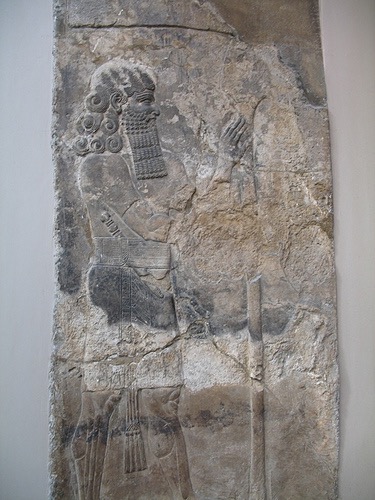
Lahmu, “Hairy,” is a protective and beneficent deity, the first-born son of Apsu and Tiamat. He and his sister Laḫamu are the parents of Anshar and Kishar, the sky father and earth mother, who birthed the gods of the Mesopotamian Pantheon. Laḫmu is depicted as a bearded man with a red sash-usually with three strands- and four to six curls on his head. He is often associated with the Kusarikku or “Bull-Man.” In Sumerian times Laḫmu may have meant “the muddy one”. Lahmu guarded the gates of the Abzu temple of Enki at Eridu. He and his sister Laḫamu are primordial deities in the Babylonian Epic of Creation –Enuma Elis and Lahmu may be related to – or identical with- ‘Lahamu’ one of Tiamat’s Creatures in that epic. http://foundfact.com/portfolio-view/lahmu/#!prettyPhoto http://foundfact.com/library/beings-people-and-gods/page/6/#!prettyPhoto

All of these figures find some association either with the underworld or the freshwater ocean under the earth (apsû) which was the domain of Enki, the god associated with wisdom, magic, incantation, and the arts and crafts of civilization (Black and Green 1992:75), and notably, all but the lahmu portray composite human–animal physiognomies (Figure 2.2).
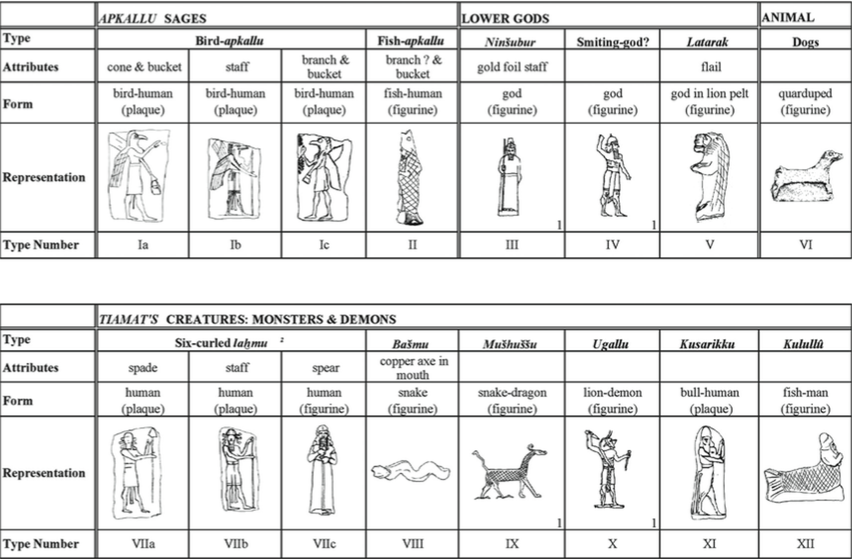
Figure 2.2. Apotropaic figures with associated features.  1. Drawing after Richards in Black and Green (1992:65).  2. The identification of the lahmu figure is controversial; it names both a cosmogonic deity and one of Tiamat’s creatures (Wiggermann 1992:155–156), and may also represent an apkallu sage (Ellis 1995:165; Russell 1991:184, fn. 27)

Figure 2.2. Apotropaic figures with associated features.
1. Drawing after Richards in Black and Green (1992:65).
2. The identification of the lahmu figure is controversial; it names both a cosmogonic deity and one of Tiamat’s creatures (Wiggermann 1992:155–156), and may also represent an apkallu sage (Ellis 1995:165; Russell 1991:184, fn. 27)

Such forms manifest a communion of things generally held to be opposed to each other. The blending of humans and animals in this context might capitalize on the tension between Mesopotamian conceptions of a structured, civilized human world and a chaotic, untamed natural world (Bottéro 1992).

Hybrids materialize a unity of self and other, human and animal as a strange being that is at once knowable and controllable and unknowable and incontrollable.

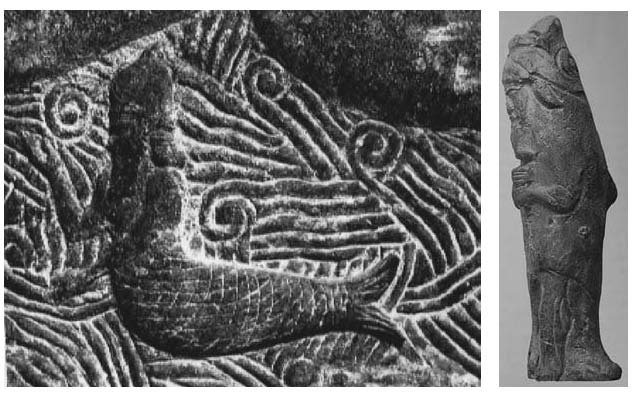
Fish-man known as a Kulullû. Terracotta figurine (8th-7th BCE) in the Louvre collection, Nr. 3337.  The Kulullû is distinct from the fish-Apkallū. They are not the same.

Fish-man known as a Kulullû. Terracotta figurine (8th-7th BCE) in the Louvre collection, Nr. 3337.
The Kulullû is distinct from the fish-Apkallū. They are not the same.

As beings in-between, hybrids embody potential, transition, and similarity in difference. Such liminality is often associated with dangerous power, a power that obeys the apotropaic economy of the supplement, since it terrifies and yet provides the surest protection against that terror (Derrida 1974:154).
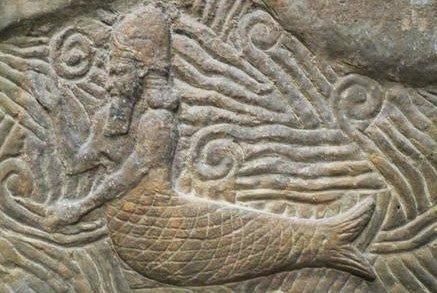
Another depiction of the Kulullû, or fish-man.

Another depiction of the Kulullû, or fish-man.

By miming such beings in clay figurines, the āšipu brings forth their active life and force in petrified form. Capitalizing on the apotropaic logic of defense, this gesture captures self-defeating force and suspends it in space, material, and time.

Many of the figurine types are depicted in movement with hands gesturing and a foot forward to suggest forward movement. Following Susan Stewart (1984:54), I submit that the force of animated life does not diminish when arrested in the fixity and exteriority of the figurine, but rather, is captured as a moment of hesitation always on the verge of forceful action.

The apotropaic figurine is a magical object — what Michael Taussig calls a “time–space compaction of the mimetic process” — doubled over since its form and matter, creation and presentation capture certain inherent energies that humans desire to control.

The magical object, which encounters the unknown by presenting its form and image “releases a force capable of vanquishing it, or even befriending it” (Deleuze 2003:52). But as ritual texts and archaeological deposits confirm, it was not just the images themselves that rendered power, but something in the process of their creation.

While such apotropaic figures appear in grand scale and idealized form on wall reliefs flanking entrances of kingly palaces purifying all who passed through the gates, the figures standing guard in floor deposits performed an additional task.”

Carolyn Nakamura, “Mastering matters: magical sense and apotropaic figurine worlds of Neo-Assyria,” Archaeologies of materiality (2005): 34-6.
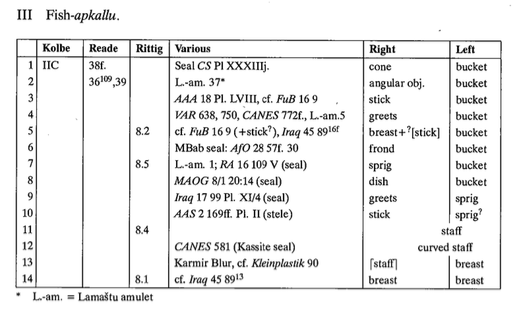
On the Fish-Apkallu

Fish Apkallu

“Lamaštu amulets:

The fish-apkallū on Lamaštu amulet 2 (and 4?), exactly like the ūmu-apkallū on Lamaštu amulets 3 and 61, has his left hand on the bed of the sick man. The right hand is slightly damaged, but probably greeting.

Fish-Apkallu statuettes of the type that were buried in the foundations of buildings.

Fish-Apkallu statuettes of the type that were buried in the foundations of buildings. It is difficult to tell whether they hold their hands in a prayerful position or hold something indistinct. 

Wrong hand:

Occasionally apkallū are attested holding the bucket in their right hand: AfO 28 57f. 30 (above IIiI/6), Lamaštu amulet 5 (?), Calmeyer Reliefbronzen 66 H:8 (bird-apkallū).

Unidentified object:

One of the apkallū on CANES 773 holds in his right hand an unidentified feather-like object.

Identification:

The identification of the fish-apkallū of ritual I/IiI with the “fish-garbed” man goes back to Smith JRAS 1926 709 (based on comparison with the Kleinplastik from Ur); identification of one of them with Oannes has been proposed since the early days of Assyriology (Kolbe Reliefprogramme 26, Zimmern KAT 535ff., ZA 35 151ff.) but was proved only after the names of the sages in Berossos’ Babyloniaka were recognized in cuneiform (van Dijk UVB 18 46ff.).

Occasionally the apkallū is mistakenly identified with the fish-man / kulullû (see below, VII.C.9), a completely different figure. U4 – a n (Oannes) and Adapa, a human sage living approximately at the same time, are probably two different figures (Borger JNES 33186, Picchioni Adapa 97ff.).

A "fish-man" / kulullû is depicted at left, and a fish-apkallū at right.  Wiggermann distinguishes these two entities.

A “fish-man” / kulullû is depicted at left, and a fish-apkallū at right.
Wiggermann distinguishes these two entities.

The texts clearly indicate that the fish-apkallū are not fish-garbed priests, but mythological figures, man and fish; they are bīnūt apsî, “creatures of apsû“, in ritual I/IIi, purād tāmtiša ina nāri ibbanú, “carp of the sea…who were grown in the river” in text IIiI.B.8 (cf. also Cagni Erra, I 162), and Berossos clearly describes them as a mixture of fish and man (cf. S. Mayer Burstein SANE I/5 13, 19).

Their names lack the determinative DINGIR, they are no gods, and the horns on the head of the fish (on palace reliefs, not on seals, cf. Kleinplastik 89, FuB 10 35) probably developed from its gills.

Berossos calls them “hemidaimones” (Jacoby FGrH 400).

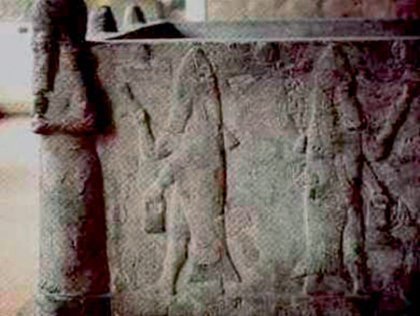
Fish-Apkallū depicted on a cistern. The fish iconography is unmistakable, as are the banduddu buckets in their left hands. Objects in their right hands are indistinct, but the traditional gestures of warding or blessing seem clear.

Fish-Apkallū depicted on a cistern. The fish iconography is unmistakable, as are the banduddu buckets in their left hands. Objects in their right hands are indistinct, but the traditional gestures of warding or blessing seem clear. The objects in their right hands may be the “angular objects” mentioned in the table by Wiggermann at the top of the page. 

History.

In the third millennium a b g al is the name of a profession: see MSL 12 10:15, ZA 72 174 11 v 3, Bauer AWL 125 i 4 (NUN.ME.KA X ME/GANA2f, cf. also Barton MBI 2 iv 2), Ukg. 6 ii 30′, iii 4 (NUN.ME.KA X ME/GANA2f.) UET 8 33:15 and for the same profession in the divine world: TCL 15 10:98 (dA b g a l) cf. 85.

In OB sum. incantations a b g a l apparently refers to a mythological sage at the court of Enki: VAS 17 13:5 (together with Enkum, Ninkum, and the seven children of Apsû), 16:11, 32:21, HSAO 262:56, PBS I/2 123:9 IIIISET 1 217 Ni 4176:12, OrNS 44 68, cf. ASKT 12 Obv. 11ff.

The “seven apkallū of Eridu“, at least in AnSt 30 78 (SB) identified with the seven antediluvian sages (Anenlilda is among them), are rooted in the third millenium (TCS 3 25:139, cf. Benito “Enki and Ninmah” and “Enki and the World Order” 91:105, and for later attestations JCS 21 11 25+a, Maqlû II 124, V 110 = AfO 21 77, VII 49, VIII 38).

The names of the seven antediluvian sages are certainly not as old as the names of the antediluvian kings: they seem to be derived partly from the titles of literary works (Hallo JAOS 83 175f.), and partly from the names of the antediluvian kings.

The element en-me-(e n) (and a m – m e, a m – i etc.) = e m e n (me —en) (cf. Finkelstein JCS 17 42, Wilcke Lugalbanda 41), “lord”, in the names of the kings has been reinterpreted as “the lord (e n) who makes good (d u 10 – g a)/ perfects (g a l a m) / refines (b ùl u g -g á) the regulations (m e)”.

Although the resulting names are good Sumerian (Lambert JCS 16 74), the consistent difference is telling. The Sumerian of the linguistically rather simple bilingual incantation to the fish-apkallū in bīt mēseri (III.B.8) could well be of MB date, and the Kassite seals with representations of the fish-apkallū prove that at this time the later views existed at least partially.

These undatable later views connect the named carp apkallū with canonized literature (Lambert JCS 16 59ff., Hallo JAOS 83 175f., van Dijk-Mayer BaMB 2 no 90) and have possibly been developed concomittantly.

Literature on the apkallū types :

Below text III.B.8, 9, 10, 11; Borger JNES 33 183ff., Foster OrNS 43 344ff., Komoróczy ActAntHung 21 135ff., 142ff., S. Mayer Burstein SANE 1/5 13ff., Kawami Iran 10 146ff., van Dijk UVB 18 43ff., all with many references to previous literature.”

F.A.M. Wiggermann, Mesopotamian Protective Spirits: The Ritual Texts, STYX&PP Publications, Groningen, 1992, p. 76-7.