Samizdat

Publishing the Forbidden. All Rights Reserved. © Samizdat 2014-2025.

Category: Grazer Morgenländische Studien

Selz: Patriarchs and Sages

“A central figure in the discussion about the alleged Mesopotamian model for the antediluvian patriarchs soon became Enoch, who lived for 365 (364) years and of whom we read in Genesis 5:24: “Enoch walked with God then he was no more, because God took him away.”

The verb lāqah in this context has received numerous comments. Biblical sources offer three interpretations:

a) The liberation of a dead person from the power of the underworld;

b) A final removal from earth (cf. Elijah); or

c) An act of temporal transference, as in dream visions.
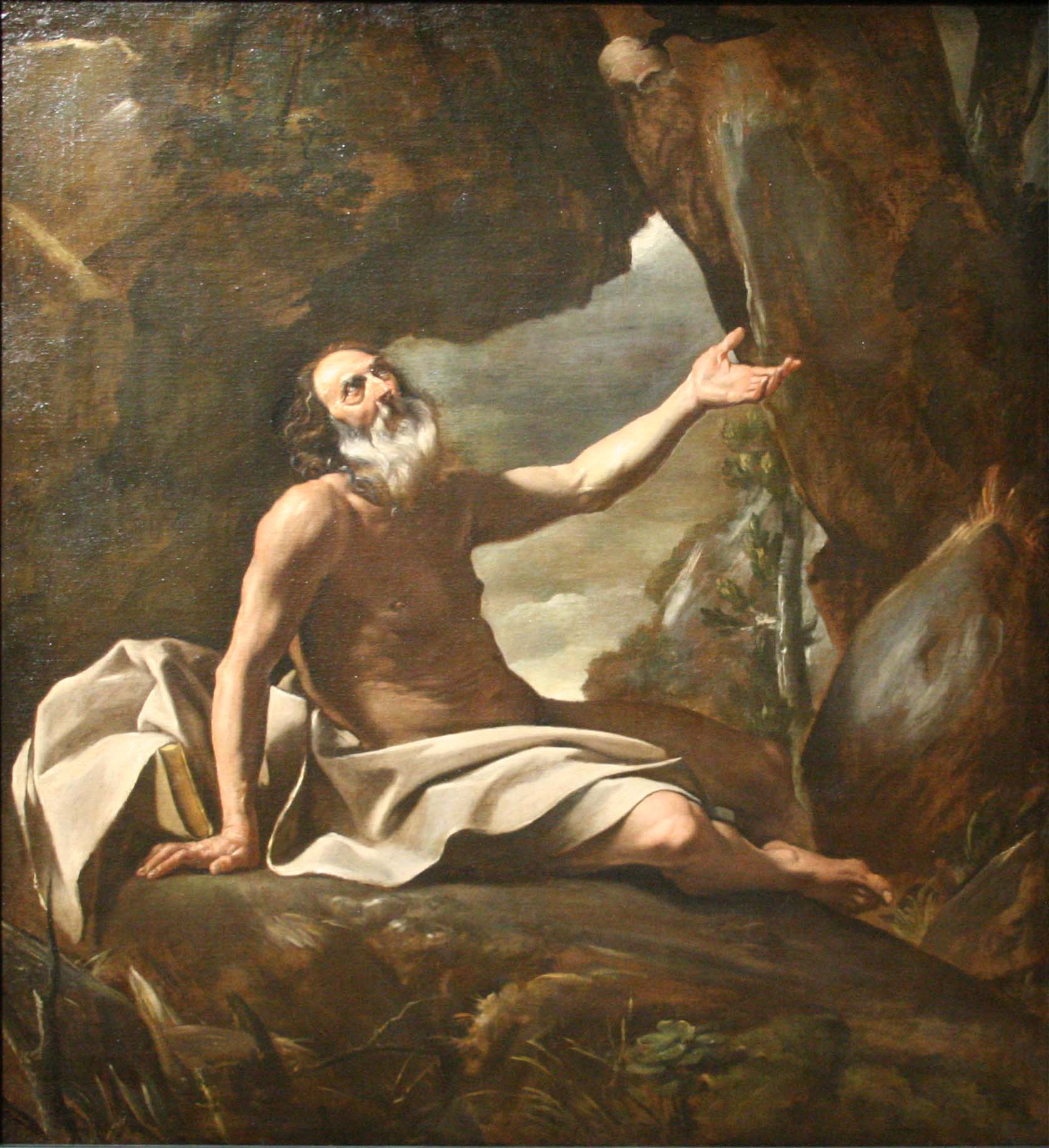
Giovanni Lanfranco (1582-1647 CE), Elie nourri par le corbeau, 1624-5 CE. Oil on canvas, held at the Musée des Beaux-Arts de Marseille, Accession number BA 451, photographed by Rvalette.  This faithful photographic reproduction of an original two-dimensional work of art is in the public domain where the copyright term is the author’s life plus 100 years or less.

Giovanni Lanfranco (1582-1647 CE), Elie nourri par le corbeau, 1624-5 CE. Oil on canvas, held at the Musée des Beaux-Arts de Marseille, Accession number BA 451, photographed by Rvalette.
This faithful photographic reproduction of an original two-dimensional work of art is in the public domain where the copyright term is the author’s life plus 100 years or less.

The name Enoch has found several interpretations: It has been argued that J derived the name from hānaq, “to dedicate” and “to train” which comes close to an interpretation of “the sage” (cf. also Arabic Idris!), and it may well be that the two values attributed to Enoch in Genesis are a “babilistic” interpretation of “a man dedicated to and trained by God.”

In the light of Genesis 4:17 the name was also thought to convey the meaning of “founder,” referring to the eponymous city Enoch. This Enoch is possibly entering the rank of those patriarchs who, according to biblical tradition, were perceived as a sort of cultural heroes.
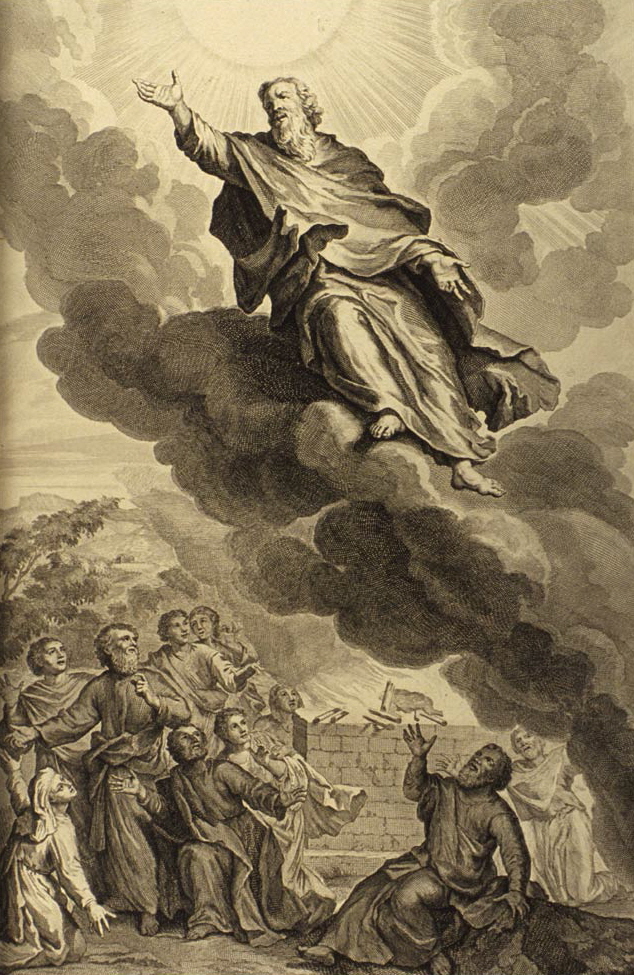
Gerard Hoet (1648-1733 CE), Illustrators of the Figures de la Bible, P. de Hondt, The Hague, 1728 CE. God took Enoch, as in Genesis 5:24: "And Enoch walked with God: and he was not; for God took him." (KJV) illustration from the 1728 Figures de la Bible; illustrated by Gerard Hoet (1648–1733) and others, and published by P. de Hondt in The Hague; image courtesy Bizzell Bible Collection, University of Oklahoma Libraries. This work is in the public domain in its country of origin and other countries and areas where the copyright term is the author's life plus 70 years or less. https://commons.wikimedia.org/wiki/File:Figures_God_took_Enoch.jpg

Gerard Hoet (1648-1733 CE), Illustrators of the Figures de la Bible, P. de Hondt, The Hague, 1728 CE.
God took Enoch, as in Genesis 5:24: “And Enoch walked with God: and he was not; for God took him.” (KJV) illustration from the 1728 Figures de la Bible; illustrated by Gerard Hoet (1648–1733) and others, and published by P. de Hondt in The Hague; image courtesy Bizzell Bible Collection, University of Oklahoma Libraries.
This work is in the public domain in its country of origin and other countries and areas where the copyright term is the author’s life plus 70 years or less.
https://commons.wikimedia.org/wiki/File:Figures_God_took_Enoch.jpg

(Westermann, Genesis, pp. 443-45 suggests that Enoch may refer to the foundation of a city or sanctuary. Westermann writes: “In Israel wurde die Erinnerung daran bewahrt, daß der Städtebau zum dem gehört, was vor und außerhalb der Geschichte Israels geschah. Die Gründung der ersten Stadt gehört der Urgeschichte an” (p. 444).

("In Israel, the memory was preserved because of urban development, 
what happened before and outside of history. 
The founding of the first city belongs to prehistory.")

Discussing Genesis 4:17 most exegetes remark that it seems unlikely that Kain, the tiller, condemmed to a nomadic life, could be renowned as the founder of a city. In an attempt to harmonize the alleged discrepancies, they even assume that the said founder was originally Enoch (cf. e.g. Westermann, Genesis, p. 443).

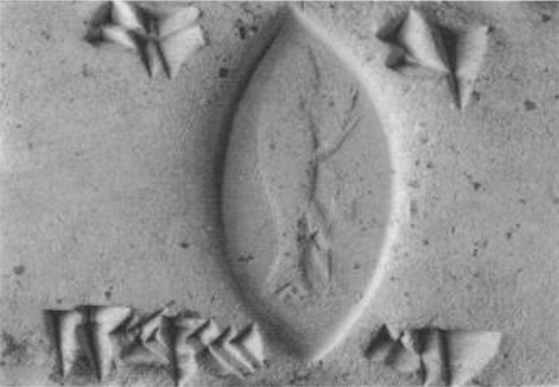
With the publication of a Seleucid text from Uruk, W 20030,7 the comparison between Berossos, the Old Testament, and the Sumerian King List reached a new level:

Seleucid text, Uruk, W 20030,7.  Excerpt from Selz, Of Heroes and Sages, 2011, p. 793.

Seleucid text, Uruk, W 20030,7. Published by J.J.A. van Dijk, “Die Tontafeln aus dem Resch-Heiligtum,” in Uruk-Wanka Vorberichte 18 (1962): pp. 43-52, from which this transcription is taken. Also on Samizdat, in Lenzi: The Uruk List of Kings and Sages.
Excerpt from Selz, Of Heroes and Sages, 2011, p. 793.

This document establishes an important link between Berossos’ account of the primeval kings and his story of the sage Oannes.

In this text the names of Mesopotamian rulers are accompanied by names of advisors, sages, the so-called apkallū which play an important role in Mesopotamian iconography and have been known, up until now, chiefly from the so-called Etiological Myth of the “Seven Sages” studied by Erica Reiner in 1961.

(E. Reiner, “The Etiological Myth of the ‘Seven Sages,’Orientalia 30 (1961): 1-11; eadem, Astral Magic in Babylonia (Transactions of the American Philosophical Society 85.4; Philadelphia: American Philosophical Society, 1995).

(See further S. Parpola, “Mesopotamian Astrology and Astronomy as Domains of the Mesopotamian ‘Wisdom,’” in Die Rolle der Astronomie in den Kulturen Mesopotamiens: Beiträge zum 3. Grazer Morgenländischen Symposium (ed. H. Galter and B. Scholz; Grazer Morgenländische Studien 3; Graz: RM Druck-und Verlagsgesellschaft, 1993), pp. 23-7.)

This list is certainly fictional, it is, however, based on scholarly traditions: the name of the well-known compiler of the standard version of the Gilgamesh Epic, dsîn-liq-unninnī, functions as an apkallu to Gilgamesh himself.

Further, a certain Kabtu-il-Marduk, perhaps referring to the author of the Erra Epic Kabti-ilāni-Marduk, is mentioned as a sage during the reign of Ibbi-Sîn (ca. 2028-2004 BCE), unlucky last king of the Ur III empire.”

Gebhard J. Selz, “Of Heroes and Sages–Considerations of the Early Mesopotamian Background of Some Enochic Traditions,” in Armin Lange, et alThe Dead Sea Scrolls in Context, v. 2, Brill, 2011, pp. 792-4.

Lenzi: Authority Rooted in Divinity

“As for the political aspect of the agenda, there are at least three points that require attention. First, we know that the locus of scholarship had shifted from court to temple, thereby removing (as far as we can tell) scholars from regular influence within the centers of political power.

 (See, e.g., Francesca Rochberg, “The Cultural Locus of Astronomy in Late Babylonia,” in Die Rolle der Astronomie in den Kulturen Mesopotamiens: Beiträge zum 3 Grazer Morgenländischen Symposium (23-27 September 1991), ed. Hannes D. Galter, Grazer Morgenländische Studien 3 (Graz: Graz, 1993), 31-45, here 44.)

Invoking the association of scholarship with memorable kings and their mythical sages or famous human scholars in the ULKS attributes to the Seleucid-era scholarly professions a venerable history, which in turn implies the scholars deserved a higher level of political influence or support than in fact they were enjoying at the time (see also the discussion of line 21 below).

Second, by emphasizing their historical connection to the antediluvian sages—the agents of Ea—the scholars were granting themselves authority rooted in divinity, a particularly difficult kind of authority to dispute.

Less systematic formulations of this genealogical idea in earlier materials provide us with the evidence to see that these Seleucid-era scribes were not inventing something new. Rather, their systematic and explicit formulation demonstrates their concern to make their position well-understood.

Map of the Main Cities of Sumer and Elam

<br /> Based on Wikipedia content that has been reviewed, edited, and republished. Original image by Phirosiberia. Uploaded by Jan van der Crabben, published on 26 April 2012 under the following license:<br /> Creative Commons: Attribution-ShareAlike.<br /> This license lets others remix, tweak, and build upon your work even for commercial reasons, as long as they credit you and license their new creations under the identical terms.<br />  <br />  http://www.ancient.eu/uploads/images/359.png?v=1431034297

Map of the Main Cities of Sumer and Elam


Based on Wikipedia content that has been reviewed, edited, and republished. Original image by Phirosiberia. Uploaded by Jan van der Crabben, published on 26 April 2012 under the following license:
Creative Commons: Attribution-ShareAlike.
This license lets others remix, tweak, and build upon your work even for commercial reasons, as long as they credit you and license their new creations under the identical terms.

http://www.ancient.eu/uploads/images/359.png?v=1431034297

No longer wandering the halls of the palace at a time when scholarship’s importance went without saying, these men could assume nothing was self-evident. The fact that Berossus includes something of the same idea in his work, which was probably written during the reign of Antiochus I, points to this conclusion as well.

The scholars, it seems, were deploying a mythmaking strategy to elevate their position and importance in society, even if achieving imperial-level influence was not their ultimate goal.

Third and finally, the genealogy suggests a position of both antiquity and prominence and thus implicitly authority to Sin-leqi-unnini, the first human ummânū in the list and ancestor of the scribe who copied the present tablet.

I doubt that it is a coincidence that this same figure is the eponymous ancestor of the scribe writing the tablet.

(For a discussion of scribal ancestors and their four clans in Uruk, see Lambert, “Ancestors, Authors, and Canonicity” and “Ancestors, Authors, and Canonicity (JCS XI, 1-14): Additions and Corrections.”)

In its present form, therefore, alongside the more general points of exalting the cult of Anu and attributing importance to scholars, we note for the sake of completeness that this list is clearly biased toward the Sin-leqi-unnini scribal clan.

(See likewise van Dijk, “Inschriftenfunde,” 50. It would not be surprising to someday find a list contemporary with the ULKS that places a rival ancestor/clan, Ekur-zakir, for example, in a similarly prominent position.

From Ronald Wallenfels, Apkallu-Sealings from Hellenistic Uruk, 1993.  Seal number 3. A fish-apkallu, a paradu-fish apkallu, depicted on a personal seal.  https://www.academia.edu/1368825/Apkallu-Sealings_from_Hellenistic_Uruk

From Ronald Wallenfels, Apkallu-Sealings from Hellenistic Uruk, 1993.
Seal number 3. A fish-apkallu, a paradu-fish apkallu, depicted on a personal seal.
https://www.academia.edu/1368825/Apkallu-Sealings_from_Hellenistic_Uruk

It is interesting that a number of members of the Ekur-zakir clan actually owned apkallū-seals. So it is clear that the apkallū tradition was utilized by other scribal clans. See Ronald Wallenfels, “Apkallu-Sealings from Hellenistic Uruk,” Baghdader Mitteilungen 24 (1993), 309-24 and Tafeln 120-23.)

But are the scholars who created and copied this list really trying to manipulate the Seleucid court? Are they trying to insinuate that the traditional association of kings and scholars should continue under a non-native king?

From Ronald Wallenfels, Apkallu-Sealings from Hellenistic Uruk, 1993.  Seal number 23. A fish-apkallu, a paradu-fish apkallu, depicted on a personal seal.  https://www.academia.edu/1368825/Apkallu-Sealings_from_Hellenistic_Uruk

From Ronald Wallenfels, Apkallu-Sealings from Hellenistic Uruk, 1993.
Seal number 23. A fish-apkallu, a paradu-fish apkallu, depicted on a personal seal.
https://www.academia.edu/1368825/Apkallu-Sealings_from_Hellenistic_Uruk

Although this is possible, it is difficult to imagine how the scribes would ever have acquired an audience for their ideas. Moreover, the identification of the person in the last line of the text before the colophon indicates a negative answer to these questions and suggests a more subtle tactic from the scholars.

As is often the case, the culmination of an Akkadian list occurs in its final line where matters are summarized or its telos obtained. Thus, as van Dijk already recognized, the contemporary purpose of the ULKS probably rests precisely here.

(“Inschriftenfunde,” 45-46, 52. Concerning the reading of the last line, see also van Dijk’s later comments in his brief note “Die Tontafelfunde der Kampagne 1959/60,” Archiv für Orientforschung 20 (1963), 217.)

Unfortunately, the last line of our text is extremely frustrating. Unlike previous lines naming kings and scholars, all we have in this line is a break hiding one or two signs, a broken IŠ sign, and a name.

No one has yet been able to provide an acceptable restoration for the beginning of the line. The following interpretation, therefore, must remain tentative.”

Alan Lenzi, The Uruk List of Kings and Sages and Late Mesopotamian ScholarshipJANER 8.2, Brill, Leiden, 2008. pp. 161-3.