
Samizdat

Publishing the Forbidden. All Rights Reserved. © Samizdat 2014-2025.

Category: Ezekiel 28

Sex, Evil, and the Fall

“If we posit a rich circulation of oral traditions in the eastern Mediterranean–including Mesopotamia, West Semitic cultures, and Greece–following the well-attested trade route in the Late Bronze and Iron Ages, then we may wish to relate these Greek, Mesopotamian, and biblical texts to these (now invisible) streams of tradition.

In this view, the texts are a literary selection and / or reworking of a few stories among the many variations that circulated in these traditions. With this maximal view of the interaction of eastern Mediterranean oral and written traditions, it is not necessary to relate the surviving texts to each other directly; it is plausible to see each as representing a particular selection of motifs and combinations, each text articulating its distinctive discourse out of the available materials of tradition.

Against this background, we may see Genesis 6:1-4 as related to Greek traditions as a member of a larger family of discourses, and, at the same time, as a distinctive version (and abbreviation) of old traditions.

It has often been argued that the biblical writers eschewed mythology and embraced instead a view of time and history closer to modern conceptions. This position, exemplified in the “Biblical Theology” school of the postwar period has been effectively countered by closer attention to the continuities between biblical and Near Eastern texts and concepts.

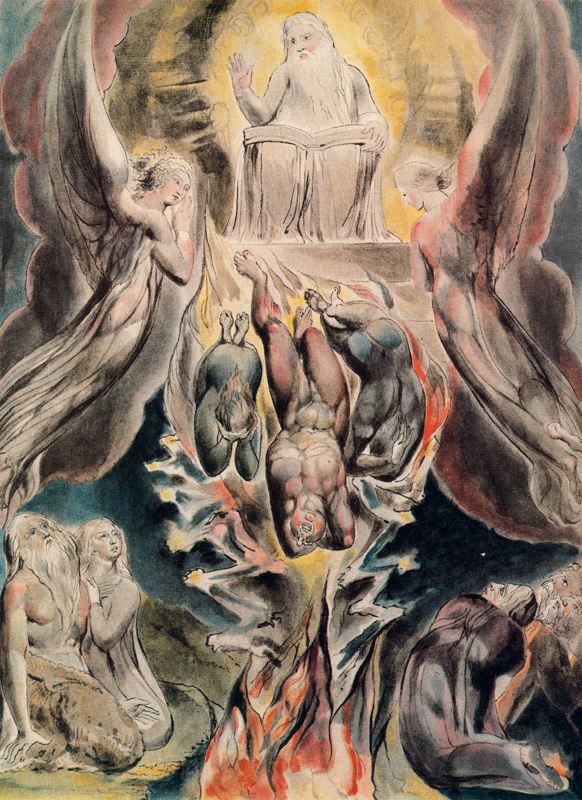
Satan in his Original Glory:  'Thou wast Perfect till Iniquity was Found in Thee'  c.1805 William Blake 1757-1827 Presented by the executors of W. Graham Robertson through the Art Fund 1949  http://www.tate.org.uk/art/work/N05892

Satan in his Original Glory:
‘Thou wast Perfect till Iniquity was Found in Thee’
c.1805 William Blake 1757-1827 Presented by the executors of W. Graham Robertson through the Art Fund 1949
http://www.tate.org.uk/art/work/N05892

Genesis 1-11 functions as myth just as thoroughly as Atrahasis or Hesiod’s Theogony, in that it lays out the origin of the present cosmic order as a product of primeval events, a narrative of the past that is constitutive of the present world.

In Alan Dundes’ succinct defintion, myth is “a sacred narrative explaining how the world or humans came to be in their present form.” (Alan Dundes, ed., The Flood Myth (Berkeley, 1988), p. 1.) Genesis 1-11 fulfills neatly this generic and functional definition. It is a cycle of ancient Israelite mythology, a prelude to the stories (which may be called legendary or epic) of national origin in the rest of the Pentateuch. Genesis 6:1-4 is an obvious example of myth in this sense.

Even as Genesis 6:1-4 shows that mythology was alive and well in ancient Israel, it also shows that such stories could be controversial, since this account has been so severely truncated in the J source. Each culture creates its own discursive boundaries, which are constantly subject to negotiation and conflict.
There were aspects of the full story of the Sons of God and the Daughters of Men that, according to the J source, ought not to be said. The boundaries between what can and cannot be said are important to discern in order to attend to the distinctive features of Israelite culture in its various manifestations.

Israelite religion is both like and unlike the religions of its neighbors according to these shifting boundaries of discourse and practice. Genesis 6:1-4 shows how the sexuality of the gods and their marriages with human women came into conflict with the unsayable in the conceptual horizons of the J source.

 William Blake (1757–1827)  wikidata: Q41513 s:en:Author:William  Deutsch: Der große Rote Drache und die mit der Sonne bekleidete Frau Français : Le grand Dragon Rouge et la Femme vêtue de soleil Español: El gran dragón rojo y la mujer vestida de sol wikidata:Q538936 Date1805-1810 Current location: National Gallery of Art  wikidata:Q214867 Washington (D.C.) Source/PhotographerThe Yorck Project: 10.000 Meisterwerke der Malerei. DVD-ROM, 2002. ISBN 3936122202. Distributed by DIRECTMEDIA Publishing GmbH. Permission (Reusing this file) http://mail.wikipedia.org/pipermail/wikide-l/2005-April/012195.html https://commons.wikimedia.org/wiki/File:William_Blake_003.jpg


William Blake (1757–1827)
wikidata: Q41513 s:en:Author:William
Deutsch: Der große Rote Drache und die mit der Sonne bekleidete Frau
Français : Le grand Dragon Rouge et la Femme vêtue de soleil
Español: El gran dragón rojo y la mujer vestida de sol
wikidata:Q538936
Date 1805-1810
Current location: National Gallery of Art
wikidata:Q214867
Washington (D.C.)
Source/Photographer The Yorck Project: 10.000 Meisterwerke der Malerei. DVD-ROM, 2002. ISBN 3936122202. Distributed by DIRECTMEDIA Publishing GmbH.
Permission
(Reusing this file) http://mail.wikipedia.org/pipermail/wikide-l/2005-April/012195.html
https://commons.wikimedia.org/wiki/File:William_Blake_003.jpg

That these issues are not spoken of elsewhere in the Hebrew Bible also illuminates this particular boundary of the unsayable. Sex, gods, and the allure of women are a potent and self-censoring combination in biblical discourse.

In post-biblical times, these tantalizing issues came to receive fuller attention, in what Freud might call a return of the repressed. The terse and sensational aspects of Genesis 6:1-4 provoked detailed exegetical attention. The wayward Sons of God and the Nephilim, the latter taken in their etymological sense as the “fallen ones,” in combination with other biblical stories of the “fall” of divine beings (especially Isaiah 14Ezekiel 28, and Psalm 82), gave rise to the myth of the fallen angels who seduced human women and introduced evil on the earth.

The awakened sexuality of these divine beings leads to their cosmic fall, similar to the exegetical equation of sex and evil in some post-biblical interpretations of the Garden of Eden story. (Elaine Pagels, Adam, Eve, and the Serpent, New York, 1988).

Through these extensions of the biblical story, the brief and cryptic text of Genesis 6:1-4 became the site of potent discourses in the Hellenistic period and beyond.”

Ronald Hendel, “The Nephilim Were on the Earth: Genesis 6:1-4 and its Ancient Near Eastern Context,” in Christoph Auffarth and Loren T. Stuckenbruck, eds., The Fall of the Angels, Brill, 2004, pp. 32-4.

An Excerpt from The Fall of the Angels

“How did the story about the fall of the angels relate to biblical tradition? Why is it only hinted at there, and not incorporated into the canon in more complete form? Two general points may be offered in response to these questions.

First, the story presupposes, rather than lies behind, the Hebrew Bible and, thus, is to be regarded as a development, indeed interpretation, of what later came to be recognized as canonical. Second, the communities which produced the story did so by transforming the biblical tradition through the dual filters of apocalyptic dualism and their own social contexts.

These points have to be taken into account when considering how it was that “the day of the Lord” of the exilic and post-exilic prophets could be absorbed into the notion of a final apocalyptic battle in later early Jewish literature. Was this shift from prophetic to apocalyptic eschatology the result of an attempt to reject the foreign domination by Hellenistic rulers—such as the Ptolemies in Egypt and the Seleucids in Syria—in the wake of Alexander the Great’s conquests?

Or was this growing dualism a reflection of the breach between urban and rural culture? Or, by contrast, did the apocalyptic religious tradition re-present knowledge gleaned from the “foreign” sciences of its day as divine revelation, doing so long before the Greeks came on the scene?

There were yet other stories in the Ancient Near East that had been told long time and retold in the Greek world. Those stories were adapted to the current social situation and to the clash of civilizations. (sic).

The famous passage from Genesis 6:1-4 played a central role in the development of apocalyptic traditions. The biblical tradition itself is ambiguous; it conveys a story about ancient “heroes”, on the one hand, and the “sons of the gods”, on the other. What these figures have to do with the destruction brought about through the Great Flood in the following narrative (Genesis 6:5ff.) constitutes the first question to be examined in this volume.

The contribution by Ronald Hendel does so by exploring possible parallels to the biblical story in the Ancient Near East. One of the most significant traditions to throw light on the biblical account is shown to be the Atrahasis Epic. If read alongside this epic, the ruptures and ambiguities within the Genesis narrative, which involves the insertion of a polytheistic conflict between deities into a monotheistic narrative about God and creation, do not appear so conspicuous or unexpected.

This is further illustrated by the common motif that has the lower world flooded by the heavenly world in order to prevent the superhuman inhabitants of the lower world from becoming too powerful. The attempt by the gods above to destroy the younger and smaller ones reaches a truce in the form of a treaty or alliance. This is how Genesis chapters 6-9 may be comprehended as a complete narrative and, in addition, came to include the passage in 6:1-4.

A tradition about a revolt in a heavenly palace is preserved in the Babylonian Atrahasis Epic, also known through the Baal-Cycle from Ugarit and the Hethitic Kumarbi Epic, has also influenced Greek mythology which tells of the conflict between Zeus, on the one hand, and his tyrannical murderer-father and the Titans his helpers, on the other. In this volume, Jan Bremmer argues impressively that the “Titans” of the story are actually not destroyed. The fear of their possible return persists and remains an irrepressible potential and threat.

How astronomic observation, the interpretation of stars as deities living in a distant world, and scientific knowledge are coalesced into the traditional image of God is shown by Matthias Albani in his analysis of Isaiah 14.

The Fall of the Rebel Angels is an oil-on-panel by Flemish renaissance artist Pieter Bruegel the Elder, painted in 1562. It is currently held and exhibited at the Royal Museums of Fine Arts of Belgium in Brussels. Bruegel's depiction of this subject is taken from a passage from the Book of Revelation (12, 2-9) and reveals the artist's profound debt to Hieronymous Bosch, especially in the grotesque figures of the fallen angels, shown as half-human, half-animal monsters.  Together with Dulle Griet and The Triumph of Death, which have similar dimensions, it was probably painted for the same collector and destined to become part of a series. https://en.wikipedia.org/wiki/The_Fall_of_the_Rebel_Angels_(Bruegel)

The Fall of the Rebel Angels is an oil-on-panel by Flemish renaissance artist Pieter Bruegel the Elder, painted in 1562. It is currently held and exhibited at the Royal Museums of Fine Arts of Belgium in Brussels.
Bruegel’s depiction of this subject is taken from a passage from the Book of Revelation (12, 2-9) and reveals the artist’s profound debt to Hieronymous Bosch, especially in the grotesque figures of the fallen angels, shown as half-human, half-animal monsters.
Together with Dulle Griet and The Triumph of Death, which have similar dimensions, it was probably painted for the same collector and destined to become part of a series.
https://en.wikipedia.org/wiki/The_Fall_of_the_Rebel_Angels_(Bruegel)

For Albani, the myth of the morning star that rises at night only to be driven away and dissolved by the light of the sun is discernible in a story about the power of God who, though rivaled by the smaller stars, is never surpassed by them.

The fact that the Isaiah account may be dated to the exilic period—and so is similar to expulsion of the throne pretender mentioned in Ezekiel 28—strengthens the likelihood that it functioned as a story of consolation. The image of the rise and fall of Helel was later translated into “Lucifer” in Latin tradition. The interpretation is depicted in Figure No. 2.

No direct line can be drawn from the Isaiah narrative to the Enochic apocalyptic literature and its Gnostic adaptation. The apocalyptic and cosmological dualisms of the latter fundamentally changed the religious tradition into something cosmic, super-historical, and superhuman.”

Christoph Auffarth & Loren T. Stuckenbruck, eds., “The Centre for Power for Evil: Its Origins and Development,” in The Fall of the Angels, Brill, 2004.