
Samizdat

Publishing the Forbidden. All Rights Reserved. © Samizdat 2014-2025.

Category: E’anatum

Selz: Victory Steles, Dreams and the Erra Epic

“A further consequence is that the appearance of the ruler was perceived as perfect in every sense, physically and mentally, he is strong and wise, these being the preconditions for his rule.

(Compare, for example, I.J. Winter, “The Body of the Able Ruler: Towards an Understanding of the Statues of Gudea,” in DUMU-E2-DUB-BA-A: Studies in Honor of Ake W. Sjöberg (ed. H. Behrens, D. Loding, and M.T. Roth; Publications of the Samuel Noah Kramer Fund 11; Philadelphia: University of Pennsylvania Museum, 1989), pp. 573-84.)

Such perfection is also mentioned repeatedly as a feature of the kings of Ur III; the best sources for this are provided by their hymns.

(See already S.N. Kramer, “Kingship in Sumer and Akkad: The Ideal King,” in Le palais et la royauté: Archéologie et civilization: Compte rendu de la XIXe Rencontre Assyriologique Internationale organisée par le Groupe François Thureau-Dangin, Paris, 29 juin–2 juillet 1971 (ed. P. Garelli; Paris: Geithner, 1974), pp. 163-76.

J. Klein, The Royal Hymns of Šulgi, King of Ur: Man’s Quest for Immortal Fame (Transactions of the American Philosophical Society 71.7; Philadelphia: American Philosophical Society, 1981); and numerous other works.)

Therefore it does not come as a surprise that in the texts from the last years of his reign, king Shulgi-r was marked with the divine classifier, which was traditionally reserved for all sorts of deities.

Roughly two centuries earlier the Old Akkadian king Narām-Sîn established this practice when he asserts that after rescuing the land from dire straits the people from various cities asked their gods to name him as their god and built him even a temple in the capital city Agade.
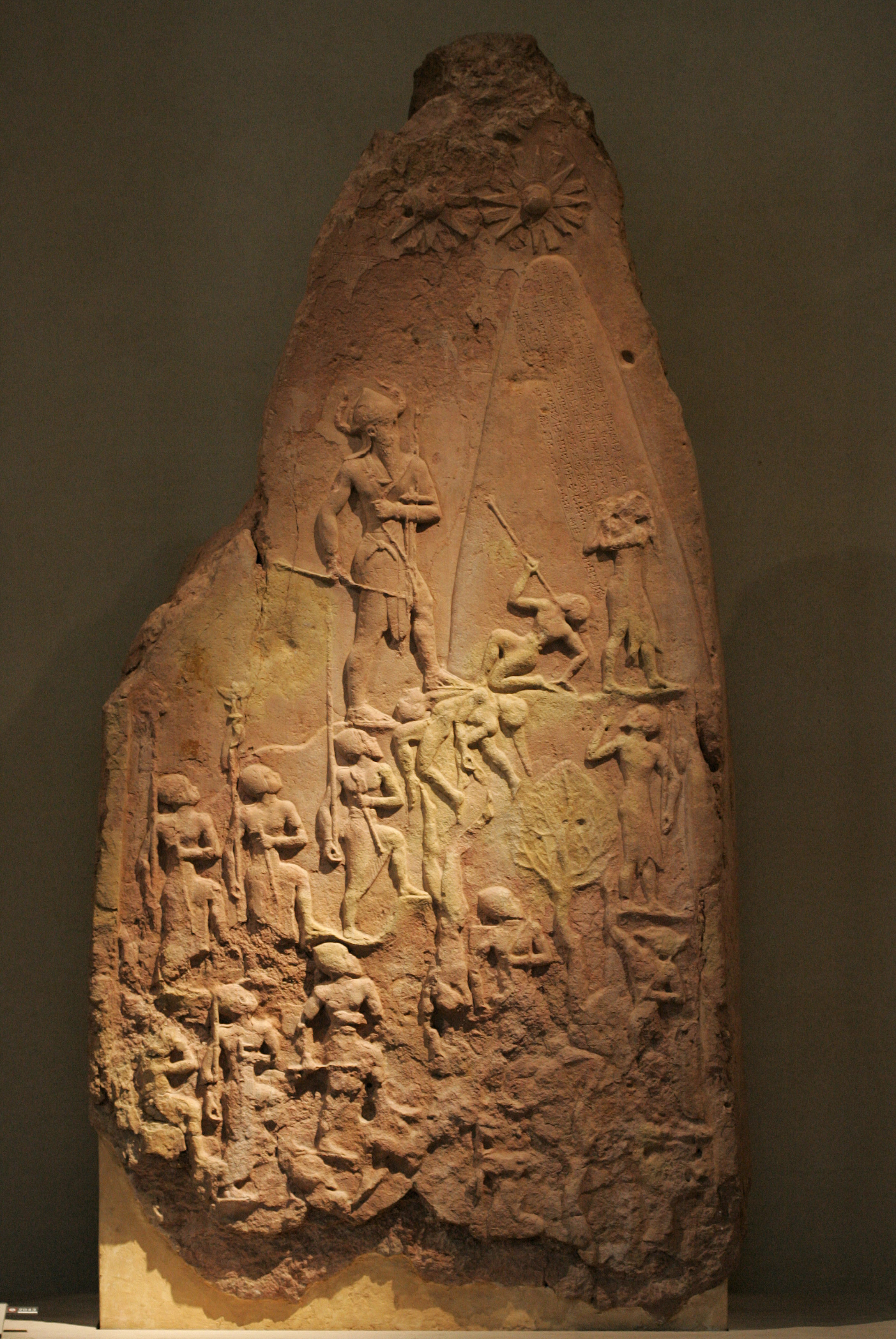
Victory Stele of Naram-Sin Brought back from Sippar to Susa as a war prize in the 12th century BCE.  Louvre Museum Accession number Sb 4 Found by J. de Morgan Photo: Rama This work is free software; you can redistribute it or modify it under the terms of the CeCILL. The terms of the CeCILL license are available at www.cecill.info. https://commons.wikimedia.org/wiki/File:Victory_stele_of_Naram_Sin_9068.jpg

Victory Stele of Naram-Sin
Brought back from Sippar to Susa as a war prize in the 12th century BCE.
Louvre Museum
Accession number Sb 4
Found by J. de Morgan
Photo: Rama
This work is free software; you can redistribute it or modify it under the terms of the CeCILL. The terms of the CeCILL license are available at http://www.cecill.info.
https://commons.wikimedia.org/wiki/File:Victory_stele_of_Naram_Sin_9068.jpg

Such (self-)deification of the ruler was not accepted unanimously in Mesopotamia: In the later cuneiform tradition Narām-Sîn’s attempt to obliterate the border between the human and the divine spheres was branded as blasphemous.

Like the giants, the rulers of Mesopotamia could have dreams. Dreams do, of course, play a major role all over the ancient Near East. For lack of space I just mention some very early examples here. The observable parallels may speak for themselves.
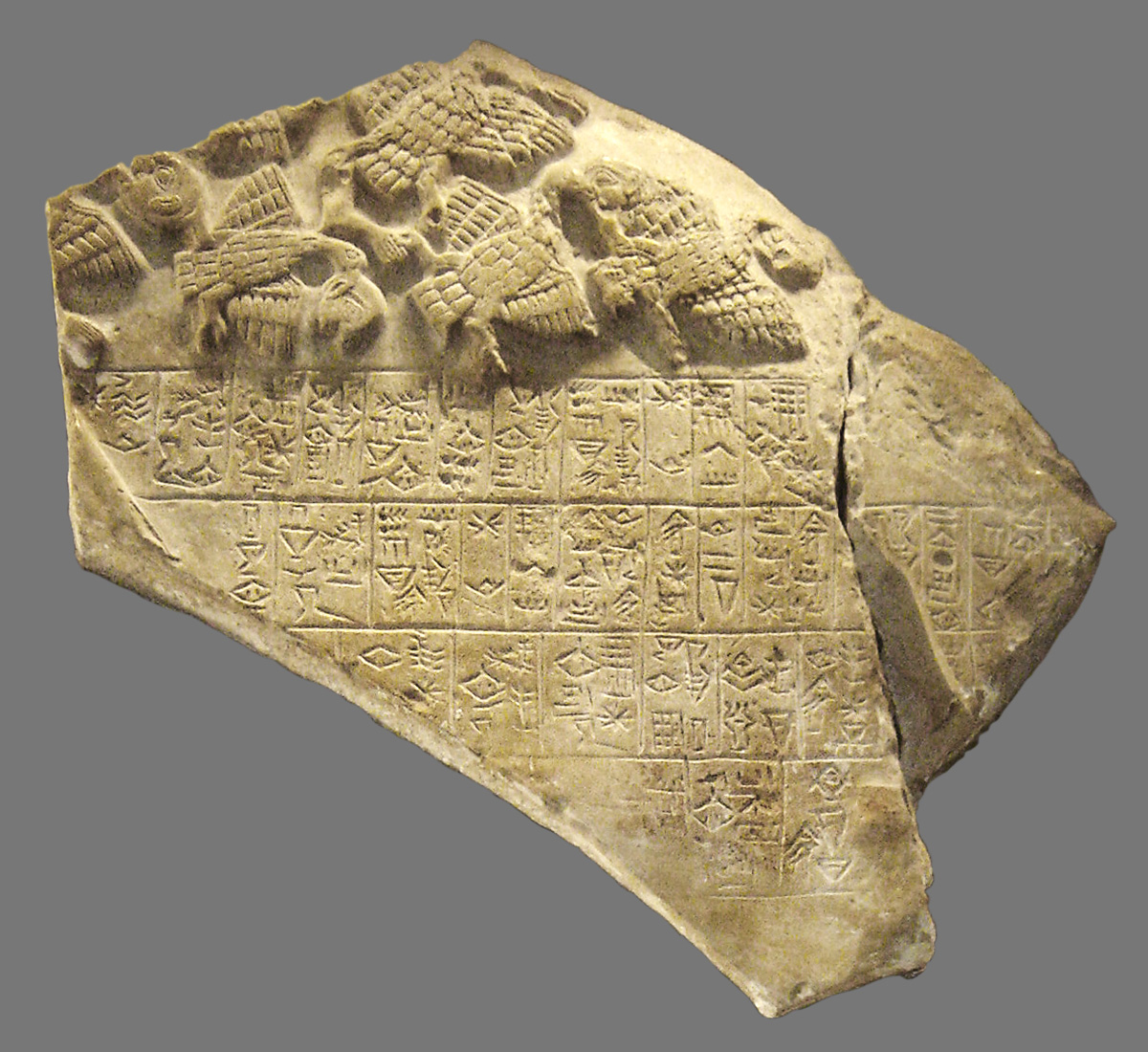
One fragment of the victory stele of the king Eannatum of Lagash over Umma, called « Stele of Vultures ». Historical side. Limestone, circa 2450 BC, Sumerian archaic dynasties. Found in 1881 in Girsu (now Tello, Iraq), Mesopotamia, by Édouard de Sarzec. Louvre Museum. Department of Mesopotamian antiquities, Richelieu, ground floor, room 1a AO 16 IO9, AO 50, AO 2246 and AO 2348 (for the whole stele) Donation of the British Museum. Eric Gaba (User:Sting), July 2005. Any use of this photograph can be made as long as you credit me (Eric Gaba – Wikimedia Commons user: Sting) as the author and distribute the copies and derivative works under the same license(s) that the one(s) stated below. A message with a reply address would also be greatly appreciated. Permission is granted to copy, distribute and/or modify this document under the terms of the GNU Free Documentation License, Version 1.2 or any later version published by the Free Software Foundation; with no Invariant Sections, no Front-Cover Texts, and no Back-Cover Texts. A copy of the license is included in the section entitled GNU Free Documentation License.

One fragment of the victory stele of the king Eannatum of Lagash over Umma, called « Stele of Vultures ». Historical side. Limestone, circa 2450 BC, Sumerian archaic dynasties. Found in 1881 in Girsu (now Tello, Iraq), Mesopotamia, by Édouard de Sarzec.
Louvre Museum.
Department of Mesopotamian antiquities, Richelieu, ground floor, room 1a
AO 16 IO9, AO 50, AO 2246 and AO 2348 (for the whole stele)
Donation of the British Museum.
Eric Gaba (User:Sting), July 2005.
Permission is granted to copy, distribute and/or modify this document under the terms of the GNU Free Documentation License, Version 1.2 or any later version published by the Free Software Foundation; with no Invariant Sections, no Front-Cover Texts, and no Back-Cover Texts. A copy of the license is included in the section entitled GNU Free Documentation License.

The earliest attestation for a dream is attested in the famous stele of vultures of the pre-Sargonic king of Lagash, E’anatum. In E’anatum 1, 6:28 we read: “to the one who has lain down, to the one who has lain down (the deity) stood at (his) head.”
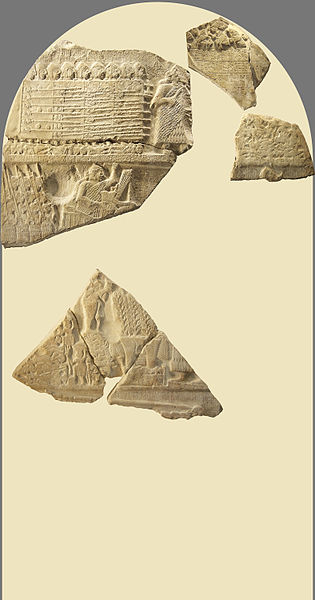
Reconstitution of the victory stele of the king Eannatum of Lagash over Umma, called « Stele of Vultures ». Historical side. Limestone, circa 2450 BC, Sumerian archaic dynasties. Found in 1881 in Girsu (now Tello, Iraq), Mesopotamia, by Édouard de Sarzec. AO 16 IO9, AO 50, AO 2246 and AO 2348 (for the whole stele) https://commons.wikimedia.org/wiki/Category:Stele_of_the_Vultures#/media/File:Stele_of_Vultures_historical_side.jpg Eric Gaba (User:Sting), July 2005. Any use of this photograph can be made as long as you credit me (Eric Gaba – Wikimedia Commons user: Sting) as the author and distribute the copies and derivative works under the same license(s) that the one(s) stated below. A message with a reply address would also be greatly appreciated. Permission is granted to copy, distribute and/or modify this document under the terms of the GNU Free Documentation License, Version 1.2 or any later version published by the Free Software Foundation; with no Invariant Sections, no Front-Cover Texts, and no Back-Cover Texts. A copy of the license is included in the section entitled GNU Free Documentation License.

Reconstitution of the victory stele of the king Eannatum of Lagash over Umma, called « Stele of Vultures ». Historical side. Limestone, circa 2450 BC, Sumerian archaic dynasties. Found in 1881 in Girsu (now Tello, Iraq), Mesopotamia, by Édouard de Sarzec.
AO 16 IO9, AO 50, AO 2246 and AO 2348 (for the whole stele)
https://commons.wikimedia.org/wiki/Category:Stele_of_the_Vultures#/media/File:Stele_of_Vultures_historical_side.jpg
Eric Gaba (User:Sting), July 2005.
Permission is granted to copy, distribute and/or modify this document under the terms of the GNU Free Documentation License, Version 1.2 or any later version published by the Free Software Foundation; with no Invariant Sections, no Front-Cover Texts, and no Back-Cover Texts. A copy of the license is included in the section entitled GNU Free Documentation License.

(We note that this passage follows the miraculous birth of the ruler E’anatum; presumably he was thus especially fitted for the dream message.)

For our purpose, here it is noteworthy, that a deity was the sender or transmitter of the dream. The dream was of divine origin, considered as revelation of the divine will.”

(The clearest reference to the divine revelation of a text is attested in the late Erra Epic with his evident “apocalyptic” theme where the author Kabti-ilāni-Marduk actually asserts in the colophon of the text: (5:40):

Reconstitution of the victory stele of the king Eannatum of Lagash over Umma, called « Stele of Vultures ». Mythological side. Limestone, circa 2450 BC, Sumerian archaic dynasties. Found in 1881 in Girsu (now Tello, Iraq), Mesopotamia, by Édouard de Sarzec. AO 16 IO9, AO 50, AO 2246 and AO 2348 (for the whole stele) https://commons.wikimedia.org/wiki/File:Stele_of_Vultures_mythological_side.jpg Eric Gaba (User:Sting), July 2005. Any use of this photograph can be made as long as you credit me (Eric Gaba – Wikimedia Commons user: Sting) as the author and distribute the copies and derivative works under the same license(s) that the one(s) stated below. A message with a reply address would also be greatly appreciated. Permission is granted to copy, distribute and/or modify this document under the terms of the GNU Free Documentation License, Version 1.2 or any later version published by the Free Software Foundation; with no Invariant Sections, no Front-Cover Texts, and no Back-Cover Texts. A copy of the license is included in the section entitled GNU Free Documentation License.

Reconstitution of the victory stele of the king Eannatum of Lagash over Umma, called « Stele of Vultures ». Mythological side. Limestone, circa 2450 BC, Sumerian archaic dynasties. Found in 1881 in Girsu (now Tello, Iraq), Mesopotamia, by Édouard de Sarzec.
AO 16 IO9, AO 50, AO 2246 and AO 2348 (for the whole stele)
https://commons.wikimedia.org/wiki/File:Stele_of_Vultures_mythological_side.jpg
Eric Gaba (User:Sting), July 2005.
Permission is granted to copy, distribute and/or modify this document under the terms of the GNU Free Documentation License, Version 1.2 or any later version published by the Free Software Foundation; with no Invariant Sections, no Front-Cover Texts, and no Back-Cover Texts. A copy of the license is included in the section entitled GNU Free Documentation License.

“For (the god) Erra had burned with wrath and planned to lay waste the countries and slay their peoples, but Ishum, his counsellor, appeased him and (Erra) left a remnant! Kabti-ilāni-Marduk, the son of Dabibi, (was) the composer of this tablet (= of this poem):

(The deity) revealed it to him during the night, and in the morning, when he recited (it), he did not skip a single (line) nor a single line (of his own) did he add to it ….” (5:55)

[Erra speaks] “The scribe who commits it to memory shall escape the enemy country (and) shall be honoured in his own country. In the sanctuary of (those) sages where they constantly mention my name, I will grant them wisdom.

To the house in which this tablet is placed—however furious Erra may be, however murderous the Sebettu (pleaiades or seven sisters) may be—the sword of destruction shall not come near.”

(English translation by L. Cagni, The Poem of Erra [Sources of the Ancient Near East 1.3; Malibu: Undena Publications, 1974).”

Gebhard J. Selz, “Of Heroes and Sages–Considerations of the Early Mesopotamian Background of Some Enochic Traditions,” in Armin Lange, et alThe Dead Sea Scrolls in Context, v. 2, Brill, 2011, pp. 796-7.

Selz: On Sacred Marriage

“This passage reminds one of the old Mesopotamian concept—and I am convinced it is a Mesopotamian concept, not a mere invention of modern scholarship—according to which a (mythical) ruler is thought to cohabit with a goddess or with her priestly incarnation.

Hierogamus, bed and couple. Period of the Amorite dynasties, early 2nd millennium BCE Baked clay, H: 11,3 cm AO 8662, Louvre.  http://www.lessingimages.com/viewimage.asp?i=08021112+&cr=413&cl=1#

Hierogamus, bed and couple. Period of the Amorite dynasties, early 2nd millennium BCE. Baked clay, H: 11,3 cm. AO 8662, Louvre.
http://www.lessingimages.com/viewimage.asp?i=08021112+&cr=413&cl=1#

(This is a much disputed issue, best known under the heading “Sacred Marriage” concept. What is interesting here is the feature of a divine-human interaction in the sexual life and the consequences thereof. We are not concerned here with the hypothesis of a purely metaphorical interpretation or with a possible actualization in an alleged ritual.

Couple on a bed (hierogamus). From Susa, 14th-12th BCE Terracotta, 11,2 x 5,8 cm SB 7979, Louvre.  http://www.lessingimages.com/viewimage.asp?i=08021158+&cr=523&cl=1#

Couple on a bed (hierogamus). From Susa, 14th-12th BCE. Terracotta, 11,2 x 5,8 cm. SB 7979, Louvre.
http://www.lessingimages.com/viewimage.asp?i=08021158+&cr=523&cl=1#

For a comparative evaluation of this topic see P. Lapinkivi, The Sumerian Sacred Marriage in the Light of Comparative Evidence (SAAS 15; Helsinki: Neo-Assyrian Text Corpus Project, 2004.)

See further E. Cancik-Kirschbaum, “Hierogamie-Eine Skizze zum Sachstand in der Altorientalistik,” in Gelebte Religionen: FS Hartmut Zinser (ed. H. Piegeler, I. Pohl, and S. Rademacher; Würzburg: Königshausen & Neumann, 2004), pp. 65-72.

Couple embracing (hierogamus). From Susa, 14th-12th BCE Terracotta, 11,3 x 6 cm SB 6609, Louvre. http://www.lessingimages.com/viewimage.asp?i=08021159+&cr=569&cl=1#

Couple embracing (hierogamus). From Susa, 14th-12th BCE. Terracotta, 11,3 x 6 cm. SB 6609, Louvre.
http://www.lessingimages.com/viewimage.asp?i=08021159+&cr=569&cl=1#

G.J. Selz, “The Divine Prototypes,” in Religion and Power: Divine Kingship in the Ancient World and Beyond (ed. N. Brisch; Oriental Institute Seminars 4; Chicago: Oriental Institute of the University of Chicago, 2008), pp. 13-31.

Accordingly, the kings of the Ur III empire depict themselves in their hymns as divine scions, as sons of the mythical ruler Lugalbanda and the Goddess Ninsu(mu)na-k. In the present context it is not without interest that these kings were thus becoming “brothers of Gilgamesh,” profiting somehow from the hero’s legendary fame.

Bed with a geometrical pattern, bed with a couple embracing (hierogamus), both from Susa, Iran, 14th-12th BCE SB 11206 geometrical pattern, terracotta 3,1 x 11,8 cm Sb 5888 bed with couple, terracotta, 3 x 9,5 cm, Louvre. http://www.lessingimages.com/viewimage.asp?i=08021160+&cr=691&cl=1#

Bed with a geometrical pattern, bed with a couple embracing (hierogamus), both from Susa, Iran, 14th-12th BCE SB 11206, geometrical pattern, terracotta 3,1 x 11,8 cm. SB 5888, bed with couple, terracotta, 3 x 9,5 cm, Louvre.
http://www.lessingimages.com/viewimage.asp?i=08021160+&cr=691&cl=1#

The divine sonship, however, can be traced back to the middle of the third millennium. An Old Sumerian ruler of the south Mesopotamian city state Lagash depicts himself in his text as follows:

“(The god) [Ni]n[gir]su-k [imp]lanted the [semen] for (the ruler) E’[a]na-tum in the [wom]b . . . rejoiced over [E’anatum]. (The goddess) Inana-k accompanied him, named him “In the E’ana (temple) of Inana-k from (the sacred precinct) Ibgal I bring him (= E’ana-Inana-lbgal-akak-atum)” and set him on the legitimising knees of (the mother goddess) Ninchursag(a). Ninchursag(a) [offered him] her legitimising breast.”

(Ean 1, 4:9-12 (H. Steible, ed., Die altsumerische Bau-und Weihinschriften [2 vols.; Freiburger altorientalische Studien 5; Wiesbaden: Steiner, 1982], pp. 1:122) RIME 1.9.3.1, 4:9-12.

See D. Frayne, ed., Presargonic Period (2700-2350 BCE) (RIME 1; Toronto: University of Toronto Press, 2008), pp. 129-30.)

Ningirsu-k rejoiced over E’anatum, semen implanted into the womb by Ningirsu-k. Ningirsu-k laid his span upon him, for (a length of) five forearms he set his forearm upon him: (he measured) five forearms (cubits), one span! (to the reconstructed measurements of this period ca. 2.72 meters). Ningirsu-k, out of his great joy, [gave him] the kin[gship of Lagash].”

(Ean. 1, 5:1-5 H. Steible, Die altsumerischen Bau-und Weihinschriften, 1:123) = RIME 1.9.3.1 (Frayne, Presargonic Period, p. 129).

Hence, the ruler is the one “who has strength,” a precondition for his successful rule.

The aforementioned size of 2.72 meters makes just a small giant. However, this size is an outward sign designating someone who transgresses human measurements and norms.

Accordingly it became possible to attribute to such an extraordinary ruler a sort of functional divinity, as can be corroborated by several additional arguments.

We can therefore say that the ruler is perceived as an Avatar, a manifestation of the state god Ningirsu-k.”

Gebhard J. Selz, “Of Heroes and Sages–Considerations of the Early Mesopotamian Background of Some Enochic Traditions,” in Armin Lange, et alThe Dead Sea Scrolls in Context, v. 2, Brill, 2011, pp. 795-6.