Samizdat

Publishing the Forbidden. All Rights Reserved. © Samizdat 2014-2025.

Category: creatures of apsû

On the Fish-Apkallu

Fish Apkallu

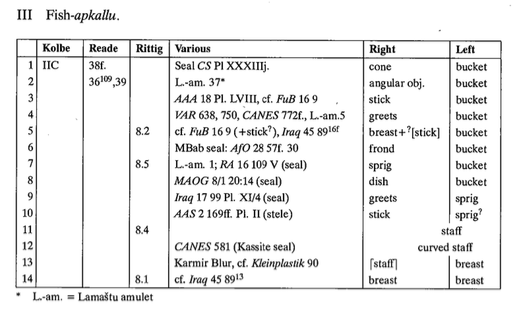
“Lamaštu amulets:

The fish-apkallū on Lamaštu amulet 2 (and 4?), exactly like the ūmu-apkallū on Lamaštu amulets 3 and 61, has his left hand on the bed of the sick man. The right hand is slightly damaged, but probably greeting.

Fish-Apkallu statuettes of the type that were buried in the foundations of buildings.

Fish-Apkallu statuettes of the type that were buried in the foundations of buildings. It is difficult to tell whether they hold their hands in a prayerful position or hold something indistinct. 

Wrong hand:

Occasionally apkallū are attested holding the bucket in their right hand: AfO 28 57f. 30 (above IIiI/6), Lamaštu amulet 5 (?), Calmeyer Reliefbronzen 66 H:8 (bird-apkallū).

Unidentified object:

One of the apkallū on CANES 773 holds in his right hand an unidentified feather-like object.

Identification:

The identification of the fish-apkallū of ritual I/IiI with the “fish-garbed” man goes back to Smith JRAS 1926 709 (based on comparison with the Kleinplastik from Ur); identification of one of them with Oannes has been proposed since the early days of Assyriology (Kolbe Reliefprogramme 26, Zimmern KAT 535ff., ZA 35 151ff.) but was proved only after the names of the sages in Berossos’ Babyloniaka were recognized in cuneiform (van Dijk UVB 18 46ff.).

Occasionally the apkallū is mistakenly identified with the fish-man / kulullû (see below, VII.C.9), a completely different figure. U4 – a n (Oannes) and Adapa, a human sage living approximately at the same time, are probably two different figures (Borger JNES 33186, Picchioni Adapa 97ff.).
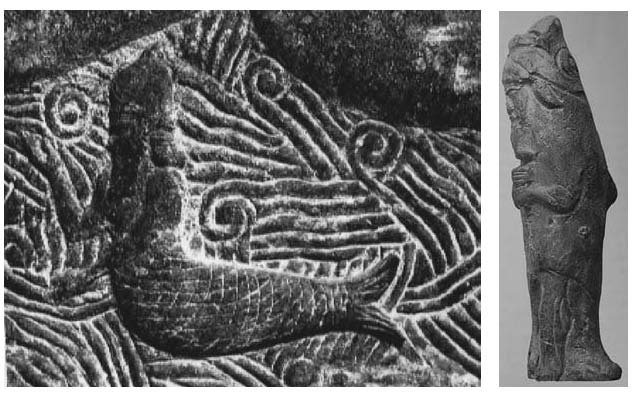
A "fish-man" / kulullû is depicted at left, and a fish-apkallū at right.  Wiggermann distinguishes these two entities.

A “fish-man” / kulullû is depicted at left, and a fish-apkallū at right.
Wiggermann distinguishes these two entities.

The texts clearly indicate that the fish-apkallū are not fish-garbed priests, but mythological figures, man and fish; they are bīnūt apsî, “creatures of apsû“, in ritual I/IIi, purād tāmtiša ina nāri ibbanú, “carp of the sea…who were grown in the river” in text IIiI.B.8 (cf. also Cagni Erra, I 162), and Berossos clearly describes them as a mixture of fish and man (cf. S. Mayer Burstein SANE I/5 13, 19).

Their names lack the determinative DINGIR, they are no gods, and the horns on the head of the fish (on palace reliefs, not on seals, cf. Kleinplastik 89, FuB 10 35) probably developed from its gills.

Berossos calls them “hemidaimones” (Jacoby FGrH 400).
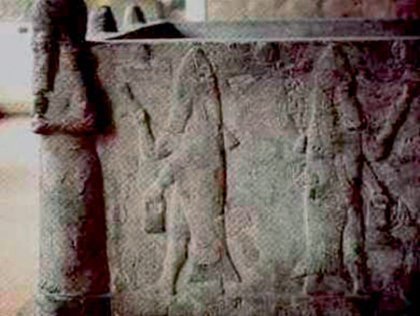
Fish-Apkallū depicted on a cistern. The fish iconography is unmistakable, as are the banduddu buckets in their left hands. Objects in their right hands are indistinct, but the traditional gestures of warding or blessing seem clear.

Fish-Apkallū depicted on a cistern. The fish iconography is unmistakable, as are the banduddu buckets in their left hands. Objects in their right hands are indistinct, but the traditional gestures of warding or blessing seem clear. The objects in their right hands may be the “angular objects” mentioned in the table by Wiggermann at the top of the page. 

History.

In the third millennium a b g al is the name of a profession: see MSL 12 10:15, ZA 72 174 11 v 3, Bauer AWL 125 i 4 (NUN.ME.KA X ME/GANA2f, cf. also Barton MBI 2 iv 2), Ukg. 6 ii 30′, iii 4 (NUN.ME.KA X ME/GANA2f.) UET 8 33:15 and for the same profession in the divine world: TCL 15 10:98 (dA b g a l) cf. 85.

In OB sum. incantations a b g a l apparently refers to a mythological sage at the court of Enki: VAS 17 13:5 (together with Enkum, Ninkum, and the seven children of Apsû), 16:11, 32:21, HSAO 262:56, PBS I/2 123:9 IIIISET 1 217 Ni 4176:12, OrNS 44 68, cf. ASKT 12 Obv. 11ff.

The “seven apkallū of Eridu“, at least in AnSt 30 78 (SB) identified with the seven antediluvian sages (Anenlilda is among them), are rooted in the third millenium (TCS 3 25:139, cf. Benito “Enki and Ninmah” and “Enki and the World Order” 91:105, and for later attestations JCS 21 11 25+a, Maqlû II 124, V 110 = AfO 21 77, VII 49, VIII 38).

The names of the seven antediluvian sages are certainly not as old as the names of the antediluvian kings: they seem to be derived partly from the titles of literary works (Hallo JAOS 83 175f.), and partly from the names of the antediluvian kings.

The element en-me-(e n) (and a m – m e, a m – i etc.) = e m e n (me —en) (cf. Finkelstein JCS 17 42, Wilcke Lugalbanda 41), “lord”, in the names of the kings has been reinterpreted as “the lord (e n) who makes good (d u 10 – g a)/ perfects (g a l a m) / refines (b ùl u g -g á) the regulations (m e)”.

Although the resulting names are good Sumerian (Lambert JCS 16 74), the consistent difference is telling. The Sumerian of the linguistically rather simple bilingual incantation to the fish-apkallū in bīt mēseri (III.B.8) could well be of MB date, and the Kassite seals with representations of the fish-apkallū prove that at this time the later views existed at least partially.

These undatable later views connect the named carp apkallū with canonized literature (Lambert JCS 16 59ff., Hallo JAOS 83 175f., van Dijk-Mayer BaMB 2 no 90) and have possibly been developed concomittantly.

Literature on the apkallū types :

Below text III.B.8, 9, 10, 11; Borger JNES 33 183ff., Foster OrNS 43 344ff., Komoróczy ActAntHung 21 135ff., 142ff., S. Mayer Burstein SANE 1/5 13ff., Kawami Iran 10 146ff., van Dijk UVB 18 43ff., all with many references to previous literature.”

F.A.M. Wiggermann, Mesopotamian Protective Spirits: The Ritual Texts, STYX&PP Publications, Groningen, 1992, p. 76-7.

Statues in Private Rooms, the apkallū, “Sages.”

“In the bedroom (kummu, cf. III.B.6), the “place of life” (AAA 22 88:146f.), at the head of the bed of the threatened man, the seven anthropomorphic ūmu-apkallū, the “leading sages” (cf. II.A.3.1), are stationed. The seven bird-apkallū are buried against the wall at the head of the bed, but in an adjoining room (uncertain, cf. II.A.3.9).

This depiction of a fish-apkallū (Apkallu, Abkallu) guarded the entrance to the temple of Ninurta at Nimrud. A fish's head can be seen on Apkallu's head, and its skin hangs down over the back of Apkallu's body.  Neo-Assyrian era, 865-860 BCE. From the Temple of Ninurta, Nimrud (ancient Kalhu; Biblical Calah), northern Mesopotamia, Iraq. (The British Museum, London). Osama Shukir Muhammed Amin FRCP (Glasg) http://www.ancient.eu/image/2708/

This depiction of a fish-apkallū (Apkallu, Abkallu) guarded the entrance to the temple of Ninurta at Nimrud. A fish’s head can be seen on Apkallu’s head, and its skin hangs down over the back of Apkallu’s body.
Neo-Assyrian era, 865-860 BCE. From the Temple of Ninurta, Nimrud (ancient Kalhu; Biblical Calah), northern Mesopotamia, Iraq. (The British Museum, London).
Osama Shukir Muhammed Amin FRCP (Glasg)
http://www.ancient.eu/image/2708/

At the threshold of the bedroom seven fish-apkallū guard the entrance; two further groups of seven fish-apkallū are buried in front of, and behind the chair. The chair may have been in the bedroom or perhaps rather in an adjoining living-room or dining-room (the furniture of a dining room in the Neo-Assyrian period has been studied by K. Deller and I. Finkel in ZA 74 86f.; it includes a kussiu, “chair”, but no bed).

Material: the ūmu-apkallū are made of e’ru, a kind of wood well known for its magical properties, but as yet not identified with certainty; Thompson DAB 298f.: “Laurel”, CAD E 318ff.: a variety of cornel (followed by AHw 247a), Salonen Wasserfahrzeuge 99, 152: “Lorbeer” (cf., Oppenheim Eames 54), Civil apud Landsberger Datepalm 26: “(dwarf)ash” (followed by CAD M/1 221a, M/2 220b, S 202a, AHw 676a), see further Sollberger Genava 26 61 and Snell Ledgers and Prices 211.

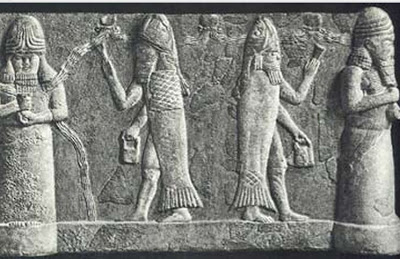
The god Ea is portrayed at far left, with water coursing from his shoulders.  Two fish-apkallu hold banduddu buckets. This bas relief is atypical in that the left-side fish-apkallu holds his banduddu in his right hand, rather than the left, as is portrayed in most other depictions.  This bas relief is also unusual in that it portrays the fish-apkallu with different objects in their raised hands. The raised hand of the fish-apkallu on the left is indistinct, partially covered by the water flowing from the shoulders of the god Ea, while the other fish-apkallu raises an object that I have not yet identified.

The god Ea is portrayed at far left, with water coursing from his shoulders.
Two fish-apkallu hold banduddu buckets. This bas relief is atypical in that the left-side fish-apkallu holds his banduddu in his right hand, rather than the left, as is portrayed in most other depictions.
This bas relief is also unusual in that it portrays the fish-apkallu with different objects in their raised hands. The raised hand of the fish-apkallu on the left is indistinct, partially covered by the water flowing from the shoulders of the god Ea, while the other fish-apkallu raises an object that I have not yet identified.

In the incantation UDUG HUL EDiN.NA DAGAL LA (cf. text III.C), that accompanies the fabrication of the statues of the ūmu apkallū, the e’ru of which they are to be made is called: gis HUL.DÚB.BA GIŠ NAM.TI.LA, “mace that hits evil (cf. Grayson Iraq 37 69), wood of life” (AAA 22 88:152f.).

Analogous to the designation of the tamarisk of which the gods were made as the “bone of divinity” (above A), the designation of the material of the ūmu apkallū reveals something of their character: they chase evil away, and procure life.

Probably relevant is the “mystical” commentary (cf. below note 3e) gis TUKUL MA.NU: VII u4-mu gis TUKUL dAMAR.UTU, “the mace of e’ru: the seven ūmu-demons, the mace of Marduk“. Here “the mace of cornel” may refer to the seven ūmu-apkallū holding an e’ru stick or mace in their right hands. In straight-forward ritual contexts (notes 2, 13c, d, e) “mace of cornel” is rather an alternative designation of the e’ru (stick/mace) itself.

The ūmu-apkallū certainly did not belong to the bīnūt apsê, “creatures of apsû” (I 144); they probably did not belong to the bīnūt šamê, “creatures of heaven”, either, since the preceding designation salmī annūti, “these statues”, refers to the statues of tamarisk made the same day, and not to the statues of cornel made the day before (I 143).

The line closing the description of the statues of cornel does not contain a general term analogous to I 143 closing the tamarisk section; perhaps I 28 did contain such a term, or perhaps no such term was used.

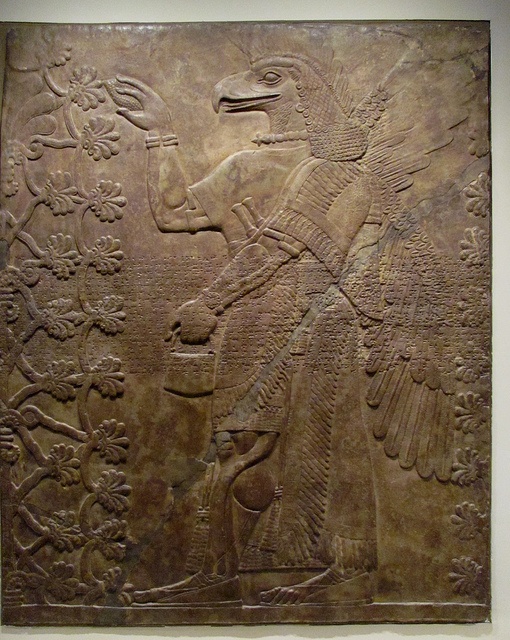
A bas relief in the Louvre.  In this case the bird-apkallū tends to a sacred tree. Considering the mullilu in his right hand and the banduddu in his left, (tree cone and water bucket), he is engaged in a water ritual intended to sanctify the sacred tree. This is a common motif in Sumerian and Neo-Assyrian idols.  This bas relief is in the Louvre.  Primary publicationNimrud NW Palace I-24 = RIMA 2.0.101.023, ex. 189 (f) Collection	Nimrud, Iraq (a); British Museum, London, UK (b); Louvre Museum, Paris, France (c); Nimrud, Iraq (d); Detroit Institute of Arts, Detroit, Michigan, USA (e); British Museum, London, UK; Louvre Museum, Paris, France  Museum no.	Nimrud fragment no. 42 (a); BM 098061 (b); AO 22198 (c); Nimrud fragment no. 43 and 45 (d); DIA 47.181 (e) (photo: DIA); AO 19849  Accession no.	1903-10-10, 0002 (b) Provenience	Kalhu (mod. Nimrud) Period	Neo-Assyrian (ca. 911-612 BC)

A bas relief in the Louvre.
In this case the bird-apkallū tends to a sacred tree. Considering the mullilu in his right hand and the banduddu in his left, (tree cone and water bucket), he is engaged in a water ritual intended to sanctify the sacred tree. This is a common motif in Sumerian and Neo-Assyrian idols.
This bas relief is in the Louvre.
Primary publication Nimrud NW Palace I-24 = RIMA 2.0.101.023, ex. 189 (f)
Collection Nimrud, Iraq (a); British Museum, London, UK (b); Louvre Museum, Paris, France (c); Nimrud, Iraq (d); Detroit Institute of Arts, Detroit, Michigan, USA (e); British Museum, London, UK; Louvre Museum, Paris, France
Museum no. Nimrud fragment no. 42 (a); BM 098061 (b); AO 22198 (c); Nimrud fragment no. 43 and 45 (d); DIA 47.181 (e) (photo: DIA); AO 19849
Accession no. 1903-10-10, 0002 (b)
Provenience Kalhu (mod. Nimrud)
Period Neo-Assyrian (ca. 911-612 BC)

The bird- and fish-apkallū are made of clay, and are included among the bīnūt apsê, “the creatures of apsû” (I 144). They and the other statues of clay are the salmū sākip lemnūti ša Ea u Marduk, “the statues repelling the evil ones, of Ea and Marduk“, stationed in the house “to expel the foot of evil” (I 160f. 165f.). The bird- and fish-apkallū are separated, however, from the other figures of clay by a line indicating the end of a section (I 183).

In text I the clay of the bird-apkallū is mixed with wax.”

F.A.M. Wiggermann, Mesopotamian Protective Spirits: The Ritual Texts, STYX&PP Publications, Groningen, 1992, p. 65.