Samizdat

Publishing the Forbidden. All Rights Reserved. © Samizdat 2014-2026.

Category: Babylon

Bel-Merodach Returns to Babylon

” … Babylon welcomed its new king–a Babylonian by birth and the son of a Babylonian princess. The ancient kingdom rejoiced that it was no longer to be ruled as a province; its ancient dignities and privileges were being partially restored.

But one great and deep-seated grievance remained. The god Merodach was still a captive in the temple of Ashur.

No king could reign aright if Merodach were not restored to E-sagila. Indeed he could not be regarded as the lord of the land until he had “taken the hands of Bel.”

The ceremony of taking the god’s hands was an act of homage. When it was consummated the king became the steward or vassal of Merodach, and every day he appeared before the divine one to receive instructions and worship him. The welfare of the whole kingdom depended on the manner in which the king acted towards the god.

If Merodach was satisfied with the king he sent blessings to the land; if he was angry he sent calamities. A pious and faithful monarch was therefore the protector of the people.

This close association of the king with the god gave the priests great influence in Babylon. They were the power behind the throne. The destinies of the royal house were placed in their hands; they could strengthen the position of a royal monarch, or cause him to be deposed if he did not satisfy their demands.

A king who reigned over Babylon without the priestly party on his side occupied an insecure position. Nor could he secure the co-operation of the priests unless the image of the god was placed in the temple. Where king was, there Merodach had to be also.

Shamash-shum-ukin pleaded with his royal brother and overlord to restore Bel Merodach to Babylon. Ashur-bani-pal hesitated for a time; he was unwilling to occupy a less dignified position, as the representative of Ashur, than his distinguished predecessor, in his relation to the southern kingdom.

At length, however, he was prevailed upon to consult the oracle of Shamash, the solar lawgiver, the revealer of destiny. The god was accordingly asked if Shamash-shum-ukin could “take the hands of Bel” in Ashur’s temple, and then proceed to Babylon as his representative.

In response, the priests of Shamash informed the emperor that Bel Merodach could not exercise sway as sovereign lord so long as he remained a prisoner in a city which was not his own.

Ashur-bani-pal accepted the verdict, and then visited Ashur’s temple to plead with Bel Merodach to return to Babylon.

“Let thy thoughts,” he cried, “dwell in Babylon, which in thy wrath thou didst bring to naught. Let thy face be turned towards E-sagila, thy lofty and divine temple. Return to the city thou hast deserted for a house unworthy of thee. O Merodach! lord of the gods, issue thou the command to return again to Babylon.”

Thus did Ashur-bani-pal make pious and dignified submission to the will of the priests. A favourable response was, of course, received from Merodach when addressed by the emperor, and the god’s image was carried back to E-sagila, accompanied by a strong force.

Ashur-bani-pal and Shamash-shum-ukin led the procession of priests and soldiers, and elaborate ceremonials were observed at each city they passed, the local gods being carried forth to do homage to Merodach.

Babylon welcomed the deity who was thus restored to his temple after the lapse of about a quarter of a century, and the priests celebrated with unconcealed satisfaction and pride the ceremony at which Shamash-shum-ukin “took the hands of Bel.”

The public rejoicings were conducted on an elaborate scale. Babylon believed that a new era of prosperity had been inaugurated, and the priests and nobles looked forward to the day when the kingdom would once again become free and independent and powerful.”

Donald A. Mackenzie, Myths of Babylonia and Assyria, 1915, pp. 480-2.

On the Neo-Platonic Forgeries

IN giving to the public a new edition of Cory’s Ancient Fragments I have endeavoured to respond to the wishes of numerous literary friends by furnishing a brief account of the several authors to whom we are indebted for these extracts, and, at the same time, some information respecting the decipherment of the hieroglyphic texts of Egypt, and the cuneiform records of Nineveh and Babylon.

The first edition of this work appeared in 1828, the second in 1832; therefore, at a time when Egyptian scholarship was still in its infancy, while cuneiform research had not yet seen the light. The discoveries of Champollion, Young, Birch, Bunsen, Brugsch, Chabas, Le Page Renouf, Godwin, and a host of other scholars in the former field of research, and of Layard, Botta, Rawlinson, Norris, Oppert, Menant, George Smith, Sayce, Fox Talbot, and Schrader in the latter, have furnished so much valuable information respecting the ancient empires of Egypt and Assyria, that we can no longer rest satisfied with the meagre accounts transmitted to us by the classic writers concerning times and people with which they were themselves but imperfectly acquainted.

At a time, therefore, when, thanks to the labours of the distinguished scholars above named, we can read with considerable facility and astonishing certainty the papyri of Egypt and the clay-tablets of Babylon, it behoves us to pause for a moment, and consider how this wonderful mine of ancient treasures was discovered, and the means by which it has been worked.

Cory’s Fragments constitute a fitting supplement to the fragments which have been exhumed from the mounds of Nineveh, and rescued from the tombs and mummy-pits of Egypt. Considered in this light they will be found to explain and complete one another; for, in the one we have Assyrians and Egyptians speaking for themselves each in his own tongue; in the other the information is supplied through a Greek channel, and reaches us, no doubt, more or less coloured by the media through which it has passed.

It is only when we place the two accounts side by side that we are in a position to estimate their respective values, and reproduce the half obliterated lines. “The contents of this volume,” says Cory, in his preface, “are fragments, which have been translated from foreign languages into Greek, or have been quoted, or transcribed, by Greeks from foreign authors; or, have been written in the Greek language by foreigners who have had access to the archives of their own countries.”

[ … ]

I have also referred the student to authorised translations of cuneiform and hieroglyphic texts, whenever I thought that any additional light was thrown by them upon the statements contained in these Fragments. Lastly, it remains only for me to say in this place that I have omitted Cory’s preface entirely, as resting chiefly upon the long-exploded learning of Jacob Bryant, Faber, and Parkhurst; and have dispensed altogether with the Neo-Platonic forgeries which Cory had placed at the end, bearing the titles respectively of, Oracles of Zoroaster, the Hermetic Creed, the Orphic, Pythagorean, and other fragments, of doubtful authenticity and of little value.

We now possess, thanks to the labours of MM. Anquetil Duperron, Spiegel, and Haug, all the remains of the so-called Zend-Avesta, of which only a small portion the Gathas are regarded by competent scholars as genuine. Comparing these so-called Oracles of Zoroaster with the genuine fragments, we have every reason to reject them as spurious.

Such as they are, however, they will be found, translated into English, in Stanley’s Lives of the Philosophers. I have preferred, therefore, in the present edition, to omit this farrago of metaphysico-philosophical nonsense, and have added several fragments of other ancient authors containing matter of greater importance.”

E. Richmond Hodges, Cory’s Ancient Fragments of the Phoenician, Carthaginian, Babylonian, Egyptian and Other Authors, London: Reeves & Turner, 1876, pp. vii-xiii.

There Were Giants

” … But if all the nations, or even the upper classes of those nations, which bear the name, be the sons of Cush, one-third of the present human race must be the descendants of that patriarch. Indeed, before the introduction of Ionism, Epiphanius and others appear to have included all mankind under the name of Scuths. The first apostacy might have been introduced by Cush, and its followers have borne his name; which the succeeding heresy of Nimrod could not obliterate.

The Scythian nations of Touran and the North were generally addicted to the Scythic superstition; and whenever they rolled back the tide of war upon their ancient rivals; the idols temples and cities were the objects upon which they satiated their revenge.

They were esteemed excommunicated, and of the Giant race, Nephelim, Rephaim and Anakim. The Scuths of Iran were also of the Giant race, with Nimrod as their chief. Of the Titanian war there appears to be a double aspect. When the Scuths of Touran are the Giants, the war between them and the Ionim is the subject of the legend; and they are the Giants cast out into Cimmerian darkness, and buried under mountains.

The other view presents both parties conjointly before the schism, as the Nephelim, Apostates or Giants, engaged in carrying on the war against Heaven itself. And in these accounts we find more frequent allusions to the Tower and its supernatural overthrow.

The catastrophe at Babel completed the dispersion. On the division of the earth and planting of the nations, there are some very curious notices extant. But whether Nimrod and his immediate adherents survived, and retained possession of Babylon, or transferred their seat of government to Nineveh and founded the great Iranian empire, or whether that empire and city were founded by Assur and the sons of Shem, is still a subject of dispute.

We find Nimrod, however, under the well-known title of Alorus, at the head of the two Chaldæan dynasties, mentioned above: but these appear rather to refer to the antediluvian patriarchs than to the proper kings of Chaldæa.

The first dynasty of Chaldæan Kings is placed by almost all chronologists as the first Iranian dynasty, that of Nimrod under the name of Evechius, and his immediate descendants. Evexius is also placed by Polyhistor as the first Chaldæan king. The dynasty of the Arabian kings of Chaldæan is placed by Eusebius, Syncellus and others, as well as by Berossus, next in the order of succession.

They have likewise been supposed to be a Scythic nation, which broke in upon the empire from the Scythian settlements of Cashgar, and obtained possession either of the entire empire, or only of the city of Babylon, during the period of its desolation, with the plains of Shinar and the country round the head of the Persian gulf, from whence they were expelled, and discharged themselves upon Palestine as the Palli or Philistines, and upon Egypt as the Hycsos or Shepherd Kings.

Next in succession, according to Eusebius and Syncellus, or perhaps contemporary with the preceding, came the long line of the great dynasty of the Assyrian Kings, who held the empire of the world for ten or twelve centuries, till their dominion was wrested from them by the Medes in the time of Thonus Concolerus, the Sardanapalus of the Greek historians.

The different catalogues of the great Assyrian succession that are extant, will be found among the Dynasties. The overthrow of the Assyrian empire was followed by several years of universal anarchy, bloodshed and revolution. And it is ascertained, that it was during this scene of confusion that Jonah was sent upon his mission to stop its progress at Nineveh.

[ … ]

The Babylonians acquired a temporary independence at the fall of the Assyrian empire, but after two or three short reigns they were subdued by Senecherib. Syria also became an independent kingdom, and prospered for a time, till again reduced under the Assyrian yoke. Persia at the same time arose, and alone maintained its independence against the growing power of the Medes and the new Assyrian dynasty, till the successes of Cyrus raised it above them all, and vested the empire of the world in the Persian race.

The Assyrian empire revived under Nabonasar, supposed to be the same with the Salmanasar of the Scriptures. Of this dynasty three several catalogues will be found, the Ecclesiastical and Astronomical canons preserved by Syncellus, and the celebrated canon of Ptolemæus, besides some other notices of the successors of Nabonasar, among the supplemental Chaldæan fragments.

The first princes of the line appear to have fixed their residence at Nineveh, and among them we may recognize the Tiglath Pileser, Senecherib, and Esar Haddon of the Scriptures. Their race appears to have terminated in Saracus, another Sardanapalus.

Nabopollasar, a successful rebel, began the last line of the Assyrian and Chaldæan monarchs. He transferred the seat of empire to Babylon, and in his reign, his celebrated son, Nebuchadnezzar, extended his conquests over the bordering kingdoms of the north and west, by the reduction of Syria, Phœnicia, Judæa, Egypt, and Arabia; an accurate account of which is transmitted by Berossus.

On the death of his father, Nebuchadnezzar succeeded to the throne. Concerning him we have several very interesting fragments from Berossus, and one from Megasthenes. In these are detailed the splendor of his works at Babylon, its celebrated walls, and brazen gates; its temples, palaces, and hanging gardens.

The prophesy of Nebuchadnezzar, probably alludes to the public notification of Daniel’s interpretation of his vision.”

I.P. Cory, Ancient Fragments, 1832, Introduction.

Prophecies of Isaiah

” … It is believed that Judah and other disaffected States were dealt with about this time. Manasseh had succeeded Hezekiah at Jerusalem when but a boy of twelve years. He appears to have come under the influence of heathen teachers.

For he built up again the high places which Hezekiah his father had destroyed; and he reared up altars for Baal, and made a grove, as did Ahab king of Israel; and worshipped all the host of heaven, and served them….

And he built altars for all the host of heaven in the two courts of the house of the Lord. And he made his son pass through the fire, and observed times, and used enchantments, and dealt with familiar spirits and wizards: he wrought much wickedness in the sight of the Lord, to provoke him to anger.

And he set a graven image of the grove that he had made in the house, of which the Lord said to David, and to Solomon his son, In this house, and in Jerusalem, which I have chosen out of all tribes of Israel, will I put my name for ever.

Isaiah ceased to prophesy after Manasseh came to the throne. According to Rabbinic traditions he was seized by his enemies and enclosed in the hollow trunk of a tree, which was sawn through.

Other orthodox teachers appear to have been slain also. “Manasseh shed innocent blood very much, till he had filled Jerusalem from one end to another.”

It is possible that there is a reference to Isaiah’s fate in an early Christian lament regarding the persecutions of the faithful:

“Others had trial of cruel mockings and scourgings, yea, moreover of bonds and imprisonment: they were stoned, they were sawn asunder, were tempted, were slain with the sword.”

There is no Assyrian evidence regarding the captivity of Manasseh.

“Wherefore the Lord brought upon them (the people of Judah) the captains of the host of the king of Assyria, which took Manasseh among the thorns, and bound him with fetters, and carried him to Babylon. And when he was in affliction, he besought the Lord his God, and humbled himself greatly before the God of his fathers, and prayed unto him: and he was intreated of him, and heard his supplication, and brought him again to Jerusalem into his kingdom.”

It was, however, in keeping with the policy of Esarhaddon to deal in this manner with an erring vassal. The Assyrian records include Manasseh of Judah (MenasÍ of the city of Yaudu) with the kings of Edom, Moab, Ammon, Tyre, Ashdod, Gaza, Byblos, &c, and “twenty-two kings of Khatti” as payers of tribute to Esarhaddon, their overlord. Hazael of Arabia was conciliated by having restored to him his gods which Sennacherib had carried away.”

Donald A. Mackenzie, Myths of Babylonia and Assyria, 1915, pp. 473-4.

I.P Cory on the Tower of Babel

” … Mankind appear to have dwelt some time in Armenia, and the Patriarch allotted to his descendants the different regions of the earth, with commands to separate into distinct communities.

His injunctions, however, were disobeyed, and great numbers, perhaps all the human race, started from Armenia in a body, and, according to the Scriptures, journied westward, but according to Berossus, travelled by a circuitous route to the plains of Shinar.

By combining the two narratives, we may conclude that they followed the winding course of the Euphrates, till they halted upon those celebrated plains, where the enterprising spirit of Nimrod tempted him to aspire to the dominion of the world, and to found the Tower and City of Babel as the metropolis of his future universal empire.

Upon the Tower of Babel and the events connected with it, will be found some very interesting fragments from Abydenus, from Hestiæus, a very ancient Greek writer, from the Babylonian Sibyl, and from Eupolemus. I have added also a curious extract from the Sibylline oracles.

In these fragments are detailed the erection of the Tower, the dispersion of its contrivers, and the confusion of the languages; with the additional circumstances of the violent destruction of the building,3 and the Titanian war, which forms so remarkable an event in all traditions of the heathens.

Previously to the erection of the Tower, men appear very generally to have apostatized from the patriarchal worship. About this time a further deviation from the truth took place; and upon the first and more simple corruption was engrafted an elaborate system of idolatry.

Some account of these deviations will be found in the extracts from Epiphanius, Cedrenus, and the Paschal chronicle. What is mentioned under the name of Barbarism, was probably the primeval patriarchal worship. lt was succeeded by a corrupted form of superstition which is known among the ancients under the name of Scuthism, or Scythism, which was most prevalent from the flood to the building of the Tower.

The new corruption, at that time introduced by Nimrod, was denominated Ionism,4 or Hellenism: and both are still flourishing in the East under the well-known appellations of Brahmenism and Buddhism; whose priests appear to have continued in an uninterrupted succession from the Brahmanes and Germanes, the philosophical sects of India mentioned by Megasthenes and Clitarchus.

By the introduction of a more degenerate superstition, Nimrod appears to have aimed at the establishment of an universal monarchy in himself and his descendants, of which Babylon was to have been the metropolis, and the Tower, the central temple of their idolatries.

All who attended him seem to have entered into the project, so far as he might have thought proper to divulge it, and to have assisted in the erection of the tower and city. But subsequent events shew that the proposed form of government and system of theology, though asquiesced in by the majority, did not command universal approbation. And the whole project was marred by the miraculous interposition of the Almighty.

What concurring circumstances might have operated to the dispersion, we have no clue to in the narrative of Moses. He mentions the miraculous confusion of the languages, and that the Lord scattered the people abroad from thence upon the face of all the earth; and they left off to build the city.

But if we may credit the heathen accounts above referred to, with which the Hindoo, and indeed almost every remnant of traditionary lore concur; a schism, most probably both of a political and religious nature, was the result; a bitter war was carried on, or at least a bloody field was fought; from which the Scuths, defeated and excommunicated by their brethren, betook themselves, in haughty independence, to the mountains of Cashgar and the north:5 whilst some violent and supernatural catastrophe, by the overthrow of the Tower, completed the dispersion.”

I.P. Cory, Ancient Fragments, 1832, Introduction.

I.P Cory on Berossus

” … In the fragments of Berossus again we have perhaps some few traces of the antediluvian world. Like Sanchoniatho, Berossus seems to have composed his work with a serious regard for truth. He was a Babylonian by birth, and flourished in the reign of Alexander the Great, and resided for some years at Athens.

As a priest of Belus, he possessed every advantage which the records of the temple and the learning and traditions of the Chaldæans could afford. He appears to have sketched his history of the earlier times from the representations upon the walls of the temple. From written and traditionary knowledge he must have learned several points too well authenticated. to be called in question; and correcting the one by the other, and at the same time blending them as usual with Mythology, he has produced the strange history before us.

The first fragment preserved by Alexander Polyhistor is extremely valuable, and contains a store of very curious information. The first book of the history apparently opens naturally enough with a description of Babylonia. Then referring to the paintings, the author finds the first series a kind of preface to the rest.

All men of every nation appear assembled in Chaldæa: among them is introduced a personage who is represented as their instructor in the arts and sciences, and informing them of the events which had previously taken place. Unconscious that Noah is represented under the character of Oannes, Berossus describes him, from the hieroglyphical delineation, as a being literally compounded of a fish and a man, and as passing the natural, instead of the diluvian night in the ocean, with other circumstances indicative of his character and life.

The instructions of the Patriarch are detailed in the next series of paintings. In the first of which, I conceive, the Chaos is pourtrayed by the confusion of the limbs of every kind of animal: the second represents the creation of the universe: the third the formation of mankind: others again that of animals, and of the heavenly bodies.

The second book appears to have comprehended the history of the antediluvian world: and of this the two succeeding fragments seem to have been extracts. The historian, as usual, has appropriated the history of the world to Chaldæa.

He finds nine persons, probably represented as kings, preceding Noah, who is again introduced under the name Xisuthrus, and he supposes that the representation was that of the first dynasty of the Chaldæan kings.

From the universal consent of history and tradition he was well assured that Alorus or Orion, the Nimrod of the Scriptures, was the founder of Babylon and the first king: consequently he places him at the top, and Xisuthrus follows as the tenth.

The destruction of the records by Nabonasar left him to fill up the intermediate names as he could: and who are inserted, is not easy so to determine.2

Berossus has given also a full and accurate description of the deluge, which is wonderfully consonant with the Mosaic account. We have also a similar account, or it may be an epitome of the same from the Assyrian history of Abydenus, who was a disciple of Aristotle, and a copyist from Berossus. I have given also a small extract from the Fragments of Nicholaus Damascenus, relative to the deluge and the ark, whose wreck is said by him as well as Berossus, Chrysostom, and other writers, to have remained upon Ararat even at the very time in which they wrote.”

I.P. Cory, Ancient Fragments, 1832, Introduction.

Destroyer of Babylon

” … In 691 B.C. Sennacherib again struck a blow for Babylonia, but was unable to depose Mushezib-Merodach. His opportunity came, however, in 689 B.C. Elam had been crippled by raids of the men of Parsua (Persia), and was unable to co-operate with the Chaldaean king of Babylon.

Sennacherib captured the great commercial metropolis, took Mushezib-Merodach prisoner, and dispatched him to Nineveh.

Then he wreaked his vengeance on Babylon.

For several days the Assyrian soldiers looted the houses and temples, and slaughtered the inhabitants without mercy. E-sagila was robbed of its treasures, images of deities were either broken in pieces or sent to Nineveh: the statue of Bel-Merodach was dispatched to Asshur so that he might take his place among the gods who were vassals of Ashur.

“The city and its houses,” Sennacherib recorded, “from foundation to roof, I destroyed them, I demolished them, I burned them with fire; walls, gateways, sacred chapels, and the towers of earth and tiles, I laid them low and cast them into the Arakhtu.”

“So thorough was Sennacherib’s destruction of the city in 689 B.C.,” writes Mr. King, “that after several years of work, Dr. Koldewey concluded that all traces of earlier buildings had been destroyed on that occasion. More recently some remains of earlier strata have been recognized, and contract-tablets have been found which date from the period of the First Dynasty.

Moreover, a number of earlier pot-burials have been unearthed, but a careful examination of the greater part of the ruins has added little to our knowledge of this most famous city before the Neo-Babylonian period.”

[ … ]

Sennacherib’s palace was the most magnificent building of its kind ever erected by an Assyrian emperor. It was lavishly decorated, and its bas-reliefs display native art at its highest pitch of excellence.

The literary remains of the time also give indication of the growth of culture: the inscriptions are distinguished by their prose style. It is evident that men of culture and refinement were numerous in Assyria. The royal library of Kalkhi received many additions during the reign of the destroyer of Babylon.

46800

Like his father, Sennacherib died a violent death. According to the Babylonian Chronicle he was slain in a revolt by his son “on the twentieth day of Tebet” (680 B.C). The revolt continued from the “20th of Tebet” (early in January) until the 2nd day of Adar (the middle of February). On the 18th of Adar, Esarhaddon, son of Sennacherib, was proclaimed king.

Berosus states that Sennacherib was murdered by two of his sons, but Esarhaddon was not one of the conspirators. The Biblical reference is as follows:

“Sennacherib … dwelt at Nineveh. And it came to pass, as he was worshipping in the house of Nisroch (?Ashur) his god, that Adrammelech and Sharezer (Ashur-shar-etir) his sons smote him with the sword: and they escaped into the land of Armenia (Urartu). And Esarhaddon his son reigned in his stead.”

Ashur-shar-etir appears to have been the claimant to the throne.

Donald A. Mackenzie, Myths of Babylonia and Assyria, 1915, pp. 468-70.

The Stele of Hammurabi

Cuneiform Excerpt Stele of Hammurabi

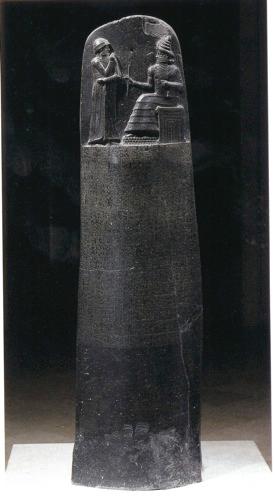
Our knowledge of the social life of Babylon and the territory under its control is derived chiefly from the Hammurabi Code of laws, of which an almost complete copy was discovered at Susa, towards the end of 1901, by the De Morgan expedition.

Full Stele of Hammurabi

The laws were inscribed on a stele of black diorite 7 ft. 3 in. high, with a circumference at the base of 6 ft. 2 in. and at the top of 5 ft. 4 in. This important relic of an ancient law-abiding people had been broken in three pieces, but when these were joined together it was found that the text was not much impaired.

On one side are twenty-eight columns and on the other sixteen. Originally there were in all nearly 4000 lines of inscriptions, but five columns, comprising about 300 lines, had been erased to give space, it is conjectured, for the name of the invader who carried the stele away, but unfortunately the record was never made.

Apex Stele of Hammurabi

On the upper part of the stele, which is now one of the treasures of the Louvre, Paris, King Hammurabi salutes, with his right hand reverently upraised, the sun god Shamash, seated on his throne, at the summit of E-sagila, by whom he is being presented with the stylus with which to inscribe the legal code.

Both figures are heavily bearded, but have shaven lips and chins. The god wears a conical headdress and a flounced robe suspended from his left shoulder, while the king has assumed a round dome-shaped hat and a flowing garment which almost sweeps the ground.

Donald A. Mackenzie, Myths of Babylonia and Assyria, 1915.

Hanging Gardens of Babylon, Temple of E-sagila, Bel Merodach, Tower of Babel

” … In Greek times Babylon was famous for the hanging or terraced gardens of the “new palace,” which had been erected by Nebuchadnezzar II.

These occupied a square which was more than a quarter of a mile in circumference. Great stone terraces, resting on arches, rose up like a giant stairway to a height of about three hundred and fifty feet, and the whole structure was strengthened by a surrounding wall over twenty feet in thickness.

So deep were the layers of mould on each terrace that fruit trees were grown amidst the plants of luxuriant foliage and the brilliant Asian flowers. Water for irrigating the gardens was raised from the river by a mechanical contrivance to a great cistern situated on the highest terrace, and it was prevented from leaking out of the soil by layers of reeds and bitumen and sheets of lead.

Spacious apartments, luxuriously furnished and decorated, were constructed in the spaces between the arches and were festooned by flowering creepers. A broad stairway ascended from terrace to terrace.

The old palace stood in a square nearly four miles in circumference, and was strongly protected by three walls, which were decorated by sculptures in low relief, representing battle scenes and scenes of the chase and royal ceremonies. Winged bulls with human heads guarded the main entrance.

Another architectural feature of the city was E-sagila, the temple of Bel Merodach, known to the Greeks as “Jupiter-Belus.” The high wall which enclosed it had gates of solid brass. “In the middle of the precinct,” wrote Herodotus,

“there was a tower of solid masonry, a furlong in length and breadth, upon which was raised a second tower, and on that a third, and so on up to eight.

The ascent to the top is on the outside, by a path which winds round all the towers. When one is about halfway up, one finds a resting-place and seats, where persons are wont to sit some time on their way to the summit.

On the topmost tower there is a spacious temple, and inside the temple stands a couch of unusual size, richly adorned, with a golden table by its side.

There is no statue of any kind set up in the place, nor is the chamber occupied of nights by anyone but a single native woman, who, as the Chaldaeans, the priests of this god, affirm, is chosen for himself by the deity out of all the women of the land.”

A woman who was the “wife of Amon” also slept in that god’s temple at Thebes in Egypt. A similar custom was observed in Lycia.

“Below, in the same precinct,” continued Herodotus, “there is a second temple, in which is a sitting figure of Jupiter, all of gold. Before the figure stands a large golden table, and the throne whereon it sits, and the base on which the throne is placed, are likewise of pure gold….

Outside the temple are two altars, one of solid gold, on which it is only lawful to offer sucklings; the other, a common altar, but of great size, on which the full-grown animals are sacrificed.

It is also on the great altar that the Chaldaeans burn the frankincense, which is offered to the amount of a thousand talents’ weight, every year, at the festival of the god.

In the time of Cyrus there was likewise in this temple a figure of a man, twelve cubits high, entirely of solid gold…. Besides the ornaments which I have mentioned, there are a large number of private offerings in this holy precinct.”

Donald A. Mackenzie, Myths of Babylonia and Assyria, 1915.

Questing for Immortality

” … Pir-napishtim, the Babylonian Noah, and the semi-divine Gilgamesh appear to be represented in Vedic mythology by Yama, god of the dead. Yama was “the first man,” and, like Gilgamesh, he set out on a journey over mountains and across water to discover Paradise.

He is lauded in the Vedic hymns as the explorer of “the path” or “way” to the “Land of the Pitris” (Fathers), the Paradise to which the Indian un-cremated dead walked on foot. Yama never lost his original character. He is a traveller in the Epics as in the Vedas.

Him who along the mighty heights departed,

Him who searched and spied the path for many,

Son of Vivasvat, gatherer of the people,

Yama, the King, with sacrifices worship.

Rigveda, x, 14, 1.

To Yama, mighty King, be gifts and homage paid,

He was the first of men that died,

the first to brave Death’s rapid rushing stream,

the first to point the road

To heaven, and welcome others to that bright abode.

Sir M. Monier Williams’ Translation.

Yama and his sister Yami were the first human pair. They are identical with the Persian Celestial twins, Yima and Yimeh. Yima resembles Mitra (Mithra); Varuna, the twin brother of Mitra, in fact, carries the noose associated with the god of death.

The Indian Yama, who was also called Pitripati, “lord of the fathers,” takes Mitra’s place in the Paradise of Ancestors beside Varuna, god of the sky and the deep. He sits below a tree, playing on a flute and drinking the Soma drink which gives immortality. When the descendants of Yama reached Paradise they assumed shining forms “refined and from all taint set free.”

In Persian mythology “Yima,” says Professor Moulton, “reigns over a community which may well have been composed of his own descendants, for he lived yet longer than Adam. To render them immortal, he gives them to eat forbidden food, being deceived by the Daevas (demons). What was this forbidden food? May we connect it with another legend whereby, at the Regeneration, Mithra is to make men immortal by giving them to eat the fat of the Ur-Kuh, the primeval cow from whose slain body, according to the Aryan legends adopted by Mithraism, mankind was first created?”

Yima is punished for “presumptuously grasping at immortality for himself and mankind, on the suggestion of an evil power, instead of waiting Ahura’s good time.” Professor Moulton wonders if this story, which he endeavours to reconstruct, “owed anything to Babylon?”

Donald A. Mackenzie, Myths of Babylonia and Assyria, 1915.

The Behistun Inscription

“In 1854 Sir Henry Rawlinson superintended diggings at Birs Nimrud (Borsippa, near Babylon), and excavated relics of the Biblical Nebuchadrezzar. This notable archaeologist began his career in the East as an officer in the Bombay army. He distinguished himself as a political agent and diplomatist. While resident at Baghdad, he devoted his leisure time to cuneiform studies.

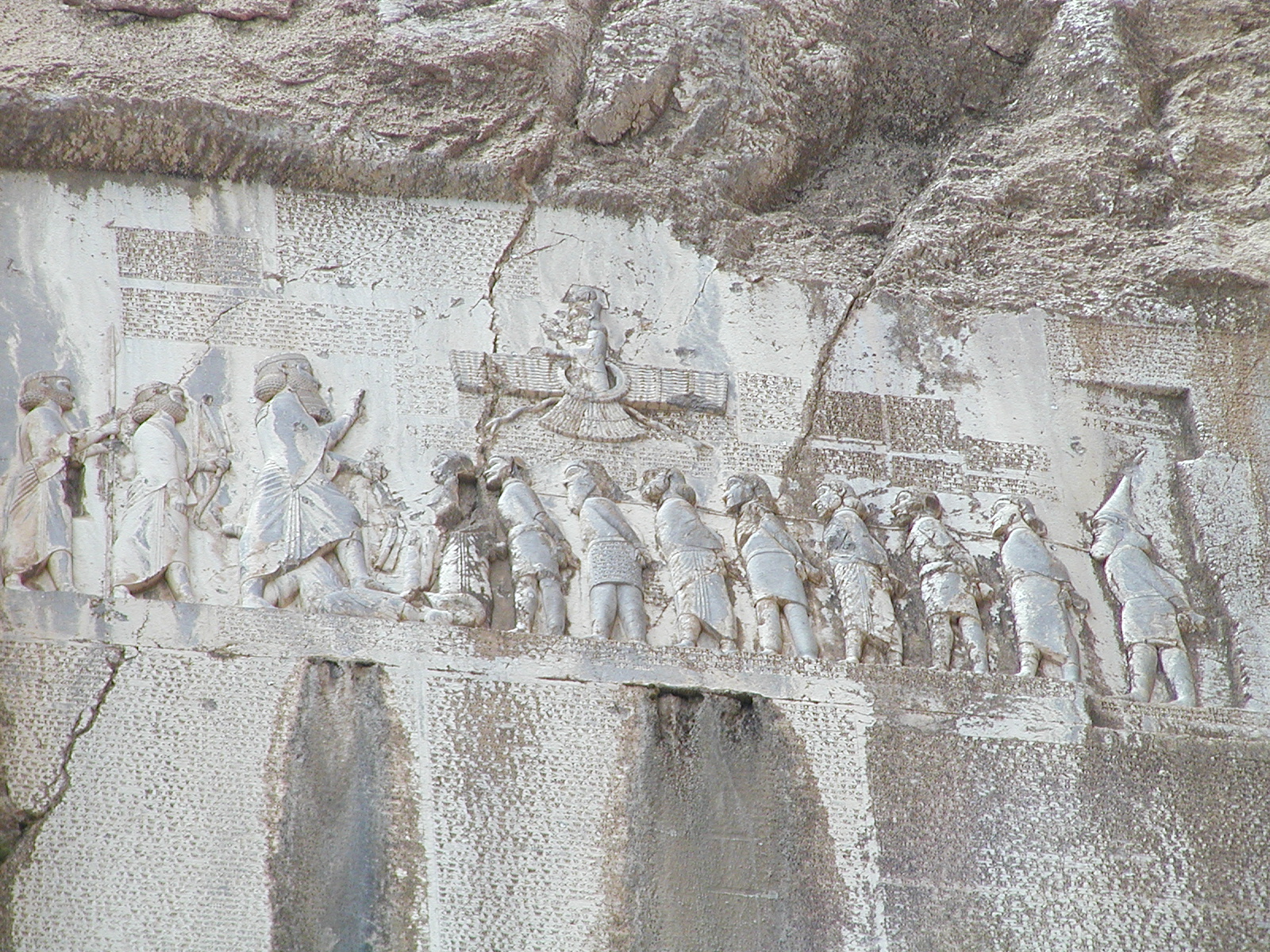
One of his remarkable feats was the copying of the famous trilingual rock inscription of Darius the Great on a mountain cliff at Behistun, in Persian Kurdistan (the Behistun Inscription). This work was carried out at great personal risk, for the cliff is 1700 feet high and the sculptures and inscriptions are situated about 300 feet from the ground.

The Behistun Inscription

Bisotun Iran Relief Achamenid Period” by Hara1603 – Own work. Licensed under Public Domain via Wikimedia Commons.

Darius was the first monarch of his line to make use of the Persian cuneiform script, which in this case he utilized in conjunction with the older and more complicated Assyro-Babylonian alphabetic and syllabic characters to record a portion of the history of his reign.

Rawlinson’s translation of the famous inscription was an important contribution towards the decipherment of the cuneiform writings of Assyria and Babylonia.”

Donald A. Mackenzie, Myths of Babylonia and Assyria, 1915.

Babylon

“Ancient Babylonia has made stronger appeal to the imagination of Christendom than even Ancient Egypt, because of its association with the captivity of the Hebrews, whose sorrows are enshrined in the familiar psalm:

By the rivers of Babylon, there we sat down;

Yea, we wept, when we remembered Zion.

We hanged our harps upon the willows….

In sacred literature proud Babylon became the city of the anti-Christ, the symbol of wickedness and cruelty and human vanity. Early Christians who suffered persecution compared their worldly state to that of the oppressed and disconsolate Hebrews, and, like them, they sighed for Jerusalem–the new Jerusalem. When St. John the Divine had visions of the ultimate triumph of Christianity, he referred to its enemies–the unbelievers and persecutors–as the citizens of the earthly Babylon, the doom of which he pronounced in stately and memorable phrases:

Babylon the great is fallen, is fallen,

And is become the habitation of devils,

And the hold of every foul spirit,

And a cage of every unclean and hateful bird….

For her sins have reached unto heaven

And God hath remembered her iniquities….

The merchants of the earth shall weep and mourn over her,

For no man buyeth their merchandise any more.

“At the noise of the taking of Babylon,” cried Jeremiah, referring to the original Babylon, “the earth is moved, and the cry is heard among the nations…. It shall be no more inhabited forever; neither shall it be dwelt in from generation to generation.” The Christian Saint rendered more profound the brooding silence of the desolated city of his vision by voicing memories of its beauty and gaiety and bustling trade:

The voice of harpers, and musicians, and of pipers and trumpeters

shall be heard no more at all in thee;

And no craftsman, of whatsoever craft he be, shall be found any more in thee;

And the light of a candle shall shine no more at all in thee;

And the voice of the bridegroom and of the bride shall be heard no more at all in thee:

For thy merchants were the great men of the earth;

For by thy sorceries were all nations deceived.

And in her was found the blood of prophets, and of saints,

And of all that were slain upon the earth.

So for nearly two thousand years has the haunting memory of the once-powerful city pervaded Christian literature, while its broken walls and ruined temples and palaces lay buried deep in desert sand. The history of the ancient land of which it was the capital survived in but meagre and fragmentary form, mingled with accumulated myths and legends. A slim volume contained all that could be derived from references in the Old Testament and the compilations of classical writers.”

Donald A. Mackenzie, Myths of Babylonia and Assyria, 1915.

Sacred Harlotry

” … They worshipped Baal of the Lebanon, who may well have been Adonis, and at Amathus on the south coast they instituted the rites of Adonis and Aphrodite, or rather Astarte. Here, as at Byblus, these rites resembled the Egyptian worship of Osiris so closely that some people even identified the Adonis of Amathus with Osiris.

[ … ]

” … it is possible that a native goddess of fertility was worshipped on the spot before the arrival of the Phoenicians, and that the newcomers identified her with their own Baalath or Astarte, whom she may have closely resembled.

If two deities were thus fused in one, we may suppose that they were both varieties of that great goddess of motherhood and fertility whose worship appears to have been spread all over Western Asia from a very early time. The supposition is confirmed as well by the archaic shape of her image as by the licentious character of her rites; for both that shape and those rites were shared by her with other Asiatic deities.

Her image was simply a white cone or pyramid. In like manner, a cone was the emblem of Astarte at Byblus, of the native goddess whom the Greeks called Artemis at Perga in Pamphylia, and of the sun-god Heliogabalus at Emesa in Syria. Conical stones, which apparently served as idols, have also been found at Golgi in Cyprus, and in the Phoenician temples of Malta; and cones of sandstone came to light at the shrine of the “Mistress of Torquoise” among the barren hills and frowning precipices of Sinai.

In Cyprus it appears that before marriage all women were formerly obliged by custom to prostitute themselves to strangers at the sanctuary of the goddess, whether she went by the name of Aphrodite, Astarte, or what not. Similar customs prevailed in many parts of Western Asia. Whatever its motive, the practice was clearly regarded, not as an orgy of lust, but as a solemn religious duty performed in the service of that great Mother Goddess of Western Asia whose name varied, while her type remained constant, from place to place.

Thus at Babylon every woman, whether rich or poor, had once in her life to submit to the embraces of a stranger at the temple of Mylitta, that is, of Ishtar or Astarte, and to dedicate to the goddess the wages earned by this sanctified harlotry. The sacred precinct was crowded with women waiting to observe the custom. Some of them had to wait there for years.

At Heliopolis or Baalbec in Syria, famous for the imposing grandeur of its ruined temples, the custom of the country required that every maiden should prostitute herself to a stranger at the temple of Astarte, and matrons as well as maids testified their devotion to the goddess in the same manner.

The emperor Constantine abolished the custom, destroyed the temple, and built a church in its stead.

In Phoenician temples women prostituted themselves for hire in the service of religion, believing that by this conduct they propitiated the goddess and won her favour. “It was a law of the Amorites, that she who was about to marry should sit in fornication seven days by the gate.” At Byblus the people shaved their heads in the annual mourning for Adonis. Women who refused to sacrifice their hair had to give themselves up to strangers on a certain day of the festival, and the money which they thus earned was devoted to the goddess.

A Greek inscription found at Tralles in Lydia proves that the practice of religious prostitution survived in that country as late as the second century of our era. It records of a certain woman, Aurelia Aemilia by name, not only that she herself served the god in the capacity of a harlot at his express command, but that her mother and other female ancestors had done the same before her; and the publicity of the record, engraved on a marble column which supported a votive offering, shows that no stain attached to such a life and such a parentage.

In Armenia the noblest families dedicated their daughters to the service of the goddess Anaitis in her temple of Acilisena, where the damsels acted as prostitutes for a long time before they were given in marriage. Nobody scrupled to take one of these girls to wife when her period of service was over. Again, the goddess Ma was served by a multitude of sacred harlots at Comana in Pontus, and crowds of men and women flocked to her sanctuary from the neighbouring cities and country to attend the biennial festivals or to pay their vows to the goddess.

If we survey the whole of the evidence on this subject, some of which has still to be laid before the reader, we may conclude that a great Mother Goddess, the personification of all the reproductive energies of nature, was worshipped under different names but with a substantial similarity of myth and ritual by many peoples of Western Asia; that associated with her was a lover, or rather series of lovers, divine yet mortal, with whom she mated year by year, their commerce being deemed essential to the propagation of animals and plants, each in their several kind; and further, that the fabulous union of the divine pair was simulated and, as it were, multiplied on earth by the real, though temporary, union of the human sexes at the sanctuary of the goddess for the sake of thereby ensuring the fruitfulness of the ground and the increase of man and beast.

At Paphos the custom of religious prostitution is said to have been instituted by King Cinyras, and to have been practised by his daughters, the sisters of Adonis, who, having incurred the wrath of Aphrodite, mated with strangers and ended their days in Egypt. In this form of the tradition the wrath of Aphrodite is probably a feature added by a later authority, who could only regard conduct which shocked his own moral sense as a punishment inflicted by the goddess instead of as a sacrifice regularly enjoined by her on all her devotees. At all events the story indicates that the princesses of Paphos had to conform to the custom as well as women of humble birth.”

James George Frazer, The Golden Bough: A Study in Magic and Religion, 1922, Adonis in Cyprus, np.

Killing the Divine King

“At Babylon, within historical times, the tenure of the kingly office was in practice lifelong, yet in theory it would seem to have been merely annual. For every year at the festival of Zagmuk the king had to renew his power by seizing the hands of the image of Marduk in his great temple of Esagil at Babylon.

Even when Babylon passed under the power of Assyria, the monarchs of that country were expected to legalise their claim to the throne every year by coming to Babylon and performing the ancient ceremony at the New Year festival, and some of them found the obligation so burdensome that rather than discharge it they renounced the title of king altogether and contented themselves with the humbler one of Governor.

Further, it would appear that in remote times, though not within the historical period, the kings of Babylon or their barbarous predecessors forfeited not merely their crown but their life at the end of a year’s tenure of office. At least this is the conclusion to which the following evidence seems to point.

According to the historian Berosus, who as a Babylonian priest spoke with ample knowledge, there was annually celebrated in Babylon a festival called the Sacaea. It began on the sixteenth day of the month Lous, and lasted for five days, during which masters and servants changed places, the servants giving orders and the masters obeying them.

A prisoner condemned to death was dressed in the king’s robes, seated on the king’s throne, allowed to issue whatever commands he pleased, to eat, drink, and enjoy himself, and to lie with the king’s concubines. But at the end of the five days he was stripped of his royal robes, scourged, and hanged or impaled. During his brief term of office he bore the title of Zoganes.

This custom might perhaps have been explained as merely a grim jest perpetrated in a season of jollity at the expense of an unhappy criminal. But one circumstance–the leave given to the mock king to enjoy the king’s concubines–is decisive against this interpretation. Considering the jealous seclusion of an oriental despot’s harem we may be quite certain that permission to invade it would never have been granted by the despot, least of all to a condemned criminal, except for the very gravest cause.

This cause could hardly be other than that the condemned man was about to die in the king’s stead, and that to make the substitution perfect it was necessary he should enjoy the full rights of royalty during his brief reign. There is nothing surprising in this substitution. The rule that the king must be put to death either on the appearance of any symptom of bodily decay or at the end of a fixed period is certainly one which, sooner or later, the kings would seek to abolish or modify.

We have seen that in Ethiopia, Sofala, and Eyeo the rule was boldly set aside by enlightened monarchs; and that in Calicut the old custom of killing the king at the end of twelve years was changed into a permission granted to any one at the end of the twelve years’ period to attack the king, and, in the event of killing him, to reign in his stead; though, as the king took care at these times to be surrounded by his guards, the permission was little more than a form.

Another way of modifying the stern old rule is seen in the Babylonian custom just described. When the time drew near for the king to be put to death (in Babylon this appears to have been at the end of a single year’s reign) he abdicated for a few days, during which a temporary king reigned and suffered in his stead. At first the temporary king may have been an innocent person, possibly a member of the king’s own family; but with the growth of civilisation the sacrifice of an innocent person would be revolting to the public sentiment, and accordingly a condemned criminal would be invested with the brief and fatal sovereignty.

In the sequel we shall find other examples of a dying criminal representing a dying god. For we must not forget that, as the case of the Shilluk kings clearly shows, the king is slain in his character of a god or a demigod, his death and resurrection, as the only means of perpetuating the divine life unimpaired, being deemed necessary for the salvation of his people and the world.”

James George Frazer, The Golden Bough: A Study in Magic and Religion, 1922, The Killing of the Divine King, np.

Mortality of the Gods

“The grave of Zeus, the great god of Greece, was shown to visitors in Crete as late as about the beginning of our era. The body of Dionysus was buried at Delphi beside the golden statue of Apollo, and his tomb bore the inscription, “Here lies Dionysus dead, the son of Semele.”

According to one account, Apollo himself was buried at Delphi; for Pythagoras is said to have carved an inscription on his tomb, setting forth how the god had been killed by the python and buried under the tripod.

The great gods of Egypt themselves were not exempt from the common lot. They too grew old and died. But when at a later time the discovery of the art of embalming gave a new lease of life to the souls of the dead by preserving their bodies for an indefinite time from corruption, the deities were permitted to share the benefit of an invention which held out to gods as well as to men a reasonable hope of immortality.

Every province then had the tomb and mummy of its dead god. The mummy of Osiris was to be seen at Mendes; Thinis boasted of the mummy of Anhouri; and Heliopolis rejoiced in the possession of that of Toumou.

The high gods of Babylon also, though they appeared to their worshippers only in dreams and visions, were conceived to be human in their bodily shape, human in their passions, and human in their fate; for like men they were born into the world, and like men they loved and fought and died.”

James George Frazer, The Golden Bough: A Study in Magic and Religion, 1922, The Mortality of the Gods, np.

Mithra and Attis Syncretism: Death and Resurrection Classic Rituals of the Adonis Cult

” … Fortunately, however, so far as our present research is concerned, we have more than probability to rely upon; not only did these Nature Cults with which we are dealing express themselves in Mystery terms, but as regards these special Mysteries we possess clear and definite information, and we know, moreover, that in the Western world they were, of all the Mystery faiths, the most widely spread, and the most influential.

As Sir J. G. Frazer has before now pointed out, there are parallel and over-lapping forms of this cult, the name of the god, and certain details of the ritual, may differ in different countries, but whether he hails from Babylon, Phrygia, or Phoenicia, whether he be called Tammuz, Attis, or Adonis, the main lines of the story are fixed, and invariable.

Always he is young and beautiful, always the beloved of a great goddess; always he is the victim of a tragic and untimely death, a death which entails bitter loss and misfortune upon a mourning world, and which, for the salvation of that world, is followed by a resurrection.

Death and Resurrection, mourning and rejoicing, present themselves in sharp antithesis in each and all of the forms.

We know the god best as Adonis, for it was under that name that, though not originally Greek, he became known to the Greek world, was adopted by them with ardour, carried by them to Alexandria, where his feast assumed the character of a State solemnity; under that name his story has been enshrined in Art, and as Adonis he is loved and lamented to this day. The Adonis ritual may be held to be the classic form of the cult.

But in Rome, the centre of Western civilization, it was otherwise: there it was the Phrygian god who was in possession; the dominating position held by the cult of Attis and the Magna Mater, and the profound influence exercised by that cult over better known, but subsequently introduced, forms of worship, have not, so far, been sufficiently realized.

The first of the Oriental cults to gain a footing in the Imperial city, the worship of the Magna Mater of Pessinonte was, for a time, rigidly confined within the limits of her sanctuary.

The orgiastic ritual of the priests of Kybele made at first little appeal to the more disciplined temperament of the Roman population. By degrees, however, it won its way, and by the reign of Claudius had become so popular that the emperor instituted public feasts in honour of Kybele and Attis, feasts which were celebrated at the Spring solstice, March 15th-27th. 1

As the public feast increased in popularity, so did the Mystery feast, of which the initiated alone were privileged to partake, acquire a symbolic significance: the foods partaken of became “un aliment de vie spirituelle, et doivent soutenir dans les épreuves de la vie l’initié.”

Philosophers boldly utilized the framework of the Attis cult as the vehicle for imparting their own doctrines, “Lorsque le Nèoplatonisme triomphera la fable Phrygienne deviendra le moule traditionnel dans lequel des exégètes subtils verseront hardiment leurs spéculations philosophiques sur les forces créatrices fécondantes, principes de toutes les formes matérielles, et sur la délivrance de l’âme divine plongée dans la corruption de ce monde terrestre.” 2

Certain of the Gnostic sects, both pre- and post-Christian, appear to have been enthusiastic participants in the Attis mysteries; 3 Hepding, in his Attis study, goes so far as to refer to Bishop Aberkios, to whose enigmatic epitaph our attention was directed in the last chapter, as “der Attis-Preister.” 4

Another element aided in the diffusion of the ritual. Of all the Oriental cults which journeyed Westward under the aegis of Rome none was so deeply rooted or so widely spread as the originally Persian cult of Mithra–the popular religion of the Roman legionary.

But between the cults of Mithra and of Attis there was a close and intimate alliance. In parts of Asia Minor the Persian god had early taken over features of the Phrygian deity. “Aussitôt que nous pouvons constater la présence du culte Persique en Italie nous le trouvons étroitement uni à celui de la Grande Mére de Pessinonte.” 1

The union between Mithra and the goddess Anâhita was held to be the equivalent of that subsisting between the two great Phrygian deities Attis-Kybele.”

Jessie L. Weston, From Ritual to Romance, 1920, pp. 136-8.

Conjuring Shaddiel

“In the middle of the thirteenth century there lived in Narbonne an old kabbalist, also a disciple of Eleazar of Worms, “of whose teacher it was attested [that is, by the people of Narbonne, and not only by the former student himself] that Elijah, may his memory be blessed, revealed himself to him every Day of Atonement.”

Whether this teacher was the Eleazar just named or some other Provençal kabbalist is not clear. But the identity of the teacher is of less importance for us than the information concerning the date when the prophet Elijah regularly appeared to him. In the Talmud such an appearance of Elijah on the Day of Atonement is mentioned, to my knowledge, only once in passing ( Yoma 19b) and not as something that is repeated periodically. This revelation, whose supreme value is thrown into sharp relief by the fact of its occurrence on the most sacred day of the year, was certainly attained only after spiritual preparation and special concentration.

We possess two texts that give an exact description of the magic rituals for conjuring up the archon who is in charge of the mysteries of the Torah. These rituals take place precisely during the night of the Day of Atonement. The first of these texts is a responsum attributed to two fictitious Babylonian geonim of the eleventh century that appears to have been composed in Provence around 1200 in an artificial Aramaic.

We are given here, among other things, an utterly fantastic report concerning a very peculiar procedure that the scholars of earlier times supposedly followed on that night in order to conjure up “Shaddiel, the great king of the demons (shedim) who rule in the air,” thereby to acquire possession and knowledge of “all the mysteries of heaven.”

This mixture of angelology and demonology is very strange. It seems to me impossible that this ritual, transferred in this instance to Babylonia, was ever really practiced. But it does indicate the mood of the group from which it stems.

The second part likewise contains theurgic instructions, but these, we may assume, describe a ritual that was actually performed. These directions constitute only one link in a long chain of incantations given since very early times for conjuring up the “archons of the Torah.”

At the end of the “Greater Hekhaloth” there is a text, Sar Torah, that is also found independently and has the same aim. We possess several other conjurations of this kind that originated in the Orient and passed, in part, into the manuscripts of the German Hasidim. This text too, which similarly prescribes the eve and the night of the Day of Atonement as the time for the performance of these rituals, certainly originated in materials that came from Babylonia through Italy to France.

But the content, half conjuration and half prayer, leaves no doubt that in its extant form it was edited in France. The text contains a long list of things that one of these perushim wished to learn from the archon of the Torah. He desires that his heart be opened to the study of the Torah, with special emphasis on the various types of gematria and number-mysticism and on the comprehension of various talmudic disciplines—such as cosmogony, the Merkabah, the divine glory, the kabhod—as well as many other specific subjects of the talmudic tradition that the author considered worth knowing.

There is nothing to indicate the author’s acquaintance with the Kabbalah; his area of interest coincides, regarding theosophical matters as well, with that of the German and French Hasidim. At the same time, we learn that in those circles too one hoped for revelations concerning the exoteric and esoteric Torah during the night of the Day of Atonement. We have before us, therefore, the sort of prayer that Jacob the Nazirite might have recited had he wished to prepare himself for a revelation of this kind.”

Gershom Scholem, Origins of the Kabbalah, pp. 240-2.