
Samizdat

Publishing the Forbidden. All Rights Reserved. © Samizdat 2014-2025.

Category: Aryan

The Knowledge of Fire and Prognostication Were Stolen From the Gods

“It was thus that “the divine storm-bird” of the ancient Accadian faith passed into the god Zu of the Semitic epoch.

“The divine storm-bird” was a ravenous bird of prey, of large size and sharp beak, who darted on its spoil and devoured the flesh. The Semitic Babylonians identified it with their Zu, partly because zu signified a “stormy wind,” partly because a species of vulture was called by the same name.

The Zu Bird dominates the top of this bas relief, while the head of the figure on the right is missing, common vandalism committed by grave robbers: defacing the heads and the eyes of idols crippled their efficacy.

The Zu Bird dominates the top of this bas relief, while the head of the figure on the right is missing, common vandalism committed by grave robbers: defacing the heads and the eyes of idols crippled their efficacy.

But the conception of the tempest as a bird which rushes on its prey is common to many mythologies. In Aryan mythology the storm-cloud appears under the varying forms of the eagle, the woodpecker, and the robin redbreast, the sacred bird of Thor; while in Chinese folk-lore the storm-bird is “a bird which in flying obscures the sun and of whose quills are made water-tuns.”

The roc of the Arabian Nights, with its wings ten thousand fathoms in width, and its egg which it was a sin in Aladdin to wish to take from the place where it hung, is but an echo of the Chinese storm-bird. It is in the nest of the storm-bird that the tempest is brewed; it swoops upon the earth with the rush of his wings, and the lightning itself is but the gleam of his flight.

Even a poet of to-day instinctively speaks of the curlews as “dreary gleams about the moorland flying over Locksley Hall.”

“The divine storm-bird” was known as Lugal-banda, “the lusty king,” and was the patron deity of the city of Marad, near Sippara. He brought the lightning, the fire of heaven, from the gods to men, giving them at once the knowledge of fire and the power of reading the future in the flashes of the storm.
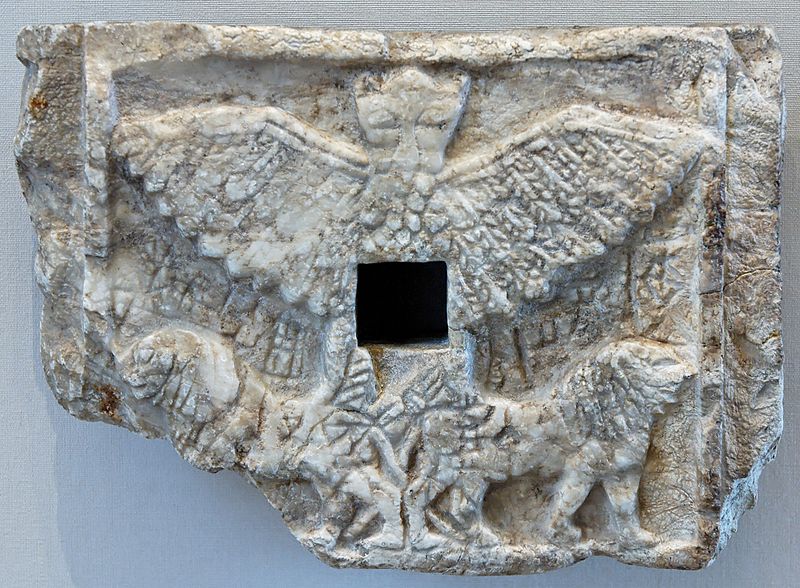
Zu or Anzu (from An 'heaven' and Zu 'to know' in Sumerian language), as a lion-headed eagle, ca. 2550–2500 BCE, Louvre.  Votive relief of Ur-Nanshe, king of Lagash, representing the bird-god Anzu (or Im-dugud) as a lion-headed eagle.  Alabaster, Early Dynastic III (2550–2500 BCE). Found in Telloh, ancient city of Girsu.  H. 21.6 cm (8 ½ in.), W. 15.1 cm (5 ¾ in.), D. 3.5 cm (1 ¼ in.)  http://bharatkalyan97.blogspot.com/2013/07/legend-of-anzu-which-stole-tablets-of.html

Zu or Anzu (from An ‘heaven’ and Zu ‘to know’ in Sumerian language), as a lion-headed eagle, ca. 2550–2500 BCE, Louvre.
Votive relief of Ur-Nanshe, king of Lagash, representing the bird-god Anzu (or Im-dugud) as a lion-headed eagle.
Alabaster, Early Dynastic III (2550–2500 BCE). Found in Telloh, ancient city of Girsu.
H. 21.6 cm (8 ½ in.), W. 15.1 cm (5 ¾ in.), D. 3.5 cm (1 ¼ in.)
http://bharatkalyan97.blogspot.com/2013/07/legend-of-anzu-which-stole-tablets-of.html

Like Prometheus, therefore, he was an outcast from the gods. He had stolen their treasures and secret wisdom, and had communicated them to mankind. In Babylonia, as in Greece, the divine benefactor of primitive humanity was doomed to suffer.

The knowledge and the artificial warmth man has gained are not the free gifts of the gods; they have been wrenched from them by guile; and though man has been allowed to retain them, his divine friend and benefactor is condemned to punishment.

The culture-god of totemistic Marad is thus a very different being from the culture-god of Eridu; both, indeed, are clad in animal form; but whereas the fish-god of Eridu is the willing and unhindered communicator of civilisation, whose successor, Merodach, becomes a god of light and healing, the bird-god of Marad is a pariah among his divine brethren, hunted out of heaven by the great gods, and wresting from them by craft man’s future knowledge of good and evil.

It was only in the later syncretic age, when these uglier facts of the earlier mythology were glossed over or forgotten, that the divine “bull” was described as “the offspring of the god Zu” (H.C. Rawlinson, The Cuneiform Inscriptions of Western Asia, 1886, iv. 123, 19).”

A.H. Sayce, Lectures on the Origin and Growth of Religion as Illustrated by the Religion of the Ancient Babylonians, 5th ed., London, 1898, pp. 293-5.

November is the Month of the Dead

“Professor von Schroeder points out that their father was the god Rudra, later known as Çiva, the god of departed souls, and of fruitfulness, i.e., a Chthonian deity, and suggests that the Maruts represent the “in Wind und Sturm dahinjagende Seelenschar.” 1

He points out that the belief in a troop of departed souls is an integral part of Aryan tradition, and classifies such belief under four main headings.

1. Under the form of a spectral Hunt, the Wild Huntsman well known in European Folk-lore. He equates this with Dionysus Zagreus, and the Hunt of Artemis-Hekate.

2. That of a spectral Army, the souls of warriors slain in fight. The Northern Einherier belong to this class, and the many traditions of spectral combats, and ghostly battles, heard, but not seen.

3. The conception of a host of women in a condition of ecstatic exaltation bordering on madness, who appear girdled with snakes, or hissing like snakes, tear living animals to pieces, and devour the flesh. The classic examples here are the Greek Maenads, and the Indian Senâs, who accompany Rudra.

4. The conception of a train of theriomorphic, phallic, demons of fertility, with their companion group of fair women. Such are the Satyrs and Nymphs of Greek, the Gandharvas and Apsaras of Indian, Mythology.

To these four main groups may be added the belief among Germanic peoples, also among the Letts, in a troop of Child Souls.

These four groups, in more or less modified forms, appear closely connected with the dominant Spirit of Vegetation, by whatever name that spirit may be known.

According to von Schroeder there was, among the Aryan peoples generally, a tendency to regard the dead as assuming the character of daimons of fertility. This view the learned Professor considers to be at the root of the annual celebrations in honour of the Departed, the ‘Feast of Souls,’ which characterized the commencement of the winter season, and is retained in the Catholic conception of November as the month of the Dead. 1

In any case we may safely conclude that the Maruts, represented as armed youths, were worshipped as deities of fruitfulness; that their dances were of a ceremonial character; and that they were, by nature and origin, closely connected with spirits of fertility of a lower order, such as the Gandharvas.

It also appears probable that, if the Dramas of which traces have been preserved in the Rig-Veda, were, as scholars are now of opinion, once actually represented, the mythological conception of the Maruts must have found its embodiment in youths, most probably of the priestly caste, who played their rôle, and actually danced the ceremonial Sword Dance.”

Jessie L. Weston, From Ritual to Romance, 1920, pp. 80-1.

Worshipping Virility

“While it is only of comparatively recent date that information as to the exact character of the worship directed to Tammuz has been available and the material we at present possess is but fragmentary in character, the corresponding cult of the Phoenician-Greek divinity we know as Adonis has for some years been the subject of scholarly research.

Not only have the details of the ritual been examined and discussed, and the surviving artistic evidence described and illustrated, but from the anthropological side attention has been forcibly directed to its importance as a factor in the elucidation of certain widespread Folk-beliefs and practices 2.

We know now that the worship of Adonis, which enjoyed among the Greeks a popularity extending to our own day, was originally of Phoenician origin, its principal centres being the cities of Byblos, and Aphaka.

From Phoenicia it spread to the Greek islands, the earliest evidence of the worship being found in Cyprus, and from thence to the mainland, where it established itself firmly.

The records of the cult go back to 700 B.C., but it may quite possibly be of much earlier date. Mr Langdon suggests that the worship of the divinity we know as Adonis, may, under another name, reach back to an antiquity equal with that we can now ascribe to the cult of Tammuz.

In its fully evolved classical form the cult of Adonis offers, as it were, a halfway house, between the fragmentary relics of Aryan and Babylonian antiquity, and the wealth of Medieval and Modern survivals to which the ingenuity and patience of contemporary scholars have directed our attention.

We all know the mythological tale popularly attached to the name of Adonis; that he was a fair youth, beloved of Aphrodite, who, wounded in the thigh by a wild boar, died of his wound.

The goddess, in despair at his death, by her prayers won from Zeus the boon that Adonis be allowed to return to earth for a portion of each year, and henceforward the youthful god divides his time between the goddess of Hades, Persephone, and Aphrodite. But the importance assumed by the story, the elaborate ceremonial with which the death of Adonis was mourned, and his restoration to life fêted, the date and character of the celebrations, all leave no doubt that the personage with whom we are dealing was no mere favourite of a goddess, but one with whose life and well-being the ordinary processes of Nature, whether animal or vegetable, were closely and intimately concerned.

In fact the central figure of these rites, by whatever name he may be called, is the somewhat elusive and impersonal entity, who represents in anthropomorphic form the principle of animate Nature, upon whose preservation, and unimpaired energies, the life of man, directly, and indirectly, depends 1.

Before proceeding to examine these rites there is one point, to which I have alluded earlier, in another connection, upon which our minds must be quite clear, i.e., the nature of the injury suffered. Writers upon the subject are of one accord in considering the usual account to be but a euphemistic veiling of the truth, while the close relation between the stories of Adonis and Attis, and the practices associated with the cult, place beyond any shadow of a doubt the fact that the true reason for this universal mourning was the cessation, or suspension, by injury or death, of the reproductive energy of the god upon whose virile activity vegetable life directly, and human life indirectly, depended.” 2

Jessie L. Weston, From Ritual to Romance, 1920. Pp. 39-41.