
Samizdat

Publishing the Forbidden. All Rights Reserved. © Samizdat 2014-2026.

Category: Araunah

Sins of Man

Merodach mourned over the doom pronounced against his city, and apparently with some effect; for after a good many broken and lost lines, the tablet goes on to describe the despatch of the terrible plague-god to Erech, “the seat of Anu and Istar, the city of the choirs of the festival-makers and consecrated maidens of Istar,” who “dreaded death,” for the nomad ‘Suti of the desert had combined against their state.

The eunuch-priests were now compelled to bow the face before another deity than the peaceful Istar, who “cried and was troubled over the city of Erech.” Eventually, however, Nerra was “quieted” by “Isum his councillor, the illustrious god who goes before him,” “and the warrior Nerra spake thus:

“Sea-land against sea-land, ‘Sumasti against ‘Sumasti, the Assyrian against the Assyrian, the Elamite against the Elamite, the Kossaean against the Kossaean, the Kurd against the Kurd, the Lullubite against the Lullubite, country against country, house against house, man against man, brother against brother, let them destroy one another, and afterwards let the Accadian come and slay them all, and fall upon their breasts.”

The warrior Nerra (further) addresses a speech to Isum, who goes before him:

‘Go, Isum, incline all thy heart to the word thou hast spoken.’

(Then) Isum sets his face towards the land of the west; the seven warrior gods, unequalled, sweep (all things) away behind him.

At the land of Phoenicia, at the mountains, the warrior arrived; he lifted up the hand, he laid it on the mountain; the mountain of Phoenicia, he counted as his own soil.”

In thus marching to the west, the minister of the Babylonian god of death approaches the country in which another angel of pestilence was seen by the king of Israel.

“By the threshing-floor of Araunah the Jebusite,” David had beheld the angel of the Lord “stretching out his hand upon Jerusalem to destroy it.”

As in Babylon, so too in Israel, the plague had been a visitation for the sins of man. It was the instrument of God’s anger wielded by the hands of his angel-minister. That same angel-minister had once before stood before Balaam, and with a drawn sword in his hand had threatened the Syrian prophet with death.

He was not a demon from the lower world, like the old Chaldean plague-spirit Namtar; he was not the inexorable law of destiny, before whom even the gods had to submit their wills; but a member of the celestial hierarchy, the messenger of a beneficent God.

He came to destroy, but it was to destroy the guilty. The sins of man, and not the malevolence or passionless law of a supernatural being, brought death and suffering into the world. The Babylonian legend of Nerra, like the records of the Old Testament, tells the same tale as the Babylonian story of the Deluge.”

A.H. Sayce, Lectures on the Origin and Growth of Religion as Illustrated by the Religion of the Ancient Babylonians, 5th ed., London, 1898, pp. 312-4.
Winds and the Babylonian Concept of Evil

Hadad, Addu or Dadda, never superseded the native name of Ramânu (Ramman) in Babylonia and Assyria, and remained foreign to the last.

Ramânu, however, was sometimes addressed as Barqu or Barak, “the lightning;” and it is possible that antiquarian zeal may have also sometimes imposed on him the Accadian title of Meru.

He grew continuously in popular favour. In Semitic Babylonia, and yet more in Semitic Assyria, his aid was constantly invoked; and, like Anu, Bel and Ea, he tended as time went on to become more and more national in character. Ramman is one of the least local of Babylonian gods.

This was due in great measure to the nature of his origin. He began as the amalgamation of two distinct deities, the wind-god and the air-god, and the extension af his cult was marked by the absorption into his person of the various deities of the winds adored by the older faith.

He continued to grow at their expense. The spirits of the winds and storms sank lower and lower; and while the beneficent side of their operation attached itself to Ramman, there remained to them only that side which was harmful and demoniac.

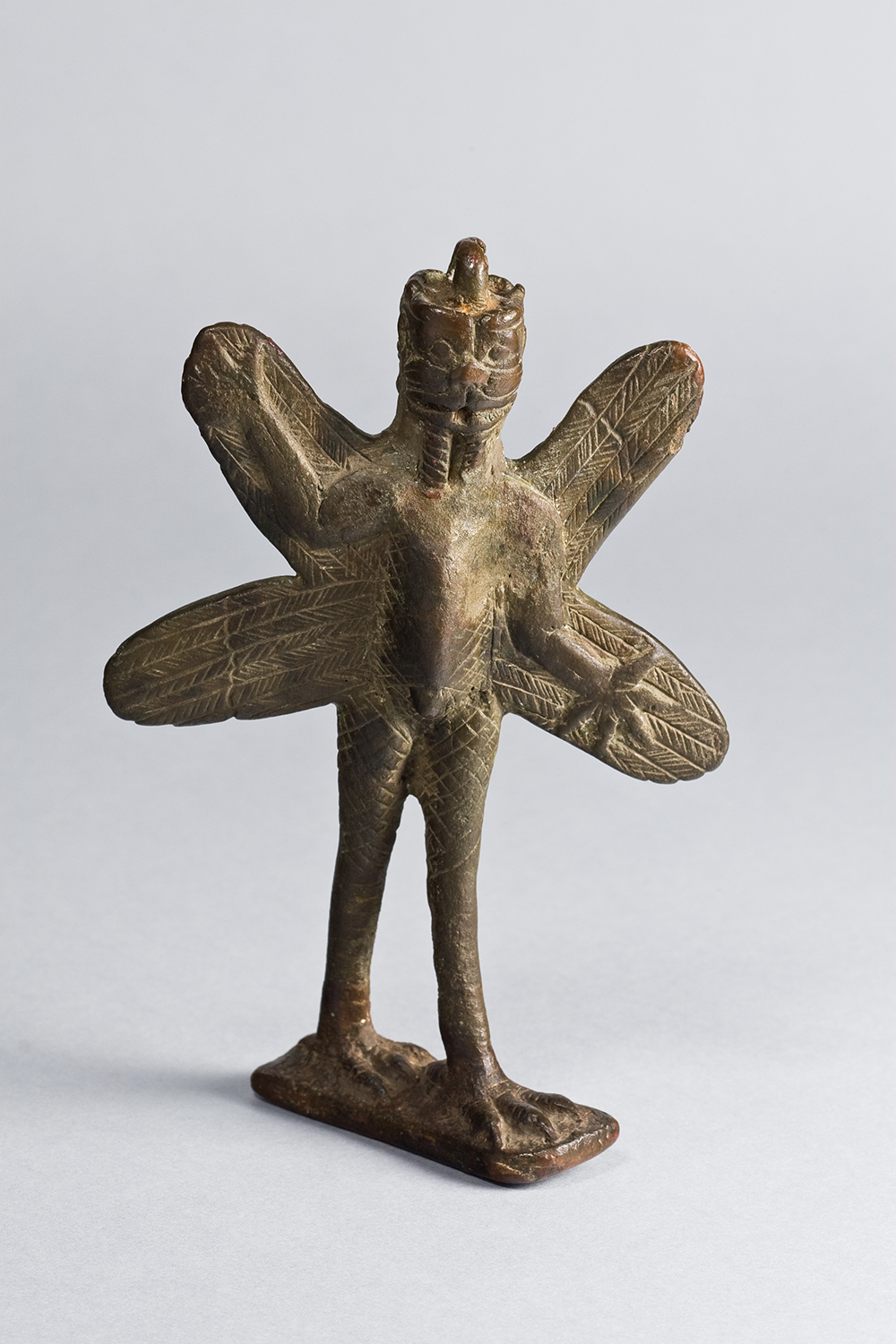
Iraq ca. 800-600 B.C. Bronze Purchased in New York, 1943 Oriental Institute Museum A25413 The demon Pazuzu stands but has a scorpion's body, feathered wings, avian legs, talons, and a lion face front and back.  Pazuzu, the "king of the evil wind demons," was not unfriendly. As an enemy of the Lamashtu demon, Pazuzu is portrayed on amulets for childbirth.  The ring at the top of this figurine suggests that it was such an amulet. https://oi.uchicago.edu/collections/highlights/highlights-collection-mesopotamia

Iraq
ca. 800-600 B.C.
Bronze
Purchased in New York, 1943
Oriental Institute Museum A25413
The demon Pazuzu stands but has a scorpion’s body, feathered wings, avian legs, talons, and a lion face front and back.
Pazuzu, the “king of the evil wind demons,” was an enemy of the Lamashtu demon. Pazuzu was portrayed on childbirth amulets. 
https://oi.uchicago.edu/collections/highlights/highlights-collection-mesopotamia

By degrees, the two aspects of their character came be separated. The higher gods came to be looked upon as the hearers of prayers and the bestowers of all good gifts; while the instruments of their vengeance an the inflictors of suffering and misery upon man were the inferior spirits of the lower sphere.

But the old conception, which derived both good and evil from the same source, did not wholly pass away. Evil never came to be regarded as the antagonist of good; it was rather the necessary complement and minister of good.

The supreme Baal thus preserved his omnipotence, while at the same time the ideas of pain and injustice were dissociated from him. In his combat with the dragon of chaos, Merodach summons the “evil wind” itself to his assistance; and in the legend of the assault of the seven wicked spirits upon the Moon, they are nevertheless called “the messengers of Anu their king.”

Nerra, the god of plague and destruction, smites the people of Babylonia on account of their sins by the command of the gods, like the angel with the drawn sword whom David saw standing over Jerusalem at the threshing-floor of Araunah; and in the story of the Deluge it is because of the wickedness of mankind that the flood is brought upon the earth.

The powers of darkness are degraded from their ancient position of independence, and either driven, like Tiamat, beyond the bounds of the created world, or reduced to the condition of ministers of divine wrath.

If we would realise how widely removed is this conception of them as the instruments of divine anger from that earlier view in which they are mere elemental powers, in themselves neither good nor evil, we cannot do better than compare these legendary compositions of the Semitic period with the old Accadian hymns that relate to the seven harmful spirits.”

A.H. Sayce, Lectures on the Origin and Growth of Religion as Illustrated by the Religion of the Ancient Babylonians, 5th ed., London, 1898, pp. 205-6.