
Samizdat

Publishing the Forbidden. All Rights Reserved. © Samizdat 2014-2026.

Category: Aquarius

Hesiod, the Great Year, and the Phoenix

“In the discussion of the Classical conception of the Great Year it was mentioned that Plato was the first author to make a clear statement about this cosmic period. He referred to an almost inconceivably long time, which he could characterize only by saying that at the completion of such a cosmic revolution the perfect number of time comprises the perfect year. It remains possible, however, that in another connection he assigned a specific duration to the Great Year.

In the eighth book of Politeia, Plato discusses the question of how an aristocracy can become degraded into a timocracy, i.e. a form of government in which ambition is the dominant principle of the rulers. (Plato, Politeia, VIII, 3, 544d-547c).

This occurs, he says, because the Guardians will not be able, by calculation and observation, to determine the appropriate times for birth. In an extremely difficult passage which has given rise to many commentaries he then gives the computation of what is incorrectly called the “nuptial number.” (A. Diès, Le nombre de Platon, essai d’exégèse et d’histoire, Académie des Inscriptions et Belles-Lettres, XIV, Paris, 1936, and others).

Plato begins by remarking that for the divine creature there is a period embraced by a perfect number. (Plato, Politeia, VIII, 3, 546b). This is reminiscent of his statement that the duration of the Great Year can be expressed in a perfect number.
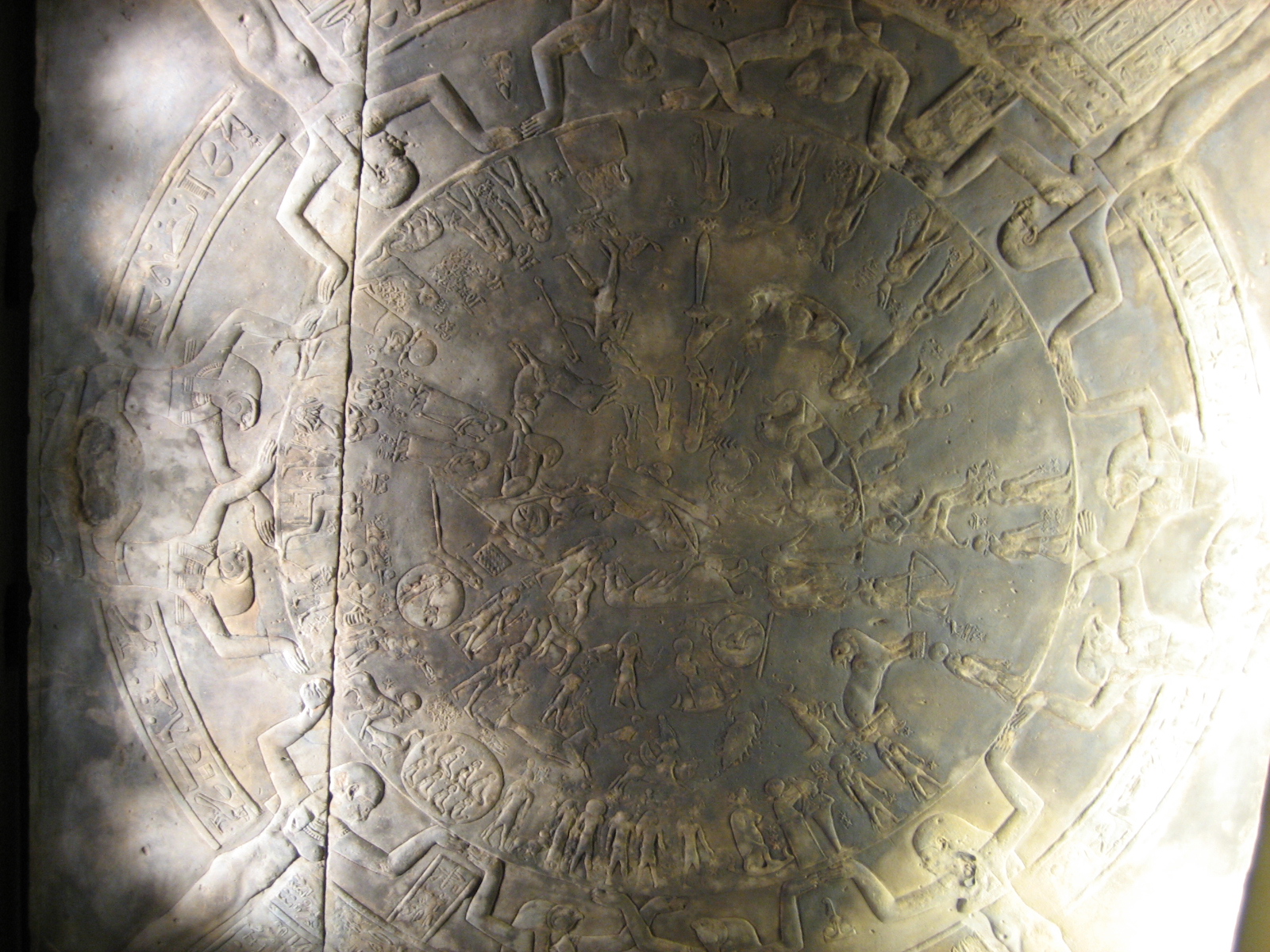
The zodiac is a planisphere or map of the stars on a plane projection, showing the 12 constellations of the zodiacal band forming 36 decans of ten days each, and the planets. These decans are groups of first-magnitude stars. These were used in the ancient Egyptian calendar, which was based on lunar cycles of around 30 days and on the heliacal rising of the star Sothis (Sirius). The celestial arch is represented by a disc held up by four pillars of the sky in the form of women, between which are inserted falcon-headed spirits. On the first ring 36 spirits symbolize the 360 days of the Egyptian year. On an inner circle, one finds constellations, showing the signs of the zodiac. Some of these are represented in the same Greco-Roman iconographic forms as their familiar counterparts (e.g. the Ram, Taurus, Scorpio, and Capricorn, albeit most in odd orientations in comparison to the conventions of ancient Greece and later Arabic-Western developments), whilst others are shown in a more Egyptian form: Aquarius is represented as the flood god Hapy, holding two vases which gush water. Rogers noted the similarities of unfamiliar iconology with the three surviving tablets of a "Seleucid zodiac" and both relating to kudurru, "boundary-stone" representations: in short, Rogers sees the Dendera zodiac as "a complete copy of the Mesopotamian zodiac". http://en.wikipedia.org/wiki/Dendera_zodiac

The zodiac is a planisphere or map of the stars on a plane projection, showing the 12 constellations of the zodiacal band forming 36 decans of ten days each, and the planets. These decans are groups of first-magnitude stars. These were used in the ancient Egyptian calendar, which was based on lunar cycles of around 30 days and on the heliacal rising of the star Sothis (Sirius).
The celestial arch is represented by a disc held up by four pillars of the sky in the form of women, between which are inserted falcon-headed spirits. On the first ring 36 spirits symbolize the 360 days of the Egyptian year.
On an inner circle, one finds constellations, showing the signs of the zodiac. Some of these are represented in the same Greco-Roman iconographic forms as their familiar counterparts (e.g. the Ram, Taurus, Scorpio, and Capricorn, albeit most in odd orientations in comparison to the conventions of ancient Greece and later Arabic-Western developments), whilst others are shown in a more Egyptian form: Aquarius is represented as the flood god Hapy, holding two vases which gush water. Rogers noted the similarities of unfamiliar iconology with the three surviving tablets of a “Seleucid zodiac” and both relating to kudurru, “boundary-stone” representations: in short, Rogers sees the Dendera zodiac as “a complete copy of the Mesopotamian zodiac”.
http://en.wikipedia.org/wiki/Dendera_zodiac

For the elucidation of “the divine creature,” reference can be made to the statement in the Timaeus that the Demiurge himself was only the creator of the fixed stars, the planets, and the earth. (Plato, Timaeus, 39e-40b.)

It is therefore probable that the reference in the Politeia to a period comprising a perfect number as belonging to that which the deity generates, should be seen as the duration of the complete cosmic revolution of the Great Year.

But for human creatures, says Plato, there is a geometric number, and this is the one for which he supplies the complex computation already mentioned. Especially since the research done by Diès there has been general agreement that this geometric number, which can be computed in several different ways, is 12,960,000.

To provide the long-sought harmony between the various components of this passage, it has been assumed that the perfect number of the divine creature is the same as the whole geometric number holding for human procreation, the component factors of the geometrical number having special relevance for the latter. (Ahlvers, 19-20, basing himself on 12,960,000 days = 36,000 years).

If this is valid, it may be concluded that in the Politeia Plato assumed a duration of 12,960,000 years for the Great Year.

Even if Plato did not mean that the perfect number of the rotation of that which the deity generates is equal to the geometric number, it would nevertheless have to be taken as probable that the number 12,960,000 originally pertained to the duration of the Great Year and that there is a relationship to the concept underlying Hesiod, frg. 304, since this fragment assumes a cycle of four successive world eras forming together a Great Year of 1,296,000 years. The Platonic number—which, incidentally, is a Babylonian sar squared—is thus ten times Hesiod’s value.”

R. van den Broek, The Myth of the Phoenix: According to Classical and Early Christian Traditions, Brill Archive, 1972, pp. 98-9.)

The Zodiacal Organization of the Gilgamesh Epic

“The doctrine of the necessity for ministering to the dead is here enunciated in no uncertain fashion.

Unless their bodies are decently buried and offerings of food and drink made at their graves, their lives in the otherworld must be abjectly miserable. The manner in which they meet their end is likewise taken into account, and warriors who have fallen on the field of battle are pre-eminently fortunate.

Eabani is evidently one of the ‘happy’ spirits; his ghost is designated utukku, a name applied not only to the fortunate dead, but likewise to a class of beneficent supernatural beings.

The term edimmu, on the other hand, designates a species of malevolent being as well as the errant and even vampirish spirits of the unhappy dead. The due observance of funeral and commemorative rites is thus a matter which touches the interests not only of the deceased but also of his relatives and friends.

We have seen from the foregoing that the epic of Gilgamesh is partly historical, partly mythological. Around the figure of a great national hero myths have grown and twined with the passing of the generations, and these have in time become woven into a connected narrative, setting forth a myth which corresponds to the daily or annual course of the sun.

Within this may be discerned other myths and fragments of myths—solar, seasonal, and diluvian.

But there is in the epic another important element which has already been referred to—the astro-theological. The zodiacal significance of the division of the epic into twelve tablets may be set aside, since, as has been indicated, the significance is in all probability a superficial one merely, added to the poem by the scribes of Assur-bani-pal, and not forming an integral part of it.

At the same time it is not hard to divide the epic naturally into twelve episodes, thus:

  1. Gilgamesh’s oppression of Erech;
  2. the seduction of Eabani;
  3. the slaying of the monster Khumbaba;
  4. the wooing of Ishtar;
  5. the fight with the sacred bull;
  6. Eabani’s death;
  7. Gilgamesh’s journey to the Mountain of the Sunset;
  8. his wanderings in the region of thick darkness;
  9. the crossing of the waters of death;
  10. the deluge-story;
  11. the plant of life;
  12. the return of Eabani’s spirit.

Throughout the epic there are indications of a correspondence between the exploits of the hero and the movements of heavenly bodies.

It is possible, for instance, that Gilgamesh and his friend Eabani had some relation to the sign Gemini, also associated in ancient Chaldean mythology with two forms of the solar deity, even as were the hero and his friend.

The sign Leo recalls the slaying of Khumbaba, the allegorical victory of light over darkness, represented on monuments by the figure of a lion (symbol of fire) fighting with a bull.

Following the sign of Leo, the wooing of the hero by the goddess Ishtar falls naturally into the sign of Virgo, the virgin. The sign of Taurus is represented by the slaying of the celestial bull, Alu, by Gilgamesh.

The journey of the hero to Mashu and his encounter with the scorpion-men at the gate of the sunset are, of course, mythological representations of the sign of Scorpio, as are also his wanderings in the region of thick darkness.

It is noticeable in this respect that Babylonian astrology often doubled the eighth sign (Scorpio) to provide a seventh; it is therefore not unlikely that this sign should correspond with two distinct episodes in the poem.

The first of these episodes is associated with Scorpio by virtue of the introduction of scorpion-men; and the second, on the assumption that the scorpion is symbolical of darkness.

Perhaps the sea-goddess Sabitu is associated astrologically with the fish-tailed goat which is the conventional representation of Capricornus.

Then the placing of the deluge-story in the XIth tablet, corresponding with the eleventh sign of the zodiac, Aquarius, the water-bearer, is evidently in keeping with the astrological aspect of the epic.

Chaldean mythology connected the rainy eleventh month with the deluge, just as the first month of spring was associated mythologically with the creation.

The healing of Gilgamesh’s sickness by Ut-Napishtim may possibly symbolise the revival of the sun after leaving the winter solstice.

Lastly, the sign of Pisces, the twelfth sign of the zodiac, corresponding to the return of Eabani from the underworld, and perhaps also to the restoration of Gilgamesh to Erech, is emblematic of life after death, and of the resumption of ordinary conditions after the deluge.

It has been suggested, though without any very definite basis, that the epic was first put together before the zodiac was divided into twelve—that is, more than two thousand years before the Christian era.

Its antiquity, however, rests on other grounds than these. In later times the Babylonian astrological system became very complicated and important, and so lent its colour to the epic that, whatever the original plan of that work may have been, its astral significance became at length its most popular aspect.”

Lewis Spence, Myths and Legends of Babylonia and Assyria, 1917, pp. 181-3.